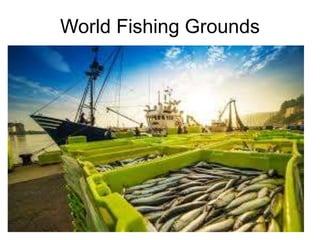
World Fishing Grounds
Physical and Non-Physical Factors for
Growth of Fishing
There could be many physical factors involved in growth
of Fishing industry
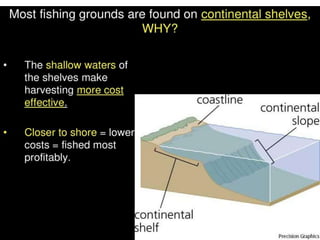
•Continental Shelf
•Broken Coastal Lines .
•Turbulent Sea Water
•Ocean-
currents
•Plankton
•Climate
• Forest
Non-Physical Factors
There are many factors that can be applied for increase
in fishing production. Some of them are as follow.
•Capital
•Cheap Labor
• Latest equipment
• Latest ports
•Modern means
•Modern Preservatory System
• Demand
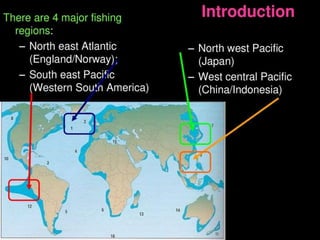
Fishing Grounds of the World
Fishing Grounds in North-East Atlantic:
Fishing Grounds in North-West Atlantic:
Fishing Grounds in the North-East Pacific:
Fishing Grounds in the North-West Pacific:
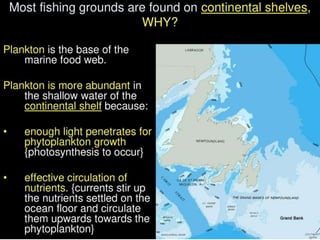
(a) The vast continental shelf of the North-West Atlantic
provides an excellent breeding ground for fish. They
feed on the plankton which is abundant here because of
the cool waters and shallow seas. Besides the famous
Grand Banks, south-east of Newfoundland, there are
other lesser banks including Green Bank, Sable Bank,
St. Pierre Bank and Georges Bank. Fish come in
enormous shoals to spawn in the shallow seas off the
Canadian-American coast and are caught all round the
year.
(b) Off Newfoundland at about latitude 45° to 55°N is the
zone of convergence of the cold Labrador Current and
the warm Gulf Stream. While the icebergs that come
south on the Labrador Current bring minerals from the
land on which plankton thrive, they also constitute a
navigational hazard.
(c) Lack of natural resources on land has driven the people
to the sea. There are few minerals, agricultural land is
restricted and the growing season is short.
(d)The New England states were noted for their shipbuilding
industries. Ports such as Boston, Gloucester, Portland, and
Saint John’s and Halifax in Canada are still important for
shipbuilding. The timber also provides material for barrels
and boxes for the packing and preservation of fish.
(e) The cool temperate climate not only favors large-scale
commercial fishing, but also the preservation and storage of
fish. Modern canning and refrigerating facilities accelerated
the fish export trade.
World Fishing.pptx

World Fishing.pptx

  • 1.
  • 4.
    Physical and Non-PhysicalFactors for Growth of Fishing There could be many physical factors involved in growth of Fishing industry •Continental Shelf •Broken Coastal Lines . •Turbulent Sea Water •Ocean- currents •Plankton •Climate • Forest
  • 5.
    Non-Physical Factors There aremany factors that can be applied for increase in fishing production. Some of them are as follow. •Capital •Cheap Labor • Latest equipment • Latest ports •Modern means •Modern Preservatory System • Demand
  • 6.
    Fishing Grounds ofthe World Fishing Grounds in North-East Atlantic: Fishing Grounds in North-West Atlantic: Fishing Grounds in the North-East Pacific: Fishing Grounds in the North-West Pacific:
  • 9.
    (a) The vastcontinental shelf of the North-West Atlantic provides an excellent breeding ground for fish. They feed on the plankton which is abundant here because of the cool waters and shallow seas. Besides the famous Grand Banks, south-east of Newfoundland, there are other lesser banks including Green Bank, Sable Bank, St. Pierre Bank and Georges Bank. Fish come in enormous shoals to spawn in the shallow seas off the Canadian-American coast and are caught all round the year. (b) Off Newfoundland at about latitude 45° to 55°N is the zone of convergence of the cold Labrador Current and the warm Gulf Stream. While the icebergs that come south on the Labrador Current bring minerals from the land on which plankton thrive, they also constitute a navigational hazard.
  • 10.
    (c) Lack ofnatural resources on land has driven the people to the sea. There are few minerals, agricultural land is restricted and the growing season is short. (d)The New England states were noted for their shipbuilding industries. Ports such as Boston, Gloucester, Portland, and Saint John’s and Halifax in Canada are still important for shipbuilding. The timber also provides material for barrels and boxes for the packing and preservation of fish. (e) The cool temperate climate not only favors large-scale commercial fishing, but also the preservation and storage of fish. Modern canning and refrigerating facilities accelerated the fish export trade.