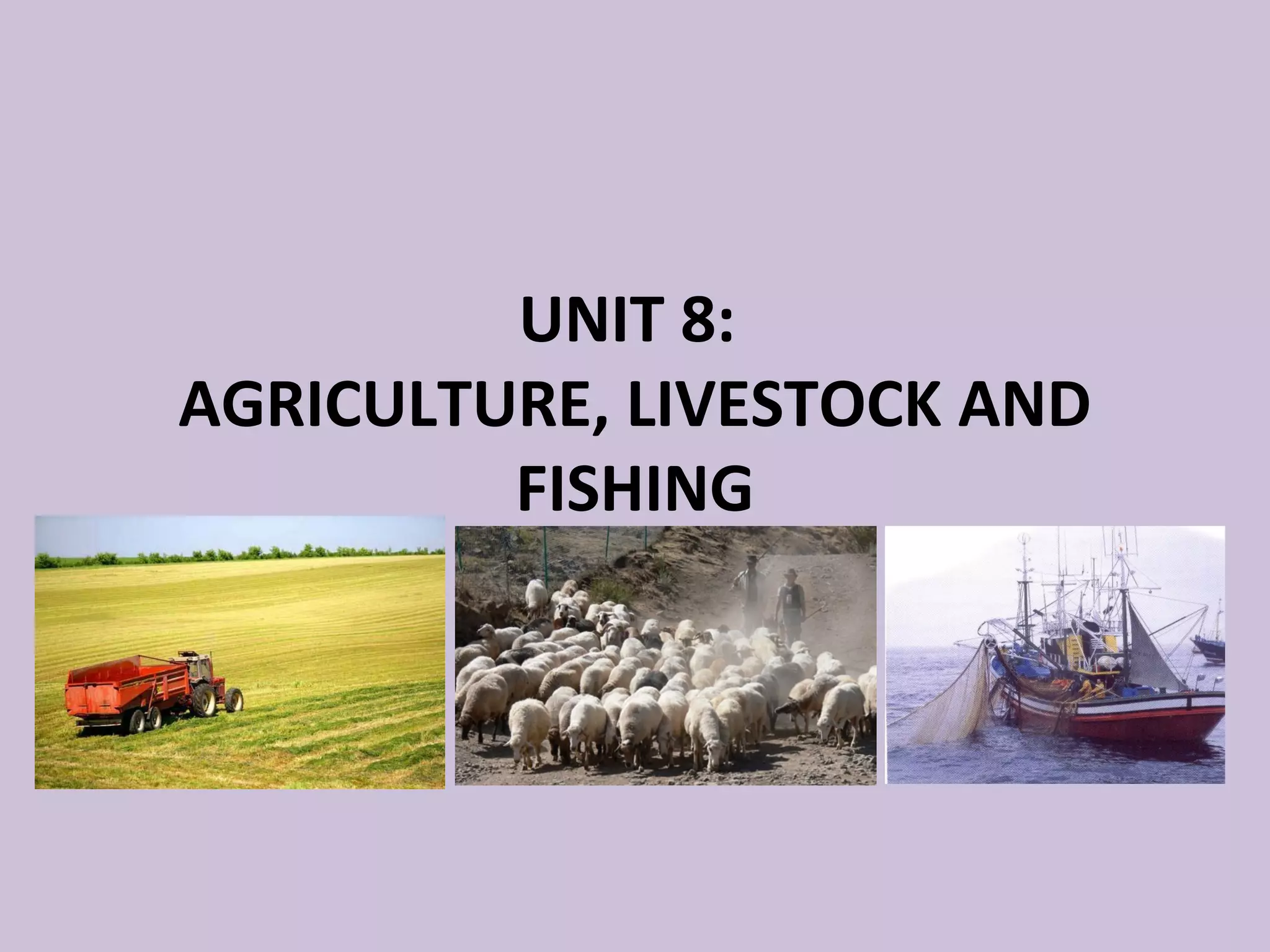
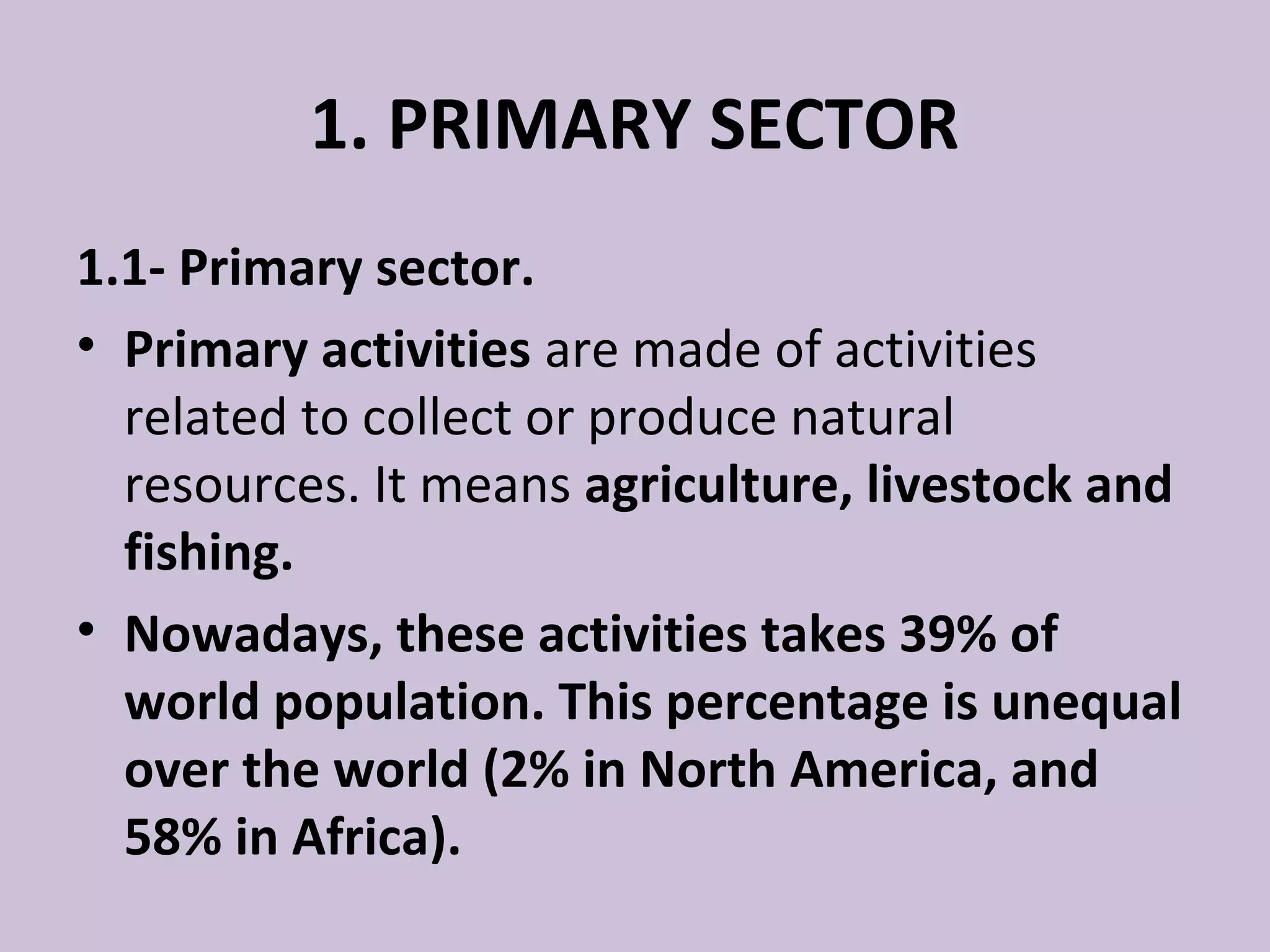
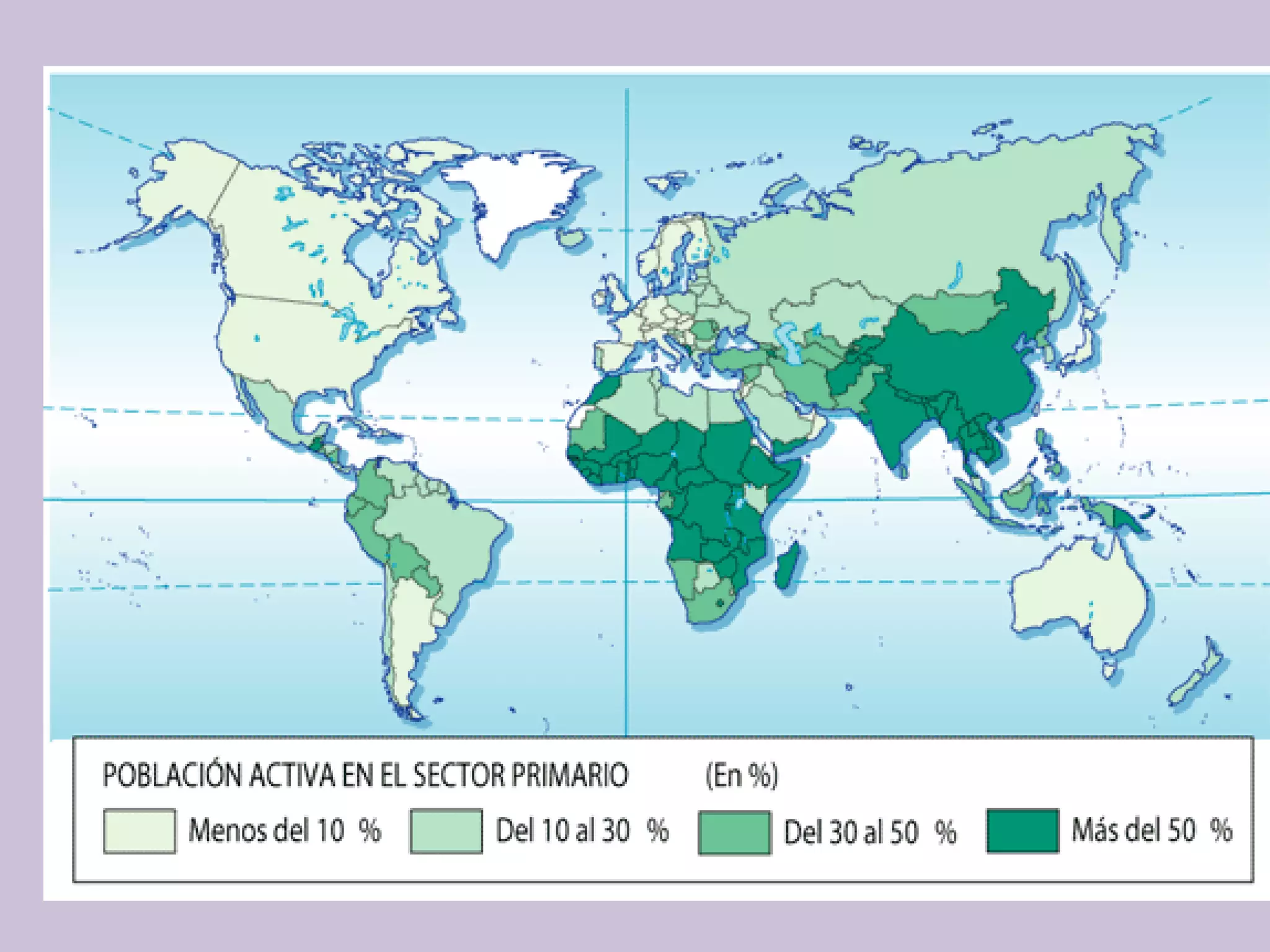
UNIT 8:
AGRICULTURE, LIVESTOCK AND
         FISHING
1. PRIMARY SECTOR
1.1- Primary sector.
• Primary activities are made of activities
  related to collect or produce natural
  resources. It means agriculture, livestock and
  fishing.
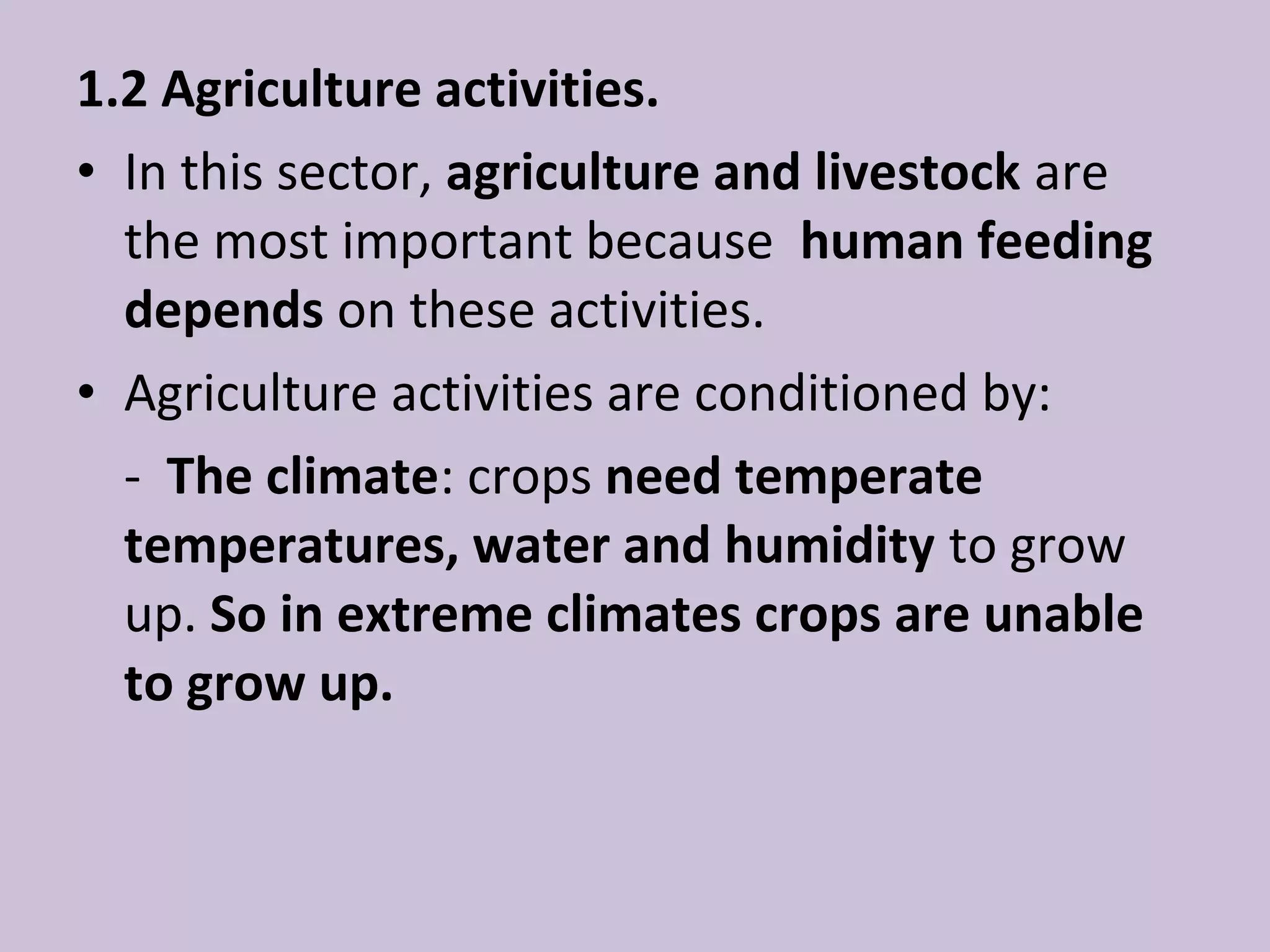
• Nowadays, these activities takes 39% of
  world population. This percentage is unequal
  over the world (2% in North America, and
  58% in Africa).
1.2 Agriculture activities.
• In this sector, agriculture and livestock are
  the most important because human feeding
  depends on these activities.
• Agriculture activities are conditioned by:
  - The climate: crops need temperate
  temperatures, water and humidity to grow
  up. So in extreme climates crops are unable
  to grow up.
- The relief: agriculture is usually located in
  plain areas or valleys. Sometimes mountain
  slopes are cultivated on terraces.


- The ground: is very important, because
  they have to be rich in nutrients, have a
  good structure and be able to keep the
  humidity.
• There are several differences between
  developed countries where the climate, the
  relief an the ground factors are less important
  than in undeveloped ones due to machinery
  and technology invested.
2- AGRARIAN LANDSCAPES
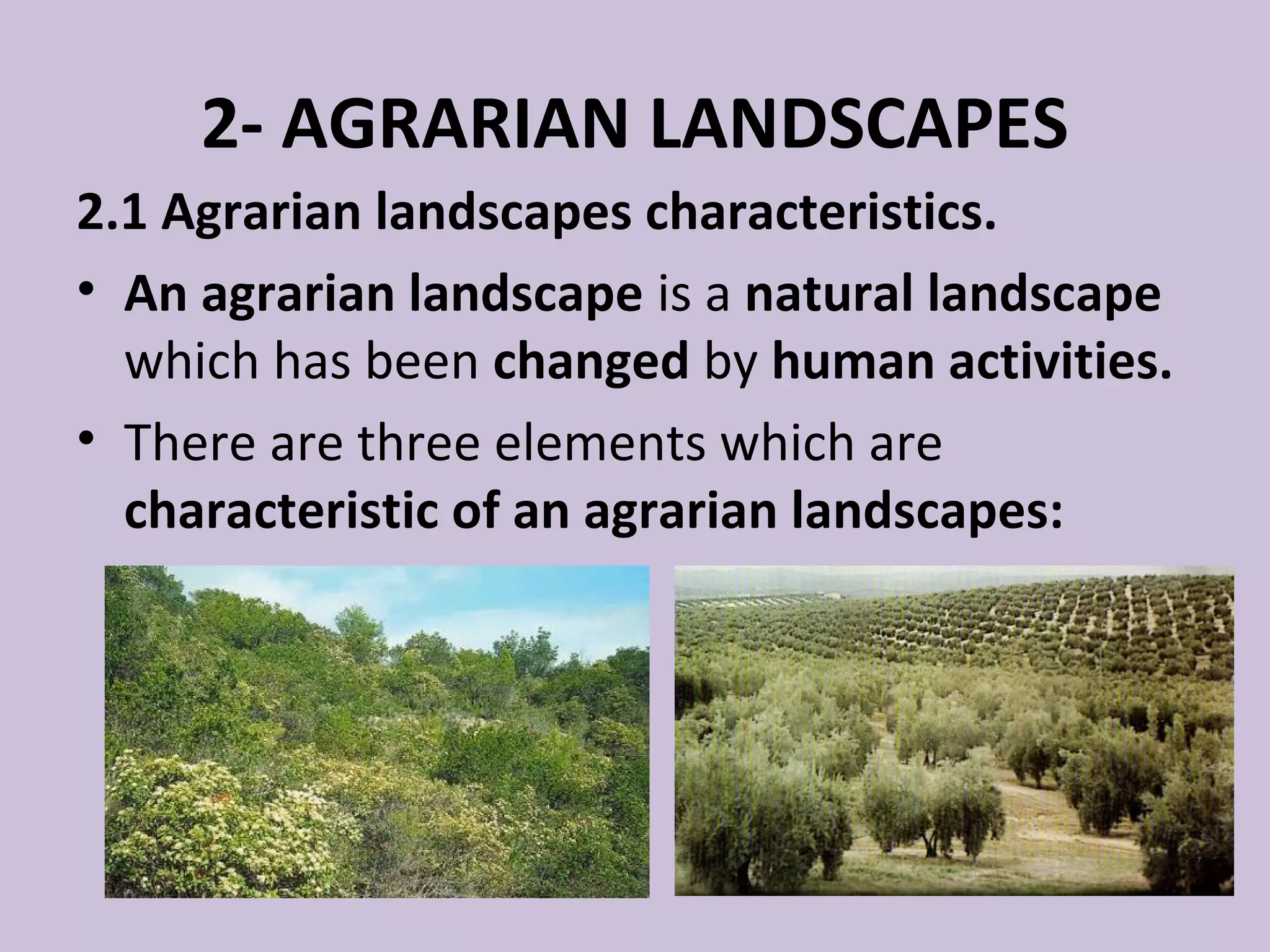
2.1 Agrarian landscapes characteristics.
• An agrarian landscape is a natural landscape
  which has been changed by human activities.
• There are three elements which are
  characteristic of an agrarian landscapes:
2.2 Plots of land.
• A plot is a piece of ground which is used to
  grow crops.
• They are different in size (small or large
  plots), shape (regular or irregular), and they
  might be closed or open plots:
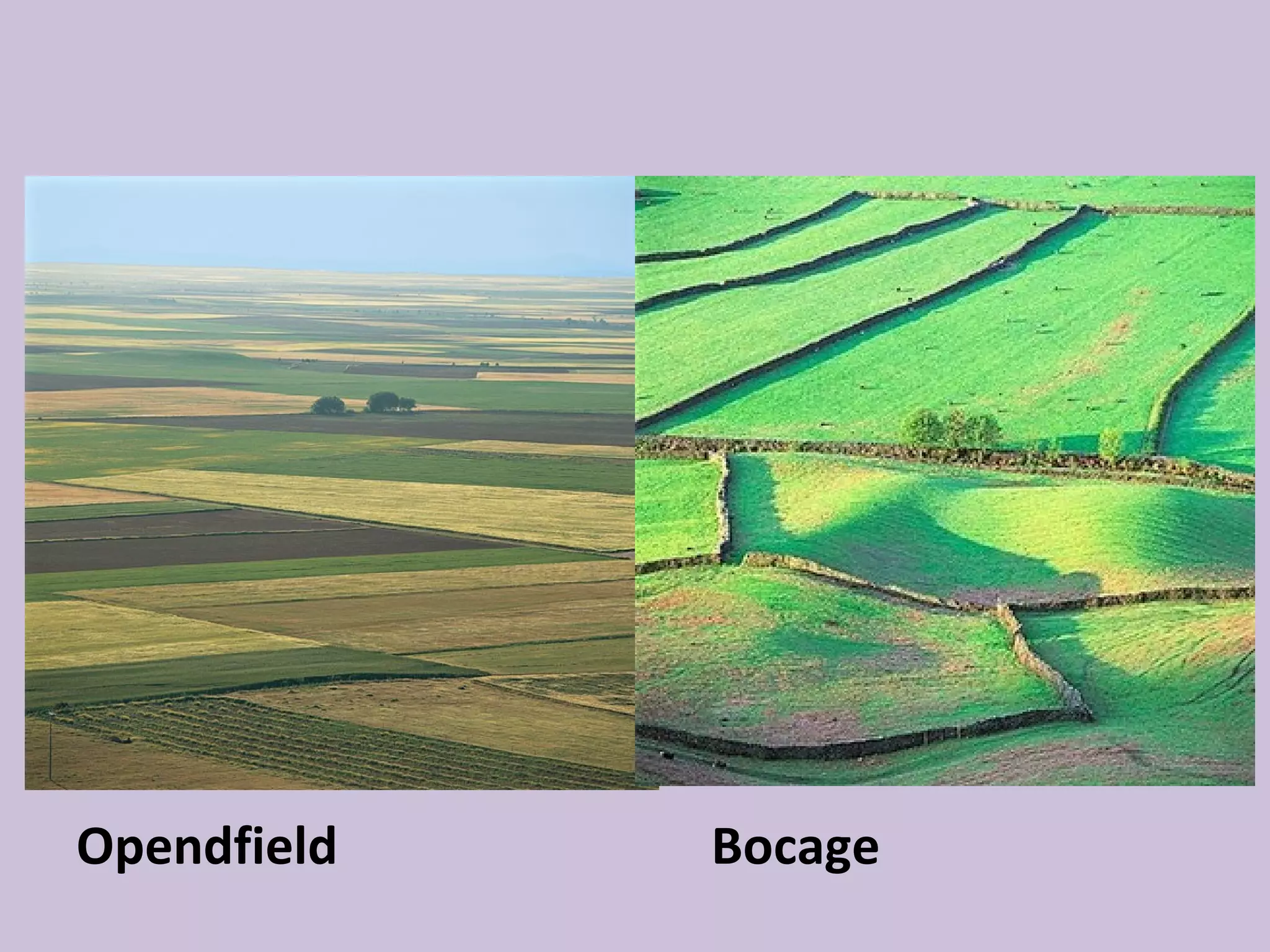
  - Openfields: are plots of land without fences.
  They usually have a small size and a regular
  shape. (Mediterranean Europe).
  - Bocage: they have a large size, besides they
  are irregular plots and are surrounded by a
  fence (Atlantic Europe)
Opendfield   Bocage
2.3 Farming Systems.
A)Multiple-crop farming system (policultivo)
  and single-crop farming:
      - MCFS: there several kind of crops are
  cultivated.
      - SCFS: the plot is used in a single and
  specialized crop (olive threes).
B) Irrigated and dry lands.
       - Irrigated landscapes: water is taken of
  the groundwater or reserves and it is used in
  fields.( it usually makes the production grow)
       - Dry landscapes: they only are irrigated by
  the rainfall (the cheapest method).
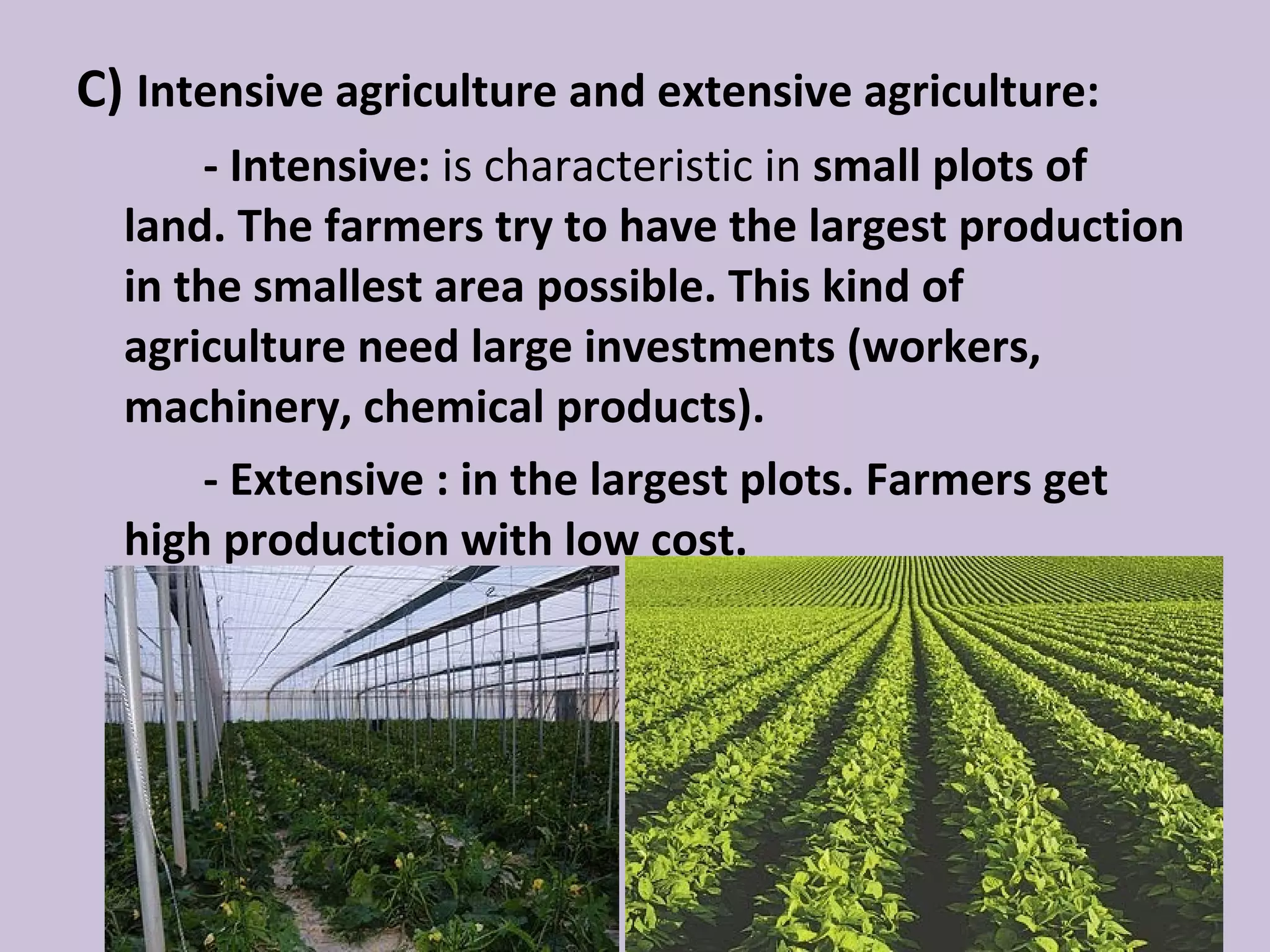
C) Intensive agriculture and extensive agriculture:
      - Intensive: is characteristic in small plots of
  land. The farmers try to have the largest production
  in the smallest area possible. This kind of
  agriculture need large investments (workers,
  machinery, chemical products).
      - Extensive : in the largest plots. Farmers get
  high production with low cost.
2.4 Rural Settlements.
• Rural areas are populated. Rural settlements
  might be scattered or concentrated.
• Nowadays, 39% of the world population live in
  rural settlements , although, there are several
  differences between developed countries
  and undeveloped countries (3% in Belgium
  and 85% in Nepal, Asia).
3- SUBSISTENCE AGRICULTURE
3.1 Characteristics.
• Subsistence farmers produce food for
  themselves and their family. There is rarely
  any profit or spare food.
• Farming systems and methods are very poor.
  Farmers haven´t got enough tools (plough or
  animals).
• Ground yield is also poor. It might be affected
  by droughts, pests or floods. In consequence
  population have several problems to get food
  or survive.
Subsistence farming in Thailand and
India
3.2 Subsistence Agriculture in the World.
• Nowadays more of 1000 million of people
  work in subsistence farming system.
• There are different kind of subsistence
  agriculture. Most important are:
  a)- Itinerant agriculture system: mainly in
  Africa, South America and Asia. Farmers burn
  the forest to get cultivable fields. Then they
  cultivate these fields for three or four years.
  Finally they must give up the field and burn
  another forest area.
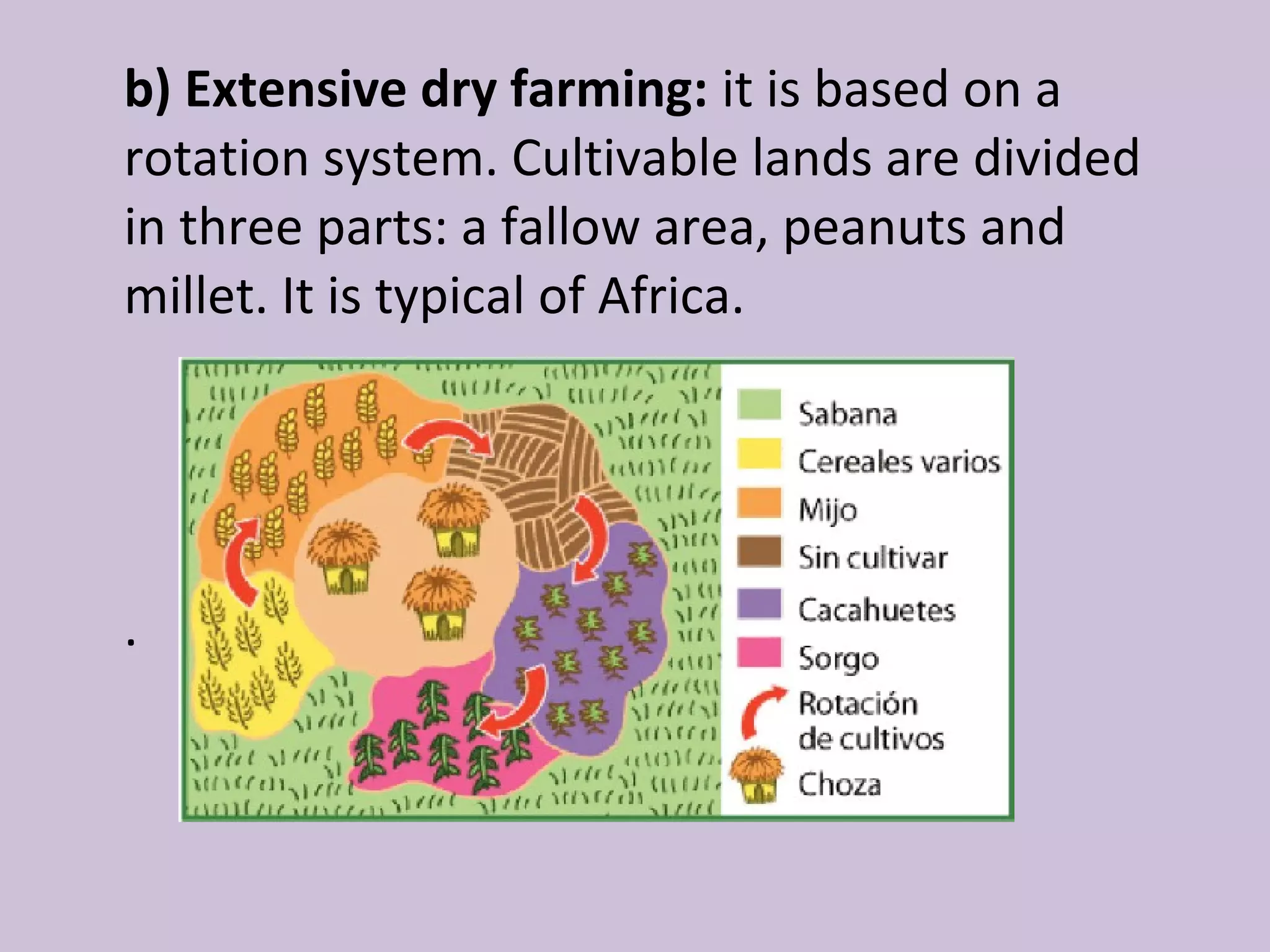
b) Extensive dry farming: it is based on a
rotation system. Cultivable lands are divided
in three parts: a fallow area, peanuts and
millet. It is typical of Africa.


.
• c) Irrigated rice growing: south-east of Asia,
  where the rainfall is abundant. It is an
  intensive farming system. Farmers get two
  harvest a year, on summer and winter.
  Normally the plots are on flooded terraces
4- MARKET AGRICULTURE
4.1 From subsistence agriculture to market
  agriculture.
• Investments, improvements make possible to
  pass from a subsistence farming system to
  another market farming system.
• It makes possible to get profits and spare
  food.
4.2 Market Agriculture.
• It’s practiced mainly in North America, West
  Europe, Japan, Australia, New Zealand and
  some parts of Argentina.
• This type of agriculture has two main
  objectives: raise the sales and reduce the
  expenses. It has some features:
  a) Field mechanization, that is to say, the use
  of machines allows:
      - Save work force.
      - Raise the production.
      - Reduce the prices of the agricultural goods.
b) The specialization of agricultural
  production in one or more products makes
  possible:
      - Raise the production.
     - Produce a greater quantity.
     - Better marketing to sell greater quantity.
c) Faster marketing of production needs to have
   better transports, it makes possible:
     - Fresh products arrive earlier to market
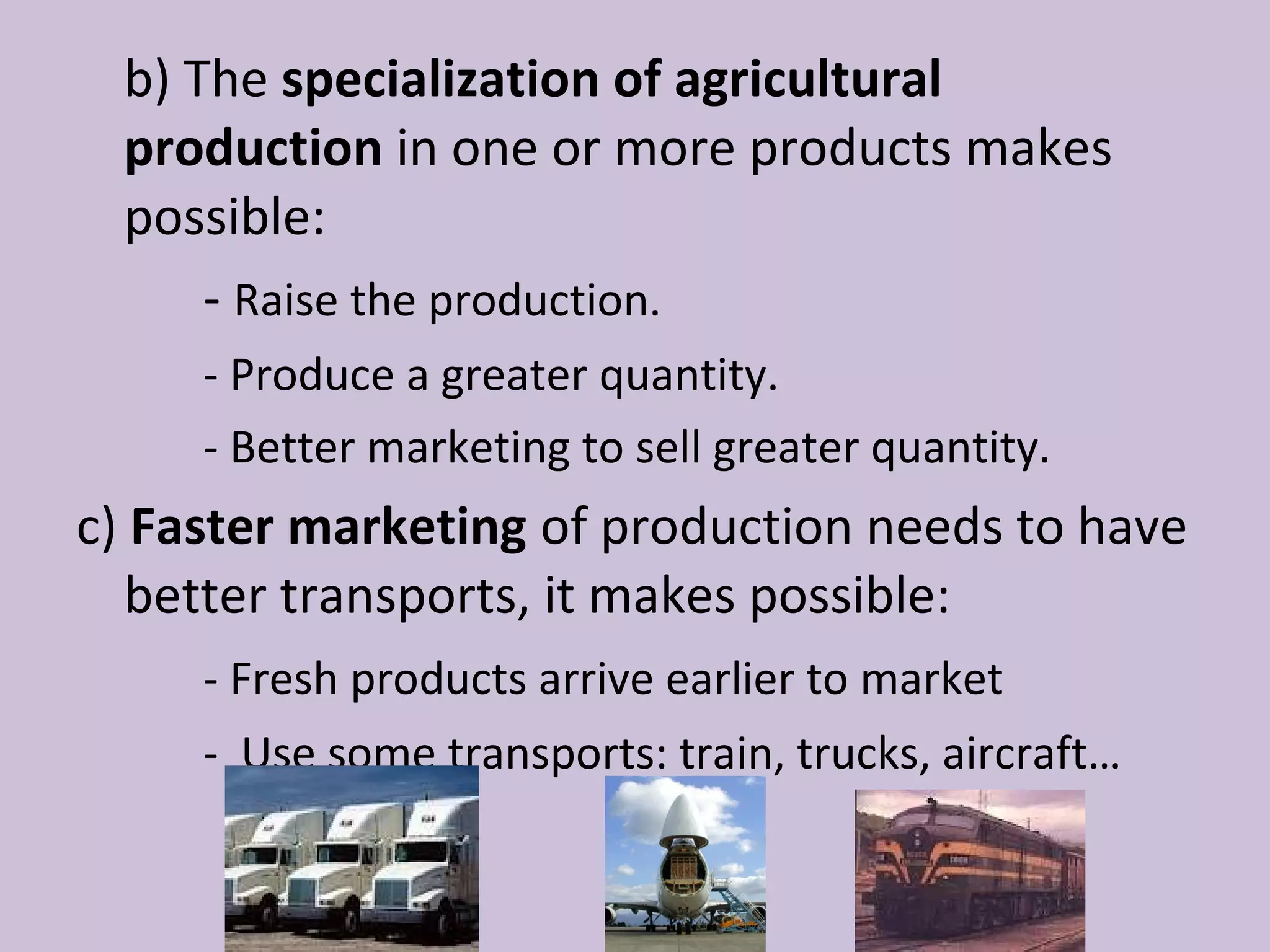
     - Use some transports: train, trucks, aircraft…
• The main target of this kind of agriculture
  system is to get the highest profit as possible.
• In the international markets it is called
  speculation agriculture.
5- LIVESTOCK IN THE WORLD
5.1 Traditional Livestock.
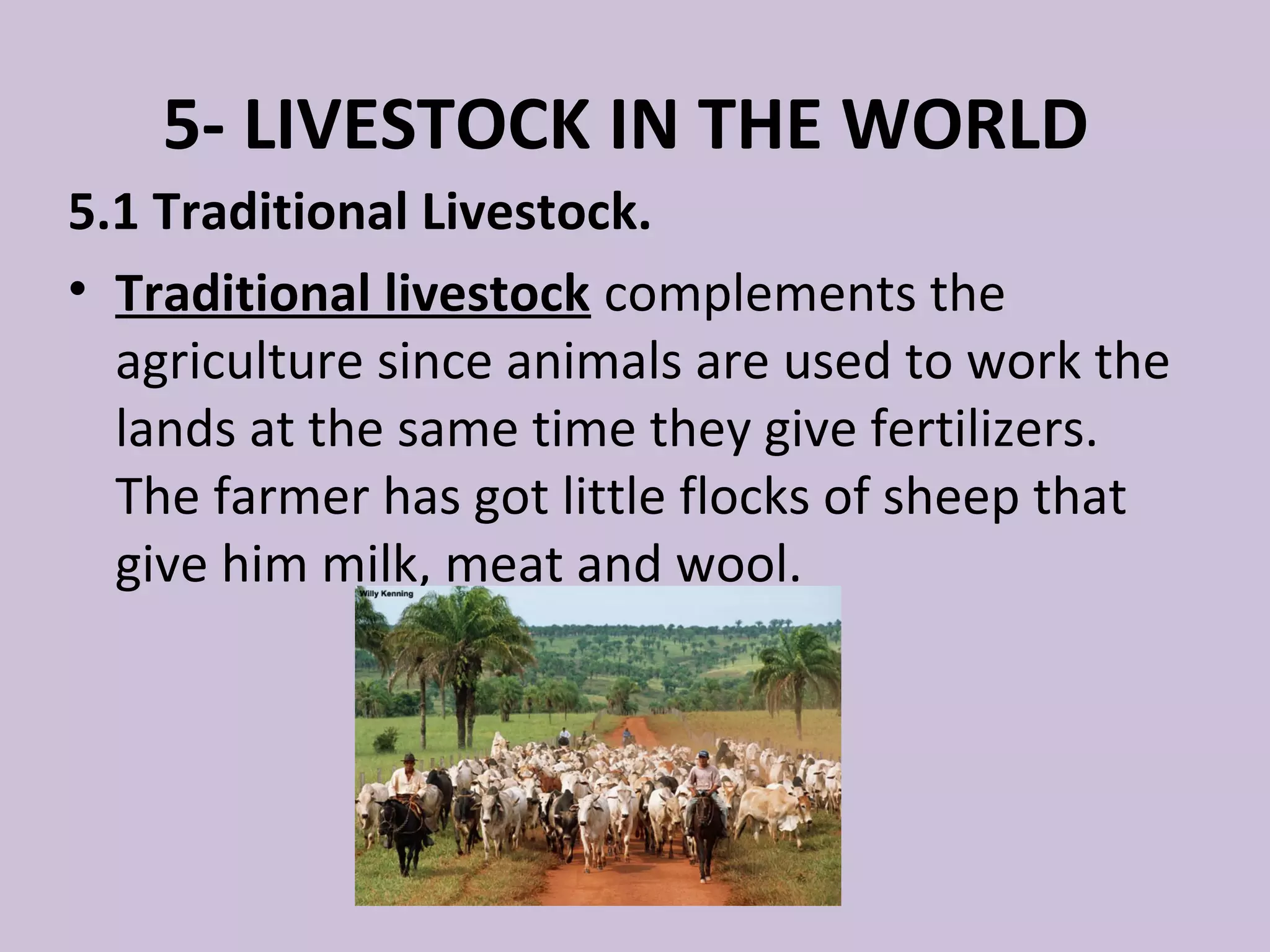
• Traditional livestock complements the
  agriculture since animals are used to work the
  lands at the same time they give fertilizers.
  The farmer has got little flocks of sheep that
  give him milk, meat and wool.
• In the driest zones, where there is no
  agriculture, we find subsistence livestock
  typical of nomadic shepherds. They move
  regularly with their flocks of camels, sheep or
  goats looking for water.
• 5.2. Market Livestock.
• Its goal is to sell the production in the market
  and to obtain as much profit as possible.
• Intensive livestock. It’s practiced in very
  specialized farms. A lot of workforce is
  employed and lots of investments,
  installations and goods are provided. Animals
  are bred in stables or farms, that is stabling.
• Extensive livestock. It’s practiced in places
  where there is good pasture. Little workforce
  is needed, but it requires important resources:
  lots of head of cattle, good commercial
  structures….
6- FISHING. TYPES OF FISHING
6.1 Fishing
• It is based on the exploitation of the animal
  resources offered by the sea. There 2 types of
  fishing: traditional and industrial.
6.2 Traditional Fishing
• It’s carried out near the coast and human
  strength and simple fishing rigs are involved.
  Little developed regions carry out this type of
  fishing. Its production is scarce and it’s used
  for self-consumption.
• Traditional Fishing
6.3 Industrial Fishing.
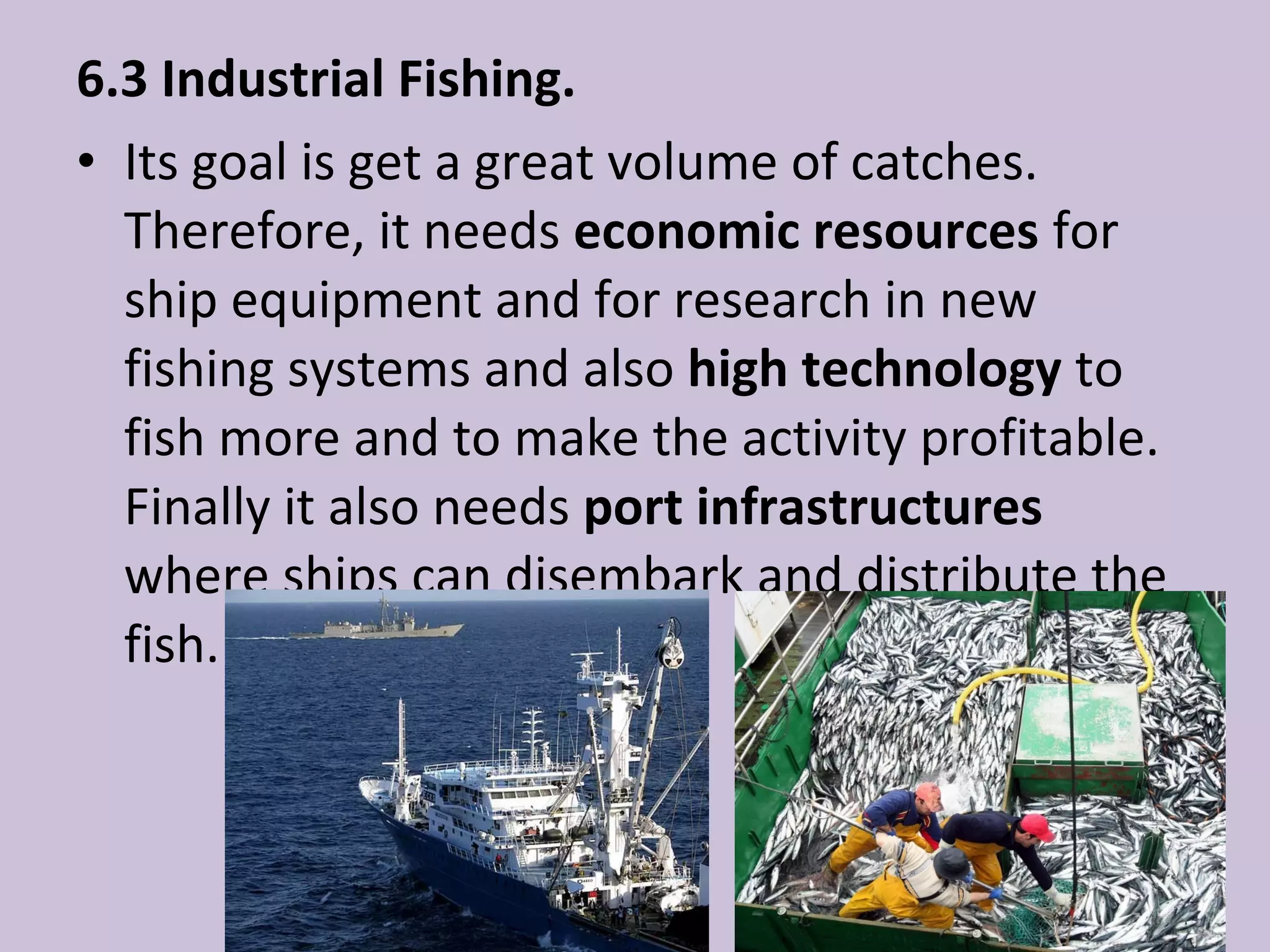
• Its goal is get a great volume of catches.
  Therefore, it needs economic resources for
  ship equipment and for research in new
  fishing systems and also high technology to
  fish more and to make the activity profitable.
  Finally it also needs port infrastructures
  where ships can disembark and distribute the
  fish.
• Depending on the place where it’s practiced,
  we distinguish different types of fishing:
  a) Coastal fishing, ships are small, they fish
  near the coast and take the catches to the fish
  market.
  b) Deep-sea fishing, it’s carried out by the
  most important fleets which rely on big ships
  and well-equipped that can stay in open sea
  for weeks or months. These ships have radars
  to detect fish shoals and their speed and
  direction, and they also have sonars to
  measure the importance of those shoals.
7- WHERE DOES FISHING TAKE PLACE?
         MAIN FISHING ZONES
• The most abundant catches take place in the
  so called fishing grounds which are:
      a- In zones where the continental shelf is vast,
  as in Japan, and where water is not very deep and
  has favorable temperatures for fish to grow.
       b- In contact zones between cold and warm
  ocean currents because there are warm and cold
  water species.
       c- In coastal zones near a cold ocean current
  because cold water has a lot of plankton.
World fishing areas
8-FISHING PROBLEMS:
8.1 Too Many Fishermen For Few Fish
• The 2 most serious problems of the fishing
  sector are: the overfishing and the lack of
  fishing grounds due to the widening of the
  territorial waters. Another problem is the
  growing pollution of water.
1) The overfishing
• The use of effective techniques and the
  increasing number of ships have caused the
  overfishing of the fishing resources, so the
  reproduction of many species is in danger.
• Some international organizations propose:
• It’s compulsory to use nets of wide mesh to protect
  the offspring.
• The control of the minimum size of the species.
• The establishment of close seasons.
• The restriction of the capacity of the fishing fleets.
2) The widening of territorial waters
• The sea tradition was based on the free use of
  the oceans. When the UN recognized the right
  of every country to have at its disposal its
  territorial waters (200 nautical miles or 370
  km), the countries with important fishing
  fleets had to leave some traditional fishing
  grounds. They had to reduce their fleets or
  establish agreements with countries which
  were far away from their origin ports.
8.2 Sustainable Exploitation
• The animal and vegetable resources offered
  by the sea are limited. To guarantee a
  sustainable exploitation of the sea resources,
  a regulated and intelligent sea exploitation is
  urgent.Some international organizations and
  the European Union:
• Establish strict fishing regulations.
• Want to restock the sea with the artificial breeding of fish.
• Propose to limit the number of fishing ships although it’s
  necessary to buy the fleets or pay an unemployment benefit
  for jobless fishermen.
• Aquiculture in this sense, offers interesting alternatives.
Acuiculture:

Unit 8. PRIMARY SECTOR

  • 1.
  • 2.
    1. PRIMARY SECTOR 1.1-Primary sector. • Primary activities are made of activities related to collect or produce natural resources. It means agriculture, livestock and fishing. • Nowadays, these activities takes 39% of world population. This percentage is unequal over the world (2% in North America, and 58% in Africa).
  • 4.
    1.2 Agriculture activities. •In this sector, agriculture and livestock are the most important because human feeding depends on these activities. • Agriculture activities are conditioned by: - The climate: crops need temperate temperatures, water and humidity to grow up. So in extreme climates crops are unable to grow up.
  • 5.
    - The relief:agriculture is usually located in plain areas or valleys. Sometimes mountain slopes are cultivated on terraces. - The ground: is very important, because they have to be rich in nutrients, have a good structure and be able to keep the humidity.
  • 6.
    • There areseveral differences between developed countries where the climate, the relief an the ground factors are less important than in undeveloped ones due to machinery and technology invested.
  • 7.
    2- AGRARIAN LANDSCAPES 2.1Agrarian landscapes characteristics. • An agrarian landscape is a natural landscape which has been changed by human activities. • There are three elements which are characteristic of an agrarian landscapes:
  • 8.
    2.2 Plots ofland. • A plot is a piece of ground which is used to grow crops. • They are different in size (small or large plots), shape (regular or irregular), and they might be closed or open plots: - Openfields: are plots of land without fences. They usually have a small size and a regular shape. (Mediterranean Europe). - Bocage: they have a large size, besides they are irregular plots and are surrounded by a fence (Atlantic Europe)
  • 9.
  • 10.
    2.3 Farming Systems. A)Multiple-cropfarming system (policultivo) and single-crop farming: - MCFS: there several kind of crops are cultivated. - SCFS: the plot is used in a single and specialized crop (olive threes).
  • 11.
    B) Irrigated anddry lands. - Irrigated landscapes: water is taken of the groundwater or reserves and it is used in fields.( it usually makes the production grow) - Dry landscapes: they only are irrigated by the rainfall (the cheapest method).
  • 12.
    C) Intensive agricultureand extensive agriculture: - Intensive: is characteristic in small plots of land. The farmers try to have the largest production in the smallest area possible. This kind of agriculture need large investments (workers, machinery, chemical products). - Extensive : in the largest plots. Farmers get high production with low cost.
  • 13.
    2.4 Rural Settlements. •Rural areas are populated. Rural settlements might be scattered or concentrated. • Nowadays, 39% of the world population live in rural settlements , although, there are several differences between developed countries and undeveloped countries (3% in Belgium and 85% in Nepal, Asia).
  • 14.
    3- SUBSISTENCE AGRICULTURE 3.1Characteristics. • Subsistence farmers produce food for themselves and their family. There is rarely any profit or spare food. • Farming systems and methods are very poor. Farmers haven´t got enough tools (plough or animals). • Ground yield is also poor. It might be affected by droughts, pests or floods. In consequence population have several problems to get food or survive.
  • 15.
    Subsistence farming inThailand and India
  • 16.
    3.2 Subsistence Agriculturein the World. • Nowadays more of 1000 million of people work in subsistence farming system. • There are different kind of subsistence agriculture. Most important are: a)- Itinerant agriculture system: mainly in Africa, South America and Asia. Farmers burn the forest to get cultivable fields. Then they cultivate these fields for three or four years. Finally they must give up the field and burn another forest area.
  • 18.
    b) Extensive dryfarming: it is based on a rotation system. Cultivable lands are divided in three parts: a fallow area, peanuts and millet. It is typical of Africa. .
  • 19.
    • c) Irrigatedrice growing: south-east of Asia, where the rainfall is abundant. It is an intensive farming system. Farmers get two harvest a year, on summer and winter. Normally the plots are on flooded terraces
  • 20.
    4- MARKET AGRICULTURE 4.1From subsistence agriculture to market agriculture. • Investments, improvements make possible to pass from a subsistence farming system to another market farming system. • It makes possible to get profits and spare food.
  • 21.
    4.2 Market Agriculture. •It’s practiced mainly in North America, West Europe, Japan, Australia, New Zealand and some parts of Argentina. • This type of agriculture has two main objectives: raise the sales and reduce the expenses. It has some features: a) Field mechanization, that is to say, the use of machines allows: - Save work force. - Raise the production. - Reduce the prices of the agricultural goods.
  • 23.
    b) The specializationof agricultural production in one or more products makes possible: - Raise the production. - Produce a greater quantity. - Better marketing to sell greater quantity. c) Faster marketing of production needs to have better transports, it makes possible: - Fresh products arrive earlier to market - Use some transports: train, trucks, aircraft…
  • 24.
    • The maintarget of this kind of agriculture system is to get the highest profit as possible. • In the international markets it is called speculation agriculture.
  • 25.
    5- LIVESTOCK INTHE WORLD 5.1 Traditional Livestock. • Traditional livestock complements the agriculture since animals are used to work the lands at the same time they give fertilizers. The farmer has got little flocks of sheep that give him milk, meat and wool.
  • 26.
    • In thedriest zones, where there is no agriculture, we find subsistence livestock typical of nomadic shepherds. They move regularly with their flocks of camels, sheep or goats looking for water.
  • 27.
    • 5.2. MarketLivestock. • Its goal is to sell the production in the market and to obtain as much profit as possible. • Intensive livestock. It’s practiced in very specialized farms. A lot of workforce is employed and lots of investments, installations and goods are provided. Animals are bred in stables or farms, that is stabling.
  • 28.
    • Extensive livestock.It’s practiced in places where there is good pasture. Little workforce is needed, but it requires important resources: lots of head of cattle, good commercial structures….
  • 29.
    6- FISHING. TYPESOF FISHING 6.1 Fishing • It is based on the exploitation of the animal resources offered by the sea. There 2 types of fishing: traditional and industrial. 6.2 Traditional Fishing • It’s carried out near the coast and human strength and simple fishing rigs are involved. Little developed regions carry out this type of fishing. Its production is scarce and it’s used for self-consumption.
  • 30.
  • 31.
    6.3 Industrial Fishing. •Its goal is get a great volume of catches. Therefore, it needs economic resources for ship equipment and for research in new fishing systems and also high technology to fish more and to make the activity profitable. Finally it also needs port infrastructures where ships can disembark and distribute the fish.
  • 32.
    • Depending onthe place where it’s practiced, we distinguish different types of fishing: a) Coastal fishing, ships are small, they fish near the coast and take the catches to the fish market. b) Deep-sea fishing, it’s carried out by the most important fleets which rely on big ships and well-equipped that can stay in open sea for weeks or months. These ships have radars to detect fish shoals and their speed and direction, and they also have sonars to measure the importance of those shoals.
  • 33.
    7- WHERE DOESFISHING TAKE PLACE? MAIN FISHING ZONES • The most abundant catches take place in the so called fishing grounds which are: a- In zones where the continental shelf is vast, as in Japan, and where water is not very deep and has favorable temperatures for fish to grow. b- In contact zones between cold and warm ocean currents because there are warm and cold water species. c- In coastal zones near a cold ocean current because cold water has a lot of plankton.
  • 34.
  • 35.
    8-FISHING PROBLEMS: 8.1 TooMany Fishermen For Few Fish • The 2 most serious problems of the fishing sector are: the overfishing and the lack of fishing grounds due to the widening of the territorial waters. Another problem is the growing pollution of water.
  • 36.
    1) The overfishing •The use of effective techniques and the increasing number of ships have caused the overfishing of the fishing resources, so the reproduction of many species is in danger. • Some international organizations propose: • It’s compulsory to use nets of wide mesh to protect the offspring. • The control of the minimum size of the species. • The establishment of close seasons. • The restriction of the capacity of the fishing fleets.
  • 37.
    2) The wideningof territorial waters • The sea tradition was based on the free use of the oceans. When the UN recognized the right of every country to have at its disposal its territorial waters (200 nautical miles or 370 km), the countries with important fishing fleets had to leave some traditional fishing grounds. They had to reduce their fleets or establish agreements with countries which were far away from their origin ports.
  • 38.
    8.2 Sustainable Exploitation •The animal and vegetable resources offered by the sea are limited. To guarantee a sustainable exploitation of the sea resources, a regulated and intelligent sea exploitation is urgent.Some international organizations and the European Union: • Establish strict fishing regulations. • Want to restock the sea with the artificial breeding of fish. • Propose to limit the number of fishing ships although it’s necessary to buy the fleets or pay an unemployment benefit for jobless fishermen. • Aquiculture in this sense, offers interesting alternatives.
  • 39.