Sustainable exploitation of
Aquatic Resources
Peter Henderson
Pisces Conservation Ltd.
www.irchouse.demon.co.uk
Peter@irchouse.demon.co.uk
Why have many fisheries collapsed?
The causes can be categorised under 3 headings
Habitat damage
Physical alteration
to spawning grounds
and habitat.
Pollution.
Obstructions to
movement.
Climatic change
Natural long-term
changes and cycles
Man-made climatic
alteration
Over-fishing
The killing of too
many animals for
the population to
replace itself.
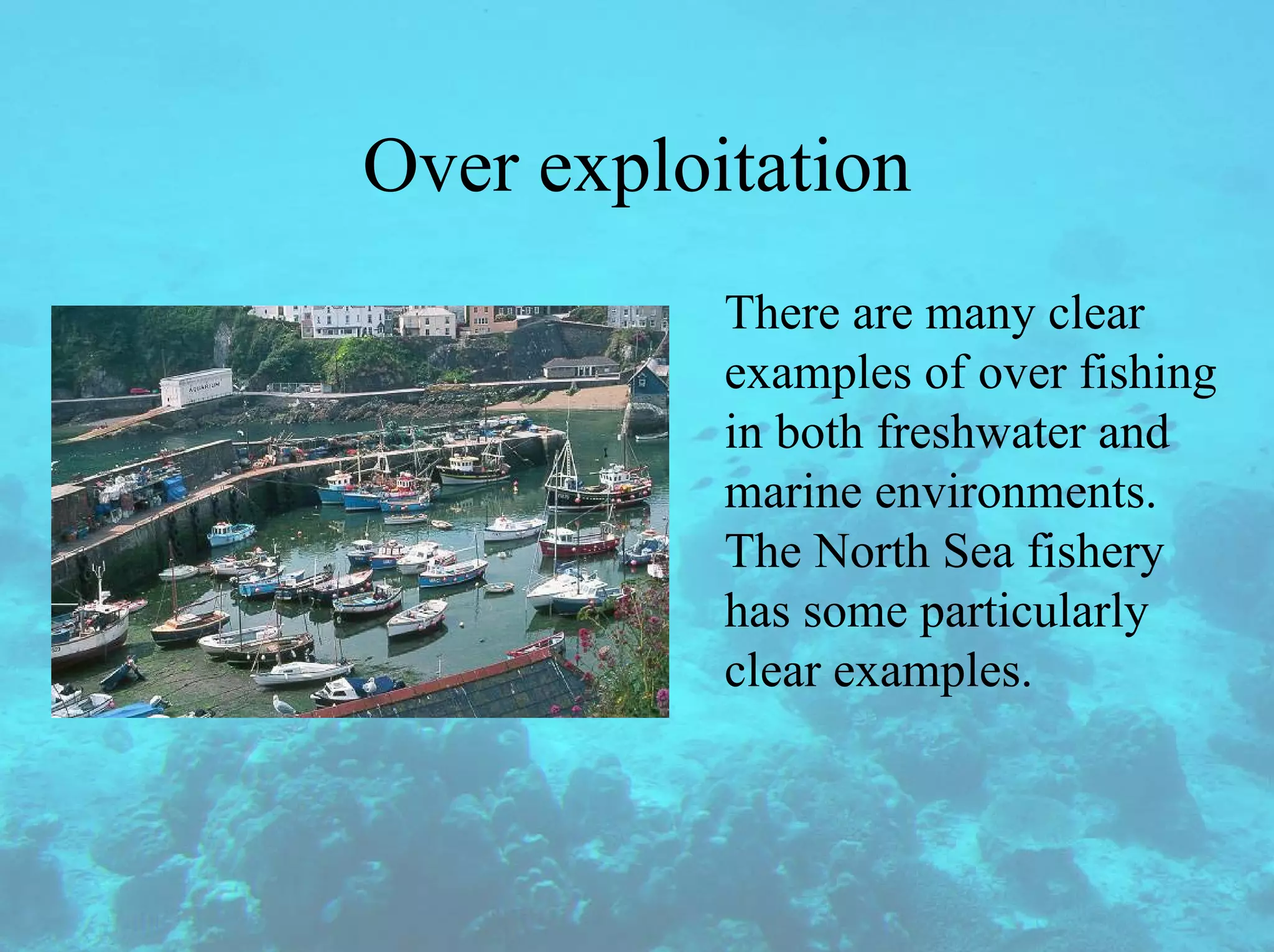
Over exploitation
There are many clear
examples of over fishing
in both freshwater and
marine environments.
The North Sea fishery
has some particularly
clear examples.
Over-exploitation in the North Sea 1.
The herring
0
200
400
600
800
1000
1200
1950
1955
1960
1965
1970
Catch in
1000s
tonnes
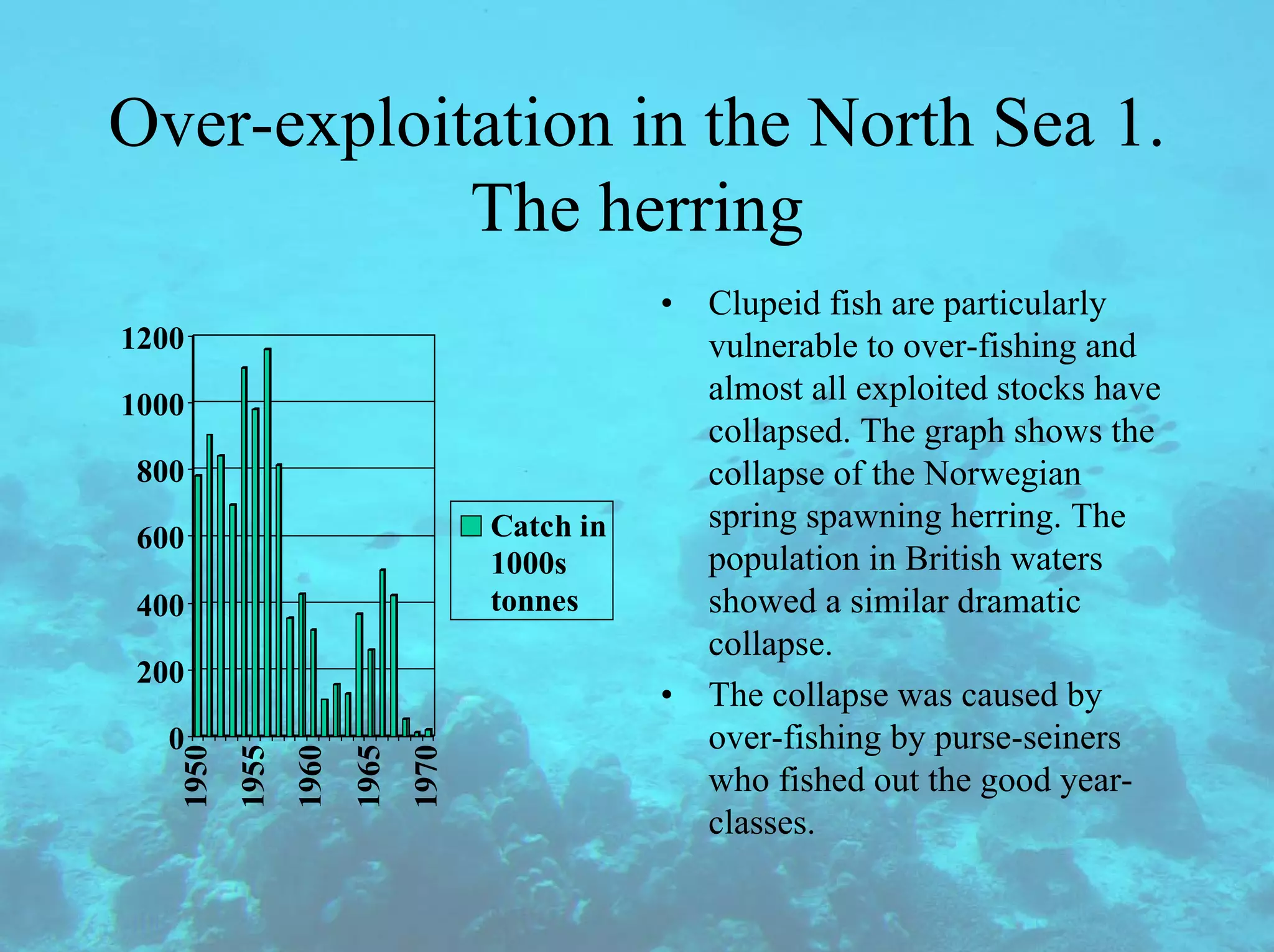
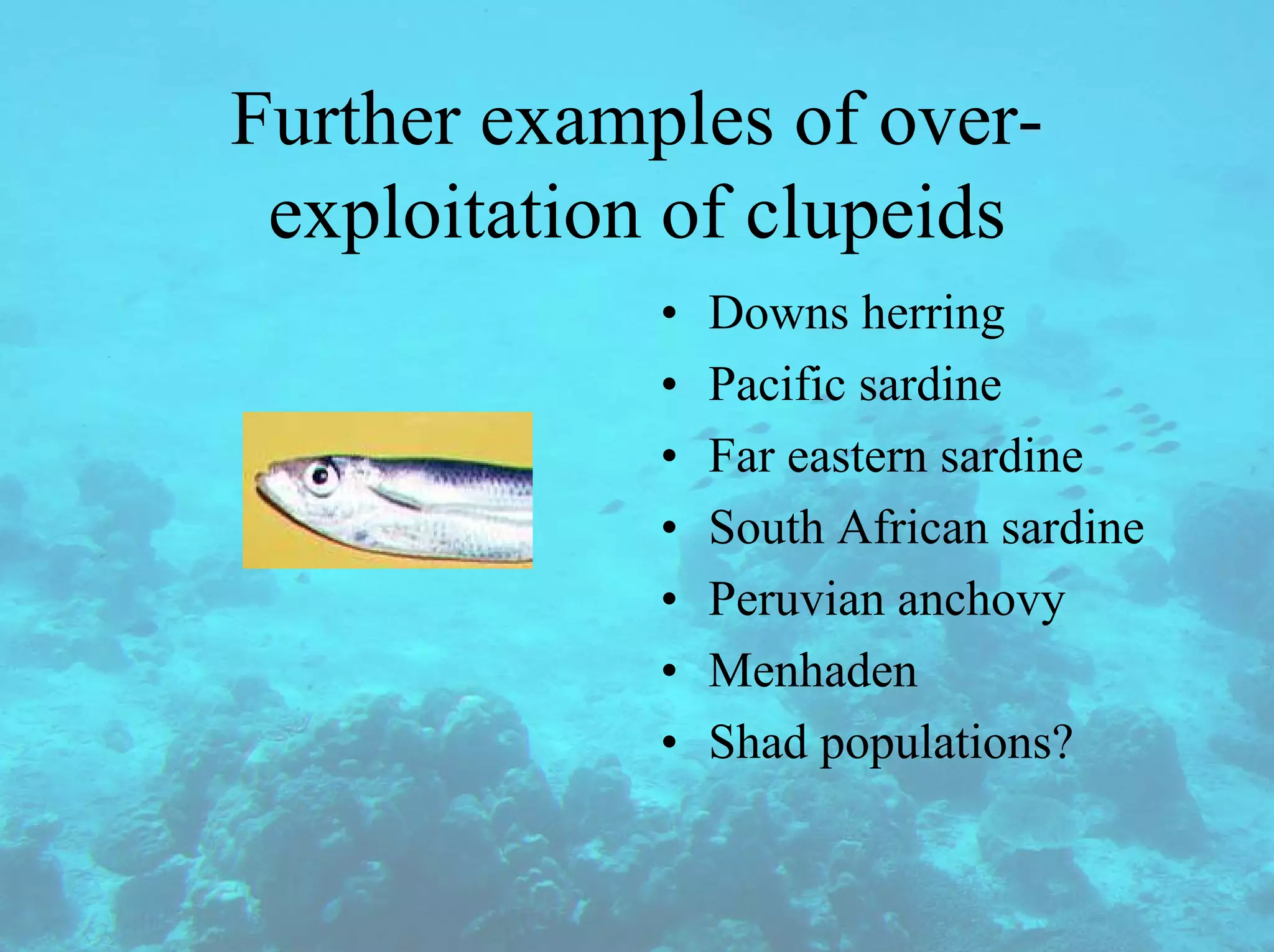
• Clupeid fish are particularly
vulnerable to over-fishing and
almost all exploited stocks have
collapsed. The graph shows the
collapse of the Norwegian
spring spawning herring. The
population in British waters
showed a similar dramatic
collapse.
• The collapse was caused by
over-fishing by purse-seiners
who fished out the good year-
classes.
Further examples of over-
exploitation of clupeids
• Downs herring
• Pacific sardine
• Far eastern sardine
• South African sardine
• Peruvian anchovy
• Menhaden
• Shad populations?
Over-exploitation in the North Sea
2. Haddock
0
5
10
15
20
25
1905
1908
1911
1914
1917
1921
1924
1927
1931
1934
1937
1939
1942
1945
1948
Catch per unit effort
One of the most well
known examples used to
show the impact of
fishing is the effect of
the two world wars on
North Sea stocks.
Reduced fishing during
the wars lead to an
increase in stocks.
Habitat damage
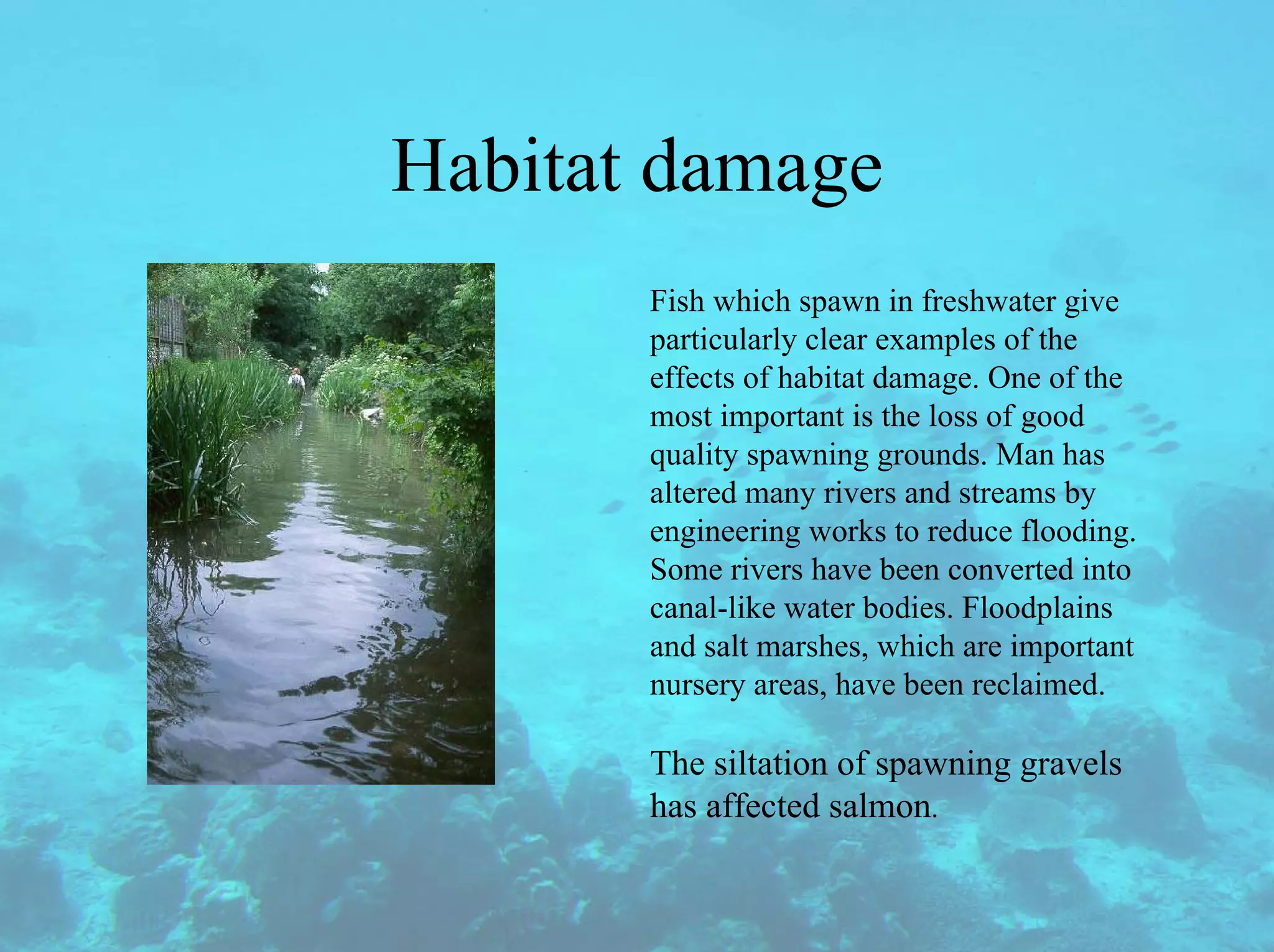
Fish which spawn in freshwater give
particularly clear examples of the
effects of habitat damage. One of the
most important is the loss of good
quality spawning grounds. Man has
altered many rivers and streams by
engineering works to reduce flooding.
Some rivers have been converted into
canal-like water bodies. Floodplains
and salt marshes, which are important
nursery areas, have been reclaimed.
The siltation of spawning gravels
has affected salmon.
Habitat damage - Pollution
Pollution of waters has had a
devastating effect on some fish
populations.
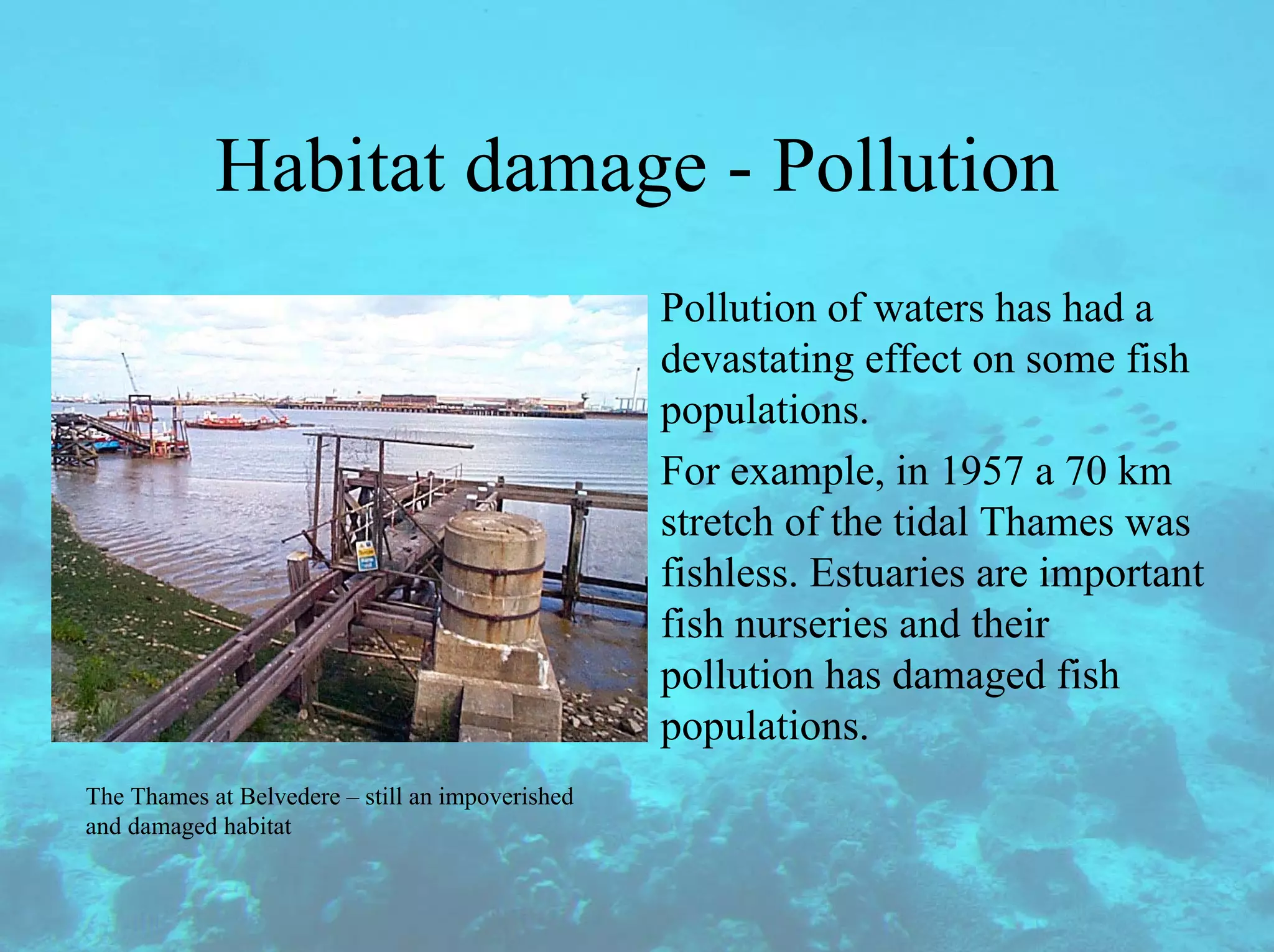
For example, in 1957 a 70 km
stretch of the tidal Thames was
fishless. Estuaries are important
fish nurseries and their
pollution has damaged fish
populations.
The Thames at Belvedere – still an impoverished
and damaged habitat
Obstructions to movement-
salmon, shad and lamprey
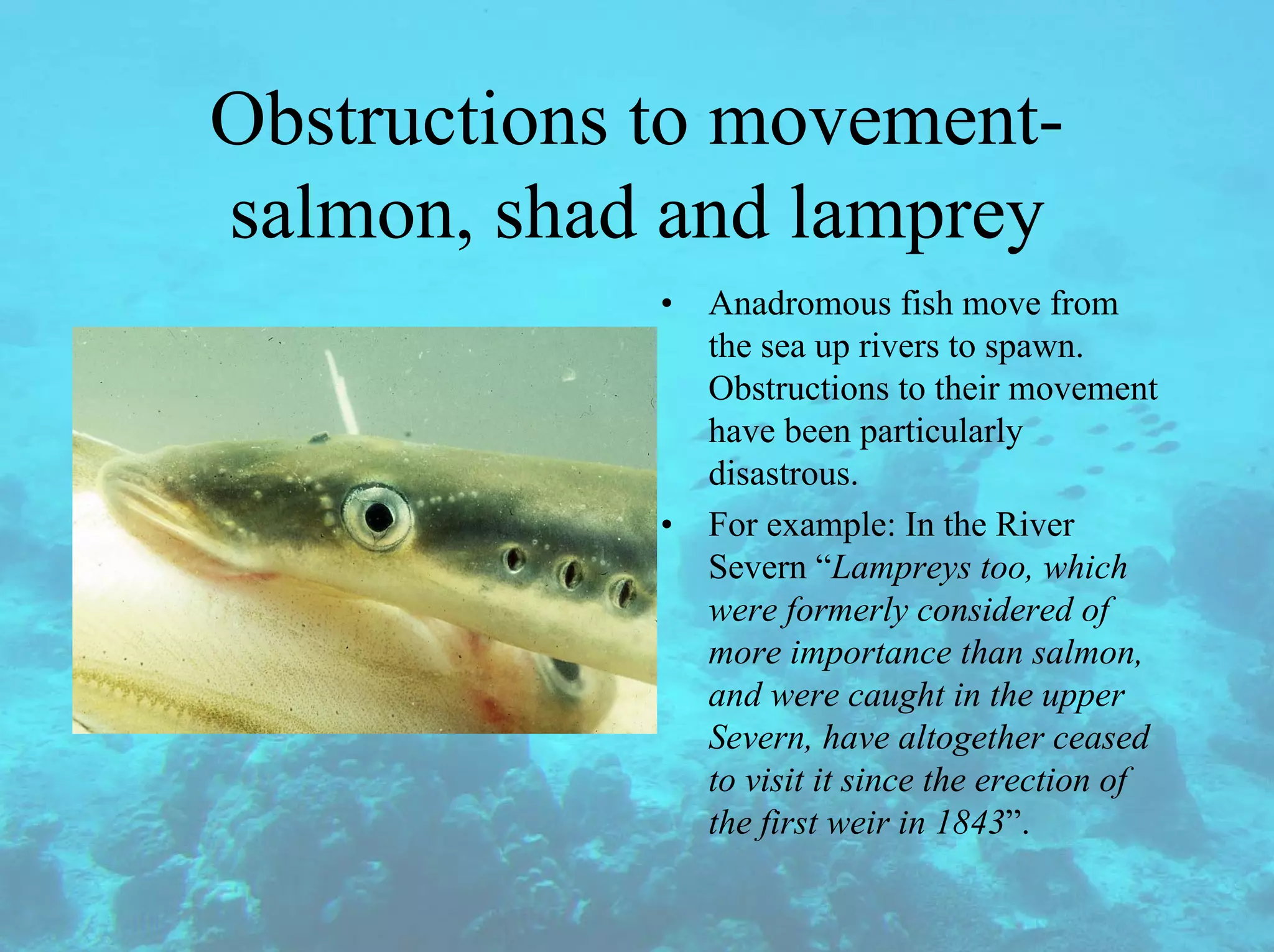
• Anadromous fish move from
the sea up rivers to spawn.
Obstructions to their movement
have been particularly
disastrous.
• For example: In the River
Severn “Lampreys too, which
were formerly considered of
more importance than salmon,
and were caught in the upper
Severn, have altogether ceased
to visit it since the erection of
the first weir in 1843”.
Interference with movement and other
factors in catadromous fish - eel
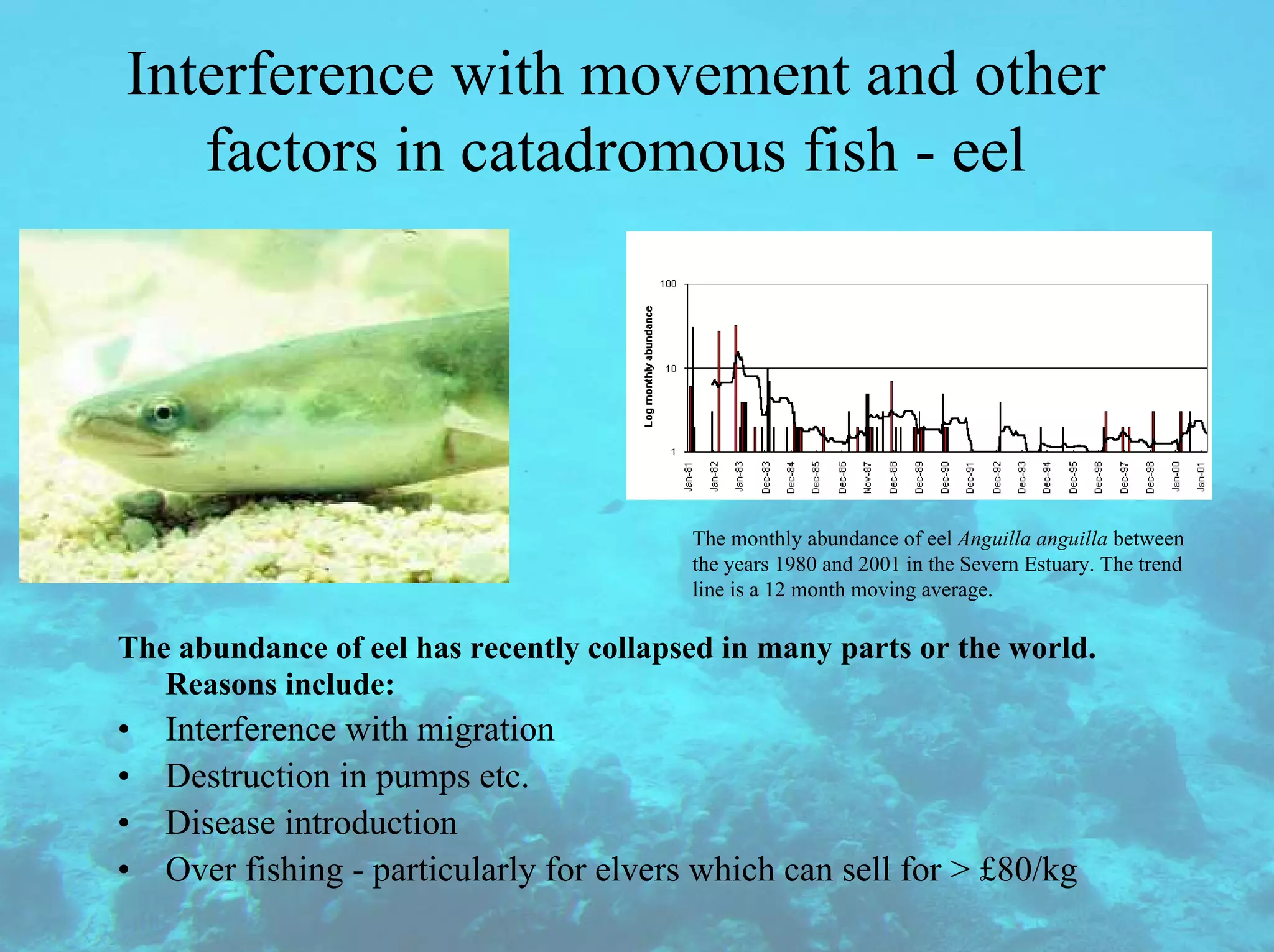
The monthly abundance of eel Anguilla anguilla between
the years 1980 and 2001 in the Severn Estuary. The trend
line is a 12 month moving average.
The abundance of eel has recently collapsed in many parts or the world.
Reasons include:
• Interference with migration
• Destruction in pumps etc.
• Disease introduction
• Over fishing - particularly for elvers which can sell for > £80/kg
Climatic change
Climatic change can act to make the identification of a sustainable catch
particularly difficult.
An example of major climatic change that is probably natural and is
known to have a profound effect on fisheries is El Nino. The warming
and cooling of the water greatly changes the anchoveta population off the
coast of Peru.
The variability in climate also tends to produce confusion. A general
decline in a population can be hidden by a short run of good years with
high recruitment.
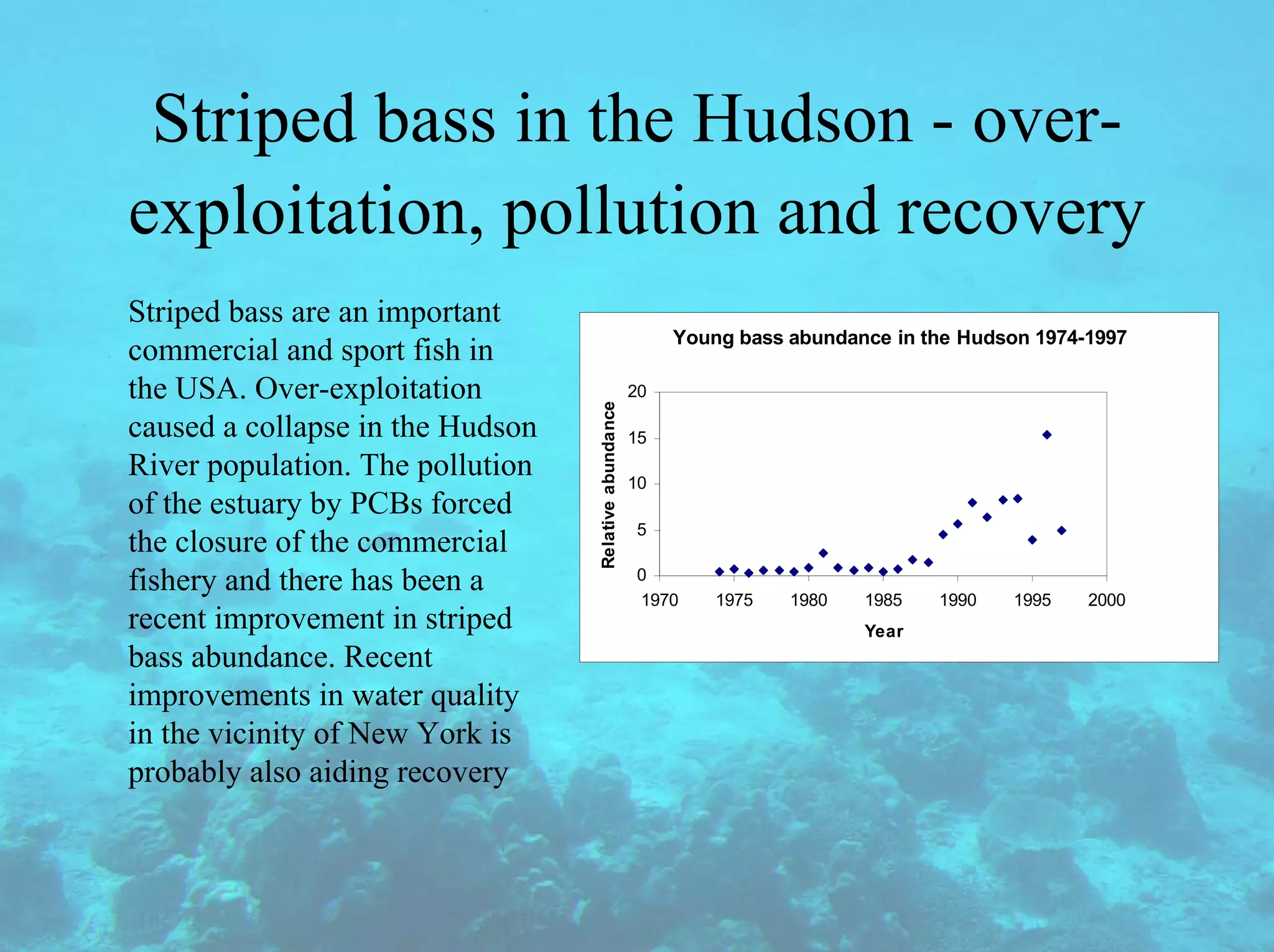
Striped bass in the Hudson - over-
exploitation, pollution and recovery
Striped bass are an important
commercial and sport fish in
the USA. Over-exploitation
caused a collapse in the Hudson
River population. The pollution
of the estuary by PCBs forced
the closure of the commercial
fishery and there has been a
recent improvement in striped
bass abundance. Recent
improvements in water quality
in the vicinity of New York is
probably also aiding recovery
Young bass abundance in the Hudson 1974-1997
0
5
10
15
20
1970 1975 1980 1985 1990 1995 2000
Year
Relative
abundance
Decline is not inevitable
• The preceding examples might lead to the
conclusion that it is impossible to achieve a
sustainable harvest of fish and crustaceans.
This is not true. With good planning,
honesty, flexibility, care for the habitat and
modest levels of harvest it can be achieved.
Examples of long-term stability
in fish populations
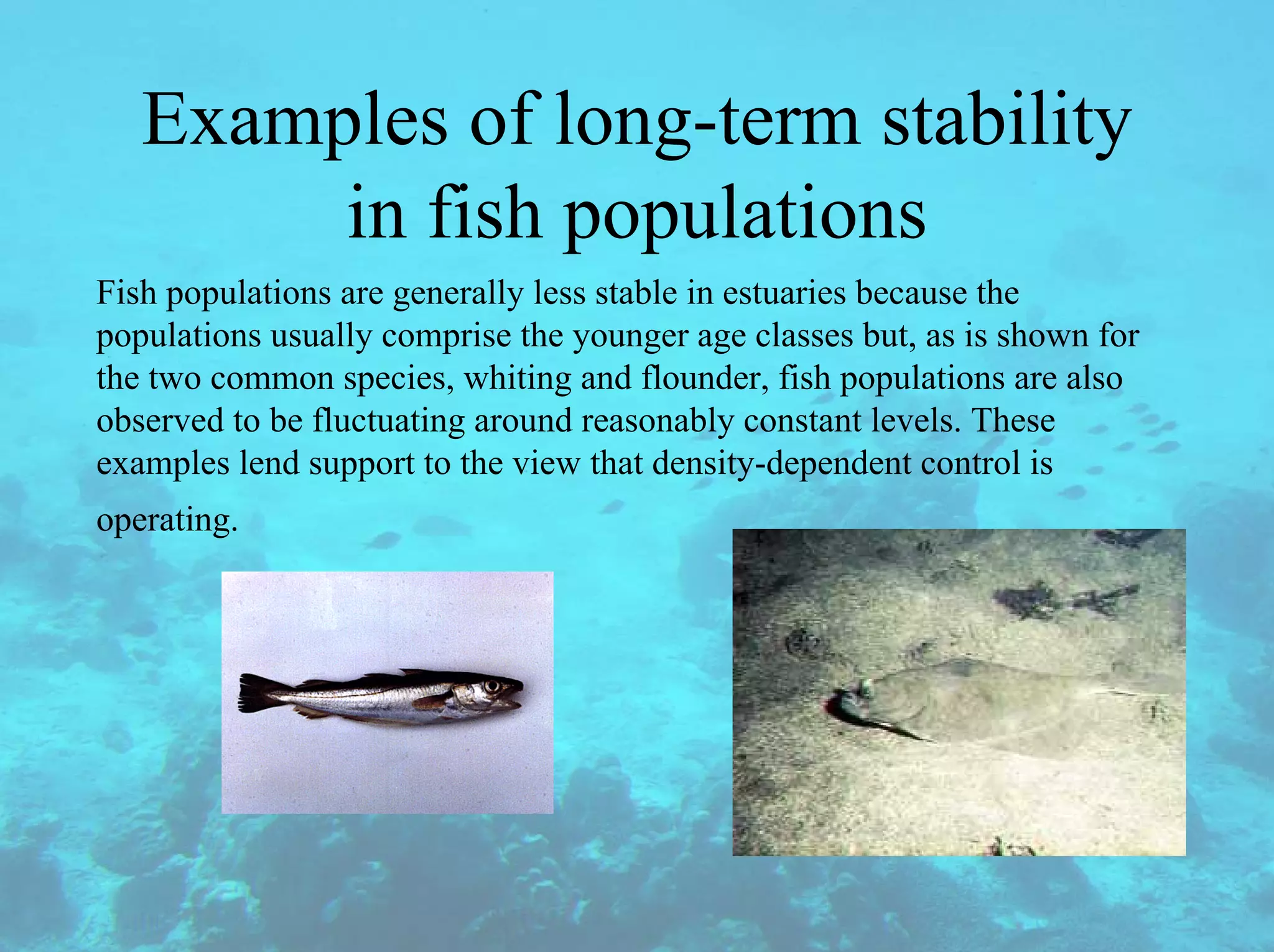
Fish populations are generally less stable in estuaries because the
populations usually comprise the younger age classes but, as is shown for
the two common species, whiting and flounder, fish populations are also
observed to be fluctuating around reasonably constant levels. These
examples lend support to the view that density-dependent control is
operating.
Whiting and flounder dynamics
Figure 2: The monthly
abundance of whiting
Merlangius merlangus between
the years 1980 and 2001 in the
Severn Estuary. The trend line
is a 12 month moving average.
Figure 3: The monthly
abundance of flounder
Platichthys flesus between
the years 1980 and 2001 in
the Severn Estuary. The
trend line is a 12 month
moving average.
A clear example of sustainable
exploitation-
Shrimp in the Severn Estuary
Fixed-net fishermen in the
Severn Estuary are continuing
a fishing tradition which was
recorded in the Domesday
book. Their principal catch is
shrimps and prawns with
smaller catches of fish such as
sprat and sole from the inter-
tidal areas of the Bristol
Channel.
Shrimp: an example of stability
with exploitation
The graph below shows the remarkable stability of shrimp
Crangon crangon in the Severn Estuary in an area where fixed-
net fishermen work. The population fluctuates around a long-
term, markedly constant, mean.
Sole in SW British waters – an
exploited population which is
increasing.
Sustainable fishing in the
Amazonian floodplain
Floodplain lakes are some of
the most productive waters
on the planet. Yet they are
quite easily over exploited by
commercial fishing. This has
even occurred in the upper
Amazon where animals are
caught both for food and for
live export for the aquarium
trade. We will look at one
example where a change in
policy has brought rapid
improvements that suggest
sustainable exploitation can
be achieved while improving
the life of the local people.
Arapaima populations
In the Mamiraua Reserve in the Amazon
floodplain it has been possible to re-establish
the Arapaima population following extensive
over fishing, by the following steps:
•The overall structure and integrity of the
habitat is protected by limiting deforestation
etc.
•Large commercial fishing boats were only
allowed to exploit a limited number of lakes.
•All other water bodies were under the control
of the local communities and were divided into
three groups.
•One group were never fished and are used as
reproductive areas for the fish. A second group
are resting from exploitation. The third group
are fished.
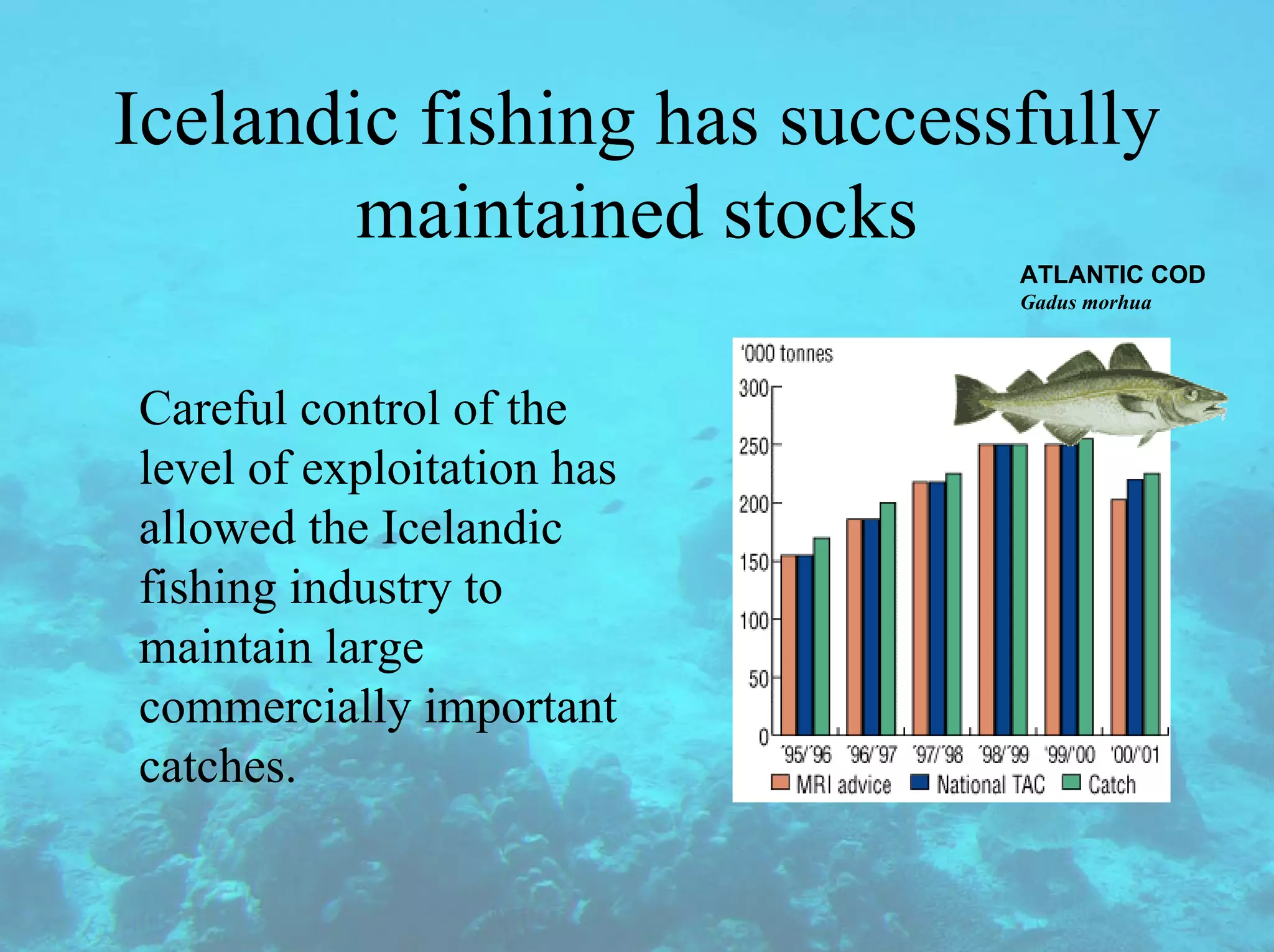
Icelandic fishing has successfully
maintained stocks
Careful control of the
level of exploitation has
allowed the Icelandic
fishing industry to
maintain large
commercially important
catches.
ATLANTIC COD
Gadus morhua
Conclusions - to achieve
sustainable exploitation
• The habitats needed by animals must not be greatly damaged or
reduced in extent. Particular care needs to be taken over spawning and
nursery grounds.
• Exploitation must be planned to allow the survival of sufficient adults
to produce strong recruitment
• The effects of climate need to be monitored and landings adjusted
accordingly
• Exploitation needs to be at a level that does not radically change the
age structure and life history of the animal.
• A precautionary approach must be taken. Present practise is to believe
in compensatory responses and aim for the maximum possible catch -
this approach has failed repeatedly.

sust Aquatic Res.pdf

  • 1.
    Sustainable exploitation of AquaticResources Peter Henderson Pisces Conservation Ltd. www.irchouse.demon.co.uk Peter@irchouse.demon.co.uk
  • 2.
    Why have manyfisheries collapsed? The causes can be categorised under 3 headings Habitat damage Physical alteration to spawning grounds and habitat. Pollution. Obstructions to movement. Climatic change Natural long-term changes and cycles Man-made climatic alteration Over-fishing The killing of too many animals for the population to replace itself.
  • 3.
    Over exploitation There aremany clear examples of over fishing in both freshwater and marine environments. The North Sea fishery has some particularly clear examples.
  • 4.
    Over-exploitation in theNorth Sea 1. The herring 0 200 400 600 800 1000 1200 1950 1955 1960 1965 1970 Catch in 1000s tonnes • Clupeid fish are particularly vulnerable to over-fishing and almost all exploited stocks have collapsed. The graph shows the collapse of the Norwegian spring spawning herring. The population in British waters showed a similar dramatic collapse. • The collapse was caused by over-fishing by purse-seiners who fished out the good year- classes.
  • 5.
    Further examples ofover- exploitation of clupeids • Downs herring • Pacific sardine • Far eastern sardine • South African sardine • Peruvian anchovy • Menhaden • Shad populations?
  • 6.
    Over-exploitation in theNorth Sea 2. Haddock 0 5 10 15 20 25 1905 1908 1911 1914 1917 1921 1924 1927 1931 1934 1937 1939 1942 1945 1948 Catch per unit effort One of the most well known examples used to show the impact of fishing is the effect of the two world wars on North Sea stocks. Reduced fishing during the wars lead to an increase in stocks.
  • 7.
    Habitat damage Fish whichspawn in freshwater give particularly clear examples of the effects of habitat damage. One of the most important is the loss of good quality spawning grounds. Man has altered many rivers and streams by engineering works to reduce flooding. Some rivers have been converted into canal-like water bodies. Floodplains and salt marshes, which are important nursery areas, have been reclaimed. The siltation of spawning gravels has affected salmon.
  • 8.
    Habitat damage -Pollution Pollution of waters has had a devastating effect on some fish populations. For example, in 1957 a 70 km stretch of the tidal Thames was fishless. Estuaries are important fish nurseries and their pollution has damaged fish populations. The Thames at Belvedere – still an impoverished and damaged habitat
  • 9.
    Obstructions to movement- salmon,shad and lamprey • Anadromous fish move from the sea up rivers to spawn. Obstructions to their movement have been particularly disastrous. • For example: In the River Severn “Lampreys too, which were formerly considered of more importance than salmon, and were caught in the upper Severn, have altogether ceased to visit it since the erection of the first weir in 1843”.
  • 10.
    Interference with movementand other factors in catadromous fish - eel The monthly abundance of eel Anguilla anguilla between the years 1980 and 2001 in the Severn Estuary. The trend line is a 12 month moving average. The abundance of eel has recently collapsed in many parts or the world. Reasons include: • Interference with migration • Destruction in pumps etc. • Disease introduction • Over fishing - particularly for elvers which can sell for > £80/kg
  • 11.
    Climatic change Climatic changecan act to make the identification of a sustainable catch particularly difficult. An example of major climatic change that is probably natural and is known to have a profound effect on fisheries is El Nino. The warming and cooling of the water greatly changes the anchoveta population off the coast of Peru. The variability in climate also tends to produce confusion. A general decline in a population can be hidden by a short run of good years with high recruitment.
  • 12.
    Striped bass inthe Hudson - over- exploitation, pollution and recovery Striped bass are an important commercial and sport fish in the USA. Over-exploitation caused a collapse in the Hudson River population. The pollution of the estuary by PCBs forced the closure of the commercial fishery and there has been a recent improvement in striped bass abundance. Recent improvements in water quality in the vicinity of New York is probably also aiding recovery Young bass abundance in the Hudson 1974-1997 0 5 10 15 20 1970 1975 1980 1985 1990 1995 2000 Year Relative abundance
  • 13.
    Decline is notinevitable • The preceding examples might lead to the conclusion that it is impossible to achieve a sustainable harvest of fish and crustaceans. This is not true. With good planning, honesty, flexibility, care for the habitat and modest levels of harvest it can be achieved.
  • 14.
    Examples of long-termstability in fish populations Fish populations are generally less stable in estuaries because the populations usually comprise the younger age classes but, as is shown for the two common species, whiting and flounder, fish populations are also observed to be fluctuating around reasonably constant levels. These examples lend support to the view that density-dependent control is operating.
  • 15.
    Whiting and flounderdynamics Figure 2: The monthly abundance of whiting Merlangius merlangus between the years 1980 and 2001 in the Severn Estuary. The trend line is a 12 month moving average. Figure 3: The monthly abundance of flounder Platichthys flesus between the years 1980 and 2001 in the Severn Estuary. The trend line is a 12 month moving average.
  • 16.
    A clear exampleof sustainable exploitation- Shrimp in the Severn Estuary Fixed-net fishermen in the Severn Estuary are continuing a fishing tradition which was recorded in the Domesday book. Their principal catch is shrimps and prawns with smaller catches of fish such as sprat and sole from the inter- tidal areas of the Bristol Channel.
  • 17.
    Shrimp: an exampleof stability with exploitation The graph below shows the remarkable stability of shrimp Crangon crangon in the Severn Estuary in an area where fixed- net fishermen work. The population fluctuates around a long- term, markedly constant, mean.
  • 18.
    Sole in SWBritish waters – an exploited population which is increasing.
  • 19.
    Sustainable fishing inthe Amazonian floodplain Floodplain lakes are some of the most productive waters on the planet. Yet they are quite easily over exploited by commercial fishing. This has even occurred in the upper Amazon where animals are caught both for food and for live export for the aquarium trade. We will look at one example where a change in policy has brought rapid improvements that suggest sustainable exploitation can be achieved while improving the life of the local people.
  • 20.
    Arapaima populations In theMamiraua Reserve in the Amazon floodplain it has been possible to re-establish the Arapaima population following extensive over fishing, by the following steps: •The overall structure and integrity of the habitat is protected by limiting deforestation etc. •Large commercial fishing boats were only allowed to exploit a limited number of lakes. •All other water bodies were under the control of the local communities and were divided into three groups. •One group were never fished and are used as reproductive areas for the fish. A second group are resting from exploitation. The third group are fished.
  • 21.
    Icelandic fishing hassuccessfully maintained stocks Careful control of the level of exploitation has allowed the Icelandic fishing industry to maintain large commercially important catches. ATLANTIC COD Gadus morhua
  • 22.
    Conclusions - toachieve sustainable exploitation • The habitats needed by animals must not be greatly damaged or reduced in extent. Particular care needs to be taken over spawning and nursery grounds. • Exploitation must be planned to allow the survival of sufficient adults to produce strong recruitment • The effects of climate need to be monitored and landings adjusted accordingly • Exploitation needs to be at a level that does not radically change the age structure and life history of the animal. • A precautionary approach must be taken. Present practise is to believe in compensatory responses and aim for the maximum possible catch - this approach has failed repeatedly.