ARE WE LOSING
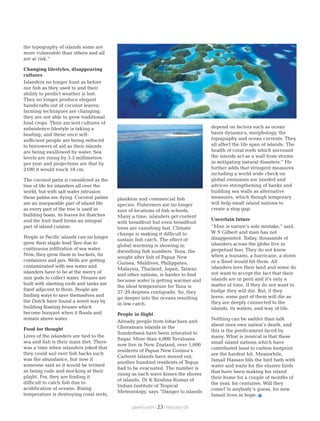
WINTERS?
HOW GREEN IS
YOUR DATA CENTRE?
SOLAR ENERGY:
THE WAY FORWARD
w w w . p l a n e t e a r t h - i n d i a . c o m
earth
P L A N E T
february 2009rs. 100
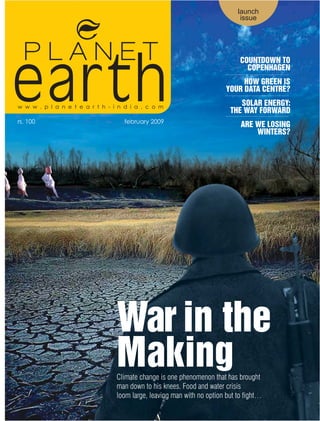
War in the
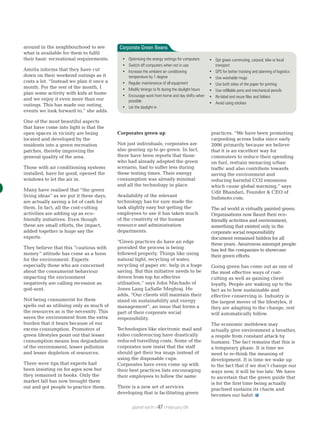
MakingClimate change is one phenomenon that has brought
man down to his knees. Food and water crisis
loom large, leaving man with no option but to fight…
launch
issue
COUNTDOWN TO
COPENHAGEN
03
04
Countdown to
Copenhagen
Can science
save the world?
The hydra-headed
challenges of food
supply, energy and
finance are all linked
and breaking a
dependence on them
is far from possible.
The answer lies in
working together and
the present financial
crunch will help us
understand its
consequences better.
The pressures of our
planet have been
created by our
lifestyles. The world
over, we spend over $
7 trillion every year on
energy and its related
infrastructure. While
the current research
and development
efforts may not
combat the climate
change challenge,
individual measures
on our part may help.
For the past few
years, climate change
has been discussed
at all the world
conferences and
across coffee tables.
But winter already
feels the heat; it
happens to be one of
the first victims of
climate change with
one season merging
into another
08
20
NEWS
Are we losing
winters?
27
28
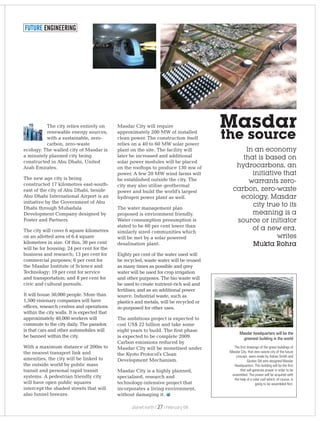
In an economy that is
based on
hydrocarbons, an
initiative that
warrants zero-carbon,
zero-waste ecology,
Masdar city true to its
meaning is a source
or initiator of a new
era, writes Mukta
Rohra
India has been
punching above its
weight in renewable
energy sector. India
started early but
other countries have
started running, if
India has to keep
pace we need to
Masdar
the source
Winds of
change
sprint. Also the
industry needs a clear
policy framework by
the government says
Dr Sivaraman in a
candid interview with
T P Venu
Every ambitious
country or business
house wishes to cash
30 Plan Well For
Better Credits
in on the benefits
offered by CDM
projects and earn
carbon credits. But be
warned that it is
environmental
compassion and not
equipment and
emissions reduction,
what will turn in
greater rewards, says
risk analyst
Swaminathan
Krishnamurthy
GREEN TECHNOLOGY
WAR
IN THE
MAKING
33
12
Run out of fuel? Consider coffee18
Longer shelf life, zero-
emissions and aromatic
exhaust fumes, are just
a fraction of the
qualities that coffee
biodiesel discovered by
Dr Manoranjan Misra and his team promise,
writes Sheetal Vyas
CONTENTS
INNOVATION
A PEOPLE
UPROOTED BY
NATURE
22 SOLAR ENERGY
THE WAY FORWARD
24
Responding to changes
reening the environment is perhaps the
most conspicuous area of concern today.
GThe governments are under pressure to
adopt ‘carbon targets’, the scientific community
is working over vehemently to find ways to adapt
to climate change and industries are embracing a
greener approach. Right from the policy makers
to newspapers, international meets to individual
discussions, environment and greening is the
buzzword. Sustainability and sustainable
development have replaced development and
growth.
While a lot has been said about saving our limited
resourcesandcappingthedamagewehavealready
donetotheenvironment,actionandcompassiontrail
miles away. Similarly to believe that our role ends
with just talking about global warming, warming
seas, breaking ice-lines and depleting water
resources,wouldbeimprudentonourpart.
Today, the reality of climate change and man’s
contribution in blistering the Earth has crossed
thelineofpossibilitytobecomeafactoflife.Now,
as we race towards an age that will mark the tail-
end of fossil fuel reserves and look up to
alternative energy utilisation, there is a critical
need to sensitise people, share knowledge and
endeavour to thin the lines between research,
conceptandreality.
With breakthrough scientific research,
sustainability drives, eco-friendly living on one
hand, and resource availability issues,
environmental concerns and programme
implementations one the other, receiving less-
than-deserved reportage, there is a pressing
need to address these issues. To give these
issues the deserved attention, Gateway Media
has introduced Planet Earth, an exclusive
magazineonEarthSciences.
The monthly periodical explores environmental
policies, Earth care issues and responsibilities like
pollution control, waste management, energy
efficiency, green living, conservation and eco-
friendly buildings and related technology
breakthroughs. Features such as Climate
Connection, explore the possibilities of a region’s
ecological balance and lifestyle being disturbed
by subtle, yet powerful climatic changes. Survival
weighs the dilemmas of environmental damage,
whichhasbeencoveredinthisissue.
Our objective is transparent, to develop a scientific
understanding of Earth’s system and its response
to natural or human-induced changes, and to
become a ready reference to the common man
seekinginformationabouttheworldaroundhim.At
the same time we believe that your suggestions
and ideas will help us improve and prioritise our
content because as compassionate residents of
theEarth,weseektomakeadifference.
Ramprasad
PublicationDirector
ramprasad@gatewaymedia.in
w w w . p l a n e t e a r t h - i n d i a . c o mvol 1 issue 1 february 2009
publications director ramprasad
associate editor sheetal vyas
online editor mukta rohra
copy editor srinivas reddy g
Design masa vijay, lakshmi d, yogesh dhabale, srinivas
web upender reddy v
head - business & events wilson rajan
wilson@gatewaymedia.in - 99499 05432
manager - marcom padmapriya c
padmapriya@gatewaymedia.in - 096191 61665
circulation sri narayana
Dr Shailesh R Nayak
Secretary, Ministry of Earth Sciences
Government of India
TO OUR READERS
Mr Kartikeya Sarabhai
Director, Centre for Environment Education
Nehru Foundation for Development
Dr Harsh Gupta
President of Geological Society of India &
Raja Ramanna Fellow, NGRI
Maj Gen (Dr) R Sivakumar
CEO, NSDI & Head NRDMS
Prof B N Goswami
Director, Indian Institute of
Tropical Meteorology
Dr Prem C Jain
Chairman, Indian Green Building Council and
CMD Spectral Services Consultants Pvt. Ltd.
Dr S R Shetye
Director, National Institute of
Oceanography
Mr Mahesh Babu
Managing Director & CEO
IL&FS Ecosmart Ltd.
Mr C S Bhaskar
Managing Director and CEO
Naturol BioEnergy Ltd.
ADVISORY BOARD
marketing & sales
mumbai: venkatram pillai manager - marketing & pr
venkat@gatewaymedia.in - 098192 34741
delhi: k n sudheer regional manager
sudheer@gatewaymedia.in - 099101 66443
kolkata: nikhil doshi region head
nikhil.doshi@gatewaymedia.in - 098369 96293
chennai: w sudhakar manager
sudhakar@gatewaymedia.in - 097899 81869
international: sowmya shenoy sr. manager
sowmya.shenoy@gatewaymedia.in - 098803 78785
Planet Earth is printed and published by L Vijayanand Reddy on behalf of Gateway Media Pvt. Ltd., Plot No.761,
Road No.39, Jubilee Hills, Hyderabad-500 033, India. Phone: +9140 2355 0991, 2355 0992 Fax : + 91 40 2355 0994
www.gatewaymedia.in. Printed at Kala Jyothi Process Pvt. Ltd. 1-1-60/5, RTC cross roads, Hyderabad - 500 020.
Please note: views expressed in the articles are those of the writer(s)
and may not be shared by the editor or members of the editorial board.
Unsolicited material will not be returned.
Copyright: no material published here should be reproduced in any
form without prior written permission from gateway media.
Feed Back: Readers are advised to send all feedback and comments to editor@gatewaymedia.in
Subscribe: Phone: +91 40 2355 0991, e-mail : subscribe@gatewaymedia.in
Write to: Gateway Media Pvt. Ltd., Plot No.761, Road No.39, Jubilee Hills, Hyderabad-500 033, INDIA
Phone: +91 40 2355 0991, 2355 0992; Fax : + 91 40 2355 0994; www.planetearth-india.com
Printed on recycle paper
COMMENTARY
Gro Harlem Brundtland, Ricardo Lagos,
Festus Mogae, And Srgjan Kerim
THE FINANCIAL CRISIS
has been uppermost in the
minds of most world
leaders. Yet, however high
the price of a global bail-
out, we know one thing: it
pales next to the enormous
costs – and profound
human consequences – of
delaying action on climate
change.
There is a sort of beauty in
this predicament: if we act
wisely, we can tackle both
crises at once. Climate
change negotiations over
the next year offer an
unprecedented
opportunity to build a
more profitable, safer, and
sustainable global
economy.
Today’s challenges –
finance, food, and energy,
for example – are many.
Yet they share a root cause,
whereby speculative and
often narrow interests have
superseded the common
interest, common
responsibilities,
and common sense.
This same short-
term thinking
characterises
the world’s
dependence
on fossil fuels.
We cannot
break that
Countdown to Copenhagen The hydra-headed
challenges of food supply, energy and finance are all linked and breaking a
dependence on them is far from possible. The answer lies in working together
and the present financial crunch will help us understand its consequences better.
planet earth | | February 0903
dependence overnight. Yet
we recognise that
continuing to pour trillions
of dollars into carbon-
based infrastructure and
fossil-fuel subsidies is like
investing in sub-prime real
estate. In essence, we are
mortgaging our children’s
future to pay for an
inherently unsustainable
and inequitable way of life.
The greatest risk we face
lies in continuing down
this path. So, how do we
begin to tackle the massive
challenge of retooling our
global economy,
preserving the planet, and
lifting billions out of
poverty?
The answer is to deal
seriously with climate
change. And this is the
time to do it – not in spite
of the financial crisis, but
because of it. As the saying
goes, a crisis is a terrible
thing to waste.
The climate
change conference
in Poznan was an
important step.
We have only
12 short
months to
hammer out
the elements of
a global
climate change
accord before world
leaders convene next
December in Copenhagen.
If we work together,
guided by a sense of
urgency and common
destiny, these negotiations
can help steer the ship of
the global economy toward
less turbulent, greener
waters and into a safe
harbor.
We believe that the best
investment in our
collective future is to scale
up the green, low-carbon
economy. It is an
investment with enormous
potential for prosperity and
profit. But it requires us to
put in place a new climate
change agreement now –
one that all countries can
accept. It must be
comprehensive and
ambitious, and it must set
clear targets for emission
reductions, adaptation,
financing, and technology
transfer.
Developed and developing
nations must find a shared
vision of how this will
work, striking a deal
whereby rich countries
lead by example in cutting
emissions while providing
the developing world with
resources and know-how
to ramp up their own
climate change efforts.
Energy investment
decisions made today will
lock in the world’s
emissions profile for years
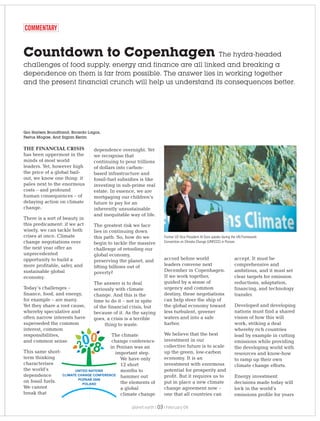
Former US Vice President Al Gore speaks during the UN Framework
Convention on Climate Change (UNFCCC) in Poznan.
UNITED NATIONS
CLIMATE CHANGE CONFERENCE
POZNAN 2008
POLAND
200
8
to come. Meanwhile, the
clock is ticking. Potentially
catastrophic consequences
await, not just for polar
bears, but for millions of
people.
Adaptation must be a vital
part of the negotiations. So
must mitigation. In the
cruel calculus of disasters,
those least responsible for
causing climate change
will suffer first and worst
from its inevitable effects.
Developing nations will
need increased financial
support to protect the
poorest and most
vulnerable.
Reaching an accord in
Copenhagen is critical. But
the route to a greener,
lower-carbon future
already is being forged in
countries from Brazil to
Bangladesh, Denmark to
Indonesia. From
investments in renewable
energy and flex-fuel
vehicles to reforestation,
countries everywhere are
realising that green is not
an option, but a necessity
for recharging their
economies and creating
millions of jobs.
For example, with the right
investments, tropical
countries could
significantly reduce
emissions from the forestry
sector while also creating
green jobs. De-forestation
currently accounts for
roughly a fifth of all
greenhouse-gas emissions.
Last month, China
announced a $ 586 billion
economic stimulus
package, some 25 per cent
of which is to help bolster
conservation,
environmental protection,
and renewable energy
efforts. We hope that the
new stimulus package
helps to move China
toward greener
development, and that
countries follow suit.
The United States has also
signaled a fundamental,
abrupt shift in its global
climate policy. In his first,
post-election public
address, Barack Obama
declared that his
presidency “will mark a
new chapter in America’s
leadership on climate
change that will
strengthen our security
and create millions of new
jobs.”
In marrying the issues of
economic revitalisation,
energy security, and
climate change, Obama
has articulated clearly the
benefits of any Green New
Deal. We welcome US re-
engagement in global
climate negotiations and
await its leadership in
transforming words into
concrete policies that
promote global green
growth.
As the US, China, and
many other nations now
realize, climate change is
much more than an
environmental issue. It is
an energy, finance, and
security issue. Indeed, it is
a Head of State issue. We
urge other world leaders to
join us in forging a shared,
long-term vision for
cooperative action that is
realized at next year’s
conference in
Copenhagen.
Global cooperation has
been key to managing the
financial crisis. It is no less
vital to managing climate
change, for which the
stakes are far higher.
Together, we must invest in
the safest, surest option –
the green economy.
Gro Harlem Brundtland is a
former Prime Minister of
Norway, Ricardo Lagos is a
former President of Chile,
Festus Mogae is a former
President of Botswana, and
Srgjan Kerim is a former
President of the UN General
Assembly. They are the UN
Secretary-General’s Special
Envoys on Climate Change.
© Project Syndicate, 2008.
www.project-syndicate.org
Can science save the world? The pressures of our
planet have been created by our lifestyles. The world over, we spend over $ 7
trillion every year on energy and its related infrastructure. While the current
research and development efforts may not combat the climate change
challenge, individual measures on our part may help.
FOR MOST PEOPLE,
there has never been a
better time to be alive than
now. The innovations that
drive economic advances –
information technology,
biotech, and nanotech –
can boost living standards
in both the developing and
the developed world. We
are becoming embedded in
a cyberspace that can link
anyone, anywhere, to all
the world’s information
and culture – and to every
other person on the planet.
Martin Rees
Twenty-first century
technologies will offer
environmentally benign
lifestyles and the resources
to ease the plight and
enhance the life chances of
the world’s two billion
poorest people. Moreover,
the greatest threat of the
1960s and 1970s – nuclear
annihilation – has
diminished. This threat
could recur, however, if
there is a renewed standoff
between new superpowers.
And there are other risks
planet earth | | February 0904
planet earth | | February 0905
needs for decades to come.
If that continues, the
concentration of CO will2
rise to twice the pre-
industrial level by 2050,
and three times that level
later in the century.
The world spends nearly
$ 7 trillion a year on
energy and its
infrastructure; yet our
current research and
development efforts are
not up to meeting the
challenge of climate
change. There is no single
solution, but some
measures, like better
insulation of buildings,
would save rather than
cost money.
Efforts to economise on
energy, storing it, and
generating it by “clean” or
low-carbon methods
deserve priority and the
sort of commitment from
governments that were
accorded to the Manhattan
Project (which created the
atomic bomb) or the Apollo
moon landing.
The top priority should be a
coordinated effort by
Europe, the United States,
and the other G-8+5
countries to build
demonstration plants to
develop carbon capture and
storage (CCS) technology.
This is crucial, because
whatever technical
advances there may be in
solar and other renewable
energy sources, we will
depend on coal and oil for
the next 40 years. Yet,
unless the rising curve of
annual emissions can be
reversed, the CO2
concentration will
irrevocably reach a truly
threatening level.
Mankind must also
confront other global
“threats without enemies”
that are separate from
(though linked with)
climate change. Loss of
biological diversity is one
of the most severe such
threats. The extinction rate
stemming from humanity’s
greater collective impact
on the planet, and from the
growing empowerment of
individuals.
Soon after World War II,
physicists at the University
of Chicago started a
journal called the Bulletin
of Atomic Scientists to
promote arms control. The
logo on the Bulletin’s cover
is a clock, the proximity of
whose hands to midnight
indicates the editors’
judgment of the
precariousness of the
world situation. Every few
years, the minute hand
shifted, either forwards or
backwards. It came closest
to midnight in 1962 during
the Cuban Missile Crisis.
When the Cold War ended,
the Bulletin’s clock was put
back to 17 minutes to
midnight. But the clock has
been creeping forward
again. We are confronted by
proliferation of nuclear
weapons (by, say, North
Korea and Iran). Al-Qaeda-
style terrorists might
willingly detonate a nuclear
weapon in a city center,
killing tens of thousands.
Even if the nuclear threat is
contained, the twenty-first
century could confront us
with grave new global
perils. Climate change
looms as this century’s
primary long-term
environmental challenge.
Human actions – burning
fossil fuels – have already
raised the carbon dioxide
concentration higher than it
has ever been in the last
500,000 years, and it is
rising by about 0.5 per cent
a year.
More disturbingly, coal,
oil, and gas are projected
to supply most of the
world’s growing energy
is 1,000 times higher than
normal, and is increasing.
Biodiversity is a crucial
component of human well-
being and economic growth.
We are clearly harmed if fish
stocks dwindle to extinction.
Less evidently, there are
plants in the rain forest
whose gene pool might be
useful to us.
The pressures on our planet
depend, of course, on our
lifestyle. The world could
not sustain its 6.5 billion
people if they all lived like
present-day Americans. But
it could if even prosperous
people adopted a
vegetarian diet, traveled
little, and interacted
virtually. New technology
will determine our lifestyle,
and the demands that we
make on energy and
environmental resources.
Nevertheless, our
problems are aggravated
by rapid growth in the
human population, which
is projected to reach eight or even
nine billion by 2050. If the increase
continues beyond 2050, one cannot
help but be gloomy about most
people’s prospects.
There are now, however, more than
60 countries where the fertility rate is
below replacement level. If this were
true of all countries, the global
population would start to decline
after 2050 – a development that
would surely be benign.
All of today’s developments – cyber,
bio, or nano – will create new risks of
abuse. The American National
Academy of Sciences has warned
that, “Just a few individuals with
specialized skills…could
inexpensively and easily produce a
panoply of lethal biological
weapons.…The deciphering of the
human genome sequence and the
complete elucidation of numerous
pathogen genomes…allow science to
be misused to create new agents of
mass destruction.”
Not even an organised network
would be required; just a fanatic with
the mindset of those who now design
computer viruses. The global village
will have its village idiots.
In our increasingly interconnected
world, there are new risks whose
consequences could be widespread –
and perhaps global. Even a tiny
probability of global catastrophe is
unacceptable. If we apply to
catastrophic risks the same prudent
analysis that leads us to buy
insurance – multiplying probability
by consequences – we would surely
prioritize measures to reduce this
kind of extreme risk. The decisions
that we will make both individually
and collectively in the foreseeable
future will determine whether
twenty-first century science yields
benign or devastating outcomes.
Lord Rees is Britain’s Astronomer Royal,
President of the Royal Society, Master of
the University of Cambridge’s Trinity
College, and Professor of Cosmology and
Astrophysics.
© Project Syndicate/Europe’s World, 2008.
www.project-syndicate.org
www.europesworld.org
ndia, as
described by
IPrime Minister
Manmohan Singh
in his National
Climate Change
Action Plan release
speech, has an
ancient legacy,
which has forever
revered nature as a
source of life and
not as a force that
needs to be overpowered in order
to meet our ends. A climate
change action plan forwarded by
such a country should look at
possibilities that will help
mobilise the nation’s energy in
facing the challenge. For a
careful strategy devised, will go a
long way in ensuring that we
sustain the development we have
made and not allow climatic
changes to reverse it.
The challenge according to him,
lies in encompassing the interests
of both present and future
generations and nurture a world,
“which should continue to inspire
the human imagination with the
immensity of the blue ocean, the
loftiness of snow-covered
mountains, the green expanse of
extensive forests and the silver
streams of ancient rivers.”
Elaborating on the primary
causes that have contributed to
the accumulation of greenhouse
gas emissions, he suggests that
we refer to our basic traditions, in
order to set people in the country
on the path of ecologically
sustainable development. While
a lot of discussion has been
initiated in terms of
compromises we
may have to make
on our growth in
the process of
achieving
ecologically
sustainable
development, the
Prime Minister
believes that the
achievement of
economic growth
need not be affected by
ecological policies.
A broader perspective on
development is what is required,
he says. And this should be
inclusive of the quality of life. The
plan will have the national
energies being focussed on eight
national missions – Solar Energy,
Enhanced Energy Efficiency,
Sustainable Habitat, Conserving
Water, Sustaining the Himalayan
Ecosystem, Creating a “Green
India”, Sustainable Agriculture
and Strategic Knowledge Platform
for Climate Change – that are to be
pursued as key components of the
sustainable development strategy.
A gradual shift from economic
activity based on fossil fuels to
one based on non-fossil fuels and
from reliance on non-renewable
and depleting sources of energy
to renewable sources of energy,
is what India requires. Not
sidelining the role India will
play in a collaborative effort to
bring about a change, he
believes that the wisdom,
creativity and enterprising nature
of the Indian population will help
in achieving this.
India’s stand on
climate change
planet earth | | February 0906
NEWS YOU CAN USE
cent post-consumerotorola, seeking
M recycled paper into capitalise on
addition, a postage-the trend towards
paid recyclingmore environmentally
envelope in boxfriendly products, has
makes it easy tounveiled the first
return previous mobilemobile phone made
phone for recycling atfrom recycled water
no cost.bottles, The MOTO
W233 Renew.
The phone was
previewed at the
annual Consumer
Electronics Show (CES)
opening in Las Vegas.
"Not only is the plastic
Through an alliancehousing of Renew
with Carbonfund.org,made from plastics
Motorola said, “itcomprised of recycled
offsets the carbonwater bottles and 100
dioxide required topercent recyclable,
manufacture,but it is also the
distribute and operateworld's first carbon
the phone throughneutral phone,"
investments inMotorola said. Care
renewable energyhas been taken that
sources andtotal packaging is
reforestation.”printed on 100 per
Mobile phone from
recycled water bottles
obiMonster, a company based in New Delhi when phone is fully charged or when Bluetooth and
Mhas developed a first of its kind eco-friendly WLAN are switched on but not being used.
software for Series 60 Mobile Devices that
The company is in the process of evaluatingenables to reduce your carbon footprint while
carbon footprint related numbers of severalincreasing your charger and battery life by
devices. It informs that if used at its optimummanaging several features of a series 60 device
level, the software could save up to US$ 10 persuch as Backlight, Charger, WLAN and Bluetooth.
year in electricity charges, and a reduction in
The software alerts the user to remove the charger carbon emissions
A mobile application that reduces your carbon footprint
gribusiness giant Monsanto announced the
Aworld's first drought-tolerant corn, a
development it says will "reset the bar" in
farming productivity.
"Drought-tolerant corn is designed
to provide farmers yield stability
during periods when water
supply is scarce by mitigating
the effects of drought or water
stress within a corn plant," Monsanto said.
Trials of the corn conducted last year in drought-
prone areas of the American Midwest "met or
exceeded the 6 per cent to 10 per cent target
yield enhancement," according to the company.
It advanced the yield by up to 10 corn bushels
per acre (six quintals per hectare) beyond the
average maximum of 130 bushels per acre (82
quintals per hectare).
The corn is the first in a series of crops planned
by Monsanto to address the affects of high food
prices and climate on agriculture-based cultures
around the world by reducing the need for water.
World's first 'drought-tolerant'
corn ready by 2010: Monsanto
Monitoring greenhouse
gases from space
cientists at the University of California, Berkeley describe a
Smethod for using microalgae for making biofuel by genetically
modifying the algae. This will minimise the number of chlorophyll
molecules needed to harvest light without compromising the
photosynthesis process in the cells and instead of making more sugar
molecules, the microalgae could be producing hydrogen or
hydrocarbons.
The scientists want to divert the normal function of photosynthesis from generating biomass to
making products such as lipids, hydrocarbons, and hydrogen. Tasios Melis, one of the paper's co-
authors uses the phrase “cellular optics” to describe this general effort to maximise the efficiency of
the solar-to-product conversion process.
Besides getting the algae to convert more sunlight to fuel, another issue that needs to be addressed
is how to configure bio-culture tanks in a way that sunlight can penetrate the outer layer of algae so
that lower-down layers can participate in the photo-conversion too.
Engineered algae to make fuel instead of sugar
surface, the Japan Equipped with two sensors,
Aerospace GOSAT will track infrared
Exploration Agency rays from the Earth, which
japanese (JAXA) said. will help calculate the
Aspace agency densities of the two
"To fight climate change, wewill launch a satellite to greenhouse gases, because
need to monitor the density ofmonitor greenhouse gases they absorb the rays at
greenhouse gases in allaround the world, hoping the certain wavelengths. The
regions around the world anddata it collects helps global satellite is set to be in orbit
how their levels change but atefforts to combat climate for five years, will collect
the moment, there are verychange. The Greenhouse data once a month, with
few observation sites on landGases Observing Satellite preliminary data from the
and they are concentrated in(GOSAT) is expected to satellite
certain areas,” said Takashienable scientists to calculate expected to be
Hamazaki, manager of the 35the density of carbon dioxide ready for
billion yen ($372.9 million)and methane from 56,000 researchers in
JAXA project.locations on the Earth's April or May.
planet earth | | February 0907
Naturalindigodyeingbecomeseco-friendly
esearch Scientist Anne Vuorema of MTT Agrifood
RResearch Finland proves in her doctoral
dissertation that glucose can serve as a reducing
agent of indigo there by making the process less
energyconsumingandsafe.
Plant derived indigo needs to be reduced to a water-
soluble leuco-form before dyeing, a process highly
time consuming and unsafe, making natural indigo
unpopular. Blue synthetic textile dye is produced from
oil, in a process which wastes non-renewable natural
resources and burdens the environment with
syntheticchemicals.
Anne Vuorema’s research can transform the process
ofextractionofindigofromtheleavesofdyer’swoad(IsatistinctoriaL.).Thenewprocesswillmake
the dyeing process more eco-friendly and enhance the energy efficiency of the process. As per the
scientist,thisnewglucosedyeingseemstosuitplant-derivedfibres,suchascottonandflax.
14 per cent drop in coral growth
he biggest and most robust corals on the
TGreat Barrier Reef (GBR) have slowed their
growth by more than 14 per cent since the
"tipping point" year of 1990, say scientists Glenn
De’ath, Janice Lough and Katharina Fabricius of
Australian Institute of Marine Science, in a
science paper titled “Declining coral calcification
ontheGreatBarrierReef.”
The researchers analysed the growth rates of
328 coral colonies on 69 individual reefs that
make up the 1,250 mile-long Great Barrier Reef, off north-east Australia. They found that the rate at
which the corals were laying down calcium in their skeletons dropped by 14.2 per cent between
1990and2005,asuddendeclineinatleast400years.
They say that the evidence is strong that the decline has been caused by a synergistic combination
of rising sea surface temperatures and ocean acidification. This happens when large amounts of
atmospheric carbon dioxide enter seawater; the resulting chemical changes effectively reduce the
abilityofmarineorganismstoformskeletons.
Reefcoralscreatetheirhardskeletonsfrommaterialsdissolvedinseawater.Scientistsbelievethat
just like corals are impacted, all calcifying organisms that are central to the function of marine
ecosystems and food webs will be affected. Corals form the backbone of reef ecosystems. Their
complexity provides the habitat for the tens of thousands of plant and animal species associated
with the reef. Looking at the sudden change, steep changes in the biodiversity and productivity of
theworld’soceansmaybeimminent.
n an effort to make IIT Mumbai campus
Ienergy-efficient, an energy audit of the
institute was recently conducted to identify
and suggest measures for conservation. The
audit was conducted by MTech students
from the Department of Energy Science and
Engineering (DESE), as a part of their course,
under the guidance of Professor Rangan
Banerjee. “We have compiled a list of
possible actions to conserve and efficiently
utiliseourresources.Thenextstepwouldbe
to prioritise their implementation,” Banerjee
said. The said recommendations if
implemented would bring about a total
saving of around Rs1.75 crore per year, the
report said. “The audit was aimed at giving
the students a feel of the practical problems
and difficulties in carrying out such
exercises. It has a big impact if students are
able to apply what they learn in practical life.
Also, the idea is to make the campus an
opendemonstrationfacility,”saidBanerjee.
An important recommendation is the use of
biogasplantforfoodwasteprocessing.“The
study showed that around 450 kg food (for
900people)wasgettingwastedperday.So,
we've suggested the use of biogas plant for
collecting all the wasted food and
converting it into fuel supply. This, in turn,
will reduce LPG usage,” said Mel George, an
MTech student, who was involved in the
study. Besides replacement of lighting and
regulators, the report suggests use of
computersindifferentsettingsormodes.
IIT Mumbai campus
planning to be
energy-efficient
NEWS
planet earth | | February 0908
Ancient global cooling affected plankton numbers
ccording to a new study, diatoms, the oceanic plankton that absorb carbon dioxide from the
Aair, may have witnessed a sudden increase in species numbers before they abruptly declined
almost 33 million years ago. The Cornell study, which was published in the January 8, 2009 issue of
thejournalNature,suggeststhatthesetrendscoincidedwithsevereglobalcooling.
The research findings question the earlier theory that diatoms’ success was related to an increase
in the nutrients received by the oceans from the neighbouring grasslands about 18 million years
ago. The study headed by graduate student Dan Rabosky of the Department of Ecology and
Evolutionary Biology at Cornell and the Cornell Laboratory of Ornithology, provides new evidence
that takes into account a widespread paleontological problem which suggests that younger fossils
areeasiertofindthanolderones.
“We just tried to address the simple fact that the number of available fossils is colossally greater
from recent time periods than from earlier time periods. It's a pretty standard correction in some
fields, but it hasn't been applied to planktonic paleontology up till now,” Science Daily quoted
Raboskyassaying.
e-wastemanagementinitiativebyNokia
okia India has launched a campaign where customers can drop
Ntheir old handset in the company's stores and win gifts. It is a
step towards promoting recycling of electronic waste and greening
the environment. The project will be rolled out in phases across the
country, it added. The Finnish handset major, in turn, will plant a tree
for every handset dropped into these bins. According to a survey
conducted by the company in 13 countries, only 3 per cent said they
had recycled their old phone. Also, 50 per cent of those surveyed
didn't know phones could be recycled, with awareness being the
lowestinIndiaat17percent.
“As responsible leaders, we want to drive best practices in our industry,” Nokia India VP and
managingdirectorDShivakumarsaid.
Biochar for soil replenishment and to combat global
warming
ormer inhabitants of the Amazon Basin enriched their fields with charred organic materials and
Ftransformed one of the Earth's most infertile soils into one of the most productive. Now,
scientists, environmental groups and policy makers forging the next world climate agreement see
biocharasanimportantwayforcombatingglobalwarmingaswell.
Christoph Steiner, soil scientist at University of Georgia says that almost any kind of organic material –
peanut shells, pine chips and even poultry litter – can be burned in air-tight conditions, a process called
pyrolysis. The byproducts are biochar, a highly porous charcoal that helps soil retain nutrients and water,
and gases and heat that can be used as energy. He now investigates the global potential of biochar to
sequestercarbon.HealsoservesasaconsultanttotheUNCCD,asisterprogrammetotheclimatechange
convention.
lack carbon, the component of soot that
Bgives it its colour, is thought to be the
second largest cause of global warming
after carbon dioxide. It is formed through
incomplete combustion of fossil fuels, wood
and vegetation. Nasa claims that, cutting
down on the pollutant, can have an
immediate cooling effect – and prevent
hundreds of thousands of deaths from air
pollutionatthesametime.
Soot contains up to 40 different cancer-
causing chemicals which also cause
respiratory and heart diseases. It is
estimated to cause two million deaths in the
developingcountrieseachyear.
The soot is spread around the globe by wind,
and heats the atmosphere by absorbing and
releasing solar radiation. When it settles
down, it darkens snow and ice, at the poles
or high in mountains, reducing its ability to
reflect sunlight resulting in faster melts and
even more absorption of sunlight by the bare
snowfreeland.
Soot falls immediately unlike carbon dioxide
that remains in air for hundereds of years.
This is hazardous to health and is heating the
Earth. Scientists believe that cutting down
on soot emissions is the fastest way to
reduce air pollution related deaths and
reducetheglobalwarmingdramatically.
They further suggest that proper vehicular
and industrial pollution control measures
and use of solar cooker and biogas for
cookingcanreducethesootemissions.
Soot reduction could
help to stop global warming
planet earth | | February 0909
Rating the desirability of 11 possible future energy
sources
study published in the journal Energy and
AEnvironmental Science that claims to be the
first comparative evaluation of alternate energy
solutions to global warming, air pollution, and
energy security compared nine electric power
sources and two liquid fuels for the purpose. It
considered their effects on water supply, land
use, wildlife and resource availability and indirect
effects on energy security, nuclear proliferation,
mortalityandunder-nutrition.
Wind power, as a source of electricity for battery
vehicles, performed best. In the second group
were battery vehicles using electricity from solar
power and from geothermal, tidal and wave
sources.
While the third level included battery vehicles
driven by hydropower, nuclear, and coal from
plants using carbon capture and storage, ethanol
use was found to cause the most climate damage, air pollution, damage to land and wildlife, and
chemicalwasteasperthisnewstudy.
Climate change
threatens Pacific,
Arctic conflicts
nvironmental stress has increased the
Erisk of conflicts in the Pacific over
resources and food. As per revelations of a
summaryofthe report"ClimateChange,The
Environment, Resources and Conflict", as
theArcticmelts,drillingunderseaoilandgas
deposits, becomes a commercially viable
process. Rising sea levels would affect
nations and islands with low-lying
coastlines, and may lead to increase in
refugeesfromvulnerablePacificislands.
“Environmental stress, caused by both climate change and a range of other factors, will act as a
threat multiplier in fragile states around the world, increasing the chances of state failure," states
thesummary.Risingsealevels,increaseinrefugees,moreillegalimmigrationandfishingarefewof
theconflictareasmentionedinthereport.
NEWS
Polarised light pollution
causes animals to miss
natural light cues
collaboration of ecologists, biologists
Aand biophysicists in the journal
Frontiers in Ecology and the Environment,
has shown that cues from polarised light
can trigger animal behaviours leading to
injury and often death.
Human-made light sources can alter natural
light cycles, causing animals that rely on
light cues to make mistakes when moving
through their environment. The research
shows that environmental cues, such as the
intensity of light, that animals use to make
decisions, occur at different levels of
severity in the natural world. When cues
become unnaturally intense, animals can
respondunnaturallystronglytothem.
Artificial light that occurs at unnatural times
or places – often called light pollution – can
attract or repulse animals, resulting in
increased predation, migrating in the wrong
direction, choosing bad nest sites or mates,
collisions with artificial structures and
reduced time available to spend looking for
food,justtonameafew.
NEWS
planet earth | | February 0910
Japan to start exploring rare elements on seabed
apan is believed to have plentiful resources under the sea not previously exploited due to the
Jprohibitivecosts.Alongwithraremetals,Japanisestimatedtohave5,000years'worthofgold,silver
andcobaltinitsseabedalongwith100years'worthofmethanehydrate,atcurrentratesofusage.
There is an increasing demand for mineral
resources around the world, which has pushed
prices higher. Japan plans to start exploring its
seabed to harvest rare earth elements used in
electronics, hoping to reduce its heavy reliance on
Chinese imports and would also try to develop its
capacity to extract badly needed energy resources
such as oil, gas and methane hydrate in the project,
which eyes test exploration by the 2018 fiscal year.
It is not yet known whether Japan's plan would
involve parts of the East China Sea where Japan
andChinadisputeunderseagasfields.
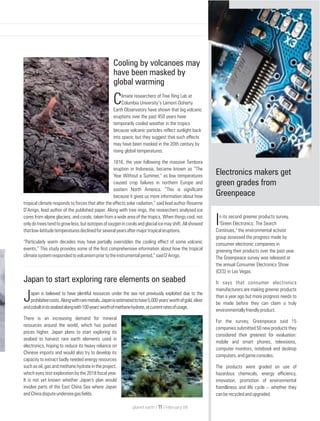
Cooling by volcanoes may
have been masked by
global warming
limate researchers of Tree Ring Lab at
CColumbia University’s Lamont-Doherty
Earth Observatory have shown that big volcanic
eruptions over the past 450 years have
temporarily cooled weather in the tropics
because volcanic particles reflect sunlight back
into space; but they suggest that such effects
may have been masked in the 20th century by
rising global temperatures.
1816, the year following the massive Tambora
eruption in Indonesia, became known as “The
Year Without a Summer,” as low temperatures
caused crop failures in northern Europe and
eastern North America. “This is significant
because it gives us more information about how
tropical climate responds to forces that alter the effects solar radiation,” said lead author Rosanne
D’Arrigo, lead author of the published paper. Along with tree rings, the researchers analysed ice
cores from alpine glaciers, and corals, taken from a wide area of the tropics. When things cool, not
onlydotreestendtogrowless,butisotopesofoxygenincoralsandglacialicemayshift.Allshowed
thatlow-latitudetemperaturesdeclinedforseveralyearsaftermajortropicaleruptions.
“Particularly warm decades may have partially overridden the cooling effect of some volcanic
events,” This study provides some of the first comprehensive information about how the tropical
climatesystemrespondedtovolcanismpriortotheinstrumentalperiod,”saidD’Arrigo.
Electronics makers get
green grades from
Greenpeace
n its second greener products survey,
I"Green Electronics: The Search
Continues," the environmental activist
group assessed the progress made by
consumer electronic companies in
greening their products over the past year.
The Greenpeace survey was released at
the annual Consumer Electronics Show
(CES) in Las Vegas.
It says that consumer electronics
manufacturers are making greener products
than a year ago but more progress needs to
be made before they can claim a truly
environmentallyfriendlyproduct.
For the survey, Greenpeace said 15
companies submitted 50 new products they
considered their greenest for evaluation:
mobile and smart phones, televisions,
computer monitors, notebook and desktop
computers,andgameconsoles.
The products were graded on use of
hazardous chemicals, energy efficiency,
innovation, promotion of environmental
friendliness and life cycle – whether they
canberecycledandupgraded.
planet earth | | February 0911
COVER STORY
A crisis ends in victory for one party and defeat for
the other. But the human conflict induced by climate
change, with food shortage pulling at one hand and
water shortage plucking the other, is likely to leave
us all defeated unless we become more
compassionate towards nature, writes Sheetal Vyas
IN THE MAKING
WAR
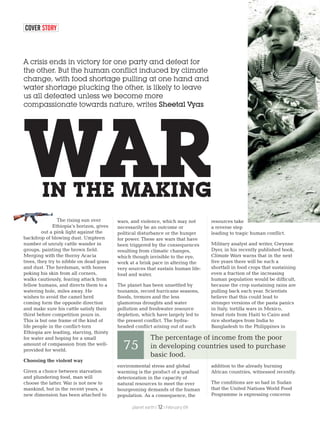
The rising sun over
Ethiopia’s horizon, gives
out a pink light against the
backdrop of blowing dust. Umpteen
number of unruly cattle wander in
groups, painting the brown field.
Merging with the thorny Acacia
trees, they try to nibble on dead grass
and dust. The herdsman, with bones
poking his skin from all corners,
walks cautiously, fearing attack from
fellow humans, and directs them to a
watering hole, miles away. He
wishes to avoid the camel herd
coming form the opposite direction
and make sure his cattle satisfy their
thirst before competition pours in.
This is but one frame of the kind of
life people in the conflict-torn
Ethiopia are leading, starving, thirsty
for water and hoping for a small
amount of compassion from the well-
provided for world.
Choosing the violent way
Given a choice between starvation
and plundering food, man will
choose the latter. War is not new to
mankind, but in the recent years, a
new dimension has been attached to
wars, and violence, which may not
necessarily be an outcome or
political disturbance or the hunger
for power. These are wars that have
been triggered by the consequences
resulting from climatic changes,
which though invisible to the eye,
work at a brisk pace in altering the
very sources that sustain human life:
food and water.
The planet has been unsettled by
tsunamis, record hurricane seasons,
floods, tremors and the less
glamorous droughts and water
pollution and freshwater resource
depletion, which have largely led to
the present conflict. The hydra-
headed conflict arising out of such
environmental stress and global
warming is the product of a gradual
deterioration in the capacity of
natural resources to meet the ever
bourgeoning demands of the human
population. As a consequence, the
resources take
a reverse step
leading to tragic human conflict.
Military analyst and writer, Gwynne
Dyer, in his recently published book,
Climate Wars warns that in the next
five years there will be such a
shortfall in food crops that sustaining
even a fraction of the increasing
human population would be difficult,
because the crop sustaining rains are
pulling back each year. Scientists
believe that this could lead to
stronger versions of the pasta panics
in Italy, tortilla wars in Mexico,
bread riots from Haiti to Cairo and
rice shortages from India to
Bangladesh to the Philippines in
addition to the already burning
African countries, witnessed recently.
The conditions are so bad in Sudan
that the United Nations World Food
Programme is expressing concerns
The percentage of income from the poor
in developing countries used to purchase
basic food.
75
planet earth | | February 0912
conflicts with the result that more
than four billion people have been
displaced in Colombia alone.
Similar is the situation in Haiti,
Gaza, Ivory Coast, Cameroon,
Mauritania, Sri Lanka, Mozambique,
Senegal, Uzbekistan, Bolivia,
Indonesia, Middle East, Pakistan and
Bangladesh, where riots have
become the order of the day. While in
places like Sudan, Chad and Central
Africa, war and conflicts between
people have become a way of life.
Close to 25,000 farmers in India took
their own lives, burdened by farming
debts and severe grain shortage.
Australia, which has been a very self-
sufficient nation, witnessed its
biggest drought period in 150 years
and China reported a grain harvest
drop of over 10 per cent.
In the case of Darfur, a semi-arid
land with moist areas dotting it, the
nomadic lives of the communities
staying here has received the worst
stroke. In the recent years their total
rainfall has dived low and is
becoming more unpredictable with
each passing year. The chaos
resulting out of this has caused them
to seek the moist lands and the
competition was such that they
fought amongst themselves to grab a
piece of cultivable land. In the last 10
years, the country has witnessed the
loss of more than 300,000 human
about the possibility of the present
food crisis taking a new turn in
combination with the poor cereal
turn out and the increase in prices of
basic food, sorghum in particular. “It
is sometimes difficult to imagine how
so much misery exists in the world.
As some of the waste disposal units
work in Sudan, people often attack
the officers who oversee the
operations and burrow through piles
of rubbish in the hope that they will
find a half-eaten fruit, scrapings from
a food can or in times of desperation
a box of shoe polish,” says a member
of the peacekeeping force in Sudan,
who wished to remain anonymous.
The sad part is that global recession
has also caused the funding agencies
to cut down their funds.
Colombia, a country always known to
produce an excess of food till
recently, is constantly fearing food
scarcity and riot outbreak. The
decrease in crop production
combined with the steep incline in
food prices, which were a result of
economic policies that turned food
trade into a profitable business, has
hit poor farmers the most. In order to
balance their food requirements and
be able to pay for food grains, they
have switched to biofuel farming.
This has given rise to internal
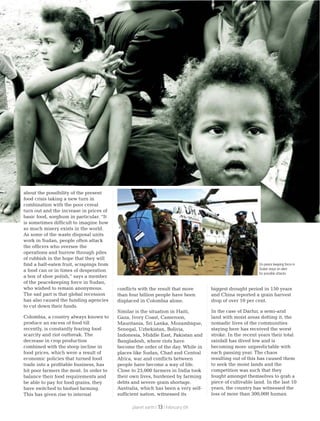
Un peace keeping force in
Sudan stays on alert
for possible attacks
planet earth | | February 0913
lives. There are other countries
where tourists are often advised not
to venture out at night because they
are likely to be attacked by severely
starved people who will do anything
for food.
The plight of civilians in the Gaza
strip is such that they have food
reserves to sustain them only for a
month. Unless a ceasefire is
announced, trucks carrying food
loads will not enter the region for
fear of security.
Climate against crop
Global warming induced climate
change cannot be ignored as a fact.
While depleting forest cover, warming
oceans, erratic rain and unpredictable
storms and droughts are all linked to
climate change, food and water crisis,
it is the behaviour of the crops that
has surprised researchers. Climate
alone cannot be blamed for the food
crunch we are facing. It works hand-
in-glove with conditions created by
man to bring about changes of such a
serious nature.
With every small increase in global
temperature, the likelihood of
climate change and crop production
variation increases. This could be
attributed to various conditions such
as flooding, lack of rain, hurricanes
like Katrina and the more recent
Gustav, and cyclonic storms like
Nargis, which left vast stretches of
agricultural land submerged under
water. “While it is believed that
hurricanes and storms do not travel
far after landfall, but the Orissa
cyclone in 1999 and Katrina proved
that wrong. They crossed kilometres
of land before weakening,” points
out Dr A N V Satyanarayana,
assitant professor, Centre for Ocean,
Rivers, Atmosphere and Land
Sciences, IIT Kharagpur.
Global warming has changed the
nature of the climate, making it more
unruly and unpredictable. Why else
would Rajasthan, a desert be flooded
all of sudden. How farmers wish they
had a steady flow of water and didn’t
had to depend on seasonal rains to
irrigate their agricultural lands.
However, the truth being otherwise,
increasing instances of either too
severe or too scanty rainfall, have left
agriculturalists high and dry. This is
made worse by storms, typhoons,
hurricanes and cyclones, which
increase the salinity of soil,
rendering it uncultivable. Water
shortage also plays on the
cultivator’s mind when he plans a
crop. Certain crops like rice, require
the land to be flooded with water in
order to produce a healthy crop. But,
with water shortage looming large
over continents, it is not possible to
flood the fields. This has caused rice
production to drop.
Scientists have often insisted that
natural surroundings and their
carbon sequestering qualities
contribute towards enhancing the
produce of a region. A good forest
cover ensures sufficient moisture,
thus inviting healthy rains. But our
greed for wood and land has
destroyed massive forest cover in
major forest-rich areas, especially the
Amazon and the rainforests of Africa.
These areas act as carbon sinks and
maintain the temperature and
moisture levels of the planet. It is
believed that an acre of forest cover
will absorb over 75 tonne of carbon
dioxide over a 20-year period.
According to Dr V Vinod Goud,
project coordinator for World Wide
Fund for Nature International & The
International Crop Research Institute
for the Semi-Arid Tropics
(WWF&ICRISAT) projects, earlier,
there used to be alternating periods
of draughts and rain. “It would rain
adequately for four-five years and as
a breather, there would be draught
for two years. People made money
during the rain-fed years and be
prepared for the succeeding
droughts. However, these days,
droughts extend for years, giving
little change to the cultivators to
think of alternatives,” he says.
Natural changes aside, the biggest
contribution to food crisis and the
conflicts arising out of it comes from
man, who constantly looks for
change and comfort. Despite wars
and natural calamities, human
population continues to grow, adding
more number of mouths to be fed
than can possibly be supported the
total cultivable land available in the
world.
In the recent years, a shift has been
noticed in the food habits of people
across the world. The commercial
value of crops, time taken to prepare
and the yield, play an important role
in helping the farmers decide what
they wish to grow. Since rice is easy
to grow and gives better yield
compared to millets and pulses, most
farmers in some parts of Andhra
Pradesh have stopped cultivating
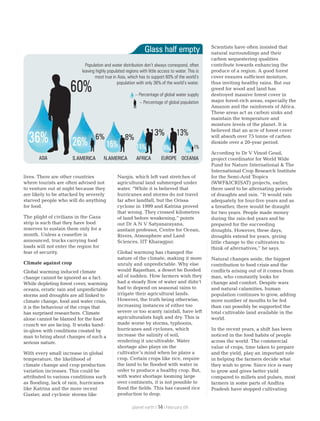
ASIA S.AMERICA N.AMERICA AFRICA EUROPE OCEANIA
15%
8%
11%
13%
8%
13%
5% 1%
36% 26%
6%
60%
Glass half empty
Population and water distribution don’t always correspond, often
leaving highly populated regions with little access to water. This is
most true in Asia, which has to support 60% of the world’s
population with only 36% of the world’s water.
– Percentage of global water supply
– Percentage of global population
planet earth | | February 0914
millets, which are akin to the dry
areas and are rich in nutrients. As a
result, millets which are sold cheaper
in the market, have taken a back seat
in cultivation. “Cotton is another
crop which is hijacking the
agricultural land meant to grow food
crops. It also leaves the soil unfit to
cultivate other crops,” says Dr Goud.
The rich dividends that crops such as
jatropha, palm, maize and sorghum
promise in terms of monetary returns
are very high compared to food
crops. Under such circumstances, it
is but natural for farmers to switch to
biofuel crops, thus creating a
foodgrain shortage. Moreover, the
introduction of genetically modified
varieties of crops, such as GM
foodgrains has been a serious
concern for farmers. The step
received a lot of flak from farmers all
over the world, for its invasive
nature. In fact, agitations have been
carried out to ban the brand in
countries like Zambia and India.
Farmers complain that GM varieties
often cross-pollinate with the native
grain variety, thus increasing their
presence, which may spell doom for
the native varieties.
They say food and housing go
together and one cannot co-exist
without the other, so also are the
corresponding problems.
Construction activity, though often
portrayed green, still continues to
plant concrete jungles, reducing land
space. The construction material
used by companies can be varied in
nature and may have different
radiation absorption capacities. Even
this causes hot and cold zones to be
created, which affect the temperature
of a place and its surrounding areas.
City skylines, often dotted with
buildings, create micro and macro
temperature zones. During the day
earth heats up and the energy is
taken and transported to the soil. The
soil then releases radiation at night.
This creates mini temperature zones
in and around the cities. Depending
on the humidity levels, it could cause
unseasonal rainfall or bring scanty
rain to the surrounding agricultural
fields. This disrupts the natural crop
cycle, affecting yield.
Crisis rooted in water
While there may be several reasons
cited for the present food crisis, the
crux of the problem is the fast
depleting water resources and the
impending great world water crisis.
Water is being described as the new
oil and may be the primary cause for
the outbreak of the Third World War.
This is so because we may live
without food, but not without water.
Pictures of women balancing huge
barrels of water on their heads, have
been flashed all over the world
earlier, but it was for the sheer grace
and ability to balance the pitchers
that they were used. However, today,
this may be the case in many parts of
the world. While the pictured women
had the luxury of balancing more
than one pitcher, people in countries
with water scarcity have to make do
with a mugful of water.
Man’s role in aggravating the
changes that climate is undergoing
has caused several countries to
intimidate other water-rich nations
with threats of war. While water wars
have been common place in India,
with states fighting with each other
to harness river sources, such wars
are a relatively new concept for
water-rich nations like Latin
America, Spain, Bolivia, Ireland,
Kenya, Pakistan, New Zealand,
Northern China, Portugal and the US
where 36 states are looming under
severe water shortage.
The impact of climate on water
resources has been treacherous. While
hurricanes, storms and heavy rains
bring in a good supply of water, it
cannot be used by man because there
is no proper system in place to reclaim
it. Increasing global warming levels
have invited severe droughts, causing
rivers and lakes to dry up. Even the
glaciers and aquifers that fed the
rivers are depleting at a very fast rate.
Such is the situation in the US that it
is warring with Canada to get access
to the great lakes that supply fresh
water to the country. Latin America,
an extremely water-rich nation seems
to have been surrounded with dry
rivers and bare lake beds. A 40 per
cent fall in rainfall in Spain has put its
water resources in peril. The
Government sought to divert water
from the river Segre, a tributary of the
gigantic Ebro, to Barcelona, which is
facing severe crisis, but was met with
severe opposition and conflict from
the Government of the Aragon
through which the Ebro flows. The
Irish economy too is suffering due to
water conflicts arising out of the
climate change induced water
shortage. The region has received
inadequate rainfall and may have
reduced winter water flows. Climate
change is believed to have reduced
the moisture content of the soil in the
region, which could affect agriculture
and accelerate the erosion of
peatlands. China’s shortage is unique
in that it has more than adequate
reserve in the south but very little
water in the north, which in turn has
doomed rice production. The biggest
threat that the water problem could
pose is countries declaring war with
one another and uncontrolled human
conflicts.
Research carried by various institutes
and data collected by Nasa shows
that glaciers all over the world are
receding. This has caused the melt
water flow into the rivers to fall
during the summer months. Since
most nations depend on rivers to
supply them with fresh water, this is
one of the primary causes for water
conflicts. Almost the entire
Chacaltaya glacier, which was a
source for several rivers in Bolivia
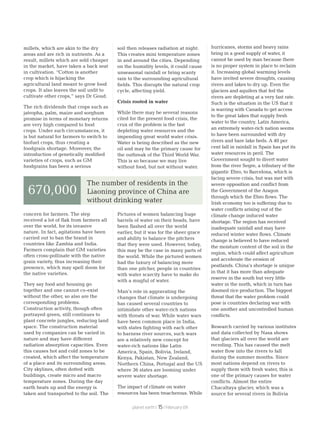
The number of residents in the
Liaoning province of China are
without drinking water
670,000
planet earth | | February 0915
planetearth||February0916
ZIMBABWE
ZAMBIA
YEMEN
VIETNAM
VANUATU
UZBEKISTAN
U. K.
U.A.E.
UKRAINE
UGANDA
TURKMENISTANTURKEY
TONGA
KIRIBATI
TOGO
THAILAND
TANZANIA
TAJIKISTAN
SYRIA
SWITZ.
SWEDEN
SWAZ.
SUDAN
SRI LANKA
MALDIVES
SPAIN
SOUTH AFRICA
SOMALIA
SOLOMON ISLANDS
SLOVENIA
SLOVAKIA
SINGAPORE
SERBIA
MONT.
SAUDI ARABIA
SAO TOME & PRINCIPE
RWANDA
RUSSIA
ROMANIA
QATAR
POLAND
PHILIPPINES
PAPUA NEW
GUINEA
PALAU
PAKISTAN
OMAN
NORWAY
NIGERIA
NIGER
NEW ZEALAND
NETH.
NEPAL
NAMIBIA
MOZAMBIQUE
MOROCCO
MONGOLIA
MOLD.
MAURITIUS
MALTA
MALI
MALAYSIA
MALAYSIA
MALAWI
MADAGASCAR
MAC.
LUX.
LITHUANIA
LIBYA
LES.
LEBANON
LATVIA
LAOS
KYRGYZSTAN
KUWAIT
SOUTH
KOREA
NORTH
KOREA
TAIWAN
KENYA
KAZAKHSTAN
JORDAN
JAPAN
ITALY
ISRAEL
IRELAND
IRAQ
IRAN
INDONESIA
INDIA
INDIA
HUNGARY
GREECE
GHANA
GERMANY
GEORGIA
GABON
FRANCE
FINLAND
FIJI
ETHIOPIA
ESTONIA
ERITREA
EQUATORIAL GUINEA
EGYPT
TIMOR-LESTE
DJIBOUTI
DENMARK
CZECH REP.
CYPRUS
CROATIA
COTE
D'IVOIRE
CONGO
DEM REPUBLIC
OF CONGO
COMOROS
CHINA
CHAD
CENTRAL AFRICAN REP.
CAMEROON
CAMBODIA
BURUNDI
BURMA
BURKINA FASO
BULGARIA
BRUNEI
BOTSWANA
B-H
BHUTAN
BENIN
BEL.
BELARUS
BANGLADESH
BAHRAIN
AZERB.
AUSTRIA
AUSTRALIA
ARM.
ANGOLA
ALGERIA
ALBANIA
AFGHANISTAN
SAMOA
U. K.
UKRAINE
TUNISIA
SWITZ.
SWEDEN
SPAIN
SLOVENIA
SLOVAKIA
SERBIA
MONT.
ROMANIA
POLAND
NORWAY
NETH.
MOROCCO
MOLD.
MALTA
MAC.
LUX.
LITHUANIA
LEBAN
LATVIA
ITALY
ISRA
IRELAND
HUNGARY
GREECE
GERMANY
FRANCE
FINLAND
ESTONIA
DENMARK
CZECH REP.
CYPRUS
CROATIA
BULGARIA
B-H
BEL.
BELARUS
AUSTRIA
ALGERIA
ALBANIA
PORTUGAL
VENEZUELA
URUGUAY
FALKLAND ISLANDS
UNITED STATES
SURINAME
SIERRA LEONE
SENEGAL
PERU
PARAGUAY
PANAMA
NICARAGUA
WESTERN
SAHARA
MEXICO
MAURITANIA
LIBERIA
ICELAND
HONDURAS
GUYANA
GUINEA
GUINEA-BISSAU
GUATEMALA
GREENLAND
THE GAMBIA
FRENCH GUIANA
EL SALVADOR
ECUADOR
COSTA RICA
COLOMBIA
CHILE
CAPE VERDE
CANADA
BRAZIL
BOLIVIA
BELIZE
ARGENTINA
TRINIDAD & TOBAGO
JAMAICA HAITI
DOM.
REP.
CUBA
BAHAMAS
BERMUDA
ST VINCENT & THE GRENADINES
ST LUCIA
ST KITTS & NEVIS
PUERTO
RICO
GRENADA
DOMINICA
BARBADOS
ANTIGUA & BARBUDA
TUNISIA
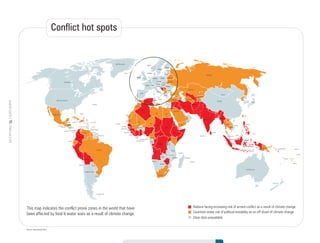
Conflict hot spots
Nations facing increasing risk of armed conflict as a result of climate change
Countries under risk of political instability as an off-shoot of climate change
Clear data unavailable
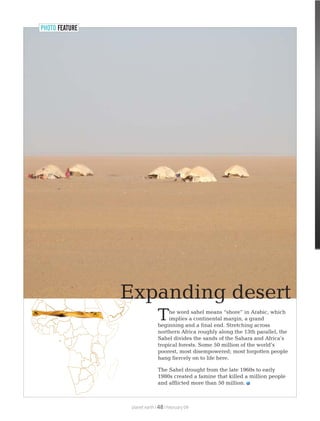
This map indicates the conflict prone zones in the world that have
been affected by food & water wars as a result of climate change.
Source: International Allert
has disappeared. Dr Rasik Ravindra,
director, National Centre for
Antarctic and Ocean Resaerch, while
admitting that green house gases
emission have increased global
temperatures, says, “Numerous
changes in climate have been
observed. These include changes in
Arctic temperatures, decrease in sea
ice cover in the Arctic region and the
breaking of ice shelves in western
Antarctica, droughts, heavy
precipitation, heat waves and
tropical cyclones. While glacial
interglacial cyclic episodes have
been witnessed in Earth’s history in
part, the present interglacial or
warmer period through which we are
passing has shown perceptible
warming trend including rise in sea
surface temperatures. Most of the
observed increase in global average
temperature is apparently due to
increase in greenhouse gas
concentration.”
The changing seasonal patterns, with
winters being affected the most, have
disturbed the snow build up. The
snow that is melting is not being
replenished during the winter
months, which in turn affects river
flows. Sometimes the melt waters
that collect in lakes below the glacial
mountains, burst, flooding the
agricultural lands. These lakes are
also a source of drinking water.
According to Dr Satyanarayana, a
process called evapo-transpiration is
causing ground water levels to fall.
In this process, certain plants with
big pores absorb excess water from
the soil and release it in the
atmosphere. This in the long run can
change the water table levels.
Often described as the Blue Planet,
Earth is covered with 75 per cent
water, why then is there such a
dearth of safe drinking water? It is
possible that changing climate is
stealing us of our freshwater
resources, but the situation may not
have been so bad had man on his
part not added to the water
siphoning process. Population
explosion is the primary reason why
we are experiencing water shortage.
The resources aren’t enough to meet
the demand and our irresponsible
use of water adds to that. Not
surprisingly, it is the more densely
populated countries that are under
threat. The declining water resources
have caused communities to seek
water deeper into the ground,
digging deeper still. While the
activity may bear water in one area
but only after it has dried the
surrounding well. River Dawa in
Ethiopia has dried up for this very
reason.
Food cultivation uses up most of the
water and it is maintained at the
expense of perennial rivers, such as
the Yellow River in China, the
Ganges and Brahmaputra in India,
Indus in Pakistan and the Nile in
Egypt. The Colarado river too is
under threat of drying up. Almost
three-fourths of naturally available
water is used for crops. Besides,
certain plant varieties require more
water for cultivation, biofuels crops,
cotton and rice for instance. Serious
resource depletion is being done by
bottled water plants which sip-dry
groundwater, which is then treated
and exported as bottled water.
Refugees from water-tight nations
increase the burden on other nations,
thus widening the crisis.
Water crisis cannot be isolated from
pollution, which has reached the
deepest layers of the earth, rendering
groundwater and aquifiers unsuitable
for drinking. At times grey water
blends with drinking water supplies,
causing serious health concerns. It is
also a matter of worry, says Dr Goud,
that construction activity has blocked
catchment areas and covered the soil
in a hard layer of tar and concrete,
which makes it difficult for rainwater
to seep in. Moreover, environmental
drives urging people to harvest
rainwater fall on deaf years. A lot of
research is being done to tackle the
water shortage crisis. The
WWF&ICRISAT project has resulted
in the development of a rice variety
that doesn’t require flooding and
gives better yields.
Nature’s water cycle of evaporation
and rainfall, ensures that a steady
and required amount of freshwater is
supplied to humankind, but we have
tampered the natural cycle on such a
scale that some of the great rivers of
the world are running dry. It is
setting in a related food and water
shortage cycle. The gurgling sound
of water is music to ears when
available in abundant supply, but
one can only hope that a situation
doesn’t come when we become water
refugees and increase our burden on
the ecosystems. “Cutting down
emissions is the only solution and the
only way out,” scientists warn.
Conflict, climate role reversal
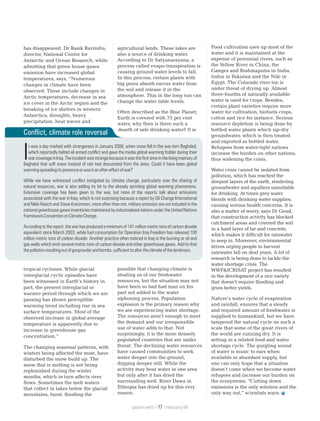
t was a day marked with strangeness in January 2008, when snow fell in the war-torn Baghdad,
which reportedly halted all armed conflict and gave the media global warming fodder during their
Iwar coverage in Iraq. The incident was strange because it was the first time in the living memory of
Baghdad that soft snow instead of rain had descended from the skies. Could it have been global
warmingspreadingitspresenceorwasitanafter-effectofwar?
While we have witnessed conflict instigated by climate change, particularly over the sharing of
natural resources, war is also adding its bit to the already sprinting global warming phenomena.
Extensive coverage has been given to the war, but none of the reports talk about emissions
associated with the war in Iraq, which is not surprising because a report by Oil Change International
and Nikki Reisch and Steve Kretzmann, more often than not, military emission are not included in the
national greenhouse gases inventories maintained by industrialised nations under the United Nations
FrameworkConventiononClimateChange.
Accordingtothereport,thewarhasproducedaminimum of141million metrictonsofcarbondioxide
equivalent since March 2003, while fuel consumption for Operation Iraq Freedom has released 100
million metric tons of carbon dioxide. Another practice often noticed in Iraq is the burning or oil and
gas wells which emit several metric tons of carbon dioxide and other greenhouse gases. Add to that
thepollutionresultingoutofgunpowderandbombs,sufficienttoaltertheclimateofthelandmass.
planet earth | | February 0917
INNOVATION
It is one thing to sit back and enjoy your morning
cup of coffee sip by sip, quite another to brew it
stronger and use it to run your car. Professor
Manoranjan Misra’s serendipitous discovery of
coffee’s fuel potential will perhaps enable you to do
so. When he left in a hurry from his lab, leaving behind a
steaming hot mug of strong Starbucks coffee on his work
desk, little did Dr Misra, echo-logic professor and
director, Center for Materials Reliability Metallurgical
and Materials Engineering, University of Nevada, Reno
know that this negligence on his part could result in an
important discovery. “I had
made a very strong cup of
Starbucks coffee and it
slipped my mind to consume
it. It remained so overnight
and the next day I noticed a
thin film of oil floating on the
top. I got very curious and
wanted to explore where the
oil came from,” says Misra
recalling the chain of events
that led to the discovery in
2006.
To satiate his curiosity,
Misra, along with two of his
students, Dr Susanta
Mohapatra and Dr
Narasimharao Kondamudi,
collected about 50 gm of
discarded coffee grounds
from the Starbucks outlet in
the university. These were
then brewed, processed and
tested. The resulting data
revealed that the brew
contained 10 to 15 per cent
of very high quality
triglyceride. A chemical
analysis established it as a
fact that the dark coloured
thick oil, which was as
aromatic as freshly ground
coffee beans, was indeed
high quality triglyceride. Spirited by this find, Misra and
his team assessed the possibilities of its application. “It
struck us that if it is triglyceride, it would make sense to
produce biodiesel out of it through transesterification. It
was a very simple process that we worked on in my
garage. The process involves the addition of alcohol to
the liquid and blend it with hydrous oxide. Once they are
combined thoroughly, all you need to do is heat it up and
your biodiesel is ready,” says Misra matter-of-factly.
It is necessary to note that oil as such doesn’t run a car. It
needs a trigger or booster which will help it burn and
ignite the engine to run a car. The triggers are often
described in terms of C10 and O10 numbers.
Transesterification does the trick.
With the green mantra attracting an increasing number of
companies, laboratories and countries, there is no dearth
of biodiesel in the market and new research turns out
varied results every single day. In fact, India has been
involved in quite a few biodiesel research projects on
jatropha, palm and shorgum at various levels. But what
sets coffee biodiesel apart from its contemporaries is its
lifespan. “Unlike biodiesel extracted out of jatropha, palm
and the likes, coffee biodiesel is very stable. Others need
to be used as soon as they are made, because any rise or
fall in the temperature or moisture content breaks them
because they do not contain
anti-oxidants. Whereas this
aromatic biodiesel contains 3
to 5 per cent anti-oxidants,
which gives more stability
and a longer shelf life of
between six-seven months.
There are no issues about
variety either because all
varieties of coffee yield
similar results,” explains 59-
year-old Misra.
The result has been
patented, but it will be some
time before the actual coffee
biodiesel hits the market for
commercial use. Misra who
originally belongs to
Bhuvaneshwar in Orissa,
India, has been working at
the University of Nevada for
almost 20 years. His area of
research concentrates on
environmental engineering,
water purification, extraction
of Hydrogen from water and
sunlight ad green energy.
However, his shift to
biodeisel research has been
very recent. Giving reasons
for this change, he says, “I
had often observed and read
that everybody is shifting to making biodiesel from food
crops, thus giving more priority to fuel that we use to run
equipment over our own body fuel, i.e. food. We need
food to survive, we can’t waste it on vehicles. I told my
group that it is about time that we looked at waste matter
to generate fuel energy instead of food. We are also
attempting to make gasoline from carbon dioxide, which
is abundant.” It is not surprising then that his team
preferred to use discarded and waste coffee grounds
instead of fresh ones. The team is presently looking at
chicken feather and fat to extract oil in addition to other
cellulose matter that could yield oil.
Misra describes his work environment as lively and
cheerful, where his students discuss the most unusual
Longer shelf life, zero-emissions
and aromatic exhaust fumes, are
just a fraction of the qualities that
coffee biodiesel discovered by
Dr Manoranjan Misra and his team
promise, writes Sheetal Vyas
Run out of fuel?
Consider coffee
planet earth | | February 0918
ideas and set about implementing them. He believes his
coffee biodiesel team to be a good mix, with two chemists
and an engineer who revel in carrying out complicated
experiments and analysing weird concoctions.
Feeding the pilot plant which the university plans to set
up in a few months, will not be a problem because Misra
and his team have ensured a steady supply through the
coffee roasting plant near the university, where nearly
250 million pounds of coffee is roasted per year. “They
use forward logic to distribute coffee to the stores, our
objective is to use reverse logic. Apparently, they pay to
discard the defective coffee which cannot be roasted or
coffee that has been over-roasted. The bulk of the coffee
from the roasters, which goes to the garbage will be used.
We are trying to device a method which will collect and
bring back used coffee. Since it is the most popular drink,
we have a big amount of waste coffee, which will make a
great number of galleons of biodiesel,” says Misra who
nurtures a deep passion for the environment.
The after birth of this process, the used coffee grounds
are also used. They are compressed, pelletised and used
in wood burning fireplaces to heat the room in countries
like the US. These are even better than wood pellets,
claims Misra.
With a zero-emissions tag and great smelling tanks,
coffee biodiesel could be the future fuel option. However,
before it is used in cars, they will have to be retro-fitted.
Diesel cars can readily speed on coffee biodiesel. Despite
his path-breaking research in the field, Misra, however,
feels that biodiesel will not solve the energy problem.
Portraying the seriousness of the problem, Misra says,
“Almost 29 million gallons of oil is consumed globally per
day. If we use all the land we have to grow only biodiesel
plants, it will give only 14 per cent of the oil required. It is
not the solution but a stopgap measure until we find an
alternative. Biodiesel is a good option because we know
how to make it. But the trouble is that it is time-
consuming.”
“It feels good to convert an out-of-the-box
idea of Professor Misra to a breakthrough
research. Our research objective is very
simple, to look for alternate fuel from
non-food sources which will decrease the
world’s fuel deficiency as well as check
global warming. While coffee biodiesel
produces only around a small fraction of
the current world’s fuel demand.
However, we need to realise that nothing
alone is going to replace the petro-fuels
which are being made by nature from
millions of years. Every bit helps.”
Dr Mohapatra, Assistant Professor, University
of Nevada, Reno, has a PhD degree from Indian
Institute of Technology, Bombay, Mumbai.
“Our project is based upon the idea of
taking everyday waste products, like used
coffee grounds, and turning them into
various forms of renewable fuels such as
biodiesel, bio-ethanol, fuel pellets and
low molecular hydrocarbons. We
succeeded partially and a lot more is to be
done in this direction. An observation is
one of the most important aspects of
scientists. At the time of research, our
only goal is to make it feasible and
nothing else and it is paid off well.”
Mr Narasimharao Kondamudi, PhD scholar,
University of Nevada, Reno, has a Masters
degree from Indian Institute of Technology,
Roorkee.
Coffee biodiesel production process
planet earth | | February 0919
Be it the saffron farmers of
Kashmir or the sugar maple
tappers of Vermont, several
regions have been bitten by
the melting winters. Apple and
mango trees are blossoming in
January, some plants are flowering
more than once in a year and their
has not been a white Christmas in
Shimla since 1991.
These unexpected seasonal
variations have been predicted by
most of the climate change models.
But it is the traditionally cold regions
that are feeling the heat.
The actual time period for snowfall
has also undergone a change with
December and January receiving
scant or no snow while February and
March witness heavy snowfall. In
most of the areas of Jammu and
Kashmir and Himachal Pradesh in
India, the snowfall months have
reduced from four months a year to
only two. Some of the Himalayan
regions are being flooded because of
untimely snowmelt.
Similar reports come from UK as well
as Canada. The spring now arrives
almost a month early and autumn is
longer. Winter months have shrunk
and it doesn’t snow as it used to.
Weather patterns are becoming
unpredictable and the lines between
the seasons are thinning.
Loosing some exotic aromas and
winter sports
One can hardly imagine some of the
exotic Indian dishes without the
aroma of saffron, but we are losing its
crop fast. As per On the Brink: A
Report on Climate Change and its
Impact in Kashmir, saffron yield in
Kashmir has decreased to almost half
since the last 10 years. Farmers say
that in the past 20 years, land that
yielded 1.5 to 2 kg saffron is now
yielding barely 200 gm.
All this is because of changing
pattern in snowfall shorter winter
and receding glaciers.
Not just India, due to unpredictable
weather pattern and shorter winter
New England once a leader in the
production of sugar maple has been
hit rather badly by climate change.
The sap tapping season has
effectively been shortened by at least
three days. Further, maple being a
highly climate sensitive tree, the
production of sap in the tree is
affected by erratic climatic changes
that the region is going thorough.
Experts believe that although
currently Canada’s maple industry is
growing the fall is not far.
Snow lines have receded; the spring
snow melt is coming earlier than
ever before. It’s the same
everywhere, the Poles, North
America as well as for the Himalayas
that form largest snow cover outside
the poles.
Higher temperatures and shorter
winters mean less time for skiing.
Winter sports a major tourist
attraction and an important
economic asset of snow capped
regions are looking for alternate
recreations to compensate the loss
due to reduced skiing months.
“Snow sports in Washington State
are potentially vulnerable to the
projected shift in winter precipitation
Are we losing
winters?
CLIMATE CONNECTION
For the past few years, climate change has been
discussed at all the world conferences and across
coffee tables. But winter already feels the heat; it
happens to be one of the first victims of climate
change with one season merging into another
Mukta Rohra
planet earth | | February 0920
from snowfall to rain as average
temperatures warm. Some ski areas
based at low elevations, including
destinations that are among the
state’s most popular, may experience
direct climate change impacts,” says
a report on impacts of climate
change by Washington State
Department of Ecology.
Himalayan ski resorts in
Kashmir and Himachal
Pradesh are in for the
same fate. Trekkers
favourite, Pindari glacier
reportedly melts 130
metres every year. There
are over 5,000 glaciers
in the Himalayas. They
are all retreating and
some of the smaller
glaciers in Himalayas
have actually vanished
leaving the mountains
bare with increased danger of
landslides.
Himalayan glaciers feed 10 river
systems and all of them have scarce
water primarily due to glacial retreat
and early melt. The Gangotri glacier
lost one-third of its 15 mile length in
the last 50 years. It loses 18 metres
every year.
Warmer temperature has lead to
shortage of water in the region and
more paddy fields are being
converted into rain fed orchards.
Lives of the locals who depend on
farming and tourism have become as
unpredictable as nature.
Not just the locals living there for
generations, lives of
nomadic communities in
these high altitude
regions have become
even more difficult. Due
to this unexpected rain,
snow and dry spells their
fixed ways of grazing the
cattle in high altitude in
winters and lower. It is
becoming difficult for
them to sustain
themselves and keep the
cattle healthy, specially
the pashmina goat as their pastures
are fast drying up.
The thought of a non-existant winter
is scary because ingrained with it
will be cancelled so many traditions,
a Lohri bonfire and a vacation in
snow-capped Gulmerg, the aroma of
saffron and the warmth of pashmina.
Well, they are all a part of the
endangered list.
saffron yield in Kashmir has decreased to almost half since the last ten years
Winter Shivers
The ten hottest years ever
documented have all occurred since
1990
Global temperatures have risen by
over 0.7C since the 1700s with 0.5C
of this warming occurring during the
past 100 years.
Since the mid-1970s the average air
temperature measured at 49 stations
of the Himalayan region rose by 1°C
with high elevation sites warming the
most
Sixty-seven percent of glaciers are
retreating in Himalayas
The Khumbu Glacier, a popular
climbing route to Mt Everest, has
retreated over 5 km from where Sir
Edmund Hillary had crossed it
The Gangotri glacier lost one-third of
its 15 mile length in the last 50 years.
It loses 18 metres every year.
Average arctic winter temperature
has already increased by 11 degrees
Fahrenheit. Arctic ice is rapidly
disappearing, and the region may
have its first completely ice-free
summer by 2040
Average global sea levels have
increased by between 0.1 and 0.2
meters over the last 100 years
Montana's Glacier National Park now
has only 27 glaciers, versus 150 in
1910.
Rice, the world’s most significant
grain crop, yield has fallen by 10% for
each degree of warming
The World Health Organization
estimates that climate change is
already responsible for an estimated
150,000 deaths per year.
In 1998 alone, 650 deaths occurred in
Orissa due to heat waves.
planet earth | | February 0921
ENVIRONMENT
As the shadows of palm trees stretch along the shores
and the orange-red sun melts into the sea, the picture
perfect island nations belie the fact that each
passing wave is questioning their existence and
only time will tell whether they will sink or swim,
writes T P Venu
A people
uprooted by
nature
smail Hassan sits in his jolhi
fathi (In the Maldivian language
IDhivehi, it means an easy chair
made out of coconut trunk and husk)
and waits for the birds of far away
lands to descend on his little island
Komandoo, in the Maldives. It is
June and still there is no trace of the
birds. It is the first time that the birds
have not come. Thanks to the
changing climate. Life for the
islanders, be it Maldives or Marshall
islands, Tonga or Trinidad, is
becoming difficult as climate
changes. Seasons no longer stick to
schedule, rain which would start in
June but now it only does in
December and melting glaciers are
changing the geography as well as
the lifestyles of islanders.
Schools of fish are no longer seen at
the locations that they were
supposed to thrive on, sea birds seem
to thin in number and prefer to spend
their winters elsewhere and rising
sea levels are eating away the heart
of the islands slowly but effectively.
Given the current rate of degradation
with global warming, whole coastal
communities will be wiped out and
along with it the indigenous cultures
which date back to centuries. Time is
ticking!
Living on the edge
We have seen war refugees and for
the first time we will have to confront
environmental refugees. Sample this:
Trinidad is losing almost four yards
of land per year, Maldivian islands
are just 1 metre above sea level,
Tuvalu 15, Kiribati islands 2 metres
and Marshall Islands less than six
and a half feet above sea level. One-
third of Palau’s reefs are lost due to
changing weather patterns. Coral
bleaching is for real and none can
escape it right from Fiji, Cook
Islands, Samoa, Tonga and Palau.
Fifteen per cent of Fiji’s reefs are
dead. These people who are living on
the edge of oceans are in jeopardy of
losing their homelands forever.
According to Dr B N Goswami,
Director of Indian Institute of
Tropical Meteorology, “Sea levels
would rise between 20-50 cm by the
end of the century and depending on
planet earth | | February 0922
the topography of islands some are
more vulnerable than others and all
are at risk.”
Changing lifestyles, disappearing
cultures
Islanders no longer hunt as before
nor fish as they used to and their
ability to predict weather is lost.
They no longer produce elegant
handicrafts out of coconut leaves;
farming techniques are changing;
they are not able to grow traditional
food crops. Their ancient cultures of
subsistence lifestyle is taking a
beating; and these once self-
sufficient people are being reduced
to borrowers of aid as their islands
are being swallowed by water. Sea
levels are rising by 3.3 millimetres
per year and projections are that by
2100 it would touch 18 cm.
The coconut palm is considered as the
tree of life for islanders all over the
world, but with salt water intrusion
these palms are dying. Coconut palms
are an inseparable part of island life
as every part of the tree is used in
building boats, its leaves for thatches
and the fruit itself forms an integral
part of island cuisine.
People in Pacific islands can no longer
grow their staple food Taro due to
continuous infiltration of sea water.
Now, they grow them in buckets, tin
containers and jars. Wells are getting
contaminated with sea water and
islanders have to be at the mercy of
rain gods to collect water. Houses are
built with slanting roofs and tanks are
fixed adjacent to them. People are
finding ways to save themselves and
the Dutch have found a novel way by
building floating houses which
become buoyant when it floods and
remain above water.
Food for thought
Lives of the islanders are tied to the
sea and fish is their main diet. There
was a time when islanders joked that
they could sail over fish backs such
was the abundance, but now if
someone said so it would be termed
as being rude and mocking at their
plight. For, they are finding it
difficult to catch fish due to
acidification of oceans. Rising
temperature is destroying coral reefs,
plankton and commercial fish
species. Fishermen are no longer
sure of locations of fish schools.
Many a time, islanders get content
with breadfruit but even breadfruit
trees are vanishing fast. Climate
change is making it difficult to
sustain fish catch. The effect of
global warming is showing in
dwindling fish numbers. Tuna, the
sought after fish of Papua New
Guinea, Maldives, Philippines,
Malaysia, Thailand, Japan, Taiwan
and other nations, is harder to find
because water is getting warmer and
the ideal temperature for Tuna is
27-29 degrees centigrade. So, they
go deeper into the oceans resulting
in low catch.
People in flight
Already people from lohachara and
Ghoramara islands in the
Sunderbans have been relocated to
Sagar. More than 4,000 Tuvaluans
now live in New Zealand, over 1,600
residents of Papua New Guinea’s
Carteret Islands have moved out,
another hundred residents of Tegua
had to be evacuated. The number is
rising as each wave kisses the shores
of islands. Dr K Krishna Kumar of
Indian Institute of Tropical
Meteorology, says “Danger to islands
depend on factors such as ocean
basin dynamics, morphology, the
topography and ocean currents. They
all affect the life span of islands. The
health of coral reefs which surround
the islands act as a wall from storms
in mitigating natural disasters.” He
further adds that stringent measures
including a world wide check on
global emissions are needed and
advices strengthening of banks and
building sea walls as alternative
measures, which though temporary
will help small island nations to
create a stop gap.
Uncertain future
“Man is nature’s sole mistake,” said,
W S Gilbert and man has not
disappointed. Today, thousands of
islanders across the globe live in
perpetual fear. They do not know
when a tsunami, a hurricane, a storm
or a flood would hit them. All
islanders love their land and some do
not want to accept the fact that their
islands are in peril and it’s only a
matter of time. If they do not want to
budge they will die. But, if they
leave, some part of them will die as
they are deeply connected to the
islands, its waters, and way of life.
Nothing can be sadder than talk
about ones own nation’s death, and
this is the predicament faced by
many. What is ironical is that these
small island nations which have
contributed least to carbon footprint
are the hardest hit. Meanwhile,
Ismail Hassan fills the bird bath with
water and waits for the elusive birds
that have been making his island
their home for a couple of months of
the year, for centuries. Will they
come? Is anybody’s guess, for now
Ismail lives in hope.
planet earth | | February 0923
The capital moat in solar energy production may have been plugged
with government subsidies and tax incentives, but technology
improvement and consumption subsidies are areas that need to be
addressed, writes Jagadeesh Napa
Solar energy
The way forward
BUSINESS BYTES
planet earth | 24 | February 09
Sunrise Sunrise (or rather
sunshine), couldn't tempt
us if it tried… If we were to
sing the famous song
popularised by Norah Jones today,
we couldn't be fooling ourselves
more, for it is the very source of
energy that is likely to bail us out of
an energy deficit.
While abundantly available, solar
energy, considered to be one of the
cleanest energy sources, still remains
underutilised. For quite a few years
now, solar power is being promoted by
an increasing number of countries as
an ideal replacement for fossil fuels.
Environmentalists too have blown
their trumpets at full lung capacity to
'go solar' from the time the first solar
cell was invented. Since then, many
efforts have been undertaken to tame
this energy resource and bring it to
the common man.
Cost, say industrial experts, is
perhaps one of the primary reasons
why its wide-scale application could
be prolonged, and it will be some
time before every household
appliance runs on cost-efficient solar
power. However, the proponents of
clean energy are joining hands with
researchers worldwide, and are
striving hard to achieve this goal.
Interestingly, about 30 per cent of the
global investments in renewable
energy development are directed
towards solar energy. India is one of
those few fortunate countries where
a part of its rural population uses
appliances that are powered by solar
energy. Selco India and Tata BP
Solar have attempted to facilitate this
and light up lives of the poor and
downtrodden with solar appliances.
They have succeeded to a large
extent, but the biggest challenge lies
in bringing solar power to society's
midriff; the middle class household.
Incidentally, this happens to be the
biggest consumer market which is
yet to be tapped.
Indian initiative
Investment in this clean alternate
energy is something that all
stakeholders have been advised to
consider. Recognising the need to
develop solar power as the next
generation's energy source, Indian
Government, together with the
Ministry of New and Renewable
Energy has set a target of generating
50 MW of solar power in the current
Five Year Plan 2007-2012.
To achieve the target, a massive
incentive scheme which offers 80 per
cent subsidy to companies investing
in solar power generation that can be
distributed to ordinary households,
has been announced by the
Government. Dr T C Tripathi, advisor
to the ministry on solar energy said,
“The Government has taken an
active initiative in this direction and
is providing up to 80 per cent of the
cost as incentive. This can be a very
big momentum for the industry as it
has garnered the support of the
Government in a big way.”
The cost of generating one unit of
solar energy (which can be fed to the
grid) currently is Rs 15. The central
and state governments have joined
forces to provide a combined
incentive of Rs 12 per unit, while the
private investors have to bear the
remaining 20 per cent that is Rs 3
per unit.
Active research need of the hour
Dr Tripathi asserts that cost is the
biggest obstacle against adopting
this clean energy in large scale.
Production cost for solar power
generation being high, it is not viable
for mass production, in which case
the incentive will attract and
encourage more industrial
investment. However, as a regulator
and a driving force for the industry, it
is also necessary for the Government
to look at ways to reduce the cost of
production. The Government's
endeavour in the long run should be
to actively encourage research in
solar power with this aim.
Research is currently underway the
world over to reduce the overall cost
of solar power generation and
institutions and organisations in
India are also in the league. It is now
time for the government to catalyse
this process. Dr Tripathi suggests the
inclusion of IITs, regional
engineering colleges, existing state-
owned power corporations like NTPC
to meet this end. He says, “Almost all
the IITs and other industry bodies are
into this kind of research and it is
focussed on different technologies
and materials that can reduce the
cost of solar modules.”
There is no dearth of scientific
experimentation in the area.
Researchers at IIT Madras are
working on solar decentralised
power generation and Hybrid
thermo-photovoltaic systems among
1500 Exajoules
1250
1000
750
500
250
Year 2000 2050
Kohle
Oil + NGL
Gas
Hydro
tradit. Bio
Wind
Nuclear
Biomass
Solar
Geothermal
Expected projections of alternate energy output
planet earth | | February 0925
other things. A study carried by
Indian Semiconductor Association
(ISA) in September 2008 has
identified that research has to be
focussed basically on two aspects –
cost reduction and improving
efficiency. Ongoing research is in
line with this as it focusses on lower
cost and less energy-intensive
techniques for polysilicon (material
used in the solar cells) production
and a reduction in the usage of this
material. In a single solar cell
module, around 45 per cent of the
cost goes for the silicon wafer and
another 35 per cent for the material
used to assemble the module. With
growing demand for silicon, the
market prices are only expected to
shoot up rather than come down.
Technology holds the key
Conversion of solar energy into
electrical energy has been described
by many (scientists and
industrialists) as one of the greatest
inventions in human history.
Polysilicon is being used to build
solar cells to trap solar energy.
According to the ISA study, usage of
silicon has reduced to 10 g/Wp
(grams per Watt peak) from 13 g/Wp
in the last few years and this is quite
an achievement. But further
reduction of silicon presents a big
challenge for the researchers. The
European Union, which is one of the
pioneers in this field, has set
ambitious targets for the short and
long terms. This includes reducing
the usage of polysilicon to below 5, 3,
2 g/Wp in the short, medium and
long terms respectively.
Incentivise usage
Presently, usage of solar power in
India is restricted to the environment-
conscious business establishments
and households. On the other hand,
NGOs have partnered with companies
manufacturing solar appliances to
distribute domestic solar appliances to
families below poverty line at cheaper
and affordable prices. While this is a
big market for these companies, the
biggest markets – middle class and
upper middle class – are yet to be
tapped. It is necessary to look at these
markets as highly potential
consumption markets of the future.
Thus to attract them to use solar
PV Technologies India Ltd. Solar PV 6000.00
Titan Energy System Ltd Solar PV, Polysilicon 5880.58
KSK Surya Photovoltaic Ventures (P) Ltd. Solar PV 3211.00
Signet Solar Inc.* Solar PV 9672.00
Moser Baer PV Technologies India Ltd* Solar PV 6000.00
Reliance Industries Ltd. Solar PV, Polysilicon 11631.00
Reliance Industries Ltd.* Semiconductor Wafer Fab 18521.00
Phoenix Solar India Ltd. Solar PV 1200.00
Tata BP Solar India Ltd.* Solar PV 1692.80
Solar Semiconductor (P) Ltd. Solar PV 11821.00
TF Solar Power (P) Ltd. Solar PV 2348.00
Lanco Solar (P) Ltd. Solar PV, Polysilicon 12938.00
* These companies have plans to produce solar energy
Company Category Proposed Investment
in crores
power at this early stage, the
Government has to subsidise certain
amount of consumption. For instance,
as it is currently providing 80 per cent
incentive to the industry, a part of
which can be diverted to the
consumer in the form of either a
subsidy or tax exemption incentive. A
direct subsidy of Re 1 per unit can be
also considered or a percentage of the
total amount paid as electricity bills
can be given as tax exemption. This
may not solve the problem altogether,
but could be applied till such time a
better solution is arrived at.
Japanese model
Japan is one country that has
directed its efforts on both focussing
its resources in the research of cost-
efficient solar power as well as
providing incentives to its biggest
consumer markets, in addition to
producers of solar power. It is the
biggest producer of solar energy in
the world and is followed by
Germany. The country had
announced the incentives
programme in 1994 and as a result
has achieved a 75 per cent reduction
in production costs till date. It
targeted the biggest consumer
market – the middle class and upper
middle class groups – for the usage
of solar power and provided
incentives through direct subsidy,
access to easy finance, net metering
etc. Consumers in Japan get a 10 per
cent subsidy on the cost of a standard
solar power system as a result of the
government's attempt to promote
solar power and reduce
environmental pollution.
The way ahead
Given the current active participation
of the Indian Government (through
incentives to the industry) to promote
solar energy, it is expected to churn
out some good results in the near
future. But a big revolution in this
domain can only be expected if the
Government proactively works
towards increasing the R&D work so
as to improve technology and at the
same time encourage the enormous
consumer markets to switch to
alternative energy.
Current usage of Solar PV Modules
Exports
Telecom
Home Lighting System
Solar Pumps
Solar PV Power plantsOthers
Solar Lanterns
Street Lights
225
5.5
7.58.5
11
16.5
39
22
Companies investing in solar energy
planet earth | | February 0926
FUTURE ENGINEERING
The city relies entirely on
renewable energy sources,
with a sustainable, zero-
carbon, zero-waste
ecology. The walled city of Masdar is
a minutely planned city being
constructed in Abu Dhabi, United
Arab Emirates.
The new age city is being
constructed 17 kilometres east-south-
east of the city of Abu Dhabi, beside
Abu Dhabi International Airport is an
initiative by the Government of Abu
Dhabi through Mubadala
Development Company designed by
Foster and Partners.
The city will cover 6 square kilometres
on an allotted area of 6.4 square
kilometres in size. Of this, 30 per cent
will be for housing; 24 per cent for the
business and research; 13 per cent for
commercial purposes; 6 per cent for
the Masdar Institute of Science and
Technology; 19 per cent for service
and transportation; and 8 per cent for
civic and cultural pursuits.
It will house 50,000 people. More than
1,500 visionary companies will have
offices, research centres and operations
within the city walls. It is expected that
approximately 40,000 workers will
commute to the city daily. The paradox
is that cars and other automobiles will
be banned within the city.
With a maximum distance of 200m to
the nearest transport link and
amenities, the city will be linked to
the outside world by public mass
transit and personal rapid transit
systems. A pedestrian friendly city
will have open public squares
intercept the shaded streets that will
also funnel breezes.
Masdar City will require
approximately 200 MW of installed
clean power. The construction itself
relies on a 40 to 60 MW solar power
plant on the site. The facility will
later be increased and additional
solar power modules will be placed
on the rooftops to produce 130 mw of
power. A few 20 MW wind farms will
be established outside the city. The
city may also utilise geothermal
power and build the world's largest
hydrogen power plant as well.
The water management plan
proposed is environment friendly.
Water consumption presumption is
stated to be 60 per cent lower than
similarly sized communities which
will be met by a solar powered
desalination plant.
Eighty per cent of the water used will
be recycled, waste water will be reused
as many times as possible and grey
water will be used for crop irrigation
and other purposes. The bio waste will
be used to create nutrient-rich soil and
fertiliser, and as an additional power
source. Industrial waste, such as
plastics and metals, will be recycled or
re-purposed for other uses.
The ambitious project is expected to
cost US$ 22 billion and take some
eight years to build. The first phase
is expected to be complete 2009.
Carbon emissions reduced by
Masdar City will be monetised under
the Kyoto Protocol's Clean
Development Mechanism.
Masdar City is a highly planned,
specialised, research and
technology-intensive project that
incorporates a living environment,
without damaging it.
In an economy
that is based on
hydrocarbons, an
initiative that
warrants zero-
carbon, zero-waste
ecology, Masdar
city true to its
meaning is a
source or initiator
of a new era,
writes
Mukta Rohra
Masdar
the source
Masdar headquarters will be the
greenest building in the world
The first drawings of the green buildings of
Masdar City, that zero-waste city of the future
concept, were made by Adrian Smith and
Gordon Gill who designed Masdar
Headquarters. This building will be the first
that will generate power in order to be
assembled. The power will be acquired with
the help of a solar roof which, of course, is
going to be assembled first.
planet earth | | February 0927
India has been punching above its weight in
renewable energy sector. India started early but
other countries have started running, if India has to
keep pace we need to sprint. Also the industry needs
a clear policy framework by the government says
Dr Sivaraman in a candid interview with T P Venu
ENERGY TALK
Winds of change
What according to you is the global
scene on renewable energy?
I don't think there is any slowdown.
In fact, in the next four to five years I
expect an increased rate of adoption
of renewable energy. There could be
a minor hiccup in the next 12 months
or so because of the general financial
tightness. But I think almost all
countries feel the need for renewable
energy in their energy mix.
Especially with the new
administration in US, it is definitely
is going to get on board the
renewable energy space and change
the attitude and dynamics of
renewable energy worldwide.
What are the other applications you
see for wind energy in the near
future?
The primary application of wind
energy is going to be grid connected
generation of power. The other
alternative uses for wind basically for
pumping are going to be in small
scale. Wind is primarily going to be
driven by the large turbines we are
looking at now.
How far do you think the use of
technology in maximising output
has succeeded in increasing
production?
There are two points how wind
turbine or wind energy can be
maximised. One is maximising the
efficiency of the machine in
harnessing wind. I think we are
moving in the right direction there
by making machines and turbines
which are capable of producing
higher power at blower wind speeds.
The second equally important area is
once the power is generated utilising
the power effectively i.e. getting it
from the place it is generated to the
place where it is to be used. That
requires an investment in the grid
and the control system of the grid.
That investment is being met
worldwide on uploading grid
capacities to absorb larger
percentages of wind. So, only when
both go in tandem will you have
optimum wind utilisation. There will
be fluctuations and the grid has to be
robust enough to take care of that
fluctuation and balance it.
Are there any specific initiatives
taken in Indian context?
What is being done is only
strengthening the grid in higher
capacity of evacuation line. In the
future what is foreseen is smart grid
which will be able to automatically
adjust generation from other sources
with better prediction of wind
generation. A lot of work in this area
is being done in Europe and it will
take some time for us to adopt here.
Apart from a host of problems, wind
energy is facing an increasing
transport time, even for the wind
turbine equipment. What is being
done to overcome this issue?
That is the problem with which we
have to live with. Even from the
highways to wind farms, transport is
a problem and the wind farm owners
have to manage. We cannot expect
the state to lay roads. Manufacturers
and farm developers have to
manage.
What are the challenges faced by
companies that are shifting to the
renewable energy sector?
The primary challenge is from the
financial market and always the
question mark that is there with
renewable energy is from the
government policy. We need to have
a clear policy on concessions that
will stay in place for the next five
years so that we can have long-term
plans. Now, we wait every year for
the budget and see if tax laws
change. All renewable energy
projects have long-term returns. We
need to have clarity in the policy.
Global wind energy capacity
crossed 100,000 MW this year. What
has India's contribution been?
We have been one of the early
players and the consumption is
pretty high and next only to
countries like Germany and
Denmark. India has been punching
above its weight in wind industry
over the last ten years. But now the
rate of growth is going to be slower
than other parts of the world.
T Shivaraman, Managing Director, Shriram EPC
planet earth | | February 0928
What do you think are the reasons?
The policy framework outside India
is better from an economic
perspective. Farm development
outside India has a significant
advantage.
The onus has to be on the
Government. Wind tariffs in India
are perhaps one of the lowest in the
world. Nowhere in the world do you
get it for something as low as 3
per kw. India gives tax breaks on
wind power which other countries
don't give. On balance, I would say
that for a standalone farm developer,
India is not as good a location as
other nations.
The problem is power being a state
subject each state has its own policy
and own requirements of renewable
energy are to be fed into the grid.
Rs
The state and central policies both
have to be in sync.
Are you doing any projects on
renewable energy?
The major work we are doing is with
our associate company Orien Grid
Power. We are setting up multiple
bio-mass plants to steer the bio-mass
research. We will probably be
established as the largest bio-mass
player in India.
You are into municipal waste
management for quite some time.
What is the scope for managed
waste being used for energy?
The municipal solid waste energy
market has lot of scope. It has vast
potential and has major
technological challenges. The Indian
scenario is very different from
Europe and we need to design
specific technology. Secondly,
change is needed from regulatory
and government perspective because
India is so huge and we need a
policy in place or else it would be a
major problem. Mumbai has already
taken up work in this area and
modifying their strategy.
Are there any states which are
conducive for players to enter into?
Rajasthan and Maharastra are two
states that come to mind.
Green Conclave will be a congregation of people who can propose a holistic vision of a better, greener Earth. The focus
of this two-day conclave (conference-cum-exhibition) will be on how the decision makers and the industry can come
together for the cause of protecting our environment and in utilising the scientific and technological know-how.
The purpose is to assess earth’s vulnerability and its attempts at adapting to natural turmoil. The conclave will gauge
the viability of green alternatives of energy, water, waste management and other important sustainability measures.
November 12-13, 2009 New Delhi
supported bypresented by
ggrreeeennCONCLAVECONCLAVE
ggrreeeenn
For more information visit www.greenconclave.in
planet earth | | February 0929
MANAGEMENT
Every ambitious country or business house wishes to
cash in on the benefits offered by CDM projects and
earn carbon credits. But be warned that it is
environmental compassion and not equipment and
emissions reduction, what will turn in greater rewards,
says risk analyst Swaminathan Krishnamurthy
Carbon credits as a concept, has come to enjoy special
privilege in corporate conversations, business plans and the
headlines of business newspapers and magazines. Such is the
obsession with the phrase that no meeting-over-hi tea,
scientific conference or business seminar is concluded without
a mention of or presentation on carbon credits.
The defining factor
It is a fact well known that the world over, serious attempts are
being made to cut down carbon (CO ) emissions. International2
bodies have been trying to implement policies and offer such
incentives that will enable countries to realise the desired reduction
in carbon emissions. The Kyoto Protocol, one such international
agreement linked to the United Nations Framework Convention on
Climate Change (UNFCCC), which became effective in February
2005, sets binding targets for over 35 industrialised nations, in
addition to the European community for reducing greenhouse gas
(GHG) emissions. These amount to an average of 5.2 per cent
compared to the 1990 levels over the five-year period 2008-2012.
Carbon credits are a means to cut down Co emissions at the national2
and international levels through trading schemes implemented to
counter global warming. A monetary value is set for each earned credit.
As per the Kyoto Protocol, the signatory Annex 1 countries (developed
countries) are under an obligation to trap GHG emissions through
individual industrial entities established in the country by capping the
annual emissions on an industrial scale. Any shortfall in the committed
GHG reduction – which could be 6 per cent for one country or 9 per cent for
another – scale is balanced through the buying and selling of carbon credits
in the international market.
The Kyoto Protocol provides for an arrangement, Clean Development
Mechanism (CDM), which allows countries that have committed to GHGs
reduction to invest in environment friendly projects that cap CO emissions.2
The need for CDM projects
While committed countries have to ensure that the target is achieved, individual
industrial entities – which could be a civil plant, a power plant or any other energy
intensive plant – in the country, who have been included in the programme or
have voluntarily agreed on a CO reduction figure need to weigh the possibilities2
planet earth | | February 0930
This is the first part in the two part series on carbon credits.
and choose alternatives. They are
usually given a specific target based
on the production capacity and the
emissions allowance they have been
given. It is basically a campaign-
based system. Emissions above the
allowed level will require them to
either pay a penalty or buy credits
from the market and get a permit
sanctioned.
Achieving the target may not be easy
for a country. Considering a
particular facility is operating at 80
per cent efficiency, it can be limit-
stretched to operate at 90 per cent
efficiency. However, if a certain
facility is already operating at 90 per
cent efficiency, each level in
efficiency increase would require the
plant to seek additional local
investment. This could make the
entity in question less competent in
the market. Therefore, it was agreed
at the Kyoto Protocol under the CDM
scheme that a part of the target
percentage will be considered for in-
house reduction and improvements,
while the remaining part could be
achieved through investments in a
GHG mitigating project elsewhere
and credits claimed for that.
Who invests in CDM projects
CDM and carbon credits projects
were initiated with the sole purpose
of ensuring that companies and
countries that are consciously
making an effort to cut
down GHGs
emissions are
rewarded suitably. It is the
industrialised, developed or Annex1
countries that invest in CDM projects
in the developing or non-Annex 1
countries. Certain established
entities also sell carbon credits to
commercial and individual
customers who volunteer to lower
their carbon footprint. Often referred
to as carbon offsetters, they
purchase such carbon
credits from
organisations that
have accrued them in excess through
individual projects. A stringent
validation process is involved which
ensures the quality of the credits.
Project eligiblity under CDM
CDM is supervised by the CDM
Executive Board (CDM EB).
Industries and businesses that are
planning to apply for CDM projects
and thus ensure that carbon credits
flow in, need to ensure that they start
planning early and consciously make
an effort to better the environment by
capping carbon emissions.
Additionality
Any project, being planned by a
company to reduce energy in the
form of power or heat generation and
which in the process would reduce
the burning of fossil fuels that could
contribute to global warming, is
eligible for CDM. However, no
amount of CO reduction will place2
the project under CDM, unless the
promoters establish that the planned
reduction in emissions is being
undertaken with the sole purpose of
arresting emissions, and it will not be
Coal is mixed in a coal mix hall at the Prosper II mine in the western town of Bottrop. A handful of nations are
developing plans to trap and seal beyond reach, the greenhouse gas carbon dioxide (CO2) produced from burning
fossil fuels in power plants. The technology, called carbon capture and storage (CCS), may help create more energy
for less CO2. The idea is that companies build coal-fired power plants and bolt on CCS technology later when it
becomes commercially viable.
You purchase
carbaon credits from
www.carbon planet.com
Carbon Planet
Purchases carbon
credits in bulk
Carbon Planet transfers
owenership of carbon
credits to the customer
Planet Saving
Super Hero
(You)
Carbon
Credits
Money
MoneyCarbon Credits
Carbon Planet
Purchases fully certified
carbon credits.
Greenhouse Gas
Emissions (eg. Co2) -
The leading human cause
of global warming
planet earth | | February 0931
possible to achieve the target without
the incentive offered by carbon
credits. This is called the
‘additionality’ factor. They will have
to prove their compassion for the
environment and explain why a
particular project which is being
undertaken, is not a business-as-
usual project and why it would
require carbon credits. They will also
have to explain how the revenue
generated from the carbon credits
would help the project proponent.
CDM/Carbon Credits, a project-
based initiative
Planning and time are two crucial
aspects of CDM projects and carbon
credits. If a project promoter says
that the project had been
commissioned in 2004, it proves that
the project has been running for 3-4
years. The supervising bodies are
likely to raise doubts about how they
were able to run it for these many
years without support. Since they
have a limited pie to give away, they
cannot consider every GHG
reducing project as a CDM project.
For example, a project being planned
by a cement company which will
help convert a wet process to a dry
process plant. Mere GHG mitigation
does not qualify a project for CDM
tag while converting a wet process
plant to a dry process plant, the
company will in any case reduce
emissions. Why then do they need
CDM support?
In a country like India, where almost
90 per cent of the cement industry is
already running under semi-dry or
dry process plants, another plant that
claims to convert the plant from one
process to another will not make any
difference, because the project
promoter knows for sure that he
cannot sustain the operations without
converting the plant into a dry process
plant. The project promoters will have
to clearly prove that CDM will prove
beneficial and play an important role.
They should prove that it would be
difficult for their project to sustain
without CDM revenue.
Emissions allowance
Every country and business unit that
is environment-conscious (and even
otherwise) will have historic
emissions calculations and what they
have committed to. It takes into
consideration the development
pattern of the country and based on
its development, it will be
categorised either as an Annex 1
country or a non-Annex 1 country.
Annex 1 countries are developed
countries, who in the process of
development have already
contributed towards global warming.
These countries have a target to meet
and these targets will percolate into
different entities within the
countries. The size of the entity will
decide the allowance they get. It is
the country’s responsibility to see
that the target is met. However, they
may have different ways of doing or
achieving this.
Joint implementation
A CDM project is termed as being
planned under joint implementation
when an entity in a developed
country invests in a project being
developed by an entity in a
developing country. The carbon
credits generated will go towards
meeting the target of the developed
country and the revenue will flow to
the entity in the developing country.
It is a win-win situation for both.
Since carbon emissions is a global
issue, it doesn’t matter where the
GHGs are being reduced as long as
they are being reduced.
The writer is a risk analyst and
climate change expert.
Look out for Part 2 of the story in the next issue
Carbon footprint: While carbon
credits are the monetary benefits that
you reap out of reducing carbon
dioxide emissions, carbon footprint is
a measure of the impact that our
lifestyle and activities have on the
environment. This is calculated in
terms of the amount of green house
gases (GHGs) that are produced
through a particular process. The
activities that produce GHGs could
include fossil fuel burning, electronic
appliances and the clearing of green
forests. Originally, the idea of carbon
footprint originated from the
ecological imbalance and damage we
are causing and thus ecological
footprint.
UNFCCC: The United Nations
Framework Convention on Climate
Change (UNFCCC) was set up in 1992
at the United Nations Conference on
Environment and Development
(UNCED) in Rio de Janeiro. As many
as 154 countries agreed to be a part
of the UNFCCC, which committed the
industrialised signatories to a
voluntary aim to reduce green house
gases emissions. This step was taken
as one of the measures to control
global warming and climate change.
The nations that signed the
proposition agreed to take stringent
measures for the good of mankind.
Clean Development Mechanism
(CDM): According to the Kyoto
Protocol, industrialised countries have
been given permission to invest
money in projects that work towards
reducing green house gases
emissions in their attempt to reach
their carbon reduction targets. These
projects are generally invested in the
developing nations by the developed
countries. However, one of the basic
criteria for CDM approval is that the
project promoter should have proved
the conscious effort being undertaken
to reduce carbon emissions and how
the additional funds will help the
project.
Jargon Buster
China
41%
Brazil
14%
India
14%
Republic of
Korea
11%
Mexico
5%
Chile
2%
African
countries
2%
Other countries
11%
CDM CERs distribution by country
planet earth | | February 0932
An increasing number of IT firms are getting together to cut down
energy consumption. Green data centres are a good option
How green is your data centre?
The operational
challenges of today's data
centres have become a
gloomy issue for IT
managers and CIOs around the
globe. As hundreds of thousands of
servers and storage systems are
deployed to keep pace with ever-
growing business computing needs,
data centre managers are faced with
increasing operational costs –
namely power, cooling and
maintenance. Today's data centres
spend just 30 per cent of their budget
on capital expenditures, while a
whopping 70 per cent is consumed
by operational expenses.
IT firms like Dell, Intel, HCL
Technologies, Wipro, Lenovo, Nokia,
Tulip Telecom etc. have realised that
"Going Green" is a profitable
business in today's world. It requires
a low initial investment but it also
earns them brownie points for
helping in reducing e-waste. Setting
up green data centres is an effort in
this direction.
A decade ago, the electricity bill was
the last thing on any CIO's mind
while setting up a data centre. The
numbers of servers were small and
the volumes of data were even
smaller. Electricity was cheaper then.
GREEN TECHNOLOGY
Gargee Borah
planet earth | | February 0933
Data centres nowadays are filled with
many racks of servers and switches
and other equipment. The energy
requirements are also growing at the
rate of 15 to 16 per cent. The ever-
increasing server load necessitates
further upgrades and newer
equipments. The amount of power
consumed by a single data centre can
sometimes be as high as that required
to light up an entire town.
Server power costs have more than
doubled, over the last decade,
placing greater stress on cooling and
power infrastructure. The annual
expenditure on a data centre just for
cooling reaches the multi-million
dollar range. So every watt
conserved provides real cost savings
back to the business.
But the demands have changed and
the power situation is gradually
turning into a crisis, data centre
design practices haven't changed
much in decades. Today new and
energy-efficient, greener
technologies are available or are
undergoing development in many
R&D labs.
Nowadays X86 server designs have
enabled dramatic improvements in
density, with rack-mount systems
packing more, ever-faster processors
into a cabinet. Advancements such
as the half-depth form factor and
back-to-back mounting enable
density levels as high as 80 1U rack-
mount servers per cabinet. The
newest multi-core processors from
AMD and Intel are enabling never-
before-seen CPU core densities, and
the introduction of quad-core
computing has increased compute
levels to an unprecedented 640
processing cores in a cabinet just 7
feet tall and 3.5 feet deep.
Density levels that high with all
those processing cores in such a
small footprint is a necessity for data
centres managing mission-critical
applications, resulting in
exponentially greater compute power
in a small amount of space. But
higher density comes with a price – a
very high price in the form of power,
cooling and maintenance. Thus,
while delivering the flexibility and
scalability that leading Internet and
High Performance Computing (HPC)
environments are clamouring for,
dense server clusters raise power
consumption levels and amplify
thermal management challenges.
Going green is no longer just a
matter of moral rightness or social
responsibility. It is now becoming a
business necessity for data centre
operations to know how much
energy each device consumes and to
find ways of reducing that energy
consumption. It simply costs too
much to not do so.
Satish Pendse, chief information
officer, Hindustan Construction
Company said, “Cooling consumes
around 35 to 40 per cent of the
electricity consumed in a data
centre; servers, storage, networking
How to maintain
an energy-efficient
data centre
1 Sealing. Ensure that the
data centre is properly sealed
to ensure optimum cooling.
Otherwise the load on air-
conditioners increases and
correspondingly power
consumption. It makes sense
to cut off the data centre
environment from the rest of
the building. Vapor sealing is a
cost-effective solution and
easy to implement. If the data
centre has raised flooring, then
it is recommended to have the
base flooring sealed with
rubber or poly vinyl matting. Put
sunscreens on windows, and if
possible have two stage
windows to trap air in
between. The use of false
ceilings is also advisable.
2. Air Flow. Should be such
that the maximum amount of
heat is removed with
minimal energy
consumption. Conventional
racks are designed to throw
heated air from the rear. Use
the front facing racks and a
conduit behind the rack that
channels hot air upwards
which is again sucked by the
air-conditioner's return path.
The proper arrangement of
cables behind racks also
allows managing the air flow.
Air travel should be
minimised by placing air-
conditioners at right angles
to the hot air path (hot air
being lighter travels
upwards).
3. Consolidation and
optimisation. Virtualisation
can be used to consolidate
servers/applications; use a
quad processor server than
two separate dual CPU
machines (think of cost and
simplicity before
virtualising). Use power
management tools. Use the
hardware to the maximum
since the same power is
consumed even if server is
running at lower utilisation
levels.
4. New technologies
Supplemental and
embedded cooling should
be adopted for more
benefits. Supplemental
cooling is a new approach
that overcomes the
limitations of raised flooring
when rack density
increases and embedded
cooling can provide direct
cooling to racks.
Source:TheClimateGroup
20 20
20
10
30
40 40
30
20
10
50
40
30
20
10
50
2020
business
asusual
2020
minus
reductions
Possible ICT*-enabled reductions
Other possible reductions
Emissions
of which from ICT*
*Information and communications techology
How IT can help
Global emissions and possible reductions, tonnes CO equivalent2
Total emissions:1.43bn tonnes CO equivalent2
PCs, peripherals
and printers
57%
Telecoms
infrastructure
and devices
25%
Data
centers 18%
Source:TheClimateGroup
IT footprints
Emissions by sub-sector,2020
planet earth | | February 0934
equipment etc. also consume a
considerable amount of power.
Increasing redundancy from N to
N+1 to N+2 also increases power
consumption.”
Utilising blade servers seem to be a
worthwhile proposition for many as
they have many benefits. However,
they can lead to densities for power
and heat that existing facilities'
infrastructure cannot handle. Virtual
PCs and other Thin Client
architectures, on the other hand, can
provide significant environmental
advantages in system power
consumption, reduced quantities of
desktop equipment, and extended
product lives. However, deployment
requires a rethinking of overall IT
system architecture for most
enterprises. Virtualisation and
adoption of multi-core processors
may also significantly affect the type
and quantity of equipment to be
installed in a data centre.
Manikkam VS, Head-Information
Technology, Henkel CAC explained,
“Equipment densities are continuing
to rise and it is important to have a
roadmap for dealing with higher
densities to ensure you are not
limited in your ability to adopt new
technology and make the most
effective use of your data centre
space. Increasing rack spacing to
accommodate higher densities is a
costly strategy when facility costs are
taken into account; significant
savings can be achieved if the facility
can scale to support higher density
racks without reducing the number
of racks being supported.”
Sometimes changing the placement
of servers can help in avoiding heat
issues, by converting a hot aisle into
a cold aisle. But this is not always
possible. Pendse explained that if
one changes how servers face, one
has to also change the path of power
cabling, the network cables and the
access approach to the servers. It
may also happen that in an existing
data centre it will require some
interior changes too, including
changes to the floor, the heat vents. If
you have a return ceiling plenum
then that path needs to be changed
or suitably modified to accommodate
the hot aisle/cold aisle approach.
This also may require downtime
which may add to the cost but in the
long run this is recovered through
savings in the energy bill.
New technologies for liquid cooling
at the rack level can address the heat
removal requirements for high
power, high density computing
environments. Adopting these
designs runs counter to the practice
of data centres being designed as
raised floor environments; a new
cabling design and fresh
management practices are needed.
The use of industrial cooling
technologies adapted from other
industries is another area of
innovation being offered for energy-
efficient cooling at the facility level.
Newer floor mount precision cooling
systems automatically adjust their
capacity to room requirements
without cycling compressors,
increasing efficiency and reliability.
This allows extra capacity to be
designed into the system initially
without a significant increase in
energy costs.
For power efficiency, more efficient
server power supplies are available
today, as are new engineering
approaches to eliminating
inefficiencies in traditional systems
with multiple AC/DC power
conversions. Innovative designs for
DC powered data centres that could
radically increase power efficiency
are being researched and tested.
The cooling and power consumption
requirements of a data centre can be
drastically reduced if proper
planning is undertaken. It is good to
plan for future requirements, but
over-provisioning everything also
leads to inefficiencies.
Be it a small, medium or large
organisation, energy saving means a
lot to everyone, especially when it
directly translates into heavy costs.
But if appropriate measures are taken
to ensure optimum efficiencies of data
centre equipment, every organization
will be able to do its bit towards
contributing to a greener earth.
planet earth | | February 0935
The high priest of the Sankat
Mochan Temple in the mystic city
of Varanasi and a former professor
of hydraulics, compares the
Ganges’ flow to the now-quick-
now-quiet quality of raag Bhairav,
has taken it upon him to ensure
that river flows clean and pure
Man with a
missionary zeal
At a time when boys his age
made schemes to trouble the
neighbouring shanty-owner
selling inconsequential ware, Dr
Veer Bhadra Mishra would search for
opportunities to steal into the waters
of river Ganges, flowing through
Tulsighat at the Sankat Mochan
temple in Varanasi. He would sit by
the banks and devise grandiose
plans to clean the Ganges or Ganga
Maiyya, as he prefers to call the
river, which has been revered in
India since the ancient times. He
was 11 then. Today at 70, when his
fight to cleanse the river off
industrial pollution, organic waste
PROFILE
planet earth | | February 0936
and poisonous chemicals, has come
to fruitition, Mishra is just as deeply
attached to the river as he was 59
years back.
The retired hydraulic engineering
professor and former head of the
Department of Civil Engineering,
Benaras Hindu University, who also
is the mahant (high priest) of the
Sankat Mochan Temple, has fought a
long fight, spanning almost 30 years,
to get his Advanced Integrated
Wastewater oxidation Pond System
(AIWPS) project to plug the flow of
domestic and industrial waste into
the Ganges, passed by the
Government. Not surprisingly, it was
no ordinary day for him when in
June 2008, a long awaited
communication from the Prime
Minister's office arrived, inviting him
to a meeting to discuss his
environment friendly and cost-
efficient technology.
The Centre agreed to support a pilot
run of his inexpensive scheme and
hold back patronage to a costlier
government-run project. The
foundation has been given the
responsibility of one AIWPS plant
with a capacity of 37 million litre per
day at Ramana. Describing his
reaction to the news then as ecstatic,
Mishra in gentle, well-measured
words says, “When the Government
decides something, it is difficult to
change their line of action. I have
been trying to impress upon the
Government the effectiveness of this
technology since the last two
decades, but it is only now that I
have succeeded.” And while he
waited for the Government's verdict
on the plan which was unanimously
passed by the city municipality, it
was his love and respect for the river
that fed his patience.
While every single day introduced
him to a new facet of the river and
strengthened his conviction, an
incident in 1965 is what actually
moved him into initiating his Swacha
Ganga mission. He recalls, “That
was when the diesel locomotive
factory was set up in Varanasi and
some of the chromium plating plants
were dumping effluents into the
river. That day I stepped into the
river for my morning Sandhya
Vandan. As I cupped the water in my
hands, a stench disturbed me. Then I
saw a thick film of
copper coloured liquid
flowing past. A little
ahead I saw several
hundreds of fish
bouncing in the water,
but strangely enough,
they were all dead. It
was very disturbing,
and I decided
something needs to be
done.”
In addition to pollution,
climate change is also
ringing its perilous bell
for the river, which has
caused the Gangotri
glacier which pumps
water to the river to
recede. But Mishra begs
to differ. He says, “I
have seen the river
swell and shrink by
planet earth | | February 0937
almost 40 feet. I don't see its flow being affected by
climate change or glacial melt. The dry river flow is
contributed by aquifiers and ground water. The problem
is that these sources are being polluted, which could
harm the river.”
Coming from a family of religious heads, which has the
eldest son inheriting the father's position at the temple,
Mishra was initiated into the temple at the age of 14. Not
the one to be restricted to the religious and philosophical
domain alone, he was the first in his line to join the
university. “I was not allowed to attend classes in my
priest's robes and had to take special permission to wear a
trouser. I was always supported by my mother and Ganga
maiyya. University life though exciting also brought forth
amusing experiences. Every time I was introduced as the
mahant of the temple and that I teach at the Benaras
Hindu University (BHU) people would assume I taught
philosophy and Sanskrit,” says Mishra in his lyrically
trained voice.
A delicate balance on the line separating religious and
scientific logic is what Mishra has maintained. He
switches between his responsibilities as the high priest
and a scientist with surprising dexterity. It is required of
him to do his morning ablution or aachaman with a sip of
the river water, but the scientist in Mishra, who was
received the 'Hero of the Planet' title from TIME
Magazine in 1999 and was included in the United
Nations Environmental Program's Global 500 Roll of
Honour in 1992, has prevailed upon him to skip this step.
For the Ganges may be holy and signify purity but it is
also true that it has become the pin cushion for high
levels of industrial pollution, organic waste, domestic
sewage and human corpses that are often flowed into the
river by the poor.
Mishra, who takes joy in learning Hindustani classical
music from his guru Channulal Mishra even at 70, and
often tries to compare the mood and flow of the river to
the various ragas, raag Bhairav in
particular, has not accepted any
position after his retirement in
2001. He owes his ability to balance
both responsibilities to his
grassroots background. “I connect
with the base as well as my
profession. I take a dip in the
Ganges and use the water to do all
the temple chores. But honestly, I
have suffered physically.
Sometimes I have severe
pain in my entire being
which I cannot
describe.
However,
this doesn't affect my dedication to the river's cause.
Where the physical world ends, metaphysical world
begins,” says the activist who often blends religious
imagery with poetic delight.
Supported by his education, Dr Mishra was able to gauge
the threats to the Ganges, and together with Dr William
Oswald, an engineering professor from the University of
California, Berkeley, developed the AIWPS. He voices
facts about the pollution levels in the Ganges with just
the same lyrical touch as he chants the mantras. “The
Ganges which flows over 1,600 miles before joining the
sea, supports over five million people through the length
of its stream. Out of the 116 cities situated on the banks of
river Ganga, five are such that have a population of more
than one million. These cities are polluting the rive more.
Most programmes that were implemented here attempted
just to remove the organic matter, which forms just 5 per
cent of the pollution. The main threat is from industrial
waste and domestic waste which feeds the fecal coliform
bacteria; the root cause of al water-borne diseases,”
informs Mishra. Shockingly, every 10 ml of water
7
contains 10 FC count of fecal coliform bacteria.
His technology doesn't dwell on the intricate. Rather, it
requires no electricity to operate the plant and uses
abundantly available natural resources to disintegrate
and treat the waste that is spewed into the river through
point sources, which include the 30-odd sewage pipelines
that release black water into the river. As the founder
president of the Sankat Mochan Foundation, a body that
has taken the responsibility to render the Ganges dirt-
free, he set up a natural water-tight inception system
along the ghats of Varanasi, with the help of Oswald, Dr
Billy Green; another scientist and engineers collected
from all over the country.
The interceptor takes all the sewage outflows and directs
it outside the city to a huge wasteland downstream
Varuna river. The diverted effluents are stored in the
ponds and are broken down by sunlight, algae and
bacteria. Once treated, the water is 95 per cent pure and
facilitates a five log reduction in fecal cloriform count,
and without any slush.
The foundation which is surviving on support from
members and other organisations abroad has switched
roles from being a catalytic agent to being a watch dog.
Though Mishra acknowledges that their work is being
recognised, he expects people to be more actively
involved. “I always wonder how, but word spreads.
Recently a college based in Tamil Nadu awarded me with
the title of “Warrior of Ganga” and when the former
president of the US, Mr Bill Clinton gave a public speech,
he invited me to share the podium with him. Such
incidents reassure us but they are not our aim. I believe
that the two banks of the river, with faith and commitment
on one bank and technology on the other, should be made
firm for the Ganges to flow happily and give us
happiness,” says Mishra.
planet earth | | February 0938
RECOMMENDATIONS
e talk in hushed tones about
Wit and it’s often considered
taboo to discuss it in public. We
seek ways to dispose it secretly,
but don’t stop at using its word
variations to express
disappointment and shock. Human
waste is common to all and we
cannot do without eliminating it,
yet we prefer not to talk about it,
unless forced. However, it’s
absolutely necessary that we
discuss it, for not just the
developing countries, but human
waste disposal is an enormous
problem but even in the most
developed nations. The Big
Necessity: The Unmentionable
World of Human Waste, aims to
disband all fears associated with
discussing human waste. It talks
about everything from car loos, to
underground sewers in urban cities
to slums that have thousands of
people sharing one restroom. Rose
George, the writer explores ways
in which human waste can be
utilized to produce energy and the
heroes of third world sanitation
movements.
The Big Necessity:
The Unmentionable
World of Human Waste
Author:
Publisher:
Rose George
Macmillan, 304 pp
ow far can one go to adapt to
Ha lifestyle of bare necessities
and still manage a sense of
humour? Well! In the engrossing
Finnish documentary Recipes for
Disaster, some of the extreme
measures that filmmaker/patriarch
John Webster inflicts on his wife
kids can be maddening and
hilarious to watch. The family
attempt to detach themselves
from life’s comforts, from fossil
fuel, plastic, makeup, shampoo,
and even toothpaste. As the
temptation to succumb to luxuries
increases the test of willpower
eats into the family.
The film traverses on how daily
routine affects global warming, it
also investigates on the impact it
has on the family. The groups
sense of humour in spite of
hardships they encounter coupled
with vintage footage and jovial
narration is a must watch.
Recipes for Disaster
Director: John Webster
Time: 85 mins
Environmental
Management in Mining
10 to 12 February 2009
Perth, WA, Australia
This event will allow you
to speak directly with
the key government
contacts that impact on
your planning through
their legislation
http://www.iqpc.com/a
u/environmentalmining
Mega Water Expo
2009
26 to 28 February 2009
Chennai, Tamil Nadu,
India Business
opportunities in water
conservation,
wastewater
management, Effluent
treatment, Water
recycle and reuse,
Desalination, Rain water
harvesting.
http://watertoday.org
Green Energy Summit
3 Mar - 7 Mar 2009
Bangalore
Green Energy Summit
2009 will provide a
unique platform for
debate, dialogue and
action between
research, industry,
academia, financial
organisations,
entrepreneurs and
government bodies
worldwide.
http://www.greenenerg
ysummit.com/
6th International
Biofuels Conference
4 to 5 March 2009
Hotel Le Meridien,
New Delhi
The Conference will
deliberate on issues
facing the biofuels
movement; provide
information about the
local and global
potential of biofuels, and
examine new
developments.
http://www.winrockindi
a.org
International
Conference on
Implementing
Environmental Water
Allocations
23 to 26 February 2009
Port Elizabeth,
South Africa
International conference
to promote the
sustainable use of
rivers, wetlands,
estuaries and
groundwater
http://www.wrc.org.za
International
Colloquium for
Environmentally
Preferred Advanced
Power Generation
10 to 12 February 2009
Newport Beach,
California, United States
ICEPAG is a three-day
international colloquium
focused on advanced
hybrid and large system
electric generation
technology: 1 megawatt
to 1,000 megawatts.
http://www.apep.uci.ed
u/ICEPAG2009
India Events International Events
You needn’t touch this recycle bin
Recycling helps
better the
environment, but
how does one do
it without having
to step on a
clumsy pedal or
touch sticky, dirty
waste disposal
lids? The new Touchless Recycling center
and trashcan uses latest sensor technology
to make recycling convenient while ensuring
a germ-free environment in your homes. It
provides two separated eight gallon
compartments. One each for trash and
recycle, or one for paper and one for
bottles/cans. The minute your hand nears
the infrared sensor on top of the trash can,
the lid opens automatically and closes 3
seconds after your hand has moved away.
The trashcans are ideal for use in kitchens,
garages, hospitals, offices, schools, child
care centers and at healthcare facilities.
Go ahead, use paper guilt-free
If you scream at your colleagues every time they
take printouts, telling them that they are destroying
trees in the process, it would be advisable to switch
to organic banana paper offered by
www.ecopaper.com. Made from combining tree-
free agricultural bio-products coupled with 100%
post consumer recycled content, this eco-friendly variety of paper is laser
printer compatible and is Process Chlorine Free (PCF), which means that the
paper has no bleach, chlorine or chlorine derivatives. Being acid-free it will
not turn yellow or disintegrate over time.
Recycled old suitcases turned into chairs
These funky chairs are a clever solution to
recycling old, out-of use suitcases, which
could add to environmental waste. Designed
by MayBeDesign, a Turkish company, the
furniture line, dubbed Sit Bag, uses patterned
material to cover recycled luggage bags.
Each chair consists of two retro hard-cases
while the automans are made of a single closed case.
planet earth | | February 0939
BOOKS
FILM
PRODUCTS
EVENTS
Growing environmental
concerns such as depletion
of the ozone layer, climatic
changes and global warming that is
melting the glaciers in the polar
region resulting in a rise in sea levels
are some of the adverse effects of
growing environmental pollution,
which has caught the eye of both
governments and the common man.
Globally, the automotive sector
accounts for a 16 per cent of the total
industrial pollution. For instance, in
the US, the transportation sector
(including gasoline and diesel
powered cars, trucks and busses)
accounts for 58 per cent of carbon
monoxide emissions, 34 per cent of
hydrocarbon emissions and 57 per
cent of nitrogen oxides.
Consumer conscience
In September 2007, Oliver Wyman, a
US-based international management
consulting firm conducted a study on
the impact of climate change on
consumer purchasing behaviour in
Europe and the US. The study
revealed that consumers want eco-
friendly cars but are reluctant to pay
a premium price for it.
Environmental compatibility
occupies fifth position after
reliability, safety, price/performance
ratio and total cost of ownership
among the attributes influencing the
purchase decision. It is worth
mentioning that environmental
compatibility has been rated above
attributes including design, service
and brand prestige.
Fifty-five per cent of the respondents
find it difficult to decide whether a
car is eco-friendly or not and look for
‘eco-seal’ on the car. Seventy per
cent of the European and US
respondents said the ‘eco-seal’
played a major role in their purchase
decision. Japanese and French
brands are perceived to be more eco-
friendly by consumers. However,
they expect German car makers to
produce more eco-friendly cars in the
next decade. Forty per cent of
European and 25 per cent of US
respondents prefer to go for a car
that can be easily recognised by its
eco-friendly design or model name.
Seventy five per cent of European
and 65 per cent of the US
respondents expect their respective
governments to offer tax incentives
upon purchase of an eco-friendly car,
which can be a driving force for
consumers.
More than 90 per cent of the
respondents consider less fuel
consumption and low CO emissions2
as important attributes in an eco-
friendly car. Eighty per cent of
European and 60 per cent of the US
respondents consider a drafted life
INDUSTRY WATCH
Omer Ahmed Siddiqui
The automotive sector contributes a total of 16 per cent to
global industrial pollution. Auto makers are striving to bring
down the levels with fuel-efficient and hybrid options
RRaacciinngg ttoowwaarrddss
aa cclleeaanneerr ttoommoorrrrooww
planet earth | | February 0940
cycle emission assessment procedure
should be implemented. Fifty per
cent of the respondents consider use
of recyclable material as an
important factor in producing eco-
friendly cars. Toyota, Renault and
Peugeot are popular among the
European respondents as eco-
friendly brands.
Automakers in action
Escorted by the emission norms and
growing consumer inclination for
eco-friendly vehicles, automakers are
left with no option but to produce
clean and green vehicles. Hybrids,
plug-in hybrids, diesel-powered cars
and vehicles running on ethanol and
fuel-cell are some of the eco-friendly
cars currently being produced.
Hybrids are twice more fuel efficient
than gasoline cars, while diesel
engines are about 30 per cent more
fuel-efficient than conventional
gasoline engines.
Hybrids from Toyota
In 1997 Toyota Motor Corporation
introduced Prius, the world's first
commercially mass produced hybrid.
This also signalled the development
of hybrid powertrain incorporated in
the Toyota Hybrid System. Since
then Toyota has positioned hybrid
cars at the core of its manufacturing
strategy. Toyota plans to start mass
production of electric cars in early
2010. The company is also promoting
its gasoline-electric hybrid system as
a core environmental technology.
Dian Ogilvie, senior vice president of
Toyota Motor North America opines,
"Over the past year, we saw a
convergence of will from industry,
government and society to respond
to climate change and to address our
collective footprint on the planet. It is
clear that the mix of limited
resources, rising temperatures and
an increasing global population that
wants to be mobile demands an
innovative and sustainable response.
We realise that the road to
sustainable mobility is a long one,
but we are ready and willing to go
the distance. Our best resource to
achieve this is our people."
Honda bets on diesel and hybrids
Honda has staged plans to become
the most eco-friendly player in the
global auto industry by 2015. In
January 2008, Honda introduced CR-
Z, a lightweight sports hybrid
concept vehicle powered by a gas-
electric hybrid system, and the FCX
Clarity, a zero-emission hydrogen
fuel cell vehicle based on the new
Honda V Flow fuel cell platform. The
company is concentrating on
developing eco-friendly and fuel-
efficient diesel engines. It is
introducing its new i-DTEC clean
diesel engine in Honda Acura in the
North American market in 2009. The
engine reduces noxious exhaust
emissions while boosting power and
fuel efficiency.
Nissan electric cars soon
Nissan, a Japanese automaker plans
to bring affordable zero-emission
vehicles to the US market. The
company plans to launch an
affordably priced electric car to the
US market by 2010. The initial
launch will be a small economy sized
car, while Nissan will role out a
complete line of electric vehicles in
all shapes and sizes worldwide by
2012.
Other small Japanese rivals
including Mazda Motor Co. and
Mitsubishi Motors Corp are
focussing on hydrogen rotary
engines and short-haul electric
vehicles respectively. In June 2008,
Genepax, a Japanese car
manufacturer, unveiled a duel fuel
car that runs on petrol and water. It
has a mileage of 80 km per litre of
water. Genepax has applied for
patents for the car. If the car becomes
a commercial success, it can solve
global fuel crisis.
Bentley's biofuel strategy
Bentley has implemented biofuel
strategy under which it is producing
a bioethanol-fuelled car which is
expected to be released at the
Green cars
Hybrids combine two
or more different
propulsion systems,
typically a gasoline
engine and one or
more electric drive
motors. Most hybrids
on the road today
compliment their gas
engines by charging
a battery when
breaking. Engines
running on diesel or
other alternative
fuels can also be
used in hybrids.
Natural gas, the
cleanest-burning
fossil fuel, is being
used by an
increasing number of
medium- and heavy-
duty commercial
vehicles. Natural gas
is stored and used in
its liquefied or
compressed states.
It is most commonly
abbreviated as LNG
for Liquefied Natural
Gas, and CNG for
Compressed Natural
Gas.
Electric cars produce
zero localised
emissions since
they’re propelled by
electric motors that
run on batteries
charged at home, or
special electric
vehicle charging
stations. Electric cars
are extremely
efficient and run for
pennies per mile,
much cheaper than
any other alternative
fuel.
Plug-in hybrids boast
great potential for
improving fuel
economy. Plug-in
hybrid technology
allows gasoline-
electric hybrid
vehicles to be
recharged from the
grid and run many
miles on battery
power alone. Plug-in
hybrids may never
need to run on
anything but
electricity for shorter
commutes.
Hydrogen is perhaps
the cleanest of all
alternative fuels,
burning with nearly
zero emissions in an
internal combustion
engine and with
emissions of only
water vapor and heat
in an electro-
mechanical fuel cell.
Ethanol (ethyl
alcohol) is the same
type of alcohol found
in alcoholic
beverages. As a fuel,
ethanol can be used
in more than 30 flex
fuel vehicle models
that have been
designed to run on
alcohol, gasoline, or
any combination of
the two fuels from
the same tank.
Biodiesel is a
renewable
alternative fuel made
from various sources
ranging from waste
vegetable oil to
soybeans. It can
often be used
seamlessly in diesel
engines of all kinds.
Biodiesel is a cleaner
fuel than standard
petroleum diesel.
Hybrid EthanolHydrogenNatural Gas Plug-insElectric Biodiesel
planet earth | | February 0941
Geneva motor show in March 2009,
and will be offered for sale by the
end of July. The Crewe-based luxury
car maker expects the strategy to
help reduce CO emissions by 40per2
cent in the next three years.
According to Bentley, considering the
total CO emissions on a well-to-2
wheel basis, ethanol offers reduced
CO emissions as compared to2
electric or hybrid cars, but this aspect
has been overlooked by European
regulators who only concentrate on
tail pipe emissions. Using bioethanol
Bentley aims to achieve 15 per cent
of its target of reducing emissions by
400 gm/km by 2012.
Landrover's start/stop technology
In December 2008, Landrover
introduced its Freelander TD4_e in
London. The ‘e’ refers to e_Terrain
Technologies, an environment
friendly programme of Landrover.
The technology stops the engine
when the car is idling and the engine
is restarted when the car moves. This
reduces fuel consumption of the car
when it moves in traffic, ultimately
reducing the tail pipe emissions.
The technology provides an 8 per
cent decrease in CO emissions and2
12 per cent improvement in fuel
economy.
General Motors finds fuel cell
promising
General Motors introduced ‘The
Provoq’ in January 2008 that runs on
a hydrogen fuel cell and a lithium
ion battery. The car uses hydrogen as
the primary fuel and battery supports
during peak power requirements.
The car is fitted with solar panels on
the roof to power electronics.
BMWs to breath on hydrogen
The US Department of Energy's
Argonne National Laboratory tested
BMW Hydrogen 7 mono fuel in
March 2008 to declare it as the
vehicle with the least emissions. The
car complied with super-ultra low-
emission vehicle (SULEV) level, the
most stringent emissions
performance standard available at
that time. Thomas Wallner, a
mechanical engineer who leads
Argonne's hydrogen vehicle testing
activities opined, “The BMW
Hydrogen 7's emissions were only a
fraction of SULEV level, making it
one of the lowest emitting
combustion engine vehicles that
have been manufactured. Moreover,
the car's engine actively cleans the
air. Argonne's testing shows that the
Hydrogen 7's 12-cylinder engine
actually shows emissions levels that,
for certain components, are cleaner
than the ambient air that comes into
the car's engine."
Coming home in a recyclable
Maruti
Not to stay behind, Maruti Suzuki
has staged plans to make its entire
line of cars eco-friendly by 2010. The
company is striving to make its cars
recyclable by complying with
European Union's end-of-life vehicle
recycling specifications. It plans to
make 85 per cent of the car
recyclable after the completion of its
green
in2008
cars
top five
planet earth | | February 0942
Honda
Civic
Hybrid
Mercury
Mariner
Hybrid
Ford
Escape
Hybrid
Toyota
Camry
Hybrid
Toyota
Prius
service life. This can be done by
eliminating the use of harmful
substances like mercury, cadmium,
lead, hexavalent chrome, toxic and
mutagenic compounds. Maruti will
launch Splash and D-segment
Kizashi car during 2009, the first of
its brands to comply with recycling
specifications. Use of recyclable
material will reduce fuel
consumption by 10 to 15 per cent.
Electric cars on role
Maini Reva the electric car
manufactured in India is making
waves in England, Germany, Austria
and Switzerland. The basic model of
the car offers 50 miles per charge,
while the high-end model offers 90
miles. Ajanta Group, the clock
making company, has staged plans to
launch an electric car cheaper than
Nano in 2009. Tata Motors also plans
to launch the electric version of
Nano in the same year. In November
2008, Fiat released Punto that is
fitted with dual engines to run on
both methane and petrol mainly to
reduce emissions and fuel
consumption.
Research and Development
A team at the Melbourne-based
Australian Centre of Excellence for
Electro materials Science at Monash
University has developed a new fuel
cell prototype that can trigger
commercial production of cheap and
fuel-efficient fuel cells for powering
eco-friendly cars. Production cost of
the fuel cell is brought down by
replacing expensive cathodes
incorporating platinum Nan particles
with cathode made of conducting
polymers.
Scientists at the Pacific Northwest
National Laboratory (PNNL), which is
a part of the Chemical Hydrogen
Storage Center of Excellence in the US,
are investigating the use of solid
ammonia borane, compressed into
small pellets for safe storage,
dispensing and easy refuelling of
hydrogen. Each millilitre of ammonia
borane weighs about three-quarters of
a gram and can store up to 1.8 litres of
hydrogen. Thus, ammonia borane
pellets for storing hydrogen, will
occupy less space and be lighter in
weight than systems using pressurised
hydrogen gas. This will also increase
the capacity of automobiles.
PNNL scientist Dave Heldebrant
notes, "With this new understanding
and our improved methods in
working with ammonia borane we're
making positive strides in
developing a viable storage medium
to provide reliable, environmentally
friendly hydrogen power generation
for future transportation needs."
Outlook
According to Peter Bosch,
Automotive expert at Oliver Wyman,
“The climate change debate has
caused environmental compatibility
to come up of nowhere to fifth place
among purchasing criteria. If this
trend continues, environmental
compatibility could become
permanently established as third
basic expectation alongside safety
and reliability.” Consumers perceive
German auto makers to be moving
towards producing eco-friendly cars.
The basic reason behind consumer
expectations with the German brands
is that they consider these brands as
the most technologically advanced
and have the capability to lead on
the environmental friendly
engineering front in the near future.
The high price tag of hybrid cars still
restraints customers from going for
them and car makers cannot reduce
the cost unless they embark on mass
production, which again should find
optimum demand. Hence, automakers
will have to create a trade-off between
technology and cost.
Hybrids, fuel-efficient diesel engines
and electric cars will rule the roads
in the near future.
Honda executive vice-president
Koichi Kondo opines, “The game is
still open as car-making enters a new
phase in which alternative energy
sources and power systems will
become mainstream, re-writing the
rules of a century-old business.
Petrol-electric hybrids will be the
next big thing to replace petrol and
diesel-powered cars.”
uto manufacturers in India are
Aconcentrating on producing
ecofriendly cars considering the
growing buzz about environmental
conservation. As a result a number of
hybrids and convertible cars such as
the Volvo C70 convertible were
showcased at the Auto Expo that
took place in New Delhi in January
2008. But the question still remains,
are these cars fit for the Indian
market? Two factors – cost and eco-
friendliness of these cars need to be
analyzed to arrive at an answer.
Hybrids cost 60 per cent more than
their equivalent models in India,
which make them more attractive to
personal car owners rather than the
commercial fleet. Even if the price
premium decreases to 10 per cent,
coupled with government incentives
and favorable tax policies, demand for
these cars for commercial
applications is unlikely to catch up
until there is a sharp rise in fuel
prices.
In India, annual petrol car emissions
amount to 22.03 million ton of CO2.
Even if 5 per cent hybrids penetrate
Indian market in the next few years it
will result in a 0.55 million ton
reduction in CO emissions per2
annum. This accounts for only 0.23
per cent of the 244.8 million ton of
total vehicular CO emissions per2
annum, which is extremely
insignificant. Further the batteries
used in hybrids are made of nickel-
metal-hydride, and there are no
battery disposal norms in India as
compared to the western nations.
Even though hybrids are the first step
towards a zero emission cars future, a
lot more work needs to be done on
the economic feasibility and
ecofriendly aspects of hybrids,
especially in the Indian context.
Hybrids: Indian feasibility
planet earth | | February 0943
Mona Ramavat
Surprised that your electricity bill somehow
always totals to more than you estimate? Well,
every gadget or appliance in your home
might be an energy thief or ghost electricity
consumer!
Bust the ghost
consumer
our electricity bills accounting
for as much as one-thirds of
Ypower more than you actually
consume can truly be a horror story!
The phantoms responsible for this lie
in your electronic gadgets that
although turned off or on power save
mode, suck up a great deal of energy.
This kind of ‘mysterious’
consumption of electricity, when
apparently, there isn’t any supply,
has come to be called ghost
electricity consumption. Surprising,
but true, a television or laptop left
plugged in, although turned off –
and forgotten – can still add to
ticking meters. What’s more, besides
escalating electricity bills, this also
results in considerable damage to the
environment.
Typical ghost energy haunts
Virtually every gadget in your home
that is plugged into a socket sucks
up more energy than you can
imagine, while it is turned off or on
standby. Televisions turned off with
the remote control, while the main
switch is left on, a hair dryer that
remains plugged in, phone chargers
that are not unplugged even after the
phone is fully charged, microwave
ovens, laptops, game consoles, DVD
players are all typical ghost
consumers. Although not designed
with the purpose of consuming
electricity when they are turned off
or on standby, these gadgets, end up
doing so by default. For instance, the
TV that is turned off using a remote
control is ‘semi-awake’ in case it
needs to be turned on again.
Printers, speakers, scanners etc. are
‘half conscious’ for any possible
signal from the computer. Many
gadgets also remain in standby mode
and don’t totally shut off unless you
LIFE STYLE
planet earth | | February 0944
switch off the mains, so that their
status gauges or clocks can remain
updated. Says Pune based
electronics engineer, Pranav Mishra,
“An easy way of determining if an
appliance that has an adaptor is
consuming ghost energy is to check
if the adaptor is warm even when the
device is switched off.” Although the
energy they consume while being
turned off is a pretty small volume,
accumulated over the weeks and
months, it can amount to quite a
deal. Besides, consider the number of
electronic gadgets in a single home
these days. When they all add up, it
is quite believable that the amount of
ghost energy consumed amounts to
something like 10 to 30 per cent of
your actual electricity consumption.
Reducing ghost energy consumption
It is practically impossible to do away
with ghost energy consumption
altogether, but with a little more
awareness and some effort, you can
certainly reduce the menace. Small
changes in your lifestyle can make a
big difference to your electricity
consumption over the months and
years. First things first; while it is
advisable to keep gadgets unplugged
when not in use, you don’t have to
switch off and pack away your laptop
each time you take a coffee break!
Instead, ensure that appliances like
laptops, microwave ovens,
televisions, DVD and CD players etc.
are unplugged at nights. Plug in
again during the day when you need
to use the device. Also, when you are
done using the PC for the day, switch
off the stabilizer too after you’ve shut
down your computer. Says hardware
engineer, Sukumar Deb, “It’s a myth
that a computer consumes greater
energy when being turned on, which
is why you need to leave it on all the
time. You can save more energy by
turning it off even if you aren’t using
the computer for a couple of hours.”
Similarly, do not leave phone
chargers plugged in till long after the
phone is charged. Professor of
electronic physics, Sitaram Mistry
suggests, “Being organised helps too.
For instance, you could store all your
cell phone chargers in a drawer or
some such place, so that they are not
left permanently plugged into
sockets. Use a charger when you
need it and immediately put it back
in its place after you are done
charging. It will help reduce ghost
energy consumption since a phone
charger draws quite a bit of power
when plugged in.” The ghosts lurk in
your bathroom too, in the form of the
electric geyser that continues to draw
power on thermostat mode, when left
switched on for a long time.
Choosing and maintaining your
gadgets
When buying a new electronic
gadget, check its technical
specifications and features
thoroughly. There might be some
gadgets – like the microwave with a
built in clock – that consume more
ghost energy than others. Check if
you really need a gadget fitted with
features you can do without. Besides
this, the regular maintenance and
upkeep can also help reduce ghost
energy consumption to an extent.
Cleaning out AC vaults or
maintaining your microwave, not
only increase the efficiency of such
devices, but also help reduce
phantom loads. Regular servicing
and maintenance of appliances is
certainly a worthwhile investment
when compared to the benefits
involved.
How the phantoms affect the
environment
It is estimated that ghost electricity
consumption globally makes up for
about one per cent of carbon dioxide
emissions. And carbon dioxide is a
gas that directly contributes to global
warming. Imagine the damage done
by every single plugged in appliance
or device in homes all over the
world! So although, it might not have
a direct bearing, ghost energy
consumption is gradually but surely
adding to the adverse affects to the
planet in the long run. So now you
know that another way to go green is
to unplug!
Ghost consumption
TV turned off using the remote
control – 6 Watts per hour
TV turned off at the switch but
still plugged in – 0.5 1 Watts
per hour
UPS of computer left on – 9-
15 Watts per hour
Cell phone charger plugged in
socket – 3 Watts per hour
Mosquito repellant – 5 Watts
per hour
You see – Broken sockets or cords, the outer
body of an appliance chipping off or missing
guards in an appliance. Cracked, cut or burnt
parts need to be replaced immediately to prevent
further damage to the appliance and a potential
electric accident.
You hear – Erratic start-stop operation sounds,
unusual popping or spluttering sounds coming
from an appliance is a sign of lack of regular
maintenance.
You smell – Smoke, fumes or a constant burning
smell, are all signs of overloading, which means
you need to have the appliance checked by the
electrician immediately.
Replace or have your
appliance repaired if:
Clean refrigerator coils regularly the dust on
the coils acts as insulation that prevents the fan
from efficiently removing heat.
Tune up heating and cooling equipment – Furnaces,
boilers, and air-conditioning systems have
mechanical parts apart from electrical
components. Over time these parts can go out of
adjustment and need lubrication and cleaning to
maintain efficiency.
Replace the rubber fill hoses on your washing
machine – Do this at least every five years to
prevent a flood caused by a burst hose.
Replace the element socket – It will help solve the
problem of an intermittent electric oven.
Replace water inlet valve – So that adequate
water continues to get into the machine to help
make your dishwasher more efficient.
–
To increase energy efficiency
planet earth | | February 0945
PERSPECTIVE
Dark clouds and
a silver lining
Lower sales, layoffs, financial insecurity, we can feel
the pinch of economic meltdown everywhere.
However, the environmentalists have a reason to
rejoice, writes Mukta Rohra
The marketplaces give a
deserted look even during
the festive season, reporting
fewer footfalls than ever. One can
clearly see recession, now showing
its impact. It is evident in the way
people are gradually changing their
ways and the way corporates are
trying to reduce expenditure.
John Machado, AVP Operations, of
Jones Lang LaSalle Meghraj,
renowned construction consultants
in Mumbai, says that even though
lifestyle may not have changed
drastically since there is a reduction
in the number of permanent
recruitments, no one wants to take a
chance in the current scenario. He
states that there is a noticeable slow
down in the number of new malls
and other constructions.
Shrinking pockets and insecurity is
forcing people to tone down their
lifestyles and conserve on whatever
resources they have. The situation is
actually compelling them to be more
cautious and more judicious in the
way they spend or switch jobs.
Gautam, an IT professional in
Hyderabad who is fond of buying
anything new that comes in the
market, is living on the edge with job
insecurity hovering over him. He
says, “I have just stopped going to
the market unless I really need to
buy something. As of now, I am
happy with what I have.”
Consumerist behaviour has certainly
taken a backseat.
Recycling and reuse have come in
vogue again. The size of the trash
cans is clear indicator of the
paradigm shift. Many have resorted
to buying the local and the seasonal
produce which is quite economical.
“It is like back to our childhood days
when so many options were either
not available or we were asked to
consume almost everything with a
limit put to it,” says Amrita, a
housewife.
Those who were vacationing
regularly have reduced the excessive
travel. This certainly is helping
conserve oil and save money, but is
also giving them an option to look
planet earth | | February 0946
An environmental review or audit is a good starting point for
the ‘Go team’. The process involves examining your current
situation and assessing what you want to improve and how
you might go about doing it. This provides a baseline against
which any improvement can be measured. Some
organisations choose to employ a contractor or consultant
to help with this.
TIP
around in the neighbourhood to see
what is available for them to fulfil
their basic recreational requirements.
Amrita informs that they have cut
down on their weekend outings as it
costs a lot. “Instead we plan it once a
month. For the rest of the month, I
plan some activity with kids at home
and we enjoy it even more than our
outings. This has made our outing,
events we look forward to,” she adds.
One of the most beautiful aspects
that have come into light is that the
open spaces in vicinity are being
located and developed by the
residents into a green recreation
patches, thereby improving the
general quality of the area.
Those with air conditioning systems
installed, have for good, opened the
windows to let the air in.
Many have realised that “the green
living ideas” as we put it these days,
are actually saving a lot of cash for
them. In fact, all the cost-cutting
activities are adding up as eco-
friendly initiatives. Even though
these are small efforts, the impact,
added together is huge say the
experts.
They believe that this “cautious with
money” attitude has come as a boon
for the environment. Experts
especially those who are concerned
about the consumerist behaviour
impacting the environment
negatively are calling recession as
god-sent.
Not being consumerist for them
spells out as utilising only as much of
the resources as is the necessity. This
saves the environment from the extra
burden that it bears because of our
excess consumption. Promoters of
green lifestyles point out that lesser
consumption means less degradation
of the environment, lesser pollution
and lesser depletion of resources.
There were tips that experts had
been insisting on for ages now but
they remained in books. Only the
market fall has now brought them
out and got people to practice them.
Corporates green up
Not just individuals, corporates are
also gearing up to go green. In fact,
there have been reports that those
who had already adopted the green
scenario, had to suffer less during
these testing times. Their energy
consumption was already minimal
and all the technology in place.
Availability of the relevant
technology has for sure made the
task slightly easy but getting the
employees to use it has taken much
of the creativity of the human
resource and administration
departments.
“Green practices do have an edge
provided the process is being
followed properly. Things like using
natural light, recycling of water,
recycling of paper etc. help in a huge
saving. But this initiative needs to be
driven from top for effective
utilisation,” says John Machado of
Jones Lang LaSalle Meghraj. He
adds, “Our clients still maintain their
stand on sustainability and energy
management”, an issue that forms a
part of their corporate social
responsibility.
Technologies like electronic mail and
video conferencing have drastically
reduced travelling costs. Some of the
corporates now insist that the staff
should get their tea mugs instead of
using the disposable cups.
Corporates have even come up with
their best practices lists encouraging
their employees to follow the same.
There is a new set of services
developing that is facilitating green
practices. “We have been promoting
carpooling across India since early
2006 primarily because we believe
that it is an excellent way for
commuters to reduce their spending
on fuel, restrain menacing urban
traffic and also contribute towards
saving the environment and
reducing harmful CO2 emissions
which cause global warming,” says
Udit Bhandari, Founder & CEO of
Indimoto.com.
The ad world is virtually painted green.
Organisations now flaunt their eco-
friendly activities and environment,
something that existed only in the
corporate social responsibility
document remained hidden for all
these years. Awareness amongst people
has led the companies to showcase
their green efforts.
Going green has come out as one of
the most effective ways of cost-
cutting as well as gaining client
loyalty. People are waking up to the
fact as to how sustainable and
effective conserving is. Industry is
the largest mover of the lifestyles, if
they are adapting to the change, rest
will automatically follow.
The economic meltdown may
actually give environment a breather,
a respite from constant attack by
humans. The fact remains that this is
a temporary phase. It is time we
need to re-think the meaning of
development. It is time we wake up
to the fact that if we don’t change our
ways now, it will be too late. We have
to ascertain that the green guide that
is for the first time being actually
practised sustains its charm and
becomes our habit.
Corporate Green Beans
• Optimising the energy settings for computers
• Switch off computers when not in use
• Increase the ambient air conditioning
temperature by 1 degree
• Regular maintenance of all equipment
• Modify timings to fit during the daylight hours
• Encourage work from home and day shifts when
possible
• Let the daylight in
• Opt green commuting, carpool, bike or local
transport
• GPS for better tracking and planning of logistics
• Use washable mugs
• Use both sides of the paper for printing
• Use refillable pens and mechanical pencils
• Re-label and reuse files and folders
• Avoid using stickies
planet earth | | February 0947
PHOTO FEATURE
he word sahel means “shore” in Arabic, which
Timplies a continental margin, a grand
beginning and a final end. Stretching across
northern Africa roughly along the 13th parallel, the
Sahel divides the sands of the Sahara and Africa’s
tropical forests. Some 50 million of the world’s
poorest, most disempowered; most forgotten people
hang fiercely on to life here.
The Sahel drought from the late 1960s to early
1980s created a famine that killed a million people
and afflicted more than 50 million.
planet earth | | February 0948
Expanding desert

Planet earth magazine

  • 1.
    ARE WE LOSING WINTERS? HOWGREEN IS YOUR DATA CENTRE? SOLAR ENERGY: THE WAY FORWARD w w w . p l a n e t e a r t h - i n d i a . c o m earth P L A N E T february 2009rs. 100 War in the MakingClimate change is one phenomenon that has brought man down to his knees. Food and water crisis loom large, leaving man with no option but to fight… launch issue COUNTDOWN TO COPENHAGEN
  • 3.
    03 04 Countdown to Copenhagen Can science savethe world? The hydra-headed challenges of food supply, energy and finance are all linked and breaking a dependence on them is far from possible. The answer lies in working together and the present financial crunch will help us understand its consequences better. The pressures of our planet have been created by our lifestyles. The world over, we spend over $ 7 trillion every year on energy and its related infrastructure. While the current research and development efforts may not combat the climate change challenge, individual measures on our part may help. For the past few years, climate change has been discussed at all the world conferences and across coffee tables. But winter already feels the heat; it happens to be one of the first victims of climate change with one season merging into another 08 20 NEWS Are we losing winters? 27 28 In an economy that is based on hydrocarbons, an initiative that warrants zero-carbon, zero-waste ecology, Masdar city true to its meaning is a source or initiator of a new era, writes Mukta Rohra India has been punching above its weight in renewable energy sector. India started early but other countries have started running, if India has to keep pace we need to Masdar the source Winds of change sprint. Also the industry needs a clear policy framework by the government says Dr Sivaraman in a candid interview with T P Venu Every ambitious country or business house wishes to cash 30 Plan Well For Better Credits in on the benefits offered by CDM projects and earn carbon credits. But be warned that it is environmental compassion and not equipment and emissions reduction, what will turn in greater rewards, says risk analyst Swaminathan Krishnamurthy GREEN TECHNOLOGY WAR IN THE MAKING 33 12 Run out of fuel? Consider coffee18 Longer shelf life, zero- emissions and aromatic exhaust fumes, are just a fraction of the qualities that coffee biodiesel discovered by Dr Manoranjan Misra and his team promise, writes Sheetal Vyas CONTENTS INNOVATION A PEOPLE UPROOTED BY NATURE 22 SOLAR ENERGY THE WAY FORWARD 24
  • 4.
    Responding to changes reeningthe environment is perhaps the most conspicuous area of concern today. GThe governments are under pressure to adopt ‘carbon targets’, the scientific community is working over vehemently to find ways to adapt to climate change and industries are embracing a greener approach. Right from the policy makers to newspapers, international meets to individual discussions, environment and greening is the buzzword. Sustainability and sustainable development have replaced development and growth. While a lot has been said about saving our limited resourcesandcappingthedamagewehavealready donetotheenvironment,actionandcompassiontrail miles away. Similarly to believe that our role ends with just talking about global warming, warming seas, breaking ice-lines and depleting water resources,wouldbeimprudentonourpart. Today, the reality of climate change and man’s contribution in blistering the Earth has crossed thelineofpossibilitytobecomeafactoflife.Now, as we race towards an age that will mark the tail- end of fossil fuel reserves and look up to alternative energy utilisation, there is a critical need to sensitise people, share knowledge and endeavour to thin the lines between research, conceptandreality. With breakthrough scientific research, sustainability drives, eco-friendly living on one hand, and resource availability issues, environmental concerns and programme implementations one the other, receiving less- than-deserved reportage, there is a pressing need to address these issues. To give these issues the deserved attention, Gateway Media has introduced Planet Earth, an exclusive magazineonEarthSciences. The monthly periodical explores environmental policies, Earth care issues and responsibilities like pollution control, waste management, energy efficiency, green living, conservation and eco- friendly buildings and related technology breakthroughs. Features such as Climate Connection, explore the possibilities of a region’s ecological balance and lifestyle being disturbed by subtle, yet powerful climatic changes. Survival weighs the dilemmas of environmental damage, whichhasbeencoveredinthisissue. Our objective is transparent, to develop a scientific understanding of Earth’s system and its response to natural or human-induced changes, and to become a ready reference to the common man seekinginformationabouttheworldaroundhim.At the same time we believe that your suggestions and ideas will help us improve and prioritise our content because as compassionate residents of theEarth,weseektomakeadifference. Ramprasad PublicationDirector ramprasad@gatewaymedia.in w w w . p l a n e t e a r t h - i n d i a . c o mvol 1 issue 1 february 2009 publications director ramprasad associate editor sheetal vyas online editor mukta rohra copy editor srinivas reddy g Design masa vijay, lakshmi d, yogesh dhabale, srinivas web upender reddy v head - business & events wilson rajan wilson@gatewaymedia.in - 99499 05432 manager - marcom padmapriya c padmapriya@gatewaymedia.in - 096191 61665 circulation sri narayana Dr Shailesh R Nayak Secretary, Ministry of Earth Sciences Government of India TO OUR READERS Mr Kartikeya Sarabhai Director, Centre for Environment Education Nehru Foundation for Development Dr Harsh Gupta President of Geological Society of India & Raja Ramanna Fellow, NGRI Maj Gen (Dr) R Sivakumar CEO, NSDI & Head NRDMS Prof B N Goswami Director, Indian Institute of Tropical Meteorology Dr Prem C Jain Chairman, Indian Green Building Council and CMD Spectral Services Consultants Pvt. Ltd. Dr S R Shetye Director, National Institute of Oceanography Mr Mahesh Babu Managing Director & CEO IL&FS Ecosmart Ltd. Mr C S Bhaskar Managing Director and CEO Naturol BioEnergy Ltd. ADVISORY BOARD marketing & sales mumbai: venkatram pillai manager - marketing & pr venkat@gatewaymedia.in - 098192 34741 delhi: k n sudheer regional manager sudheer@gatewaymedia.in - 099101 66443 kolkata: nikhil doshi region head nikhil.doshi@gatewaymedia.in - 098369 96293 chennai: w sudhakar manager sudhakar@gatewaymedia.in - 097899 81869 international: sowmya shenoy sr. manager sowmya.shenoy@gatewaymedia.in - 098803 78785 Planet Earth is printed and published by L Vijayanand Reddy on behalf of Gateway Media Pvt. Ltd., Plot No.761, Road No.39, Jubilee Hills, Hyderabad-500 033, India. Phone: +9140 2355 0991, 2355 0992 Fax : + 91 40 2355 0994 www.gatewaymedia.in. Printed at Kala Jyothi Process Pvt. Ltd. 1-1-60/5, RTC cross roads, Hyderabad - 500 020. Please note: views expressed in the articles are those of the writer(s) and may not be shared by the editor or members of the editorial board. Unsolicited material will not be returned. Copyright: no material published here should be reproduced in any form without prior written permission from gateway media. Feed Back: Readers are advised to send all feedback and comments to editor@gatewaymedia.in Subscribe: Phone: +91 40 2355 0991, e-mail : subscribe@gatewaymedia.in Write to: Gateway Media Pvt. Ltd., Plot No.761, Road No.39, Jubilee Hills, Hyderabad-500 033, INDIA Phone: +91 40 2355 0991, 2355 0992; Fax : + 91 40 2355 0994; www.planetearth-india.com Printed on recycle paper
  • 5.
    COMMENTARY Gro Harlem Brundtland,Ricardo Lagos, Festus Mogae, And Srgjan Kerim THE FINANCIAL CRISIS has been uppermost in the minds of most world leaders. Yet, however high the price of a global bail- out, we know one thing: it pales next to the enormous costs – and profound human consequences – of delaying action on climate change. There is a sort of beauty in this predicament: if we act wisely, we can tackle both crises at once. Climate change negotiations over the next year offer an unprecedented opportunity to build a more profitable, safer, and sustainable global economy. Today’s challenges – finance, food, and energy, for example – are many. Yet they share a root cause, whereby speculative and often narrow interests have superseded the common interest, common responsibilities, and common sense. This same short- term thinking characterises the world’s dependence on fossil fuels. We cannot break that Countdown to Copenhagen The hydra-headed challenges of food supply, energy and finance are all linked and breaking a dependence on them is far from possible. The answer lies in working together and the present financial crunch will help us understand its consequences better. planet earth | | February 0903 dependence overnight. Yet we recognise that continuing to pour trillions of dollars into carbon- based infrastructure and fossil-fuel subsidies is like investing in sub-prime real estate. In essence, we are mortgaging our children’s future to pay for an inherently unsustainable and inequitable way of life. The greatest risk we face lies in continuing down this path. So, how do we begin to tackle the massive challenge of retooling our global economy, preserving the planet, and lifting billions out of poverty? The answer is to deal seriously with climate change. And this is the time to do it – not in spite of the financial crisis, but because of it. As the saying goes, a crisis is a terrible thing to waste. The climate change conference in Poznan was an important step. We have only 12 short months to hammer out the elements of a global climate change accord before world leaders convene next December in Copenhagen. If we work together, guided by a sense of urgency and common destiny, these negotiations can help steer the ship of the global economy toward less turbulent, greener waters and into a safe harbor. We believe that the best investment in our collective future is to scale up the green, low-carbon economy. It is an investment with enormous potential for prosperity and profit. But it requires us to put in place a new climate change agreement now – one that all countries can accept. It must be comprehensive and ambitious, and it must set clear targets for emission reductions, adaptation, financing, and technology transfer. Developed and developing nations must find a shared vision of how this will work, striking a deal whereby rich countries lead by example in cutting emissions while providing the developing world with resources and know-how to ramp up their own climate change efforts. Energy investment decisions made today will lock in the world’s emissions profile for years Former US Vice President Al Gore speaks during the UN Framework Convention on Climate Change (UNFCCC) in Poznan. UNITED NATIONS CLIMATE CHANGE CONFERENCE POZNAN 2008 POLAND 200 8
  • 6.
    to come. Meanwhile,the clock is ticking. Potentially catastrophic consequences await, not just for polar bears, but for millions of people. Adaptation must be a vital part of the negotiations. So must mitigation. In the cruel calculus of disasters, those least responsible for causing climate change will suffer first and worst from its inevitable effects. Developing nations will need increased financial support to protect the poorest and most vulnerable. Reaching an accord in Copenhagen is critical. But the route to a greener, lower-carbon future already is being forged in countries from Brazil to Bangladesh, Denmark to Indonesia. From investments in renewable energy and flex-fuel vehicles to reforestation, countries everywhere are realising that green is not an option, but a necessity for recharging their economies and creating millions of jobs. For example, with the right investments, tropical countries could significantly reduce emissions from the forestry sector while also creating green jobs. De-forestation currently accounts for roughly a fifth of all greenhouse-gas emissions. Last month, China announced a $ 586 billion economic stimulus package, some 25 per cent of which is to help bolster conservation, environmental protection, and renewable energy efforts. We hope that the new stimulus package helps to move China toward greener development, and that countries follow suit. The United States has also signaled a fundamental, abrupt shift in its global climate policy. In his first, post-election public address, Barack Obama declared that his presidency “will mark a new chapter in America’s leadership on climate change that will strengthen our security and create millions of new jobs.” In marrying the issues of economic revitalisation, energy security, and climate change, Obama has articulated clearly the benefits of any Green New Deal. We welcome US re- engagement in global climate negotiations and await its leadership in transforming words into concrete policies that promote global green growth. As the US, China, and many other nations now realize, climate change is much more than an environmental issue. It is an energy, finance, and security issue. Indeed, it is a Head of State issue. We urge other world leaders to join us in forging a shared, long-term vision for cooperative action that is realized at next year’s conference in Copenhagen. Global cooperation has been key to managing the financial crisis. It is no less vital to managing climate change, for which the stakes are far higher. Together, we must invest in the safest, surest option – the green economy. Gro Harlem Brundtland is a former Prime Minister of Norway, Ricardo Lagos is a former President of Chile, Festus Mogae is a former President of Botswana, and Srgjan Kerim is a former President of the UN General Assembly. They are the UN Secretary-General’s Special Envoys on Climate Change. © Project Syndicate, 2008. www.project-syndicate.org Can science save the world? The pressures of our planet have been created by our lifestyles. The world over, we spend over $ 7 trillion every year on energy and its related infrastructure. While the current research and development efforts may not combat the climate change challenge, individual measures on our part may help. FOR MOST PEOPLE, there has never been a better time to be alive than now. The innovations that drive economic advances – information technology, biotech, and nanotech – can boost living standards in both the developing and the developed world. We are becoming embedded in a cyberspace that can link anyone, anywhere, to all the world’s information and culture – and to every other person on the planet. Martin Rees Twenty-first century technologies will offer environmentally benign lifestyles and the resources to ease the plight and enhance the life chances of the world’s two billion poorest people. Moreover, the greatest threat of the 1960s and 1970s – nuclear annihilation – has diminished. This threat could recur, however, if there is a renewed standoff between new superpowers. And there are other risks planet earth | | February 0904
  • 7.
    planet earth || February 0905 needs for decades to come. If that continues, the concentration of CO will2 rise to twice the pre- industrial level by 2050, and three times that level later in the century. The world spends nearly $ 7 trillion a year on energy and its infrastructure; yet our current research and development efforts are not up to meeting the challenge of climate change. There is no single solution, but some measures, like better insulation of buildings, would save rather than cost money. Efforts to economise on energy, storing it, and generating it by “clean” or low-carbon methods deserve priority and the sort of commitment from governments that were accorded to the Manhattan Project (which created the atomic bomb) or the Apollo moon landing. The top priority should be a coordinated effort by Europe, the United States, and the other G-8+5 countries to build demonstration plants to develop carbon capture and storage (CCS) technology. This is crucial, because whatever technical advances there may be in solar and other renewable energy sources, we will depend on coal and oil for the next 40 years. Yet, unless the rising curve of annual emissions can be reversed, the CO2 concentration will irrevocably reach a truly threatening level. Mankind must also confront other global “threats without enemies” that are separate from (though linked with) climate change. Loss of biological diversity is one of the most severe such threats. The extinction rate stemming from humanity’s greater collective impact on the planet, and from the growing empowerment of individuals. Soon after World War II, physicists at the University of Chicago started a journal called the Bulletin of Atomic Scientists to promote arms control. The logo on the Bulletin’s cover is a clock, the proximity of whose hands to midnight indicates the editors’ judgment of the precariousness of the world situation. Every few years, the minute hand shifted, either forwards or backwards. It came closest to midnight in 1962 during the Cuban Missile Crisis. When the Cold War ended, the Bulletin’s clock was put back to 17 minutes to midnight. But the clock has been creeping forward again. We are confronted by proliferation of nuclear weapons (by, say, North Korea and Iran). Al-Qaeda- style terrorists might willingly detonate a nuclear weapon in a city center, killing tens of thousands. Even if the nuclear threat is contained, the twenty-first century could confront us with grave new global perils. Climate change looms as this century’s primary long-term environmental challenge. Human actions – burning fossil fuels – have already raised the carbon dioxide concentration higher than it has ever been in the last 500,000 years, and it is rising by about 0.5 per cent a year. More disturbingly, coal, oil, and gas are projected to supply most of the world’s growing energy is 1,000 times higher than normal, and is increasing. Biodiversity is a crucial component of human well- being and economic growth. We are clearly harmed if fish stocks dwindle to extinction. Less evidently, there are plants in the rain forest whose gene pool might be useful to us. The pressures on our planet depend, of course, on our lifestyle. The world could not sustain its 6.5 billion people if they all lived like present-day Americans. But it could if even prosperous people adopted a vegetarian diet, traveled little, and interacted virtually. New technology will determine our lifestyle, and the demands that we make on energy and environmental resources. Nevertheless, our problems are aggravated by rapid growth in the human population, which
  • 8.
    is projected toreach eight or even nine billion by 2050. If the increase continues beyond 2050, one cannot help but be gloomy about most people’s prospects. There are now, however, more than 60 countries where the fertility rate is below replacement level. If this were true of all countries, the global population would start to decline after 2050 – a development that would surely be benign. All of today’s developments – cyber, bio, or nano – will create new risks of abuse. The American National Academy of Sciences has warned that, “Just a few individuals with specialized skills…could inexpensively and easily produce a panoply of lethal biological weapons.…The deciphering of the human genome sequence and the complete elucidation of numerous pathogen genomes…allow science to be misused to create new agents of mass destruction.” Not even an organised network would be required; just a fanatic with the mindset of those who now design computer viruses. The global village will have its village idiots. In our increasingly interconnected world, there are new risks whose consequences could be widespread – and perhaps global. Even a tiny probability of global catastrophe is unacceptable. If we apply to catastrophic risks the same prudent analysis that leads us to buy insurance – multiplying probability by consequences – we would surely prioritize measures to reduce this kind of extreme risk. The decisions that we will make both individually and collectively in the foreseeable future will determine whether twenty-first century science yields benign or devastating outcomes. Lord Rees is Britain’s Astronomer Royal, President of the Royal Society, Master of the University of Cambridge’s Trinity College, and Professor of Cosmology and Astrophysics. © Project Syndicate/Europe’s World, 2008. www.project-syndicate.org www.europesworld.org ndia, as described by IPrime Minister Manmohan Singh in his National Climate Change Action Plan release speech, has an ancient legacy, which has forever revered nature as a source of life and not as a force that needs to be overpowered in order to meet our ends. A climate change action plan forwarded by such a country should look at possibilities that will help mobilise the nation’s energy in facing the challenge. For a careful strategy devised, will go a long way in ensuring that we sustain the development we have made and not allow climatic changes to reverse it. The challenge according to him, lies in encompassing the interests of both present and future generations and nurture a world, “which should continue to inspire the human imagination with the immensity of the blue ocean, the loftiness of snow-covered mountains, the green expanse of extensive forests and the silver streams of ancient rivers.” Elaborating on the primary causes that have contributed to the accumulation of greenhouse gas emissions, he suggests that we refer to our basic traditions, in order to set people in the country on the path of ecologically sustainable development. While a lot of discussion has been initiated in terms of compromises we may have to make on our growth in the process of achieving ecologically sustainable development, the Prime Minister believes that the achievement of economic growth need not be affected by ecological policies. A broader perspective on development is what is required, he says. And this should be inclusive of the quality of life. The plan will have the national energies being focussed on eight national missions – Solar Energy, Enhanced Energy Efficiency, Sustainable Habitat, Conserving Water, Sustaining the Himalayan Ecosystem, Creating a “Green India”, Sustainable Agriculture and Strategic Knowledge Platform for Climate Change – that are to be pursued as key components of the sustainable development strategy. A gradual shift from economic activity based on fossil fuels to one based on non-fossil fuels and from reliance on non-renewable and depleting sources of energy to renewable sources of energy, is what India requires. Not sidelining the role India will play in a collaborative effort to bring about a change, he believes that the wisdom, creativity and enterprising nature of the Indian population will help in achieving this. India’s stand on climate change planet earth | | February 0906
  • 9.
    NEWS YOU CANUSE cent post-consumerotorola, seeking M recycled paper into capitalise on addition, a postage-the trend towards paid recyclingmore environmentally envelope in boxfriendly products, has makes it easy tounveiled the first return previous mobilemobile phone made phone for recycling atfrom recycled water no cost.bottles, The MOTO W233 Renew. The phone was previewed at the annual Consumer Electronics Show (CES) opening in Las Vegas. "Not only is the plastic Through an alliancehousing of Renew with Carbonfund.org,made from plastics Motorola said, “itcomprised of recycled offsets the carbonwater bottles and 100 dioxide required topercent recyclable, manufacture,but it is also the distribute and operateworld's first carbon the phone throughneutral phone," investments inMotorola said. Care renewable energyhas been taken that sources andtotal packaging is reforestation.”printed on 100 per Mobile phone from recycled water bottles obiMonster, a company based in New Delhi when phone is fully charged or when Bluetooth and Mhas developed a first of its kind eco-friendly WLAN are switched on but not being used. software for Series 60 Mobile Devices that The company is in the process of evaluatingenables to reduce your carbon footprint while carbon footprint related numbers of severalincreasing your charger and battery life by devices. It informs that if used at its optimummanaging several features of a series 60 device level, the software could save up to US$ 10 persuch as Backlight, Charger, WLAN and Bluetooth. year in electricity charges, and a reduction in The software alerts the user to remove the charger carbon emissions A mobile application that reduces your carbon footprint gribusiness giant Monsanto announced the Aworld's first drought-tolerant corn, a development it says will "reset the bar" in farming productivity. "Drought-tolerant corn is designed to provide farmers yield stability during periods when water supply is scarce by mitigating the effects of drought or water stress within a corn plant," Monsanto said. Trials of the corn conducted last year in drought- prone areas of the American Midwest "met or exceeded the 6 per cent to 10 per cent target yield enhancement," according to the company. It advanced the yield by up to 10 corn bushels per acre (six quintals per hectare) beyond the average maximum of 130 bushels per acre (82 quintals per hectare). The corn is the first in a series of crops planned by Monsanto to address the affects of high food prices and climate on agriculture-based cultures around the world by reducing the need for water. World's first 'drought-tolerant' corn ready by 2010: Monsanto Monitoring greenhouse gases from space cientists at the University of California, Berkeley describe a Smethod for using microalgae for making biofuel by genetically modifying the algae. This will minimise the number of chlorophyll molecules needed to harvest light without compromising the photosynthesis process in the cells and instead of making more sugar molecules, the microalgae could be producing hydrogen or hydrocarbons. The scientists want to divert the normal function of photosynthesis from generating biomass to making products such as lipids, hydrocarbons, and hydrogen. Tasios Melis, one of the paper's co- authors uses the phrase “cellular optics” to describe this general effort to maximise the efficiency of the solar-to-product conversion process. Besides getting the algae to convert more sunlight to fuel, another issue that needs to be addressed is how to configure bio-culture tanks in a way that sunlight can penetrate the outer layer of algae so that lower-down layers can participate in the photo-conversion too. Engineered algae to make fuel instead of sugar surface, the Japan Equipped with two sensors, Aerospace GOSAT will track infrared Exploration Agency rays from the Earth, which japanese (JAXA) said. will help calculate the Aspace agency densities of the two "To fight climate change, wewill launch a satellite to greenhouse gases, because need to monitor the density ofmonitor greenhouse gases they absorb the rays at greenhouse gases in allaround the world, hoping the certain wavelengths. The regions around the world anddata it collects helps global satellite is set to be in orbit how their levels change but atefforts to combat climate for five years, will collect the moment, there are verychange. The Greenhouse data once a month, with few observation sites on landGases Observing Satellite preliminary data from the and they are concentrated in(GOSAT) is expected to satellite certain areas,” said Takashienable scientists to calculate expected to be Hamazaki, manager of the 35the density of carbon dioxide ready for billion yen ($372.9 million)and methane from 56,000 researchers in JAXA project.locations on the Earth's April or May. planet earth | | February 0907
  • 10.
    Naturalindigodyeingbecomeseco-friendly esearch Scientist AnneVuorema of MTT Agrifood RResearch Finland proves in her doctoral dissertation that glucose can serve as a reducing agent of indigo there by making the process less energyconsumingandsafe. Plant derived indigo needs to be reduced to a water- soluble leuco-form before dyeing, a process highly time consuming and unsafe, making natural indigo unpopular. Blue synthetic textile dye is produced from oil, in a process which wastes non-renewable natural resources and burdens the environment with syntheticchemicals. Anne Vuorema’s research can transform the process ofextractionofindigofromtheleavesofdyer’swoad(IsatistinctoriaL.).Thenewprocesswillmake the dyeing process more eco-friendly and enhance the energy efficiency of the process. As per the scientist,thisnewglucosedyeingseemstosuitplant-derivedfibres,suchascottonandflax. 14 per cent drop in coral growth he biggest and most robust corals on the TGreat Barrier Reef (GBR) have slowed their growth by more than 14 per cent since the "tipping point" year of 1990, say scientists Glenn De’ath, Janice Lough and Katharina Fabricius of Australian Institute of Marine Science, in a science paper titled “Declining coral calcification ontheGreatBarrierReef.” The researchers analysed the growth rates of 328 coral colonies on 69 individual reefs that make up the 1,250 mile-long Great Barrier Reef, off north-east Australia. They found that the rate at which the corals were laying down calcium in their skeletons dropped by 14.2 per cent between 1990and2005,asuddendeclineinatleast400years. They say that the evidence is strong that the decline has been caused by a synergistic combination of rising sea surface temperatures and ocean acidification. This happens when large amounts of atmospheric carbon dioxide enter seawater; the resulting chemical changes effectively reduce the abilityofmarineorganismstoformskeletons. Reefcoralscreatetheirhardskeletonsfrommaterialsdissolvedinseawater.Scientistsbelievethat just like corals are impacted, all calcifying organisms that are central to the function of marine ecosystems and food webs will be affected. Corals form the backbone of reef ecosystems. Their complexity provides the habitat for the tens of thousands of plant and animal species associated with the reef. Looking at the sudden change, steep changes in the biodiversity and productivity of theworld’soceansmaybeimminent. n an effort to make IIT Mumbai campus Ienergy-efficient, an energy audit of the institute was recently conducted to identify and suggest measures for conservation. The audit was conducted by MTech students from the Department of Energy Science and Engineering (DESE), as a part of their course, under the guidance of Professor Rangan Banerjee. “We have compiled a list of possible actions to conserve and efficiently utiliseourresources.Thenextstepwouldbe to prioritise their implementation,” Banerjee said. The said recommendations if implemented would bring about a total saving of around Rs1.75 crore per year, the report said. “The audit was aimed at giving the students a feel of the practical problems and difficulties in carrying out such exercises. It has a big impact if students are able to apply what they learn in practical life. Also, the idea is to make the campus an opendemonstrationfacility,”saidBanerjee. An important recommendation is the use of biogasplantforfoodwasteprocessing.“The study showed that around 450 kg food (for 900people)wasgettingwastedperday.So, we've suggested the use of biogas plant for collecting all the wasted food and converting it into fuel supply. This, in turn, will reduce LPG usage,” said Mel George, an MTech student, who was involved in the study. Besides replacement of lighting and regulators, the report suggests use of computersindifferentsettingsormodes. IIT Mumbai campus planning to be energy-efficient NEWS planet earth | | February 0908
  • 11.
    Ancient global coolingaffected plankton numbers ccording to a new study, diatoms, the oceanic plankton that absorb carbon dioxide from the Aair, may have witnessed a sudden increase in species numbers before they abruptly declined almost 33 million years ago. The Cornell study, which was published in the January 8, 2009 issue of thejournalNature,suggeststhatthesetrendscoincidedwithsevereglobalcooling. The research findings question the earlier theory that diatoms’ success was related to an increase in the nutrients received by the oceans from the neighbouring grasslands about 18 million years ago. The study headed by graduate student Dan Rabosky of the Department of Ecology and Evolutionary Biology at Cornell and the Cornell Laboratory of Ornithology, provides new evidence that takes into account a widespread paleontological problem which suggests that younger fossils areeasiertofindthanolderones. “We just tried to address the simple fact that the number of available fossils is colossally greater from recent time periods than from earlier time periods. It's a pretty standard correction in some fields, but it hasn't been applied to planktonic paleontology up till now,” Science Daily quoted Raboskyassaying. e-wastemanagementinitiativebyNokia okia India has launched a campaign where customers can drop Ntheir old handset in the company's stores and win gifts. It is a step towards promoting recycling of electronic waste and greening the environment. The project will be rolled out in phases across the country, it added. The Finnish handset major, in turn, will plant a tree for every handset dropped into these bins. According to a survey conducted by the company in 13 countries, only 3 per cent said they had recycled their old phone. Also, 50 per cent of those surveyed didn't know phones could be recycled, with awareness being the lowestinIndiaat17percent. “As responsible leaders, we want to drive best practices in our industry,” Nokia India VP and managingdirectorDShivakumarsaid. Biochar for soil replenishment and to combat global warming ormer inhabitants of the Amazon Basin enriched their fields with charred organic materials and Ftransformed one of the Earth's most infertile soils into one of the most productive. Now, scientists, environmental groups and policy makers forging the next world climate agreement see biocharasanimportantwayforcombatingglobalwarmingaswell. Christoph Steiner, soil scientist at University of Georgia says that almost any kind of organic material – peanut shells, pine chips and even poultry litter – can be burned in air-tight conditions, a process called pyrolysis. The byproducts are biochar, a highly porous charcoal that helps soil retain nutrients and water, and gases and heat that can be used as energy. He now investigates the global potential of biochar to sequestercarbon.HealsoservesasaconsultanttotheUNCCD,asisterprogrammetotheclimatechange convention. lack carbon, the component of soot that Bgives it its colour, is thought to be the second largest cause of global warming after carbon dioxide. It is formed through incomplete combustion of fossil fuels, wood and vegetation. Nasa claims that, cutting down on the pollutant, can have an immediate cooling effect – and prevent hundreds of thousands of deaths from air pollutionatthesametime. Soot contains up to 40 different cancer- causing chemicals which also cause respiratory and heart diseases. It is estimated to cause two million deaths in the developingcountrieseachyear. The soot is spread around the globe by wind, and heats the atmosphere by absorbing and releasing solar radiation. When it settles down, it darkens snow and ice, at the poles or high in mountains, reducing its ability to reflect sunlight resulting in faster melts and even more absorption of sunlight by the bare snowfreeland. Soot falls immediately unlike carbon dioxide that remains in air for hundereds of years. This is hazardous to health and is heating the Earth. Scientists believe that cutting down on soot emissions is the fastest way to reduce air pollution related deaths and reducetheglobalwarmingdramatically. They further suggest that proper vehicular and industrial pollution control measures and use of solar cooker and biogas for cookingcanreducethesootemissions. Soot reduction could help to stop global warming planet earth | | February 0909
  • 12.
    Rating the desirabilityof 11 possible future energy sources study published in the journal Energy and AEnvironmental Science that claims to be the first comparative evaluation of alternate energy solutions to global warming, air pollution, and energy security compared nine electric power sources and two liquid fuels for the purpose. It considered their effects on water supply, land use, wildlife and resource availability and indirect effects on energy security, nuclear proliferation, mortalityandunder-nutrition. Wind power, as a source of electricity for battery vehicles, performed best. In the second group were battery vehicles using electricity from solar power and from geothermal, tidal and wave sources. While the third level included battery vehicles driven by hydropower, nuclear, and coal from plants using carbon capture and storage, ethanol use was found to cause the most climate damage, air pollution, damage to land and wildlife, and chemicalwasteasperthisnewstudy. Climate change threatens Pacific, Arctic conflicts nvironmental stress has increased the Erisk of conflicts in the Pacific over resources and food. As per revelations of a summaryofthe report"ClimateChange,The Environment, Resources and Conflict", as theArcticmelts,drillingunderseaoilandgas deposits, becomes a commercially viable process. Rising sea levels would affect nations and islands with low-lying coastlines, and may lead to increase in refugeesfromvulnerablePacificislands. “Environmental stress, caused by both climate change and a range of other factors, will act as a threat multiplier in fragile states around the world, increasing the chances of state failure," states thesummary.Risingsealevels,increaseinrefugees,moreillegalimmigrationandfishingarefewof theconflictareasmentionedinthereport. NEWS Polarised light pollution causes animals to miss natural light cues collaboration of ecologists, biologists Aand biophysicists in the journal Frontiers in Ecology and the Environment, has shown that cues from polarised light can trigger animal behaviours leading to injury and often death. Human-made light sources can alter natural light cycles, causing animals that rely on light cues to make mistakes when moving through their environment. The research shows that environmental cues, such as the intensity of light, that animals use to make decisions, occur at different levels of severity in the natural world. When cues become unnaturally intense, animals can respondunnaturallystronglytothem. Artificial light that occurs at unnatural times or places – often called light pollution – can attract or repulse animals, resulting in increased predation, migrating in the wrong direction, choosing bad nest sites or mates, collisions with artificial structures and reduced time available to spend looking for food,justtonameafew. NEWS planet earth | | February 0910
  • 13.
    Japan to startexploring rare elements on seabed apan is believed to have plentiful resources under the sea not previously exploited due to the Jprohibitivecosts.Alongwithraremetals,Japanisestimatedtohave5,000years'worthofgold,silver andcobaltinitsseabedalongwith100years'worthofmethanehydrate,atcurrentratesofusage. There is an increasing demand for mineral resources around the world, which has pushed prices higher. Japan plans to start exploring its seabed to harvest rare earth elements used in electronics, hoping to reduce its heavy reliance on Chinese imports and would also try to develop its capacity to extract badly needed energy resources such as oil, gas and methane hydrate in the project, which eyes test exploration by the 2018 fiscal year. It is not yet known whether Japan's plan would involve parts of the East China Sea where Japan andChinadisputeunderseagasfields. Cooling by volcanoes may have been masked by global warming limate researchers of Tree Ring Lab at CColumbia University’s Lamont-Doherty Earth Observatory have shown that big volcanic eruptions over the past 450 years have temporarily cooled weather in the tropics because volcanic particles reflect sunlight back into space; but they suggest that such effects may have been masked in the 20th century by rising global temperatures. 1816, the year following the massive Tambora eruption in Indonesia, became known as “The Year Without a Summer,” as low temperatures caused crop failures in northern Europe and eastern North America. “This is significant because it gives us more information about how tropical climate responds to forces that alter the effects solar radiation,” said lead author Rosanne D’Arrigo, lead author of the published paper. Along with tree rings, the researchers analysed ice cores from alpine glaciers, and corals, taken from a wide area of the tropics. When things cool, not onlydotreestendtogrowless,butisotopesofoxygenincoralsandglacialicemayshift.Allshowed thatlow-latitudetemperaturesdeclinedforseveralyearsaftermajortropicaleruptions. “Particularly warm decades may have partially overridden the cooling effect of some volcanic events,” This study provides some of the first comprehensive information about how the tropical climatesystemrespondedtovolcanismpriortotheinstrumentalperiod,”saidD’Arrigo. Electronics makers get green grades from Greenpeace n its second greener products survey, I"Green Electronics: The Search Continues," the environmental activist group assessed the progress made by consumer electronic companies in greening their products over the past year. The Greenpeace survey was released at the annual Consumer Electronics Show (CES) in Las Vegas. It says that consumer electronics manufacturers are making greener products than a year ago but more progress needs to be made before they can claim a truly environmentallyfriendlyproduct. For the survey, Greenpeace said 15 companies submitted 50 new products they considered their greenest for evaluation: mobile and smart phones, televisions, computer monitors, notebook and desktop computers,andgameconsoles. The products were graded on use of hazardous chemicals, energy efficiency, innovation, promotion of environmental friendliness and life cycle – whether they canberecycledandupgraded. planet earth | | February 0911
  • 14.
    COVER STORY A crisisends in victory for one party and defeat for the other. But the human conflict induced by climate change, with food shortage pulling at one hand and water shortage plucking the other, is likely to leave us all defeated unless we become more compassionate towards nature, writes Sheetal Vyas IN THE MAKING WAR The rising sun over Ethiopia’s horizon, gives out a pink light against the backdrop of blowing dust. Umpteen number of unruly cattle wander in groups, painting the brown field. Merging with the thorny Acacia trees, they try to nibble on dead grass and dust. The herdsman, with bones poking his skin from all corners, walks cautiously, fearing attack from fellow humans, and directs them to a watering hole, miles away. He wishes to avoid the camel herd coming form the opposite direction and make sure his cattle satisfy their thirst before competition pours in. This is but one frame of the kind of life people in the conflict-torn Ethiopia are leading, starving, thirsty for water and hoping for a small amount of compassion from the well- provided for world. Choosing the violent way Given a choice between starvation and plundering food, man will choose the latter. War is not new to mankind, but in the recent years, a new dimension has been attached to wars, and violence, which may not necessarily be an outcome or political disturbance or the hunger for power. These are wars that have been triggered by the consequences resulting from climatic changes, which though invisible to the eye, work at a brisk pace in altering the very sources that sustain human life: food and water. The planet has been unsettled by tsunamis, record hurricane seasons, floods, tremors and the less glamorous droughts and water pollution and freshwater resource depletion, which have largely led to the present conflict. The hydra- headed conflict arising out of such environmental stress and global warming is the product of a gradual deterioration in the capacity of natural resources to meet the ever bourgeoning demands of the human population. As a consequence, the resources take a reverse step leading to tragic human conflict. Military analyst and writer, Gwynne Dyer, in his recently published book, Climate Wars warns that in the next five years there will be such a shortfall in food crops that sustaining even a fraction of the increasing human population would be difficult, because the crop sustaining rains are pulling back each year. Scientists believe that this could lead to stronger versions of the pasta panics in Italy, tortilla wars in Mexico, bread riots from Haiti to Cairo and rice shortages from India to Bangladesh to the Philippines in addition to the already burning African countries, witnessed recently. The conditions are so bad in Sudan that the United Nations World Food Programme is expressing concerns The percentage of income from the poor in developing countries used to purchase basic food. 75 planet earth | | February 0912
  • 15.
    conflicts with theresult that more than four billion people have been displaced in Colombia alone. Similar is the situation in Haiti, Gaza, Ivory Coast, Cameroon, Mauritania, Sri Lanka, Mozambique, Senegal, Uzbekistan, Bolivia, Indonesia, Middle East, Pakistan and Bangladesh, where riots have become the order of the day. While in places like Sudan, Chad and Central Africa, war and conflicts between people have become a way of life. Close to 25,000 farmers in India took their own lives, burdened by farming debts and severe grain shortage. Australia, which has been a very self- sufficient nation, witnessed its biggest drought period in 150 years and China reported a grain harvest drop of over 10 per cent. In the case of Darfur, a semi-arid land with moist areas dotting it, the nomadic lives of the communities staying here has received the worst stroke. In the recent years their total rainfall has dived low and is becoming more unpredictable with each passing year. The chaos resulting out of this has caused them to seek the moist lands and the competition was such that they fought amongst themselves to grab a piece of cultivable land. In the last 10 years, the country has witnessed the loss of more than 300,000 human about the possibility of the present food crisis taking a new turn in combination with the poor cereal turn out and the increase in prices of basic food, sorghum in particular. “It is sometimes difficult to imagine how so much misery exists in the world. As some of the waste disposal units work in Sudan, people often attack the officers who oversee the operations and burrow through piles of rubbish in the hope that they will find a half-eaten fruit, scrapings from a food can or in times of desperation a box of shoe polish,” says a member of the peacekeeping force in Sudan, who wished to remain anonymous. The sad part is that global recession has also caused the funding agencies to cut down their funds. Colombia, a country always known to produce an excess of food till recently, is constantly fearing food scarcity and riot outbreak. The decrease in crop production combined with the steep incline in food prices, which were a result of economic policies that turned food trade into a profitable business, has hit poor farmers the most. In order to balance their food requirements and be able to pay for food grains, they have switched to biofuel farming. This has given rise to internal Un peace keeping force in Sudan stays on alert for possible attacks planet earth | | February 0913
  • 16.
    lives. There areother countries where tourists are often advised not to venture out at night because they are likely to be attacked by severely starved people who will do anything for food. The plight of civilians in the Gaza strip is such that they have food reserves to sustain them only for a month. Unless a ceasefire is announced, trucks carrying food loads will not enter the region for fear of security. Climate against crop Global warming induced climate change cannot be ignored as a fact. While depleting forest cover, warming oceans, erratic rain and unpredictable storms and droughts are all linked to climate change, food and water crisis, it is the behaviour of the crops that has surprised researchers. Climate alone cannot be blamed for the food crunch we are facing. It works hand- in-glove with conditions created by man to bring about changes of such a serious nature. With every small increase in global temperature, the likelihood of climate change and crop production variation increases. This could be attributed to various conditions such as flooding, lack of rain, hurricanes like Katrina and the more recent Gustav, and cyclonic storms like Nargis, which left vast stretches of agricultural land submerged under water. “While it is believed that hurricanes and storms do not travel far after landfall, but the Orissa cyclone in 1999 and Katrina proved that wrong. They crossed kilometres of land before weakening,” points out Dr A N V Satyanarayana, assitant professor, Centre for Ocean, Rivers, Atmosphere and Land Sciences, IIT Kharagpur. Global warming has changed the nature of the climate, making it more unruly and unpredictable. Why else would Rajasthan, a desert be flooded all of sudden. How farmers wish they had a steady flow of water and didn’t had to depend on seasonal rains to irrigate their agricultural lands. However, the truth being otherwise, increasing instances of either too severe or too scanty rainfall, have left agriculturalists high and dry. This is made worse by storms, typhoons, hurricanes and cyclones, which increase the salinity of soil, rendering it uncultivable. Water shortage also plays on the cultivator’s mind when he plans a crop. Certain crops like rice, require the land to be flooded with water in order to produce a healthy crop. But, with water shortage looming large over continents, it is not possible to flood the fields. This has caused rice production to drop. Scientists have often insisted that natural surroundings and their carbon sequestering qualities contribute towards enhancing the produce of a region. A good forest cover ensures sufficient moisture, thus inviting healthy rains. But our greed for wood and land has destroyed massive forest cover in major forest-rich areas, especially the Amazon and the rainforests of Africa. These areas act as carbon sinks and maintain the temperature and moisture levels of the planet. It is believed that an acre of forest cover will absorb over 75 tonne of carbon dioxide over a 20-year period. According to Dr V Vinod Goud, project coordinator for World Wide Fund for Nature International & The International Crop Research Institute for the Semi-Arid Tropics (WWF&ICRISAT) projects, earlier, there used to be alternating periods of draughts and rain. “It would rain adequately for four-five years and as a breather, there would be draught for two years. People made money during the rain-fed years and be prepared for the succeeding droughts. However, these days, droughts extend for years, giving little change to the cultivators to think of alternatives,” he says. Natural changes aside, the biggest contribution to food crisis and the conflicts arising out of it comes from man, who constantly looks for change and comfort. Despite wars and natural calamities, human population continues to grow, adding more number of mouths to be fed than can possibly be supported the total cultivable land available in the world. In the recent years, a shift has been noticed in the food habits of people across the world. The commercial value of crops, time taken to prepare and the yield, play an important role in helping the farmers decide what they wish to grow. Since rice is easy to grow and gives better yield compared to millets and pulses, most farmers in some parts of Andhra Pradesh have stopped cultivating ASIA S.AMERICA N.AMERICA AFRICA EUROPE OCEANIA 15% 8% 11% 13% 8% 13% 5% 1% 36% 26% 6% 60% Glass half empty Population and water distribution don’t always correspond, often leaving highly populated regions with little access to water. This is most true in Asia, which has to support 60% of the world’s population with only 36% of the world’s water. – Percentage of global water supply – Percentage of global population planet earth | | February 0914
  • 17.
    millets, which areakin to the dry areas and are rich in nutrients. As a result, millets which are sold cheaper in the market, have taken a back seat in cultivation. “Cotton is another crop which is hijacking the agricultural land meant to grow food crops. It also leaves the soil unfit to cultivate other crops,” says Dr Goud. The rich dividends that crops such as jatropha, palm, maize and sorghum promise in terms of monetary returns are very high compared to food crops. Under such circumstances, it is but natural for farmers to switch to biofuel crops, thus creating a foodgrain shortage. Moreover, the introduction of genetically modified varieties of crops, such as GM foodgrains has been a serious concern for farmers. The step received a lot of flak from farmers all over the world, for its invasive nature. In fact, agitations have been carried out to ban the brand in countries like Zambia and India. Farmers complain that GM varieties often cross-pollinate with the native grain variety, thus increasing their presence, which may spell doom for the native varieties. They say food and housing go together and one cannot co-exist without the other, so also are the corresponding problems. Construction activity, though often portrayed green, still continues to plant concrete jungles, reducing land space. The construction material used by companies can be varied in nature and may have different radiation absorption capacities. Even this causes hot and cold zones to be created, which affect the temperature of a place and its surrounding areas. City skylines, often dotted with buildings, create micro and macro temperature zones. During the day earth heats up and the energy is taken and transported to the soil. The soil then releases radiation at night. This creates mini temperature zones in and around the cities. Depending on the humidity levels, it could cause unseasonal rainfall or bring scanty rain to the surrounding agricultural fields. This disrupts the natural crop cycle, affecting yield. Crisis rooted in water While there may be several reasons cited for the present food crisis, the crux of the problem is the fast depleting water resources and the impending great world water crisis. Water is being described as the new oil and may be the primary cause for the outbreak of the Third World War. This is so because we may live without food, but not without water. Pictures of women balancing huge barrels of water on their heads, have been flashed all over the world earlier, but it was for the sheer grace and ability to balance the pitchers that they were used. However, today, this may be the case in many parts of the world. While the pictured women had the luxury of balancing more than one pitcher, people in countries with water scarcity have to make do with a mugful of water. Man’s role in aggravating the changes that climate is undergoing has caused several countries to intimidate other water-rich nations with threats of war. While water wars have been common place in India, with states fighting with each other to harness river sources, such wars are a relatively new concept for water-rich nations like Latin America, Spain, Bolivia, Ireland, Kenya, Pakistan, New Zealand, Northern China, Portugal and the US where 36 states are looming under severe water shortage. The impact of climate on water resources has been treacherous. While hurricanes, storms and heavy rains bring in a good supply of water, it cannot be used by man because there is no proper system in place to reclaim it. Increasing global warming levels have invited severe droughts, causing rivers and lakes to dry up. Even the glaciers and aquifers that fed the rivers are depleting at a very fast rate. Such is the situation in the US that it is warring with Canada to get access to the great lakes that supply fresh water to the country. Latin America, an extremely water-rich nation seems to have been surrounded with dry rivers and bare lake beds. A 40 per cent fall in rainfall in Spain has put its water resources in peril. The Government sought to divert water from the river Segre, a tributary of the gigantic Ebro, to Barcelona, which is facing severe crisis, but was met with severe opposition and conflict from the Government of the Aragon through which the Ebro flows. The Irish economy too is suffering due to water conflicts arising out of the climate change induced water shortage. The region has received inadequate rainfall and may have reduced winter water flows. Climate change is believed to have reduced the moisture content of the soil in the region, which could affect agriculture and accelerate the erosion of peatlands. China’s shortage is unique in that it has more than adequate reserve in the south but very little water in the north, which in turn has doomed rice production. The biggest threat that the water problem could pose is countries declaring war with one another and uncontrolled human conflicts. Research carried by various institutes and data collected by Nasa shows that glaciers all over the world are receding. This has caused the melt water flow into the rivers to fall during the summer months. Since most nations depend on rivers to supply them with fresh water, this is one of the primary causes for water conflicts. Almost the entire Chacaltaya glacier, which was a source for several rivers in Bolivia The number of residents in the Liaoning province of China are without drinking water 670,000 planet earth | | February 0915
  • 18.
    planetearth||February0916 ZIMBABWE ZAMBIA YEMEN VIETNAM VANUATU UZBEKISTAN U. K. U.A.E. UKRAINE UGANDA TURKMENISTANTURKEY TONGA KIRIBATI TOGO THAILAND TANZANIA TAJIKISTAN SYRIA SWITZ. SWEDEN SWAZ. SUDAN SRI LANKA MALDIVES SPAIN SOUTHAFRICA SOMALIA SOLOMON ISLANDS SLOVENIA SLOVAKIA SINGAPORE SERBIA MONT. SAUDI ARABIA SAO TOME & PRINCIPE RWANDA RUSSIA ROMANIA QATAR POLAND PHILIPPINES PAPUA NEW GUINEA PALAU PAKISTAN OMAN NORWAY NIGERIA NIGER NEW ZEALAND NETH. NEPAL NAMIBIA MOZAMBIQUE MOROCCO MONGOLIA MOLD. MAURITIUS MALTA MALI MALAYSIA MALAYSIA MALAWI MADAGASCAR MAC. LUX. LITHUANIA LIBYA LES. LEBANON LATVIA LAOS KYRGYZSTAN KUWAIT SOUTH KOREA NORTH KOREA TAIWAN KENYA KAZAKHSTAN JORDAN JAPAN ITALY ISRAEL IRELAND IRAQ IRAN INDONESIA INDIA INDIA HUNGARY GREECE GHANA GERMANY GEORGIA GABON FRANCE FINLAND FIJI ETHIOPIA ESTONIA ERITREA EQUATORIAL GUINEA EGYPT TIMOR-LESTE DJIBOUTI DENMARK CZECH REP. CYPRUS CROATIA COTE D'IVOIRE CONGO DEM REPUBLIC OF CONGO COMOROS CHINA CHAD CENTRAL AFRICAN REP. CAMEROON CAMBODIA BURUNDI BURMA BURKINA FASO BULGARIA BRUNEI BOTSWANA B-H BHUTAN BENIN BEL. BELARUS BANGLADESH BAHRAIN AZERB. AUSTRIA AUSTRALIA ARM. ANGOLA ALGERIA ALBANIA AFGHANISTAN SAMOA U. K. UKRAINE TUNISIA SWITZ. SWEDEN SPAIN SLOVENIA SLOVAKIA SERBIA MONT. ROMANIA POLAND NORWAY NETH. MOROCCO MOLD. MALTA MAC. LUX. LITHUANIA LEBAN LATVIA ITALY ISRA IRELAND HUNGARY GREECE GERMANY FRANCE FINLAND ESTONIA DENMARK CZECH REP. CYPRUS CROATIA BULGARIA B-H BEL. BELARUS AUSTRIA ALGERIA ALBANIA PORTUGAL VENEZUELA URUGUAY FALKLAND ISLANDS UNITED STATES SURINAME SIERRA LEONE SENEGAL PERU PARAGUAY PANAMA NICARAGUA WESTERN SAHARA MEXICO MAURITANIA LIBERIA ICELAND HONDURAS GUYANA GUINEA GUINEA-BISSAU GUATEMALA GREENLAND THE GAMBIA FRENCH GUIANA EL SALVADOR ECUADOR COSTA RICA COLOMBIA CHILE CAPE VERDE CANADA BRAZIL BOLIVIA BELIZE ARGENTINA TRINIDAD & TOBAGO JAMAICA HAITI DOM. REP. CUBA BAHAMAS BERMUDA ST VINCENT & THE GRENADINES ST LUCIA ST KITTS & NEVIS PUERTO RICO GRENADA DOMINICA BARBADOS ANTIGUA & BARBUDA TUNISIA Conflict hot spots Nations facing increasing risk of armed conflict as a result of climate change Countries under risk of political instability as an off-shoot of climate change Clear data unavailable This map indicates the conflict prone zones in the world that have been affected by food & water wars as a result of climate change. Source: International Allert
  • 19.
    has disappeared. DrRasik Ravindra, director, National Centre for Antarctic and Ocean Resaerch, while admitting that green house gases emission have increased global temperatures, says, “Numerous changes in climate have been observed. These include changes in Arctic temperatures, decrease in sea ice cover in the Arctic region and the breaking of ice shelves in western Antarctica, droughts, heavy precipitation, heat waves and tropical cyclones. While glacial interglacial cyclic episodes have been witnessed in Earth’s history in part, the present interglacial or warmer period through which we are passing has shown perceptible warming trend including rise in sea surface temperatures. Most of the observed increase in global average temperature is apparently due to increase in greenhouse gas concentration.” The changing seasonal patterns, with winters being affected the most, have disturbed the snow build up. The snow that is melting is not being replenished during the winter months, which in turn affects river flows. Sometimes the melt waters that collect in lakes below the glacial mountains, burst, flooding the agricultural lands. These lakes are also a source of drinking water. According to Dr Satyanarayana, a process called evapo-transpiration is causing ground water levels to fall. In this process, certain plants with big pores absorb excess water from the soil and release it in the atmosphere. This in the long run can change the water table levels. Often described as the Blue Planet, Earth is covered with 75 per cent water, why then is there such a dearth of safe drinking water? It is possible that changing climate is stealing us of our freshwater resources, but the situation may not have been so bad had man on his part not added to the water siphoning process. Population explosion is the primary reason why we are experiencing water shortage. The resources aren’t enough to meet the demand and our irresponsible use of water adds to that. Not surprisingly, it is the more densely populated countries that are under threat. The declining water resources have caused communities to seek water deeper into the ground, digging deeper still. While the activity may bear water in one area but only after it has dried the surrounding well. River Dawa in Ethiopia has dried up for this very reason. Food cultivation uses up most of the water and it is maintained at the expense of perennial rivers, such as the Yellow River in China, the Ganges and Brahmaputra in India, Indus in Pakistan and the Nile in Egypt. The Colarado river too is under threat of drying up. Almost three-fourths of naturally available water is used for crops. Besides, certain plant varieties require more water for cultivation, biofuels crops, cotton and rice for instance. Serious resource depletion is being done by bottled water plants which sip-dry groundwater, which is then treated and exported as bottled water. Refugees from water-tight nations increase the burden on other nations, thus widening the crisis. Water crisis cannot be isolated from pollution, which has reached the deepest layers of the earth, rendering groundwater and aquifiers unsuitable for drinking. At times grey water blends with drinking water supplies, causing serious health concerns. It is also a matter of worry, says Dr Goud, that construction activity has blocked catchment areas and covered the soil in a hard layer of tar and concrete, which makes it difficult for rainwater to seep in. Moreover, environmental drives urging people to harvest rainwater fall on deaf years. A lot of research is being done to tackle the water shortage crisis. The WWF&ICRISAT project has resulted in the development of a rice variety that doesn’t require flooding and gives better yields. Nature’s water cycle of evaporation and rainfall, ensures that a steady and required amount of freshwater is supplied to humankind, but we have tampered the natural cycle on such a scale that some of the great rivers of the world are running dry. It is setting in a related food and water shortage cycle. The gurgling sound of water is music to ears when available in abundant supply, but one can only hope that a situation doesn’t come when we become water refugees and increase our burden on the ecosystems. “Cutting down emissions is the only solution and the only way out,” scientists warn. Conflict, climate role reversal t was a day marked with strangeness in January 2008, when snow fell in the war-torn Baghdad, which reportedly halted all armed conflict and gave the media global warming fodder during their Iwar coverage in Iraq. The incident was strange because it was the first time in the living memory of Baghdad that soft snow instead of rain had descended from the skies. Could it have been global warmingspreadingitspresenceorwasitanafter-effectofwar? While we have witnessed conflict instigated by climate change, particularly over the sharing of natural resources, war is also adding its bit to the already sprinting global warming phenomena. Extensive coverage has been given to the war, but none of the reports talk about emissions associated with the war in Iraq, which is not surprising because a report by Oil Change International and Nikki Reisch and Steve Kretzmann, more often than not, military emission are not included in the national greenhouse gases inventories maintained by industrialised nations under the United Nations FrameworkConventiononClimateChange. Accordingtothereport,thewarhasproducedaminimum of141million metrictonsofcarbondioxide equivalent since March 2003, while fuel consumption for Operation Iraq Freedom has released 100 million metric tons of carbon dioxide. Another practice often noticed in Iraq is the burning or oil and gas wells which emit several metric tons of carbon dioxide and other greenhouse gases. Add to that thepollutionresultingoutofgunpowderandbombs,sufficienttoaltertheclimateofthelandmass. planet earth | | February 0917
  • 20.
    INNOVATION It is onething to sit back and enjoy your morning cup of coffee sip by sip, quite another to brew it stronger and use it to run your car. Professor Manoranjan Misra’s serendipitous discovery of coffee’s fuel potential will perhaps enable you to do so. When he left in a hurry from his lab, leaving behind a steaming hot mug of strong Starbucks coffee on his work desk, little did Dr Misra, echo-logic professor and director, Center for Materials Reliability Metallurgical and Materials Engineering, University of Nevada, Reno know that this negligence on his part could result in an important discovery. “I had made a very strong cup of Starbucks coffee and it slipped my mind to consume it. It remained so overnight and the next day I noticed a thin film of oil floating on the top. I got very curious and wanted to explore where the oil came from,” says Misra recalling the chain of events that led to the discovery in 2006. To satiate his curiosity, Misra, along with two of his students, Dr Susanta Mohapatra and Dr Narasimharao Kondamudi, collected about 50 gm of discarded coffee grounds from the Starbucks outlet in the university. These were then brewed, processed and tested. The resulting data revealed that the brew contained 10 to 15 per cent of very high quality triglyceride. A chemical analysis established it as a fact that the dark coloured thick oil, which was as aromatic as freshly ground coffee beans, was indeed high quality triglyceride. Spirited by this find, Misra and his team assessed the possibilities of its application. “It struck us that if it is triglyceride, it would make sense to produce biodiesel out of it through transesterification. It was a very simple process that we worked on in my garage. The process involves the addition of alcohol to the liquid and blend it with hydrous oxide. Once they are combined thoroughly, all you need to do is heat it up and your biodiesel is ready,” says Misra matter-of-factly. It is necessary to note that oil as such doesn’t run a car. It needs a trigger or booster which will help it burn and ignite the engine to run a car. The triggers are often described in terms of C10 and O10 numbers. Transesterification does the trick. With the green mantra attracting an increasing number of companies, laboratories and countries, there is no dearth of biodiesel in the market and new research turns out varied results every single day. In fact, India has been involved in quite a few biodiesel research projects on jatropha, palm and shorgum at various levels. But what sets coffee biodiesel apart from its contemporaries is its lifespan. “Unlike biodiesel extracted out of jatropha, palm and the likes, coffee biodiesel is very stable. Others need to be used as soon as they are made, because any rise or fall in the temperature or moisture content breaks them because they do not contain anti-oxidants. Whereas this aromatic biodiesel contains 3 to 5 per cent anti-oxidants, which gives more stability and a longer shelf life of between six-seven months. There are no issues about variety either because all varieties of coffee yield similar results,” explains 59- year-old Misra. The result has been patented, but it will be some time before the actual coffee biodiesel hits the market for commercial use. Misra who originally belongs to Bhuvaneshwar in Orissa, India, has been working at the University of Nevada for almost 20 years. His area of research concentrates on environmental engineering, water purification, extraction of Hydrogen from water and sunlight ad green energy. However, his shift to biodeisel research has been very recent. Giving reasons for this change, he says, “I had often observed and read that everybody is shifting to making biodiesel from food crops, thus giving more priority to fuel that we use to run equipment over our own body fuel, i.e. food. We need food to survive, we can’t waste it on vehicles. I told my group that it is about time that we looked at waste matter to generate fuel energy instead of food. We are also attempting to make gasoline from carbon dioxide, which is abundant.” It is not surprising then that his team preferred to use discarded and waste coffee grounds instead of fresh ones. The team is presently looking at chicken feather and fat to extract oil in addition to other cellulose matter that could yield oil. Misra describes his work environment as lively and cheerful, where his students discuss the most unusual Longer shelf life, zero-emissions and aromatic exhaust fumes, are just a fraction of the qualities that coffee biodiesel discovered by Dr Manoranjan Misra and his team promise, writes Sheetal Vyas Run out of fuel? Consider coffee planet earth | | February 0918
  • 21.
    ideas and setabout implementing them. He believes his coffee biodiesel team to be a good mix, with two chemists and an engineer who revel in carrying out complicated experiments and analysing weird concoctions. Feeding the pilot plant which the university plans to set up in a few months, will not be a problem because Misra and his team have ensured a steady supply through the coffee roasting plant near the university, where nearly 250 million pounds of coffee is roasted per year. “They use forward logic to distribute coffee to the stores, our objective is to use reverse logic. Apparently, they pay to discard the defective coffee which cannot be roasted or coffee that has been over-roasted. The bulk of the coffee from the roasters, which goes to the garbage will be used. We are trying to device a method which will collect and bring back used coffee. Since it is the most popular drink, we have a big amount of waste coffee, which will make a great number of galleons of biodiesel,” says Misra who nurtures a deep passion for the environment. The after birth of this process, the used coffee grounds are also used. They are compressed, pelletised and used in wood burning fireplaces to heat the room in countries like the US. These are even better than wood pellets, claims Misra. With a zero-emissions tag and great smelling tanks, coffee biodiesel could be the future fuel option. However, before it is used in cars, they will have to be retro-fitted. Diesel cars can readily speed on coffee biodiesel. Despite his path-breaking research in the field, Misra, however, feels that biodiesel will not solve the energy problem. Portraying the seriousness of the problem, Misra says, “Almost 29 million gallons of oil is consumed globally per day. If we use all the land we have to grow only biodiesel plants, it will give only 14 per cent of the oil required. It is not the solution but a stopgap measure until we find an alternative. Biodiesel is a good option because we know how to make it. But the trouble is that it is time- consuming.” “It feels good to convert an out-of-the-box idea of Professor Misra to a breakthrough research. Our research objective is very simple, to look for alternate fuel from non-food sources which will decrease the world’s fuel deficiency as well as check global warming. While coffee biodiesel produces only around a small fraction of the current world’s fuel demand. However, we need to realise that nothing alone is going to replace the petro-fuels which are being made by nature from millions of years. Every bit helps.” Dr Mohapatra, Assistant Professor, University of Nevada, Reno, has a PhD degree from Indian Institute of Technology, Bombay, Mumbai. “Our project is based upon the idea of taking everyday waste products, like used coffee grounds, and turning them into various forms of renewable fuels such as biodiesel, bio-ethanol, fuel pellets and low molecular hydrocarbons. We succeeded partially and a lot more is to be done in this direction. An observation is one of the most important aspects of scientists. At the time of research, our only goal is to make it feasible and nothing else and it is paid off well.” Mr Narasimharao Kondamudi, PhD scholar, University of Nevada, Reno, has a Masters degree from Indian Institute of Technology, Roorkee. Coffee biodiesel production process planet earth | | February 0919
  • 22.
    Be it thesaffron farmers of Kashmir or the sugar maple tappers of Vermont, several regions have been bitten by the melting winters. Apple and mango trees are blossoming in January, some plants are flowering more than once in a year and their has not been a white Christmas in Shimla since 1991. These unexpected seasonal variations have been predicted by most of the climate change models. But it is the traditionally cold regions that are feeling the heat. The actual time period for snowfall has also undergone a change with December and January receiving scant or no snow while February and March witness heavy snowfall. In most of the areas of Jammu and Kashmir and Himachal Pradesh in India, the snowfall months have reduced from four months a year to only two. Some of the Himalayan regions are being flooded because of untimely snowmelt. Similar reports come from UK as well as Canada. The spring now arrives almost a month early and autumn is longer. Winter months have shrunk and it doesn’t snow as it used to. Weather patterns are becoming unpredictable and the lines between the seasons are thinning. Loosing some exotic aromas and winter sports One can hardly imagine some of the exotic Indian dishes without the aroma of saffron, but we are losing its crop fast. As per On the Brink: A Report on Climate Change and its Impact in Kashmir, saffron yield in Kashmir has decreased to almost half since the last 10 years. Farmers say that in the past 20 years, land that yielded 1.5 to 2 kg saffron is now yielding barely 200 gm. All this is because of changing pattern in snowfall shorter winter and receding glaciers. Not just India, due to unpredictable weather pattern and shorter winter New England once a leader in the production of sugar maple has been hit rather badly by climate change. The sap tapping season has effectively been shortened by at least three days. Further, maple being a highly climate sensitive tree, the production of sap in the tree is affected by erratic climatic changes that the region is going thorough. Experts believe that although currently Canada’s maple industry is growing the fall is not far. Snow lines have receded; the spring snow melt is coming earlier than ever before. It’s the same everywhere, the Poles, North America as well as for the Himalayas that form largest snow cover outside the poles. Higher temperatures and shorter winters mean less time for skiing. Winter sports a major tourist attraction and an important economic asset of snow capped regions are looking for alternate recreations to compensate the loss due to reduced skiing months. “Snow sports in Washington State are potentially vulnerable to the projected shift in winter precipitation Are we losing winters? CLIMATE CONNECTION For the past few years, climate change has been discussed at all the world conferences and across coffee tables. But winter already feels the heat; it happens to be one of the first victims of climate change with one season merging into another Mukta Rohra planet earth | | February 0920
  • 23.
    from snowfall torain as average temperatures warm. Some ski areas based at low elevations, including destinations that are among the state’s most popular, may experience direct climate change impacts,” says a report on impacts of climate change by Washington State Department of Ecology. Himalayan ski resorts in Kashmir and Himachal Pradesh are in for the same fate. Trekkers favourite, Pindari glacier reportedly melts 130 metres every year. There are over 5,000 glaciers in the Himalayas. They are all retreating and some of the smaller glaciers in Himalayas have actually vanished leaving the mountains bare with increased danger of landslides. Himalayan glaciers feed 10 river systems and all of them have scarce water primarily due to glacial retreat and early melt. The Gangotri glacier lost one-third of its 15 mile length in the last 50 years. It loses 18 metres every year. Warmer temperature has lead to shortage of water in the region and more paddy fields are being converted into rain fed orchards. Lives of the locals who depend on farming and tourism have become as unpredictable as nature. Not just the locals living there for generations, lives of nomadic communities in these high altitude regions have become even more difficult. Due to this unexpected rain, snow and dry spells their fixed ways of grazing the cattle in high altitude in winters and lower. It is becoming difficult for them to sustain themselves and keep the cattle healthy, specially the pashmina goat as their pastures are fast drying up. The thought of a non-existant winter is scary because ingrained with it will be cancelled so many traditions, a Lohri bonfire and a vacation in snow-capped Gulmerg, the aroma of saffron and the warmth of pashmina. Well, they are all a part of the endangered list. saffron yield in Kashmir has decreased to almost half since the last ten years Winter Shivers The ten hottest years ever documented have all occurred since 1990 Global temperatures have risen by over 0.7C since the 1700s with 0.5C of this warming occurring during the past 100 years. Since the mid-1970s the average air temperature measured at 49 stations of the Himalayan region rose by 1°C with high elevation sites warming the most Sixty-seven percent of glaciers are retreating in Himalayas The Khumbu Glacier, a popular climbing route to Mt Everest, has retreated over 5 km from where Sir Edmund Hillary had crossed it The Gangotri glacier lost one-third of its 15 mile length in the last 50 years. It loses 18 metres every year. Average arctic winter temperature has already increased by 11 degrees Fahrenheit. Arctic ice is rapidly disappearing, and the region may have its first completely ice-free summer by 2040 Average global sea levels have increased by between 0.1 and 0.2 meters over the last 100 years Montana's Glacier National Park now has only 27 glaciers, versus 150 in 1910. Rice, the world’s most significant grain crop, yield has fallen by 10% for each degree of warming The World Health Organization estimates that climate change is already responsible for an estimated 150,000 deaths per year. In 1998 alone, 650 deaths occurred in Orissa due to heat waves. planet earth | | February 0921
  • 24.
    ENVIRONMENT As the shadowsof palm trees stretch along the shores and the orange-red sun melts into the sea, the picture perfect island nations belie the fact that each passing wave is questioning their existence and only time will tell whether they will sink or swim, writes T P Venu A people uprooted by nature smail Hassan sits in his jolhi fathi (In the Maldivian language IDhivehi, it means an easy chair made out of coconut trunk and husk) and waits for the birds of far away lands to descend on his little island Komandoo, in the Maldives. It is June and still there is no trace of the birds. It is the first time that the birds have not come. Thanks to the changing climate. Life for the islanders, be it Maldives or Marshall islands, Tonga or Trinidad, is becoming difficult as climate changes. Seasons no longer stick to schedule, rain which would start in June but now it only does in December and melting glaciers are changing the geography as well as the lifestyles of islanders. Schools of fish are no longer seen at the locations that they were supposed to thrive on, sea birds seem to thin in number and prefer to spend their winters elsewhere and rising sea levels are eating away the heart of the islands slowly but effectively. Given the current rate of degradation with global warming, whole coastal communities will be wiped out and along with it the indigenous cultures which date back to centuries. Time is ticking! Living on the edge We have seen war refugees and for the first time we will have to confront environmental refugees. Sample this: Trinidad is losing almost four yards of land per year, Maldivian islands are just 1 metre above sea level, Tuvalu 15, Kiribati islands 2 metres and Marshall Islands less than six and a half feet above sea level. One- third of Palau’s reefs are lost due to changing weather patterns. Coral bleaching is for real and none can escape it right from Fiji, Cook Islands, Samoa, Tonga and Palau. Fifteen per cent of Fiji’s reefs are dead. These people who are living on the edge of oceans are in jeopardy of losing their homelands forever. According to Dr B N Goswami, Director of Indian Institute of Tropical Meteorology, “Sea levels would rise between 20-50 cm by the end of the century and depending on planet earth | | February 0922
  • 25.
    the topography ofislands some are more vulnerable than others and all are at risk.” Changing lifestyles, disappearing cultures Islanders no longer hunt as before nor fish as they used to and their ability to predict weather is lost. They no longer produce elegant handicrafts out of coconut leaves; farming techniques are changing; they are not able to grow traditional food crops. Their ancient cultures of subsistence lifestyle is taking a beating; and these once self- sufficient people are being reduced to borrowers of aid as their islands are being swallowed by water. Sea levels are rising by 3.3 millimetres per year and projections are that by 2100 it would touch 18 cm. The coconut palm is considered as the tree of life for islanders all over the world, but with salt water intrusion these palms are dying. Coconut palms are an inseparable part of island life as every part of the tree is used in building boats, its leaves for thatches and the fruit itself forms an integral part of island cuisine. People in Pacific islands can no longer grow their staple food Taro due to continuous infiltration of sea water. Now, they grow them in buckets, tin containers and jars. Wells are getting contaminated with sea water and islanders have to be at the mercy of rain gods to collect water. Houses are built with slanting roofs and tanks are fixed adjacent to them. People are finding ways to save themselves and the Dutch have found a novel way by building floating houses which become buoyant when it floods and remain above water. Food for thought Lives of the islanders are tied to the sea and fish is their main diet. There was a time when islanders joked that they could sail over fish backs such was the abundance, but now if someone said so it would be termed as being rude and mocking at their plight. For, they are finding it difficult to catch fish due to acidification of oceans. Rising temperature is destroying coral reefs, plankton and commercial fish species. Fishermen are no longer sure of locations of fish schools. Many a time, islanders get content with breadfruit but even breadfruit trees are vanishing fast. Climate change is making it difficult to sustain fish catch. The effect of global warming is showing in dwindling fish numbers. Tuna, the sought after fish of Papua New Guinea, Maldives, Philippines, Malaysia, Thailand, Japan, Taiwan and other nations, is harder to find because water is getting warmer and the ideal temperature for Tuna is 27-29 degrees centigrade. So, they go deeper into the oceans resulting in low catch. People in flight Already people from lohachara and Ghoramara islands in the Sunderbans have been relocated to Sagar. More than 4,000 Tuvaluans now live in New Zealand, over 1,600 residents of Papua New Guinea’s Carteret Islands have moved out, another hundred residents of Tegua had to be evacuated. The number is rising as each wave kisses the shores of islands. Dr K Krishna Kumar of Indian Institute of Tropical Meteorology, says “Danger to islands depend on factors such as ocean basin dynamics, morphology, the topography and ocean currents. They all affect the life span of islands. The health of coral reefs which surround the islands act as a wall from storms in mitigating natural disasters.” He further adds that stringent measures including a world wide check on global emissions are needed and advices strengthening of banks and building sea walls as alternative measures, which though temporary will help small island nations to create a stop gap. Uncertain future “Man is nature’s sole mistake,” said, W S Gilbert and man has not disappointed. Today, thousands of islanders across the globe live in perpetual fear. They do not know when a tsunami, a hurricane, a storm or a flood would hit them. All islanders love their land and some do not want to accept the fact that their islands are in peril and it’s only a matter of time. If they do not want to budge they will die. But, if they leave, some part of them will die as they are deeply connected to the islands, its waters, and way of life. Nothing can be sadder than talk about ones own nation’s death, and this is the predicament faced by many. What is ironical is that these small island nations which have contributed least to carbon footprint are the hardest hit. Meanwhile, Ismail Hassan fills the bird bath with water and waits for the elusive birds that have been making his island their home for a couple of months of the year, for centuries. Will they come? Is anybody’s guess, for now Ismail lives in hope. planet earth | | February 0923
  • 26.
    The capital moatin solar energy production may have been plugged with government subsidies and tax incentives, but technology improvement and consumption subsidies are areas that need to be addressed, writes Jagadeesh Napa Solar energy The way forward BUSINESS BYTES planet earth | 24 | February 09
  • 27.
    Sunrise Sunrise (orrather sunshine), couldn't tempt us if it tried… If we were to sing the famous song popularised by Norah Jones today, we couldn't be fooling ourselves more, for it is the very source of energy that is likely to bail us out of an energy deficit. While abundantly available, solar energy, considered to be one of the cleanest energy sources, still remains underutilised. For quite a few years now, solar power is being promoted by an increasing number of countries as an ideal replacement for fossil fuels. Environmentalists too have blown their trumpets at full lung capacity to 'go solar' from the time the first solar cell was invented. Since then, many efforts have been undertaken to tame this energy resource and bring it to the common man. Cost, say industrial experts, is perhaps one of the primary reasons why its wide-scale application could be prolonged, and it will be some time before every household appliance runs on cost-efficient solar power. However, the proponents of clean energy are joining hands with researchers worldwide, and are striving hard to achieve this goal. Interestingly, about 30 per cent of the global investments in renewable energy development are directed towards solar energy. India is one of those few fortunate countries where a part of its rural population uses appliances that are powered by solar energy. Selco India and Tata BP Solar have attempted to facilitate this and light up lives of the poor and downtrodden with solar appliances. They have succeeded to a large extent, but the biggest challenge lies in bringing solar power to society's midriff; the middle class household. Incidentally, this happens to be the biggest consumer market which is yet to be tapped. Indian initiative Investment in this clean alternate energy is something that all stakeholders have been advised to consider. Recognising the need to develop solar power as the next generation's energy source, Indian Government, together with the Ministry of New and Renewable Energy has set a target of generating 50 MW of solar power in the current Five Year Plan 2007-2012. To achieve the target, a massive incentive scheme which offers 80 per cent subsidy to companies investing in solar power generation that can be distributed to ordinary households, has been announced by the Government. Dr T C Tripathi, advisor to the ministry on solar energy said, “The Government has taken an active initiative in this direction and is providing up to 80 per cent of the cost as incentive. This can be a very big momentum for the industry as it has garnered the support of the Government in a big way.” The cost of generating one unit of solar energy (which can be fed to the grid) currently is Rs 15. The central and state governments have joined forces to provide a combined incentive of Rs 12 per unit, while the private investors have to bear the remaining 20 per cent that is Rs 3 per unit. Active research need of the hour Dr Tripathi asserts that cost is the biggest obstacle against adopting this clean energy in large scale. Production cost for solar power generation being high, it is not viable for mass production, in which case the incentive will attract and encourage more industrial investment. However, as a regulator and a driving force for the industry, it is also necessary for the Government to look at ways to reduce the cost of production. The Government's endeavour in the long run should be to actively encourage research in solar power with this aim. Research is currently underway the world over to reduce the overall cost of solar power generation and institutions and organisations in India are also in the league. It is now time for the government to catalyse this process. Dr Tripathi suggests the inclusion of IITs, regional engineering colleges, existing state- owned power corporations like NTPC to meet this end. He says, “Almost all the IITs and other industry bodies are into this kind of research and it is focussed on different technologies and materials that can reduce the cost of solar modules.” There is no dearth of scientific experimentation in the area. Researchers at IIT Madras are working on solar decentralised power generation and Hybrid thermo-photovoltaic systems among 1500 Exajoules 1250 1000 750 500 250 Year 2000 2050 Kohle Oil + NGL Gas Hydro tradit. Bio Wind Nuclear Biomass Solar Geothermal Expected projections of alternate energy output planet earth | | February 0925
  • 28.
    other things. Astudy carried by Indian Semiconductor Association (ISA) in September 2008 has identified that research has to be focussed basically on two aspects – cost reduction and improving efficiency. Ongoing research is in line with this as it focusses on lower cost and less energy-intensive techniques for polysilicon (material used in the solar cells) production and a reduction in the usage of this material. In a single solar cell module, around 45 per cent of the cost goes for the silicon wafer and another 35 per cent for the material used to assemble the module. With growing demand for silicon, the market prices are only expected to shoot up rather than come down. Technology holds the key Conversion of solar energy into electrical energy has been described by many (scientists and industrialists) as one of the greatest inventions in human history. Polysilicon is being used to build solar cells to trap solar energy. According to the ISA study, usage of silicon has reduced to 10 g/Wp (grams per Watt peak) from 13 g/Wp in the last few years and this is quite an achievement. But further reduction of silicon presents a big challenge for the researchers. The European Union, which is one of the pioneers in this field, has set ambitious targets for the short and long terms. This includes reducing the usage of polysilicon to below 5, 3, 2 g/Wp in the short, medium and long terms respectively. Incentivise usage Presently, usage of solar power in India is restricted to the environment- conscious business establishments and households. On the other hand, NGOs have partnered with companies manufacturing solar appliances to distribute domestic solar appliances to families below poverty line at cheaper and affordable prices. While this is a big market for these companies, the biggest markets – middle class and upper middle class – are yet to be tapped. It is necessary to look at these markets as highly potential consumption markets of the future. Thus to attract them to use solar PV Technologies India Ltd. Solar PV 6000.00 Titan Energy System Ltd Solar PV, Polysilicon 5880.58 KSK Surya Photovoltaic Ventures (P) Ltd. Solar PV 3211.00 Signet Solar Inc.* Solar PV 9672.00 Moser Baer PV Technologies India Ltd* Solar PV 6000.00 Reliance Industries Ltd. Solar PV, Polysilicon 11631.00 Reliance Industries Ltd.* Semiconductor Wafer Fab 18521.00 Phoenix Solar India Ltd. Solar PV 1200.00 Tata BP Solar India Ltd.* Solar PV 1692.80 Solar Semiconductor (P) Ltd. Solar PV 11821.00 TF Solar Power (P) Ltd. Solar PV 2348.00 Lanco Solar (P) Ltd. Solar PV, Polysilicon 12938.00 * These companies have plans to produce solar energy Company Category Proposed Investment in crores power at this early stage, the Government has to subsidise certain amount of consumption. For instance, as it is currently providing 80 per cent incentive to the industry, a part of which can be diverted to the consumer in the form of either a subsidy or tax exemption incentive. A direct subsidy of Re 1 per unit can be also considered or a percentage of the total amount paid as electricity bills can be given as tax exemption. This may not solve the problem altogether, but could be applied till such time a better solution is arrived at. Japanese model Japan is one country that has directed its efforts on both focussing its resources in the research of cost- efficient solar power as well as providing incentives to its biggest consumer markets, in addition to producers of solar power. It is the biggest producer of solar energy in the world and is followed by Germany. The country had announced the incentives programme in 1994 and as a result has achieved a 75 per cent reduction in production costs till date. It targeted the biggest consumer market – the middle class and upper middle class groups – for the usage of solar power and provided incentives through direct subsidy, access to easy finance, net metering etc. Consumers in Japan get a 10 per cent subsidy on the cost of a standard solar power system as a result of the government's attempt to promote solar power and reduce environmental pollution. The way ahead Given the current active participation of the Indian Government (through incentives to the industry) to promote solar energy, it is expected to churn out some good results in the near future. But a big revolution in this domain can only be expected if the Government proactively works towards increasing the R&D work so as to improve technology and at the same time encourage the enormous consumer markets to switch to alternative energy. Current usage of Solar PV Modules Exports Telecom Home Lighting System Solar Pumps Solar PV Power plantsOthers Solar Lanterns Street Lights 225 5.5 7.58.5 11 16.5 39 22 Companies investing in solar energy planet earth | | February 0926
  • 29.
    FUTURE ENGINEERING The cityrelies entirely on renewable energy sources, with a sustainable, zero- carbon, zero-waste ecology. The walled city of Masdar is a minutely planned city being constructed in Abu Dhabi, United Arab Emirates. The new age city is being constructed 17 kilometres east-south- east of the city of Abu Dhabi, beside Abu Dhabi International Airport is an initiative by the Government of Abu Dhabi through Mubadala Development Company designed by Foster and Partners. The city will cover 6 square kilometres on an allotted area of 6.4 square kilometres in size. Of this, 30 per cent will be for housing; 24 per cent for the business and research; 13 per cent for commercial purposes; 6 per cent for the Masdar Institute of Science and Technology; 19 per cent for service and transportation; and 8 per cent for civic and cultural pursuits. It will house 50,000 people. More than 1,500 visionary companies will have offices, research centres and operations within the city walls. It is expected that approximately 40,000 workers will commute to the city daily. The paradox is that cars and other automobiles will be banned within the city. With a maximum distance of 200m to the nearest transport link and amenities, the city will be linked to the outside world by public mass transit and personal rapid transit systems. A pedestrian friendly city will have open public squares intercept the shaded streets that will also funnel breezes. Masdar City will require approximately 200 MW of installed clean power. The construction itself relies on a 40 to 60 MW solar power plant on the site. The facility will later be increased and additional solar power modules will be placed on the rooftops to produce 130 mw of power. A few 20 MW wind farms will be established outside the city. The city may also utilise geothermal power and build the world's largest hydrogen power plant as well. The water management plan proposed is environment friendly. Water consumption presumption is stated to be 60 per cent lower than similarly sized communities which will be met by a solar powered desalination plant. Eighty per cent of the water used will be recycled, waste water will be reused as many times as possible and grey water will be used for crop irrigation and other purposes. The bio waste will be used to create nutrient-rich soil and fertiliser, and as an additional power source. Industrial waste, such as plastics and metals, will be recycled or re-purposed for other uses. The ambitious project is expected to cost US$ 22 billion and take some eight years to build. The first phase is expected to be complete 2009. Carbon emissions reduced by Masdar City will be monetised under the Kyoto Protocol's Clean Development Mechanism. Masdar City is a highly planned, specialised, research and technology-intensive project that incorporates a living environment, without damaging it. In an economy that is based on hydrocarbons, an initiative that warrants zero- carbon, zero-waste ecology, Masdar city true to its meaning is a source or initiator of a new era, writes Mukta Rohra Masdar the source Masdar headquarters will be the greenest building in the world The first drawings of the green buildings of Masdar City, that zero-waste city of the future concept, were made by Adrian Smith and Gordon Gill who designed Masdar Headquarters. This building will be the first that will generate power in order to be assembled. The power will be acquired with the help of a solar roof which, of course, is going to be assembled first. planet earth | | February 0927
  • 30.
    India has beenpunching above its weight in renewable energy sector. India started early but other countries have started running, if India has to keep pace we need to sprint. Also the industry needs a clear policy framework by the government says Dr Sivaraman in a candid interview with T P Venu ENERGY TALK Winds of change What according to you is the global scene on renewable energy? I don't think there is any slowdown. In fact, in the next four to five years I expect an increased rate of adoption of renewable energy. There could be a minor hiccup in the next 12 months or so because of the general financial tightness. But I think almost all countries feel the need for renewable energy in their energy mix. Especially with the new administration in US, it is definitely is going to get on board the renewable energy space and change the attitude and dynamics of renewable energy worldwide. What are the other applications you see for wind energy in the near future? The primary application of wind energy is going to be grid connected generation of power. The other alternative uses for wind basically for pumping are going to be in small scale. Wind is primarily going to be driven by the large turbines we are looking at now. How far do you think the use of technology in maximising output has succeeded in increasing production? There are two points how wind turbine or wind energy can be maximised. One is maximising the efficiency of the machine in harnessing wind. I think we are moving in the right direction there by making machines and turbines which are capable of producing higher power at blower wind speeds. The second equally important area is once the power is generated utilising the power effectively i.e. getting it from the place it is generated to the place where it is to be used. That requires an investment in the grid and the control system of the grid. That investment is being met worldwide on uploading grid capacities to absorb larger percentages of wind. So, only when both go in tandem will you have optimum wind utilisation. There will be fluctuations and the grid has to be robust enough to take care of that fluctuation and balance it. Are there any specific initiatives taken in Indian context? What is being done is only strengthening the grid in higher capacity of evacuation line. In the future what is foreseen is smart grid which will be able to automatically adjust generation from other sources with better prediction of wind generation. A lot of work in this area is being done in Europe and it will take some time for us to adopt here. Apart from a host of problems, wind energy is facing an increasing transport time, even for the wind turbine equipment. What is being done to overcome this issue? That is the problem with which we have to live with. Even from the highways to wind farms, transport is a problem and the wind farm owners have to manage. We cannot expect the state to lay roads. Manufacturers and farm developers have to manage. What are the challenges faced by companies that are shifting to the renewable energy sector? The primary challenge is from the financial market and always the question mark that is there with renewable energy is from the government policy. We need to have a clear policy on concessions that will stay in place for the next five years so that we can have long-term plans. Now, we wait every year for the budget and see if tax laws change. All renewable energy projects have long-term returns. We need to have clarity in the policy. Global wind energy capacity crossed 100,000 MW this year. What has India's contribution been? We have been one of the early players and the consumption is pretty high and next only to countries like Germany and Denmark. India has been punching above its weight in wind industry over the last ten years. But now the rate of growth is going to be slower than other parts of the world. T Shivaraman, Managing Director, Shriram EPC planet earth | | February 0928
  • 31.
    What do youthink are the reasons? The policy framework outside India is better from an economic perspective. Farm development outside India has a significant advantage. The onus has to be on the Government. Wind tariffs in India are perhaps one of the lowest in the world. Nowhere in the world do you get it for something as low as 3 per kw. India gives tax breaks on wind power which other countries don't give. On balance, I would say that for a standalone farm developer, India is not as good a location as other nations. The problem is power being a state subject each state has its own policy and own requirements of renewable energy are to be fed into the grid. Rs The state and central policies both have to be in sync. Are you doing any projects on renewable energy? The major work we are doing is with our associate company Orien Grid Power. We are setting up multiple bio-mass plants to steer the bio-mass research. We will probably be established as the largest bio-mass player in India. You are into municipal waste management for quite some time. What is the scope for managed waste being used for energy? The municipal solid waste energy market has lot of scope. It has vast potential and has major technological challenges. The Indian scenario is very different from Europe and we need to design specific technology. Secondly, change is needed from regulatory and government perspective because India is so huge and we need a policy in place or else it would be a major problem. Mumbai has already taken up work in this area and modifying their strategy. Are there any states which are conducive for players to enter into? Rajasthan and Maharastra are two states that come to mind. Green Conclave will be a congregation of people who can propose a holistic vision of a better, greener Earth. The focus of this two-day conclave (conference-cum-exhibition) will be on how the decision makers and the industry can come together for the cause of protecting our environment and in utilising the scientific and technological know-how. The purpose is to assess earth’s vulnerability and its attempts at adapting to natural turmoil. The conclave will gauge the viability of green alternatives of energy, water, waste management and other important sustainability measures. November 12-13, 2009 New Delhi supported bypresented by ggrreeeennCONCLAVECONCLAVE ggrreeeenn For more information visit www.greenconclave.in planet earth | | February 0929
  • 32.
    MANAGEMENT Every ambitious countryor business house wishes to cash in on the benefits offered by CDM projects and earn carbon credits. But be warned that it is environmental compassion and not equipment and emissions reduction, what will turn in greater rewards, says risk analyst Swaminathan Krishnamurthy Carbon credits as a concept, has come to enjoy special privilege in corporate conversations, business plans and the headlines of business newspapers and magazines. Such is the obsession with the phrase that no meeting-over-hi tea, scientific conference or business seminar is concluded without a mention of or presentation on carbon credits. The defining factor It is a fact well known that the world over, serious attempts are being made to cut down carbon (CO ) emissions. International2 bodies have been trying to implement policies and offer such incentives that will enable countries to realise the desired reduction in carbon emissions. The Kyoto Protocol, one such international agreement linked to the United Nations Framework Convention on Climate Change (UNFCCC), which became effective in February 2005, sets binding targets for over 35 industrialised nations, in addition to the European community for reducing greenhouse gas (GHG) emissions. These amount to an average of 5.2 per cent compared to the 1990 levels over the five-year period 2008-2012. Carbon credits are a means to cut down Co emissions at the national2 and international levels through trading schemes implemented to counter global warming. A monetary value is set for each earned credit. As per the Kyoto Protocol, the signatory Annex 1 countries (developed countries) are under an obligation to trap GHG emissions through individual industrial entities established in the country by capping the annual emissions on an industrial scale. Any shortfall in the committed GHG reduction – which could be 6 per cent for one country or 9 per cent for another – scale is balanced through the buying and selling of carbon credits in the international market. The Kyoto Protocol provides for an arrangement, Clean Development Mechanism (CDM), which allows countries that have committed to GHGs reduction to invest in environment friendly projects that cap CO emissions.2 The need for CDM projects While committed countries have to ensure that the target is achieved, individual industrial entities – which could be a civil plant, a power plant or any other energy intensive plant – in the country, who have been included in the programme or have voluntarily agreed on a CO reduction figure need to weigh the possibilities2 planet earth | | February 0930 This is the first part in the two part series on carbon credits.
  • 33.
    and choose alternatives.They are usually given a specific target based on the production capacity and the emissions allowance they have been given. It is basically a campaign- based system. Emissions above the allowed level will require them to either pay a penalty or buy credits from the market and get a permit sanctioned. Achieving the target may not be easy for a country. Considering a particular facility is operating at 80 per cent efficiency, it can be limit- stretched to operate at 90 per cent efficiency. However, if a certain facility is already operating at 90 per cent efficiency, each level in efficiency increase would require the plant to seek additional local investment. This could make the entity in question less competent in the market. Therefore, it was agreed at the Kyoto Protocol under the CDM scheme that a part of the target percentage will be considered for in- house reduction and improvements, while the remaining part could be achieved through investments in a GHG mitigating project elsewhere and credits claimed for that. Who invests in CDM projects CDM and carbon credits projects were initiated with the sole purpose of ensuring that companies and countries that are consciously making an effort to cut down GHGs emissions are rewarded suitably. It is the industrialised, developed or Annex1 countries that invest in CDM projects in the developing or non-Annex 1 countries. Certain established entities also sell carbon credits to commercial and individual customers who volunteer to lower their carbon footprint. Often referred to as carbon offsetters, they purchase such carbon credits from organisations that have accrued them in excess through individual projects. A stringent validation process is involved which ensures the quality of the credits. Project eligiblity under CDM CDM is supervised by the CDM Executive Board (CDM EB). Industries and businesses that are planning to apply for CDM projects and thus ensure that carbon credits flow in, need to ensure that they start planning early and consciously make an effort to better the environment by capping carbon emissions. Additionality Any project, being planned by a company to reduce energy in the form of power or heat generation and which in the process would reduce the burning of fossil fuels that could contribute to global warming, is eligible for CDM. However, no amount of CO reduction will place2 the project under CDM, unless the promoters establish that the planned reduction in emissions is being undertaken with the sole purpose of arresting emissions, and it will not be Coal is mixed in a coal mix hall at the Prosper II mine in the western town of Bottrop. A handful of nations are developing plans to trap and seal beyond reach, the greenhouse gas carbon dioxide (CO2) produced from burning fossil fuels in power plants. The technology, called carbon capture and storage (CCS), may help create more energy for less CO2. The idea is that companies build coal-fired power plants and bolt on CCS technology later when it becomes commercially viable. You purchase carbaon credits from www.carbon planet.com Carbon Planet Purchases carbon credits in bulk Carbon Planet transfers owenership of carbon credits to the customer Planet Saving Super Hero (You) Carbon Credits Money MoneyCarbon Credits Carbon Planet Purchases fully certified carbon credits. Greenhouse Gas Emissions (eg. Co2) - The leading human cause of global warming planet earth | | February 0931
  • 34.
    possible to achievethe target without the incentive offered by carbon credits. This is called the ‘additionality’ factor. They will have to prove their compassion for the environment and explain why a particular project which is being undertaken, is not a business-as- usual project and why it would require carbon credits. They will also have to explain how the revenue generated from the carbon credits would help the project proponent. CDM/Carbon Credits, a project- based initiative Planning and time are two crucial aspects of CDM projects and carbon credits. If a project promoter says that the project had been commissioned in 2004, it proves that the project has been running for 3-4 years. The supervising bodies are likely to raise doubts about how they were able to run it for these many years without support. Since they have a limited pie to give away, they cannot consider every GHG reducing project as a CDM project. For example, a project being planned by a cement company which will help convert a wet process to a dry process plant. Mere GHG mitigation does not qualify a project for CDM tag while converting a wet process plant to a dry process plant, the company will in any case reduce emissions. Why then do they need CDM support? In a country like India, where almost 90 per cent of the cement industry is already running under semi-dry or dry process plants, another plant that claims to convert the plant from one process to another will not make any difference, because the project promoter knows for sure that he cannot sustain the operations without converting the plant into a dry process plant. The project promoters will have to clearly prove that CDM will prove beneficial and play an important role. They should prove that it would be difficult for their project to sustain without CDM revenue. Emissions allowance Every country and business unit that is environment-conscious (and even otherwise) will have historic emissions calculations and what they have committed to. It takes into consideration the development pattern of the country and based on its development, it will be categorised either as an Annex 1 country or a non-Annex 1 country. Annex 1 countries are developed countries, who in the process of development have already contributed towards global warming. These countries have a target to meet and these targets will percolate into different entities within the countries. The size of the entity will decide the allowance they get. It is the country’s responsibility to see that the target is met. However, they may have different ways of doing or achieving this. Joint implementation A CDM project is termed as being planned under joint implementation when an entity in a developed country invests in a project being developed by an entity in a developing country. The carbon credits generated will go towards meeting the target of the developed country and the revenue will flow to the entity in the developing country. It is a win-win situation for both. Since carbon emissions is a global issue, it doesn’t matter where the GHGs are being reduced as long as they are being reduced. The writer is a risk analyst and climate change expert. Look out for Part 2 of the story in the next issue Carbon footprint: While carbon credits are the monetary benefits that you reap out of reducing carbon dioxide emissions, carbon footprint is a measure of the impact that our lifestyle and activities have on the environment. This is calculated in terms of the amount of green house gases (GHGs) that are produced through a particular process. The activities that produce GHGs could include fossil fuel burning, electronic appliances and the clearing of green forests. Originally, the idea of carbon footprint originated from the ecological imbalance and damage we are causing and thus ecological footprint. UNFCCC: The United Nations Framework Convention on Climate Change (UNFCCC) was set up in 1992 at the United Nations Conference on Environment and Development (UNCED) in Rio de Janeiro. As many as 154 countries agreed to be a part of the UNFCCC, which committed the industrialised signatories to a voluntary aim to reduce green house gases emissions. This step was taken as one of the measures to control global warming and climate change. The nations that signed the proposition agreed to take stringent measures for the good of mankind. Clean Development Mechanism (CDM): According to the Kyoto Protocol, industrialised countries have been given permission to invest money in projects that work towards reducing green house gases emissions in their attempt to reach their carbon reduction targets. These projects are generally invested in the developing nations by the developed countries. However, one of the basic criteria for CDM approval is that the project promoter should have proved the conscious effort being undertaken to reduce carbon emissions and how the additional funds will help the project. Jargon Buster China 41% Brazil 14% India 14% Republic of Korea 11% Mexico 5% Chile 2% African countries 2% Other countries 11% CDM CERs distribution by country planet earth | | February 0932
  • 35.
    An increasing numberof IT firms are getting together to cut down energy consumption. Green data centres are a good option How green is your data centre? The operational challenges of today's data centres have become a gloomy issue for IT managers and CIOs around the globe. As hundreds of thousands of servers and storage systems are deployed to keep pace with ever- growing business computing needs, data centre managers are faced with increasing operational costs – namely power, cooling and maintenance. Today's data centres spend just 30 per cent of their budget on capital expenditures, while a whopping 70 per cent is consumed by operational expenses. IT firms like Dell, Intel, HCL Technologies, Wipro, Lenovo, Nokia, Tulip Telecom etc. have realised that "Going Green" is a profitable business in today's world. It requires a low initial investment but it also earns them brownie points for helping in reducing e-waste. Setting up green data centres is an effort in this direction. A decade ago, the electricity bill was the last thing on any CIO's mind while setting up a data centre. The numbers of servers were small and the volumes of data were even smaller. Electricity was cheaper then. GREEN TECHNOLOGY Gargee Borah planet earth | | February 0933
  • 36.
    Data centres nowadaysare filled with many racks of servers and switches and other equipment. The energy requirements are also growing at the rate of 15 to 16 per cent. The ever- increasing server load necessitates further upgrades and newer equipments. The amount of power consumed by a single data centre can sometimes be as high as that required to light up an entire town. Server power costs have more than doubled, over the last decade, placing greater stress on cooling and power infrastructure. The annual expenditure on a data centre just for cooling reaches the multi-million dollar range. So every watt conserved provides real cost savings back to the business. But the demands have changed and the power situation is gradually turning into a crisis, data centre design practices haven't changed much in decades. Today new and energy-efficient, greener technologies are available or are undergoing development in many R&D labs. Nowadays X86 server designs have enabled dramatic improvements in density, with rack-mount systems packing more, ever-faster processors into a cabinet. Advancements such as the half-depth form factor and back-to-back mounting enable density levels as high as 80 1U rack- mount servers per cabinet. The newest multi-core processors from AMD and Intel are enabling never- before-seen CPU core densities, and the introduction of quad-core computing has increased compute levels to an unprecedented 640 processing cores in a cabinet just 7 feet tall and 3.5 feet deep. Density levels that high with all those processing cores in such a small footprint is a necessity for data centres managing mission-critical applications, resulting in exponentially greater compute power in a small amount of space. But higher density comes with a price – a very high price in the form of power, cooling and maintenance. Thus, while delivering the flexibility and scalability that leading Internet and High Performance Computing (HPC) environments are clamouring for, dense server clusters raise power consumption levels and amplify thermal management challenges. Going green is no longer just a matter of moral rightness or social responsibility. It is now becoming a business necessity for data centre operations to know how much energy each device consumes and to find ways of reducing that energy consumption. It simply costs too much to not do so. Satish Pendse, chief information officer, Hindustan Construction Company said, “Cooling consumes around 35 to 40 per cent of the electricity consumed in a data centre; servers, storage, networking How to maintain an energy-efficient data centre 1 Sealing. Ensure that the data centre is properly sealed to ensure optimum cooling. Otherwise the load on air- conditioners increases and correspondingly power consumption. It makes sense to cut off the data centre environment from the rest of the building. Vapor sealing is a cost-effective solution and easy to implement. If the data centre has raised flooring, then it is recommended to have the base flooring sealed with rubber or poly vinyl matting. Put sunscreens on windows, and if possible have two stage windows to trap air in between. The use of false ceilings is also advisable. 2. Air Flow. Should be such that the maximum amount of heat is removed with minimal energy consumption. Conventional racks are designed to throw heated air from the rear. Use the front facing racks and a conduit behind the rack that channels hot air upwards which is again sucked by the air-conditioner's return path. The proper arrangement of cables behind racks also allows managing the air flow. Air travel should be minimised by placing air- conditioners at right angles to the hot air path (hot air being lighter travels upwards). 3. Consolidation and optimisation. Virtualisation can be used to consolidate servers/applications; use a quad processor server than two separate dual CPU machines (think of cost and simplicity before virtualising). Use power management tools. Use the hardware to the maximum since the same power is consumed even if server is running at lower utilisation levels. 4. New technologies Supplemental and embedded cooling should be adopted for more benefits. Supplemental cooling is a new approach that overcomes the limitations of raised flooring when rack density increases and embedded cooling can provide direct cooling to racks. Source:TheClimateGroup 20 20 20 10 30 40 40 30 20 10 50 40 30 20 10 50 2020 business asusual 2020 minus reductions Possible ICT*-enabled reductions Other possible reductions Emissions of which from ICT* *Information and communications techology How IT can help Global emissions and possible reductions, tonnes CO equivalent2 Total emissions:1.43bn tonnes CO equivalent2 PCs, peripherals and printers 57% Telecoms infrastructure and devices 25% Data centers 18% Source:TheClimateGroup IT footprints Emissions by sub-sector,2020 planet earth | | February 0934
  • 37.
    equipment etc. alsoconsume a considerable amount of power. Increasing redundancy from N to N+1 to N+2 also increases power consumption.” Utilising blade servers seem to be a worthwhile proposition for many as they have many benefits. However, they can lead to densities for power and heat that existing facilities' infrastructure cannot handle. Virtual PCs and other Thin Client architectures, on the other hand, can provide significant environmental advantages in system power consumption, reduced quantities of desktop equipment, and extended product lives. However, deployment requires a rethinking of overall IT system architecture for most enterprises. Virtualisation and adoption of multi-core processors may also significantly affect the type and quantity of equipment to be installed in a data centre. Manikkam VS, Head-Information Technology, Henkel CAC explained, “Equipment densities are continuing to rise and it is important to have a roadmap for dealing with higher densities to ensure you are not limited in your ability to adopt new technology and make the most effective use of your data centre space. Increasing rack spacing to accommodate higher densities is a costly strategy when facility costs are taken into account; significant savings can be achieved if the facility can scale to support higher density racks without reducing the number of racks being supported.” Sometimes changing the placement of servers can help in avoiding heat issues, by converting a hot aisle into a cold aisle. But this is not always possible. Pendse explained that if one changes how servers face, one has to also change the path of power cabling, the network cables and the access approach to the servers. It may also happen that in an existing data centre it will require some interior changes too, including changes to the floor, the heat vents. If you have a return ceiling plenum then that path needs to be changed or suitably modified to accommodate the hot aisle/cold aisle approach. This also may require downtime which may add to the cost but in the long run this is recovered through savings in the energy bill. New technologies for liquid cooling at the rack level can address the heat removal requirements for high power, high density computing environments. Adopting these designs runs counter to the practice of data centres being designed as raised floor environments; a new cabling design and fresh management practices are needed. The use of industrial cooling technologies adapted from other industries is another area of innovation being offered for energy- efficient cooling at the facility level. Newer floor mount precision cooling systems automatically adjust their capacity to room requirements without cycling compressors, increasing efficiency and reliability. This allows extra capacity to be designed into the system initially without a significant increase in energy costs. For power efficiency, more efficient server power supplies are available today, as are new engineering approaches to eliminating inefficiencies in traditional systems with multiple AC/DC power conversions. Innovative designs for DC powered data centres that could radically increase power efficiency are being researched and tested. The cooling and power consumption requirements of a data centre can be drastically reduced if proper planning is undertaken. It is good to plan for future requirements, but over-provisioning everything also leads to inefficiencies. Be it a small, medium or large organisation, energy saving means a lot to everyone, especially when it directly translates into heavy costs. But if appropriate measures are taken to ensure optimum efficiencies of data centre equipment, every organization will be able to do its bit towards contributing to a greener earth. planet earth | | February 0935
  • 38.
    The high priestof the Sankat Mochan Temple in the mystic city of Varanasi and a former professor of hydraulics, compares the Ganges’ flow to the now-quick- now-quiet quality of raag Bhairav, has taken it upon him to ensure that river flows clean and pure Man with a missionary zeal At a time when boys his age made schemes to trouble the neighbouring shanty-owner selling inconsequential ware, Dr Veer Bhadra Mishra would search for opportunities to steal into the waters of river Ganges, flowing through Tulsighat at the Sankat Mochan temple in Varanasi. He would sit by the banks and devise grandiose plans to clean the Ganges or Ganga Maiyya, as he prefers to call the river, which has been revered in India since the ancient times. He was 11 then. Today at 70, when his fight to cleanse the river off industrial pollution, organic waste PROFILE planet earth | | February 0936
  • 39.
    and poisonous chemicals,has come to fruitition, Mishra is just as deeply attached to the river as he was 59 years back. The retired hydraulic engineering professor and former head of the Department of Civil Engineering, Benaras Hindu University, who also is the mahant (high priest) of the Sankat Mochan Temple, has fought a long fight, spanning almost 30 years, to get his Advanced Integrated Wastewater oxidation Pond System (AIWPS) project to plug the flow of domestic and industrial waste into the Ganges, passed by the Government. Not surprisingly, it was no ordinary day for him when in June 2008, a long awaited communication from the Prime Minister's office arrived, inviting him to a meeting to discuss his environment friendly and cost- efficient technology. The Centre agreed to support a pilot run of his inexpensive scheme and hold back patronage to a costlier government-run project. The foundation has been given the responsibility of one AIWPS plant with a capacity of 37 million litre per day at Ramana. Describing his reaction to the news then as ecstatic, Mishra in gentle, well-measured words says, “When the Government decides something, it is difficult to change their line of action. I have been trying to impress upon the Government the effectiveness of this technology since the last two decades, but it is only now that I have succeeded.” And while he waited for the Government's verdict on the plan which was unanimously passed by the city municipality, it was his love and respect for the river that fed his patience. While every single day introduced him to a new facet of the river and strengthened his conviction, an incident in 1965 is what actually moved him into initiating his Swacha Ganga mission. He recalls, “That was when the diesel locomotive factory was set up in Varanasi and some of the chromium plating plants were dumping effluents into the river. That day I stepped into the river for my morning Sandhya Vandan. As I cupped the water in my hands, a stench disturbed me. Then I saw a thick film of copper coloured liquid flowing past. A little ahead I saw several hundreds of fish bouncing in the water, but strangely enough, they were all dead. It was very disturbing, and I decided something needs to be done.” In addition to pollution, climate change is also ringing its perilous bell for the river, which has caused the Gangotri glacier which pumps water to the river to recede. But Mishra begs to differ. He says, “I have seen the river swell and shrink by planet earth | | February 0937
  • 40.
    almost 40 feet.I don't see its flow being affected by climate change or glacial melt. The dry river flow is contributed by aquifiers and ground water. The problem is that these sources are being polluted, which could harm the river.” Coming from a family of religious heads, which has the eldest son inheriting the father's position at the temple, Mishra was initiated into the temple at the age of 14. Not the one to be restricted to the religious and philosophical domain alone, he was the first in his line to join the university. “I was not allowed to attend classes in my priest's robes and had to take special permission to wear a trouser. I was always supported by my mother and Ganga maiyya. University life though exciting also brought forth amusing experiences. Every time I was introduced as the mahant of the temple and that I teach at the Benaras Hindu University (BHU) people would assume I taught philosophy and Sanskrit,” says Mishra in his lyrically trained voice. A delicate balance on the line separating religious and scientific logic is what Mishra has maintained. He switches between his responsibilities as the high priest and a scientist with surprising dexterity. It is required of him to do his morning ablution or aachaman with a sip of the river water, but the scientist in Mishra, who was received the 'Hero of the Planet' title from TIME Magazine in 1999 and was included in the United Nations Environmental Program's Global 500 Roll of Honour in 1992, has prevailed upon him to skip this step. For the Ganges may be holy and signify purity but it is also true that it has become the pin cushion for high levels of industrial pollution, organic waste, domestic sewage and human corpses that are often flowed into the river by the poor. Mishra, who takes joy in learning Hindustani classical music from his guru Channulal Mishra even at 70, and often tries to compare the mood and flow of the river to the various ragas, raag Bhairav in particular, has not accepted any position after his retirement in 2001. He owes his ability to balance both responsibilities to his grassroots background. “I connect with the base as well as my profession. I take a dip in the Ganges and use the water to do all the temple chores. But honestly, I have suffered physically. Sometimes I have severe pain in my entire being which I cannot describe. However, this doesn't affect my dedication to the river's cause. Where the physical world ends, metaphysical world begins,” says the activist who often blends religious imagery with poetic delight. Supported by his education, Dr Mishra was able to gauge the threats to the Ganges, and together with Dr William Oswald, an engineering professor from the University of California, Berkeley, developed the AIWPS. He voices facts about the pollution levels in the Ganges with just the same lyrical touch as he chants the mantras. “The Ganges which flows over 1,600 miles before joining the sea, supports over five million people through the length of its stream. Out of the 116 cities situated on the banks of river Ganga, five are such that have a population of more than one million. These cities are polluting the rive more. Most programmes that were implemented here attempted just to remove the organic matter, which forms just 5 per cent of the pollution. The main threat is from industrial waste and domestic waste which feeds the fecal coliform bacteria; the root cause of al water-borne diseases,” informs Mishra. Shockingly, every 10 ml of water 7 contains 10 FC count of fecal coliform bacteria. His technology doesn't dwell on the intricate. Rather, it requires no electricity to operate the plant and uses abundantly available natural resources to disintegrate and treat the waste that is spewed into the river through point sources, which include the 30-odd sewage pipelines that release black water into the river. As the founder president of the Sankat Mochan Foundation, a body that has taken the responsibility to render the Ganges dirt- free, he set up a natural water-tight inception system along the ghats of Varanasi, with the help of Oswald, Dr Billy Green; another scientist and engineers collected from all over the country. The interceptor takes all the sewage outflows and directs it outside the city to a huge wasteland downstream Varuna river. The diverted effluents are stored in the ponds and are broken down by sunlight, algae and bacteria. Once treated, the water is 95 per cent pure and facilitates a five log reduction in fecal cloriform count, and without any slush. The foundation which is surviving on support from members and other organisations abroad has switched roles from being a catalytic agent to being a watch dog. Though Mishra acknowledges that their work is being recognised, he expects people to be more actively involved. “I always wonder how, but word spreads. Recently a college based in Tamil Nadu awarded me with the title of “Warrior of Ganga” and when the former president of the US, Mr Bill Clinton gave a public speech, he invited me to share the podium with him. Such incidents reassure us but they are not our aim. I believe that the two banks of the river, with faith and commitment on one bank and technology on the other, should be made firm for the Ganges to flow happily and give us happiness,” says Mishra. planet earth | | February 0938
  • 41.
    RECOMMENDATIONS e talk inhushed tones about Wit and it’s often considered taboo to discuss it in public. We seek ways to dispose it secretly, but don’t stop at using its word variations to express disappointment and shock. Human waste is common to all and we cannot do without eliminating it, yet we prefer not to talk about it, unless forced. However, it’s absolutely necessary that we discuss it, for not just the developing countries, but human waste disposal is an enormous problem but even in the most developed nations. The Big Necessity: The Unmentionable World of Human Waste, aims to disband all fears associated with discussing human waste. It talks about everything from car loos, to underground sewers in urban cities to slums that have thousands of people sharing one restroom. Rose George, the writer explores ways in which human waste can be utilized to produce energy and the heroes of third world sanitation movements. The Big Necessity: The Unmentionable World of Human Waste Author: Publisher: Rose George Macmillan, 304 pp ow far can one go to adapt to Ha lifestyle of bare necessities and still manage a sense of humour? Well! In the engrossing Finnish documentary Recipes for Disaster, some of the extreme measures that filmmaker/patriarch John Webster inflicts on his wife kids can be maddening and hilarious to watch. The family attempt to detach themselves from life’s comforts, from fossil fuel, plastic, makeup, shampoo, and even toothpaste. As the temptation to succumb to luxuries increases the test of willpower eats into the family. The film traverses on how daily routine affects global warming, it also investigates on the impact it has on the family. The groups sense of humour in spite of hardships they encounter coupled with vintage footage and jovial narration is a must watch. Recipes for Disaster Director: John Webster Time: 85 mins Environmental Management in Mining 10 to 12 February 2009 Perth, WA, Australia This event will allow you to speak directly with the key government contacts that impact on your planning through their legislation http://www.iqpc.com/a u/environmentalmining Mega Water Expo 2009 26 to 28 February 2009 Chennai, Tamil Nadu, India Business opportunities in water conservation, wastewater management, Effluent treatment, Water recycle and reuse, Desalination, Rain water harvesting. http://watertoday.org Green Energy Summit 3 Mar - 7 Mar 2009 Bangalore Green Energy Summit 2009 will provide a unique platform for debate, dialogue and action between research, industry, academia, financial organisations, entrepreneurs and government bodies worldwide. http://www.greenenerg ysummit.com/ 6th International Biofuels Conference 4 to 5 March 2009 Hotel Le Meridien, New Delhi The Conference will deliberate on issues facing the biofuels movement; provide information about the local and global potential of biofuels, and examine new developments. http://www.winrockindi a.org International Conference on Implementing Environmental Water Allocations 23 to 26 February 2009 Port Elizabeth, South Africa International conference to promote the sustainable use of rivers, wetlands, estuaries and groundwater http://www.wrc.org.za International Colloquium for Environmentally Preferred Advanced Power Generation 10 to 12 February 2009 Newport Beach, California, United States ICEPAG is a three-day international colloquium focused on advanced hybrid and large system electric generation technology: 1 megawatt to 1,000 megawatts. http://www.apep.uci.ed u/ICEPAG2009 India Events International Events You needn’t touch this recycle bin Recycling helps better the environment, but how does one do it without having to step on a clumsy pedal or touch sticky, dirty waste disposal lids? The new Touchless Recycling center and trashcan uses latest sensor technology to make recycling convenient while ensuring a germ-free environment in your homes. It provides two separated eight gallon compartments. One each for trash and recycle, or one for paper and one for bottles/cans. The minute your hand nears the infrared sensor on top of the trash can, the lid opens automatically and closes 3 seconds after your hand has moved away. The trashcans are ideal for use in kitchens, garages, hospitals, offices, schools, child care centers and at healthcare facilities. Go ahead, use paper guilt-free If you scream at your colleagues every time they take printouts, telling them that they are destroying trees in the process, it would be advisable to switch to organic banana paper offered by www.ecopaper.com. Made from combining tree- free agricultural bio-products coupled with 100% post consumer recycled content, this eco-friendly variety of paper is laser printer compatible and is Process Chlorine Free (PCF), which means that the paper has no bleach, chlorine or chlorine derivatives. Being acid-free it will not turn yellow or disintegrate over time. Recycled old suitcases turned into chairs These funky chairs are a clever solution to recycling old, out-of use suitcases, which could add to environmental waste. Designed by MayBeDesign, a Turkish company, the furniture line, dubbed Sit Bag, uses patterned material to cover recycled luggage bags. Each chair consists of two retro hard-cases while the automans are made of a single closed case. planet earth | | February 0939 BOOKS FILM PRODUCTS EVENTS
  • 42.
    Growing environmental concerns suchas depletion of the ozone layer, climatic changes and global warming that is melting the glaciers in the polar region resulting in a rise in sea levels are some of the adverse effects of growing environmental pollution, which has caught the eye of both governments and the common man. Globally, the automotive sector accounts for a 16 per cent of the total industrial pollution. For instance, in the US, the transportation sector (including gasoline and diesel powered cars, trucks and busses) accounts for 58 per cent of carbon monoxide emissions, 34 per cent of hydrocarbon emissions and 57 per cent of nitrogen oxides. Consumer conscience In September 2007, Oliver Wyman, a US-based international management consulting firm conducted a study on the impact of climate change on consumer purchasing behaviour in Europe and the US. The study revealed that consumers want eco- friendly cars but are reluctant to pay a premium price for it. Environmental compatibility occupies fifth position after reliability, safety, price/performance ratio and total cost of ownership among the attributes influencing the purchase decision. It is worth mentioning that environmental compatibility has been rated above attributes including design, service and brand prestige. Fifty-five per cent of the respondents find it difficult to decide whether a car is eco-friendly or not and look for ‘eco-seal’ on the car. Seventy per cent of the European and US respondents said the ‘eco-seal’ played a major role in their purchase decision. Japanese and French brands are perceived to be more eco- friendly by consumers. However, they expect German car makers to produce more eco-friendly cars in the next decade. Forty per cent of European and 25 per cent of US respondents prefer to go for a car that can be easily recognised by its eco-friendly design or model name. Seventy five per cent of European and 65 per cent of the US respondents expect their respective governments to offer tax incentives upon purchase of an eco-friendly car, which can be a driving force for consumers. More than 90 per cent of the respondents consider less fuel consumption and low CO emissions2 as important attributes in an eco- friendly car. Eighty per cent of European and 60 per cent of the US respondents consider a drafted life INDUSTRY WATCH Omer Ahmed Siddiqui The automotive sector contributes a total of 16 per cent to global industrial pollution. Auto makers are striving to bring down the levels with fuel-efficient and hybrid options RRaacciinngg ttoowwaarrddss aa cclleeaanneerr ttoommoorrrrooww planet earth | | February 0940
  • 43.
    cycle emission assessmentprocedure should be implemented. Fifty per cent of the respondents consider use of recyclable material as an important factor in producing eco- friendly cars. Toyota, Renault and Peugeot are popular among the European respondents as eco- friendly brands. Automakers in action Escorted by the emission norms and growing consumer inclination for eco-friendly vehicles, automakers are left with no option but to produce clean and green vehicles. Hybrids, plug-in hybrids, diesel-powered cars and vehicles running on ethanol and fuel-cell are some of the eco-friendly cars currently being produced. Hybrids are twice more fuel efficient than gasoline cars, while diesel engines are about 30 per cent more fuel-efficient than conventional gasoline engines. Hybrids from Toyota In 1997 Toyota Motor Corporation introduced Prius, the world's first commercially mass produced hybrid. This also signalled the development of hybrid powertrain incorporated in the Toyota Hybrid System. Since then Toyota has positioned hybrid cars at the core of its manufacturing strategy. Toyota plans to start mass production of electric cars in early 2010. The company is also promoting its gasoline-electric hybrid system as a core environmental technology. Dian Ogilvie, senior vice president of Toyota Motor North America opines, "Over the past year, we saw a convergence of will from industry, government and society to respond to climate change and to address our collective footprint on the planet. It is clear that the mix of limited resources, rising temperatures and an increasing global population that wants to be mobile demands an innovative and sustainable response. We realise that the road to sustainable mobility is a long one, but we are ready and willing to go the distance. Our best resource to achieve this is our people." Honda bets on diesel and hybrids Honda has staged plans to become the most eco-friendly player in the global auto industry by 2015. In January 2008, Honda introduced CR- Z, a lightweight sports hybrid concept vehicle powered by a gas- electric hybrid system, and the FCX Clarity, a zero-emission hydrogen fuel cell vehicle based on the new Honda V Flow fuel cell platform. The company is concentrating on developing eco-friendly and fuel- efficient diesel engines. It is introducing its new i-DTEC clean diesel engine in Honda Acura in the North American market in 2009. The engine reduces noxious exhaust emissions while boosting power and fuel efficiency. Nissan electric cars soon Nissan, a Japanese automaker plans to bring affordable zero-emission vehicles to the US market. The company plans to launch an affordably priced electric car to the US market by 2010. The initial launch will be a small economy sized car, while Nissan will role out a complete line of electric vehicles in all shapes and sizes worldwide by 2012. Other small Japanese rivals including Mazda Motor Co. and Mitsubishi Motors Corp are focussing on hydrogen rotary engines and short-haul electric vehicles respectively. In June 2008, Genepax, a Japanese car manufacturer, unveiled a duel fuel car that runs on petrol and water. It has a mileage of 80 km per litre of water. Genepax has applied for patents for the car. If the car becomes a commercial success, it can solve global fuel crisis. Bentley's biofuel strategy Bentley has implemented biofuel strategy under which it is producing a bioethanol-fuelled car which is expected to be released at the Green cars Hybrids combine two or more different propulsion systems, typically a gasoline engine and one or more electric drive motors. Most hybrids on the road today compliment their gas engines by charging a battery when breaking. Engines running on diesel or other alternative fuels can also be used in hybrids. Natural gas, the cleanest-burning fossil fuel, is being used by an increasing number of medium- and heavy- duty commercial vehicles. Natural gas is stored and used in its liquefied or compressed states. It is most commonly abbreviated as LNG for Liquefied Natural Gas, and CNG for Compressed Natural Gas. Electric cars produce zero localised emissions since they’re propelled by electric motors that run on batteries charged at home, or special electric vehicle charging stations. Electric cars are extremely efficient and run for pennies per mile, much cheaper than any other alternative fuel. Plug-in hybrids boast great potential for improving fuel economy. Plug-in hybrid technology allows gasoline- electric hybrid vehicles to be recharged from the grid and run many miles on battery power alone. Plug-in hybrids may never need to run on anything but electricity for shorter commutes. Hydrogen is perhaps the cleanest of all alternative fuels, burning with nearly zero emissions in an internal combustion engine and with emissions of only water vapor and heat in an electro- mechanical fuel cell. Ethanol (ethyl alcohol) is the same type of alcohol found in alcoholic beverages. As a fuel, ethanol can be used in more than 30 flex fuel vehicle models that have been designed to run on alcohol, gasoline, or any combination of the two fuels from the same tank. Biodiesel is a renewable alternative fuel made from various sources ranging from waste vegetable oil to soybeans. It can often be used seamlessly in diesel engines of all kinds. Biodiesel is a cleaner fuel than standard petroleum diesel. Hybrid EthanolHydrogenNatural Gas Plug-insElectric Biodiesel planet earth | | February 0941
  • 44.
    Geneva motor showin March 2009, and will be offered for sale by the end of July. The Crewe-based luxury car maker expects the strategy to help reduce CO emissions by 40per2 cent in the next three years. According to Bentley, considering the total CO emissions on a well-to-2 wheel basis, ethanol offers reduced CO emissions as compared to2 electric or hybrid cars, but this aspect has been overlooked by European regulators who only concentrate on tail pipe emissions. Using bioethanol Bentley aims to achieve 15 per cent of its target of reducing emissions by 400 gm/km by 2012. Landrover's start/stop technology In December 2008, Landrover introduced its Freelander TD4_e in London. The ‘e’ refers to e_Terrain Technologies, an environment friendly programme of Landrover. The technology stops the engine when the car is idling and the engine is restarted when the car moves. This reduces fuel consumption of the car when it moves in traffic, ultimately reducing the tail pipe emissions. The technology provides an 8 per cent decrease in CO emissions and2 12 per cent improvement in fuel economy. General Motors finds fuel cell promising General Motors introduced ‘The Provoq’ in January 2008 that runs on a hydrogen fuel cell and a lithium ion battery. The car uses hydrogen as the primary fuel and battery supports during peak power requirements. The car is fitted with solar panels on the roof to power electronics. BMWs to breath on hydrogen The US Department of Energy's Argonne National Laboratory tested BMW Hydrogen 7 mono fuel in March 2008 to declare it as the vehicle with the least emissions. The car complied with super-ultra low- emission vehicle (SULEV) level, the most stringent emissions performance standard available at that time. Thomas Wallner, a mechanical engineer who leads Argonne's hydrogen vehicle testing activities opined, “The BMW Hydrogen 7's emissions were only a fraction of SULEV level, making it one of the lowest emitting combustion engine vehicles that have been manufactured. Moreover, the car's engine actively cleans the air. Argonne's testing shows that the Hydrogen 7's 12-cylinder engine actually shows emissions levels that, for certain components, are cleaner than the ambient air that comes into the car's engine." Coming home in a recyclable Maruti Not to stay behind, Maruti Suzuki has staged plans to make its entire line of cars eco-friendly by 2010. The company is striving to make its cars recyclable by complying with European Union's end-of-life vehicle recycling specifications. It plans to make 85 per cent of the car recyclable after the completion of its green in2008 cars top five planet earth | | February 0942 Honda Civic Hybrid Mercury Mariner Hybrid Ford Escape Hybrid Toyota Camry Hybrid Toyota Prius
  • 45.
    service life. Thiscan be done by eliminating the use of harmful substances like mercury, cadmium, lead, hexavalent chrome, toxic and mutagenic compounds. Maruti will launch Splash and D-segment Kizashi car during 2009, the first of its brands to comply with recycling specifications. Use of recyclable material will reduce fuel consumption by 10 to 15 per cent. Electric cars on role Maini Reva the electric car manufactured in India is making waves in England, Germany, Austria and Switzerland. The basic model of the car offers 50 miles per charge, while the high-end model offers 90 miles. Ajanta Group, the clock making company, has staged plans to launch an electric car cheaper than Nano in 2009. Tata Motors also plans to launch the electric version of Nano in the same year. In November 2008, Fiat released Punto that is fitted with dual engines to run on both methane and petrol mainly to reduce emissions and fuel consumption. Research and Development A team at the Melbourne-based Australian Centre of Excellence for Electro materials Science at Monash University has developed a new fuel cell prototype that can trigger commercial production of cheap and fuel-efficient fuel cells for powering eco-friendly cars. Production cost of the fuel cell is brought down by replacing expensive cathodes incorporating platinum Nan particles with cathode made of conducting polymers. Scientists at the Pacific Northwest National Laboratory (PNNL), which is a part of the Chemical Hydrogen Storage Center of Excellence in the US, are investigating the use of solid ammonia borane, compressed into small pellets for safe storage, dispensing and easy refuelling of hydrogen. Each millilitre of ammonia borane weighs about three-quarters of a gram and can store up to 1.8 litres of hydrogen. Thus, ammonia borane pellets for storing hydrogen, will occupy less space and be lighter in weight than systems using pressurised hydrogen gas. This will also increase the capacity of automobiles. PNNL scientist Dave Heldebrant notes, "With this new understanding and our improved methods in working with ammonia borane we're making positive strides in developing a viable storage medium to provide reliable, environmentally friendly hydrogen power generation for future transportation needs." Outlook According to Peter Bosch, Automotive expert at Oliver Wyman, “The climate change debate has caused environmental compatibility to come up of nowhere to fifth place among purchasing criteria. If this trend continues, environmental compatibility could become permanently established as third basic expectation alongside safety and reliability.” Consumers perceive German auto makers to be moving towards producing eco-friendly cars. The basic reason behind consumer expectations with the German brands is that they consider these brands as the most technologically advanced and have the capability to lead on the environmental friendly engineering front in the near future. The high price tag of hybrid cars still restraints customers from going for them and car makers cannot reduce the cost unless they embark on mass production, which again should find optimum demand. Hence, automakers will have to create a trade-off between technology and cost. Hybrids, fuel-efficient diesel engines and electric cars will rule the roads in the near future. Honda executive vice-president Koichi Kondo opines, “The game is still open as car-making enters a new phase in which alternative energy sources and power systems will become mainstream, re-writing the rules of a century-old business. Petrol-electric hybrids will be the next big thing to replace petrol and diesel-powered cars.” uto manufacturers in India are Aconcentrating on producing ecofriendly cars considering the growing buzz about environmental conservation. As a result a number of hybrids and convertible cars such as the Volvo C70 convertible were showcased at the Auto Expo that took place in New Delhi in January 2008. But the question still remains, are these cars fit for the Indian market? Two factors – cost and eco- friendliness of these cars need to be analyzed to arrive at an answer. Hybrids cost 60 per cent more than their equivalent models in India, which make them more attractive to personal car owners rather than the commercial fleet. Even if the price premium decreases to 10 per cent, coupled with government incentives and favorable tax policies, demand for these cars for commercial applications is unlikely to catch up until there is a sharp rise in fuel prices. In India, annual petrol car emissions amount to 22.03 million ton of CO2. Even if 5 per cent hybrids penetrate Indian market in the next few years it will result in a 0.55 million ton reduction in CO emissions per2 annum. This accounts for only 0.23 per cent of the 244.8 million ton of total vehicular CO emissions per2 annum, which is extremely insignificant. Further the batteries used in hybrids are made of nickel- metal-hydride, and there are no battery disposal norms in India as compared to the western nations. Even though hybrids are the first step towards a zero emission cars future, a lot more work needs to be done on the economic feasibility and ecofriendly aspects of hybrids, especially in the Indian context. Hybrids: Indian feasibility planet earth | | February 0943
  • 46.
    Mona Ramavat Surprised thatyour electricity bill somehow always totals to more than you estimate? Well, every gadget or appliance in your home might be an energy thief or ghost electricity consumer! Bust the ghost consumer our electricity bills accounting for as much as one-thirds of Ypower more than you actually consume can truly be a horror story! The phantoms responsible for this lie in your electronic gadgets that although turned off or on power save mode, suck up a great deal of energy. This kind of ‘mysterious’ consumption of electricity, when apparently, there isn’t any supply, has come to be called ghost electricity consumption. Surprising, but true, a television or laptop left plugged in, although turned off – and forgotten – can still add to ticking meters. What’s more, besides escalating electricity bills, this also results in considerable damage to the environment. Typical ghost energy haunts Virtually every gadget in your home that is plugged into a socket sucks up more energy than you can imagine, while it is turned off or on standby. Televisions turned off with the remote control, while the main switch is left on, a hair dryer that remains plugged in, phone chargers that are not unplugged even after the phone is fully charged, microwave ovens, laptops, game consoles, DVD players are all typical ghost consumers. Although not designed with the purpose of consuming electricity when they are turned off or on standby, these gadgets, end up doing so by default. For instance, the TV that is turned off using a remote control is ‘semi-awake’ in case it needs to be turned on again. Printers, speakers, scanners etc. are ‘half conscious’ for any possible signal from the computer. Many gadgets also remain in standby mode and don’t totally shut off unless you LIFE STYLE planet earth | | February 0944
  • 47.
    switch off themains, so that their status gauges or clocks can remain updated. Says Pune based electronics engineer, Pranav Mishra, “An easy way of determining if an appliance that has an adaptor is consuming ghost energy is to check if the adaptor is warm even when the device is switched off.” Although the energy they consume while being turned off is a pretty small volume, accumulated over the weeks and months, it can amount to quite a deal. Besides, consider the number of electronic gadgets in a single home these days. When they all add up, it is quite believable that the amount of ghost energy consumed amounts to something like 10 to 30 per cent of your actual electricity consumption. Reducing ghost energy consumption It is practically impossible to do away with ghost energy consumption altogether, but with a little more awareness and some effort, you can certainly reduce the menace. Small changes in your lifestyle can make a big difference to your electricity consumption over the months and years. First things first; while it is advisable to keep gadgets unplugged when not in use, you don’t have to switch off and pack away your laptop each time you take a coffee break! Instead, ensure that appliances like laptops, microwave ovens, televisions, DVD and CD players etc. are unplugged at nights. Plug in again during the day when you need to use the device. Also, when you are done using the PC for the day, switch off the stabilizer too after you’ve shut down your computer. Says hardware engineer, Sukumar Deb, “It’s a myth that a computer consumes greater energy when being turned on, which is why you need to leave it on all the time. You can save more energy by turning it off even if you aren’t using the computer for a couple of hours.” Similarly, do not leave phone chargers plugged in till long after the phone is charged. Professor of electronic physics, Sitaram Mistry suggests, “Being organised helps too. For instance, you could store all your cell phone chargers in a drawer or some such place, so that they are not left permanently plugged into sockets. Use a charger when you need it and immediately put it back in its place after you are done charging. It will help reduce ghost energy consumption since a phone charger draws quite a bit of power when plugged in.” The ghosts lurk in your bathroom too, in the form of the electric geyser that continues to draw power on thermostat mode, when left switched on for a long time. Choosing and maintaining your gadgets When buying a new electronic gadget, check its technical specifications and features thoroughly. There might be some gadgets – like the microwave with a built in clock – that consume more ghost energy than others. Check if you really need a gadget fitted with features you can do without. Besides this, the regular maintenance and upkeep can also help reduce ghost energy consumption to an extent. Cleaning out AC vaults or maintaining your microwave, not only increase the efficiency of such devices, but also help reduce phantom loads. Regular servicing and maintenance of appliances is certainly a worthwhile investment when compared to the benefits involved. How the phantoms affect the environment It is estimated that ghost electricity consumption globally makes up for about one per cent of carbon dioxide emissions. And carbon dioxide is a gas that directly contributes to global warming. Imagine the damage done by every single plugged in appliance or device in homes all over the world! So although, it might not have a direct bearing, ghost energy consumption is gradually but surely adding to the adverse affects to the planet in the long run. So now you know that another way to go green is to unplug! Ghost consumption TV turned off using the remote control – 6 Watts per hour TV turned off at the switch but still plugged in – 0.5 1 Watts per hour UPS of computer left on – 9- 15 Watts per hour Cell phone charger plugged in socket – 3 Watts per hour Mosquito repellant – 5 Watts per hour You see – Broken sockets or cords, the outer body of an appliance chipping off or missing guards in an appliance. Cracked, cut or burnt parts need to be replaced immediately to prevent further damage to the appliance and a potential electric accident. You hear – Erratic start-stop operation sounds, unusual popping or spluttering sounds coming from an appliance is a sign of lack of regular maintenance. You smell – Smoke, fumes or a constant burning smell, are all signs of overloading, which means you need to have the appliance checked by the electrician immediately. Replace or have your appliance repaired if: Clean refrigerator coils regularly the dust on the coils acts as insulation that prevents the fan from efficiently removing heat. Tune up heating and cooling equipment – Furnaces, boilers, and air-conditioning systems have mechanical parts apart from electrical components. Over time these parts can go out of adjustment and need lubrication and cleaning to maintain efficiency. Replace the rubber fill hoses on your washing machine – Do this at least every five years to prevent a flood caused by a burst hose. Replace the element socket – It will help solve the problem of an intermittent electric oven. Replace water inlet valve – So that adequate water continues to get into the machine to help make your dishwasher more efficient. – To increase energy efficiency planet earth | | February 0945
  • 48.
    PERSPECTIVE Dark clouds and asilver lining Lower sales, layoffs, financial insecurity, we can feel the pinch of economic meltdown everywhere. However, the environmentalists have a reason to rejoice, writes Mukta Rohra The marketplaces give a deserted look even during the festive season, reporting fewer footfalls than ever. One can clearly see recession, now showing its impact. It is evident in the way people are gradually changing their ways and the way corporates are trying to reduce expenditure. John Machado, AVP Operations, of Jones Lang LaSalle Meghraj, renowned construction consultants in Mumbai, says that even though lifestyle may not have changed drastically since there is a reduction in the number of permanent recruitments, no one wants to take a chance in the current scenario. He states that there is a noticeable slow down in the number of new malls and other constructions. Shrinking pockets and insecurity is forcing people to tone down their lifestyles and conserve on whatever resources they have. The situation is actually compelling them to be more cautious and more judicious in the way they spend or switch jobs. Gautam, an IT professional in Hyderabad who is fond of buying anything new that comes in the market, is living on the edge with job insecurity hovering over him. He says, “I have just stopped going to the market unless I really need to buy something. As of now, I am happy with what I have.” Consumerist behaviour has certainly taken a backseat. Recycling and reuse have come in vogue again. The size of the trash cans is clear indicator of the paradigm shift. Many have resorted to buying the local and the seasonal produce which is quite economical. “It is like back to our childhood days when so many options were either not available or we were asked to consume almost everything with a limit put to it,” says Amrita, a housewife. Those who were vacationing regularly have reduced the excessive travel. This certainly is helping conserve oil and save money, but is also giving them an option to look planet earth | | February 0946 An environmental review or audit is a good starting point for the ‘Go team’. The process involves examining your current situation and assessing what you want to improve and how you might go about doing it. This provides a baseline against which any improvement can be measured. Some organisations choose to employ a contractor or consultant to help with this. TIP
  • 49.
    around in theneighbourhood to see what is available for them to fulfil their basic recreational requirements. Amrita informs that they have cut down on their weekend outings as it costs a lot. “Instead we plan it once a month. For the rest of the month, I plan some activity with kids at home and we enjoy it even more than our outings. This has made our outing, events we look forward to,” she adds. One of the most beautiful aspects that have come into light is that the open spaces in vicinity are being located and developed by the residents into a green recreation patches, thereby improving the general quality of the area. Those with air conditioning systems installed, have for good, opened the windows to let the air in. Many have realised that “the green living ideas” as we put it these days, are actually saving a lot of cash for them. In fact, all the cost-cutting activities are adding up as eco- friendly initiatives. Even though these are small efforts, the impact, added together is huge say the experts. They believe that this “cautious with money” attitude has come as a boon for the environment. Experts especially those who are concerned about the consumerist behaviour impacting the environment negatively are calling recession as god-sent. Not being consumerist for them spells out as utilising only as much of the resources as is the necessity. This saves the environment from the extra burden that it bears because of our excess consumption. Promoters of green lifestyles point out that lesser consumption means less degradation of the environment, lesser pollution and lesser depletion of resources. There were tips that experts had been insisting on for ages now but they remained in books. Only the market fall has now brought them out and got people to practice them. Corporates green up Not just individuals, corporates are also gearing up to go green. In fact, there have been reports that those who had already adopted the green scenario, had to suffer less during these testing times. Their energy consumption was already minimal and all the technology in place. Availability of the relevant technology has for sure made the task slightly easy but getting the employees to use it has taken much of the creativity of the human resource and administration departments. “Green practices do have an edge provided the process is being followed properly. Things like using natural light, recycling of water, recycling of paper etc. help in a huge saving. But this initiative needs to be driven from top for effective utilisation,” says John Machado of Jones Lang LaSalle Meghraj. He adds, “Our clients still maintain their stand on sustainability and energy management”, an issue that forms a part of their corporate social responsibility. Technologies like electronic mail and video conferencing have drastically reduced travelling costs. Some of the corporates now insist that the staff should get their tea mugs instead of using the disposable cups. Corporates have even come up with their best practices lists encouraging their employees to follow the same. There is a new set of services developing that is facilitating green practices. “We have been promoting carpooling across India since early 2006 primarily because we believe that it is an excellent way for commuters to reduce their spending on fuel, restrain menacing urban traffic and also contribute towards saving the environment and reducing harmful CO2 emissions which cause global warming,” says Udit Bhandari, Founder & CEO of Indimoto.com. The ad world is virtually painted green. Organisations now flaunt their eco- friendly activities and environment, something that existed only in the corporate social responsibility document remained hidden for all these years. Awareness amongst people has led the companies to showcase their green efforts. Going green has come out as one of the most effective ways of cost- cutting as well as gaining client loyalty. People are waking up to the fact as to how sustainable and effective conserving is. Industry is the largest mover of the lifestyles, if they are adapting to the change, rest will automatically follow. The economic meltdown may actually give environment a breather, a respite from constant attack by humans. The fact remains that this is a temporary phase. It is time we need to re-think the meaning of development. It is time we wake up to the fact that if we don’t change our ways now, it will be too late. We have to ascertain that the green guide that is for the first time being actually practised sustains its charm and becomes our habit. Corporate Green Beans • Optimising the energy settings for computers • Switch off computers when not in use • Increase the ambient air conditioning temperature by 1 degree • Regular maintenance of all equipment • Modify timings to fit during the daylight hours • Encourage work from home and day shifts when possible • Let the daylight in • Opt green commuting, carpool, bike or local transport • GPS for better tracking and planning of logistics • Use washable mugs • Use both sides of the paper for printing • Use refillable pens and mechanical pencils • Re-label and reuse files and folders • Avoid using stickies planet earth | | February 0947
  • 50.
    PHOTO FEATURE he wordsahel means “shore” in Arabic, which Timplies a continental margin, a grand beginning and a final end. Stretching across northern Africa roughly along the 13th parallel, the Sahel divides the sands of the Sahara and Africa’s tropical forests. Some 50 million of the world’s poorest, most disempowered; most forgotten people hang fiercely on to life here. The Sahel drought from the late 1960s to early 1980s created a famine that killed a million people and afflicted more than 50 million. planet earth | | February 0948 Expanding desert