Current Perspectives on Teaching World Englishes  and English as a Lingua Franca by Jennifer Jenkins

The purpose of the article is to explore recent research into Wes and ELF focusing on its implications for TESOL, and the extent to which it is being taken into account by English language teachers, linguists and SLA researchers.
TESOL - T eachers of  E nglish to  S peakers of  O ther  L anguages
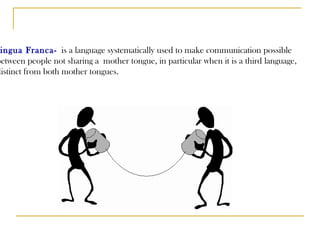
Lingua Franca-  is a language systematically used to make communication possible between people not sharing a mother tongue, in particular when it is a third language, distinct from both mother tongues.
Englishization  -the impact of English on local languages Nativisation  -the impact of local languages on English
WEs - W orld  E ngishe s 1-all varieties of English worldwide and the different approaches used to describe and analyze them 2 -so-called new Englishes in Africa, Asia and Caribbean 3 -pluricentric approach to the study of  English associated with Kachru  (Kachruvian approach) 1=World English (singular) +international English(es) =global English(es) 2= nativised,indigenised, institutionalised=new Englishes=English  as a second language
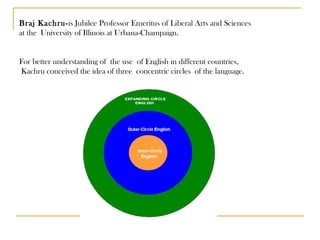
Braj Kachru- is Jubilee Professor Emeritus of Liberal Arts and Sciences  at the University of Illinois at Urbana-Champaign.  For better understanding of  the use  of English in different countries, Kachru conceived the idea of three concentric circles of the language.
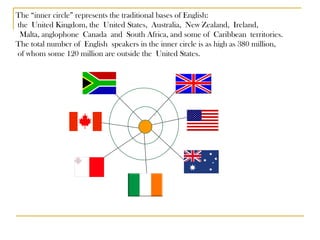
The “inner circle” represents the traditional bases of English: the United Kingdom, the United States, Australia, New Zealand, Ireland,   Malta, anglophone Canada and South Africa, and some of Caribbean territories.  The total number of English speakers in the inner circle is as high as 380 million, of whom some 120 million are outside the United States.
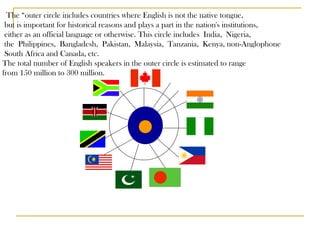
  The “outer circle includes countries where English is not the native tongue, but is important for historical reasons and plays a part in the nation's institutions, either as an official language or otherwise. This circle includes India, Nigeria, the Philippines, Bangladesh, Pakistan, Malaysia, Tanzania, Kenya, non-Anglophone South Africa and Canada, etc.  The total number of English speakers in the outer circle is estimated to range  from 150 million to 300 million.
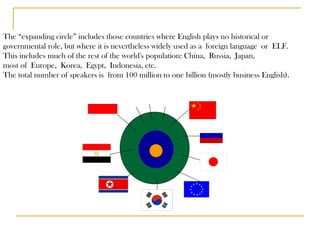
The “expanding circle” includes those countries where English plays no historical or  governmental role, but where it is nevertheless widely used as a foreign language or ELF.  This includes much of the rest of the world's population: China, Russia, Japan,  most of Europe, Korea, Egypt, Indonesia, etc.  The total number of speakers is  from 100 million to one billion (mostly business English).
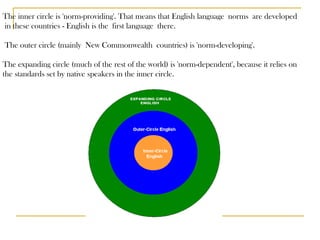
The inner circle is 'norm-providing'. That means that English language norms are developed in these countries - English is the first language there. The outer circle (mainly New Commonwealth countries) is 'norm-developing'.  The expanding circle (much of the rest of the world) is 'norm-dependent', because it relies on  the standards set by native speakers in the inner circle.
Monocentric  views on English-norms of English should be taken from native  speakers communities. Pluricentric  views on English –norms of English  should be based on the local norms  of  English  of the place where English is used.
Problems
International English =?English as an international languages (EIL) International   English -local Englishes of those non-mother tongue countries  where it has an international institutionalized role, some researchers (Gorlach, 1990) include the mother tongue English countries (inner circle) EIL -use of English as a means of international communication  across national and linguistic boundaries (expanding circle) ELF=EIL
Phenomenon of  World Standard (Spoken) English-WSE It is a hypothetical, monolithic form of English, based on the native speaker English, which is developing of its own accord (Crystal, 2003;Gorlach, 1990,McArthur, 1998). Some WEs scholars assume that ELF refers to the same phenomenon as WSE  and then criticize ELF for promoting a monocentric view based on American  and British norms rather than pluricentric view based on local norms.
ELF researchers don’t support the concept of a monolithic English for the entire world.  They seek to identify frequently and systematically used forms that differ from inner circle forms without causing communication problems. At the same time they believe that anyone participating in the international communication needs to be familiar with and have in their linguistic repertoire for use as and when appropriate certain forms (phonological, lexicogrammatical, etc.)  that are widely used and widely intelligible across groups of English speakers from different first language backgrounds.
Recent Developments in  WEs and ELF research
Research activity has increased substantially Kachru(2005) categorizes WEs research interests as follows: the historical background to the spread of English the linguistic processes responsible for features among varieties the sociocultural contexts of English use the impact of English on local languages the impact of  local languages on English bilingualism and multilingualism literary creativity in institutionalized settings the functional allocation of varieties within English-using communities the communicative needs of users underlie observed linguistic differences teaching and learning of English in the outer and expanding circles
There is an increase in dictionaries and grammars of different Englishes: The Macquarie Dictionary (1997)-includes words from a range of southeast  Asian Englishes. Scholarly books: Penningteo(1998) and Bolton(2002)-books on Hong Kong English; Adamson(2004)-on China English; Stanlaw(2004)-on Japanese English; Karchu(2005)-on “the Asianness in Asian Englishes”; Parkir(1992) collection of studies of Singapore English lexis; Brown, Deterding and Ee Ling(2000,2005)-on pronunciation of Singapore English; Bolton(2003)-on China English; Ward(2002)-collection on implications for teaching and learning of Asian Englishes; Cenoz and Jessner(2000), Gnutzmann(1999),Gnutzmann and Intemann(20005), Lesznyak(2004 ) -   studies on teaching, learning and use of English in Europe
Journals on WEs and ELF studies: World Englishes English Worldwide English Today Asian Englishes (published in Tokyo )
Some Key Research Projects  And Controversies
Research on WEs-scholary debate Concept of interlanguage which is relevant for ELF and  expanding  and outer circles varieties of English.
Interlanguage theory by Selinker,1972, 1992): A second language competence lies on an interlanguage continuum  at some point between their L1 and their L2, in this case English. Any differences between their output and standard British or American  English are to be regarded as errors caused mainly by L1 interference (transfer), while the point  at which these so-called errors become fixed within the individual learner’s repertoire is attributed to a phenomenon known as fossilization.
The major argument against IL theory  is that outer circle English speakers are not attempting to identify with inner circle speakers or to produce the norms of an exonormative variety of English grounded in an inner circle experience. Such norms are the results of monolingual bias that is unable to comprehend  the bilingual experience . The major problem of traditional SLA is its focus on individual acquisition and IL errors rather than acquisition by entire speech communities.
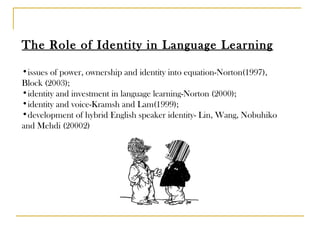
The Role of Identity in Language Learning issues of power, ownership and identity into equation-Norton(1997), Block (2003); identity and investment in language learning-Norton (2000);  identity and voice-Kramsh and Lam(1999); development of hybrid English speaker identity- Lin, Wang, Nobuhiko and Mehdi (20002)
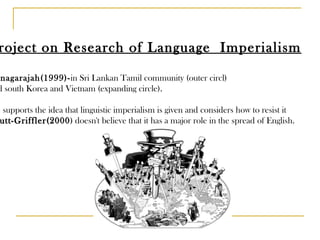
Project on Research of Language  Imperialism Canagarajah(1999)- in Sri Lankan Tamil community (outer circl)  and south Korea and Vietnam (expanding circle). He supports the idea that linguistic imperialism is given and considers how to resist it Brutt-Griffler(2000 )  doesn't believe that it has a major role in the spread of English.
Research on ELF Seidlhofer(2004) focuses on  ELF lexicogrammar. She tries to find out which items are used systematically and frequently, but differently from native speaker use and without causing communication problems.
non-use of the third person  present tense-s interchangeable use of the relative pronouns  who  and  which omission of the definite and indefinite articles use of all-purpose question tag such as isn’t it? or no? instead of shouldn’t they? increasing of redundancy by adding prepositions (we have to study about..) increasing  of explicitness (black color-black, How long time-How long) heavy reliance on certain verbs of high semantic generality such  as do, have, make, put, take pluralisation of nouns which are considered uncountable use of that-causes instead of infinitive constructions (I want that we discuss about my…)
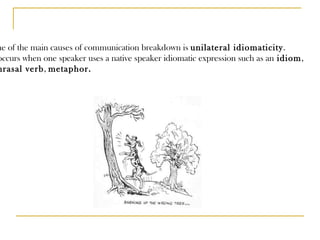
One of the main causes of communication breakdown is  unilateral idiomaticity .  It occurs when one speaker uses a native speaker idiomatic expression such as an  idiom , phrasal verb ,  metaphor.
Debate on The Appropriateness of Native-Speaker Standard English It is difficult to define the term of “standard English”-Seidlhofer(2005): rights of expanding and developing their own norms (outer circle), not to continue to defer to educated native speakers’ norms The belief in native speaker ownership persists among both native and nonnative speakers: teachers, educators, linguists.
Debate on The Concept of Native Speaker Leung, Harris, Rampton(1997) argue against the native-nonnative distinction. American and British English are the only varieties which  considered  worth learning in many parts of the world.  UK and the USA English speakers are the best English teachers as they are native speakers. English villages are established in Japan and Korea –learners are immersed in native speaker English. The native speakers teachers (with no educational background)  are brought to parts of East Asia (the NET scheme in Hong Kong) JET scheme (Japan), Korea, Thailand.
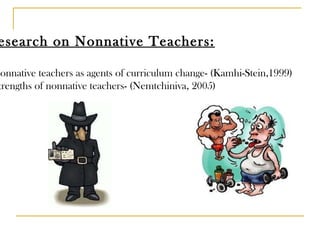
Research on Nonnative Teachers: nonnative teachers as agents of curriculum change- (Kamhi-Stein,1999) strengths of nonnative teachers- (Nemtchiniva, 2005)
Both WEs and ELF researchers agree with: importance of teachers and teacher trainers language awareness in all 3 circles need of pluricentric rather than monocentric approach to the teaching and use of English importance of accommodation skills: WEs and ELF speakers should be able to adjust  their speech in order be intelligible to interlocutors from a wide range of L1 backgrounds, most of whom are not inner circle native speakers
Problems
Testing: to devise the means to distinguish between  a learner’s error and local variety indentify accommodations
Definition of “expert” speaker of English
Lack of Wes and  ELF perspective in teaching materials and books for teachers

Current Prospectives on Teaching WEs and ELF

  • 1.
    Current Perspectives onTeaching World Englishes and English as a Lingua Franca by Jennifer Jenkins
  • 2.
    The purpose ofthe article is to explore recent research into Wes and ELF focusing on its implications for TESOL, and the extent to which it is being taken into account by English language teachers, linguists and SLA researchers.
  • 3.
    TESOL - Teachers of E nglish to S peakers of O ther L anguages
  • 4.
    Lingua Franca-  isa language systematically used to make communication possible between people not sharing a mother tongue, in particular when it is a third language, distinct from both mother tongues.
  • 5.
    Englishization -theimpact of English on local languages Nativisation -the impact of local languages on English
  • 6.
    WEs - World E ngishe s 1-all varieties of English worldwide and the different approaches used to describe and analyze them 2 -so-called new Englishes in Africa, Asia and Caribbean 3 -pluricentric approach to the study of English associated with Kachru (Kachruvian approach) 1=World English (singular) +international English(es) =global English(es) 2= nativised,indigenised, institutionalised=new Englishes=English as a second language
  • 7.
    Braj Kachru- isJubilee Professor Emeritus of Liberal Arts and Sciences at the University of Illinois at Urbana-Champaign. For better understanding of the use of English in different countries, Kachru conceived the idea of three concentric circles of the language.
  • 8.
    The “inner circle”represents the traditional bases of English: the United Kingdom, the United States, Australia, New Zealand, Ireland,   Malta, anglophone Canada and South Africa, and some of Caribbean territories. The total number of English speakers in the inner circle is as high as 380 million, of whom some 120 million are outside the United States.
  • 9.
      The “outercircle includes countries where English is not the native tongue, but is important for historical reasons and plays a part in the nation's institutions, either as an official language or otherwise. This circle includes India, Nigeria, the Philippines, Bangladesh, Pakistan, Malaysia, Tanzania, Kenya, non-Anglophone South Africa and Canada, etc. The total number of English speakers in the outer circle is estimated to range from 150 million to 300 million.
  • 10.
    The “expanding circle”includes those countries where English plays no historical or governmental role, but where it is nevertheless widely used as a foreign language or ELF. This includes much of the rest of the world's population: China, Russia, Japan, most of Europe, Korea, Egypt, Indonesia, etc. The total number of speakers is from 100 million to one billion (mostly business English).
  • 11.
    The inner circleis 'norm-providing'. That means that English language norms are developed in these countries - English is the first language there. The outer circle (mainly New Commonwealth countries) is 'norm-developing'. The expanding circle (much of the rest of the world) is 'norm-dependent', because it relies on the standards set by native speakers in the inner circle.
  • 12.
    Monocentric viewson English-norms of English should be taken from native speakers communities. Pluricentric views on English –norms of English should be based on the local norms of English of the place where English is used.
  • 13.
  • 14.
    International English =?Englishas an international languages (EIL) International English -local Englishes of those non-mother tongue countries where it has an international institutionalized role, some researchers (Gorlach, 1990) include the mother tongue English countries (inner circle) EIL -use of English as a means of international communication across national and linguistic boundaries (expanding circle) ELF=EIL
  • 15.
    Phenomenon of World Standard (Spoken) English-WSE It is a hypothetical, monolithic form of English, based on the native speaker English, which is developing of its own accord (Crystal, 2003;Gorlach, 1990,McArthur, 1998). Some WEs scholars assume that ELF refers to the same phenomenon as WSE and then criticize ELF for promoting a monocentric view based on American and British norms rather than pluricentric view based on local norms.
  • 16.
    ELF researchers don’tsupport the concept of a monolithic English for the entire world. They seek to identify frequently and systematically used forms that differ from inner circle forms without causing communication problems. At the same time they believe that anyone participating in the international communication needs to be familiar with and have in their linguistic repertoire for use as and when appropriate certain forms (phonological, lexicogrammatical, etc.) that are widely used and widely intelligible across groups of English speakers from different first language backgrounds.
  • 17.
    Recent Developments in WEs and ELF research
  • 18.
    Research activity hasincreased substantially Kachru(2005) categorizes WEs research interests as follows: the historical background to the spread of English the linguistic processes responsible for features among varieties the sociocultural contexts of English use the impact of English on local languages the impact of local languages on English bilingualism and multilingualism literary creativity in institutionalized settings the functional allocation of varieties within English-using communities the communicative needs of users underlie observed linguistic differences teaching and learning of English in the outer and expanding circles
  • 19.
    There is anincrease in dictionaries and grammars of different Englishes: The Macquarie Dictionary (1997)-includes words from a range of southeast Asian Englishes. Scholarly books: Penningteo(1998) and Bolton(2002)-books on Hong Kong English; Adamson(2004)-on China English; Stanlaw(2004)-on Japanese English; Karchu(2005)-on “the Asianness in Asian Englishes”; Parkir(1992) collection of studies of Singapore English lexis; Brown, Deterding and Ee Ling(2000,2005)-on pronunciation of Singapore English; Bolton(2003)-on China English; Ward(2002)-collection on implications for teaching and learning of Asian Englishes; Cenoz and Jessner(2000), Gnutzmann(1999),Gnutzmann and Intemann(20005), Lesznyak(2004 ) - studies on teaching, learning and use of English in Europe
  • 20.
    Journals on WEsand ELF studies: World Englishes English Worldwide English Today Asian Englishes (published in Tokyo )
  • 21.
    Some Key ResearchProjects And Controversies
  • 22.
    Research on WEs-scholarydebate Concept of interlanguage which is relevant for ELF and expanding and outer circles varieties of English.
  • 23.
    Interlanguage theory bySelinker,1972, 1992): A second language competence lies on an interlanguage continuum at some point between their L1 and their L2, in this case English. Any differences between their output and standard British or American English are to be regarded as errors caused mainly by L1 interference (transfer), while the point at which these so-called errors become fixed within the individual learner’s repertoire is attributed to a phenomenon known as fossilization.
  • 24.
    The major argumentagainst IL theory is that outer circle English speakers are not attempting to identify with inner circle speakers or to produce the norms of an exonormative variety of English grounded in an inner circle experience. Such norms are the results of monolingual bias that is unable to comprehend the bilingual experience . The major problem of traditional SLA is its focus on individual acquisition and IL errors rather than acquisition by entire speech communities.
  • 25.
    The Role ofIdentity in Language Learning issues of power, ownership and identity into equation-Norton(1997), Block (2003); identity and investment in language learning-Norton (2000); identity and voice-Kramsh and Lam(1999); development of hybrid English speaker identity- Lin, Wang, Nobuhiko and Mehdi (20002)
  • 26.
    Project on Researchof Language Imperialism Canagarajah(1999)- in Sri Lankan Tamil community (outer circl) and south Korea and Vietnam (expanding circle). He supports the idea that linguistic imperialism is given and considers how to resist it Brutt-Griffler(2000 ) doesn't believe that it has a major role in the spread of English.
  • 27.
    Research on ELFSeidlhofer(2004) focuses on ELF lexicogrammar. She tries to find out which items are used systematically and frequently, but differently from native speaker use and without causing communication problems.
  • 28.
    non-use of thethird person present tense-s interchangeable use of the relative pronouns who and which omission of the definite and indefinite articles use of all-purpose question tag such as isn’t it? or no? instead of shouldn’t they? increasing of redundancy by adding prepositions (we have to study about..) increasing of explicitness (black color-black, How long time-How long) heavy reliance on certain verbs of high semantic generality such as do, have, make, put, take pluralisation of nouns which are considered uncountable use of that-causes instead of infinitive constructions (I want that we discuss about my…)
  • 29.
    One of themain causes of communication breakdown is unilateral idiomaticity . It occurs when one speaker uses a native speaker idiomatic expression such as an idiom , phrasal verb , metaphor.
  • 30.
    Debate on TheAppropriateness of Native-Speaker Standard English It is difficult to define the term of “standard English”-Seidlhofer(2005): rights of expanding and developing their own norms (outer circle), not to continue to defer to educated native speakers’ norms The belief in native speaker ownership persists among both native and nonnative speakers: teachers, educators, linguists.
  • 31.
    Debate on TheConcept of Native Speaker Leung, Harris, Rampton(1997) argue against the native-nonnative distinction. American and British English are the only varieties which considered worth learning in many parts of the world. UK and the USA English speakers are the best English teachers as they are native speakers. English villages are established in Japan and Korea –learners are immersed in native speaker English. The native speakers teachers (with no educational background) are brought to parts of East Asia (the NET scheme in Hong Kong) JET scheme (Japan), Korea, Thailand.
  • 32.
    Research on NonnativeTeachers: nonnative teachers as agents of curriculum change- (Kamhi-Stein,1999) strengths of nonnative teachers- (Nemtchiniva, 2005)
  • 33.
    Both WEs andELF researchers agree with: importance of teachers and teacher trainers language awareness in all 3 circles need of pluricentric rather than monocentric approach to the teaching and use of English importance of accommodation skills: WEs and ELF speakers should be able to adjust their speech in order be intelligible to interlocutors from a wide range of L1 backgrounds, most of whom are not inner circle native speakers
  • 34.
  • 35.
    Testing: to devisethe means to distinguish between a learner’s error and local variety indentify accommodations
  • 36.
    Definition of “expert”speaker of English
  • 37.
    Lack of Wesand ELF perspective in teaching materials and books for teachers