English as a global language
Bilingualism
 English as a global language
 The process of Standardization
 Bilingual Education
 Discussion Facilitation by Sarah and Brooke
 Your Teaching Philosophies
 Individual Consultation, meeting
arrangements for the final projects.
 Let’s take a few minutes to reflect on one of
the chapters from this week’s readings.
Share one or more learning points from the
readings. Share one question that you are
wrestling with as future educators.
 Do you have a regional accent?
 Do you reside in Midwest?
 Do you have college education?
 Do you pay attention to your grammar?
 Are you easily understood by ALL?
 Are you always in consensus of others about
what proper English is?
 Language varieties are not superior than one
another
 The issue of standard English is complicated
in the context of World Englishes
 “Standardization” is a political act.
What happens when you have students who
come to class with a home language and
culture that are different from the ones they
encounter in class? How do you
accommodate for all?
Historical Context
• Anglo-Saxon settlement: 5th century
• The Scandinavian settlement: 9th century
• 1066 and on: The Middle English Period
• First Diaspora: Colonization of Americas by
Europeans: Walter Raleigh’s expedition of 1584 to
the New World
• Second Diaspora (1795-on): diffusion of English
within diverse groups of speakers
•
•
7
 In 1900s-Queen’s or King’s English: “good, proper
English)
 In 1930s-British Standard English (BrSE) and
American Standard English (AmSE)
 In the late 20th century- Emergence of traditional
standard English. Coexistence of BrSE and AmSE
with world English or range of world
Englishes…Standard Englishes
8
9
 Supranatural standards: Standard English to
which both US and UK varieties contribute.
 Prevalence and spread of English led to notions
such as World English/World Standard
English/International Standard English
10
The geographical, historical and sociocultural
factors:
1700’s-1800’s 1800’s-1900’s Late 1900’s- Early
2000’s
the language of the
leading colonial
nation
the language of the
leader of the
industrial revolution
the language of the
leading economic
power
Britain Britain the USA
The Big languages/
Regional
Languages
Used by wider
communication
and official
purposes
National languages
Used for primary
education and
local news
Local Vernacular
languages
Used with family
and friends
The Big Languages
English French
Regional Languages
(Languages of the
United Nations)
National Languages
Around 180 languages
serve over 180 nation
states
Official languages
within Nation States
Around 600 languages
worldwide
Local Vernacular
Languages
The remainder of the
world’s
6000+languagnes
 UK and US usage as dual standard in world media.
 The influential model of WE: ESL/EFL/ENL. However, remember
that such notions are also being problemitized and challenged in
today’s fluid circumstances such as the Internet, migration, mass
travel etc.
 We see tensions among the various linguistic standards. There is a
need for some kind of standard international variety for practical
manifestations
 There is more certainty on what users of English will be able to
read and write in order to be understood worldwide. One the other
hand, there is less assurance about how they speak in order to be
understood worldwide.
 There is a wish or need among self-confident L2 users to know
where they stand within the framework of complex WE. Do they
have a full voice? Does NS respect their investment to this
language? Can they talk back as equals?
13
 ELT was always a significant part of colonial
policy. Where the empire spread so did English
(Pennycook, 1998 p.20)
 English=Power (e.g. material, symbolic and
cultural capital) Colonizers vs colonized
 Linguistic Imperialism (Phillipson, 1992): the
spread of English within British and American
colonies. Leads to structural and cultural
inequalities.
14
 English is best taught monolingually
 The ideal of English teacher is a native speaker
 The earlier english is taught the better the
results are.
 If other languages are used much, standars of
english will drop.
 Core English speaking countries vs periphery
countries (Nigeria, India, Singapore)
15
 Periphery:
1) “countries that require English as an
international link”—Japan, Korea, Italy, Turkey
2) “and those who use it intranational
purposes”—India, Singapore (former colonial
countries
 Center:
Countries in the Inner circle (USA, UK, New
Zealand, Australia)
16
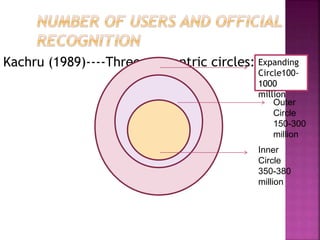
Kachru (1989)----Three concentric circles: Expanding
Circle100-
1000
million
Outer
Circle
150-300
million
Inner
Circle
350-380
million
The 19th century promoted this belief: “
Knowing Enlighs is like possessing the fabeled
alladdin’s lamp, which permits one to open, as
it were, the linguisitc gates to international
business, technology, service, science and
travel”(p.1)
“ English is used official of semi-official
language in 60 courtiers, and had a prominent
place in a further 20…Over two-thirds of the
world’s scientists write in English. The
quarters of the world’s mail is written in
English” Crystal (1987)
18
 Pennycook endorses Phillipson’s view and also
thinks that Anglophone countries (Britain and
America) have promoted English because of
economic and political reasons.
19
 The estimate of the number of speakers of
English:
 native or native-like----670 million;
 Reasonable competence 1800 million;
 NNES1200-1500 million.
1. Economic Incentives (e.g. outsourcing,
international corporations)
2. Educational Incentives (e.g. dominated by NS
model and SE)
3. Mass media Incentives (e.g. US controls 75
percent of the world film market)
21
 What are your views on English as an
international language? Do you agree that the
spread of English creates social and cultural
inequalities in the world and in the ELT
profession?
 How do you think English Language Teaching
(ELT) profession can help eradicate/fight
linguicism?
22
 Read and blog about the assessment article
 Collect your observation reports and draft
your teaching philosophy.
 Email me as a group to arrange an individual
group meeting right after the thanksgiving
break!
 Contribute to our class article on Waiting for
Superman (optional)
 Enjoy the break, TESOLers!

English 345 week 13

  • 1.
    English as aglobal language Bilingualism
  • 2.
     English asa global language  The process of Standardization  Bilingual Education  Discussion Facilitation by Sarah and Brooke  Your Teaching Philosophies  Individual Consultation, meeting arrangements for the final projects.
  • 3.
     Let’s takea few minutes to reflect on one of the chapters from this week’s readings. Share one or more learning points from the readings. Share one question that you are wrestling with as future educators.
  • 4.
     Do youhave a regional accent?  Do you reside in Midwest?  Do you have college education?  Do you pay attention to your grammar?  Are you easily understood by ALL?  Are you always in consensus of others about what proper English is?
  • 5.
     Language varietiesare not superior than one another  The issue of standard English is complicated in the context of World Englishes  “Standardization” is a political act. What happens when you have students who come to class with a home language and culture that are different from the ones they encounter in class? How do you accommodate for all?
  • 7.
    Historical Context • Anglo-Saxonsettlement: 5th century • The Scandinavian settlement: 9th century • 1066 and on: The Middle English Period • First Diaspora: Colonization of Americas by Europeans: Walter Raleigh’s expedition of 1584 to the New World • Second Diaspora (1795-on): diffusion of English within diverse groups of speakers • • 7
  • 8.
     In 1900s-Queen’sor King’s English: “good, proper English)  In 1930s-British Standard English (BrSE) and American Standard English (AmSE)  In the late 20th century- Emergence of traditional standard English. Coexistence of BrSE and AmSE with world English or range of world Englishes…Standard Englishes 8
  • 9.
  • 10.
     Supranatural standards:Standard English to which both US and UK varieties contribute.  Prevalence and spread of English led to notions such as World English/World Standard English/International Standard English 10
  • 11.
    The geographical, historicaland sociocultural factors: 1700’s-1800’s 1800’s-1900’s Late 1900’s- Early 2000’s the language of the leading colonial nation the language of the leader of the industrial revolution the language of the leading economic power Britain Britain the USA
  • 12.
    The Big languages/ Regional Languages Usedby wider communication and official purposes National languages Used for primary education and local news Local Vernacular languages Used with family and friends The Big Languages English French Regional Languages (Languages of the United Nations) National Languages Around 180 languages serve over 180 nation states Official languages within Nation States Around 600 languages worldwide Local Vernacular Languages The remainder of the world’s 6000+languagnes
  • 13.
     UK andUS usage as dual standard in world media.  The influential model of WE: ESL/EFL/ENL. However, remember that such notions are also being problemitized and challenged in today’s fluid circumstances such as the Internet, migration, mass travel etc.  We see tensions among the various linguistic standards. There is a need for some kind of standard international variety for practical manifestations  There is more certainty on what users of English will be able to read and write in order to be understood worldwide. One the other hand, there is less assurance about how they speak in order to be understood worldwide.  There is a wish or need among self-confident L2 users to know where they stand within the framework of complex WE. Do they have a full voice? Does NS respect their investment to this language? Can they talk back as equals? 13
  • 14.
     ELT wasalways a significant part of colonial policy. Where the empire spread so did English (Pennycook, 1998 p.20)  English=Power (e.g. material, symbolic and cultural capital) Colonizers vs colonized  Linguistic Imperialism (Phillipson, 1992): the spread of English within British and American colonies. Leads to structural and cultural inequalities. 14
  • 15.
     English isbest taught monolingually  The ideal of English teacher is a native speaker  The earlier english is taught the better the results are.  If other languages are used much, standars of english will drop.  Core English speaking countries vs periphery countries (Nigeria, India, Singapore) 15
  • 16.
     Periphery: 1) “countriesthat require English as an international link”—Japan, Korea, Italy, Turkey 2) “and those who use it intranational purposes”—India, Singapore (former colonial countries  Center: Countries in the Inner circle (USA, UK, New Zealand, Australia) 16
  • 17.
    Kachru (1989)----Three concentriccircles: Expanding Circle100- 1000 million Outer Circle 150-300 million Inner Circle 350-380 million
  • 18.
    The 19th centurypromoted this belief: “ Knowing Enlighs is like possessing the fabeled alladdin’s lamp, which permits one to open, as it were, the linguisitc gates to international business, technology, service, science and travel”(p.1) “ English is used official of semi-official language in 60 courtiers, and had a prominent place in a further 20…Over two-thirds of the world’s scientists write in English. The quarters of the world’s mail is written in English” Crystal (1987) 18
  • 19.
     Pennycook endorsesPhillipson’s view and also thinks that Anglophone countries (Britain and America) have promoted English because of economic and political reasons. 19
  • 20.
     The estimateof the number of speakers of English:  native or native-like----670 million;  Reasonable competence 1800 million;  NNES1200-1500 million.
  • 21.
    1. Economic Incentives(e.g. outsourcing, international corporations) 2. Educational Incentives (e.g. dominated by NS model and SE) 3. Mass media Incentives (e.g. US controls 75 percent of the world film market) 21
  • 22.
     What areyour views on English as an international language? Do you agree that the spread of English creates social and cultural inequalities in the world and in the ELT profession?  How do you think English Language Teaching (ELT) profession can help eradicate/fight linguicism? 22
  • 23.
     Read andblog about the assessment article  Collect your observation reports and draft your teaching philosophy.  Email me as a group to arrange an individual group meeting right after the thanksgiving break!  Contribute to our class article on Waiting for Superman (optional)  Enjoy the break, TESOLers!

Editor's Notes

  • #8 Germanic invaders came and settled in Britain from the north-western coastline of continental Europe in the fifth and sixth centuries. The invaders all spoke a language that was Germanic (related to what emerged as Dutch, Frisian, German and the Scandinavian languages, and to Gothic) The reason that we know so little about the linguistic situation in this period is because we do not have much in the way of written records from any of the Germanic languages of north-western Europe until several centuries later. The Celts were already resident in Britain when the Anglo-Saxons arrived, but there are few obvious traces of their language in English today. Some scholars have suggested that the Celtic tongue might have had an underlying influence on the grammatical development of English, The next invaders were the Norsemen. From the middle of the ninth century large numbers of Norse invaders settled in Britain, particularly in northern English also changed enormously, with tremendous numbers of borrowings from French and Latin, in addition to the Scandinavian loanwords already mentioned, which were slowly starting to appear in the written language. Old English, like German today, showed a tendency to find native equivalents for foreign words and phrases (although both Old English and modern German show plenty of loanwords), whereas Middle English acquired the habit that modern English retains today of readily accommodating foreign words. Trilingualism in English, French, and Latin was common in the worlds of business and the professions, with words crossing over from one language to another with ease. One In this period english speakers from england, scotland and ireland migrated to North America, australia and new zeland. Walter Raleigh’s first expediation did not result in settlement. They landed on the north carolina and fell into conflicts with Indian population. We don’t know too much about this period as we don’t have much written documentation. Second Diaspora: took place in 18th and 19th century—uincludes the history of english in colonial africa –how it spread in east africa, west africa (ghana, nigeria, camneroon. East africa—Uganda, malawi, zimbabwe
  • #15 Colonialism fueled the discourse of Other and Self—Other was portraid as backward, dirty, primative (said’s oriantalism) while colonizers and their language were portrayed as modern, civilized , superior and advanced Phillips:
  • #16 Economic powers of the center : the dominance of english is asserted and maintained by the establishment and continious reconstruction of structural and cultural inequalities between english and other languages
  • #19 We—mostly associated with the work of B.KACHRU
  • #22 English language is central in many capitalistic deeds and endevours today. E.G. OUTSOURCING, INTERNATIONAL COORPORATIONS, THE TENENT THAT students will benefit from NS, pressure to publish in english—see different ministry of educations around the world (E.G. South Korea’s pushing for English only public school, many asian countries are promoting early enligh learning. Many students are enoucraged to go abroad and study in an english speaking country. Music industry, advertising, movies (US controls 75 percent of the world film market)