








Improving End of Life Care
TDA Workshop
Wednesday 18 November
14:00 – 15:00
Welcome and Introduction
Peter Blythin
Purpose of Workshop 
Development and Support to enhance the quality of end of life care
Share improvement proposal based on Transform Programme
Understand your initial requirements for support 
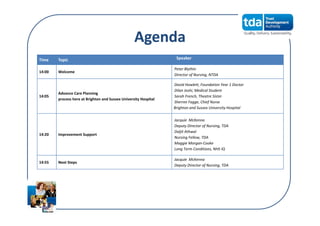
Agenda
Time Topic Speaker
14:00 Welcome 
Peter Blythin
Director of Nursing, NTDA
14:05
Advance Care Planning
process here at Brighton and Sussex University Hospital
David Howlett, Foundation Year 1 Doctor
Dilan Joshi, Medical Student
Sarah French, Theatre Sister
Sherree Fagge, Chief Nurse
Brighton and Sussex University Hospital
14:20 Improvement Support
Jacquie  McKenna
Deputy Director of Nursing, TDA
Daljit Athwal
Nursing Fellow, TDA
Maggie Morgan‐Cooke
Long Term Conditions, NHS IQ
14:55 Next Steps
Jacquie  McKenna
Deputy Director of Nursing, TDA
Advance Care Planning
process here at BSUH
Transforming End of Life Care in
Acute Hospitals Conference
18 November 2015
David Howlett
Foundation Year 1 Doctor
Dilan Joshi
Medical Student
Sarah French
Theatre Sister
Sherree Fagge
Chief Nurse
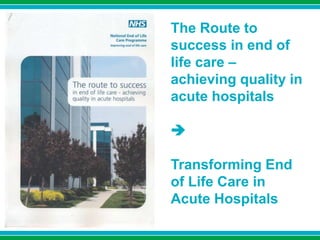
The Route to
success in end of
life care –
achieving quality in
acute hospitals

Transforming End
of Life Care in
Acute Hospitals
Five key enablers
1. Advance Care Planning process
2. ShareMyCare our Electronic Palliative
Care Coordination System (EPaCCS)
3. AMBER care bundle
4. Rapid Discharge Pathway for the dying
patient who would like to die at home
5. The Priorities of Care of the Dying Person
What are we doing?
Major focus at BSUH
for all staff on a
personal and professional level
Advance Care Planning
process
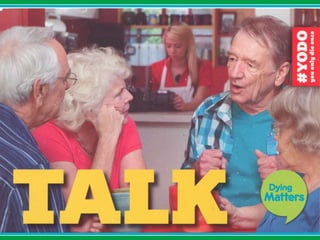
I didn’t want that video
(Dying Matters 2012)
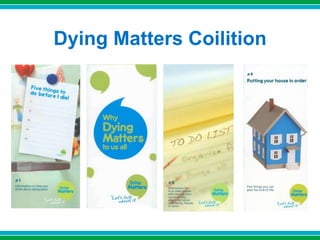
Dying Matters Coilition
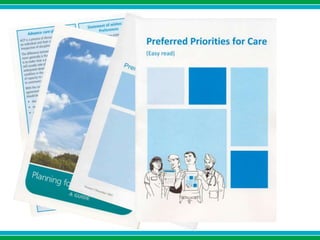
Advance Care Planning in Kent,
Surrey and Sussex:
A Report and Recommendations
from the South East Coast Clinical
Senate
Five key enablers
1. Advance Care Planning process
2. ShareMyCare our Electronic Palliative
Care Coordination System (EPaCCS)
3. AMBER care bundle
4. Rapid Discharge Pathway for the dying
patient who would like to die at home
5. The Priorities of Care of the Dying Person
• Engagement & Networking
– End of Life Care Links for all clinical areas
• Education
– End of Life Care Education Series
– End of Life Care Study Days
– End of Life Care Link Workshops
– End of Life Care Newsletter
– End of Life Care Intranet Site
– End of Life Care Conference
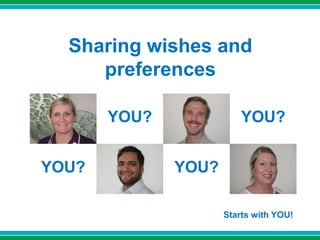
Sharing wishes and
preferences
Starts with YOU!
YOU?
Context
• Identified Trusts assessed as inadequate or 
requires improvement
• Key national imperative
• TDA working in collaboration with NHS England, 
The National Council for Palliative Care and 
Macmillan
• Part of CQC eight core services inspected
CQC reports – positive themes
• Caring and compassionate staff
• Specialist team working 
relationships
• Communication with relatives 
and patients
CQC reports – improvement 
themes
• Documentation – DNA CPR forms and personalised care plans
• Leadership and strategy
• Mental Capacity – assessments, DNA CPR, staff knowledge
• EoLC Training
• National guidance – post LPC
• Identifying EoLC patients
• Lack of measures re care and experience
• Staffing levels –impacting opportunities
• Incident reporting – inconsistencies, learning
• Discharge of EoLC patients
The six ambitions for palliative and 
end of life care
1. Each person is seen as an individual
I, and the people important to me, have opportunities to have honest, informed 
and timely conversations and to know that I might die soon. I am asked what 
matters most to me. Those who care for me know that and work with me to do 
what’s possible.
2. Maximising comfort and wellbeing
My care is regularly reviewed and every effort is made for me to have the support, 
care and treatment that might be needed to help me to be as comfortable and as 
free from distress as possible
3. Each person gets fair access to care
I live in a society where I get good end of life care regardless of who I am,    where I 
live or the circumstances of my life.
The six ambitions for palliative and 
end of life care4. Care is coordinated
I get the right help at the right time from the right people. I have a team around 
me who know my needs and my plans and work together to help me achieve 
them. I can always reach someone who will listen and respond at any time of the 
day or night.
5. All staff are prepared to care
Wherever I am, health and care staff bring empathy, skills and expertise and give 
me competent, confident and compassionate care.
6. Each community is prepared to help
I live in a community where everybody recognises that we all have a role to play 
in supporting each other in times of crisis and loss. People are ready, willing and 
confident to have conversations about living and dying well and to support each 
other in emotional and practical ways
What support do you need
Consider following 3 areas:
1. What are the barriers you are facing which 
get in the way of delivering high quality End 
of Life Care?
2. Where there is good practice in your Trust, 
what supports/facilitates this?
3. Where/what support do you need to 
improve?
Supporting You ‐ Plan
• Year Long Improvement Programme – Transform
• Rough timescales
‐ November 2015 to January 2016 – Diagnostics to 
understand Trust requirements
‐ February 2016 to March 2016 – Improvement Agreements
‐ April 2016 to November 2016 – Implement and Evaluate
• Monthly telecon
• Learning Webex Events
• Trust Visits
Thank you
Anything else?

Transforming End of Life Care in Acute Hospitals PM Workshop 2: NHS Trust Development Authority