Risk Assessment Tools
Clinical Risk Assessment Tools
The Office of the Senior Practitioner DHS, defines risk as
“The chance of somebody getting hurt, being in danger, or
doing something dangerous to other people.”
Clinical Risk Assessment Tools
Clinical Risk Assessment Tools are specific assessments that
are used to measure levels of risk for certain situations,
procedures and outcomes.
Clinical Risk Assessment Tools
In the clinical setting, nurses use a variety of clinical risk
assessment tools that will help with the patients care.
Clinical Risk Assessment Tools
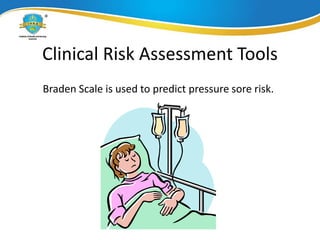
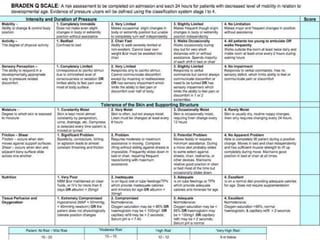
Braden Scale is used to predict pressure sore risk.
Clinical Risk Assessment Tools
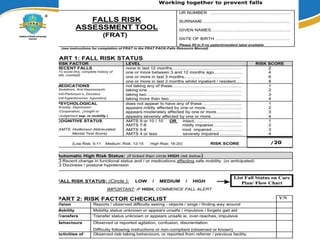
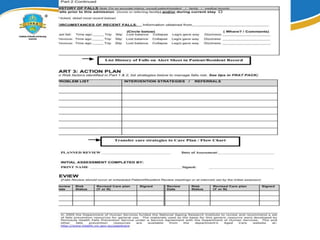
Falls Risk Assessment is
used to predict the
likelihood of a fall
occurring.
Clinical Risk Assessment Tools
• The Women’s defines Clinical risk management as
“an approach to improving the quality and safety of
health care by identifying circumstances that put
patients at risk and then acting to prevent or control
those risks.”
• Clinical Risk is usually reviewed by the Quality
Committee.
Clinical Risk Assessment Tools
The Women’s defines Clinical risk management as “an
approach to improving the quality and safety of health
care by identifying circumstances that put patients at
risk and then acting to prevent or control those risks.”
Clinical Risk Assessment Tools
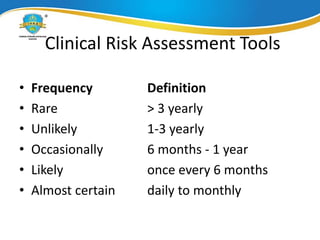
• Frequency Definition
• Rare > 3 yearly
• Unlikely 1-3 yearly
• Occasionally 6 months - 1 year
• Likely once every 6 months
• Almost certain daily to monthly
Clinical Risk Assessment Tools
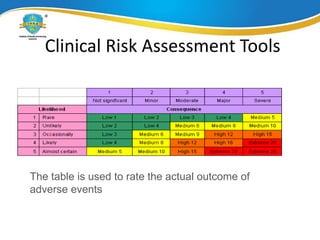
The table is used to rate the actual outcome of
adverse events
Nursing Care Plans, Clinical Pathways
and Clinical Risk Assessment Tools
Clinical Risk Assessment Tools should be filled out on
admission so that clinical pathways and nursing care plans
can meet the needs of the patient.
References
• Queensland Health 2009, Clinical Pathways, Queensland
Government, viewed 11th October 2010
http://www.health.qld.gov.au/cpic/service_improve/clinical_pathw
ays.asp
• The Office of Senior Practitioner 2009, Positive solutions in practice:
clinical risk assessment and management in people with an
intellectual disability, State Government Victoria, viewed 11th
October 2010
• http://www.dhs.vic.gov.au/__data/assets/pdf_file/0003/432489/os
p_clinicalriskassessriskmanageinpeoplewithintellectdis_easyread_p
df_0510.pdf
References
• Aged care in Victoria 2009, Falls Risk Assessment Tool (FRAT),
Victorian Government Health Information, viewed 11th
October 2010,
http://www.health.vic.gov.au/agedcare/maintaining/falls/pro
viders/rac/plans_frat.htm
• Our Organisation The Women’s 2010, Risk Management
Guidelines, The Royal Women’s Hospital, viewed 11th October
2010,
http://intranet.thewomens.org.au/RiskManagementGuideline
s?searchTerms[]=risk&searchTerms[]=assessment
IHNA offers qualifications in aged
care, disability and nursing. Go to
http://www.ihna.edu.au to kick
start your health career.
Thank you for
viewing this
presentation!

Tools for Risk Assessment in Nursing - Return to Nursing Program

  • 1.
  • 2.
    Clinical Risk AssessmentTools The Office of the Senior Practitioner DHS, defines risk as “The chance of somebody getting hurt, being in danger, or doing something dangerous to other people.”
  • 3.
    Clinical Risk AssessmentTools Clinical Risk Assessment Tools are specific assessments that are used to measure levels of risk for certain situations, procedures and outcomes.
  • 4.
    Clinical Risk AssessmentTools In the clinical setting, nurses use a variety of clinical risk assessment tools that will help with the patients care.
  • 5.
    Clinical Risk AssessmentTools Braden Scale is used to predict pressure sore risk.
  • 7.
    Clinical Risk AssessmentTools Falls Risk Assessment is used to predict the likelihood of a fall occurring.
  • 10.
    Clinical Risk AssessmentTools • The Women’s defines Clinical risk management as “an approach to improving the quality and safety of health care by identifying circumstances that put patients at risk and then acting to prevent or control those risks.” • Clinical Risk is usually reviewed by the Quality Committee.
  • 11.
    Clinical Risk AssessmentTools The Women’s defines Clinical risk management as “an approach to improving the quality and safety of health care by identifying circumstances that put patients at risk and then acting to prevent or control those risks.”
  • 12.
    Clinical Risk AssessmentTools • Frequency Definition • Rare > 3 yearly • Unlikely 1-3 yearly • Occasionally 6 months - 1 year • Likely once every 6 months • Almost certain daily to monthly
  • 13.
    Clinical Risk AssessmentTools The table is used to rate the actual outcome of adverse events
  • 14.
    Nursing Care Plans,Clinical Pathways and Clinical Risk Assessment Tools Clinical Risk Assessment Tools should be filled out on admission so that clinical pathways and nursing care plans can meet the needs of the patient.
  • 15.
    References • Queensland Health2009, Clinical Pathways, Queensland Government, viewed 11th October 2010 http://www.health.qld.gov.au/cpic/service_improve/clinical_pathw ays.asp • The Office of Senior Practitioner 2009, Positive solutions in practice: clinical risk assessment and management in people with an intellectual disability, State Government Victoria, viewed 11th October 2010 • http://www.dhs.vic.gov.au/__data/assets/pdf_file/0003/432489/os p_clinicalriskassessriskmanageinpeoplewithintellectdis_easyread_p df_0510.pdf
  • 16.
    References • Aged carein Victoria 2009, Falls Risk Assessment Tool (FRAT), Victorian Government Health Information, viewed 11th October 2010, http://www.health.vic.gov.au/agedcare/maintaining/falls/pro viders/rac/plans_frat.htm • Our Organisation The Women’s 2010, Risk Management Guidelines, The Royal Women’s Hospital, viewed 11th October 2010, http://intranet.thewomens.org.au/RiskManagementGuideline s?searchTerms[]=risk&searchTerms[]=assessment
  • 17.
    IHNA offers qualificationsin aged care, disability and nursing. Go to http://www.ihna.edu.au to kick start your health career. Thank you for viewing this presentation!