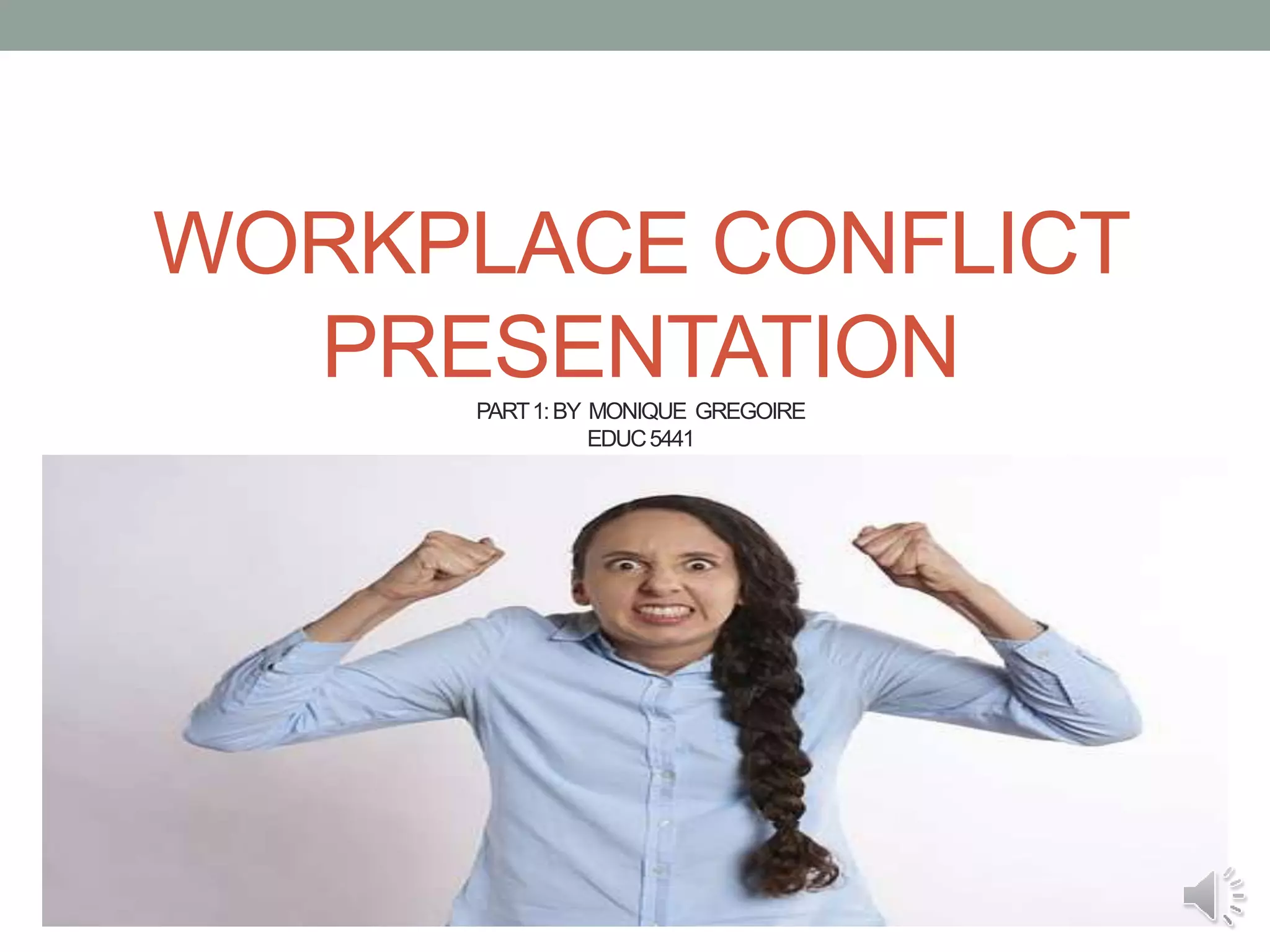
WORKPLACE CONFLICT
PRESENTATIONPART1:BY MONIQUE GREGOIRE
EDUC5441
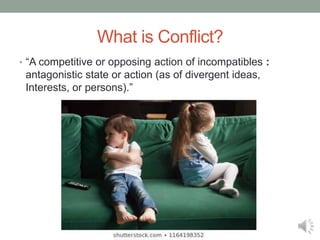
What is Conflict?
• “A competitive or opposing action of incompatibles :
antagonistic state or action (as of divergent ideas,
Interests, or persons).”
The Scenario
Two people at work have been assigned to teach health
and safety workshops. They have both taken their
assignments to whole new level, and think they are now at
a management level. The staff are becoming uncomfortable
with their attitude and behavior which is causing animosity.
Everyone is speaking poorly about them, and no-one cares
to work with either person. What are the options?
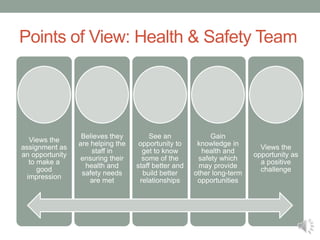
Points of View: Health & Safety Team
Views the
assignment as
an opportunity
to make a
good
impression
Believes they
are helping the
staff in
ensuring their
health and
safety needs
are met
See an
opportunity to
get to know
some of the
staff better and
build better
relationships
Gain
knowledge in
health and
safety which
may provide
other long-term
opportunities
Views the
opportunity as
a positive
challenge
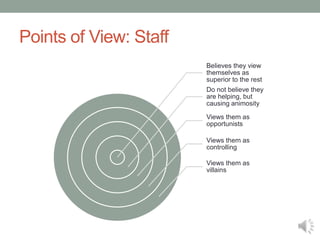
Points of View: Staff
Believes they view
themselves as
superior to the rest
Do not believe they
are helping, but
causing animosity
Views them as
opportunists
Views them as
controlling
Views them as
villains
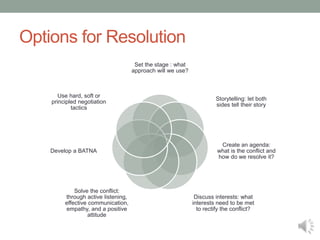
Options for Resolution
Set the stage : what
approach will we use?
Storytelling: let both
sides tell their story
Create an agenda:
what is the conflict and
how do we resolve it?
Discuss interests: what
interests need to be met
to rectify the conflict?
Solve the conflict:
through active listening,
effective communication,
empathy, and a positive
attitude
Develop a BATNA
Use hard, soft or
principled negotiation
tactics
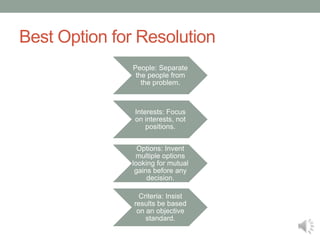
Best Option for Resolution
People: Separate
the people from
the problem.
Interests: Focus
on interests, not
positions.
Options: Invent
multiple options
looking for mutual
gains before any
decision.
Criteria: Insist
results be based
on an objective
standard.
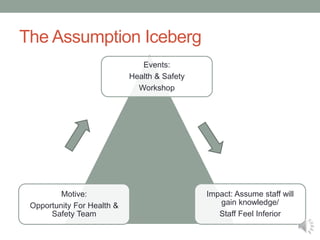
The Assumption Iceberg
Events:
Health & Safety
Workshop
Motive:
Opportunity For Health &
Safety Team
Impact: Assume staff will
gain knowledge/
Staff Feel Inferior
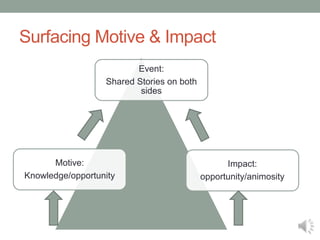
Event:
Shared Stories on both
sides
Motive:
Knowledge/opportunity
Impact:
opportunity/animosity
Surfacing Motive & Impact
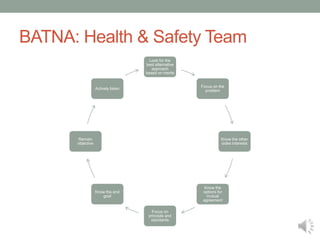
BATNA: Health & Safety Team
Look for the
best alternative
approach
based on merits
Focus on the
problem
Know the other
sides interests
Know the
options for
mutual
agreement
Focus on
principle and
standards
Know the end
goal
Remain
objective
Actively listen
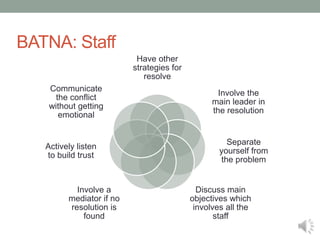
BATNA: Staff
Have other
strategies for
resolve
Involve the
main leader in
the resolution
Separate
yourself from
the problem
Discuss main
objectives which
involves all the
staff
Involve a
mediator if no
resolution is
found
Actively listen
to build trust
Communicate
the conflict
without getting
emotional
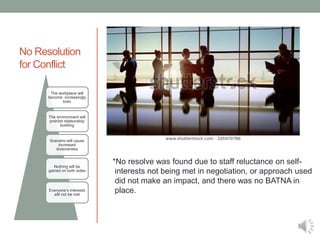
No Resolution
for Conflict
The workplace will
become increasingly
toxic
The environment will
prohibit relationship
building
Scenario will cause
increased
divisiveness
Nothing will be
gained on both sides
Everyone’s interests
will not be met
*No resolve was found due to staff reluctance on self-
interests not being met in negotiation, or approach used
did not make an impact, and there was no BATNA in
place.
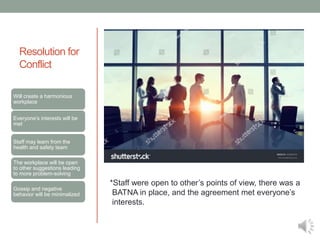
Resolution for
Conflict
Will create a harmonious
workplace
Everyone’s interests will be
met
Staff may learn from the
health and safety team
The workplace will be open
to other suggestions leading
to more problem-solving
Gossip and negative
behavior will be minimalized
*Staff were open to other’s points of view, there was a
BATNA in place, and the agreement met everyone’s
interests.
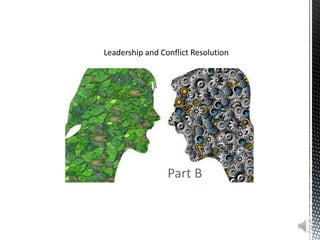
Part B
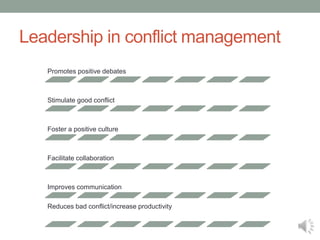
Leadership in conflict management
Promotes positive debates
Stimulate good conflict
Foster a positive culture
Facilitate collaboration
Improves communication
Reduces bad conflict/increase productivity
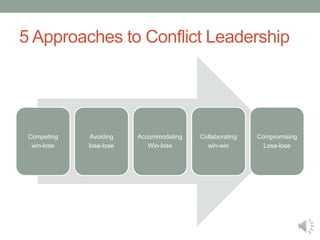
5 Approaches to Conflict Leadership
Competing
win-lose
Avoiding
lose-lose
Accommodating
Win-lose
Collaborating
win-win
Compromising
Lose-lose
Impact on Workplace
The type of conflict management approach creates a positive or negative impact in the
workplace. Leaders who gain trust, act with integrity, actively listen, and alter their
leadership style to resolve different types of conflict to lessen negative impact are more likely to:
- Create a harmonious workplace
- Endure low levels of conflict among team members
- Respect differences
- Possess greater self-awareness
- Address the conflict immediately
Reference
Fisher, R., Ury, W. (2011). Getting to Yes: Negotiating Agreement Without Giving In. London, UK: Penguin Group
Harper, G. (2004). The Joy of Conflict Resolution: Transforming Victims, Villains and Heroes in the Workplace and at Home.
Gabriola Island, BC: New Society Publishers
Konstantin, Y. (n.d). Image. Retrieved from https://www.shutterstock.com/image-photo/team-successful-business-people-
105970766?id=105970766&irgwc=1&utm_medium=Affiliate&utm_campaign=Pavel+Nemec&utm_source=46297&utm_term
Merriam-Webster Dictionary. (2019). Definition of Conflict. Retrieved from https://www.merriam-webster.com/dictionary/conflict
Nivens, S. (n.d). Image. Retrieved from https://www.shutterstock.com/image-photo/silhouettes-business-people-office-mixed-
media-455859976
Pixabay. (2019). Conflict Image. Retrieved from https://pixabay.com/images/search/conflict/
Pixabay. (2019). Conflict Image. Retrieved from https://pixabay.com/illustrations/conflict-ecology-environment-1445377
Sahu, S., Pathardikar, A.D. (2015). Managing Conflict Through Transformational Leadership. Is Collaborative Style a Solution?
Delhi Business Review, Vol. 16 No.1. Retrieved from
https://www.researchgate.net/publication/289723549_MANAGING_CONFLICT_THROUGH_TRANSFORMATIONAL_LEADE
RSHIP_IS_COLLABORATIVE_STYLE_A_SOLUTION

Workplace conflict presentation

  • 1.
  • 2.
    What is Conflict? •“A competitive or opposing action of incompatibles : antagonistic state or action (as of divergent ideas, Interests, or persons).”
  • 3.
    The Scenario Two peopleat work have been assigned to teach health and safety workshops. They have both taken their assignments to whole new level, and think they are now at a management level. The staff are becoming uncomfortable with their attitude and behavior which is causing animosity. Everyone is speaking poorly about them, and no-one cares to work with either person. What are the options?
  • 4.
    Points of View:Health & Safety Team Views the assignment as an opportunity to make a good impression Believes they are helping the staff in ensuring their health and safety needs are met See an opportunity to get to know some of the staff better and build better relationships Gain knowledge in health and safety which may provide other long-term opportunities Views the opportunity as a positive challenge
  • 5.
    Points of View:Staff Believes they view themselves as superior to the rest Do not believe they are helping, but causing animosity Views them as opportunists Views them as controlling Views them as villains
  • 6.
    Options for Resolution Setthe stage : what approach will we use? Storytelling: let both sides tell their story Create an agenda: what is the conflict and how do we resolve it? Discuss interests: what interests need to be met to rectify the conflict? Solve the conflict: through active listening, effective communication, empathy, and a positive attitude Develop a BATNA Use hard, soft or principled negotiation tactics
  • 7.
    Best Option forResolution People: Separate the people from the problem. Interests: Focus on interests, not positions. Options: Invent multiple options looking for mutual gains before any decision. Criteria: Insist results be based on an objective standard.
  • 8.
    The Assumption Iceberg Events: Health& Safety Workshop Motive: Opportunity For Health & Safety Team Impact: Assume staff will gain knowledge/ Staff Feel Inferior
  • 9.
    Event: Shared Stories onboth sides Motive: Knowledge/opportunity Impact: opportunity/animosity Surfacing Motive & Impact
  • 10.
    BATNA: Health &Safety Team Look for the best alternative approach based on merits Focus on the problem Know the other sides interests Know the options for mutual agreement Focus on principle and standards Know the end goal Remain objective Actively listen
  • 11.
    BATNA: Staff Have other strategiesfor resolve Involve the main leader in the resolution Separate yourself from the problem Discuss main objectives which involves all the staff Involve a mediator if no resolution is found Actively listen to build trust Communicate the conflict without getting emotional
  • 12.
    No Resolution for Conflict Theworkplace will become increasingly toxic The environment will prohibit relationship building Scenario will cause increased divisiveness Nothing will be gained on both sides Everyone’s interests will not be met *No resolve was found due to staff reluctance on self- interests not being met in negotiation, or approach used did not make an impact, and there was no BATNA in place.
  • 13.
    Resolution for Conflict Will createa harmonious workplace Everyone’s interests will be met Staff may learn from the health and safety team The workplace will be open to other suggestions leading to more problem-solving Gossip and negative behavior will be minimalized *Staff were open to other’s points of view, there was a BATNA in place, and the agreement met everyone’s interests.
  • 14.
  • 15.
    Leadership in conflictmanagement Promotes positive debates Stimulate good conflict Foster a positive culture Facilitate collaboration Improves communication Reduces bad conflict/increase productivity
  • 16.
    5 Approaches toConflict Leadership Competing win-lose Avoiding lose-lose Accommodating Win-lose Collaborating win-win Compromising Lose-lose
  • 17.
    Impact on Workplace Thetype of conflict management approach creates a positive or negative impact in the workplace. Leaders who gain trust, act with integrity, actively listen, and alter their leadership style to resolve different types of conflict to lessen negative impact are more likely to: - Create a harmonious workplace - Endure low levels of conflict among team members - Respect differences - Possess greater self-awareness - Address the conflict immediately
  • 18.
    Reference Fisher, R., Ury,W. (2011). Getting to Yes: Negotiating Agreement Without Giving In. London, UK: Penguin Group Harper, G. (2004). The Joy of Conflict Resolution: Transforming Victims, Villains and Heroes in the Workplace and at Home. Gabriola Island, BC: New Society Publishers Konstantin, Y. (n.d). Image. Retrieved from https://www.shutterstock.com/image-photo/team-successful-business-people- 105970766?id=105970766&irgwc=1&utm_medium=Affiliate&utm_campaign=Pavel+Nemec&utm_source=46297&utm_term Merriam-Webster Dictionary. (2019). Definition of Conflict. Retrieved from https://www.merriam-webster.com/dictionary/conflict Nivens, S. (n.d). Image. Retrieved from https://www.shutterstock.com/image-photo/silhouettes-business-people-office-mixed- media-455859976 Pixabay. (2019). Conflict Image. Retrieved from https://pixabay.com/images/search/conflict/ Pixabay. (2019). Conflict Image. Retrieved from https://pixabay.com/illustrations/conflict-ecology-environment-1445377 Sahu, S., Pathardikar, A.D. (2015). Managing Conflict Through Transformational Leadership. Is Collaborative Style a Solution? Delhi Business Review, Vol. 16 No.1. Retrieved from https://www.researchgate.net/publication/289723549_MANAGING_CONFLICT_THROUGH_TRANSFORMATIONAL_LEADE RSHIP_IS_COLLABORATIVE_STYLE_A_SOLUTION

Editor's Notes

  • #2 Image: Pixabay. (2019). Retrieved from https://pixabay.com/images/search/conflict/
  • #3 Merriam-Webster Dictionary. (2019). Definition of Conflict. Retrieved from https://www.merriam-webster.com/dictionary/conflict Image: Pixabay. (2019). Retrieved from https://pixabay.com/images/search/conflict/
  • #7 Harper, G. (2004). The Joy of Conflict Resolution: Transforming Victims, Villains and Heroes in the Workplace and at Home. Gabriola Island, BC: New Society Publishers
  • #8 Fisher, R., Ury, W. (2011). Getting to Yes: Negotiating Agreement Without Giving In. London, UK: Penguin Group
  • #9 Harper, G. (2004). The Joy of Conflict Resolution: Transforming Victims, Villains and Heroes in the Workplace and at Home. Gabriola Island, BC: New Society Publishers
  • #10 Harper, G. (2004). The Joy of Conflict Resolution: Transforming Victims, Villains and Heroes in the Workplace and at Home. Gabriola Island, BC: New Society Publishers
  • #11 Fisher, R., Ury, W. (2011). Getting to Yes: Negotiating Agreement Without Giving In. London, UK: Penguin Group
  • #13 Image: Konstantin, Y. (n.d). Retrieved from https://www.shutterstock.com/image-photo/team-successful-business-people-105970766?id=105970766&irgwc=1&utm_medium=Affiliate&utm_campaign=Pavel+Nemec&utm_source=46297&utm_term=
  • #14 Image: Nivens, S. (n.d). Retrieved from https://www.shutterstock.com/image-photo/silhouettes-business-people-office-mixed-media-455859976
  • #15 Pixabay. (2019). Conflict Image. Retrieved from https://pixabay.com/illustrations/conflict-ecology-environment-1445377/
  • #16 Sahu, S., Pathardikar, A.D. (2015). Managing Conflict Through Transformational Leadership. Is Collaborative Style a Solution? Delhi Business Review, Vol. 16 No.1. Retrieved from https://www.researchgate.net/publication/289723549_MANAGING_CONFLICT_THROUGH_TRANSFORMATIONAL_LEADERSHIP_IS_COLLABORATIVE_STYLE_A_SOLUTION
  • #17 Sahu, S., Pathardikar, A.D. (2015). Managing Conflict Through Transformational Leadership. Is Collaborative Style a Solution? Delhi Business Review, Vol. 16 No.1. Retrieved from https://www.researchgate.net/publication/289723549_MANAGING_CONFLICT_THROUGH_TRANSFORMATIONAL_LEADERSHIP_IS_COLLABORATIVE_STYLE_A_SOLUTION