A High Level Overview of
Determining Optimal Manpower
 Manning refers to the number and types of
operators (including maintainers and other support
personnel) required to operate a single instance of
the system or process
 Manning analyses address the following:
◦ What are the different types of personnel required?
◦ How many of each type?
◦ Operating on what schedule?
 Building on the mission task analysis, and job
analyses, an initial estimate of required manning
can be provided on this basis:
◦ Peak number of operators required across all mission
scenarios provides an initial estimate of the minimum
crew size on a shift (section)
◦ Number of different skill set requirements (given current
occupational breakouts) gives an initial estimate of the
number of different positions that are required
 Initial manning estimates typically involve
unequal utilization across positions
 Refinement of the initial manning estimates
requires further analysis of task performance
requirements and workload
◦ Opportunities to create appropriate skill set
combinations through training
◦ Opportunities to balance utilization by job redesign
 Further refinement is done by a detailed analysis
of crew workload
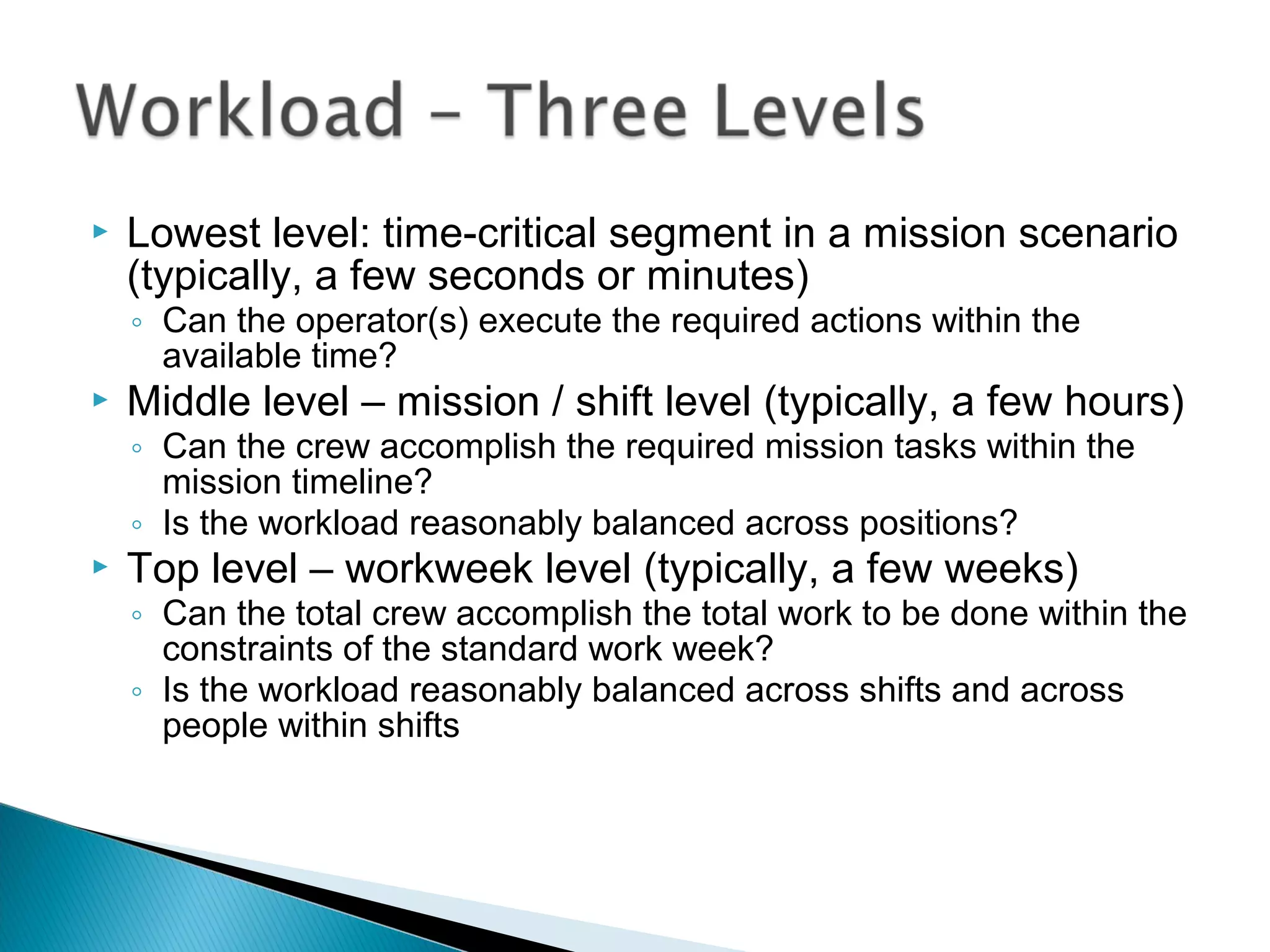
 Lowest level: time-critical segment in a mission scenario
(typically, a few seconds or minutes)
◦ Can the operator(s) execute the required actions within the
available time?
 Middle level – mission / shift level (typically, a few hours)
◦ Can the crew accomplish the required mission tasks within the
mission timeline?
◦ Is the workload reasonably balanced across positions?
 Top level – workweek level (typically, a few weeks)
◦ Can the total crew accomplish the total work to be done within the
constraints of the standard work week?
◦ Is the workload reasonably balanced across shifts and across
people within shifts
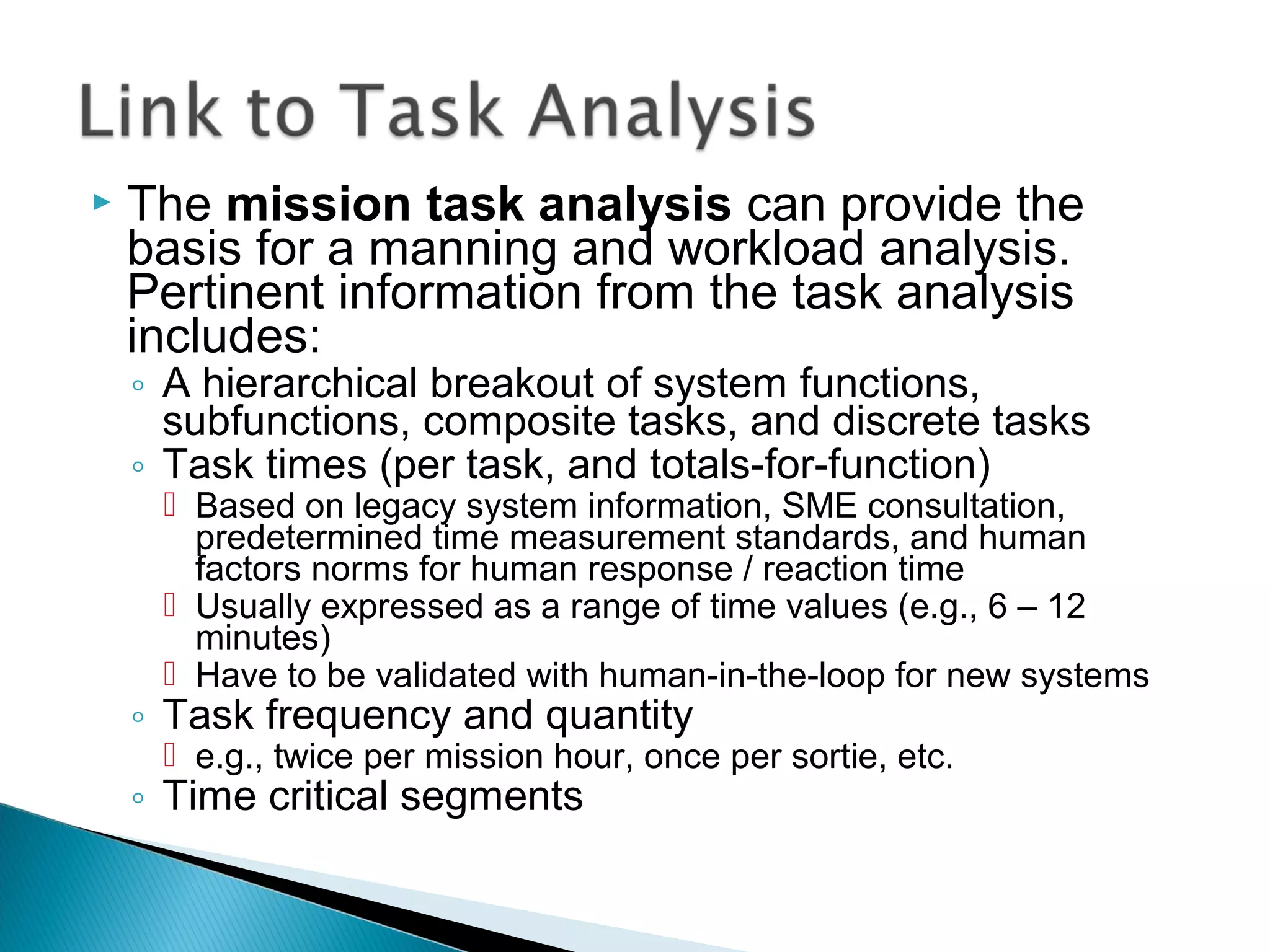
 The mission task analysis can provide the
basis for a manning and workload analysis.
Pertinent information from the task analysis
includes:
◦ A hierarchical breakout of system functions,
subfunctions, composite tasks, and discrete tasks
◦ Task times (per task, and totals-for-function)
 Based on legacy system information, SME consultation,
predetermined time measurement standards, and human
factors norms for human response / reaction time
 Usually expressed as a range of time values (e.g., 6 – 12
minutes)
 Have to be validated with human-in-the-loop for new systems
◦ Task frequency and quantity
 e.g., twice per mission hour, once per sortie, etc.
◦ Time critical segments
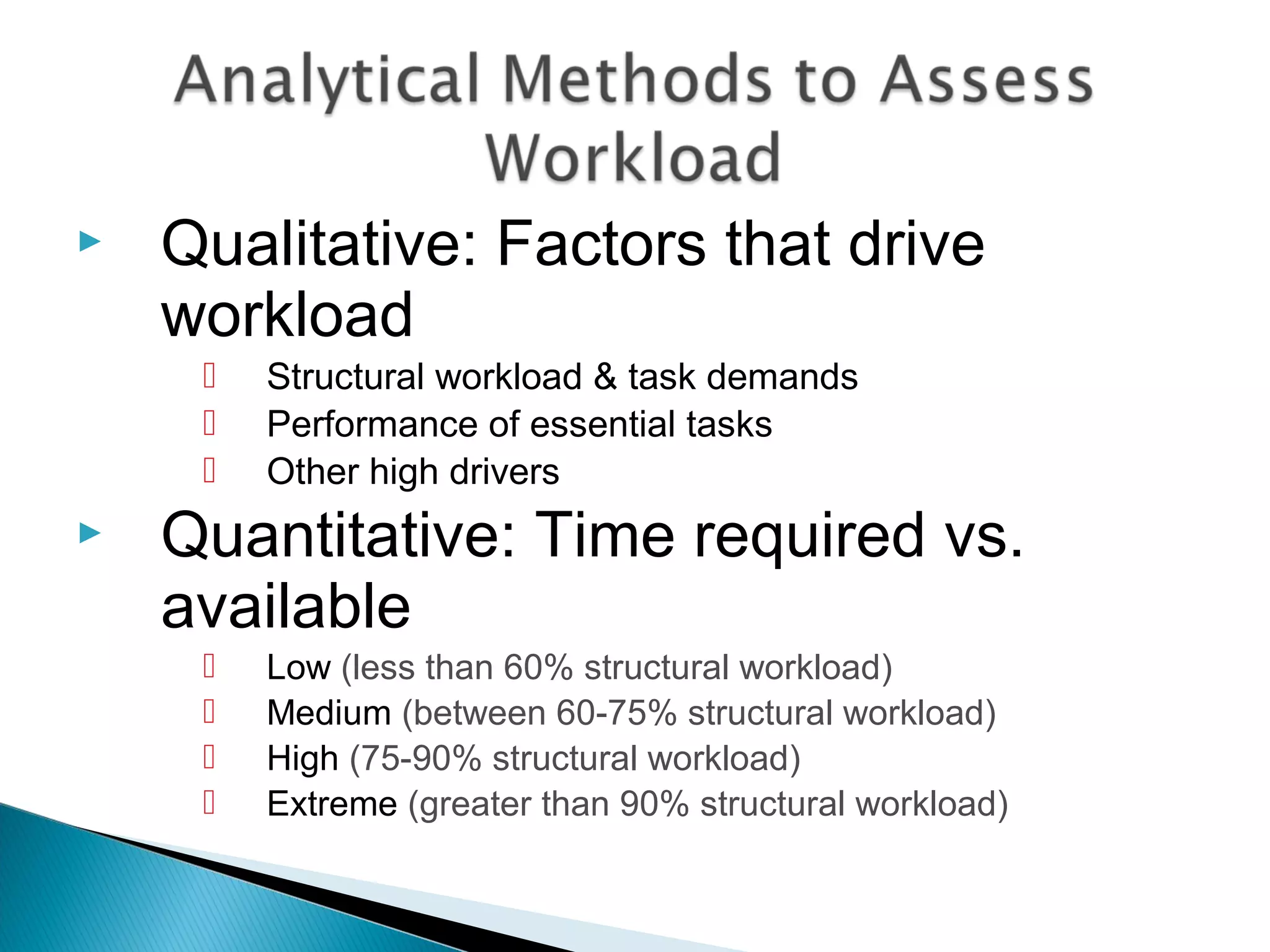
 Qualitative: Factors that drive
workload
 Structural workload & task demands
 Performance of essential tasks
 Other high drivers
 Quantitative: Time required vs.
available
 Low (less than 60% structural workload)
 Medium (between 60-75% structural workload)
 High (75-90% structural workload)
 Extreme (greater than 90% structural workload)
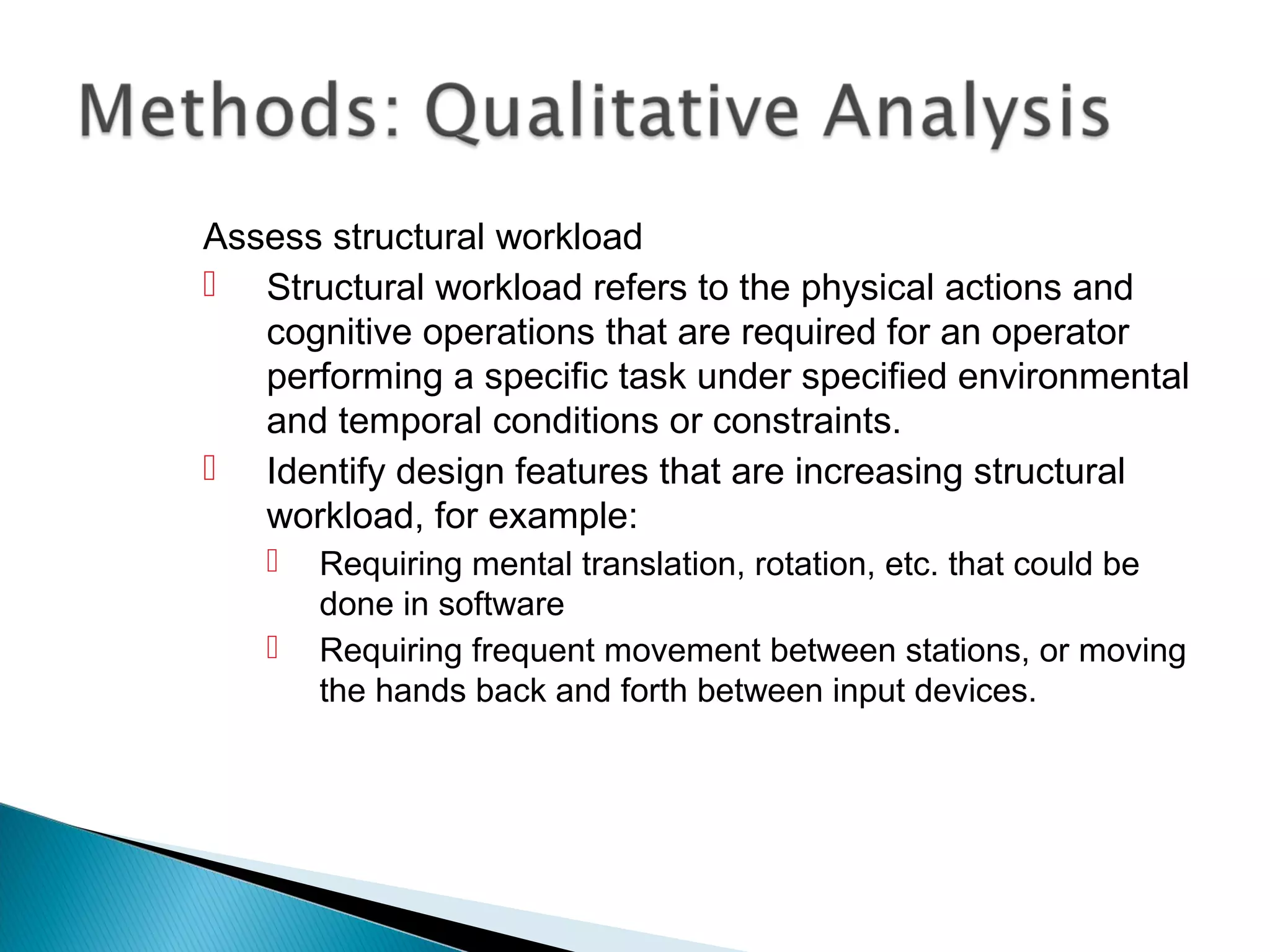
Assess structural workload
 Structural workload refers to the physical actions and
cognitive operations that are required for an operator
performing a specific task under specified environmental
and temporal conditions or constraints.
 Identify design features that are increasing structural
workload, for example:
 Requiring mental translation, rotation, etc. that could be
done in software
 Requiring frequent movement between stations, or moving
the hands back and forth between input devices.
Assess task demands
 Task demand refers to the way in which the nature of the
particular task to be performed can place demands on
different human psychophysical resource channels such
as visual, auditory, cognitive, and psychomotor.
 Identify tasks or task sequences that are highly
demanding on one or more of those channels
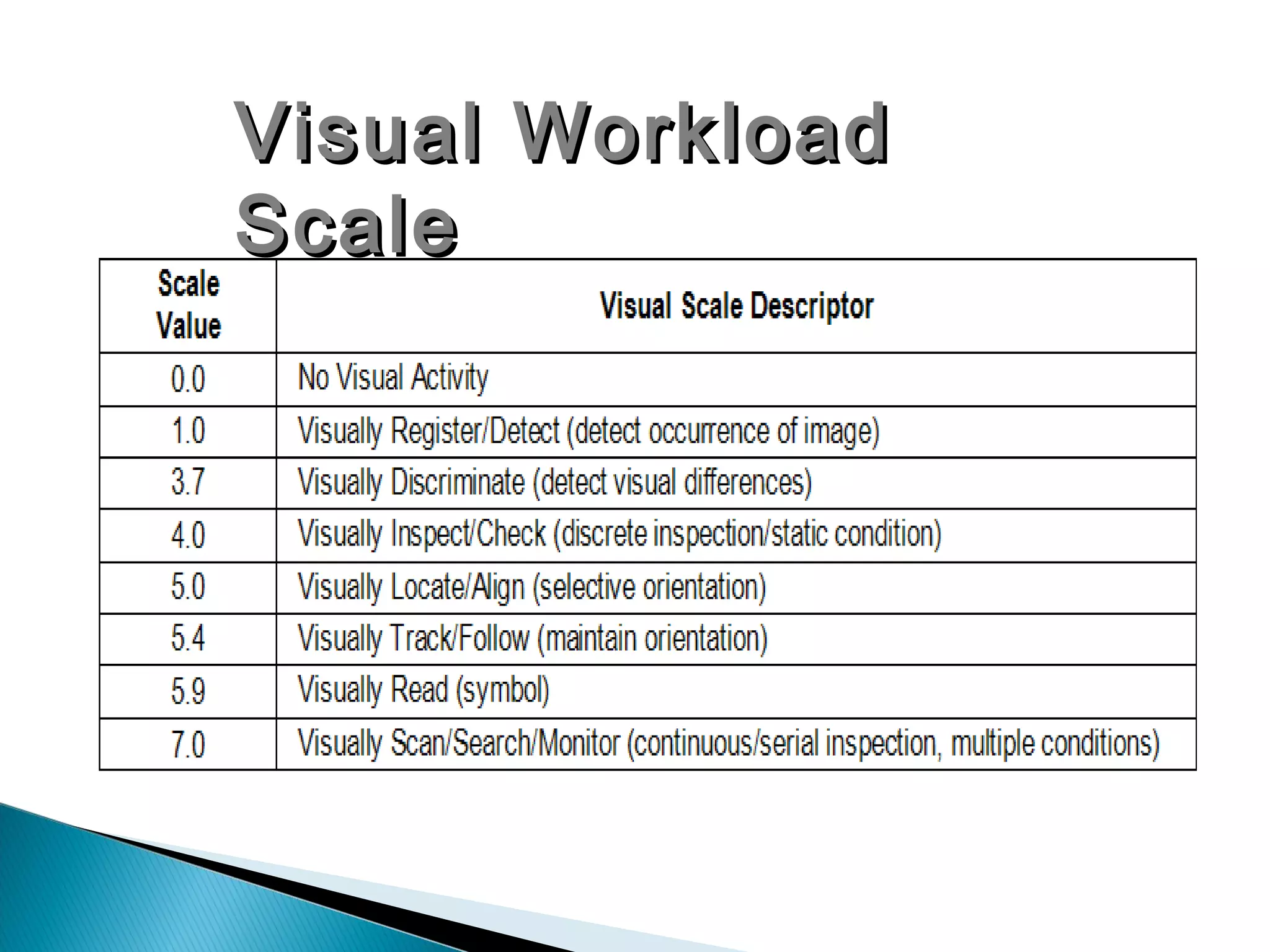
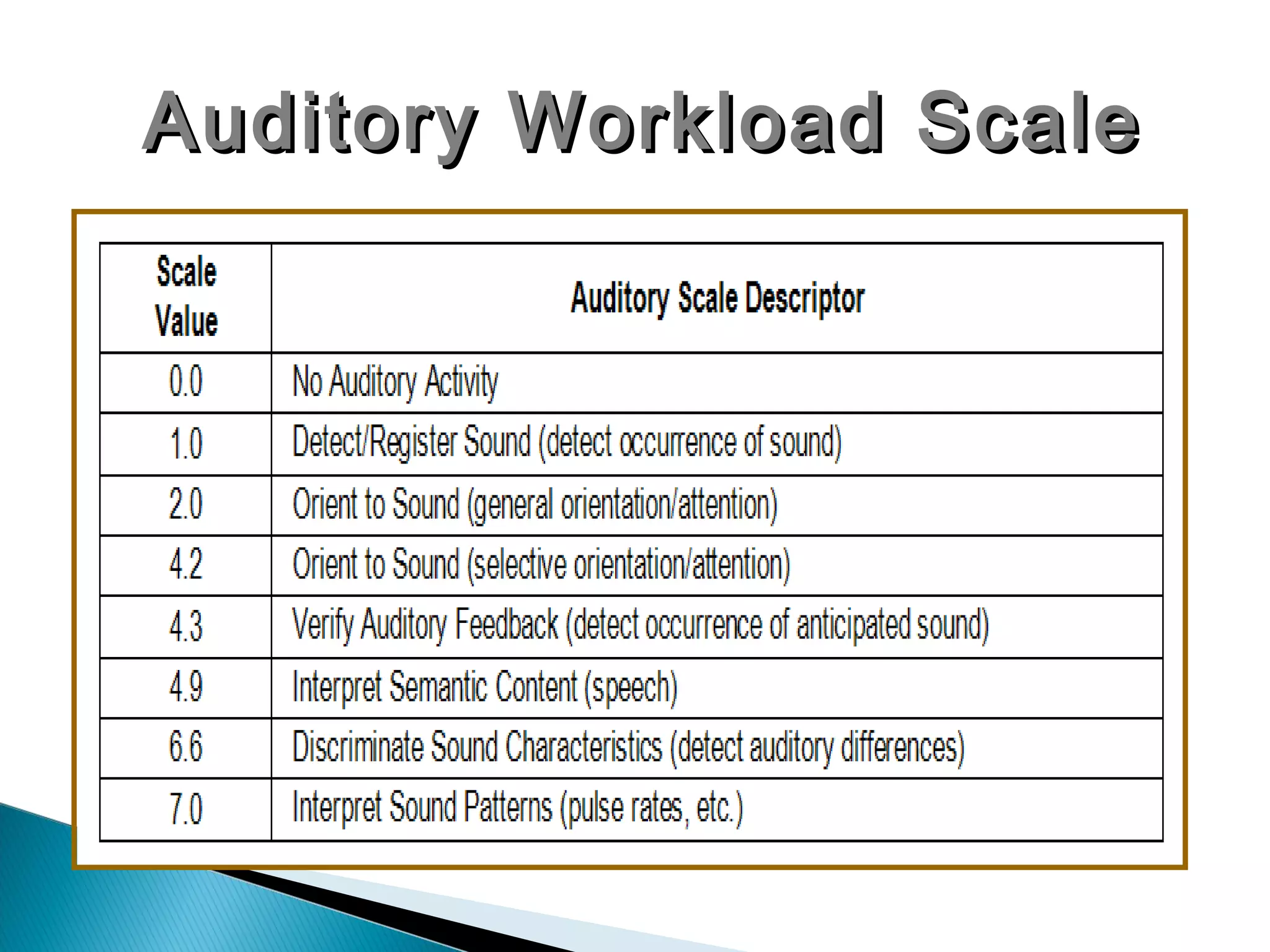
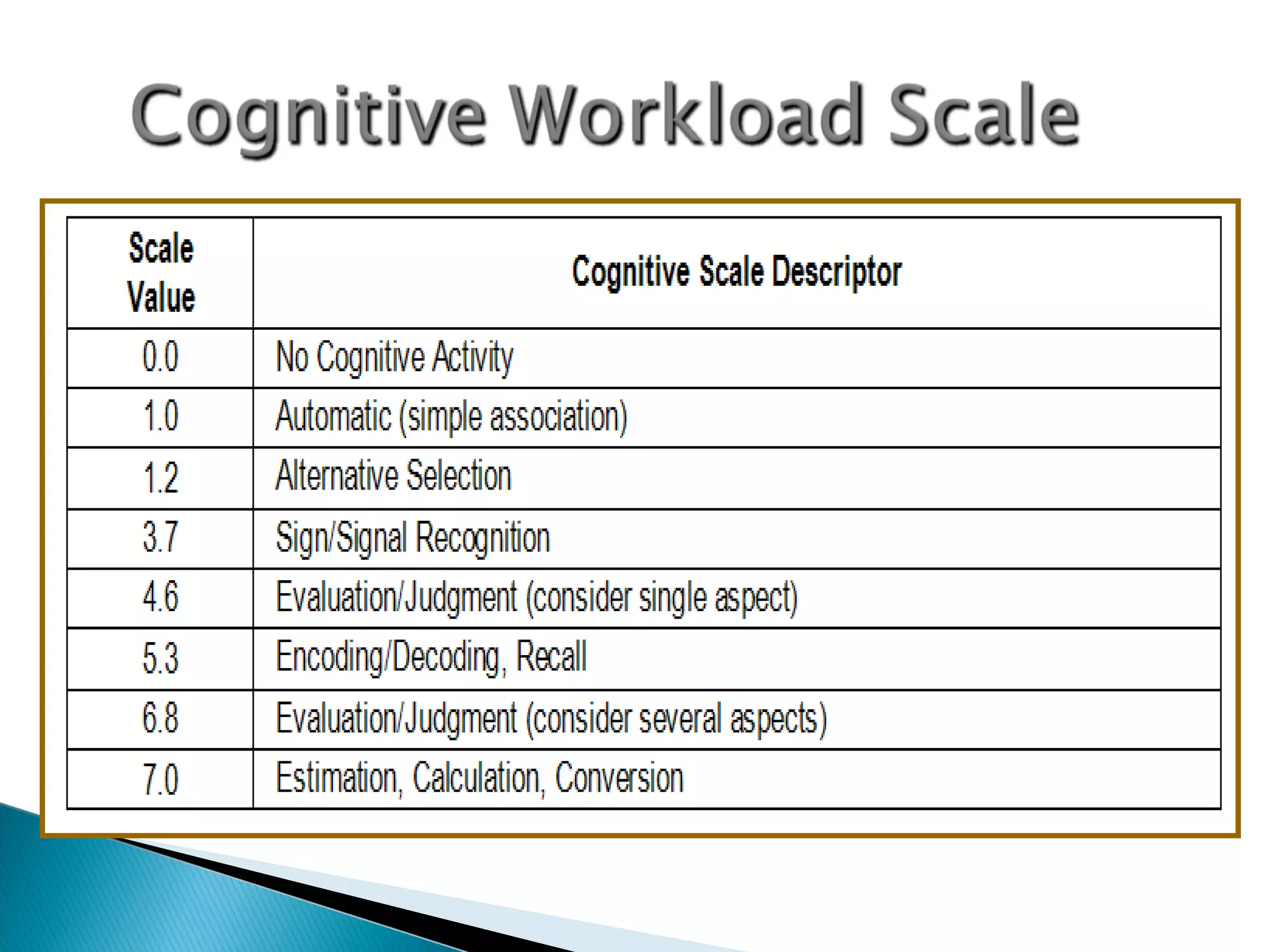
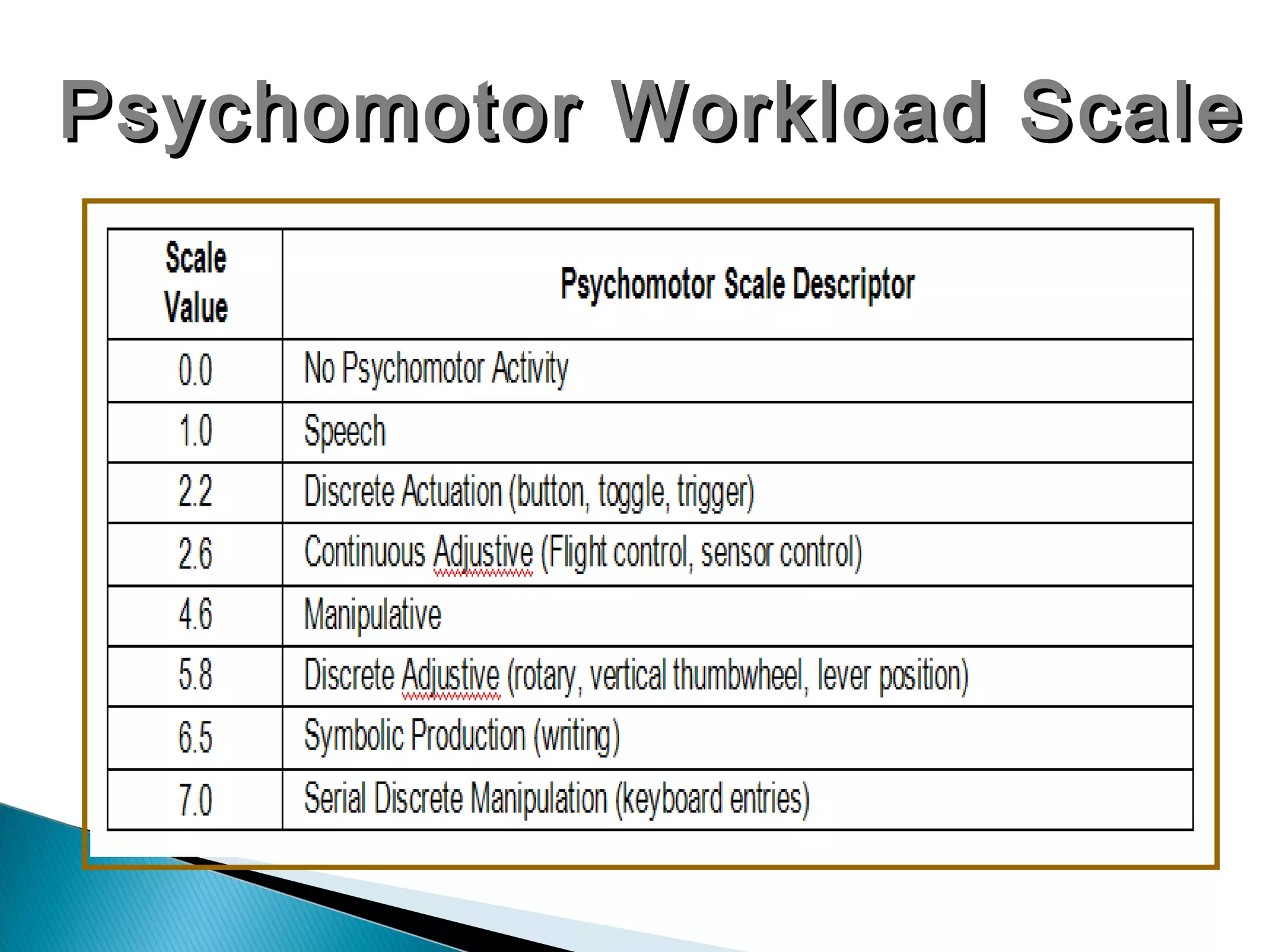
 Can use the VACP scales to help assess these demands
Visual WorkloadVisual Workload
ScaleScale
Auditory Workload ScaleAuditory Workload Scale
Psychomotor Workload ScalePsychomotor Workload Scale
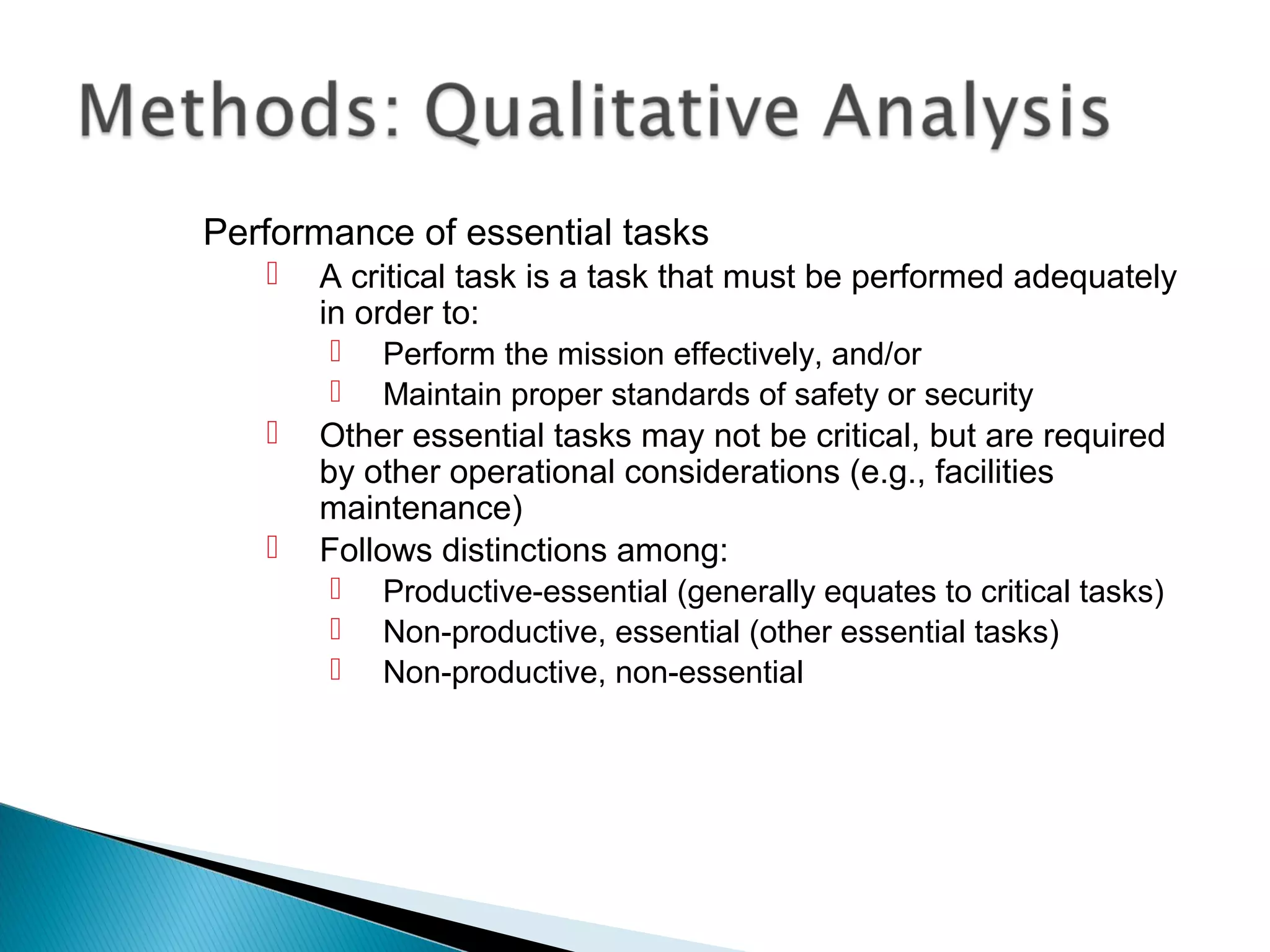
Performance of essential tasks
 A critical task is a task that must be performed adequately
in order to:
 Perform the mission effectively, and/or
 Maintain proper standards of safety or security
 Other essential tasks may not be critical, but are required
by other operational considerations (e.g., facilities
maintenance)
 Follows distinctions among:
 Productive-essential (generally equates to critical tasks)
 Non-productive, essential (other essential tasks)
 Non-productive, non-essential
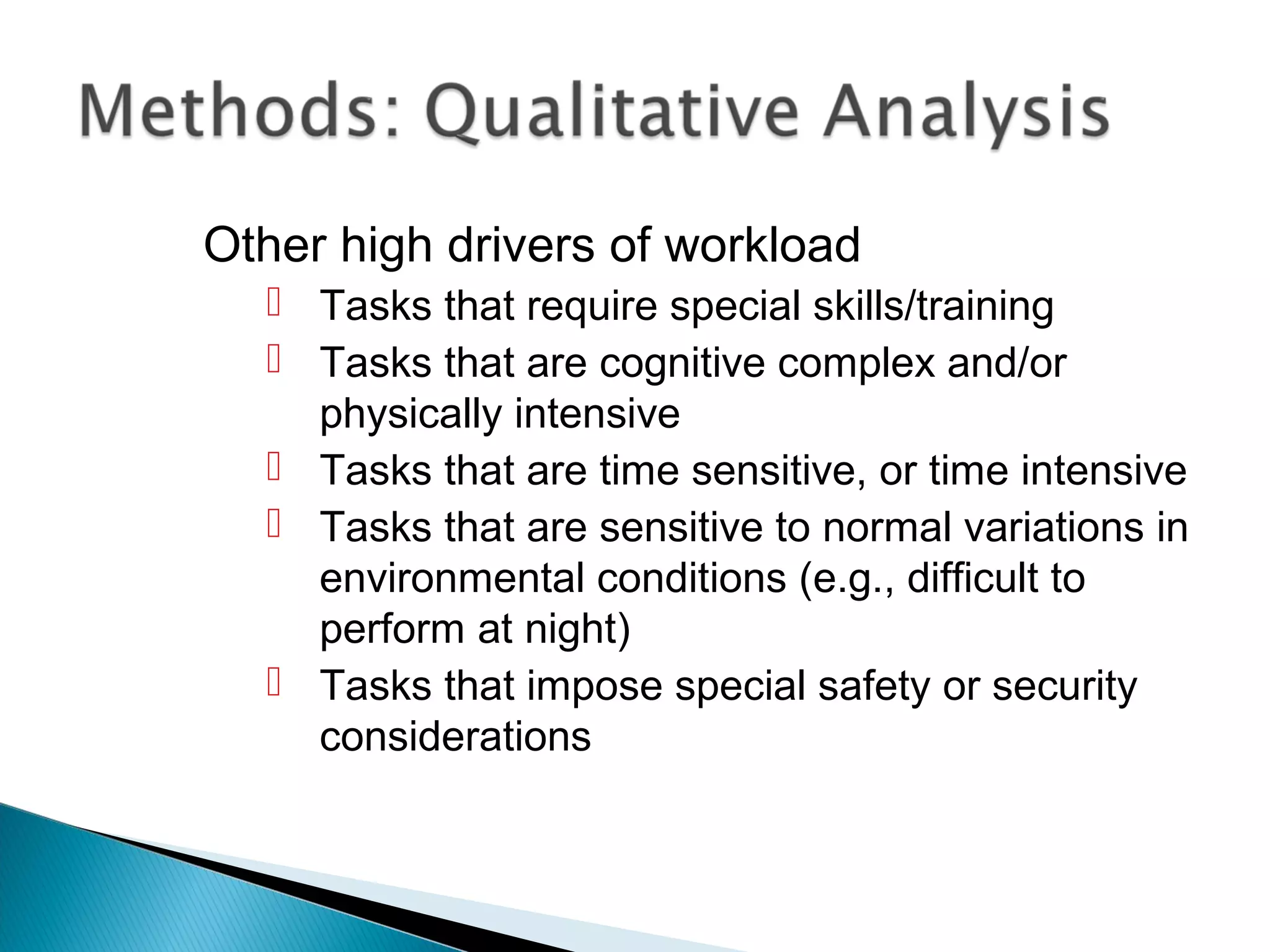
Other high drivers of workload
 Tasks that require special skills/training
 Tasks that are cognitive complex and/or
physically intensive
 Tasks that are time sensitive, or time intensive
 Tasks that are sensitive to normal variations in
environmental conditions (e.g., difficult to
perform at night)
 Tasks that impose special safety or security
considerations
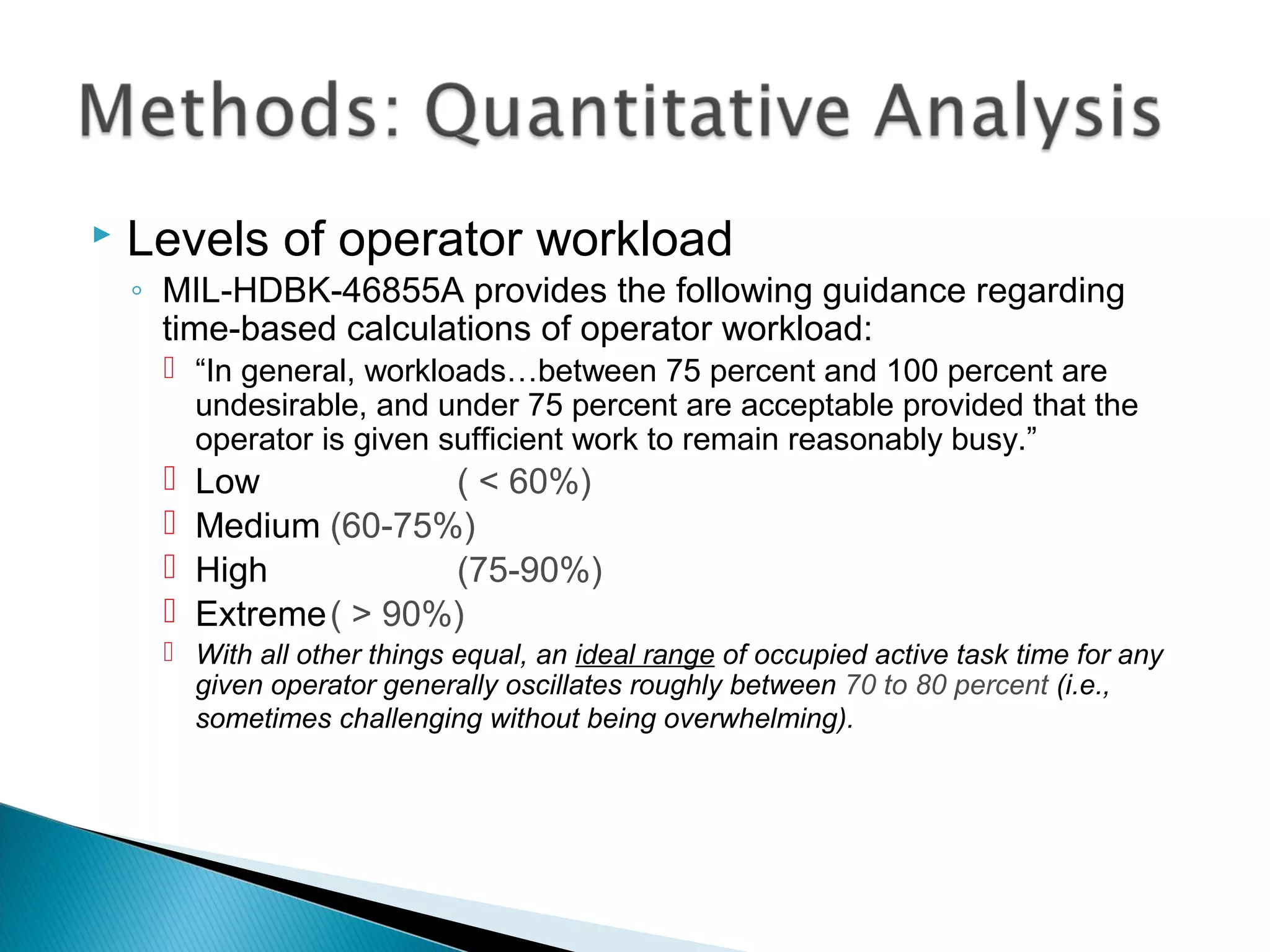
 Levels of operator workload
◦ MIL-HDBK-46855A provides the following guidance regarding
time-based calculations of operator workload:
 “In general, workloads…between 75 percent and 100 percent are
undesirable, and under 75 percent are acceptable provided that the
operator is given sufficient work to remain reasonably busy.”
 Low ( < 60%)
 Medium (60-75%)
 High (75-90%)
 Extreme( > 90%)
 With all other things equal, an ideal range of occupied active task time for any
given operator generally oscillates roughly between 70 to 80 percent (i.e.,
sometimes challenging without being overwhelming).
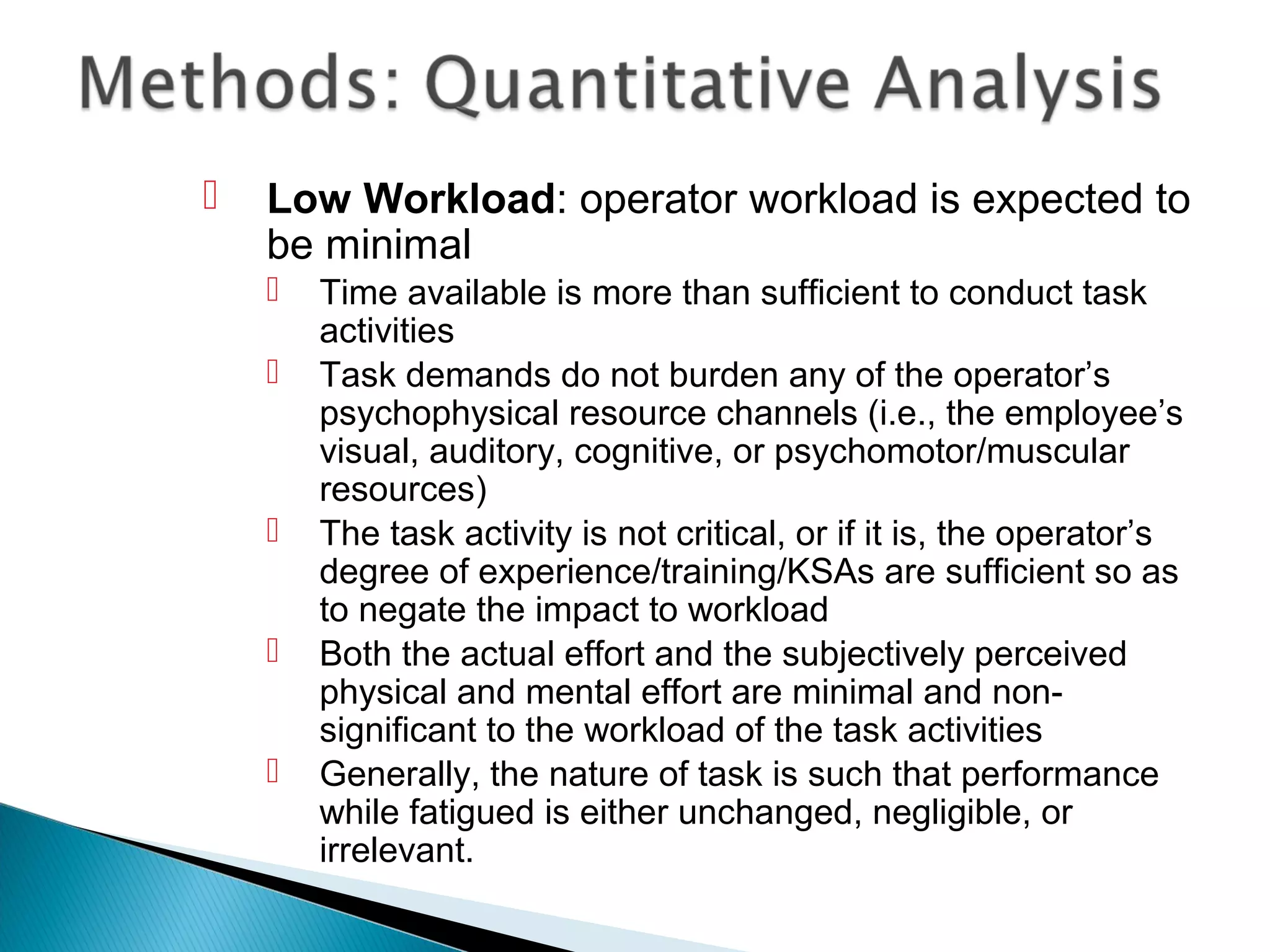
 Low Workload: operator workload is expected to
be minimal
 Time available is more than sufficient to conduct task
activities
 Task demands do not burden any of the operator’s
psychophysical resource channels (i.e., the employee’s
visual, auditory, cognitive, or psychomotor/muscular
resources)
 The task activity is not critical, or if it is, the operator’s
degree of experience/training/KSAs are sufficient so as
to negate the impact to workload
 Both the actual effort and the subjectively perceived
physical and mental effort are minimal and non-
significant to the workload of the task activities
 Generally, the nature of task is such that performance
while fatigued is either unchanged, negligible, or
irrelevant.
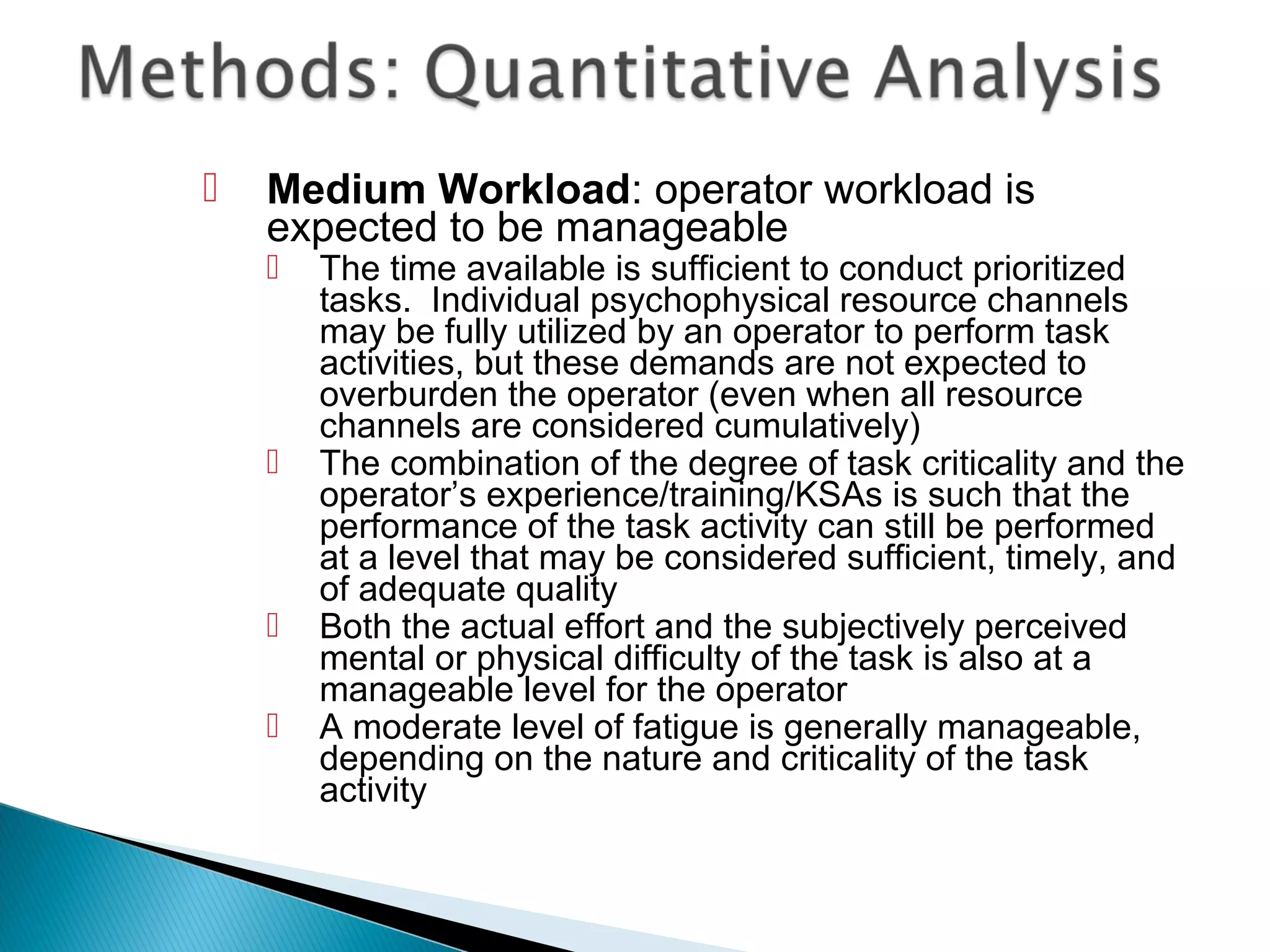
 Medium Workload: operator workload is
expected to be manageable
 The time available is sufficient to conduct prioritized
tasks. Individual psychophysical resource channels
may be fully utilized by an operator to perform task
activities, but these demands are not expected to
overburden the operator (even when all resource
channels are considered cumulatively)
 The combination of the degree of task criticality and the
operator’s experience/training/KSAs is such that the
performance of the task activity can still be performed
at a level that may be considered sufficient, timely, and
of adequate quality
 Both the actual effort and the subjectively perceived
mental or physical difficulty of the task is also at a
manageable level for the operator
 A moderate level of fatigue is generally manageable,
depending on the nature and criticality of the task
activity
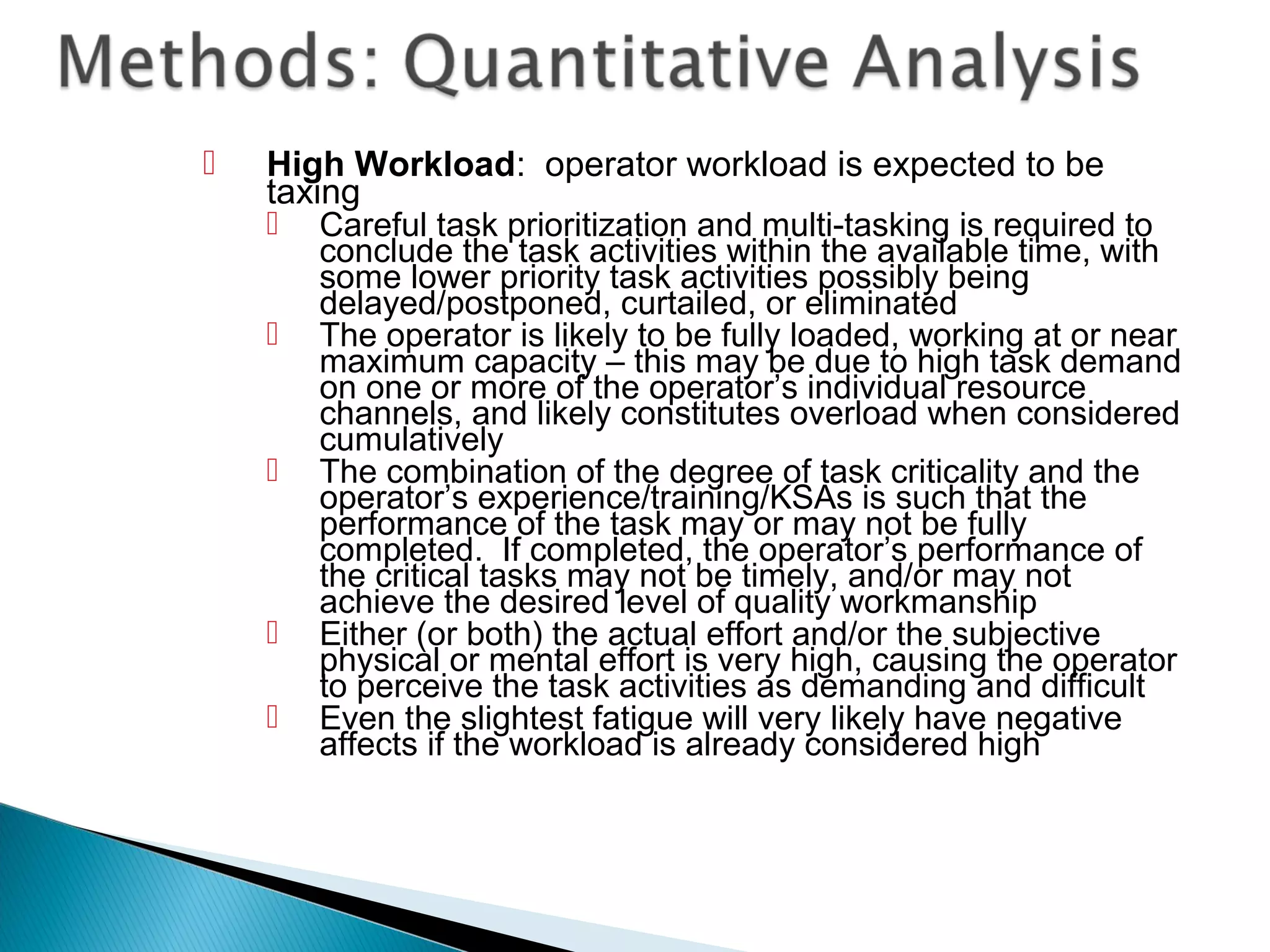
 High Workload: operator workload is expected to be
taxing
 Careful task prioritization and multi-tasking is required to
conclude the task activities within the available time, with
some lower priority task activities possibly being
delayed/postponed, curtailed, or eliminated
 The operator is likely to be fully loaded, working at or near
maximum capacity – this may be due to high task demand
on one or more of the operator’s individual resource
channels, and likely constitutes overload when considered
cumulatively
 The combination of the degree of task criticality and the
operator’s experience/training/KSAs is such that the
performance of the task may or may not be fully
completed. If completed, the operator’s performance of
the critical tasks may not be timely, and/or may not
achieve the desired level of quality workmanship
 Either (or both) the actual effort and/or the subjective
physical or mental effort is very high, causing the operator
to perceive the task activities as demanding and difficult
 Even the slightest fatigue will very likely have negative
affects if the workload is already considered high
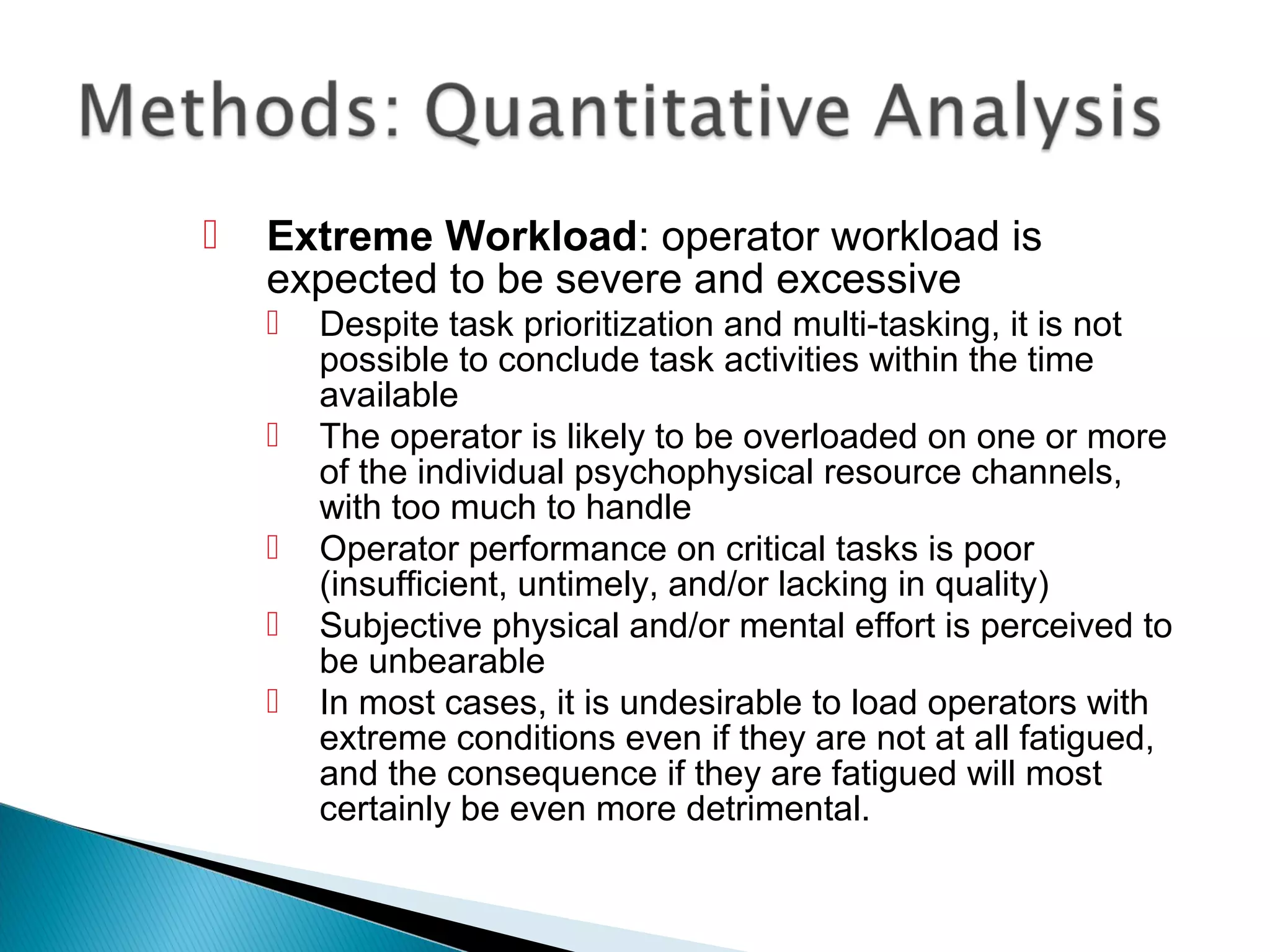
 Extreme Workload: operator workload is
expected to be severe and excessive
 Despite task prioritization and multi-tasking, it is not
possible to conclude task activities within the time
available
 The operator is likely to be overloaded on one or more
of the individual psychophysical resource channels,
with too much to handle
 Operator performance on critical tasks is poor
(insufficient, untimely, and/or lacking in quality)
 Subjective physical and/or mental effort is perceived to
be unbearable
 In most cases, it is undesirable to load operators with
extreme conditions even if they are not at all fatigued,
and the consequence if they are fatigued will most
certainly be even more detrimental.
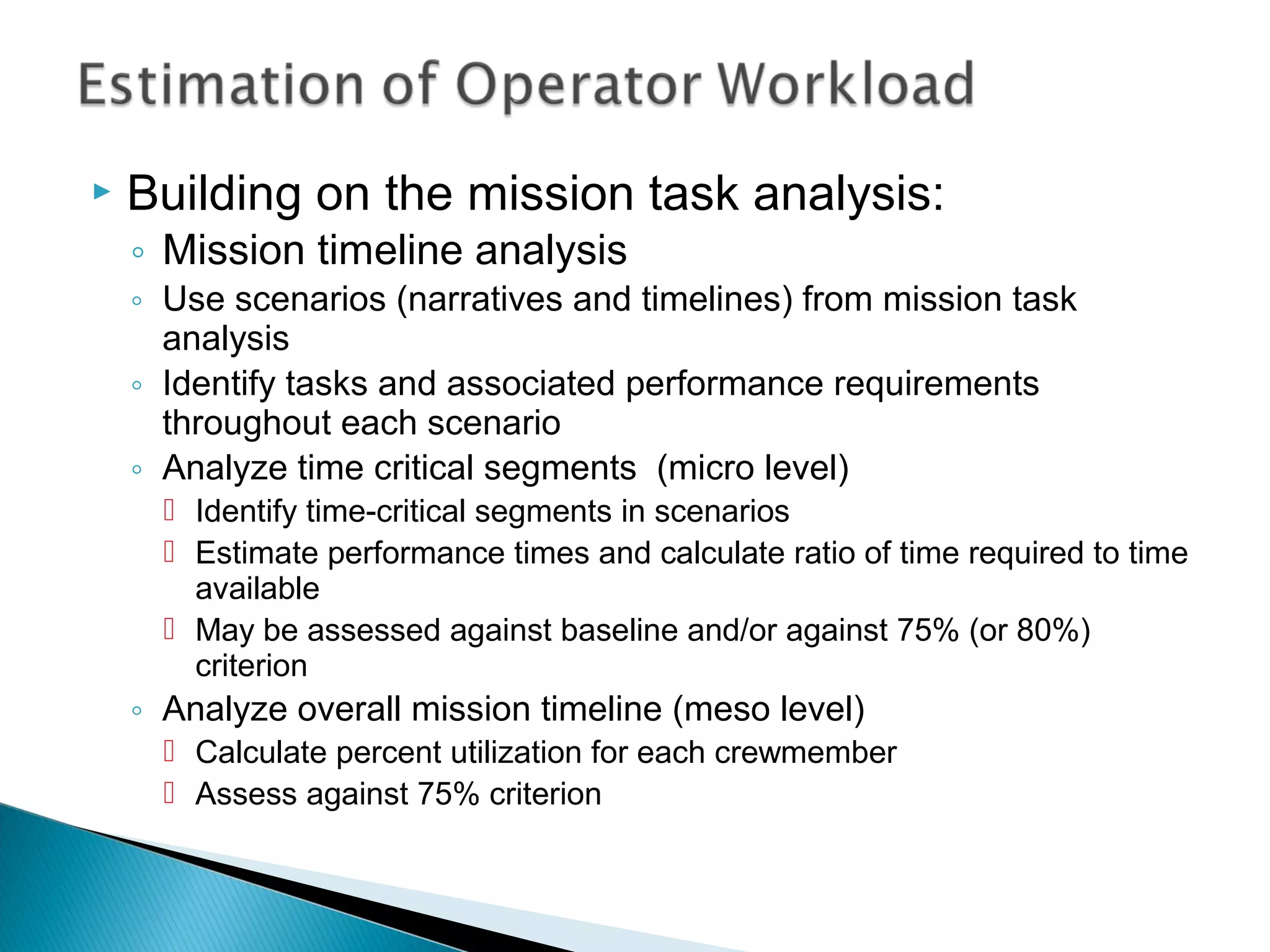
 Building on the mission task analysis:
◦ Mission timeline analysis
◦ Use scenarios (narratives and timelines) from mission task
analysis
◦ Identify tasks and associated performance requirements
throughout each scenario
◦ Analyze time critical segments (micro level)
 Identify time-critical segments in scenarios
 Estimate performance times and calculate ratio of time required to time
available
 May be assessed against baseline and/or against 75% (or 80%)
criterion
◦ Analyze overall mission timeline (meso level)
 Calculate percent utilization for each crewmember
 Assess against 75% criterion
 Conduct a timeline analysis of structural
workload (time required to execute required
actions)
 Use a threshold of 75% - 80% of time required
to time available
◦ Allows room for hesitation or error
 Workload problems associated with time critical
segments must be addressed by design (fewer
steps) or in some cases by manning (more
people involved)
 Analyze crew performance in selected segments
of the design reference scenarios developed in
the Mission Task Analysis
 Specify number of crew, and KSAs (skill objects)
of each crew position
 Use this model to predict mission performance
and crew workload (percent utilization for each
position) at the meso and macro levels
 Two methods to analyze structural workload at
mission and workweek levels
◦ Expected Utilization (if you have a basis for assigning
tasks to individual positions)
◦ Full Time Equivalent (FTE) (if any position can perform
any task)
 Expected Utilization
 Calculate for each position separately:
Expected Total Time on Task
 E [Ui ] = Total Available Duty Time X 100
 Ideal range is roughly 70-80 percent
 Possible to have expected utility greater than 100% if task
times exceed duty time available
 Shift task assignments to attempt to balance expected
utilization across positions
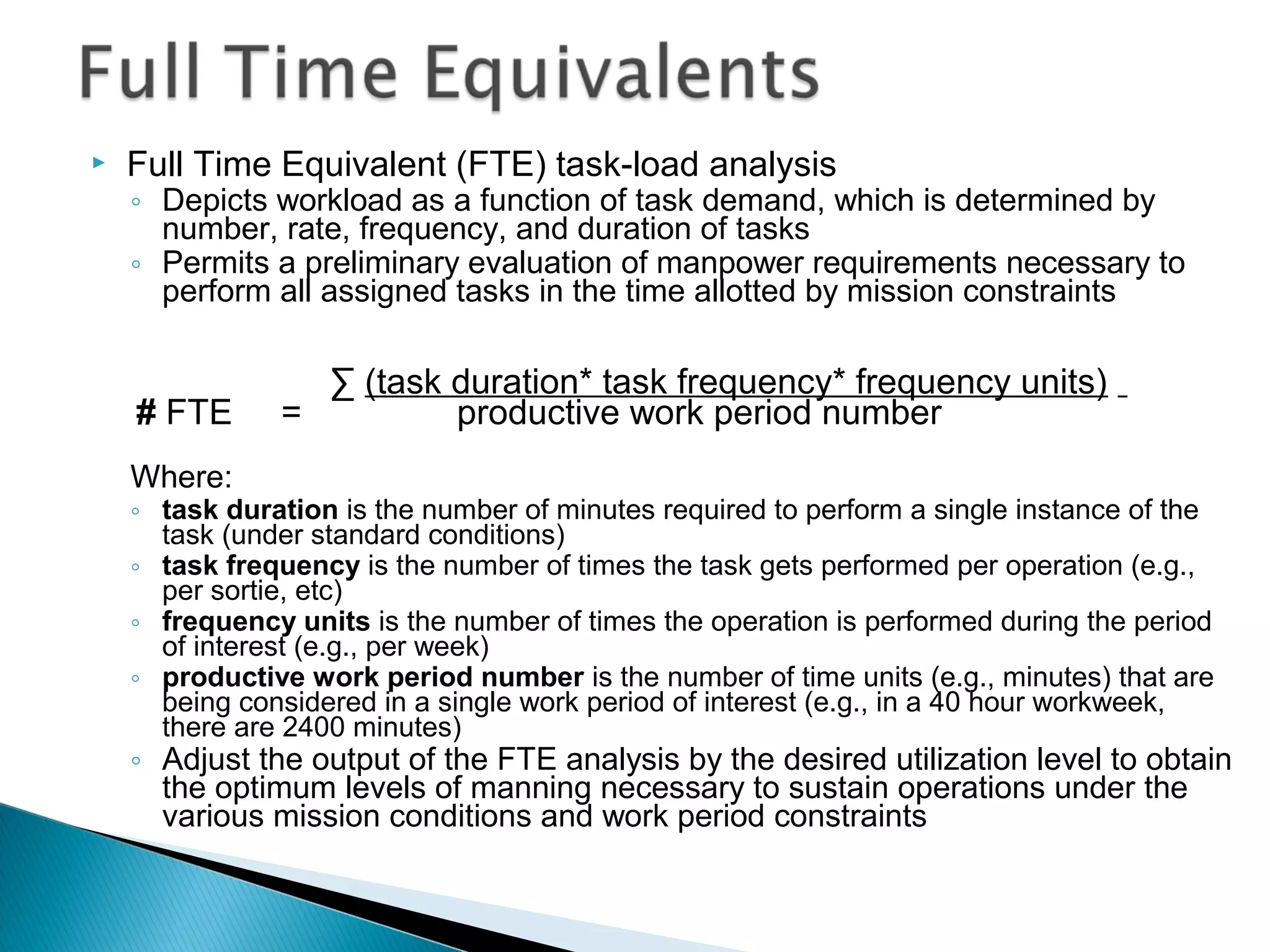
 Full Time Equivalent (FTE) task-load analysis
◦ Depicts workload as a function of task demand, which is determined by
number, rate, frequency, and duration of tasks
◦ Permits a preliminary evaluation of manpower requirements necessary to
perform all assigned tasks in the time allotted by mission constraints
∑ (task duration* task frequency* frequency units)
# FTE = productive work period number
Where:
◦ task duration is the number of minutes required to perform a single instance of the
task (under standard conditions)
◦ task frequency is the number of times the task gets performed per operation (e.g.,
per sortie, etc)
◦ frequency units is the number of times the operation is performed during the period
of interest (e.g., per week)
◦ productive work period number is the number of time units (e.g., minutes) that are
being considered in a single work period of interest (e.g., in a 40 hour workweek,
there are 2400 minutes)
◦ Adjust the output of the FTE analysis by the desired utilization level to obtain
the optimum levels of manning necessary to sustain operations under the
various mission conditions and work period constraints

Workload analysis

  • 1.
    A High LevelOverview of Determining Optimal Manpower
  • 2.
     Manning refersto the number and types of operators (including maintainers and other support personnel) required to operate a single instance of the system or process  Manning analyses address the following: ◦ What are the different types of personnel required? ◦ How many of each type? ◦ Operating on what schedule?
  • 3.
     Building onthe mission task analysis, and job analyses, an initial estimate of required manning can be provided on this basis: ◦ Peak number of operators required across all mission scenarios provides an initial estimate of the minimum crew size on a shift (section) ◦ Number of different skill set requirements (given current occupational breakouts) gives an initial estimate of the number of different positions that are required
  • 4.
     Initial manningestimates typically involve unequal utilization across positions  Refinement of the initial manning estimates requires further analysis of task performance requirements and workload ◦ Opportunities to create appropriate skill set combinations through training ◦ Opportunities to balance utilization by job redesign  Further refinement is done by a detailed analysis of crew workload
  • 5.
     Lowest level:time-critical segment in a mission scenario (typically, a few seconds or minutes) ◦ Can the operator(s) execute the required actions within the available time?  Middle level – mission / shift level (typically, a few hours) ◦ Can the crew accomplish the required mission tasks within the mission timeline? ◦ Is the workload reasonably balanced across positions?  Top level – workweek level (typically, a few weeks) ◦ Can the total crew accomplish the total work to be done within the constraints of the standard work week? ◦ Is the workload reasonably balanced across shifts and across people within shifts
  • 6.
     The missiontask analysis can provide the basis for a manning and workload analysis. Pertinent information from the task analysis includes: ◦ A hierarchical breakout of system functions, subfunctions, composite tasks, and discrete tasks ◦ Task times (per task, and totals-for-function)  Based on legacy system information, SME consultation, predetermined time measurement standards, and human factors norms for human response / reaction time  Usually expressed as a range of time values (e.g., 6 – 12 minutes)  Have to be validated with human-in-the-loop for new systems ◦ Task frequency and quantity  e.g., twice per mission hour, once per sortie, etc. ◦ Time critical segments
  • 7.
     Qualitative: Factorsthat drive workload  Structural workload & task demands  Performance of essential tasks  Other high drivers  Quantitative: Time required vs. available  Low (less than 60% structural workload)  Medium (between 60-75% structural workload)  High (75-90% structural workload)  Extreme (greater than 90% structural workload)
  • 8.
    Assess structural workload Structural workload refers to the physical actions and cognitive operations that are required for an operator performing a specific task under specified environmental and temporal conditions or constraints.  Identify design features that are increasing structural workload, for example:  Requiring mental translation, rotation, etc. that could be done in software  Requiring frequent movement between stations, or moving the hands back and forth between input devices.
  • 9.
    Assess task demands Task demand refers to the way in which the nature of the particular task to be performed can place demands on different human psychophysical resource channels such as visual, auditory, cognitive, and psychomotor.  Identify tasks or task sequences that are highly demanding on one or more of those channels  Can use the VACP scales to help assess these demands
  • 10.
  • 11.
  • 13.
  • 14.
    Performance of essentialtasks  A critical task is a task that must be performed adequately in order to:  Perform the mission effectively, and/or  Maintain proper standards of safety or security  Other essential tasks may not be critical, but are required by other operational considerations (e.g., facilities maintenance)  Follows distinctions among:  Productive-essential (generally equates to critical tasks)  Non-productive, essential (other essential tasks)  Non-productive, non-essential
  • 15.
    Other high driversof workload  Tasks that require special skills/training  Tasks that are cognitive complex and/or physically intensive  Tasks that are time sensitive, or time intensive  Tasks that are sensitive to normal variations in environmental conditions (e.g., difficult to perform at night)  Tasks that impose special safety or security considerations
  • 16.
     Levels ofoperator workload ◦ MIL-HDBK-46855A provides the following guidance regarding time-based calculations of operator workload:  “In general, workloads…between 75 percent and 100 percent are undesirable, and under 75 percent are acceptable provided that the operator is given sufficient work to remain reasonably busy.”  Low ( < 60%)  Medium (60-75%)  High (75-90%)  Extreme( > 90%)  With all other things equal, an ideal range of occupied active task time for any given operator generally oscillates roughly between 70 to 80 percent (i.e., sometimes challenging without being overwhelming).
  • 17.
     Low Workload:operator workload is expected to be minimal  Time available is more than sufficient to conduct task activities  Task demands do not burden any of the operator’s psychophysical resource channels (i.e., the employee’s visual, auditory, cognitive, or psychomotor/muscular resources)  The task activity is not critical, or if it is, the operator’s degree of experience/training/KSAs are sufficient so as to negate the impact to workload  Both the actual effort and the subjectively perceived physical and mental effort are minimal and non- significant to the workload of the task activities  Generally, the nature of task is such that performance while fatigued is either unchanged, negligible, or irrelevant.
  • 18.
     Medium Workload:operator workload is expected to be manageable  The time available is sufficient to conduct prioritized tasks. Individual psychophysical resource channels may be fully utilized by an operator to perform task activities, but these demands are not expected to overburden the operator (even when all resource channels are considered cumulatively)  The combination of the degree of task criticality and the operator’s experience/training/KSAs is such that the performance of the task activity can still be performed at a level that may be considered sufficient, timely, and of adequate quality  Both the actual effort and the subjectively perceived mental or physical difficulty of the task is also at a manageable level for the operator  A moderate level of fatigue is generally manageable, depending on the nature and criticality of the task activity
  • 19.
     High Workload:operator workload is expected to be taxing  Careful task prioritization and multi-tasking is required to conclude the task activities within the available time, with some lower priority task activities possibly being delayed/postponed, curtailed, or eliminated  The operator is likely to be fully loaded, working at or near maximum capacity – this may be due to high task demand on one or more of the operator’s individual resource channels, and likely constitutes overload when considered cumulatively  The combination of the degree of task criticality and the operator’s experience/training/KSAs is such that the performance of the task may or may not be fully completed. If completed, the operator’s performance of the critical tasks may not be timely, and/or may not achieve the desired level of quality workmanship  Either (or both) the actual effort and/or the subjective physical or mental effort is very high, causing the operator to perceive the task activities as demanding and difficult  Even the slightest fatigue will very likely have negative affects if the workload is already considered high
  • 20.
     Extreme Workload:operator workload is expected to be severe and excessive  Despite task prioritization and multi-tasking, it is not possible to conclude task activities within the time available  The operator is likely to be overloaded on one or more of the individual psychophysical resource channels, with too much to handle  Operator performance on critical tasks is poor (insufficient, untimely, and/or lacking in quality)  Subjective physical and/or mental effort is perceived to be unbearable  In most cases, it is undesirable to load operators with extreme conditions even if they are not at all fatigued, and the consequence if they are fatigued will most certainly be even more detrimental.
  • 21.
     Building onthe mission task analysis: ◦ Mission timeline analysis ◦ Use scenarios (narratives and timelines) from mission task analysis ◦ Identify tasks and associated performance requirements throughout each scenario ◦ Analyze time critical segments (micro level)  Identify time-critical segments in scenarios  Estimate performance times and calculate ratio of time required to time available  May be assessed against baseline and/or against 75% (or 80%) criterion ◦ Analyze overall mission timeline (meso level)  Calculate percent utilization for each crewmember  Assess against 75% criterion
  • 22.
     Conduct atimeline analysis of structural workload (time required to execute required actions)  Use a threshold of 75% - 80% of time required to time available ◦ Allows room for hesitation or error  Workload problems associated with time critical segments must be addressed by design (fewer steps) or in some cases by manning (more people involved)
  • 23.
     Analyze crewperformance in selected segments of the design reference scenarios developed in the Mission Task Analysis  Specify number of crew, and KSAs (skill objects) of each crew position  Use this model to predict mission performance and crew workload (percent utilization for each position) at the meso and macro levels
  • 24.
     Two methodsto analyze structural workload at mission and workweek levels ◦ Expected Utilization (if you have a basis for assigning tasks to individual positions) ◦ Full Time Equivalent (FTE) (if any position can perform any task)
  • 25.
     Expected Utilization Calculate for each position separately: Expected Total Time on Task  E [Ui ] = Total Available Duty Time X 100  Ideal range is roughly 70-80 percent  Possible to have expected utility greater than 100% if task times exceed duty time available  Shift task assignments to attempt to balance expected utilization across positions
  • 26.
     Full TimeEquivalent (FTE) task-load analysis ◦ Depicts workload as a function of task demand, which is determined by number, rate, frequency, and duration of tasks ◦ Permits a preliminary evaluation of manpower requirements necessary to perform all assigned tasks in the time allotted by mission constraints ∑ (task duration* task frequency* frequency units) # FTE = productive work period number Where: ◦ task duration is the number of minutes required to perform a single instance of the task (under standard conditions) ◦ task frequency is the number of times the task gets performed per operation (e.g., per sortie, etc) ◦ frequency units is the number of times the operation is performed during the period of interest (e.g., per week) ◦ productive work period number is the number of time units (e.g., minutes) that are being considered in a single work period of interest (e.g., in a 40 hour workweek, there are 2400 minutes) ◦ Adjust the output of the FTE analysis by the desired utilization level to obtain the optimum levels of manning necessary to sustain operations under the various mission conditions and work period constraints