Methods we used to lower our young son’s histamine burden,
to reduce the frequency and intensity of dangerous and painful
histamine mediated reactions.
Copyright Tiffany Blackden 2013
All Rights Reserved
The Mastocytosis Society
DC Regional Regional Meeting
April 2013
Copyright Tiffany Blackden 2013
All Rights Reserved
Our family!
The reasons we’ve stayed up all night
researching and continuing to figure
out ways to support health!
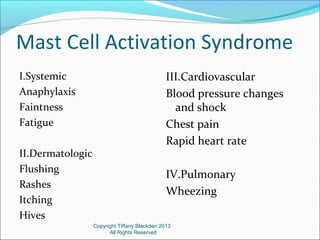
Mast Cell Activation Syndrome
I.Systemic
Anaphylaxis
Faintness
Fatigue
II.Dermatologic
Flushing
Rashes
Itching
Hives
III.Cardiovascular
Blood pressure changes
and shock
Chest pain
Rapid heart rate
IV.Pulmonary
Wheezing
Copyright Tiffany Blackden 2013
All Rights Reserved
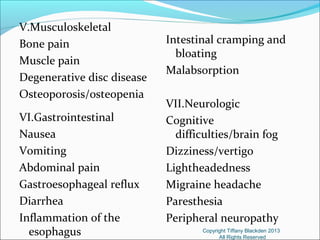
V.Musculoskeletal
Bone pain
Muscle pain
Degenerative disc disease
Osteoporosis/osteopenia
VI.Gastrointestinal
Nausea
Vomiting
Abdominal pain
Gastroesophageal reflux
Diarrhea
Inflammation of the
esophagus
Intestinal cramping and
bloating
Malabsorption
VII.Neurologic
Cognitive
difficulties/brain fog
Dizziness/vertigo
Lightheadedness
Migraine headache
Paresthesia
Peripheral neuropathy
Copyright Tiffany Blackden 2013
All Rights Reserved
Max’s Daily MCAS Presentation
Hives, dermatographia, flushing, swelling, stomachaches,
headaches, fatigue, stuffiness, dizziness, reflux, diarrhea,
leg pain, itching from:
Foods (too many to name!)
Friction
Heat
Cold
Change in temp
Animals
Chemicals
Synthetic Fabrics
Skin Contact With Plants/Grass
Etc…???
Copyright Tiffany Blackden 2013
All Rights Reserved
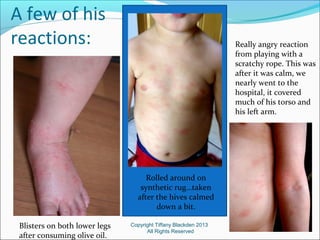
A few of his
reactions:
Copyright Tiffany Blackden 2013
All Rights Reserved
Blisters on both lower legs
after consuming olive oil.
Rolled around on
synthetic rug…taken
after the hives calmed
down a bit.
Really angry reaction
from playing with a
scratchy rope. This was
after it was calm, we
nearly went to the
hospital, it covered
much of his torso and
his left arm.
Max’s Health Team:
Naturopathic Doctors
Nationally Certified Nutritionists
Acupuncturist - BioSet Practitioner
Chinese Medicine Practitioner
Osteopathic Doctor (D.O.)
Chiropractor
MD Homeopath
Biomedical MD
His Mommy, Daddy and Sister
Copyright Tiffany Blackden 2013
All Rights Reserved
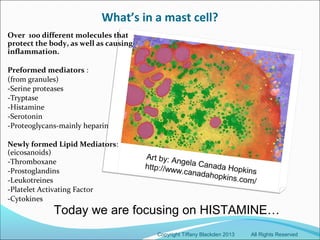
What’s in a mast cell?
Copyright Tiffany Blackden 2013 All Rights Reserved
Today we are focusing on HISTAMINE…
Art by: Angela Canada Hopkins
http://www.canadahopkins.com/
Over 100 different molecules that
protect the body, as well as causing
inflammation.
Preformed mediators :
(from granules)
-Serine proteases
-Tryptase
-Histamine
-Serotonin
-Proteoglycans-mainly heparin
Newly formed Lipid Mediators:
(eicosanoids)
-Thromboxane
-Prostoglandins
-Leukotreines
-Platelet Activating Factor
-Cytokines
The reasons we focused on lowering
the systemic histamine burden:
First step in protocol for mast cell disorders is
antihistamines, primarily H1 and H2 drugs.
Mast cells have histamine receptors on the cell
membrance that make them more ready to
degranulate or selectively secrete mediators.
Dietary histamine (and other biogenic amines, like
tyramine) was a primary *group* of foods that were
bothering our son.
Copyright Tiffany Blackden 2013
All Rights Reserved
Copyright Tiffany Blackden 2013
All Rights Reserved
Local Immune Response for Injury
Protective Mechanism in ‘Boundary’ Tissues
Regulates Smooth Muscle Contraction
Neurotransmitter
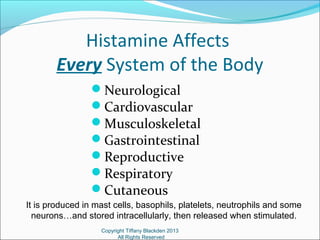
Histamine Affects
Every System of the Body
Neurological
Cardiovascular
Musculoskeletal
Gastrointestinal
Reproductive
Respiratory
Cutaneous
Copyright Tiffany Blackden 2013
All Rights Reserved
It is produced in mast cells, basophils, platelets, neutrophils and some
neurons…and stored intracellularly, then released when stimulated.
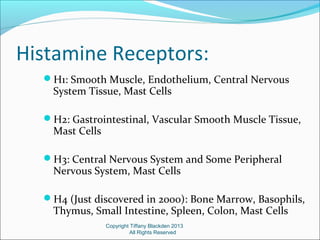
Histamine Receptors:
H1: Smooth Muscle, Endothelium, Central Nervous
System Tissue, Mast Cells
H2: Gastrointestinal, Vascular Smooth Muscle Tissue,
Mast Cells
H3: Central Nervous System and Some Peripheral
Nervous System, Mast Cells
H4 (Just discovered in 2000): Bone Marrow, Basophils,
Thymus, Small Intestine, Spleen, Colon, Mast Cells
Copyright Tiffany Blackden 2013
All Rights Reserved
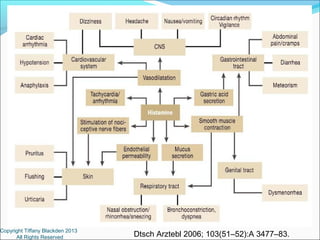
Copyright Tiffany Blackden 2013
All Rights Reserved Dtsch Arztebl 2006; 103(51–52):A 3477–83.
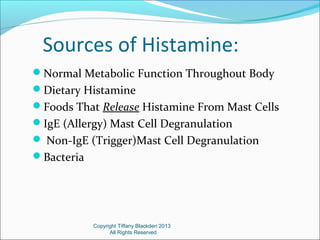
Sources of Histamine:
Normal Metabolic Function Throughout Body
Dietary Histamine
Foods That Release Histamine From Mast Cells
IgE (Allergy) Mast Cell Degranulation
 Non-IgE (Trigger)Mast Cell Degranulation
Bacteria
Copyright Tiffany Blackden 2013
All Rights Reserved
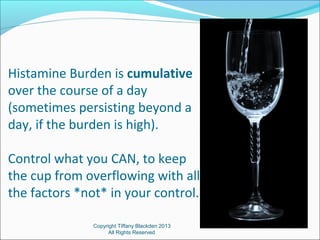
Histamine Burden is cumulative
over the course of a day
(sometimes persisting beyond a
day, if the burden is high).
Control what you CAN, to keep
the cup from overflowing with all
the factors *not* in your control.
Copyright Tiffany Blackden 2013
All Rights Reserved
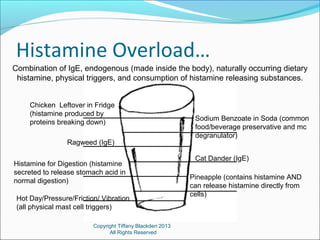
Histamine Overload…
Copyright Tiffany Blackden 2013
All Rights Reserved
Histamine for Digestion (histamine
secreted to release stomach acid in
normal digestion)
Pineapple (contains histamine AND
can release histamine directly from
cells)
Sodium Benzoate in Soda (common
food/beverage preservative and mc
degranulator)
Cat Dander (IgE)
Ragweed (IgE)
Hot Day/Pressure/Friction/ Vibration
(all physical mast cell triggers)
Chicken Leftover in Fridge
(histamine produced by
proteins breaking down)
Combination of IgE, endogenous (made inside the body), naturally occurring dietary
histamine, physical triggers, and consumption of histamine releasing substances.
Avoiding High Histamine Pitfalls…
All of these can increase your histamine burden, or
decrease your body’s ability to process histamine.
Fermented Foods
Cured Foods
Dyes
Preservatives/Additives
Sulphites
Refrigerated Leftovers (we freeze them)
Alcohol
High Histamine Foods
Histamine Releasing Foods
Histamine Degrading Enzyme Inhibiting Chemicals
Copyright Tiffany Blackden 2013
All Rights Reserved
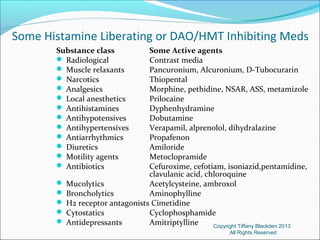
Some Histamine Liberating or DAO/HMT Inhibiting Meds
Substance class Some Active agents
 Radiological Contrast media
 Muscle relaxants Pancuronium, Alcuronium, D-Tubocurarin
 Narcotics Thiopental
 Analgesics Morphine, pethidine, NSAR, ASS, metamizole
 Local anesthetics Prilocaine
 Antihistamines Dyphenhydramine
 Antihypotensives Dobutamine
 Antihypertensives Verapamil, alprenolol, dihydralazine
 Antiarrhythmics Propafenon
 Diuretics Amiloride
 Motility agents Metoclopramide
 Antibiotics Cefuroxime, cefotiam, isoniazid,pentamidine,
clavulanic acid, chloroquine
 Mucolytics Acetylcysteine, ambroxol
 Broncholytics Aminophylline
 H2 receptor antagonists Cimetidine
 Cytostatics Cyclophosphamide
 Antidepressants Amitriptylline Copyright Tiffany Blackden 2013
All Rights Reserved
Now we know how we get
histamine IN our systems…
How Does Histamine
*EXIT* Our Bodies?
Copyright Tiffany Blackden 2013
All Rights Reserved
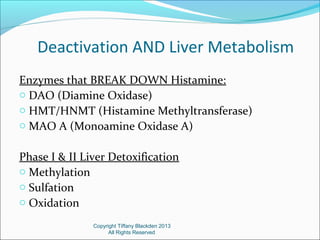
Deactivation AND Liver Metabolism
Enzymes that BREAK DOWN Histamine:
o DAO (Diamine Oxidase)
o HMT/HNMT (Histamine Methyltransferase)
o MAO A (Monoamine Oxidase A)
Phase I & II Liver Detoxification
o Methylation
o Sulfation
o Oxidation
Copyright Tiffany Blackden 2013
All Rights Reserved
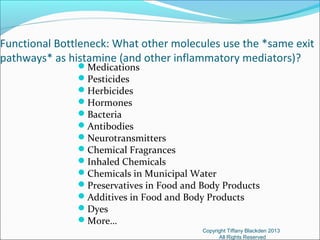
Functional Bottleneck: What other molecules use the *same exit
pathways* as histamine (and other inflammatory mediators)?
Medications
Pesticides
Herbicides
Hormones
Bacteria
Antibodies
Neurotransmitters
Chemical Fragrances
Inhaled Chemicals
Chemicals in Municipal Water
Preservatives in Food and Body Products
Additives in Food and Body Products
Dyes
More…
Copyright Tiffany Blackden 2013
All Rights Reserved
Ways to Help the Liver Flush Histamine
Reduce overall chemical load.
Move lymph in our bodies.
Exercise.
Lower our stress level.
Drink lots of clean water.
Get adequate nutrients for detoxification.
Copyright Tiffany Blackden 2013
All Rights Reserved
REDUCING OVERALL CHEMICAL LOAD-
Indirect Contact
Yard
Insect Repellants, Weed Killers, Fertilizers
Home
 Cleaning, Air freshening, Painting, Construction, Pet products
Public Places
stores with fragrance everywhere, airborne chemicals from
products in stores, people with perfume/detergent/dryer sheet
Hobby
Paints, Compounds, Gasoline, Carbon Monoxide, Polishes,
Cleaning Products
Copyright Tiffany Blackden 2013
All Rights Reserved
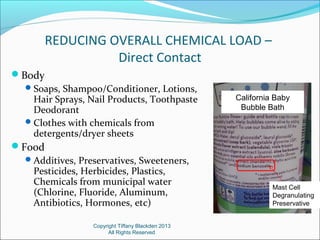
REDUCING OVERALL CHEMICAL LOAD –
Direct Contact
Body
Soaps, Shampoo/Conditioner, Lotions,
Hair Sprays, Nail Products, Toothpaste
Deodorant
Clothes with chemicals from
detergents/dryer sheets
Food
Additives, Preservatives, Sweeteners,
Pesticides, Herbicides, Plastics,
Chemicals from municipal water
(Chlorine, Fluoride, Aluminum,
Antibiotics, Hormones, etc)
Copyright Tiffany Blackden 2013
All Rights Reserved
California Baby
Bubble Bath
Mast Cell
Degranulating
Preservative
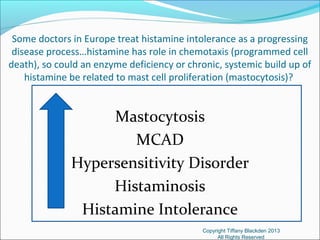
Some doctors in Europe treat histamine intolerance as a progressing
disease process…histamine has role in chemotaxis (programmed cell
death), so could an enzyme deficiency or chronic, systemic build up of
histamine be related to mast cell proliferation (mastocytosis)?
Mastocytosis
MCAD
Hypersensitivity Disorder
Histaminosis
Histamine Intolerance
Copyright Tiffany Blackden 2013
All Rights Reserved
Mast Cell – Histamine Diaries
Foods (Sensitivities/Histamine/Glycemic Index)
Beverages (Hydration Level/Dyes/Sweeteners)
Exposures (Pollen/Stores/Chemicals/Smells)
Reactions (Type/Duration/Medication)
Sleep (Amount/Quality)
Emotional State (Anxious/Depressed/Happy/Stressed)
Copyright Tiffany Blackden 2013
All Rights Reserved
Our Daily High Quality Nutrition
Drink plenty of good quality water EVERY day.
 Low Histamine/Tyramine/Other Biogenic Amines, Organic Whole Foods
(locally grown when possible)
 Rotate Foods As Much As Possible
 No Gluten/Dairy/Soy/Eggs/Nuts/Citrus/Dyes/Additives
Preservatives/Polyunsaturated Fats
 Only grass fed beef, venison and wild caught fish
 Good quality fats daily(No PUFAs, we use ghee and coconut oil)
 Digestive Enzymes
 Sources of Trace Minerals (Pink Himalayan Salt, Dulse Flakes & Wakame,
Superdupermineralpackedwheatgrass juice)
 Some High Quality Supplements (Vit D, Vit K2, Mitochondrial Support
Supps-CoQ10, l-carnitine, d-ribose and magnesium)
 Raw Leafy Greens (methylation support)
Copyright Tiffany Blackden 2013
All Rights Reserved
Other Daily Health Support
Hydration, Hydration, Hydration
Dense Nutrition
Epsom Salt Baths Almost Daily (Additional Magnesium
Chloride Spray as Needed)
Moderate Exercise-Play, Mini Trampoline
Clean Air
Good Quality Sleep
Limit All Man-made Chemical Exposure Possible
Ayurvedic-Style Meal Preparation (60%+ of calories by 1pm)
12 Hour Night Fast (Liver Function Support)
Low Stress
Copyright Tiffany Blackden 2013
All Rights Reserved
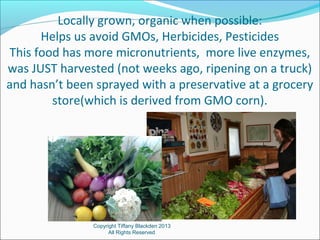
Locally grown, organic when possible:
Helps us avoid GMOs, Herbicides, Pesticides
This food has more micronutrients, more live enzymes,
was JUST harvested (not weeks ago, ripening on a truck)
and hasn’t been sprayed with a preservative at a grocery
store(which is derived from GMO corn).
Copyright Tiffany Blackden 2013
All Rights Reserved
What MCAS has taught us:
 WE are responsible for our family’s healthcare…it is necessary to understand as much as
we can, so we can make the lifestyle changes necessary for health.
 We *hire* doctors, and can choose the team that serves us best. We require that they
are open minded and willing to do some research, since this disease is such an
unknown. Much of our most effective care has been out of pocket and on the periphery
of traditional western medicine.
 Stress has a dramatic effect on our health. This can NOT be overstated, when mast cells
and histamine levels are involved.
 Eating right and living in a way that has allowed a healthier life was not easy (we moved
across country, let our beloved pets go, change our diet, change all of our household and
personal care products and homeschool to help our son), but every step we’ve taken has
brought us to a more complete level of health and wellness.
 It’s a marathon, that requires daily effort. It can’t be done as a sprint…little changes,
consistently added, allow for some sense of balance as you go along the path.
 When you have a chronically sick child, it is vitally important to take care of yourself.
 We must trust our intuition.
Copyright Tiffany Blackden 2013
All Rights Reserved
Get in touch, get support…
Please connect with me:
Tiffany Blackden on Facebook, Twitter or LinkedIn
Email: Tiffany@TiffanyBlackden.com
Join Facebook Group:
“Mastocytosis – Holistic Approach”
Our FB page for our medical journey & research:
www.Facebook.com/blackdenfamily
Copyright Tiffany Blackden 2013 All Rights Reserved

Working with Histamine Overload April 2013

  • 1.
    Methods we usedto lower our young son’s histamine burden, to reduce the frequency and intensity of dangerous and painful histamine mediated reactions. Copyright Tiffany Blackden 2013 All Rights Reserved The Mastocytosis Society DC Regional Regional Meeting April 2013
  • 2.
    Copyright Tiffany Blackden2013 All Rights Reserved Our family! The reasons we’ve stayed up all night researching and continuing to figure out ways to support health!
  • 3.
    Mast Cell ActivationSyndrome I.Systemic Anaphylaxis Faintness Fatigue II.Dermatologic Flushing Rashes Itching Hives III.Cardiovascular Blood pressure changes and shock Chest pain Rapid heart rate IV.Pulmonary Wheezing Copyright Tiffany Blackden 2013 All Rights Reserved
  • 4.
    V.Musculoskeletal Bone pain Muscle pain Degenerativedisc disease Osteoporosis/osteopenia VI.Gastrointestinal Nausea Vomiting Abdominal pain Gastroesophageal reflux Diarrhea Inflammation of the esophagus Intestinal cramping and bloating Malabsorption VII.Neurologic Cognitive difficulties/brain fog Dizziness/vertigo Lightheadedness Migraine headache Paresthesia Peripheral neuropathy Copyright Tiffany Blackden 2013 All Rights Reserved
  • 5.
    Max’s Daily MCASPresentation Hives, dermatographia, flushing, swelling, stomachaches, headaches, fatigue, stuffiness, dizziness, reflux, diarrhea, leg pain, itching from: Foods (too many to name!) Friction Heat Cold Change in temp Animals Chemicals Synthetic Fabrics Skin Contact With Plants/Grass Etc…??? Copyright Tiffany Blackden 2013 All Rights Reserved
  • 6.
    A few ofhis reactions: Copyright Tiffany Blackden 2013 All Rights Reserved Blisters on both lower legs after consuming olive oil. Rolled around on synthetic rug…taken after the hives calmed down a bit. Really angry reaction from playing with a scratchy rope. This was after it was calm, we nearly went to the hospital, it covered much of his torso and his left arm.
  • 7.
    Max’s Health Team: NaturopathicDoctors Nationally Certified Nutritionists Acupuncturist - BioSet Practitioner Chinese Medicine Practitioner Osteopathic Doctor (D.O.) Chiropractor MD Homeopath Biomedical MD His Mommy, Daddy and Sister Copyright Tiffany Blackden 2013 All Rights Reserved
  • 8.
    What’s in amast cell? Copyright Tiffany Blackden 2013 All Rights Reserved Today we are focusing on HISTAMINE… Art by: Angela Canada Hopkins http://www.canadahopkins.com/ Over 100 different molecules that protect the body, as well as causing inflammation. Preformed mediators : (from granules) -Serine proteases -Tryptase -Histamine -Serotonin -Proteoglycans-mainly heparin Newly formed Lipid Mediators: (eicosanoids) -Thromboxane -Prostoglandins -Leukotreines -Platelet Activating Factor -Cytokines
  • 9.
    The reasons wefocused on lowering the systemic histamine burden: First step in protocol for mast cell disorders is antihistamines, primarily H1 and H2 drugs. Mast cells have histamine receptors on the cell membrance that make them more ready to degranulate or selectively secrete mediators. Dietary histamine (and other biogenic amines, like tyramine) was a primary *group* of foods that were bothering our son. Copyright Tiffany Blackden 2013 All Rights Reserved
  • 10.
    Copyright Tiffany Blackden2013 All Rights Reserved Local Immune Response for Injury Protective Mechanism in ‘Boundary’ Tissues Regulates Smooth Muscle Contraction Neurotransmitter
  • 11.
    Histamine Affects Every Systemof the Body Neurological Cardiovascular Musculoskeletal Gastrointestinal Reproductive Respiratory Cutaneous Copyright Tiffany Blackden 2013 All Rights Reserved It is produced in mast cells, basophils, platelets, neutrophils and some neurons…and stored intracellularly, then released when stimulated.
  • 12.
    Histamine Receptors: H1: SmoothMuscle, Endothelium, Central Nervous System Tissue, Mast Cells H2: Gastrointestinal, Vascular Smooth Muscle Tissue, Mast Cells H3: Central Nervous System and Some Peripheral Nervous System, Mast Cells H4 (Just discovered in 2000): Bone Marrow, Basophils, Thymus, Small Intestine, Spleen, Colon, Mast Cells Copyright Tiffany Blackden 2013 All Rights Reserved
  • 13.
    Copyright Tiffany Blackden2013 All Rights Reserved Dtsch Arztebl 2006; 103(51–52):A 3477–83.
  • 14.
    Sources of Histamine: NormalMetabolic Function Throughout Body Dietary Histamine Foods That Release Histamine From Mast Cells IgE (Allergy) Mast Cell Degranulation  Non-IgE (Trigger)Mast Cell Degranulation Bacteria Copyright Tiffany Blackden 2013 All Rights Reserved
  • 15.
    Histamine Burden iscumulative over the course of a day (sometimes persisting beyond a day, if the burden is high). Control what you CAN, to keep the cup from overflowing with all the factors *not* in your control. Copyright Tiffany Blackden 2013 All Rights Reserved
  • 16.
    Histamine Overload… Copyright TiffanyBlackden 2013 All Rights Reserved Histamine for Digestion (histamine secreted to release stomach acid in normal digestion) Pineapple (contains histamine AND can release histamine directly from cells) Sodium Benzoate in Soda (common food/beverage preservative and mc degranulator) Cat Dander (IgE) Ragweed (IgE) Hot Day/Pressure/Friction/ Vibration (all physical mast cell triggers) Chicken Leftover in Fridge (histamine produced by proteins breaking down) Combination of IgE, endogenous (made inside the body), naturally occurring dietary histamine, physical triggers, and consumption of histamine releasing substances.
  • 17.
    Avoiding High HistaminePitfalls… All of these can increase your histamine burden, or decrease your body’s ability to process histamine. Fermented Foods Cured Foods Dyes Preservatives/Additives Sulphites Refrigerated Leftovers (we freeze them) Alcohol High Histamine Foods Histamine Releasing Foods Histamine Degrading Enzyme Inhibiting Chemicals Copyright Tiffany Blackden 2013 All Rights Reserved
  • 18.
    Some Histamine Liberatingor DAO/HMT Inhibiting Meds Substance class Some Active agents  Radiological Contrast media  Muscle relaxants Pancuronium, Alcuronium, D-Tubocurarin  Narcotics Thiopental  Analgesics Morphine, pethidine, NSAR, ASS, metamizole  Local anesthetics Prilocaine  Antihistamines Dyphenhydramine  Antihypotensives Dobutamine  Antihypertensives Verapamil, alprenolol, dihydralazine  Antiarrhythmics Propafenon  Diuretics Amiloride  Motility agents Metoclopramide  Antibiotics Cefuroxime, cefotiam, isoniazid,pentamidine, clavulanic acid, chloroquine  Mucolytics Acetylcysteine, ambroxol  Broncholytics Aminophylline  H2 receptor antagonists Cimetidine  Cytostatics Cyclophosphamide  Antidepressants Amitriptylline Copyright Tiffany Blackden 2013 All Rights Reserved
  • 19.
    Now we knowhow we get histamine IN our systems… How Does Histamine *EXIT* Our Bodies? Copyright Tiffany Blackden 2013 All Rights Reserved
  • 20.
    Deactivation AND LiverMetabolism Enzymes that BREAK DOWN Histamine: o DAO (Diamine Oxidase) o HMT/HNMT (Histamine Methyltransferase) o MAO A (Monoamine Oxidase A) Phase I & II Liver Detoxification o Methylation o Sulfation o Oxidation Copyright Tiffany Blackden 2013 All Rights Reserved
  • 21.
    Functional Bottleneck: Whatother molecules use the *same exit pathways* as histamine (and other inflammatory mediators)? Medications Pesticides Herbicides Hormones Bacteria Antibodies Neurotransmitters Chemical Fragrances Inhaled Chemicals Chemicals in Municipal Water Preservatives in Food and Body Products Additives in Food and Body Products Dyes More… Copyright Tiffany Blackden 2013 All Rights Reserved
  • 22.
    Ways to Helpthe Liver Flush Histamine Reduce overall chemical load. Move lymph in our bodies. Exercise. Lower our stress level. Drink lots of clean water. Get adequate nutrients for detoxification. Copyright Tiffany Blackden 2013 All Rights Reserved
  • 23.
    REDUCING OVERALL CHEMICALLOAD- Indirect Contact Yard Insect Repellants, Weed Killers, Fertilizers Home  Cleaning, Air freshening, Painting, Construction, Pet products Public Places stores with fragrance everywhere, airborne chemicals from products in stores, people with perfume/detergent/dryer sheet Hobby Paints, Compounds, Gasoline, Carbon Monoxide, Polishes, Cleaning Products Copyright Tiffany Blackden 2013 All Rights Reserved
  • 24.
    REDUCING OVERALL CHEMICALLOAD – Direct Contact Body Soaps, Shampoo/Conditioner, Lotions, Hair Sprays, Nail Products, Toothpaste Deodorant Clothes with chemicals from detergents/dryer sheets Food Additives, Preservatives, Sweeteners, Pesticides, Herbicides, Plastics, Chemicals from municipal water (Chlorine, Fluoride, Aluminum, Antibiotics, Hormones, etc) Copyright Tiffany Blackden 2013 All Rights Reserved California Baby Bubble Bath Mast Cell Degranulating Preservative
  • 25.
    Some doctors inEurope treat histamine intolerance as a progressing disease process…histamine has role in chemotaxis (programmed cell death), so could an enzyme deficiency or chronic, systemic build up of histamine be related to mast cell proliferation (mastocytosis)? Mastocytosis MCAD Hypersensitivity Disorder Histaminosis Histamine Intolerance Copyright Tiffany Blackden 2013 All Rights Reserved
  • 26.
    Mast Cell –Histamine Diaries Foods (Sensitivities/Histamine/Glycemic Index) Beverages (Hydration Level/Dyes/Sweeteners) Exposures (Pollen/Stores/Chemicals/Smells) Reactions (Type/Duration/Medication) Sleep (Amount/Quality) Emotional State (Anxious/Depressed/Happy/Stressed) Copyright Tiffany Blackden 2013 All Rights Reserved
  • 27.
    Our Daily HighQuality Nutrition Drink plenty of good quality water EVERY day.  Low Histamine/Tyramine/Other Biogenic Amines, Organic Whole Foods (locally grown when possible)  Rotate Foods As Much As Possible  No Gluten/Dairy/Soy/Eggs/Nuts/Citrus/Dyes/Additives Preservatives/Polyunsaturated Fats  Only grass fed beef, venison and wild caught fish  Good quality fats daily(No PUFAs, we use ghee and coconut oil)  Digestive Enzymes  Sources of Trace Minerals (Pink Himalayan Salt, Dulse Flakes & Wakame, Superdupermineralpackedwheatgrass juice)  Some High Quality Supplements (Vit D, Vit K2, Mitochondrial Support Supps-CoQ10, l-carnitine, d-ribose and magnesium)  Raw Leafy Greens (methylation support) Copyright Tiffany Blackden 2013 All Rights Reserved
  • 28.
    Other Daily HealthSupport Hydration, Hydration, Hydration Dense Nutrition Epsom Salt Baths Almost Daily (Additional Magnesium Chloride Spray as Needed) Moderate Exercise-Play, Mini Trampoline Clean Air Good Quality Sleep Limit All Man-made Chemical Exposure Possible Ayurvedic-Style Meal Preparation (60%+ of calories by 1pm) 12 Hour Night Fast (Liver Function Support) Low Stress Copyright Tiffany Blackden 2013 All Rights Reserved
  • 29.
    Locally grown, organicwhen possible: Helps us avoid GMOs, Herbicides, Pesticides This food has more micronutrients, more live enzymes, was JUST harvested (not weeks ago, ripening on a truck) and hasn’t been sprayed with a preservative at a grocery store(which is derived from GMO corn). Copyright Tiffany Blackden 2013 All Rights Reserved
  • 30.
    What MCAS hastaught us:  WE are responsible for our family’s healthcare…it is necessary to understand as much as we can, so we can make the lifestyle changes necessary for health.  We *hire* doctors, and can choose the team that serves us best. We require that they are open minded and willing to do some research, since this disease is such an unknown. Much of our most effective care has been out of pocket and on the periphery of traditional western medicine.  Stress has a dramatic effect on our health. This can NOT be overstated, when mast cells and histamine levels are involved.  Eating right and living in a way that has allowed a healthier life was not easy (we moved across country, let our beloved pets go, change our diet, change all of our household and personal care products and homeschool to help our son), but every step we’ve taken has brought us to a more complete level of health and wellness.  It’s a marathon, that requires daily effort. It can’t be done as a sprint…little changes, consistently added, allow for some sense of balance as you go along the path.  When you have a chronically sick child, it is vitally important to take care of yourself.  We must trust our intuition. Copyright Tiffany Blackden 2013 All Rights Reserved
  • 31.
    Get in touch,get support… Please connect with me: Tiffany Blackden on Facebook, Twitter or LinkedIn Email: Tiffany@TiffanyBlackden.com Join Facebook Group: “Mastocytosis – Holistic Approach” Our FB page for our medical journey & research: www.Facebook.com/blackdenfamily Copyright Tiffany Blackden 2013 All Rights Reserved

Editor's Notes

  • #13 Type Location Function H 1 histamine receptor Found on smooth muscle , endothelium , and central nervous system tissue Causes, bronchoconstriction , bronchial smooth muscle contraction, vasodilation , separation of endothelial cells (responsible for hives ), and pain and itching due to insect stings; the primary receptors involved in allergic rhinitis symptoms and motion sickness ; sleep and appetite suppression. H 2 histamine receptor Located on parietal cells and vascular smooth muscle cells Primarily involved in vasodilation. Also stimulate gastric acid secretion H 3 histamine receptor Found on central nervous system and to a lesser extent peripheral nervous system tissue Decreased neurotransmitter release: histamine, acetylcholine, norepinephrine, serotonin H 4 histamine receptor Found primarily in the basophils and in the bone marrow. It is also found on thymus, small intestine, spleen, and colon. Plays a role in chemotaxis.