Working with
Components
At the simplest level, Flows are sequences of message-processing
events. As the following schematic illustrates, a message that
enters a flow may be:
validated (filtered)
enriched (appended)
transformed into a new format
processed by custom-coded business logic
logged to a database
evaluated to determine what sort of response gets returned to
party that submitted the original message
Prudhvi
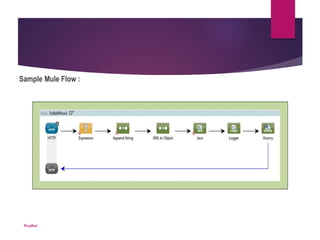
Sample Mule Flow :
Prudhvi
Flow Building Blocks :
The following sub-sections detail the various types of building
blocks (and processing blocks) that can populate a Mule Flow.
a. Message Source (Optional)
b. Message Processors
c. Message Processing Blocks
d. End Points
Prudhvi
Message Source (Optional)
The first building block in most Flows is a Message Source,
which receives messages from one or more external sources,
thus triggering a Flow instance. Each time it receives another
message, the Message Source triggers another Flow instance.
Prudhvi
Message Processors
Typically, these are pre-packaged units of functionality that process
messages in various ways. Except for Message Sources, all the building
blocks in a Flow qualify as Message Processors. Unlike the Mule Services
they have largely supplanted, Message Processors offer the following
advantages:
They don’t have to be connected to each other with routers, endpoints,
and VM queues in the rigid fashion required for Services
Multiple Message Processors can be combined into various structures that
provide the exact functionality you need for your application
Prudhvi
Message Processing Blocks
Mule provides several ways to combine multiple message
processors into functional processing blocks.
For instance, the Composite Source scope allows you to
embed into a single message source two or more inbound
endpoints, each one listening to a different transport channel.
Whenever one of these listeners receives an incoming
message, it triggers a flow instance and starts the message
through the message processing sequence.
Prudhvi
Endpoints
As previously mentioned, Endpoints implement transport
channels that facilitate the insertion or extraction of data
from Flows. Endpoints serve a diverse variety of roles,
depending on how they are configured. For example, they
can, as previously mentioned, serve as Inbound or Outbound
conduits. They can implement one-way or request-response
exchange patterns. And, in certain situations, you can embed
other types of message processors, such as transformers or
filters, into endpoints.
Prudhvi
THANK YOU
Prudhvi

Working with components

  • 1.
  • 2.
    At the simplestlevel, Flows are sequences of message-processing events. As the following schematic illustrates, a message that enters a flow may be: validated (filtered) enriched (appended) transformed into a new format processed by custom-coded business logic logged to a database evaluated to determine what sort of response gets returned to party that submitted the original message Prudhvi
  • 3.
  • 4.
    Flow Building Blocks: The following sub-sections detail the various types of building blocks (and processing blocks) that can populate a Mule Flow. a. Message Source (Optional) b. Message Processors c. Message Processing Blocks d. End Points Prudhvi
  • 5.
    Message Source (Optional) Thefirst building block in most Flows is a Message Source, which receives messages from one or more external sources, thus triggering a Flow instance. Each time it receives another message, the Message Source triggers another Flow instance. Prudhvi
  • 6.
    Message Processors Typically, theseare pre-packaged units of functionality that process messages in various ways. Except for Message Sources, all the building blocks in a Flow qualify as Message Processors. Unlike the Mule Services they have largely supplanted, Message Processors offer the following advantages: They don’t have to be connected to each other with routers, endpoints, and VM queues in the rigid fashion required for Services Multiple Message Processors can be combined into various structures that provide the exact functionality you need for your application Prudhvi
  • 7.
    Message Processing Blocks Muleprovides several ways to combine multiple message processors into functional processing blocks. For instance, the Composite Source scope allows you to embed into a single message source two or more inbound endpoints, each one listening to a different transport channel. Whenever one of these listeners receives an incoming message, it triggers a flow instance and starts the message through the message processing sequence. Prudhvi
  • 8.
    Endpoints As previously mentioned,Endpoints implement transport channels that facilitate the insertion or extraction of data from Flows. Endpoints serve a diverse variety of roles, depending on how they are configured. For example, they can, as previously mentioned, serve as Inbound or Outbound conduits. They can implement one-way or request-response exchange patterns. And, in certain situations, you can embed other types of message processors, such as transformers or filters, into endpoints. Prudhvi
  • 9.