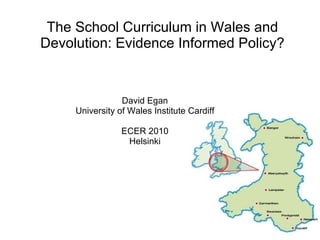
The School Curriculum in Wales and Devolution: Evidence Informed Policy? David Egan University of Wales Institute Cardiff ECER 2010 Helsinki
Context Role of the Welsh Office before devolution: ‘delivery of programmes and services’ decided at Whitehall National Assembly for Wales took over devolved power in 1999 The Learning Country  (Welsh Assembly Govt, 2001) communitarian, state provided education system move away from high stakes testing moved away from prescriptive pedagogies e.g. National Strategies
Curriculum reform in Wales abandonment of national testing at ages 7, 11 and 14 introduction of the Foundation phase , 3-7 years olds reform of 14-19 education introduction of a Welsh baccalaureate initial work scoping 8-14 phase in education School Effectiveness Framework implemented from September 2010 Completed within the reformed National Curriculum through greater freedom to innovate.
Evidence Informed Policy? Foundation Stage Expert Adviser produced recommendations (2000);  development work involving civil servants, practitioners, academics and special interest groups consultation period (2002) pilot in 41 schools (September 2004) guidance information for practitioners nursery and reception children from 2009 all 3-7 years olds from 2011
Evidence Informed Policy? Assessment decision to end testing for 7 year olds based on evidence from Inspectorate, practitioners and officials within Education Dept. review of curriculum and assessment arrangements by former Chief Inspector in 2003 – questionnaires and stakeholder interviews. further expert review by Prof Richard Daugherty (ARG) in 2004 Pedagogy pilot of Assessment for Learning  and thinking skills strategies with groups of schools Pedagogy Strategy and School Effectiveness Framework
Evidence Informed Policy? 14-19 Education and Training broader curriculum offer from September 2009 Review Group formed 2007, Prof Adrian Webb collaboration between providers needs to improve policy development led by WAG officials with practitioner secondees initial development and scoping work involved 170 individuals from a wider range of stakeholder groups 14-19 Learning Networks in the 22 LAs of Wales less involvement of academic research high political engagement
Evidence Informed Policy? Welsh Baccalaureate broaden curriculum for 14-18 year olds review of international evidence  pilot undertaken between 2003-2006 pilot received a positive evaluation by University of Nottingham target: 40% of all 14-19 years involved by 2010
Evidence Informed Policy? Review of 8-14 Education in Wales Task Group established in early 2009 led by Prof Egan strong stakeholder engagement: headteachers, Local Authority personnel, school governor, school inspector recommendations: creation of discrete 8-14 phase with discrete policy for pedagogy leadership, transition, assessment, literacy and inclusion development of 8-14 workforce changes to school governance and organisation changes to inspection framework commissioning of educational research on 8-14 achievement more equal distribution of funding between phases
Conclusion stakeholder interaction strongest in Foundation Phase and weakest for 14-19 reform greatest impact where there is a strong personal commitment and involvement of senior politicians in networks with practitioners WAG draws on educational research in Wales Issues of capacity and dissemination what counts as evidence?   quantitative and qualitative approaches  practitioner input and research-based evidence Informal brokerage –  Bridging the divide between policy makers and researchers Strong involvement of practitioners

The School Curriculum in Wales and Devolution: Evidence Informed Policy

  • 1.
    The School Curriculumin Wales and Devolution: Evidence Informed Policy? David Egan University of Wales Institute Cardiff ECER 2010 Helsinki
  • 2.
    Context Role ofthe Welsh Office before devolution: ‘delivery of programmes and services’ decided at Whitehall National Assembly for Wales took over devolved power in 1999 The Learning Country (Welsh Assembly Govt, 2001) communitarian, state provided education system move away from high stakes testing moved away from prescriptive pedagogies e.g. National Strategies
  • 3.
    Curriculum reform inWales abandonment of national testing at ages 7, 11 and 14 introduction of the Foundation phase , 3-7 years olds reform of 14-19 education introduction of a Welsh baccalaureate initial work scoping 8-14 phase in education School Effectiveness Framework implemented from September 2010 Completed within the reformed National Curriculum through greater freedom to innovate.
  • 4.
    Evidence Informed Policy?Foundation Stage Expert Adviser produced recommendations (2000); development work involving civil servants, practitioners, academics and special interest groups consultation period (2002) pilot in 41 schools (September 2004) guidance information for practitioners nursery and reception children from 2009 all 3-7 years olds from 2011
  • 5.
    Evidence Informed Policy?Assessment decision to end testing for 7 year olds based on evidence from Inspectorate, practitioners and officials within Education Dept. review of curriculum and assessment arrangements by former Chief Inspector in 2003 – questionnaires and stakeholder interviews. further expert review by Prof Richard Daugherty (ARG) in 2004 Pedagogy pilot of Assessment for Learning and thinking skills strategies with groups of schools Pedagogy Strategy and School Effectiveness Framework
  • 6.
    Evidence Informed Policy?14-19 Education and Training broader curriculum offer from September 2009 Review Group formed 2007, Prof Adrian Webb collaboration between providers needs to improve policy development led by WAG officials with practitioner secondees initial development and scoping work involved 170 individuals from a wider range of stakeholder groups 14-19 Learning Networks in the 22 LAs of Wales less involvement of academic research high political engagement
  • 7.
    Evidence Informed Policy?Welsh Baccalaureate broaden curriculum for 14-18 year olds review of international evidence pilot undertaken between 2003-2006 pilot received a positive evaluation by University of Nottingham target: 40% of all 14-19 years involved by 2010
  • 8.
    Evidence Informed Policy?Review of 8-14 Education in Wales Task Group established in early 2009 led by Prof Egan strong stakeholder engagement: headteachers, Local Authority personnel, school governor, school inspector recommendations: creation of discrete 8-14 phase with discrete policy for pedagogy leadership, transition, assessment, literacy and inclusion development of 8-14 workforce changes to school governance and organisation changes to inspection framework commissioning of educational research on 8-14 achievement more equal distribution of funding between phases
  • 9.
    Conclusion stakeholder interactionstrongest in Foundation Phase and weakest for 14-19 reform greatest impact where there is a strong personal commitment and involvement of senior politicians in networks with practitioners WAG draws on educational research in Wales Issues of capacity and dissemination what counts as evidence? quantitative and qualitative approaches practitioner input and research-based evidence Informal brokerage – Bridging the divide between policy makers and researchers Strong involvement of practitioners