©2010, 2007, 2003 Pearson Education, Inc.
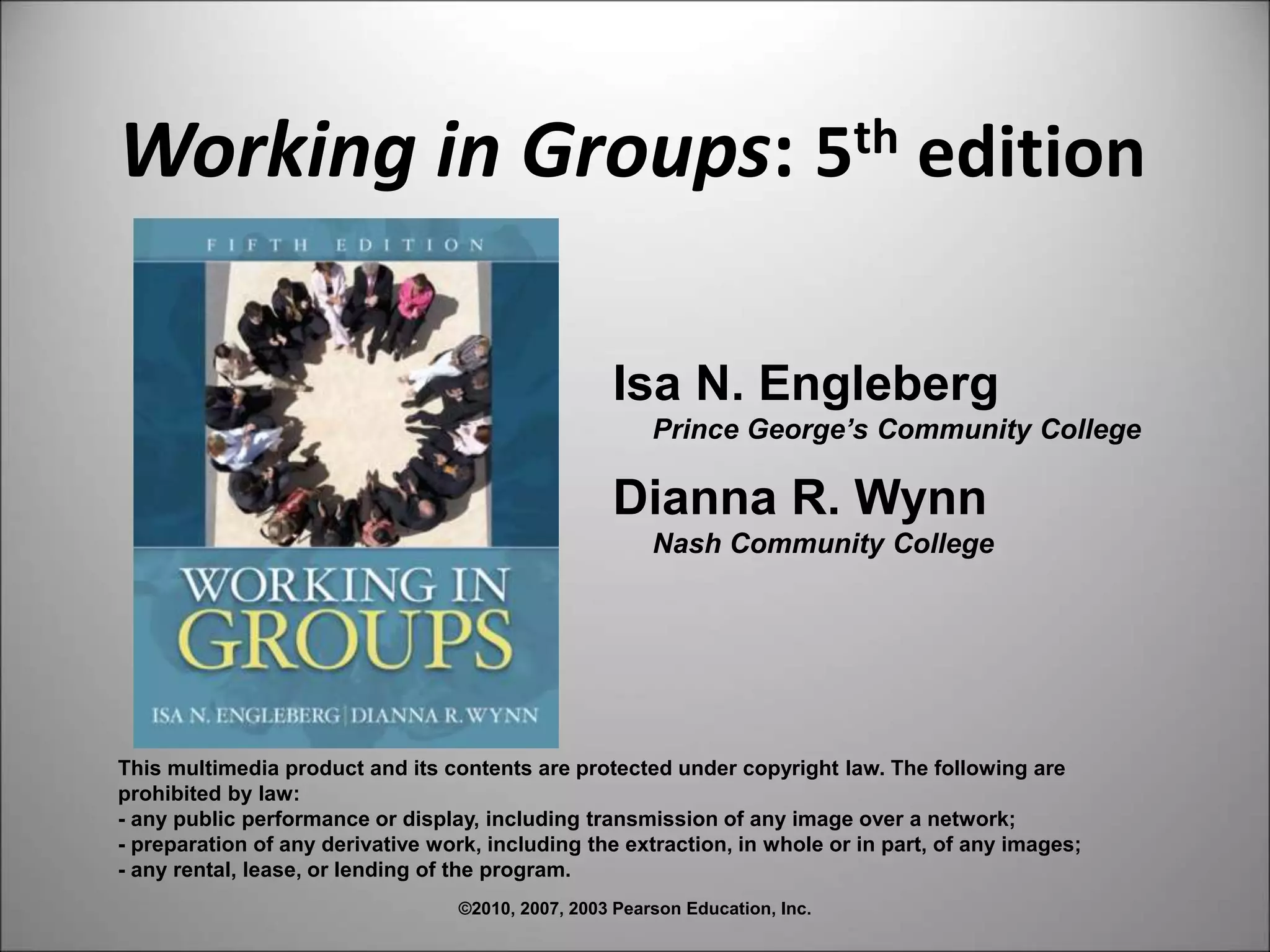
Working in Groups: 5th edition
This multimedia product and its contents are protected under copyright law. The following are
prohibited by law:
- any public performance or display, including transmission of any image over a network;
- preparation of any derivative work, including the extraction, in whole or in part, of any images;
- any rental, lease, or lending of the program.
Isa N. Engleberg
Prince George’s Community College
Dianna R. Wynn
Nash Community College
©2010, 2007, 2003 Pearson Education, Inc.
Chapter 3:
Group
Membership
©2010, 2007, 2003 Pearson Education, Inc.
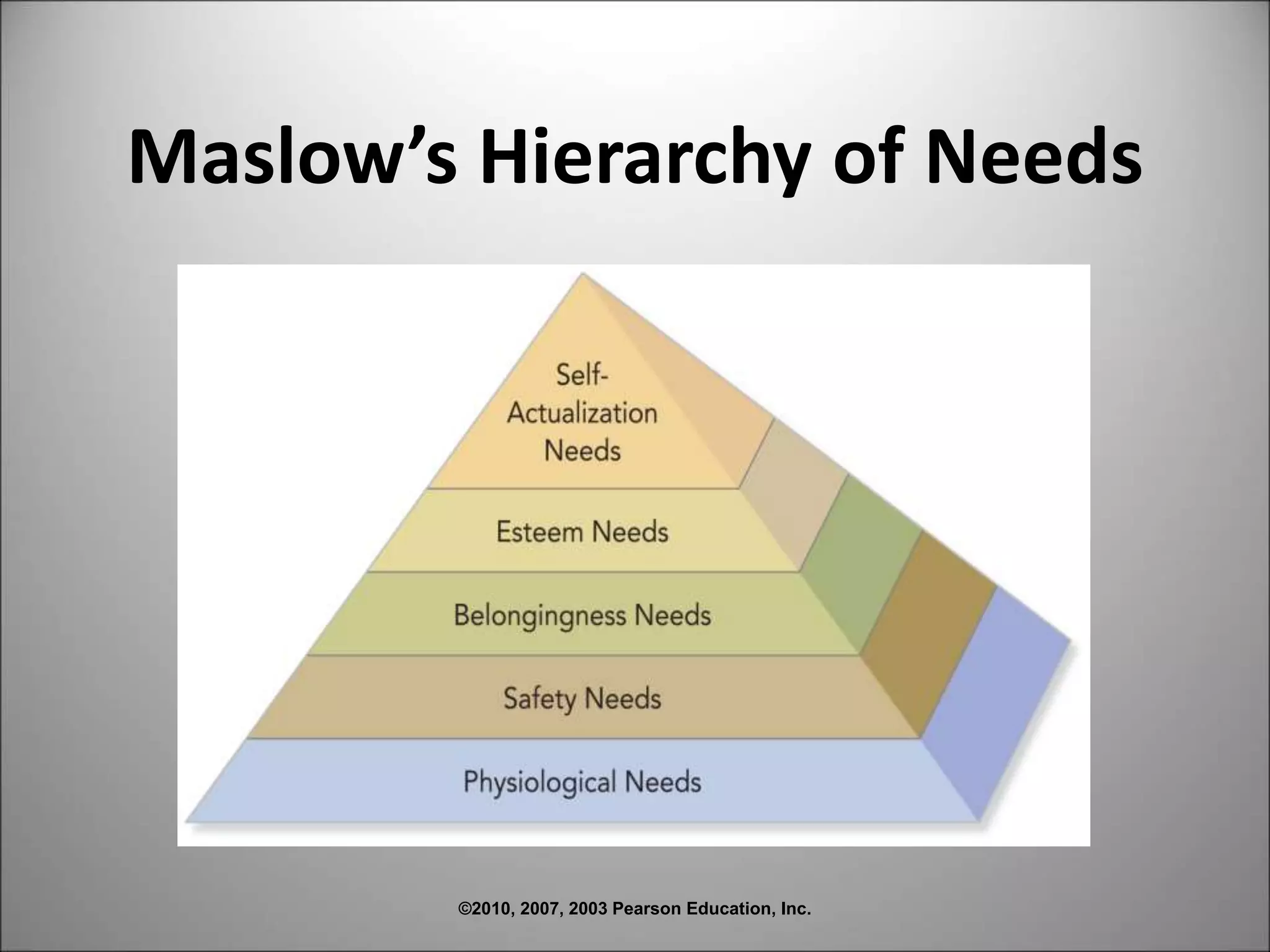
Maslow’s Hierarchy of Needs
©2010, 2007, 2003 Pearson Education, Inc.
Match the Need to the Group
Need
A. Physiological
B. Safety
C. Belongingness
D. Esteem
E. Self-Actualization
Group
___ police force
___ family
___ garden society
___ adult literacy group
___ sorority/fraternity
___ executive club
___ pro basketball team
©2010, 2007, 2003 Pearson Education, Inc.
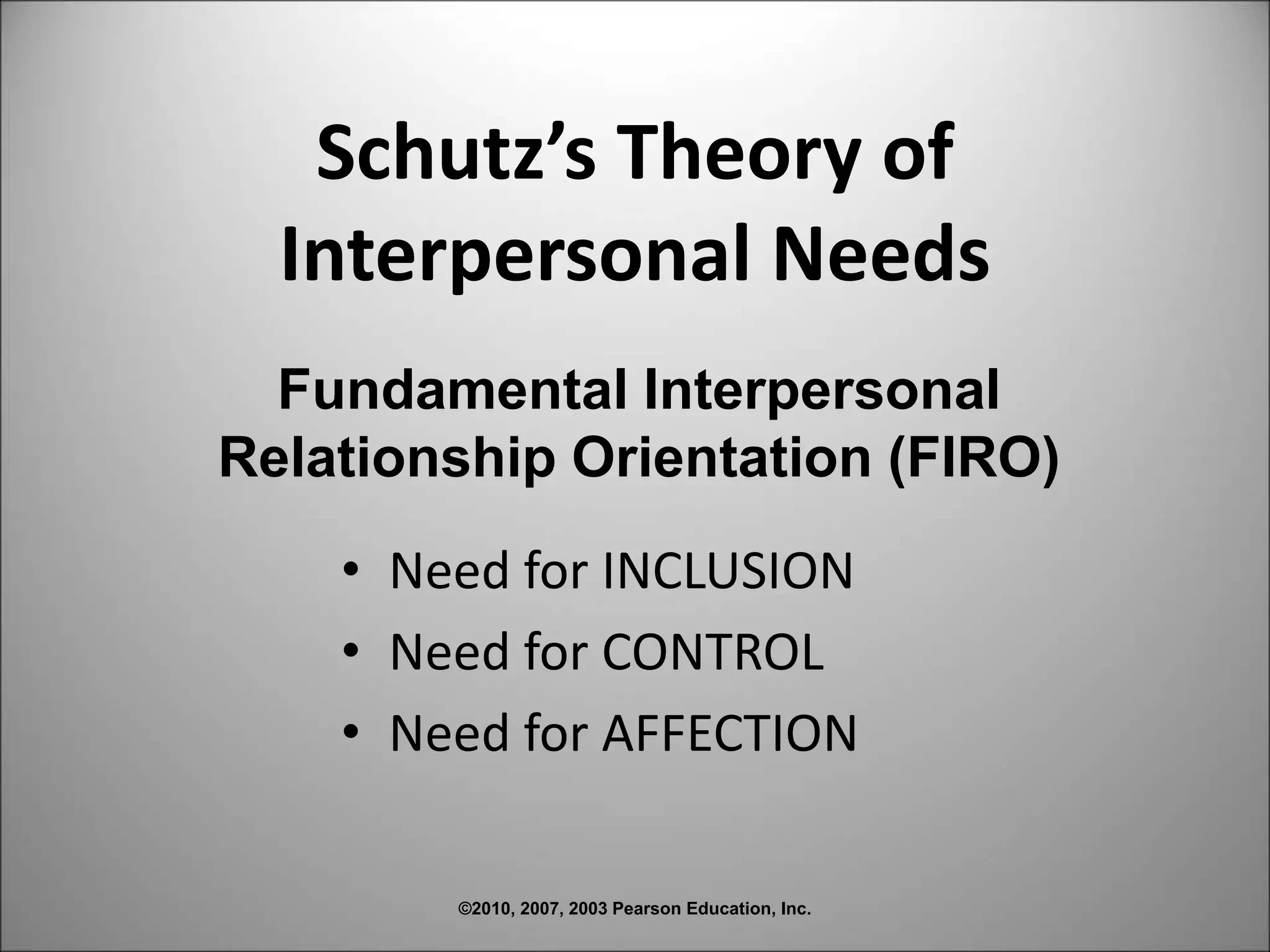
Schutz’s Theory of
Interpersonal Needs
• Need for INCLUSION
• Need for CONTROL
• Need for AFFECTION
Fundamental Interpersonal
Relationship Orientation (FIRO)
©2010, 2007, 2003 Pearson Education, Inc.
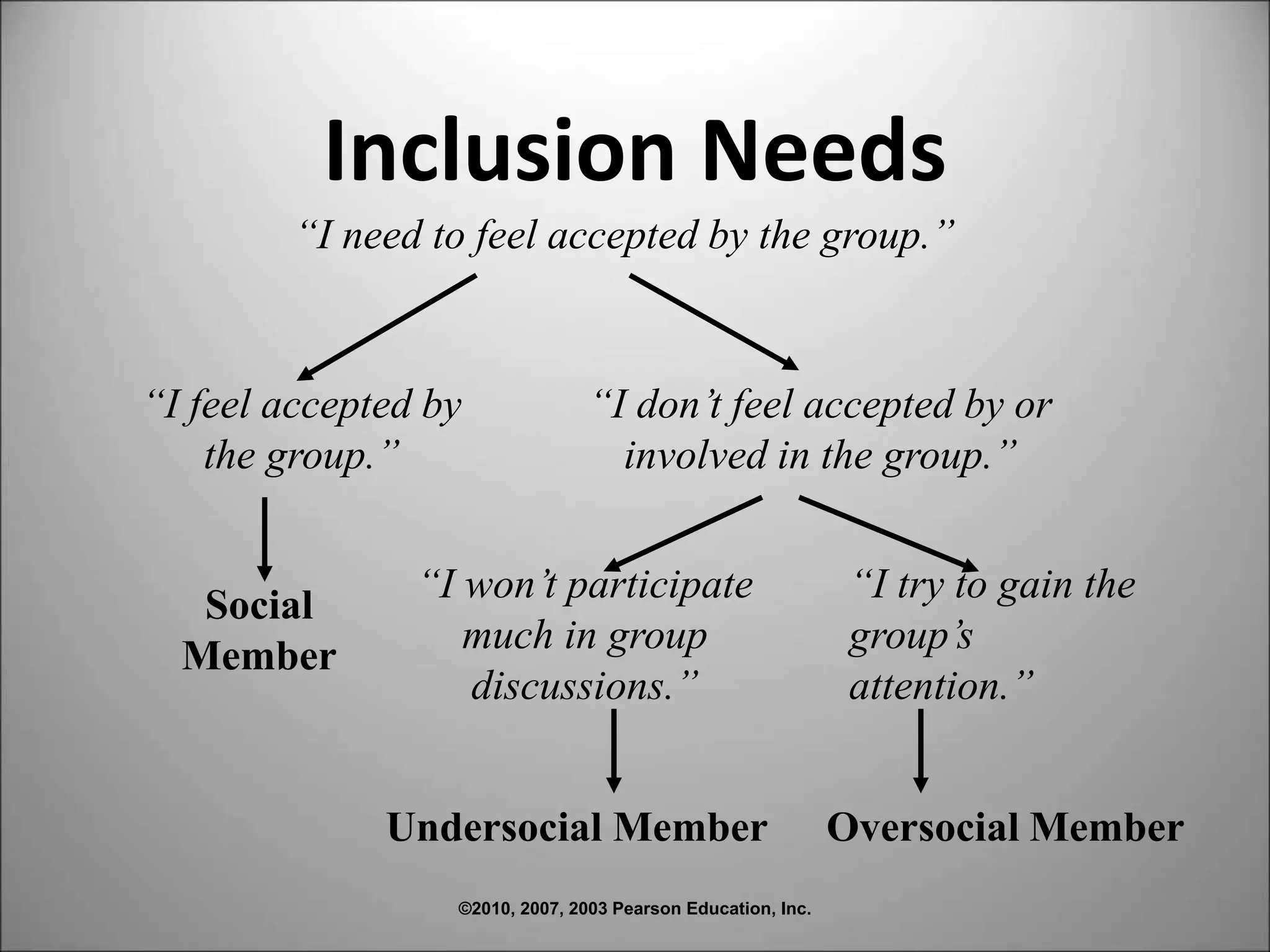
Inclusion Needs
“I need to feel accepted by the group.”
“I feel accepted by
the group.”
Social
Member
“I don’t feel accepted by or
involved in the group.”
“I won’t participate
much in group
discussions.”
“I try to gain the
group’s
attention.”
Undersocial Member Oversocial Member
©2010, 2007, 2003 Pearson Education, Inc.
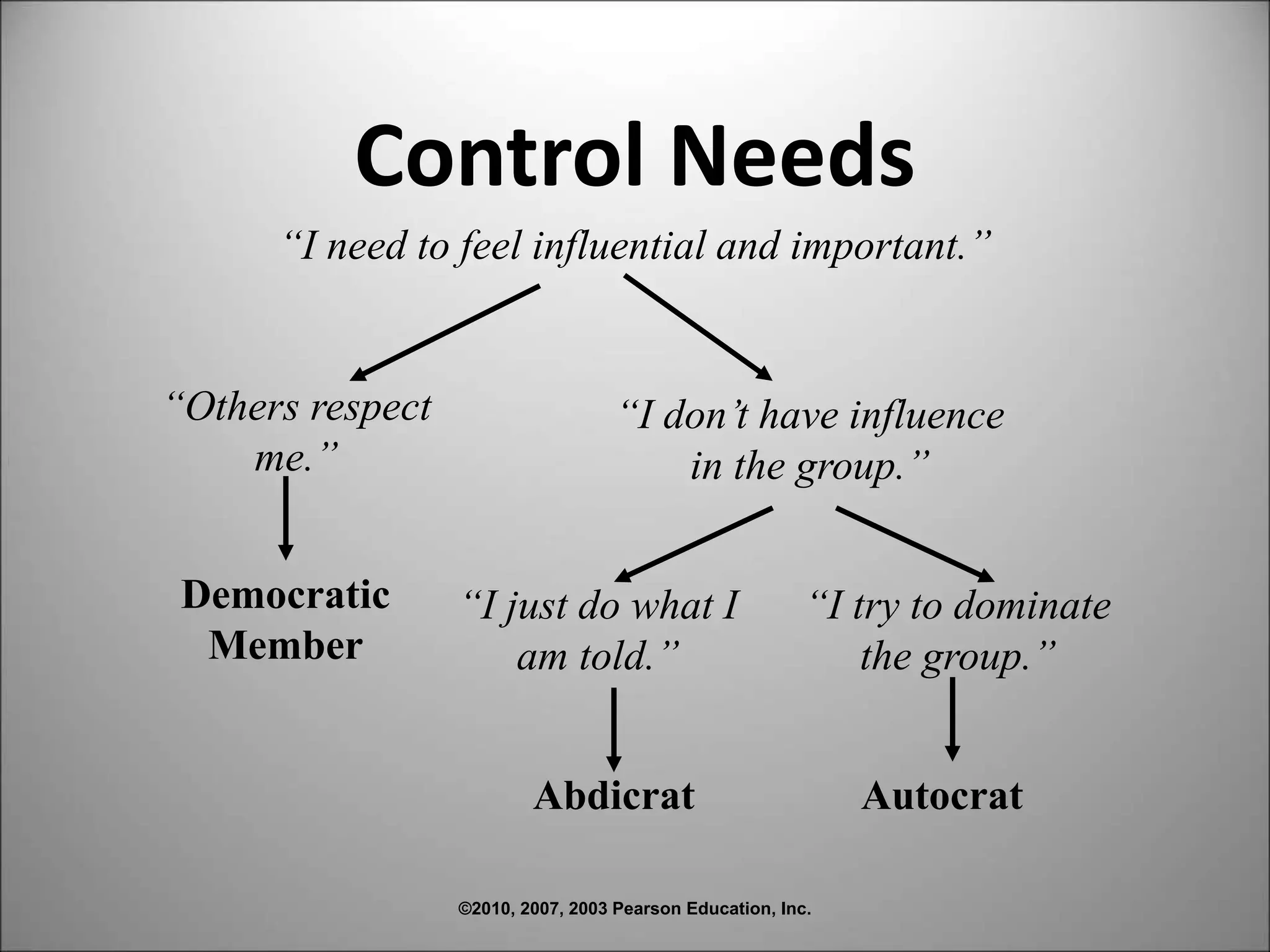
“I need to feel influential and important.”
“Others respect
me.”
Democratic
Member
“I don’t have influence
in the group.”
“I just do what I
am told.”
“I try to dominate
the group.”
Abdicrat Autocrat
Control Needs
©2010, 2007, 2003 Pearson Education, Inc.
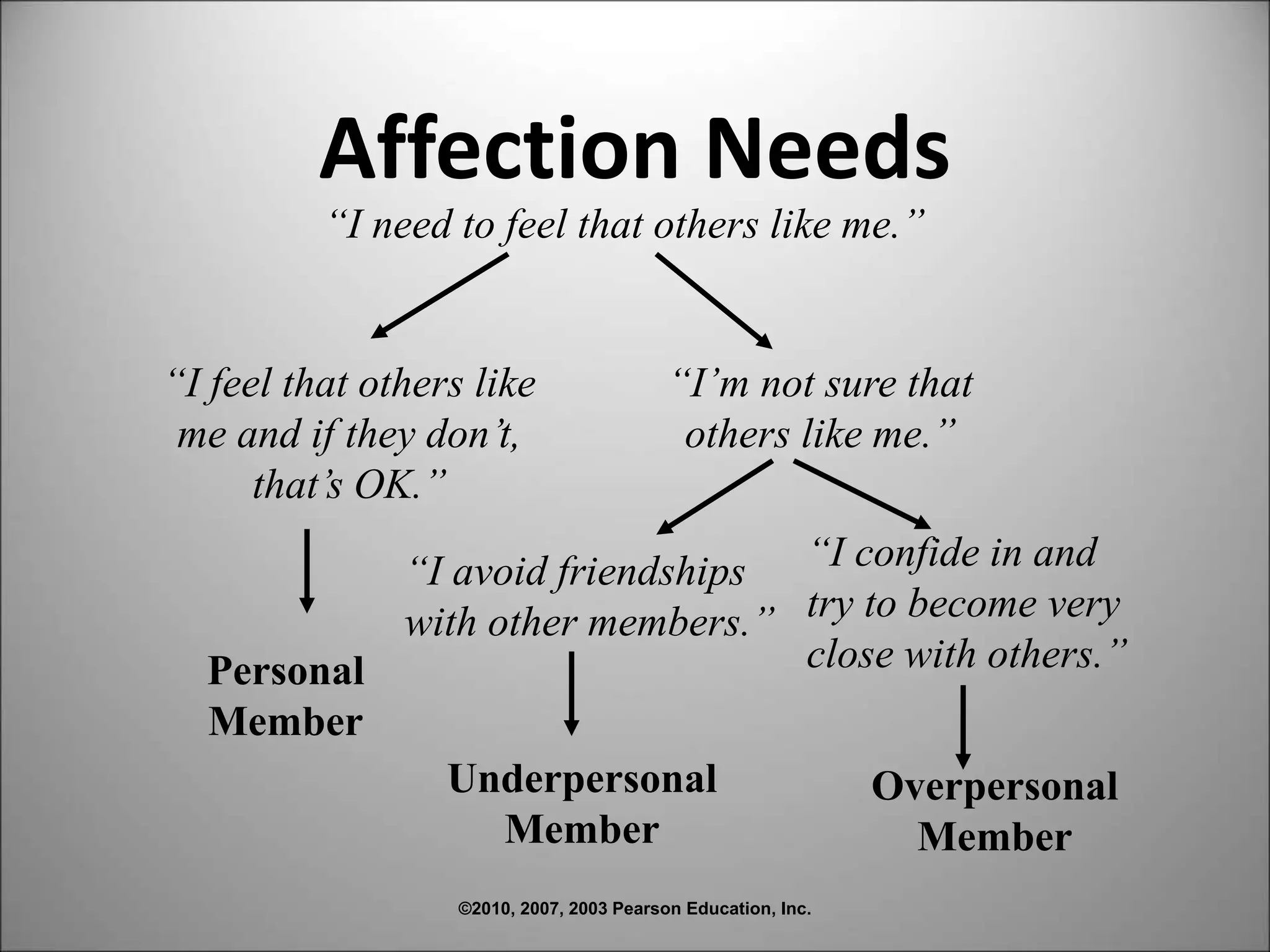
“I need to feel that others like me.”
“I feel that others like
me and if they don’t,
that’s OK.”
Personal
Member
“I’m not sure that
others like me.”
“I avoid friendships
with other members.”
“I confide in and
try to become very
close with others.”
Underpersonal
Member
Overpersonal
Member
Affection Needs
©2010, 2007, 2003 Pearson Education, Inc.
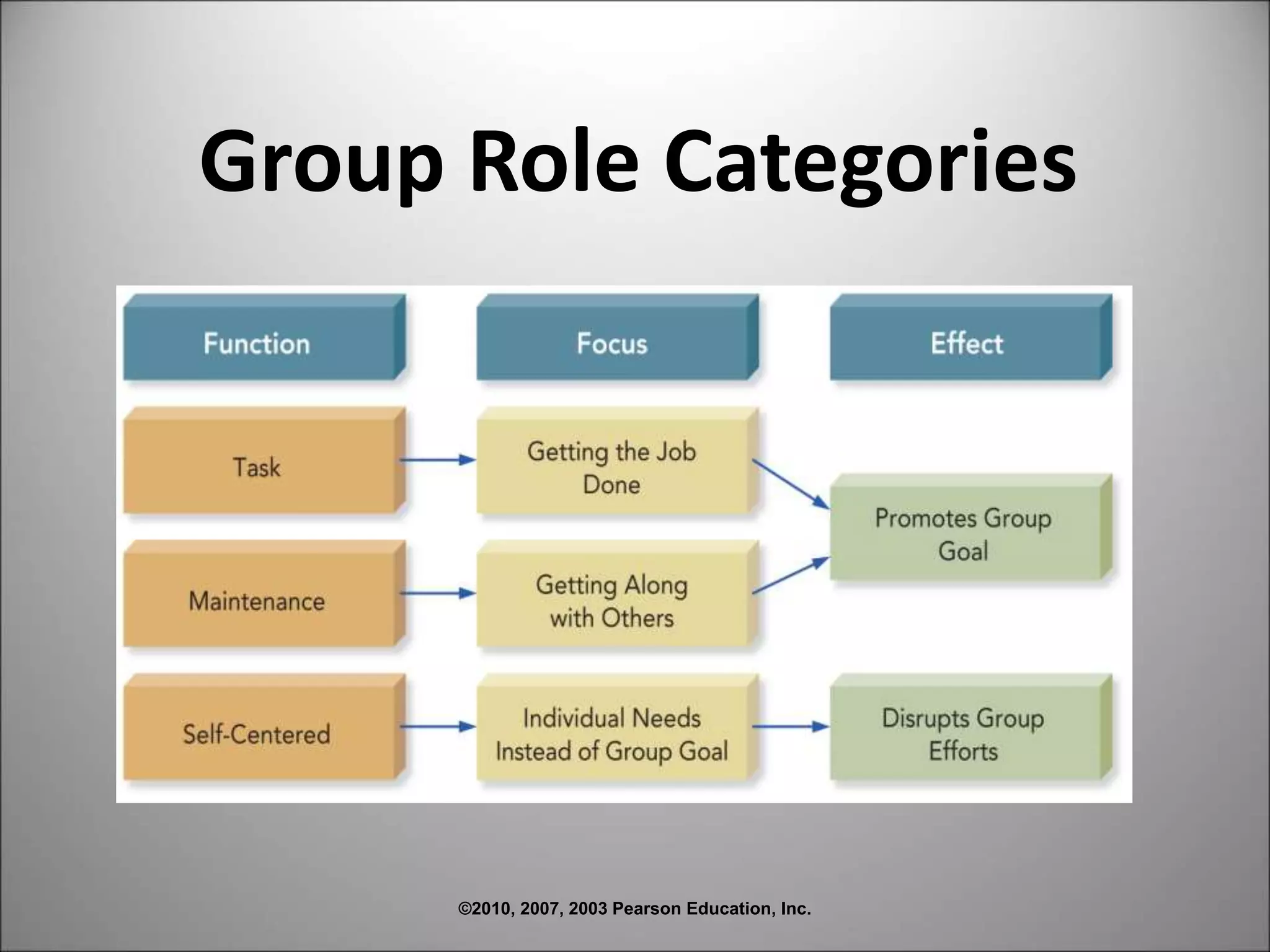
Group Role Categories
©2010, 2007, 2003 Pearson Education, Inc.
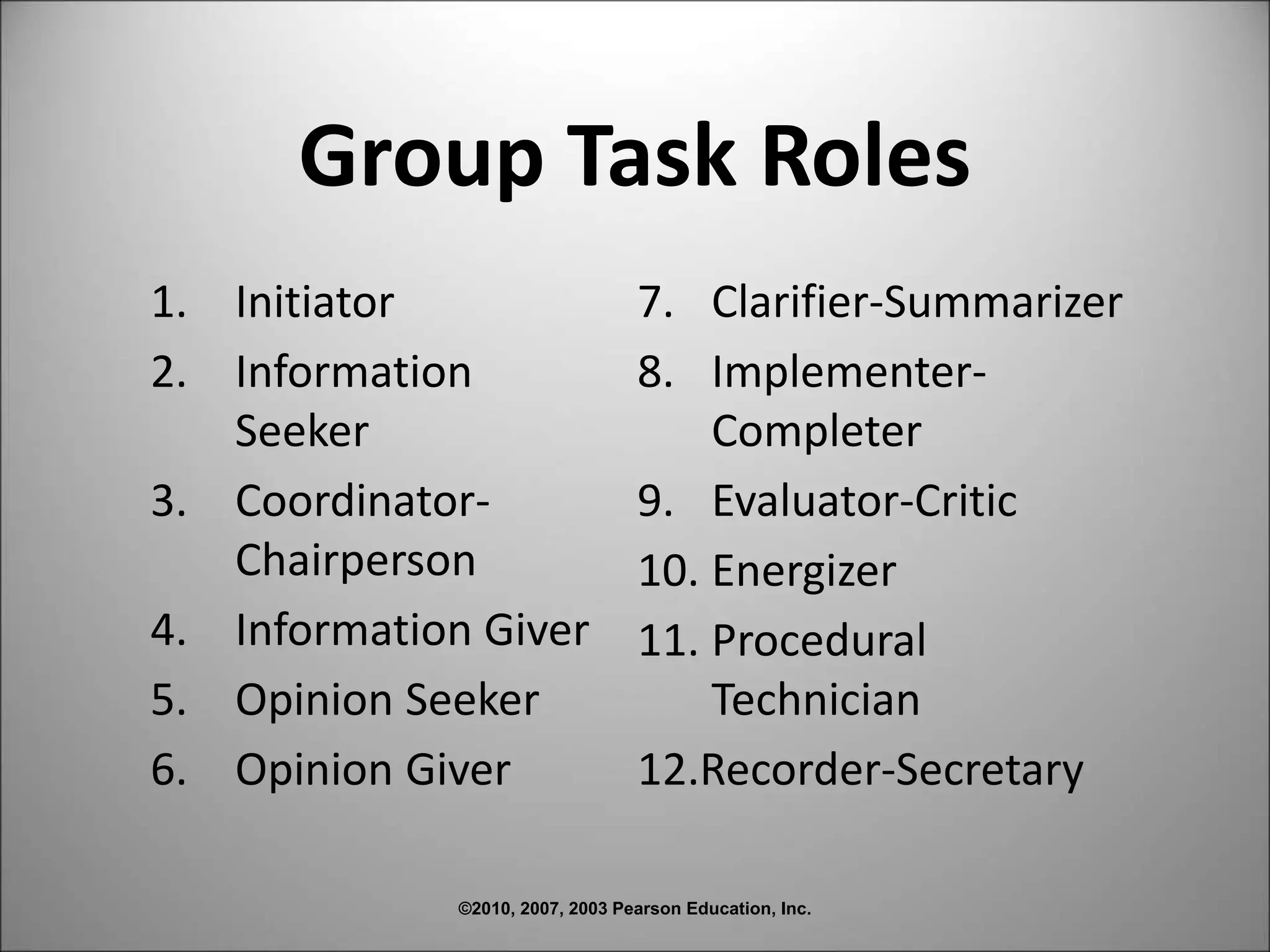
Group Task Roles
1. Initiator
2. Information
Seeker
3. Coordinator-
Chairperson
4. Information Giver
5. Opinion Seeker
6. Opinion Giver
7. Clarifier-Summarizer
8. Implementer-
Completer
9. Evaluator-Critic
10. Energizer
11. Procedural
Technician
12.Recorder-Secretary
©2010, 2007, 2003 Pearson Education, Inc.
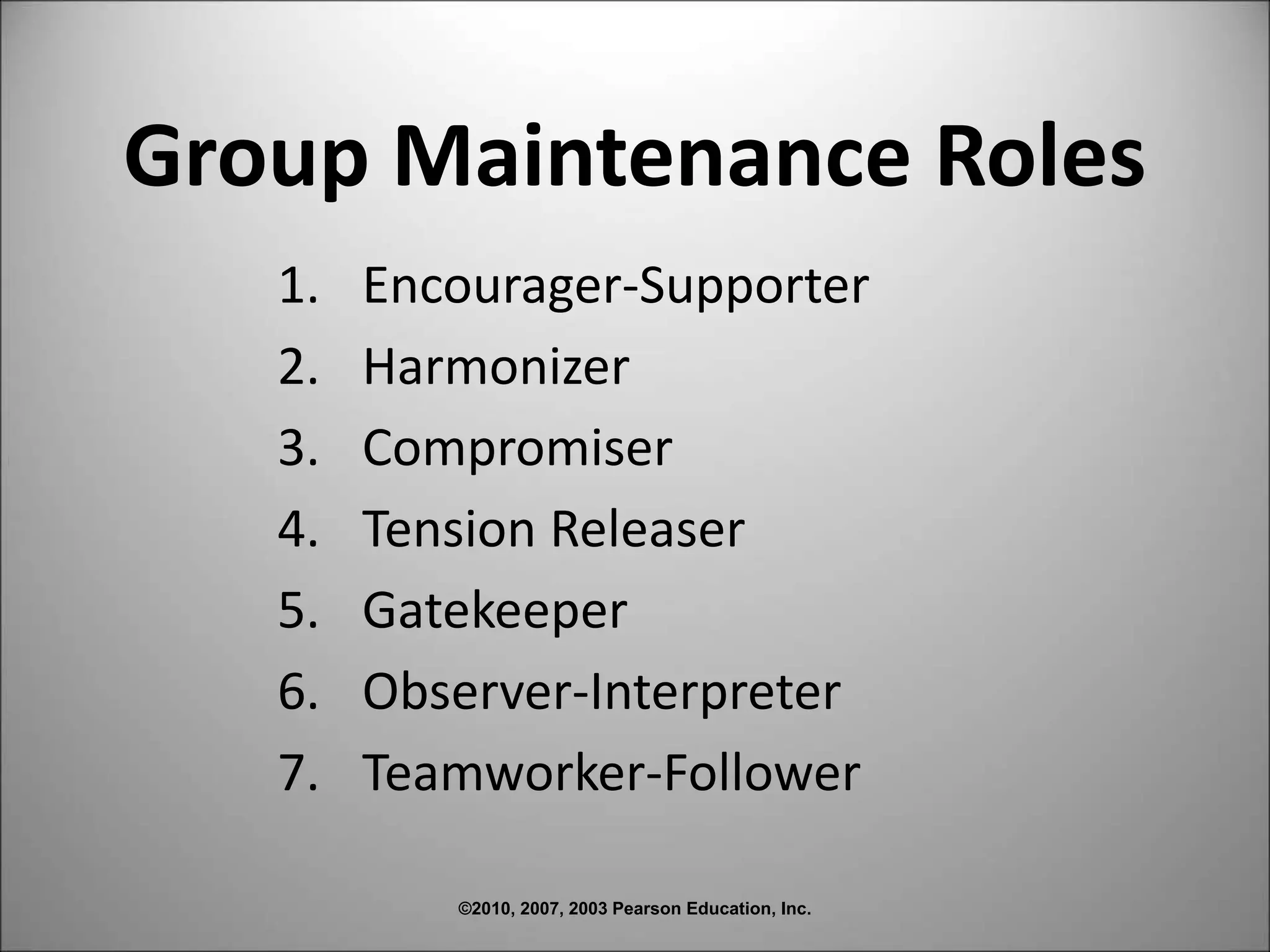
Group Maintenance Roles
1. Encourager-Supporter
2. Harmonizer
3. Compromiser
4. Tension Releaser
5. Gatekeeper
6. Observer-Interpreter
7. Teamworker-Follower
©2010, 2007, 2003 Pearson Education, Inc.
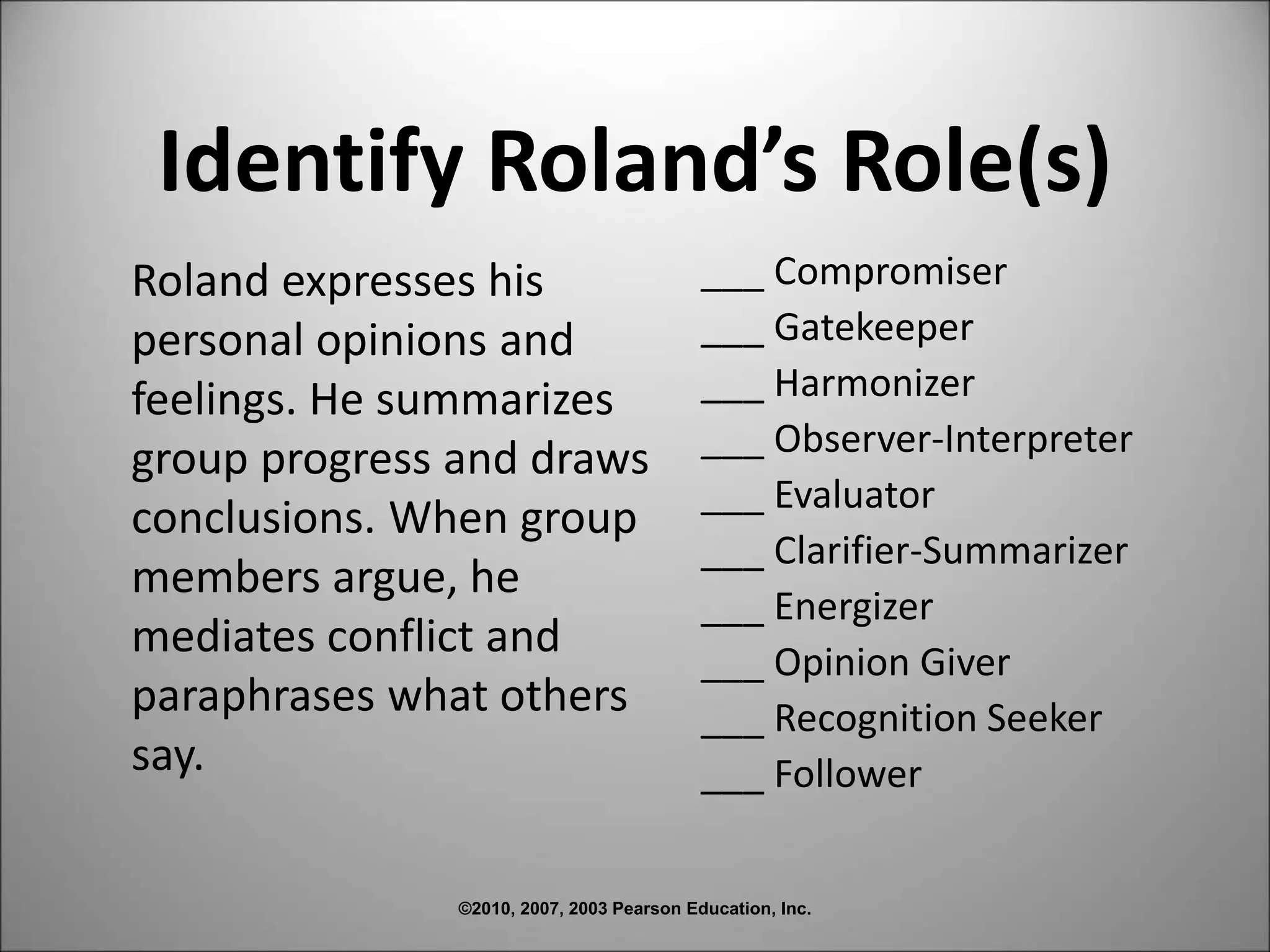
Identify Roland’s Role(s)
Roland expresses his
personal opinions and
feelings. He summarizes
group progress and draws
conclusions. When group
members argue, he
mediates conflict and
paraphrases what others
say.
___ Compromiser
___ Gatekeeper
___ Harmonizer
___ Observer-Interpreter
___ Evaluator
___ Clarifier-Summarizer
___ Energizer
___ Opinion Giver
___ Recognition Seeker
___ Follower
©2010, 2007, 2003 Pearson Education, Inc.
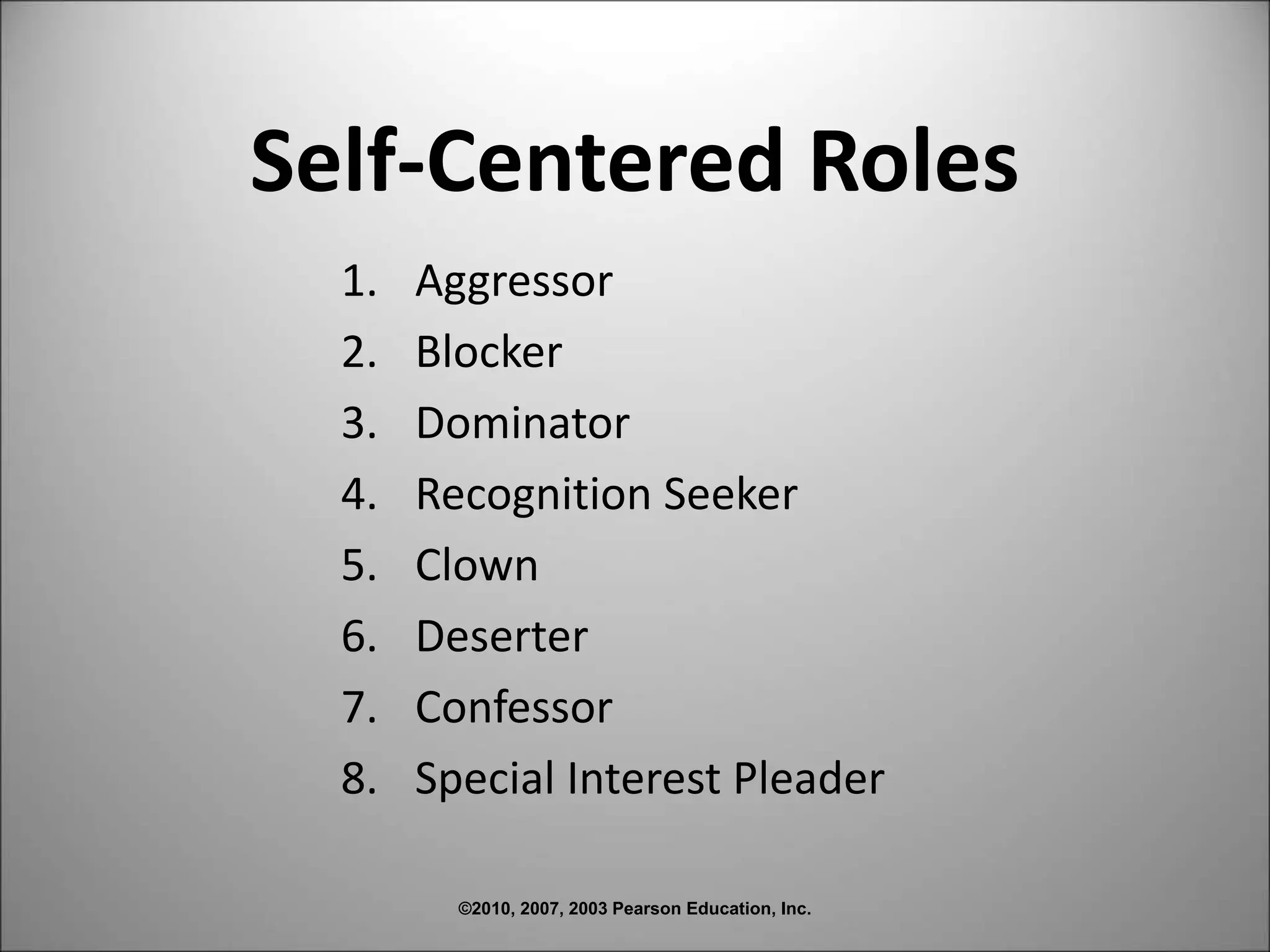
Self-Centered Roles
1. Aggressor
2. Blocker
3. Dominator
4. Recognition Seeker
5. Clown
6. Deserter
7. Confessor
8. Special Interest Pleader
©2010, 2007, 2003 Pearson Education, Inc.
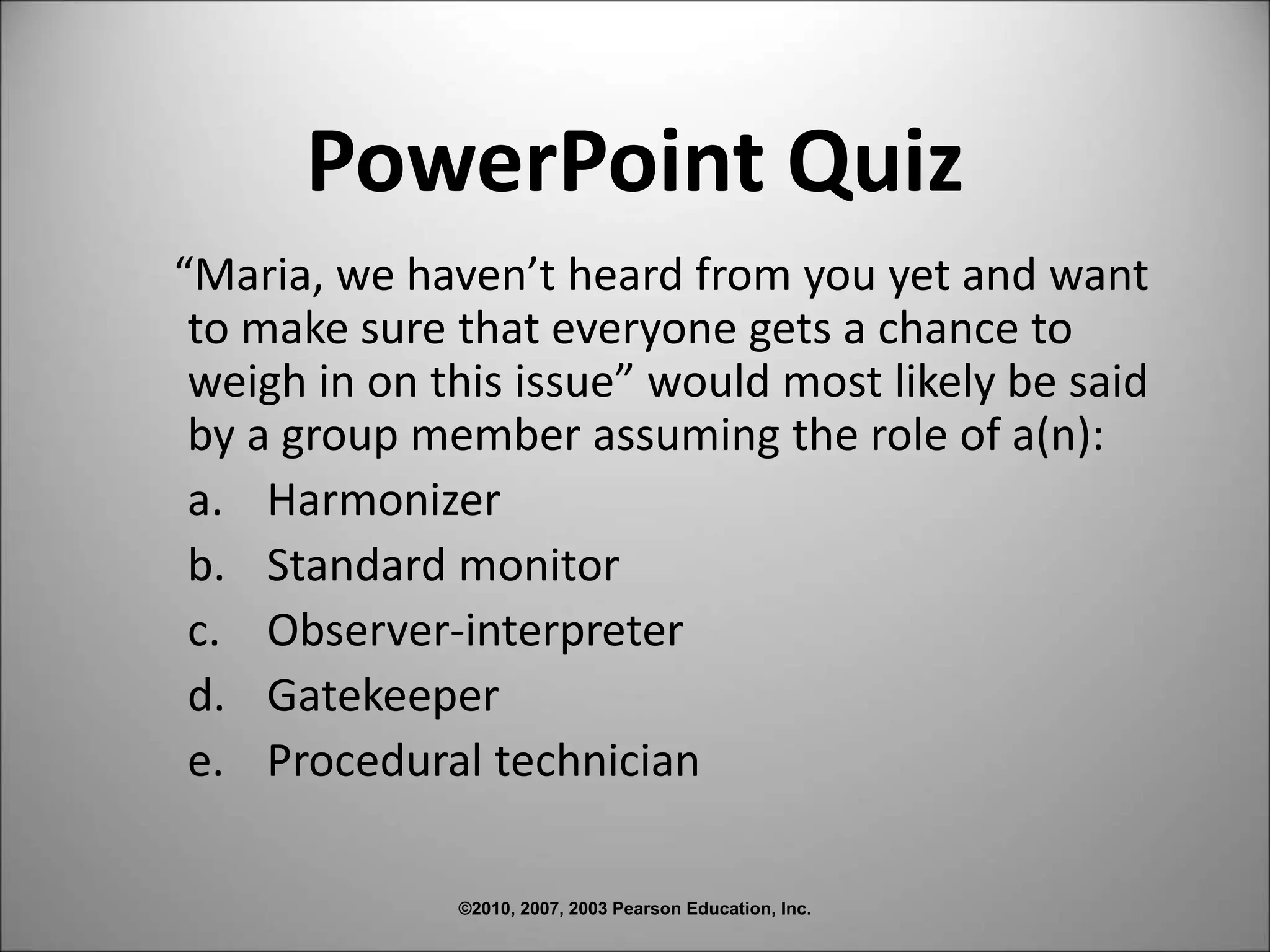
PowerPoint Quiz
“Maria, we haven’t heard from you yet and want
to make sure that everyone gets a chance to
weigh in on this issue” would most likely be said
by a group member assuming the role of a(n):
a. Harmonizer
b. Standard monitor
c. Observer-interpreter
d. Gatekeeper
e. Procedural technician
©2010, 2007, 2003 Pearson Education, Inc.
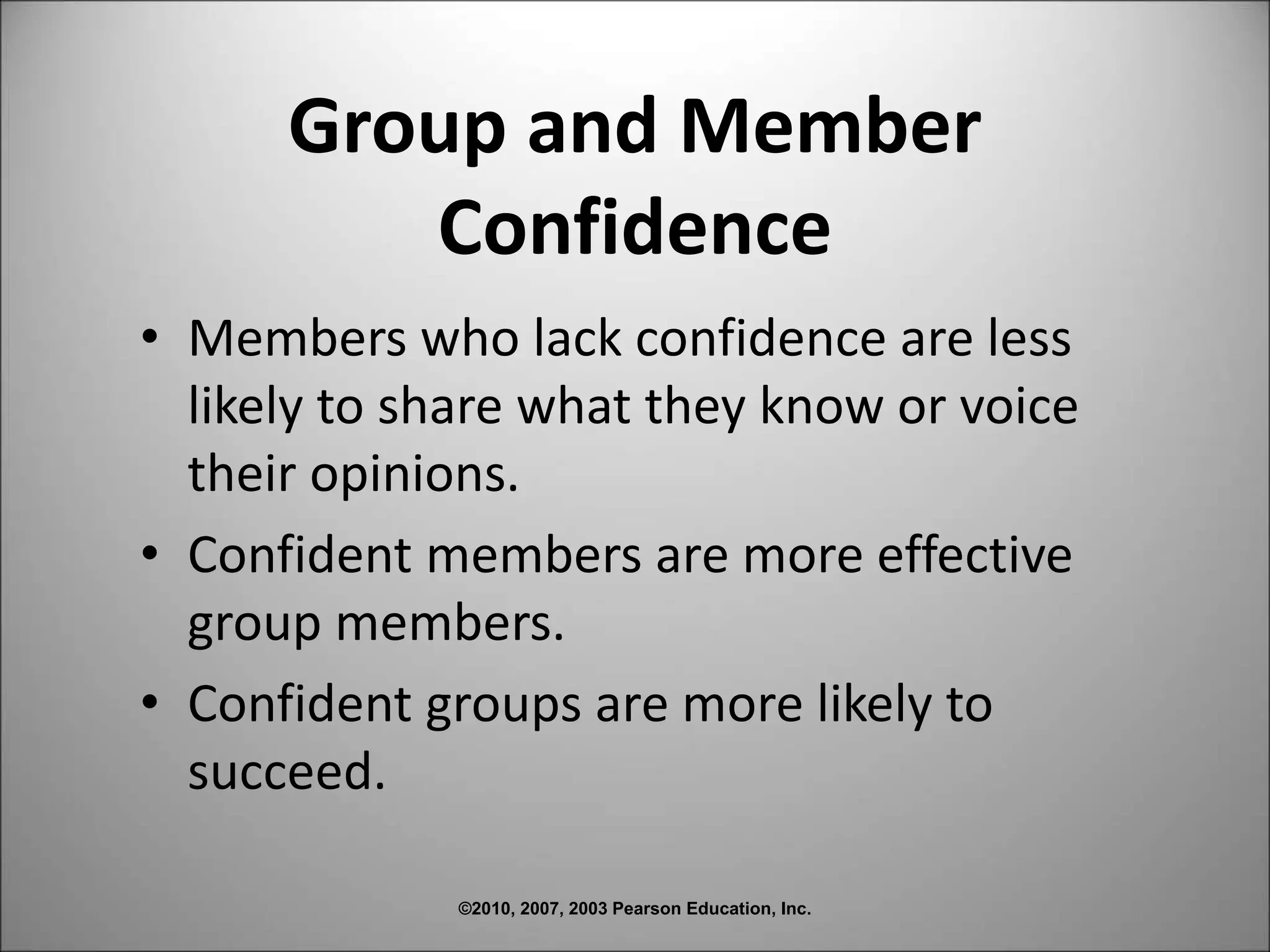
Group and Member
Confidence
• Members who lack confidence are less
likely to share what they know or voice
their opinions.
• Confident members are more effective
group members.
• Confident groups are more likely to
succeed.
©2010, 2007, 2003 Pearson Education, Inc.
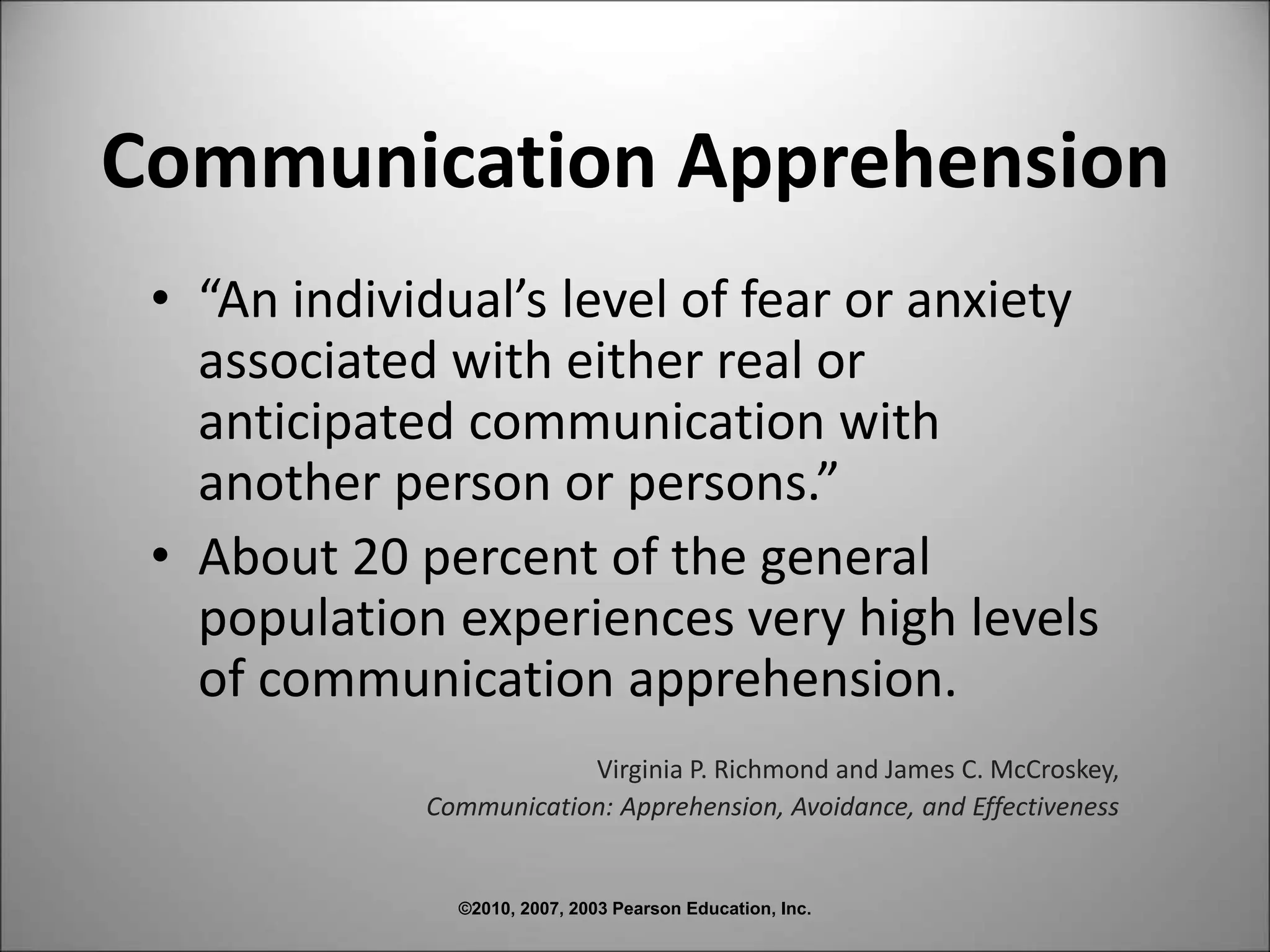
Communication Apprehension
• “An individual’s level of fear or anxiety
associated with either real or
anticipated communication with
another person or persons.”
• About 20 percent of the general
population experiences very high levels
of communication apprehension.
Virginia P. Richmond and James C. McCroskey,
Communication: Apprehension, Avoidance, and Effectiveness
©2010, 2007, 2003 Pearson Education, Inc.
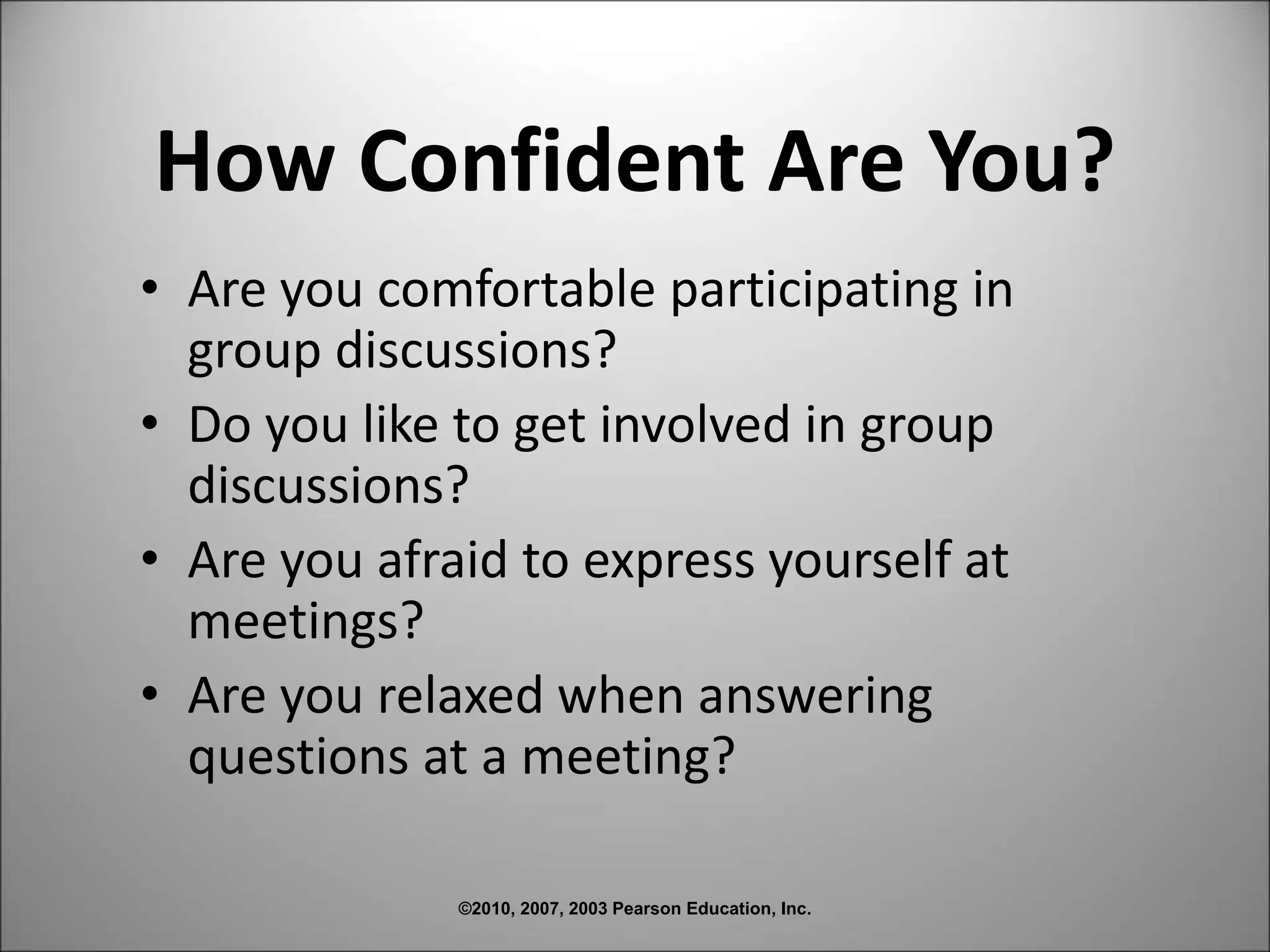
How Confident Are You?
• Are you comfortable participating in
group discussions?
• Do you like to get involved in group
discussions?
• Are you afraid to express yourself at
meetings?
• Are you relaxed when answering
questions at a meeting?
©2010, 2007, 2003 Pearson Education, Inc.
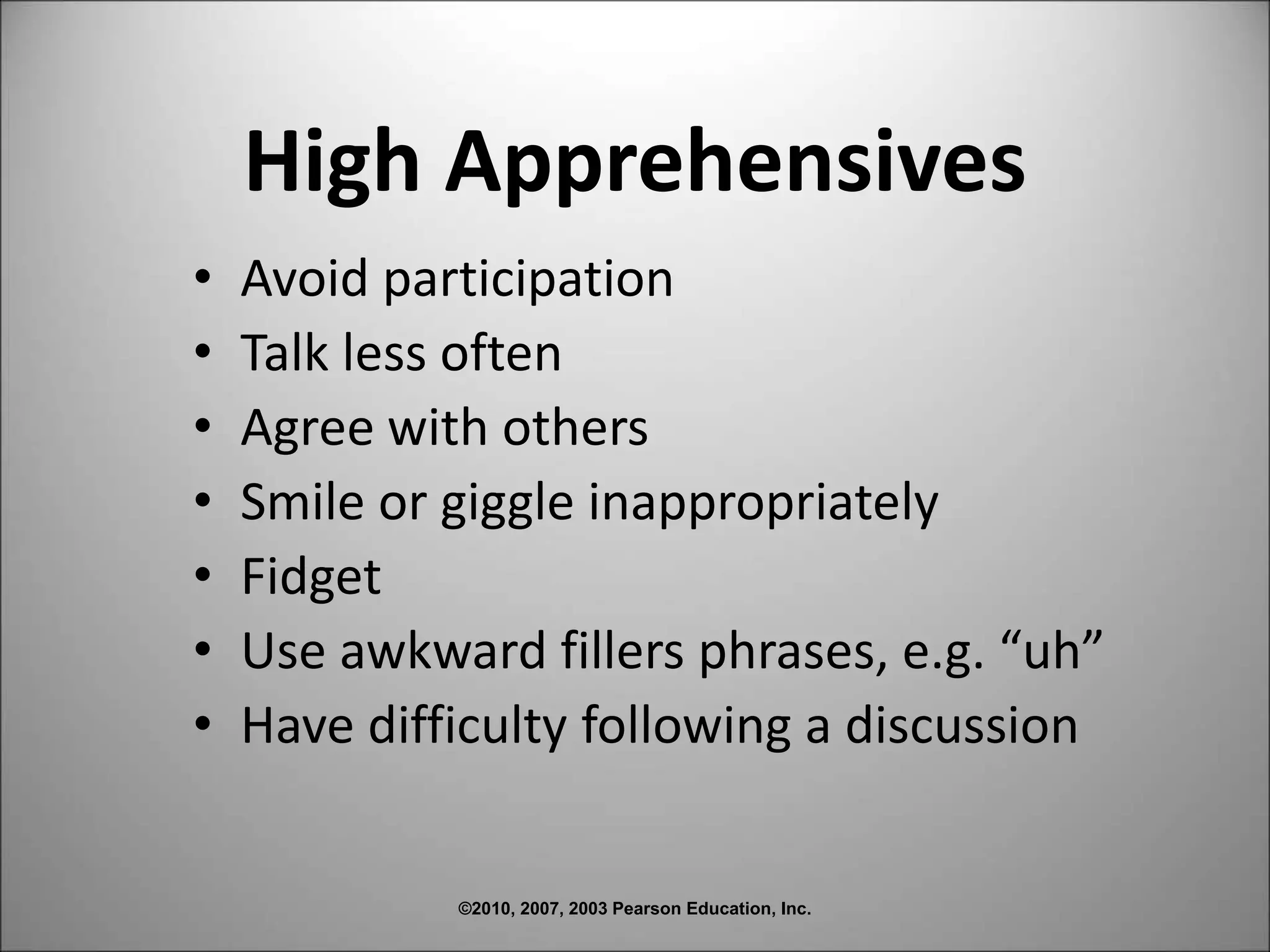
High Apprehensives
• Avoid participation
• Talk less often
• Agree with others
• Smile or giggle inappropriately
• Fidget
• Use awkward fillers phrases, e.g. “uh”
• Have difficulty following a discussion
©2010, 2007, 2003 Pearson Education, Inc.
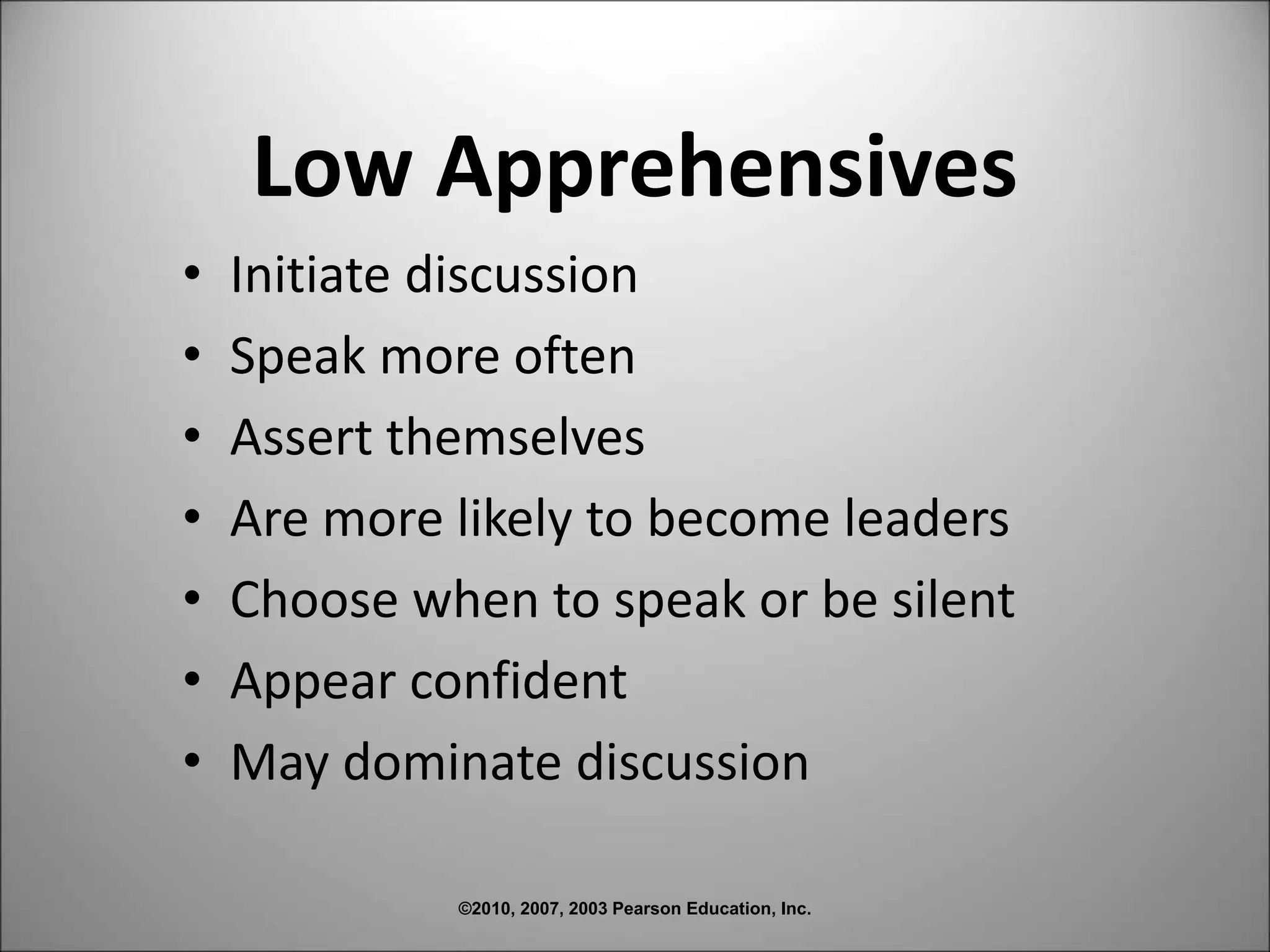
Low Apprehensives
• Initiate discussion
• Speak more often
• Assert themselves
• Are more likely to become leaders
• Choose when to speak or be silent
• Appear confident
• May dominate discussion
©2010, 2007, 2003 Pearson Education, Inc.
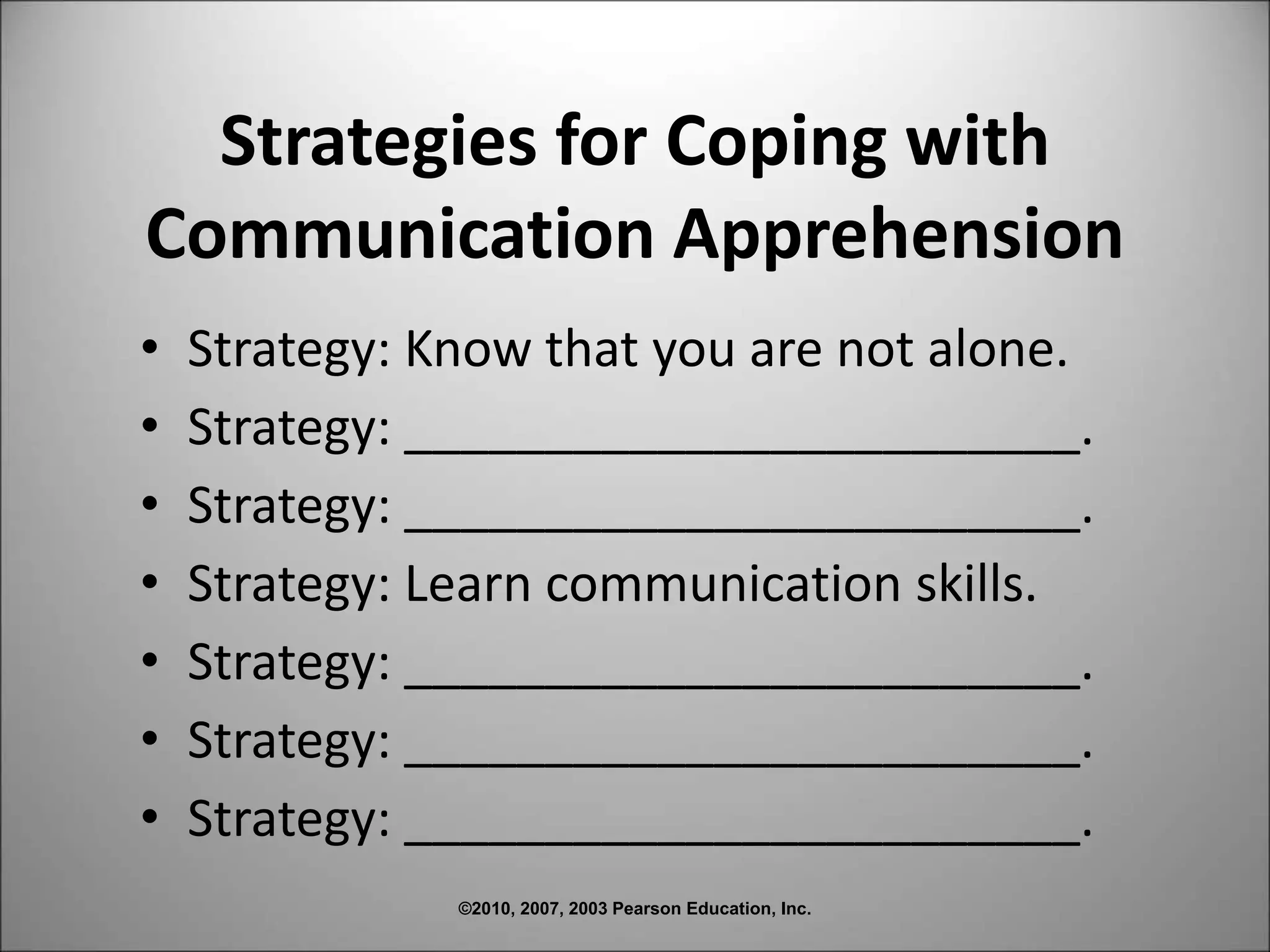
Strategies for Coping with
Communication Apprehension
• Strategy: Know that you are not alone.
• Strategy: ________________________.
• Strategy: Learn communication skills.
• Strategy: ________________________.
©2010, 2007, 2003 Pearson Education, Inc.
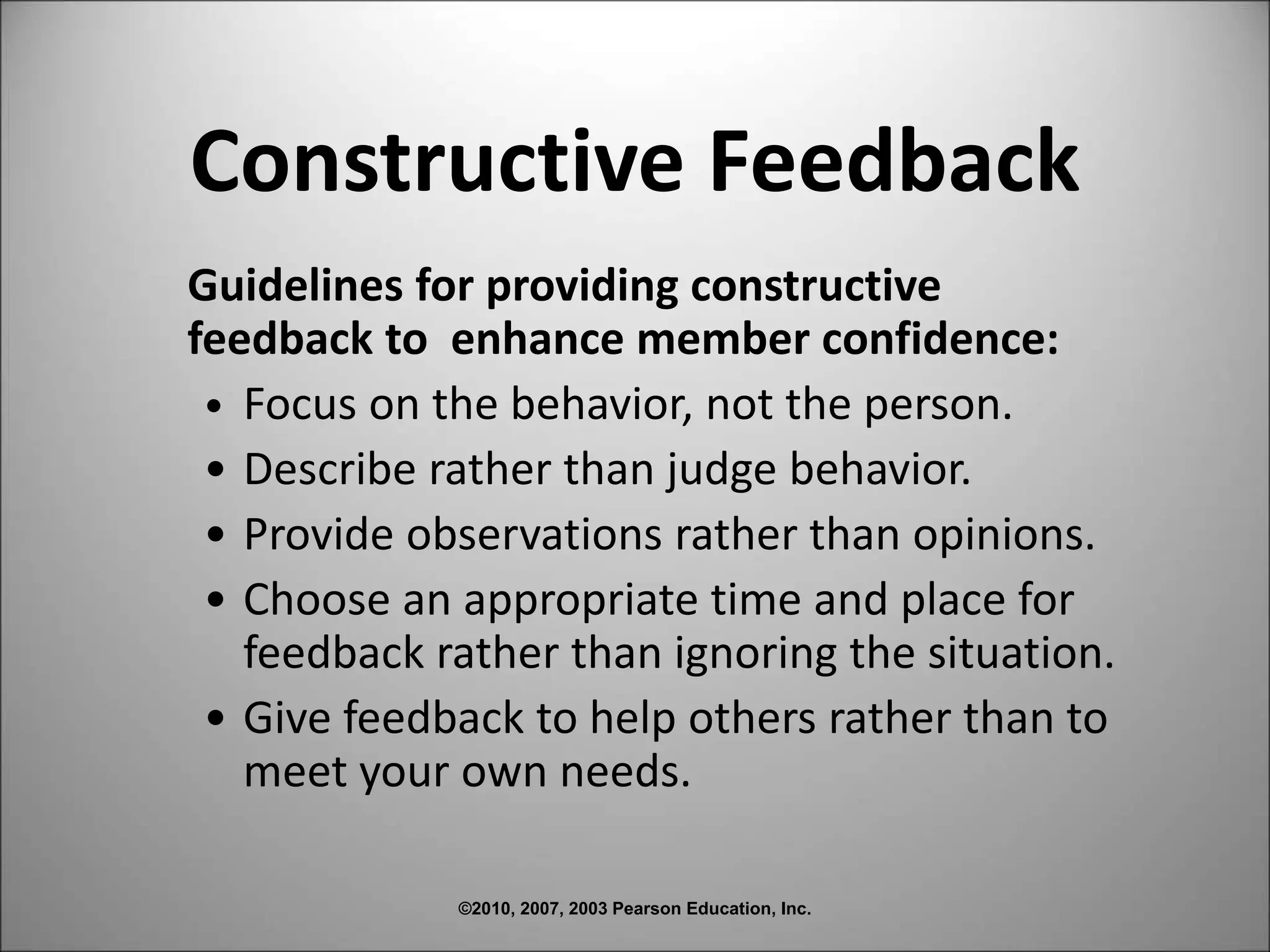
Constructive Feedback
Guidelines for providing constructive
feedback to enhance member confidence:
• Focus on the behavior, not the person.
• Describe rather than judge behavior.
• Provide observations rather than opinions.
• Choose an appropriate time and place for
feedback rather than ignoring the situation.
• Give feedback to help others rather than to
meet your own needs.
©2010, 2007, 2003 Pearson Education, Inc.
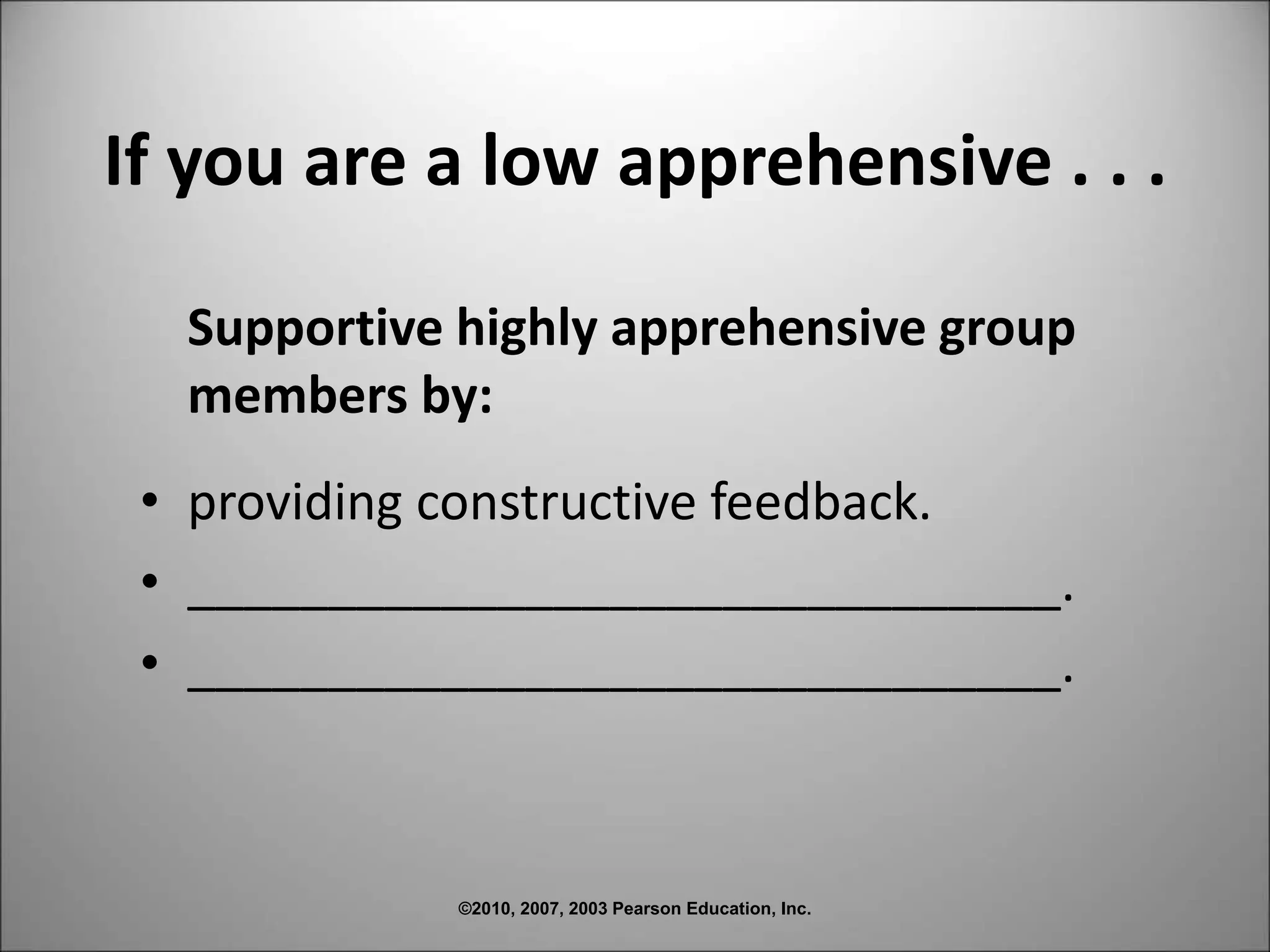
If you are a low apprehensive . . .
Supportive highly apprehensive group
members by:
• providing constructive feedback.
• _______________________________.
• _______________________________.
©2010, 2007, 2003 Pearson Education, Inc.
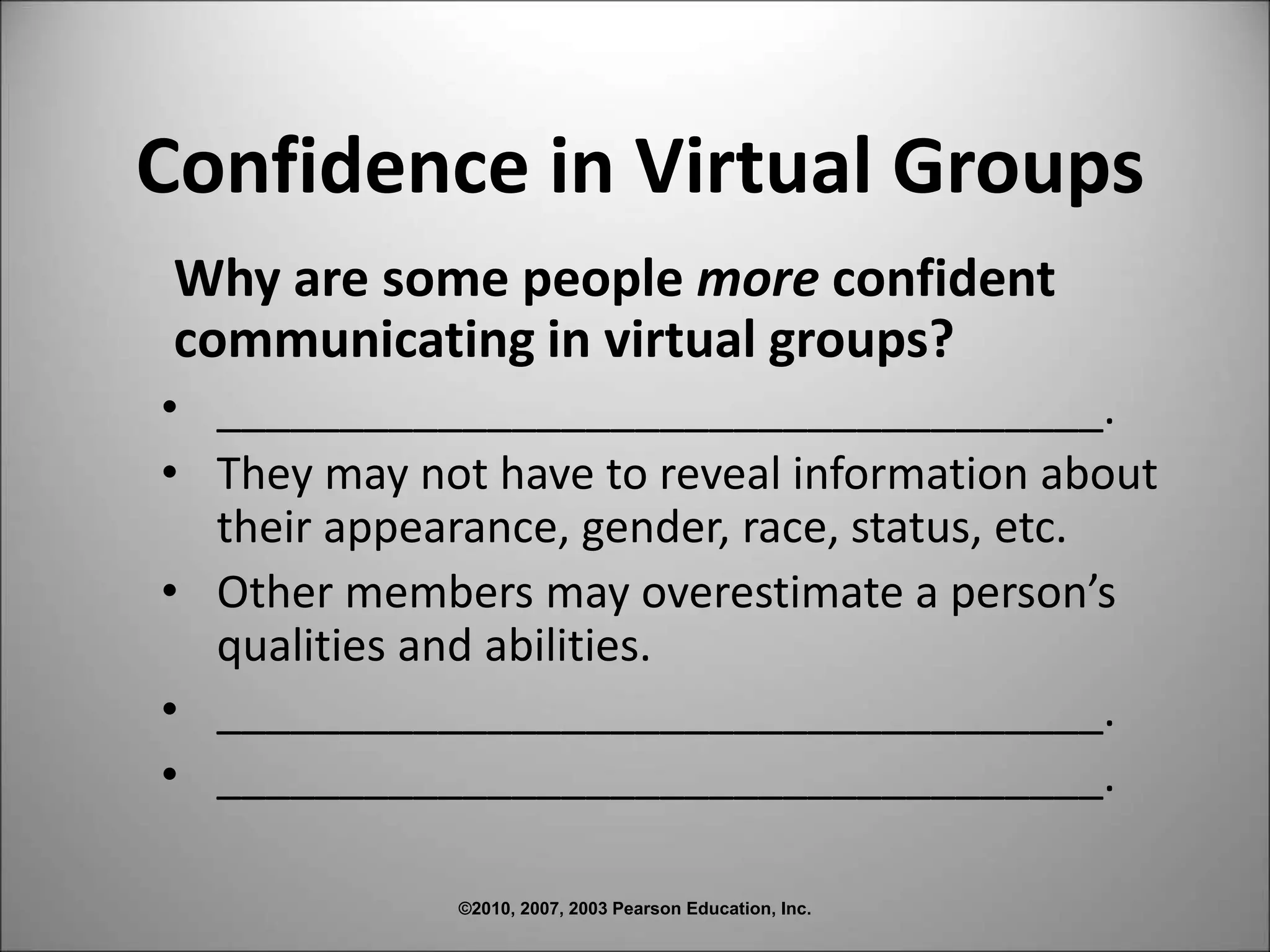
Confidence in Virtual Groups
Why are some people more confident
communicating in virtual groups?
• ____________________________________.
• They may not have to reveal information about
their appearance, gender, race, status, etc.
• Other members may overestimate a person’s
qualities and abilities.
• ____________________________________.
• ____________________________________.
©2010, 2007, 2003 Pearson Education, Inc.
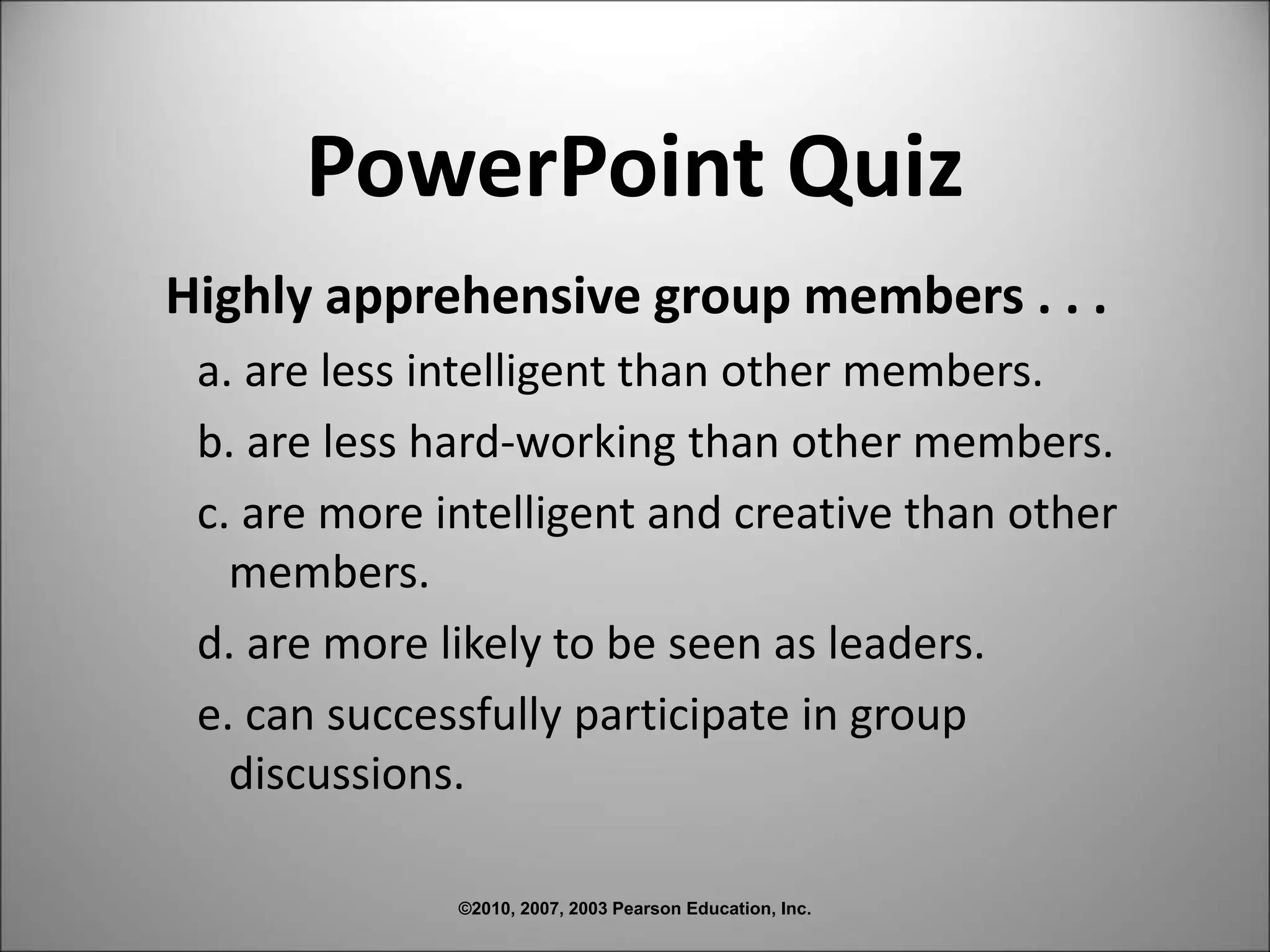
PowerPoint Quiz
Highly apprehensive group members . . .
a. are less intelligent than other members.
b. are less hard-working than other members.
c. are more intelligent and creative than other
members.
d. are more likely to be seen as leaders.
e. can successfully participate in group
discussions.
©2010, 2007, 2003 Pearson Education, Inc.
Assertiveness
Speaking up and acting in your
own best interests without
denying the rights and interests
of others
©2010, 2007, 2003 Pearson Education, Inc.
Assertive Group Members
• Appear confident, honest, open, and
cooperative
• Volunteer ideas and opinions
• Ask and answer questions without fear or
hostility
• Stand up for their beliefs, even when others
disagree
• Express their feelings openly
• Respect and defend the rights and opinions of
others
©2010, 2007, 2003 Pearson Education, Inc.
Balancing Passivity and Aggression
• Passive group members often lack
confidence.
–Reluctant to express their opinions
and feelings, fear criticism, and usually
do what they are told
• Aggressive members act in their own
self-interest at the expense of others.
–Critical, insensitive, combative, and
even abusive
©2010, 2007, 2003 Pearson Education, Inc.
Passive-Aggressive Members
Passive-aggressive members mask
aggression by appearing passive or
cooperative.
– They rarely exhibit aggressive behavior.
– They do not respect the rights of others.
– They often get what they want by
• undermining others behind their backs.
• deceiving others about their intentions.
©2010, 2007, 2003 Pearson Education, Inc.
Group Effectiveness
and Member Assertiveness
©2010, 2007, 2003 Pearson Education, Inc.
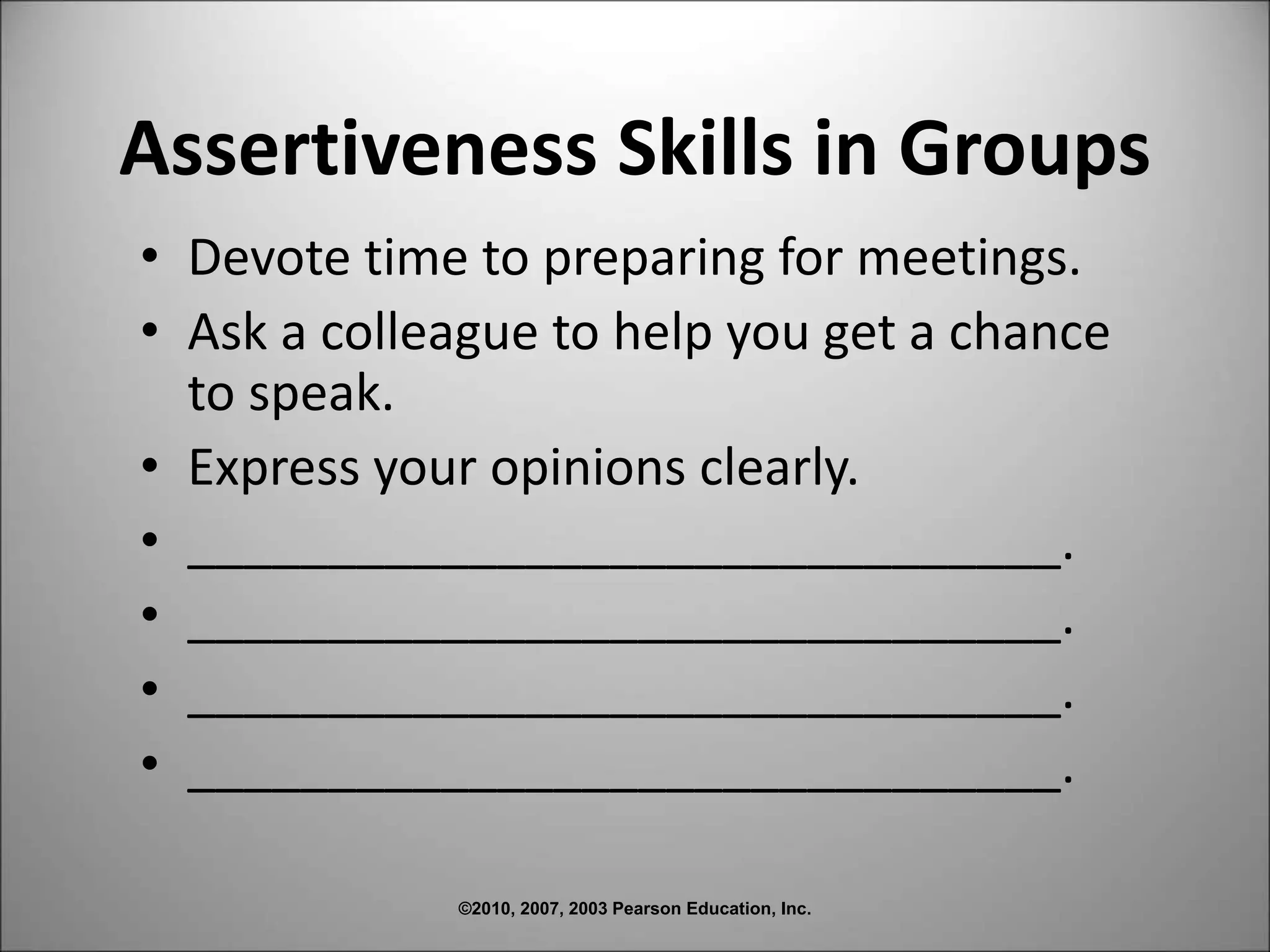
Assertiveness Skills in Groups
• Devote time to preparing for meetings.
• Ask a colleague to help you get a chance
to speak.
• Express your opinions clearly.
• _______________________________.
• _______________________________.
• _______________________________.
• _______________________________.
©2010, 2007, 2003 Pearson Education, Inc.
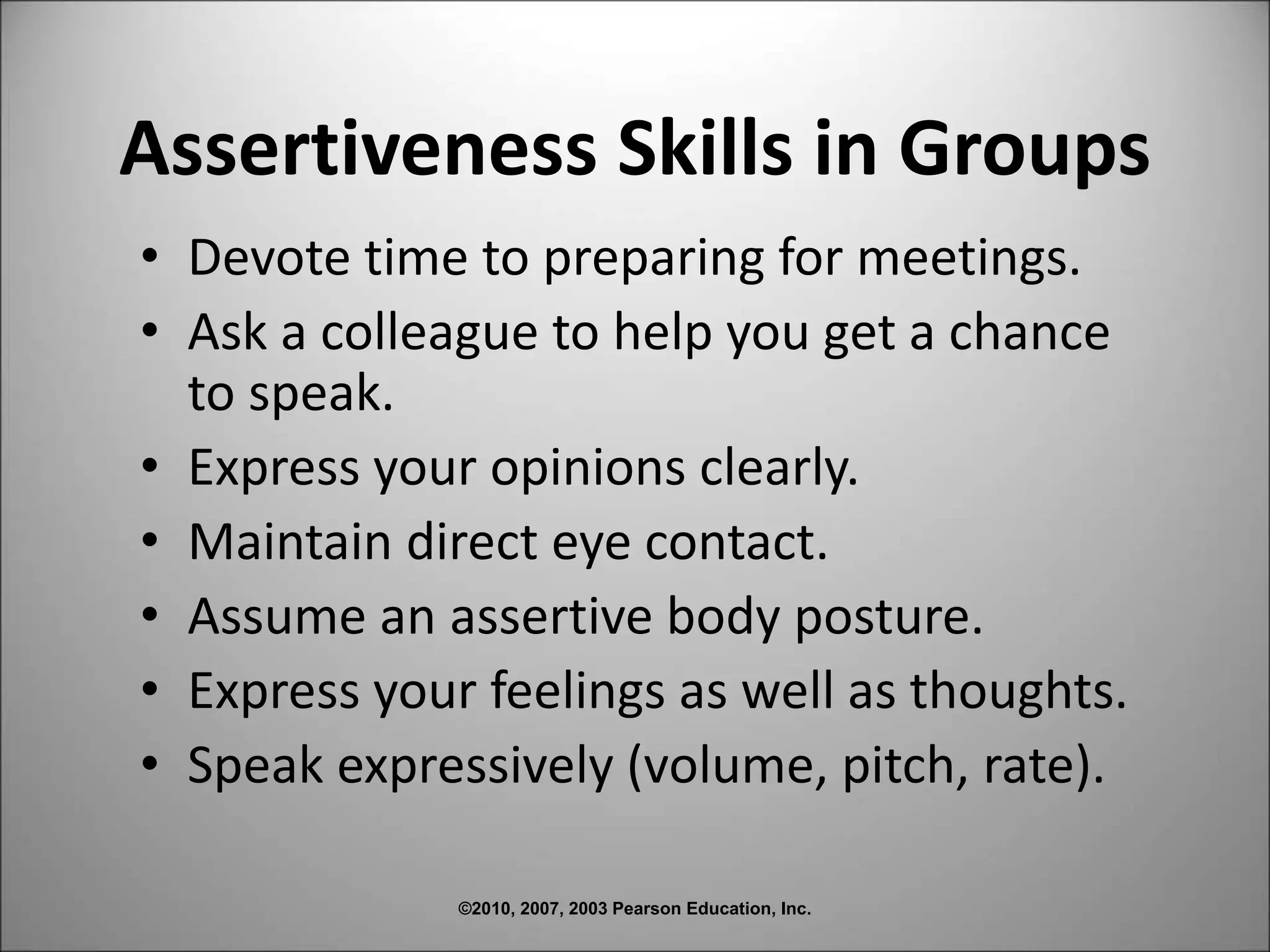
Assertiveness Skills in Groups
• Devote time to preparing for meetings.
• Ask a colleague to help you get a chance
to speak.
• Express your opinions clearly.
• Maintain direct eye contact.
• Assume an assertive body posture.
• Express your feelings as well as thoughts.
• Speak expressively (volume, pitch, rate).

Working in Groups ppt 5ed

  • 1.
    ©2010, 2007, 2003Pearson Education, Inc. Working in Groups: 5th edition This multimedia product and its contents are protected under copyright law. The following are prohibited by law: - any public performance or display, including transmission of any image over a network; - preparation of any derivative work, including the extraction, in whole or in part, of any images; - any rental, lease, or lending of the program. Isa N. Engleberg Prince George’s Community College Dianna R. Wynn Nash Community College
  • 2.
    ©2010, 2007, 2003Pearson Education, Inc. Chapter 3: Group Membership
  • 3.
    ©2010, 2007, 2003Pearson Education, Inc. Maslow’s Hierarchy of Needs
  • 4.
    ©2010, 2007, 2003Pearson Education, Inc. Match the Need to the Group Need A. Physiological B. Safety C. Belongingness D. Esteem E. Self-Actualization Group ___ police force ___ family ___ garden society ___ adult literacy group ___ sorority/fraternity ___ executive club ___ pro basketball team
  • 5.
    ©2010, 2007, 2003Pearson Education, Inc. Schutz’s Theory of Interpersonal Needs • Need for INCLUSION • Need for CONTROL • Need for AFFECTION Fundamental Interpersonal Relationship Orientation (FIRO)
  • 6.
    ©2010, 2007, 2003Pearson Education, Inc. Inclusion Needs “I need to feel accepted by the group.” “I feel accepted by the group.” Social Member “I don’t feel accepted by or involved in the group.” “I won’t participate much in group discussions.” “I try to gain the group’s attention.” Undersocial Member Oversocial Member
  • 7.
    ©2010, 2007, 2003Pearson Education, Inc. “I need to feel influential and important.” “Others respect me.” Democratic Member “I don’t have influence in the group.” “I just do what I am told.” “I try to dominate the group.” Abdicrat Autocrat Control Needs
  • 8.
    ©2010, 2007, 2003Pearson Education, Inc. “I need to feel that others like me.” “I feel that others like me and if they don’t, that’s OK.” Personal Member “I’m not sure that others like me.” “I avoid friendships with other members.” “I confide in and try to become very close with others.” Underpersonal Member Overpersonal Member Affection Needs
  • 9.
    ©2010, 2007, 2003Pearson Education, Inc. Group Role Categories
  • 10.
    ©2010, 2007, 2003Pearson Education, Inc. Group Task Roles 1. Initiator 2. Information Seeker 3. Coordinator- Chairperson 4. Information Giver 5. Opinion Seeker 6. Opinion Giver 7. Clarifier-Summarizer 8. Implementer- Completer 9. Evaluator-Critic 10. Energizer 11. Procedural Technician 12.Recorder-Secretary
  • 11.
    ©2010, 2007, 2003Pearson Education, Inc. Group Maintenance Roles 1. Encourager-Supporter 2. Harmonizer 3. Compromiser 4. Tension Releaser 5. Gatekeeper 6. Observer-Interpreter 7. Teamworker-Follower
  • 12.
    ©2010, 2007, 2003Pearson Education, Inc. Identify Roland’s Role(s) Roland expresses his personal opinions and feelings. He summarizes group progress and draws conclusions. When group members argue, he mediates conflict and paraphrases what others say. ___ Compromiser ___ Gatekeeper ___ Harmonizer ___ Observer-Interpreter ___ Evaluator ___ Clarifier-Summarizer ___ Energizer ___ Opinion Giver ___ Recognition Seeker ___ Follower
  • 13.
    ©2010, 2007, 2003Pearson Education, Inc. Self-Centered Roles 1. Aggressor 2. Blocker 3. Dominator 4. Recognition Seeker 5. Clown 6. Deserter 7. Confessor 8. Special Interest Pleader
  • 14.
    ©2010, 2007, 2003Pearson Education, Inc. PowerPoint Quiz “Maria, we haven’t heard from you yet and want to make sure that everyone gets a chance to weigh in on this issue” would most likely be said by a group member assuming the role of a(n): a. Harmonizer b. Standard monitor c. Observer-interpreter d. Gatekeeper e. Procedural technician
  • 15.
    ©2010, 2007, 2003Pearson Education, Inc. Group and Member Confidence • Members who lack confidence are less likely to share what they know or voice their opinions. • Confident members are more effective group members. • Confident groups are more likely to succeed.
  • 16.
    ©2010, 2007, 2003Pearson Education, Inc. Communication Apprehension • “An individual’s level of fear or anxiety associated with either real or anticipated communication with another person or persons.” • About 20 percent of the general population experiences very high levels of communication apprehension. Virginia P. Richmond and James C. McCroskey, Communication: Apprehension, Avoidance, and Effectiveness
  • 17.
    ©2010, 2007, 2003Pearson Education, Inc. How Confident Are You? • Are you comfortable participating in group discussions? • Do you like to get involved in group discussions? • Are you afraid to express yourself at meetings? • Are you relaxed when answering questions at a meeting?
  • 18.
    ©2010, 2007, 2003Pearson Education, Inc. High Apprehensives • Avoid participation • Talk less often • Agree with others • Smile or giggle inappropriately • Fidget • Use awkward fillers phrases, e.g. “uh” • Have difficulty following a discussion
  • 19.
    ©2010, 2007, 2003Pearson Education, Inc. Low Apprehensives • Initiate discussion • Speak more often • Assert themselves • Are more likely to become leaders • Choose when to speak or be silent • Appear confident • May dominate discussion
  • 20.
    ©2010, 2007, 2003Pearson Education, Inc. Strategies for Coping with Communication Apprehension • Strategy: Know that you are not alone. • Strategy: ________________________. • Strategy: ________________________. • Strategy: Learn communication skills. • Strategy: ________________________. • Strategy: ________________________. • Strategy: ________________________.
  • 21.
    ©2010, 2007, 2003Pearson Education, Inc. Constructive Feedback Guidelines for providing constructive feedback to enhance member confidence: • Focus on the behavior, not the person. • Describe rather than judge behavior. • Provide observations rather than opinions. • Choose an appropriate time and place for feedback rather than ignoring the situation. • Give feedback to help others rather than to meet your own needs.
  • 22.
    ©2010, 2007, 2003Pearson Education, Inc. If you are a low apprehensive . . . Supportive highly apprehensive group members by: • providing constructive feedback. • _______________________________. • _______________________________.
  • 23.
    ©2010, 2007, 2003Pearson Education, Inc. Confidence in Virtual Groups Why are some people more confident communicating in virtual groups? • ____________________________________. • They may not have to reveal information about their appearance, gender, race, status, etc. • Other members may overestimate a person’s qualities and abilities. • ____________________________________. • ____________________________________.
  • 24.
    ©2010, 2007, 2003Pearson Education, Inc. PowerPoint Quiz Highly apprehensive group members . . . a. are less intelligent than other members. b. are less hard-working than other members. c. are more intelligent and creative than other members. d. are more likely to be seen as leaders. e. can successfully participate in group discussions.
  • 25.
    ©2010, 2007, 2003Pearson Education, Inc. Assertiveness Speaking up and acting in your own best interests without denying the rights and interests of others
  • 26.
    ©2010, 2007, 2003Pearson Education, Inc. Assertive Group Members • Appear confident, honest, open, and cooperative • Volunteer ideas and opinions • Ask and answer questions without fear or hostility • Stand up for their beliefs, even when others disagree • Express their feelings openly • Respect and defend the rights and opinions of others
  • 27.
    ©2010, 2007, 2003Pearson Education, Inc. Balancing Passivity and Aggression • Passive group members often lack confidence. –Reluctant to express their opinions and feelings, fear criticism, and usually do what they are told • Aggressive members act in their own self-interest at the expense of others. –Critical, insensitive, combative, and even abusive
  • 28.
    ©2010, 2007, 2003Pearson Education, Inc. Passive-Aggressive Members Passive-aggressive members mask aggression by appearing passive or cooperative. – They rarely exhibit aggressive behavior. – They do not respect the rights of others. – They often get what they want by • undermining others behind their backs. • deceiving others about their intentions.
  • 29.
    ©2010, 2007, 2003Pearson Education, Inc. Group Effectiveness and Member Assertiveness
  • 30.
    ©2010, 2007, 2003Pearson Education, Inc. Assertiveness Skills in Groups • Devote time to preparing for meetings. • Ask a colleague to help you get a chance to speak. • Express your opinions clearly. • _______________________________. • _______________________________. • _______________________________. • _______________________________.
  • 31.
    ©2010, 2007, 2003Pearson Education, Inc. Assertiveness Skills in Groups • Devote time to preparing for meetings. • Ask a colleague to help you get a chance to speak. • Express your opinions clearly. • Maintain direct eye contact. • Assume an assertive body posture. • Express your feelings as well as thoughts. • Speak expressively (volume, pitch, rate).