Chapter 9
Group Relationships
Group Relationships
• Traditional Perspective
• Interpretive Perspective
• Critical Perspective
Traditional Perspective
• Communication Skills: Communication
Competence in Groups
• Groups as Organizational Subsystems
• Group Decision-Making and Problem Solving
• Roles and Role Categories in Groups
Communication Skills:
Communication Competence
in Groups
Components of Communication Competence
[Model 1]
• Appropriate Communication Behavior
– Does not violate a relational or situational rule
• Effective Communication Behavior
– Accomplish goals through communication
Communication Skills:
Communication Competence
in Groups
Components of Communication Competence
[Model 2]
• Knowledge
– Knowing what behavior suits a situation
• Skill
– Having the ability to perform the behavior
• Motivation
– The desire to communicate in a competent
manner [Spitzberg & Cupach, 1984]
Groups as Organizational
Subsystems
• Quality Circles
• Focus Groups
• Task Forces
Quality Circles
• A group of employees who meet regularly to improve
work productivity and work quality as well as solving
any other relevant work-related problems.
• Based on the ideas of W. Edwards Deming, an
advocate of managing people and processes to
maximize the quality of the final product produced by
an organization.
• Comprised of workers from the same work area who
volunteer to meet regularly to solve problems related
to their jobs.
• Recommended size is 5-15 members.
Focus Groups
• Purpose: gather information about a topic so management
can gain a better understanding of how people view it
• Relatively unstructured conversations since the group is
encouraged to discuss the issue or problem in any way
they choose
• Role of the focus group facilitator is to introduce the topic
and give no further direction although he or she may ask
questions of a general, follow-up, or probing nature
• Discussions often reveal the participants' interests and
values concerning the topic and provide insight into what
the participants perceive to be the important issues
regarding the problem it is facing
Focus Groups
• Issues or problems that would prompt an
organization to turn to focus groups:
– The advertising industry seeks input into
consumer opinions about products or services
– A public relations department of an oil company
needs to determine how to address the public
following an oil spill
– A human resources department wants to
understand problems of sexual harassment within
an organization
Task Force
• A committee authorized by management to study
a specific subject or problem for a specified
period of time
• End product: a formal report of findings or
recommended solutions
• Example: Study evaluations of several plans that
consider different sites for a new factory
• Report is usually delivered in writing and orally to
the person or department who called for the
special committee. Then the task force disbands.
Group Decision-Making
and Problem-Solving
Group Decision Modes
• Lack of response
• Authority rule
• Minority coalition
• Majority rule
• Consensus
• Unanimity
Group Versus Individual
Decisions
Synergy
The ability of people working together to
produce a result that is greater than the
sum of their individual capabilities
Group Versus Individual
Decisions
When do Groups Outperform Individuals?
• The task requires a wide range and variety of
information and skills
• When neither the group nor the individual compared
possess expertise on the task
• When the task is particularly complex even when
both the group and the individual compared have
expertise
• When comparing a group of non-experts to an
individual with special expertise, the group may
sometimes produce a superior decision
Group Versus Individual
Decisions
When do Individuals outperform Groups?
• Uninformed group members will not usually
outperform a person with special expertise in the
problem being confronted
• When groups establish norms of mediocrity
• When groups become too large (>10), individuals
may outperform groups [task coordination and
efficiency problems and social loafing]
• When the task is a simple one groups do not produce
superior decisions to individuals. When time is a
critical factor [crisis situations]
Group Decision-Making
Effectiveness
Group decisions depends on the group's vigilance in
interaction concerning four questions:
• Problem analysis: Is there something about the
current state of affairs that requires change?
• Objectives: What do we want to achieve or
accomplish in deciding what to do about the
problem?
• Choices: What are the choices available to us?
• Evaluation: What are the positive and negative
aspects of those choices? (Hirokawa & Rost,
1992)
Group Decision-Making
Effectiveness
Conditions that promote team effectiveness:
• Motivated team members
• Adequate time and informational resources
for the task
• Competent leadership
• Direct organizational assistance (e.g.,
training) [Hirokawa & Keyton, 1995]
Group Decision
Development
Logical/Unitary Sequence Model
• Orientation
• Conflict
• Emergence
• Reinforcement
Fisher (1970)
Group Decision
Development
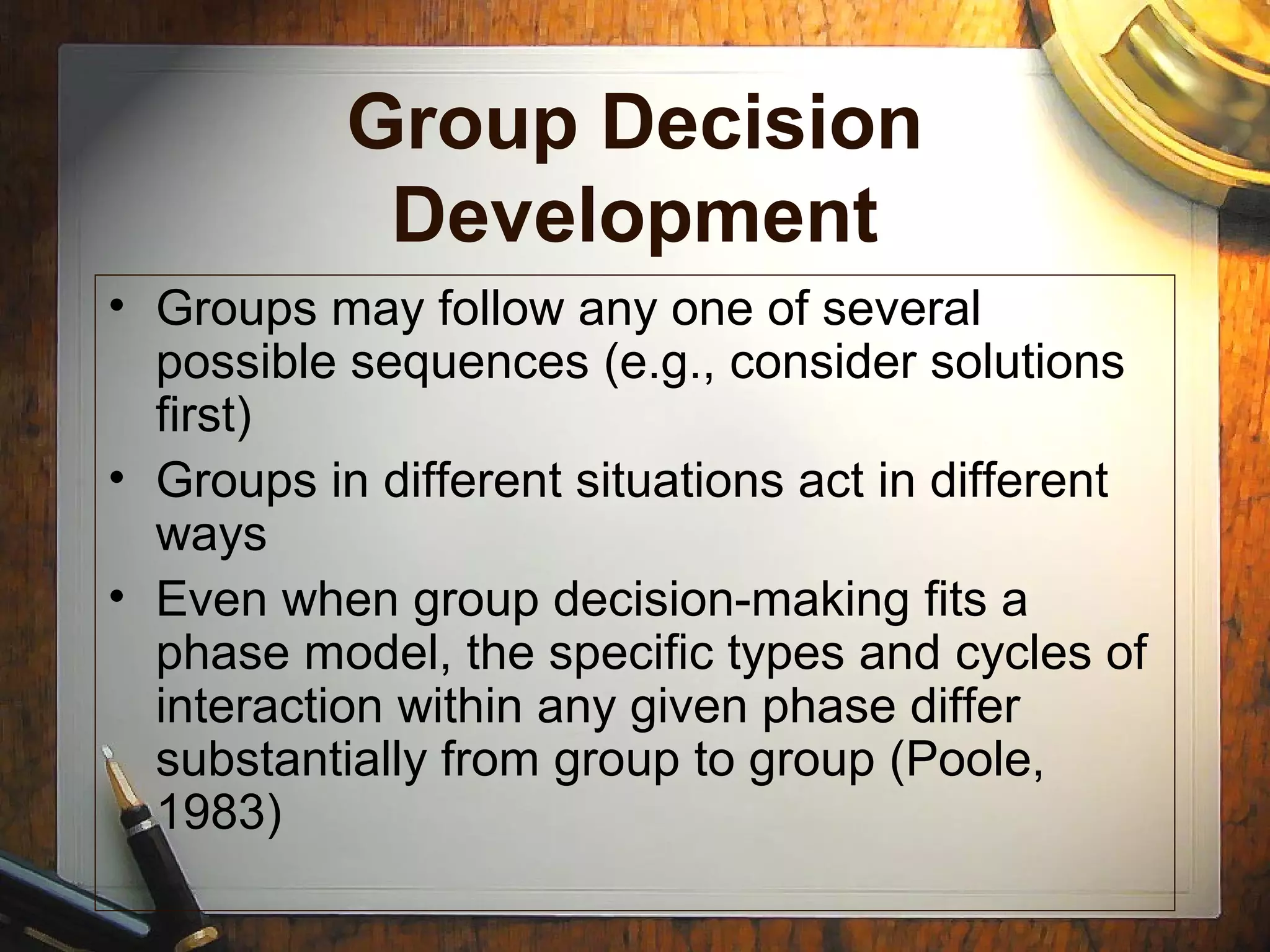
• Groups may follow any one of several
possible sequences (e.g., consider solutions
first)
• Groups in different situations act in different
ways
• Even when group decision-making fits a
phase model, the specific types and cycles of
interaction within any given phase differ
substantially from group to group (Poole,
1983)
Roles and Role
Categories in Groups
• Perceived role: the set of behaviors that the
occupant of the position believes he or she
should perform
• Expected role: the set of behaviors that
others believe he or she should perform
• Enacted role: the actual set of performed
behaviors [Wofford, Gerloff & Cummins, 1979]
Roles and Role
Categories in Groups
• Task Roles
• Maintenance Roles
• Self-Centered Roles
Task Roles
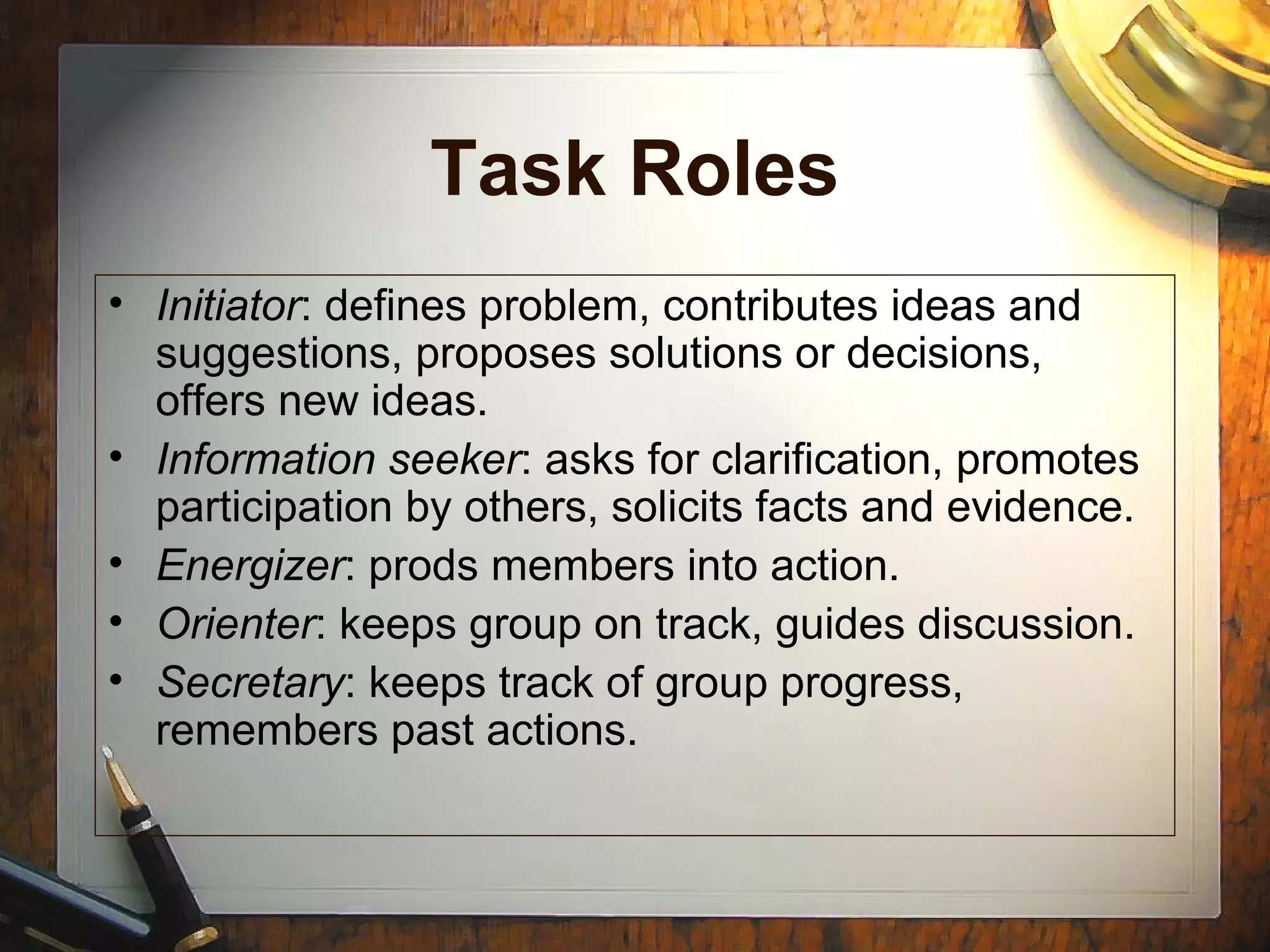
• Initiator: defines problem, contributes ideas and
suggestions, proposes solutions or decisions,
offers new ideas.
• Information seeker: asks for clarification, promotes
participation by others, solicits facts and evidence.
• Energizer: prods members into action.
• Orienter: keeps group on track, guides discussion.
• Secretary: keeps track of group progress,
remembers past actions.
Maintenance Roles
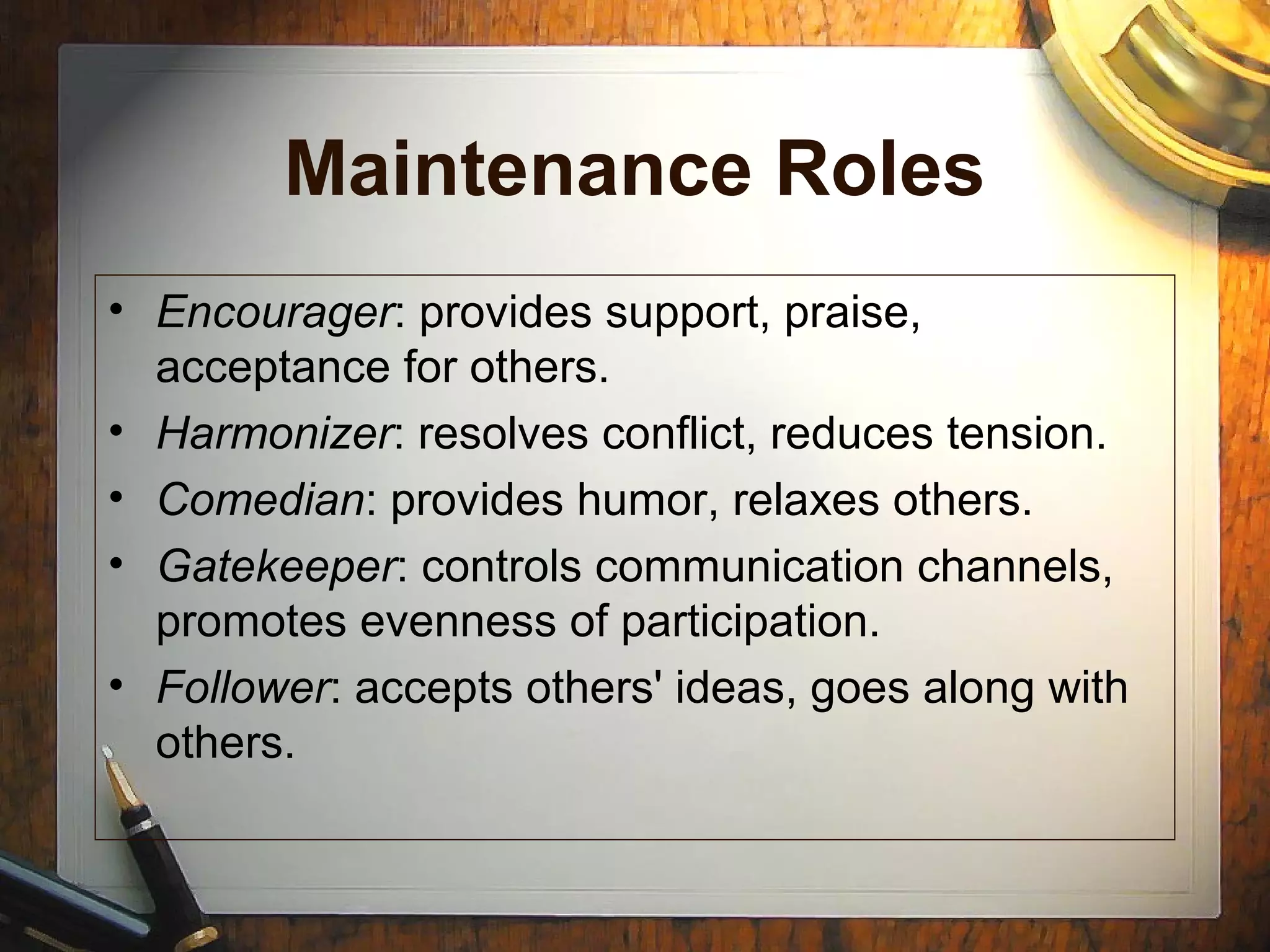
• Encourager: provides support, praise,
acceptance for others.
• Harmonizer: resolves conflict, reduces tension.
• Comedian: provides humor, relaxes others.
• Gatekeeper: controls communication channels,
promotes evenness of participation.
• Follower: accepts others' ideas, goes along with
others.
Self-Centered Roles
• Blocker: interferes with progress of group by
consistently making negative responses to others
• Aggressor: attacks other members in an effort to
promote his or her own status
• Dominator: monopolizes group time with long, drawn-
out monologues
• Deserter: withdraws from group discussion by
refusing to participate, engages in irrelevant
conversations
• Special-interest pleader: brings irrelevant information
into discussion, argues incessantly for his or her own
point of view
Interpretive Perspective
• Bona Fide Group Perspective
• Norms and Conformity
• Values and Sense-Making
• Decision-Making and Culture
Bona Fide Group
Perspective
Two Central Parts of the Group Experience:
• Stable yet permeable group boundaries
– A group cannot exist without defined boundaries
– Group boundaries are also dynamic and fluid
(e.g., multiple group memberships, members
leave and join the group)
• Interdependence with their relative contexts
– Reciprocal relationship between the group and the
environments within which it is embedded (e.g.,
historical, economic, cultural contexts)
Norms and Conformity
• Norm: a standard of behavioral expectations
shared by group members against which the
validity of perceptions is judged and the
appropriateness of feelings and behavior is
evaluated [Secord & Backman, 1964]
• Norms may be developed within the group or
imported (brought in) from the larger system of
which the group is a part
Norms and Conformity
• Norms may be explicitly stated or implicitly
understood.
• Explicit normative standards could include
policies, written rules, and verbally
communicated procedures and standards.
• Implicit norms and other rules are not explicitly
articulated, but the individual group member
can observe and learn about their functions.
Stages of Pressure to
Produce Conformity to Norms
• Delay action toward the deviant, allowing for
self-correction.
• Joke humorously with the deviant about the
violation.
• Ridicule and deride the violation.
• Seriously try to persuade the deviant to
conform.
• Engage in heated argument with the deviant.
• Reject or isolate the deviant.
Why are Norms Essential
to Group Action?
• They help to reduce uncertainty
– When we understand the norms and rules in a
situation, we can have more confidence about the
appropriateness of our own actions and in our
expectations of others.
• Some predictability is required for joint action
and cooperation
– In order to collaborate at all, we must have some
shared expectations for one another's behavior.
Negative Impact of
Norms
• Norms can hamper group creativity and protect
inefficient and archaic practices (e.g., changes in
policy can only occur if there is consensus
support for the change).
• Norms also enforce inequities within and
between groups. They can be used as
instruments of repression that primarily serve the
interests of a privileged few (e.g., only upper
level managers may take advantage of the
flexible work hours policy).
Values and Sense-
Making
• Work group relationships provide the primary
context from which individual values and attitudes
toward work and the organization are derived
• One important function of group communication:
provide the basic frames of reference from which
individual members understand, enact, and justify
the organization and its mission
• The group, as "the unit of social life”, provides the
basic "petri dish" for culturing the negotiated order
of meanings and values
Decision-Making and
Culture
• Individualistic Cultures
• Collectivistic Cultures
Individualistic Cultures
• Decisions are made quickly
• Reliance on centralized authority
• Implementation is slow and uncertain
• People look after themselves and those to
whom they are most closely connected
• Opposition and misunderstanding surface
after decision is announced
Collectivistic Cultures
• Bottom-up consensus decision-making
• Slow and cumbersome decision process
• Decisions implemented effectively because
support is developed among all participants
during the decision process
• Members belong to in-groups which look after
them in exchange for loyalty
• In-group relationships are more intimate than
in individualistic cultures
Critical Perspective
Giddens’ Structuration Theory
• Social structure is a product of human action
• Social structures both enable humans to act
and constrain their subsequent actions
• Human action creates social structures by
producing and reproducing them (the duality
of structure)
• Far End Design example from Chapter 2

Ch09

  • 1.
  • 2.
    Group Relationships • TraditionalPerspective • Interpretive Perspective • Critical Perspective
  • 3.
    Traditional Perspective • CommunicationSkills: Communication Competence in Groups • Groups as Organizational Subsystems • Group Decision-Making and Problem Solving • Roles and Role Categories in Groups
  • 4.
    Communication Skills: Communication Competence inGroups Components of Communication Competence [Model 1] • Appropriate Communication Behavior – Does not violate a relational or situational rule • Effective Communication Behavior – Accomplish goals through communication
  • 5.
    Communication Skills: Communication Competence inGroups Components of Communication Competence [Model 2] • Knowledge – Knowing what behavior suits a situation • Skill – Having the ability to perform the behavior • Motivation – The desire to communicate in a competent manner [Spitzberg & Cupach, 1984]
  • 6.
    Groups as Organizational Subsystems •Quality Circles • Focus Groups • Task Forces
  • 7.
    Quality Circles • Agroup of employees who meet regularly to improve work productivity and work quality as well as solving any other relevant work-related problems. • Based on the ideas of W. Edwards Deming, an advocate of managing people and processes to maximize the quality of the final product produced by an organization. • Comprised of workers from the same work area who volunteer to meet regularly to solve problems related to their jobs. • Recommended size is 5-15 members.
  • 8.
    Focus Groups • Purpose:gather information about a topic so management can gain a better understanding of how people view it • Relatively unstructured conversations since the group is encouraged to discuss the issue or problem in any way they choose • Role of the focus group facilitator is to introduce the topic and give no further direction although he or she may ask questions of a general, follow-up, or probing nature • Discussions often reveal the participants' interests and values concerning the topic and provide insight into what the participants perceive to be the important issues regarding the problem it is facing
  • 9.
    Focus Groups • Issuesor problems that would prompt an organization to turn to focus groups: – The advertising industry seeks input into consumer opinions about products or services – A public relations department of an oil company needs to determine how to address the public following an oil spill – A human resources department wants to understand problems of sexual harassment within an organization
  • 10.
    Task Force • Acommittee authorized by management to study a specific subject or problem for a specified period of time • End product: a formal report of findings or recommended solutions • Example: Study evaluations of several plans that consider different sites for a new factory • Report is usually delivered in writing and orally to the person or department who called for the special committee. Then the task force disbands.
  • 11.
    Group Decision-Making and Problem-Solving GroupDecision Modes • Lack of response • Authority rule • Minority coalition • Majority rule • Consensus • Unanimity
  • 12.
    Group Versus Individual Decisions Synergy Theability of people working together to produce a result that is greater than the sum of their individual capabilities
  • 13.
    Group Versus Individual Decisions Whendo Groups Outperform Individuals? • The task requires a wide range and variety of information and skills • When neither the group nor the individual compared possess expertise on the task • When the task is particularly complex even when both the group and the individual compared have expertise • When comparing a group of non-experts to an individual with special expertise, the group may sometimes produce a superior decision
  • 14.
    Group Versus Individual Decisions Whendo Individuals outperform Groups? • Uninformed group members will not usually outperform a person with special expertise in the problem being confronted • When groups establish norms of mediocrity • When groups become too large (>10), individuals may outperform groups [task coordination and efficiency problems and social loafing] • When the task is a simple one groups do not produce superior decisions to individuals. When time is a critical factor [crisis situations]
  • 15.
    Group Decision-Making Effectiveness Group decisionsdepends on the group's vigilance in interaction concerning four questions: • Problem analysis: Is there something about the current state of affairs that requires change? • Objectives: What do we want to achieve or accomplish in deciding what to do about the problem? • Choices: What are the choices available to us? • Evaluation: What are the positive and negative aspects of those choices? (Hirokawa & Rost, 1992)
  • 16.
    Group Decision-Making Effectiveness Conditions thatpromote team effectiveness: • Motivated team members • Adequate time and informational resources for the task • Competent leadership • Direct organizational assistance (e.g., training) [Hirokawa & Keyton, 1995]
  • 17.
    Group Decision Development Logical/Unitary SequenceModel • Orientation • Conflict • Emergence • Reinforcement Fisher (1970)
  • 18.
    Group Decision Development • Groupsmay follow any one of several possible sequences (e.g., consider solutions first) • Groups in different situations act in different ways • Even when group decision-making fits a phase model, the specific types and cycles of interaction within any given phase differ substantially from group to group (Poole, 1983)
  • 19.
    Roles and Role Categoriesin Groups • Perceived role: the set of behaviors that the occupant of the position believes he or she should perform • Expected role: the set of behaviors that others believe he or she should perform • Enacted role: the actual set of performed behaviors [Wofford, Gerloff & Cummins, 1979]
  • 20.
    Roles and Role Categoriesin Groups • Task Roles • Maintenance Roles • Self-Centered Roles
  • 21.
    Task Roles • Initiator:defines problem, contributes ideas and suggestions, proposes solutions or decisions, offers new ideas. • Information seeker: asks for clarification, promotes participation by others, solicits facts and evidence. • Energizer: prods members into action. • Orienter: keeps group on track, guides discussion. • Secretary: keeps track of group progress, remembers past actions.
  • 22.
    Maintenance Roles • Encourager:provides support, praise, acceptance for others. • Harmonizer: resolves conflict, reduces tension. • Comedian: provides humor, relaxes others. • Gatekeeper: controls communication channels, promotes evenness of participation. • Follower: accepts others' ideas, goes along with others.
  • 23.
    Self-Centered Roles • Blocker:interferes with progress of group by consistently making negative responses to others • Aggressor: attacks other members in an effort to promote his or her own status • Dominator: monopolizes group time with long, drawn- out monologues • Deserter: withdraws from group discussion by refusing to participate, engages in irrelevant conversations • Special-interest pleader: brings irrelevant information into discussion, argues incessantly for his or her own point of view
  • 24.
    Interpretive Perspective • BonaFide Group Perspective • Norms and Conformity • Values and Sense-Making • Decision-Making and Culture
  • 25.
    Bona Fide Group Perspective TwoCentral Parts of the Group Experience: • Stable yet permeable group boundaries – A group cannot exist without defined boundaries – Group boundaries are also dynamic and fluid (e.g., multiple group memberships, members leave and join the group) • Interdependence with their relative contexts – Reciprocal relationship between the group and the environments within which it is embedded (e.g., historical, economic, cultural contexts)
  • 26.
    Norms and Conformity •Norm: a standard of behavioral expectations shared by group members against which the validity of perceptions is judged and the appropriateness of feelings and behavior is evaluated [Secord & Backman, 1964] • Norms may be developed within the group or imported (brought in) from the larger system of which the group is a part
  • 27.
    Norms and Conformity •Norms may be explicitly stated or implicitly understood. • Explicit normative standards could include policies, written rules, and verbally communicated procedures and standards. • Implicit norms and other rules are not explicitly articulated, but the individual group member can observe and learn about their functions.
  • 28.
    Stages of Pressureto Produce Conformity to Norms • Delay action toward the deviant, allowing for self-correction. • Joke humorously with the deviant about the violation. • Ridicule and deride the violation. • Seriously try to persuade the deviant to conform. • Engage in heated argument with the deviant. • Reject or isolate the deviant.
  • 29.
    Why are NormsEssential to Group Action? • They help to reduce uncertainty – When we understand the norms and rules in a situation, we can have more confidence about the appropriateness of our own actions and in our expectations of others. • Some predictability is required for joint action and cooperation – In order to collaborate at all, we must have some shared expectations for one another's behavior.
  • 30.
    Negative Impact of Norms •Norms can hamper group creativity and protect inefficient and archaic practices (e.g., changes in policy can only occur if there is consensus support for the change). • Norms also enforce inequities within and between groups. They can be used as instruments of repression that primarily serve the interests of a privileged few (e.g., only upper level managers may take advantage of the flexible work hours policy).
  • 31.
    Values and Sense- Making •Work group relationships provide the primary context from which individual values and attitudes toward work and the organization are derived • One important function of group communication: provide the basic frames of reference from which individual members understand, enact, and justify the organization and its mission • The group, as "the unit of social life”, provides the basic "petri dish" for culturing the negotiated order of meanings and values
  • 32.
    Decision-Making and Culture • IndividualisticCultures • Collectivistic Cultures
  • 33.
    Individualistic Cultures • Decisionsare made quickly • Reliance on centralized authority • Implementation is slow and uncertain • People look after themselves and those to whom they are most closely connected • Opposition and misunderstanding surface after decision is announced
  • 34.
    Collectivistic Cultures • Bottom-upconsensus decision-making • Slow and cumbersome decision process • Decisions implemented effectively because support is developed among all participants during the decision process • Members belong to in-groups which look after them in exchange for loyalty • In-group relationships are more intimate than in individualistic cultures
  • 35.
    Critical Perspective Giddens’ StructurationTheory • Social structure is a product of human action • Social structures both enable humans to act and constrain their subsequent actions • Human action creates social structures by producing and reproducing them (the duality of structure) • Far End Design example from Chapter 2