Working Effectively with
  Legacy Code
                     Roberto Hernandez-Pou
                     Managing Consultant
                     Excella Consulting
                     @hernandezrobert
                     http://www.overridethis.com


Excella Consulting – http://www.excella.com
Legacy Code: Characteristics

•    Poor Architecture
•    Non-Uniform coding styles
•    Poor or Non-Existing Documentation
•    Mythical “Oral” Documentation
•    No Tests (or Minimal Test Coverage)
• Extremely Valuable!
       – Only Successful code becomes Legacy Code.


Excella Consulting – http://www.excella.com                                  #DCAEC12   @HernandezRobert
* Based on the Book “Working Effectively with Legacy Code” by Michael Feathers
Agenda

•    How does code become Legacy Code?
•    Reasons to work with Legacy Code
•    What are my options?
•    How do we approach the work?
       – Edit and Pray „or‟ Cover and Modify
•    The Legacy Code Change Algorithm
•    Sensing and Separation
•    Fake Collaborators
•    Seams
•    Tools
•    TDD for Legacy Code


Excella Consulting – http://www.excella.com                                  #DCAEC12   @HernandezRobert
* Based on the Book “Working Effectively with Legacy Code” by Michael Feathers
How does code become Legacy Code?

• New Features or New Requirements
       – Developers usually turn to shortcuts and hacks to make deadlines
         and deliver on time to market.


• Software Team Turnover or Large Development Teams
       – Multiple styles of coding.
       – Lack of vision.
       – Code duplication.


• Poor Team Communication.


Excella Consulting – http://www.excella.com                                  #DCAEC12   @HernandezRobert
* Based on the Book “Working Effectively with Legacy Code” by Michael Feathers
Reasons to “Work with Legacy Code”

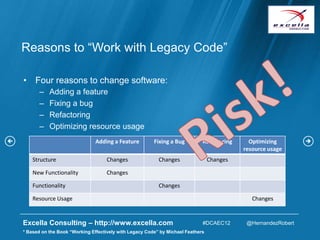
• Four reasons to change software:
       –   Adding a feature
       –   Fixing a bug
       –   Refactoring
       –   Optimizing resource usage
                               Adding a Feature         Fixing a Bug         Refactoring     Optimizing
                                                                                           resource usage
    Structure                       Changes               Changes                Changes

    New Functionality               Changes

    Functionality                                         Changes

    Resource Usage                                                                            Changes


Excella Consulting – http://www.excella.com                                  #DCAEC12       @HernandezRobert
* Based on the Book “Working Effectively with Legacy Code” by Michael Feathers
As a Developer what are my options?

• Look for a new Job?
• Start from scratch.
       – Big bang approach!
• Have somebody else do the job:
       – Members of the original development team
       – Consultants ($$$)

• Deal with it!


Excella Consulting – http://www.excella.com                                  #DCAEC12   @HernandezRobert
* Based on the Book “Working Effectively with Legacy Code” by Michael Feathers
How do we approach the work?

• Working with Feedback
       – Edit and pray
          (Industry standard)

       – Cover and modify


Excella Consulting – http://www.excella.com                                  #DCAEC12   @HernandezRobert
* Based on the Book “Working Effectively with Legacy Code” by Michael Feathers
Edit and Pray

•   Carefully plan the changes
•   Make sure you understand the code
•   Start making changes
•   Poke around to see if you broke anything
•   Deploy to production environment
•   Wait for feedback from customers
Cover and Modify

• Build a safety net (Covering = Testing)
• Unit Testing
• Higher level testing


                                   The Legacy Code Dilemma
                      When we change code, we should have tests in place.
                         To put tests in place we need to change code


Excella Consulting – http://www.excella.com                                  #DCAEC12   @HernandezRobert
* Based on the Book “Working Effectively with Legacy Code” by Michael Feathers
Cover and Modify

• Introduce Unit Tests

• Unit Tests are:
       –   Fast
       –   Localise Problems
       –   Do not talk to a database
       –   Do not communicate over the network
       –   Do not communicate with local resources
       –   Do not need config changes


Excella Consulting – http://www.excella.com                                  #DCAEC12   @HernandezRobert
* Based on the Book “Working Effectively with Legacy Code” by Michael Feathers
The Legacy Code Change Algorithm

    Identify change points
    Find test points
    Break dependencies
    Write tests
    Make changes and refactor


Excella Consulting – http://www.excella.com                                  #DCAEC12   @HernandezRobert
* Based on the Book “Working Effectively with Legacy Code” by Michael Feathers
Sensing & Separation


• Sensing: we break dependencies to sense when we can't access
  values our code computes

• Separation: we break dependencies to separate when we can't
  even get a piece of code into a test harness to run


Excella Consulting – http://www.excella.com                                  #DCAEC12   @HernandezRobert
* Based on the Book “Working Effectively with Legacy Code” by Michael Feathers
Fake Collaborators

• Object that impersonates some collaborator of your class when its
  being tested.
       – Demo: Echo Console


Excella Consulting – http://www.excella.com                                  #DCAEC12   @HernandezRobert
* Based on the Book “Working Effectively with Legacy Code” by Michael Feathers
The Seam Model

• Seam: a place where you can alter behavior of your program
  without editing in that place.
• Enabling Point: Every seam has an enabling point, a place where
  you can make the decision to use one behavior or another.

• Looking for existing seams in legacy code allow us to break
  dependencies (for sensing or separation) without refactoring.

• Demo: Echo Console
• Demo: Fake Data Reader


Excella Consulting – http://www.excella.com                                  #DCAEC12   @HernandezRobert
* Based on the Book “Working Effectively with Legacy Code” by Michael Feathers
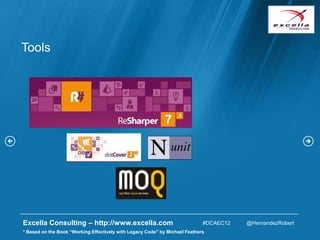
Tools


Excella Consulting – http://www.excella.com                                  #DCAEC12   @HernandezRobert
* Based on the Book “Working Effectively with Legacy Code” by Michael Feathers
Test Driven Development

• Test-Driven Development (TDD)

       1. Write a failing test
       2. Get it to compile
       3. Make it pass
       4. Remove duplication
       5. Repeat


• Programming by difference


Excella Consulting – http://www.excella.com                                  #DCAEC12   @HernandezRobert
* Based on the Book “Working Effectively with Legacy Code” by Michael Feathers
Test Driven Development

• Test-Driven Development (TDD) for legacy

       0. Get the class you want to change under test
       1. Write a failing test
       2. Get it to compile
       3. Make it pass (try not to change existing code)
       4. Remove duplication
       5. Repeat


• Programming by difference


Excella Consulting – http://www.excella.com                                  #DCAEC12   @HernandezRobert
* Based on the Book “Working Effectively with Legacy Code” by Michael Feathers
Conclusions

• No “silver bullet” here, it's hard work but not impossible
• Overwhelming at first but things will get better as the number of
  tests increase
• Be pragmatic!
Resources


           “Working Effectively with Legacy Code” by
   1.
           Michael Feathers

   2.      http://www.objectmentor.com

   3.      http://www.overridethis.com

           http://bitbucket.org/rhp_74/overridethis.legacycode
   4.
           sample

Excella Consulting – http://www.excella.com
Thank You!


   1.      Blog: http://www.overridethis.com

   2.      Email: roberto.hernandez@excella.com

   3.      @hernandezrobert

   4.


Excella Consulting – http://www.excella.com

Working Effectively With Legacy Code

  • 1.
    Working Effectively with Legacy Code Roberto Hernandez-Pou Managing Consultant Excella Consulting @hernandezrobert http://www.overridethis.com Excella Consulting – http://www.excella.com
  • 2.
    Legacy Code: Characteristics • Poor Architecture • Non-Uniform coding styles • Poor or Non-Existing Documentation • Mythical “Oral” Documentation • No Tests (or Minimal Test Coverage) • Extremely Valuable! – Only Successful code becomes Legacy Code. Excella Consulting – http://www.excella.com #DCAEC12 @HernandezRobert * Based on the Book “Working Effectively with Legacy Code” by Michael Feathers
  • 3.
    Agenda • How does code become Legacy Code? • Reasons to work with Legacy Code • What are my options? • How do we approach the work? – Edit and Pray „or‟ Cover and Modify • The Legacy Code Change Algorithm • Sensing and Separation • Fake Collaborators • Seams • Tools • TDD for Legacy Code Excella Consulting – http://www.excella.com #DCAEC12 @HernandezRobert * Based on the Book “Working Effectively with Legacy Code” by Michael Feathers
  • 4.
    How does codebecome Legacy Code? • New Features or New Requirements – Developers usually turn to shortcuts and hacks to make deadlines and deliver on time to market. • Software Team Turnover or Large Development Teams – Multiple styles of coding. – Lack of vision. – Code duplication. • Poor Team Communication. Excella Consulting – http://www.excella.com #DCAEC12 @HernandezRobert * Based on the Book “Working Effectively with Legacy Code” by Michael Feathers
  • 5.
    Reasons to “Workwith Legacy Code” • Four reasons to change software: – Adding a feature – Fixing a bug – Refactoring – Optimizing resource usage Adding a Feature Fixing a Bug Refactoring Optimizing resource usage Structure Changes Changes Changes New Functionality Changes Functionality Changes Resource Usage Changes Excella Consulting – http://www.excella.com #DCAEC12 @HernandezRobert * Based on the Book “Working Effectively with Legacy Code” by Michael Feathers
  • 6.
    As a Developerwhat are my options? • Look for a new Job? • Start from scratch. – Big bang approach! • Have somebody else do the job: – Members of the original development team – Consultants ($$$) • Deal with it! Excella Consulting – http://www.excella.com #DCAEC12 @HernandezRobert * Based on the Book “Working Effectively with Legacy Code” by Michael Feathers
  • 7.
    How do weapproach the work? • Working with Feedback – Edit and pray (Industry standard) – Cover and modify Excella Consulting – http://www.excella.com #DCAEC12 @HernandezRobert * Based on the Book “Working Effectively with Legacy Code” by Michael Feathers
  • 8.
    Edit and Pray • Carefully plan the changes • Make sure you understand the code • Start making changes • Poke around to see if you broke anything • Deploy to production environment • Wait for feedback from customers
  • 9.
    Cover and Modify •Build a safety net (Covering = Testing) • Unit Testing • Higher level testing The Legacy Code Dilemma When we change code, we should have tests in place. To put tests in place we need to change code Excella Consulting – http://www.excella.com #DCAEC12 @HernandezRobert * Based on the Book “Working Effectively with Legacy Code” by Michael Feathers
  • 10.
    Cover and Modify •Introduce Unit Tests • Unit Tests are: – Fast – Localise Problems – Do not talk to a database – Do not communicate over the network – Do not communicate with local resources – Do not need config changes Excella Consulting – http://www.excella.com #DCAEC12 @HernandezRobert * Based on the Book “Working Effectively with Legacy Code” by Michael Feathers
  • 11.
    The Legacy CodeChange Algorithm  Identify change points  Find test points  Break dependencies  Write tests  Make changes and refactor Excella Consulting – http://www.excella.com #DCAEC12 @HernandezRobert * Based on the Book “Working Effectively with Legacy Code” by Michael Feathers
  • 12.
    Sensing & Separation •Sensing: we break dependencies to sense when we can't access values our code computes • Separation: we break dependencies to separate when we can't even get a piece of code into a test harness to run Excella Consulting – http://www.excella.com #DCAEC12 @HernandezRobert * Based on the Book “Working Effectively with Legacy Code” by Michael Feathers
  • 13.
    Fake Collaborators • Objectthat impersonates some collaborator of your class when its being tested. – Demo: Echo Console Excella Consulting – http://www.excella.com #DCAEC12 @HernandezRobert * Based on the Book “Working Effectively with Legacy Code” by Michael Feathers
  • 14.
    The Seam Model •Seam: a place where you can alter behavior of your program without editing in that place. • Enabling Point: Every seam has an enabling point, a place where you can make the decision to use one behavior or another. • Looking for existing seams in legacy code allow us to break dependencies (for sensing or separation) without refactoring. • Demo: Echo Console • Demo: Fake Data Reader Excella Consulting – http://www.excella.com #DCAEC12 @HernandezRobert * Based on the Book “Working Effectively with Legacy Code” by Michael Feathers
  • 15.
    Tools Excella Consulting –http://www.excella.com #DCAEC12 @HernandezRobert * Based on the Book “Working Effectively with Legacy Code” by Michael Feathers
  • 16.
    Test Driven Development •Test-Driven Development (TDD) 1. Write a failing test 2. Get it to compile 3. Make it pass 4. Remove duplication 5. Repeat • Programming by difference Excella Consulting – http://www.excella.com #DCAEC12 @HernandezRobert * Based on the Book “Working Effectively with Legacy Code” by Michael Feathers
  • 17.
    Test Driven Development •Test-Driven Development (TDD) for legacy 0. Get the class you want to change under test 1. Write a failing test 2. Get it to compile 3. Make it pass (try not to change existing code) 4. Remove duplication 5. Repeat • Programming by difference Excella Consulting – http://www.excella.com #DCAEC12 @HernandezRobert * Based on the Book “Working Effectively with Legacy Code” by Michael Feathers
  • 18.
    Conclusions • No “silverbullet” here, it's hard work but not impossible • Overwhelming at first but things will get better as the number of tests increase • Be pragmatic!
  • 19.
    Resources “Working Effectively with Legacy Code” by 1. Michael Feathers 2. http://www.objectmentor.com 3. http://www.overridethis.com http://bitbucket.org/rhp_74/overridethis.legacycode 4. sample Excella Consulting – http://www.excella.com
  • 20.
    Thank You! 1. Blog: http://www.overridethis.com 2. Email: roberto.hernandez@excella.com 3. @hernandezrobert 4. Excella Consulting – http://www.excella.com