Let's Sharpen Your Agile Ax, It's Story Splitting Time
No, this is not a well-formed acceptance criterion because it is not a present tense indicative statement that can be clearly determined as true or false. It does not provide enough information to determine if the requirement has been met.
Let's Sharpen Your Agile Ax, It's Story Splitting Time
1.
Let’s Sharpen Your
AgileAx: It’s Story
Splitting Time
Presented by Brian Sjoberg
8/25/2016
Developed by Ken Furlong and Brian Sjoberg
3.
• Agile/Lean
Coach atExcella
• Focus on Org.
Transformation
• DC Scrum User
Group
Introduction
3
4.
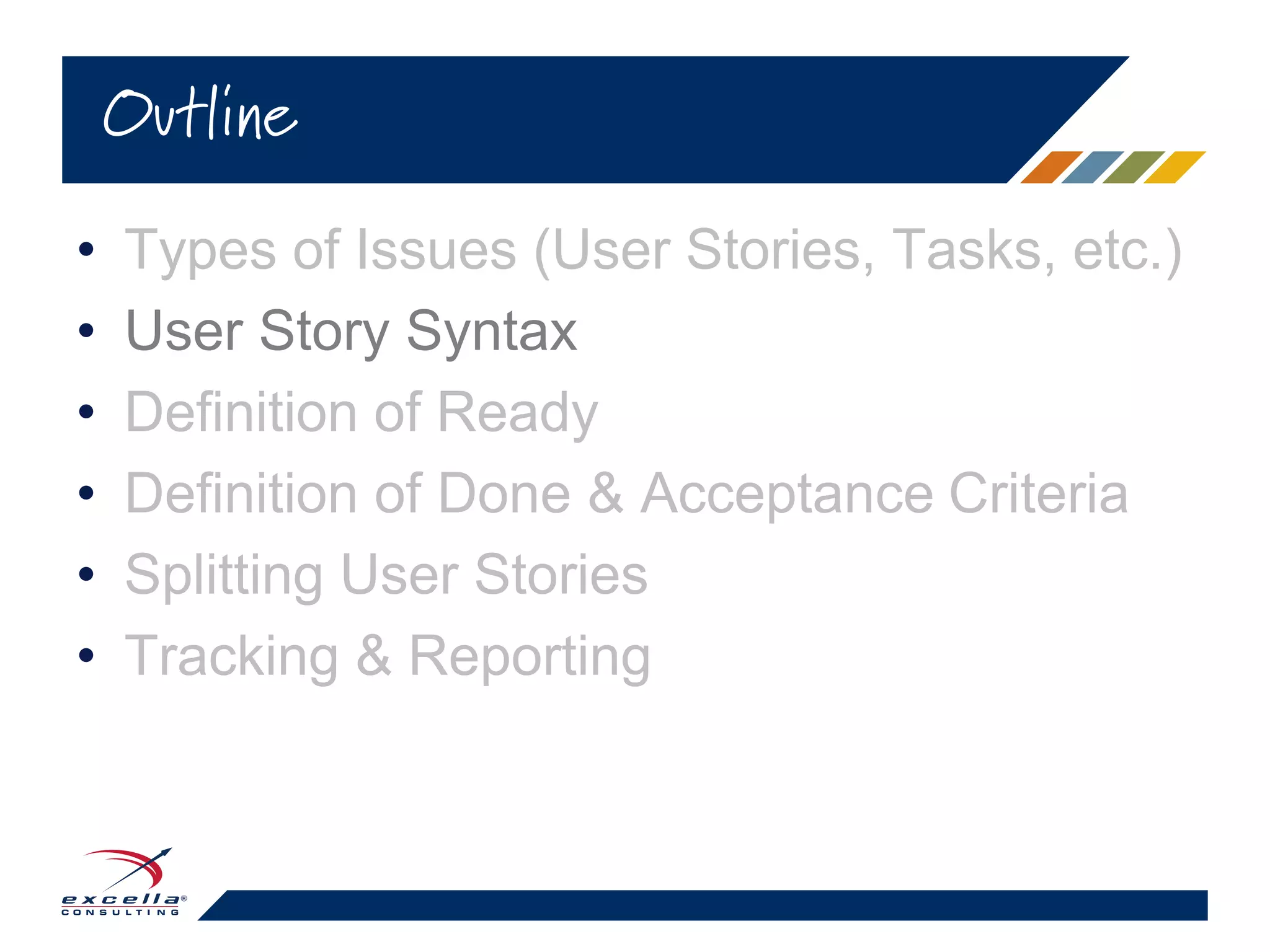
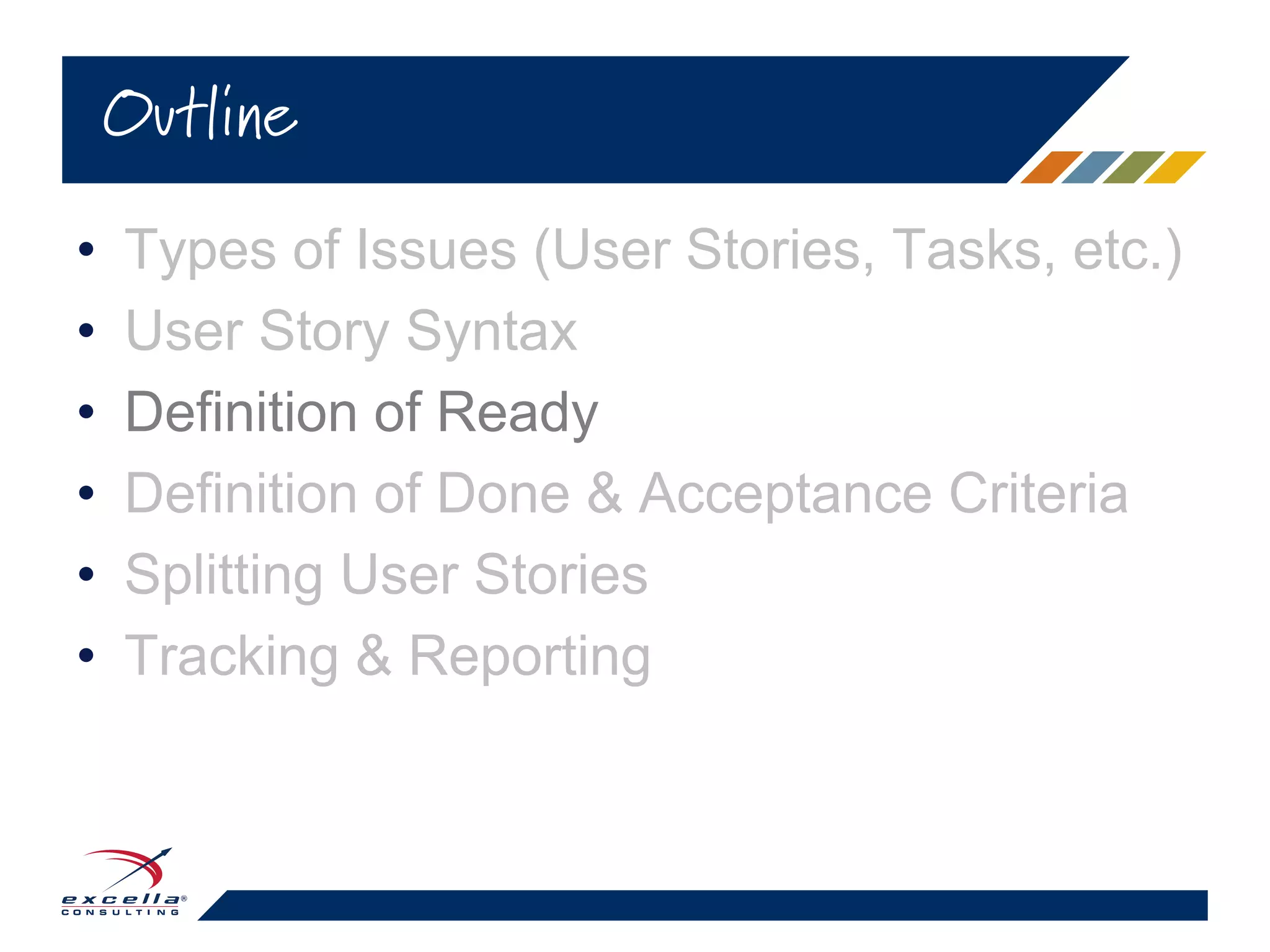
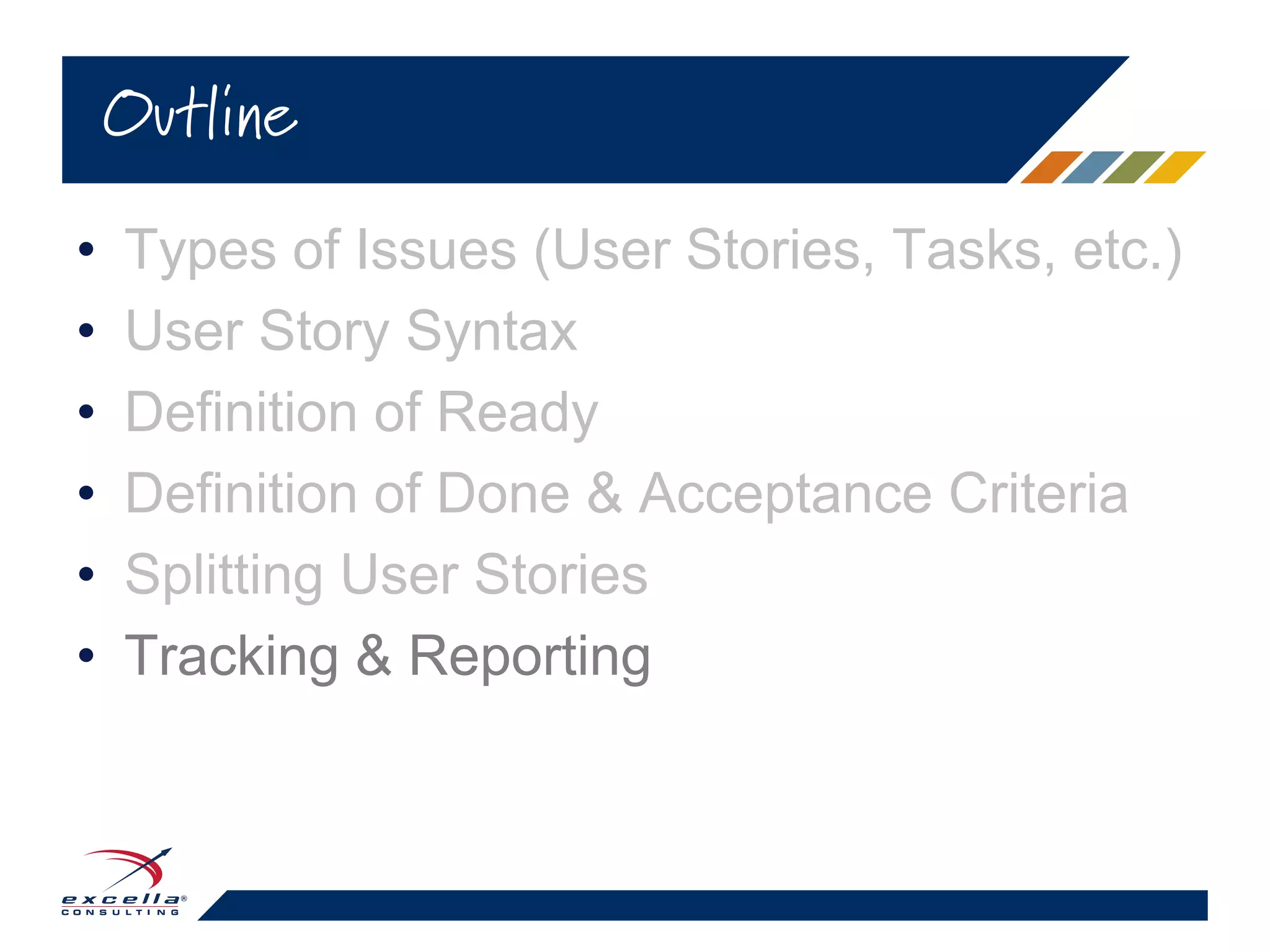
• Types ofIssues (User Stories, Tasks, etc.)
• User Story Syntax
• Definition of Ready
• Definition of Done & Acceptance Criteria
• Splitting User Stories
• Tracking & Reporting (Bonus)
Outline
5.
• Types ofIssues (User Stories, Tasks, etc.)
• User Story Syntax
• Definition of Ready
• Definition of Done & Acceptance Criteria
• Splitting User Stories
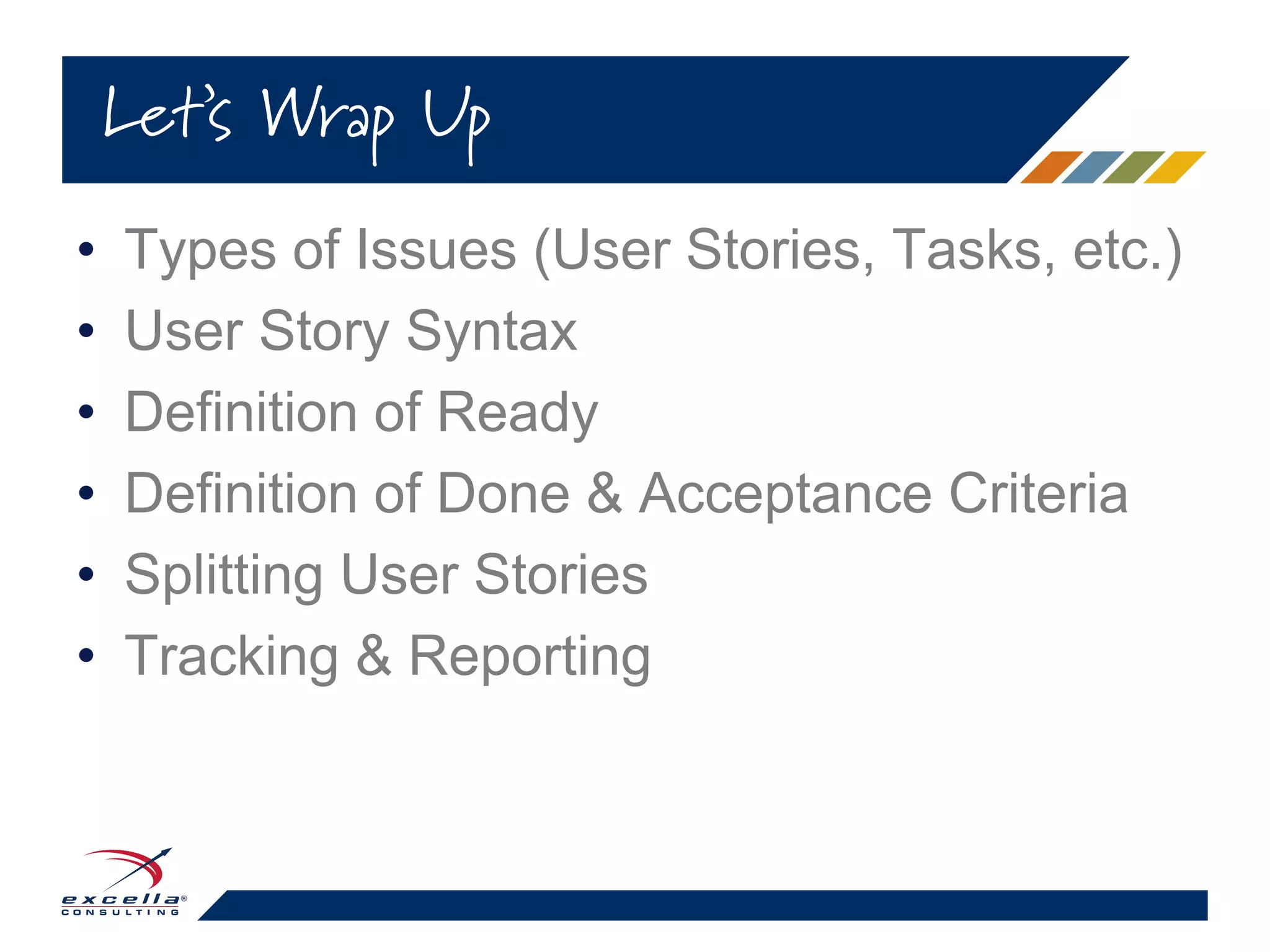
• Tracking & Reporting
Outline
6.
• An artifactto facilitate communication
• User story is a way to represent a
customer’s request to the team that
creates a product.
• Helps prevent misunderstanding
• Best option so far
User Story
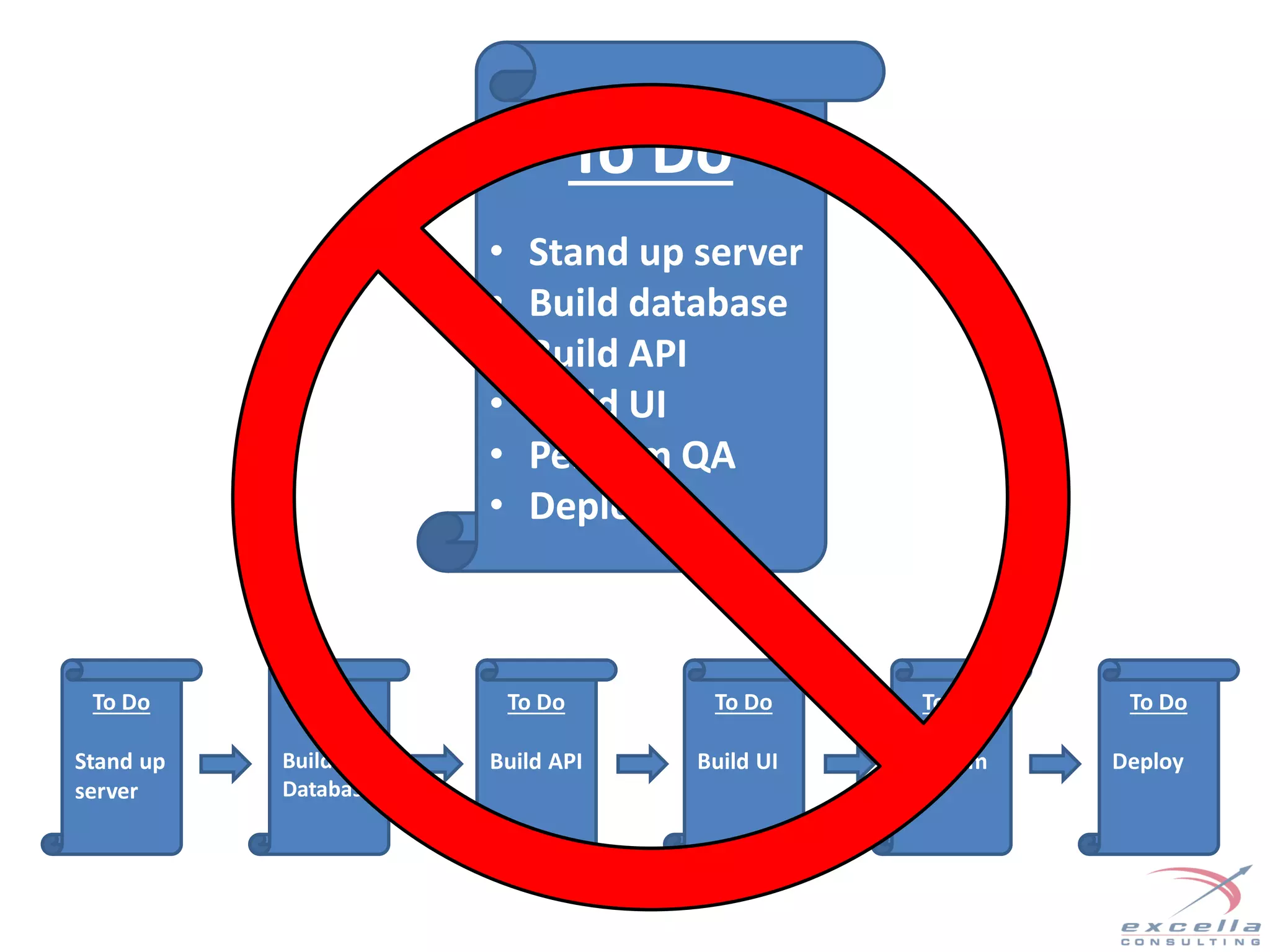
To Do
• Standup server
• Build database
• Build API
• Build UI
• Perform QA
• Deploy
To Do
Stand up
server
To Do
Build
Database
To Do
Build API
To Do
Build UI
To Do
Perform
QA
To Do
Deploy
14.
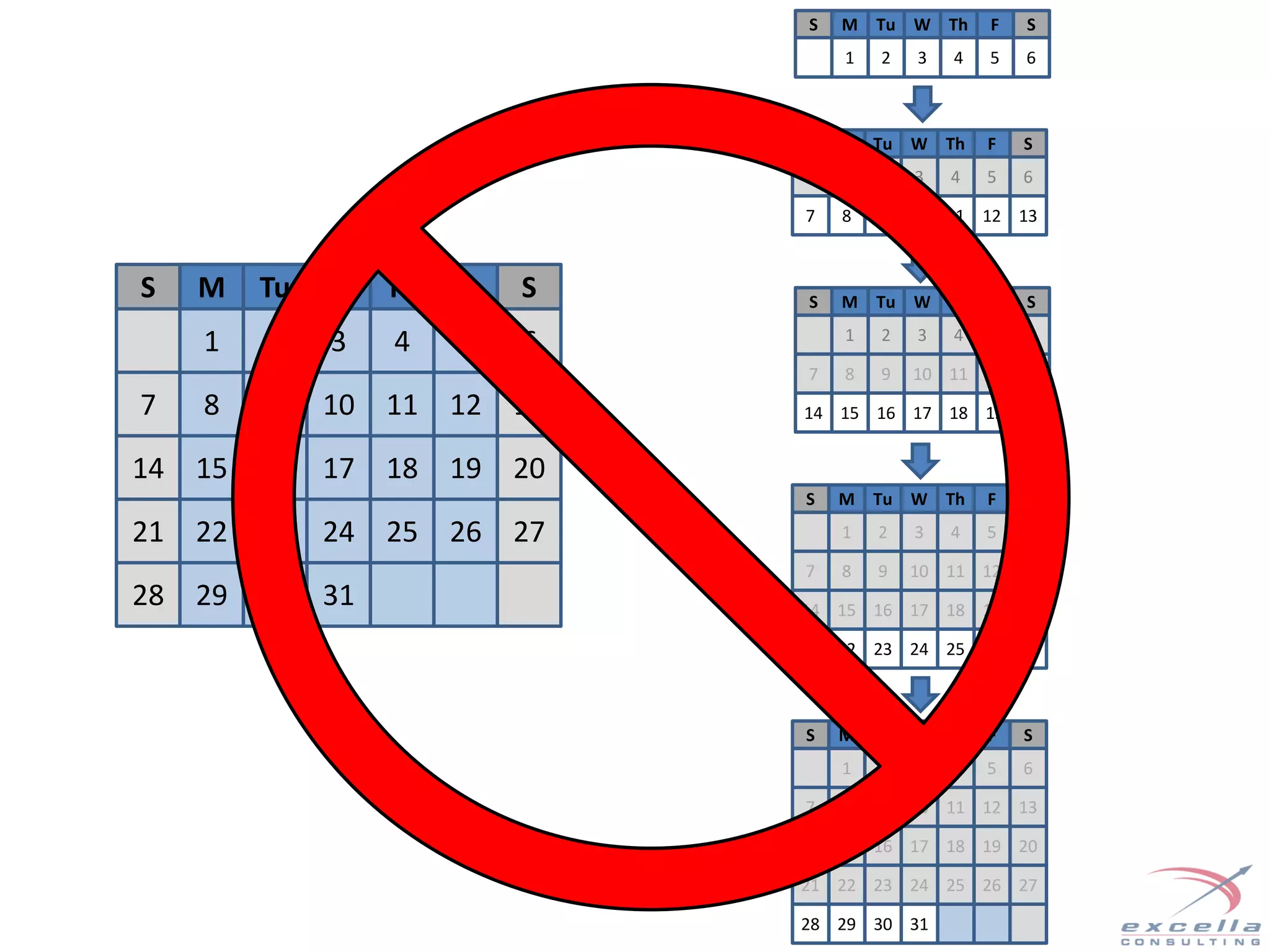
S M TuW Th F S
1 2 3 4 5 6
7 8 9 10 11 12 13
14 15 16 17 18 19 20
21 22 23 24 25 26 27
28 29 30 31
S M Tu W Th F S
1 2 3 4 5 6
7 8 9 10 11 12 13
14 15 16 17 18 19 20
21 22 23 24 25 26 27
28 29 30 31
S M Tu W Th F S
1 2 3 4 5 6
S M Tu W Th F S
1 2 3 4 5 6
7 8 9 10 11 12 13
S M Tu W Th F S
1 2 3 4 5 6
7 8 9 10 11 12 13
14 15 16 17 18 19 20
S M Tu W Th F S
1 2 3 4 5 6
7 8 9 10 11 12 13
14 15 16 17 18 19 20
21 22 23 24 25 26 27
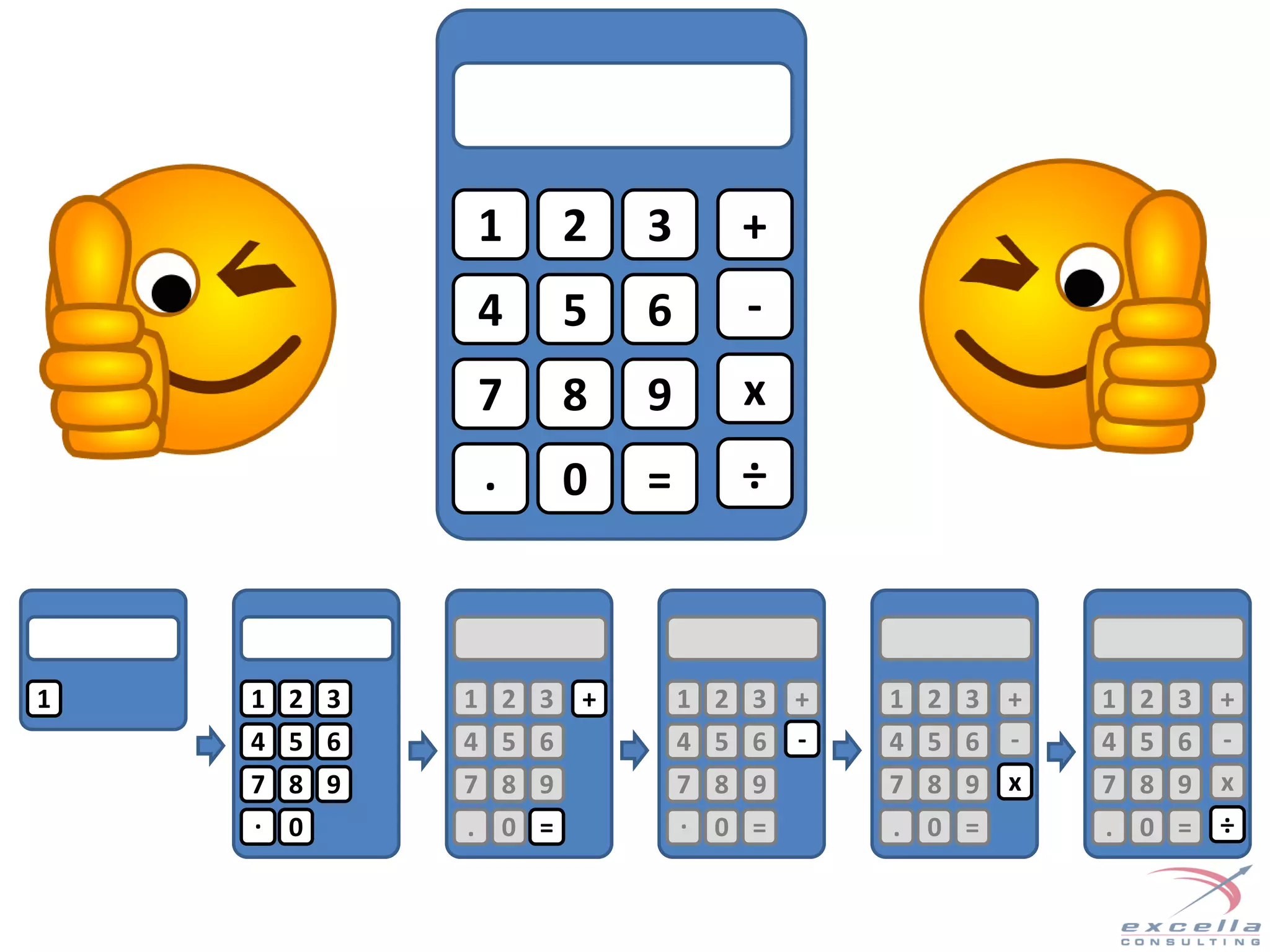
1 2 3
45 6
7 8 9
0
+
-
x
÷. =
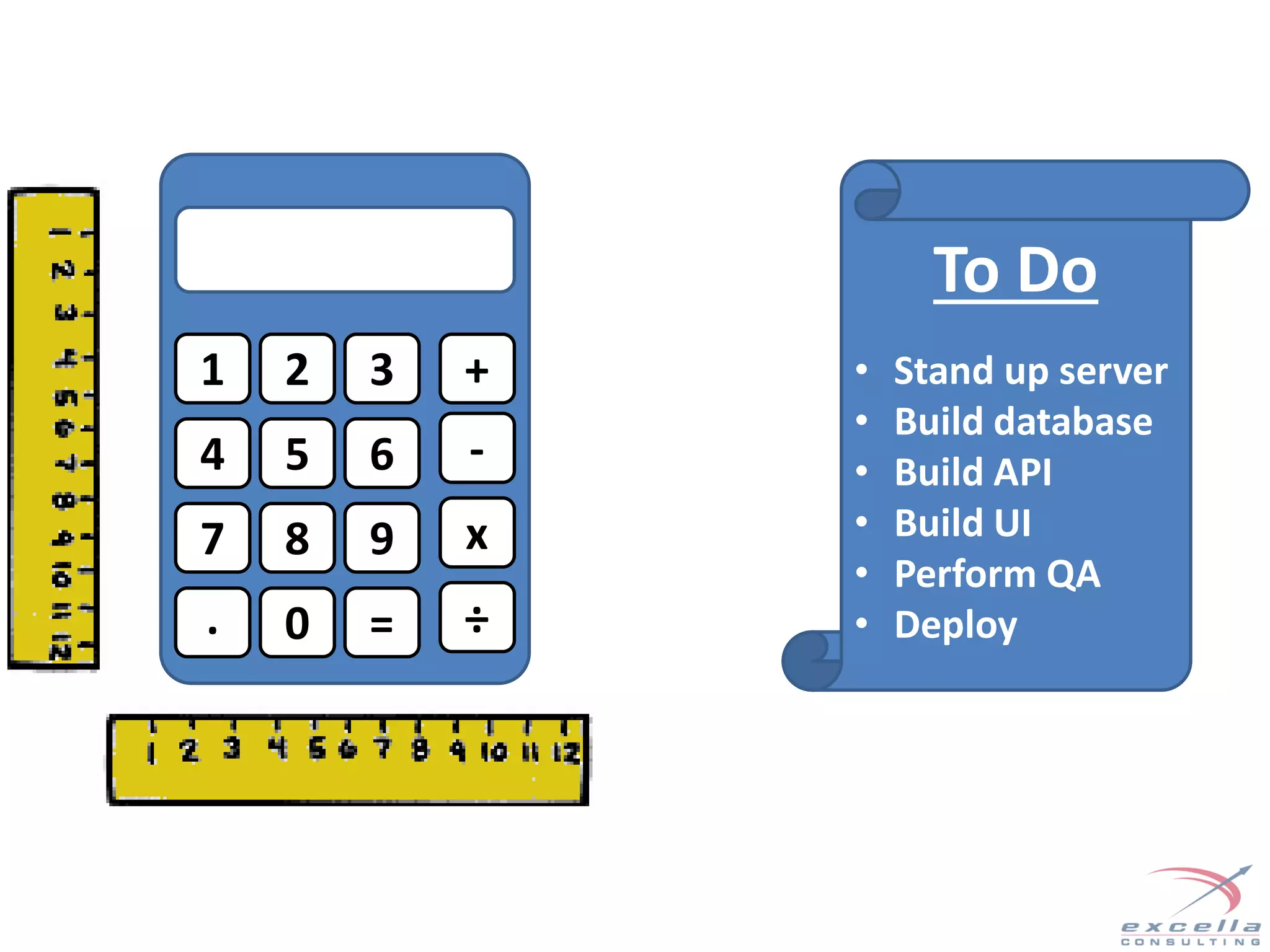
To Do
• Stand up server
• Build database
• Build API
• Build UI
• Perform QA
• Deploy
17.
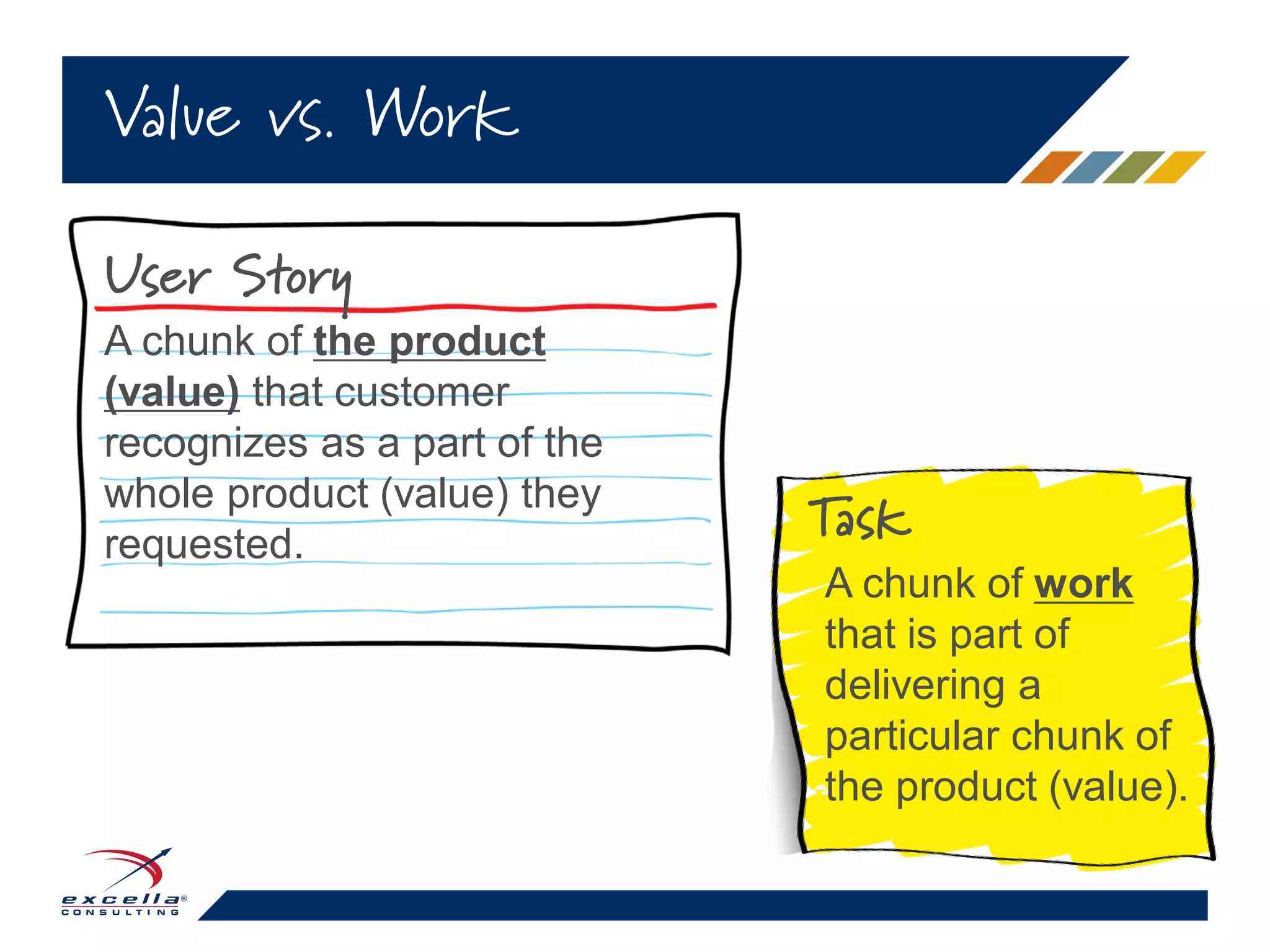
Value vs. Work
Task
Achunk of work
that is part of
delivering a
particular chunk of
the product (value).
User Story
A chunk of the product
(value) that customer
recognizes as a part of the
whole product (value) they
requested.
18.
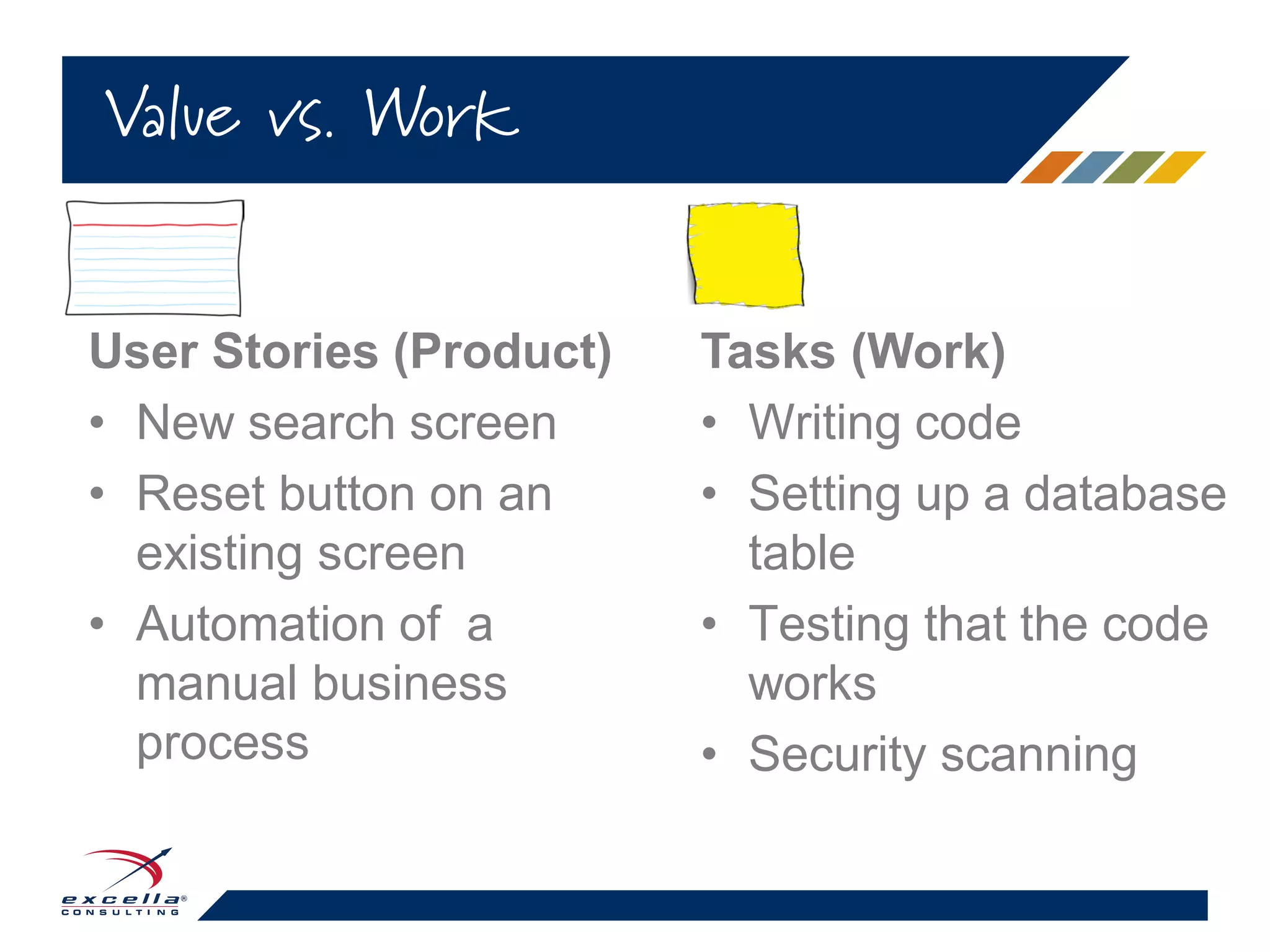
Value vs. Work
UserStories (Product)
• New search screen
• Reset button on an
existing screen
• Automation of a
manual business
process
Tasks (Work)
• Writing code
• Setting up a database
table
• Testing that the code
works
• Security scanning
19.
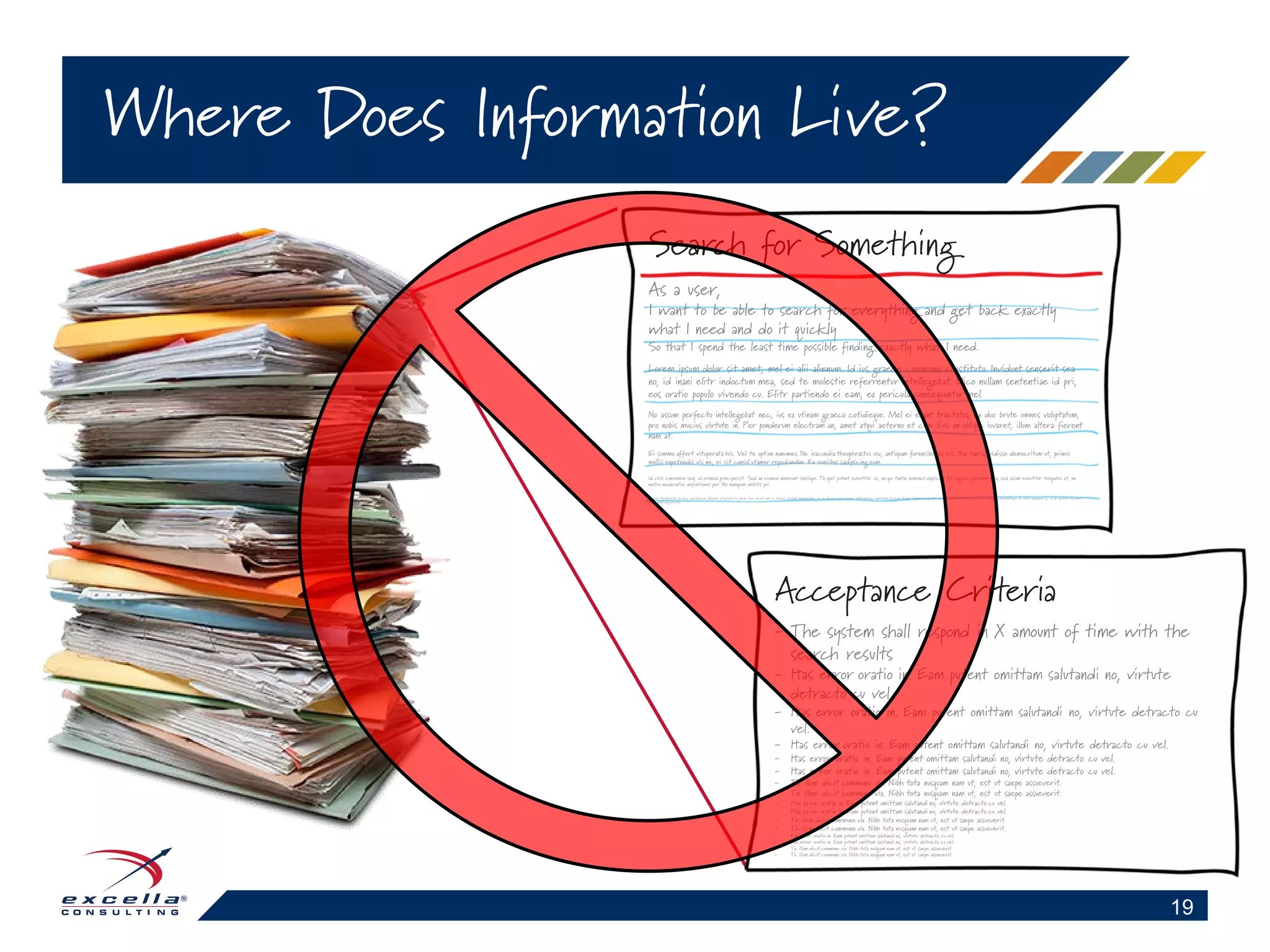
Where Does InformationLive?
19
Search for Something
As a user,
I want to be able to search for everything and get back exactly
what I need and do it quickly
So that I spend the least time possible finding exactly what I need.
Lorem ipsum dolor sit amet, mel ei alii alienum. Id ius graece commune constituto. Invidunt senserit sea
no, id inani elitr indoctum mea, sed te molestie referrentur intellegebat. Dico nullam sententiae id pri,
eos oratio populo vivendo cu. Elitr partiendo ei eam, ex pericula consequuntur mel.
No assum perfecto intellegebat nec, ius ex utinam graeco cotidieque. Mel ei erant tractatos, ea duo brute omnes voluptatum,
pro nobis mucius virtute in. Per ponderum electram an, amet atqui aeterno et cum. Eos an oblique iuvaret, illum altera fierent
nam at.
Ei summo affert vituperata his. Vel te option nonumes. Ne iracundia theophrastus usu, antiopam forensibus ex his. Has tantas vidisse democritum ut, primis
mollis expetendis vis ne, ei sit consul utamur repudiandae. Ea sensibus sadipscing eum.
Id viris convenire sed, id eirmod principes sit. Sed an eirmod deserunt similique. Te quot putent evertitur ius, an quo tantas nominavi explicari. Ex regione platonem mea, sed assum evertitur torquatos at, ne
nostro moderatius definitiones per. Ne numquam debitis pri.
Legere theophrastus an mea, sed alterum platonem vituperata eu, dicta libris dicunt nam ei. Inermis invidunt interpretaris eu ius. Id sea reque errem, tollit pertinax expetendis te eum. Dicam volumus suscipiantur an duo, ne per elit salutatus, duo ei nemore concludaturque. Ei soluta admodum ius, ius an deleniti tincidunt.
Reque nulla aliquid ut pri.
- The system shall respond in X amount of time with the
search results
- Has error oratio in. Eam putent omittam salutandi no, virtute
detracto cu vel.
- Has error oratio in. Eam putent omittam salutandi no, virtute detracto cu
vel.
- Has error oratio in. Eam putent omittam salutandi no, virtute detracto cu vel.
- Te illum dicit commune vix. Nibh tota nusquam nam ut, est ut saepe assueverit.
- Has error oratio in. Eam putent omittam salutandi no, virtute detracto cu vel.
- Te illum dicit commune vix. Nibh tota nusquam nam ut, est ut saepe assueverit.
- Has error oratio in. Eam putent omittam salutandi no, virtute detracto cu vel.
- Te illum dicit commune vix. Nibh tota nusquam nam ut, est ut saepe assueverit.
Acceptance Criteria
20.
• Not allinformation lives in a user story.
• There can be a lot of information we need
to capture and make available that do not
belong in stories.
Where Does Information Live?
21.
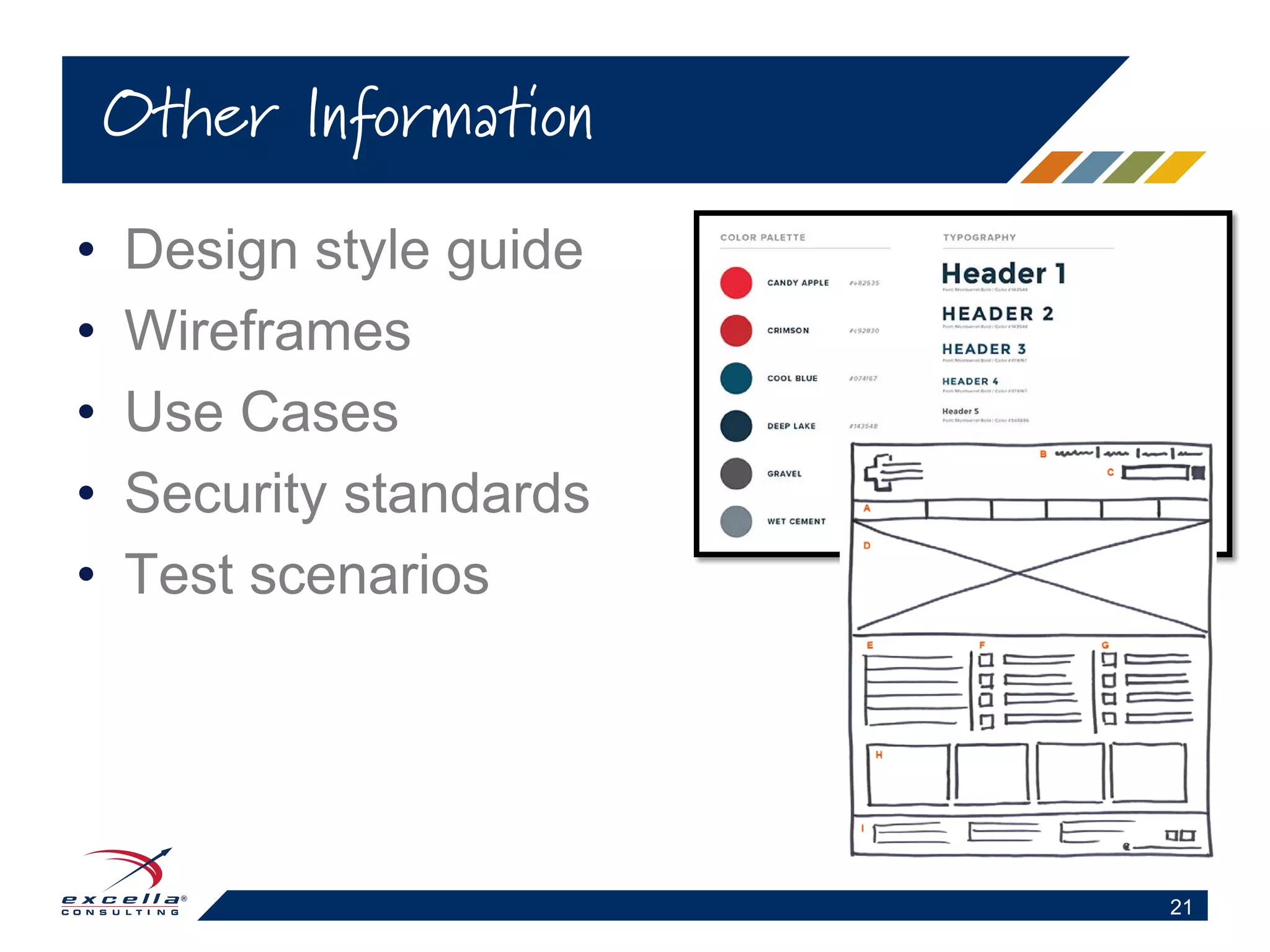
• Design styleguide
• Wireframes
• Use Cases
• Security standards
• Test scenarios
Other Information
21
22.
• Large chunksof work that don’t pertain to a
particular user story
• Some use ‘technical user story’ and ‘research
spike’
– Work that cuts across multiple stories (e.g.,
setting up an environment)
– Work that pertains to larger initiative but perhaps
not specific stories (e.g., research something)
– Work that multiple folks will be collaborating on or
that needs to be visible to others
“Tech Stories”, “Spikes”
23.
• Set upJenkins for Continuous Integration
• Set up Cucumber for Automated Acceptance
Testing
• Why does business care?
– Jenkins – Improve health of code base that will
result in faster and more reliable release delivery
– Cucumber – Improve code quality by catching
bugs earlier in development that will result in less
defects and time to market
Tech Story Examples
23
24.
• A larger,loosely defined user story that
we expect to be broken down into smaller
chunks and to be defined in progressively
more detail as it gets closer to being built
• When an Epic is fully broken down into
stories, the Epic could cease to exist
(rather than serving as a category or
“umbrella” for those stories)
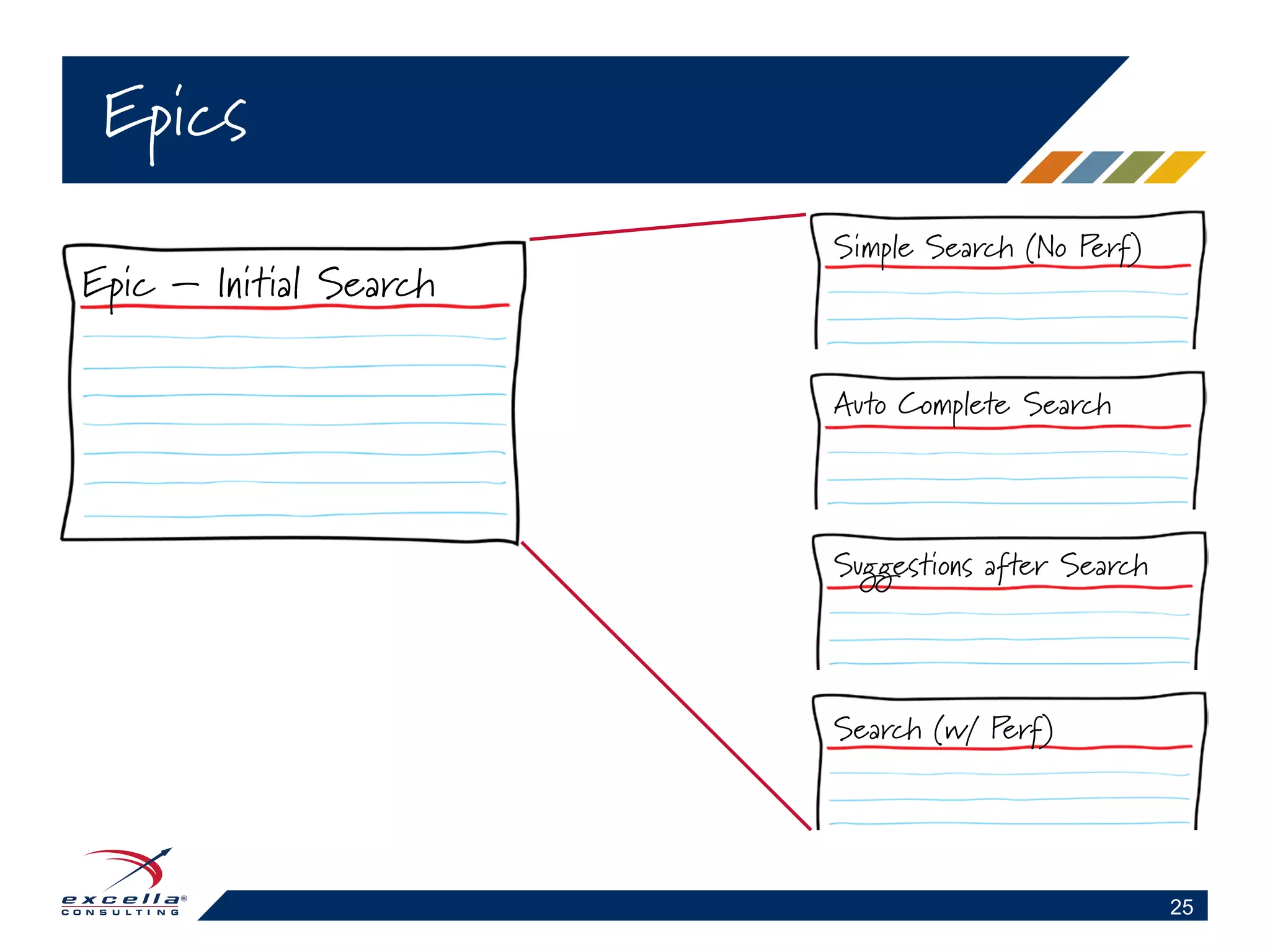
Epics
25.
Epics
25
Epic – InitialSearch
Simple Search (No Perf)
Auto Complete Search
Suggestions after Search
Search (w/ Perf)
26.
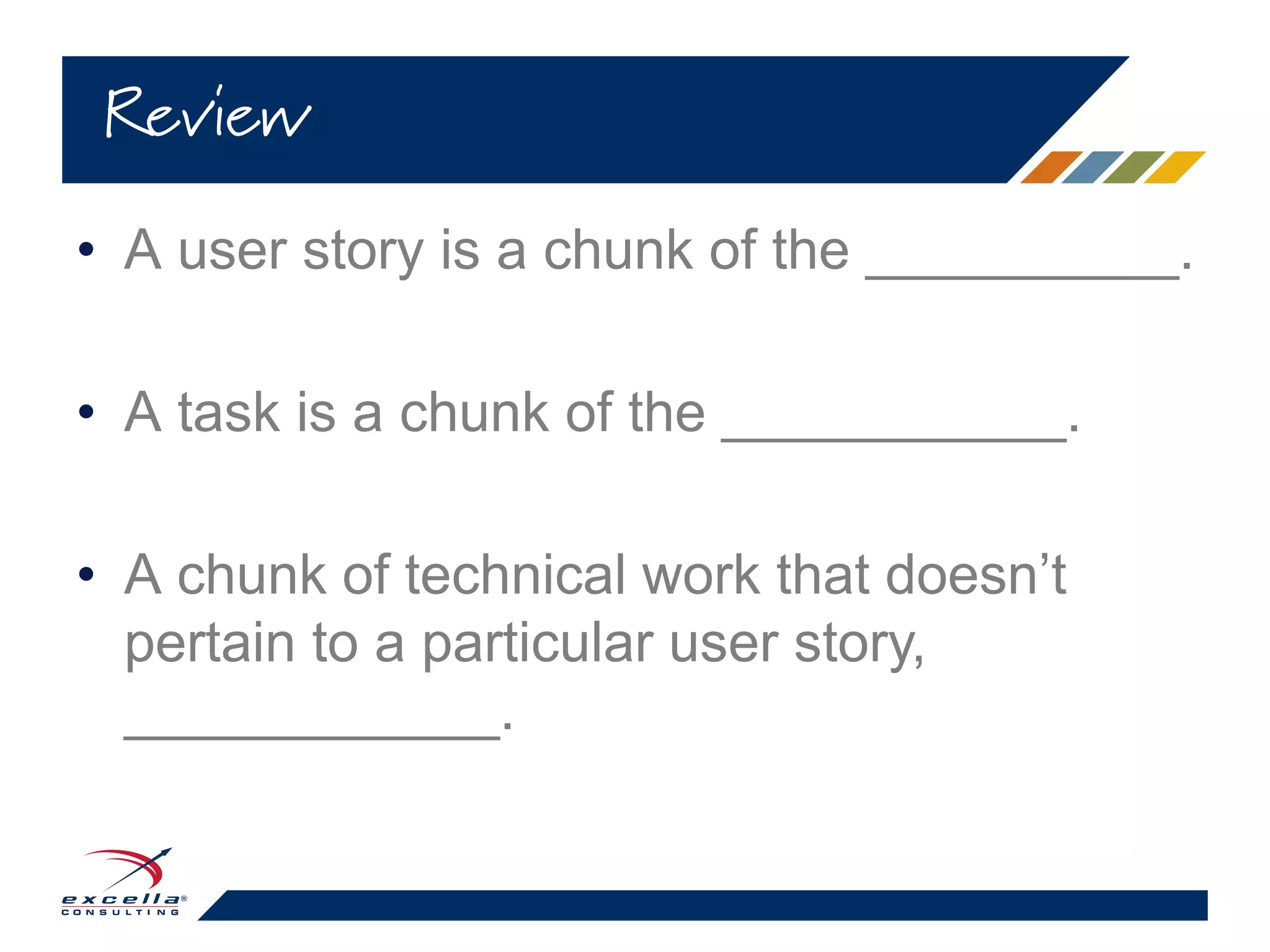
• A userstory is a chunk of the __________.
• A task is a chunk of the ___________.
• A chunk of technical work that doesn’t
pertain to a particular user story,
____________.
Review
27.
• Types ofIssues (User Stories, Tasks, etc.)
• User Story Syntax
• Definition of Ready
• Definition of Done & Acceptance Criteria
• Splitting User Stories
• Tracking & Reporting
Outline
28.
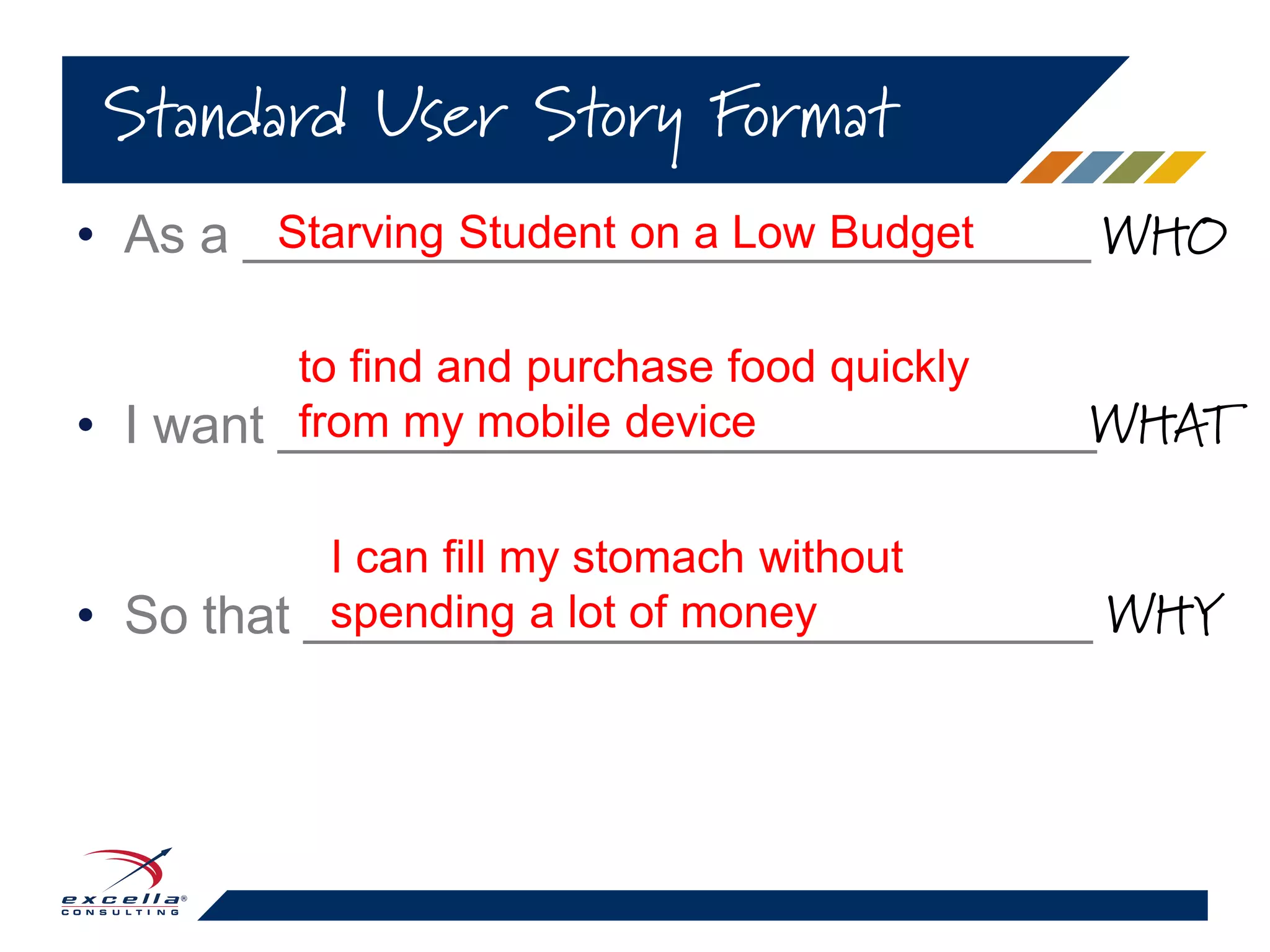
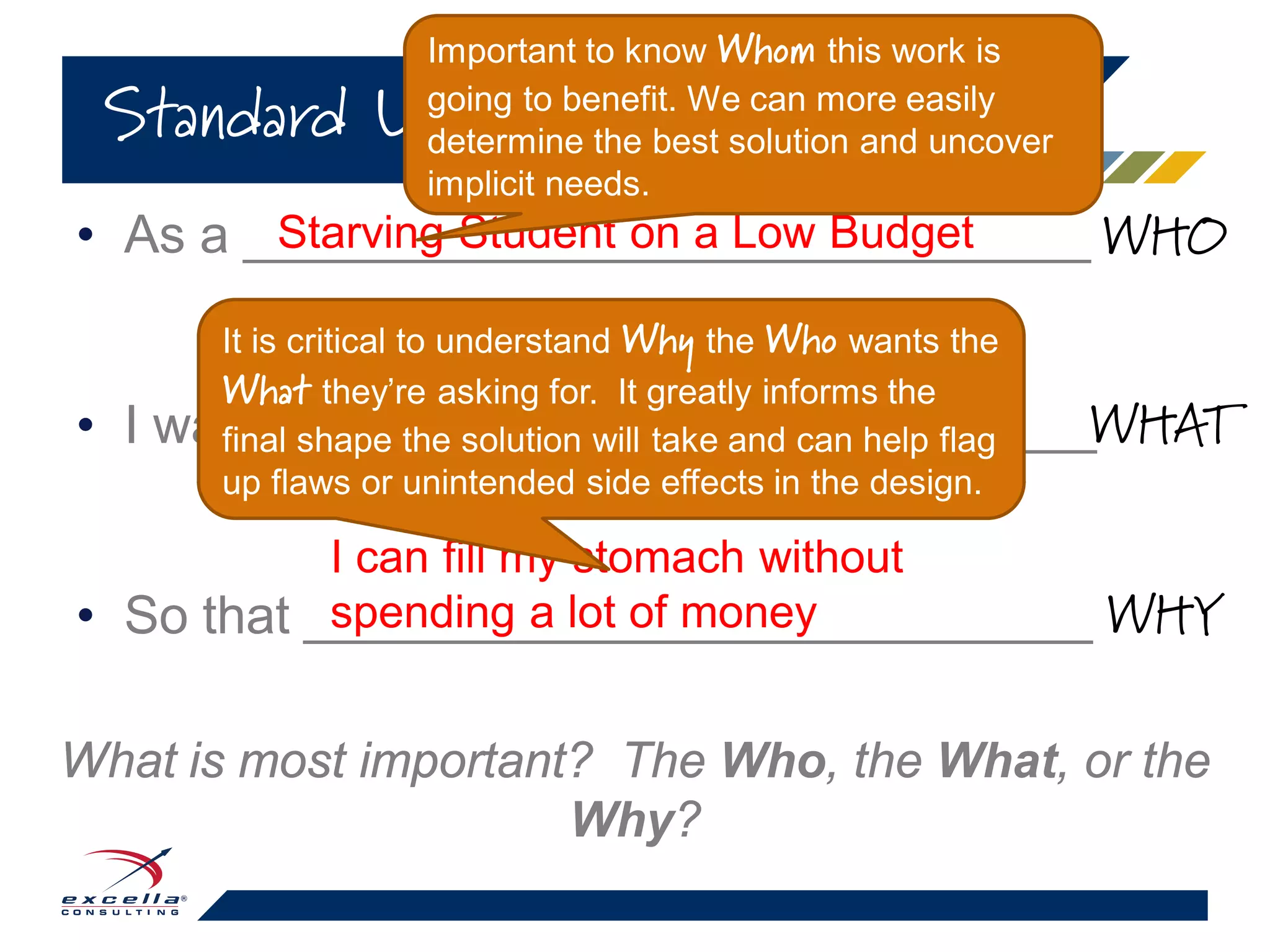
• As a_____________________________
• I want ____________________________
• So that ___________________________
Standard User Story Format
Starving Student on a Low Budget
to find and purchase food quickly
from my mobile device
I can fill my stomach without
spending a lot of money
WHO
WHAT
WHY
29.
• As a_____________________________
• I want ____________________________
• So that ___________________________
Standard User Story Format
Starving Student on a Low Budget
to find and purchase food quickly
from my mobile device
I can fill my stomach without
spending a lot of money
Important to know Whom this work is
going to benefit. We can more easily
determine the best solution and uncover
implicit needs.
It is critical to understand Why the Who wants the
What they’re asking for. It greatly informs the
final shape the solution will take and can help flag
up flaws or unintended side effects in the design.
WHO
WHAT
WHY
What is most important? The Who, the What, or the
Why?
30.
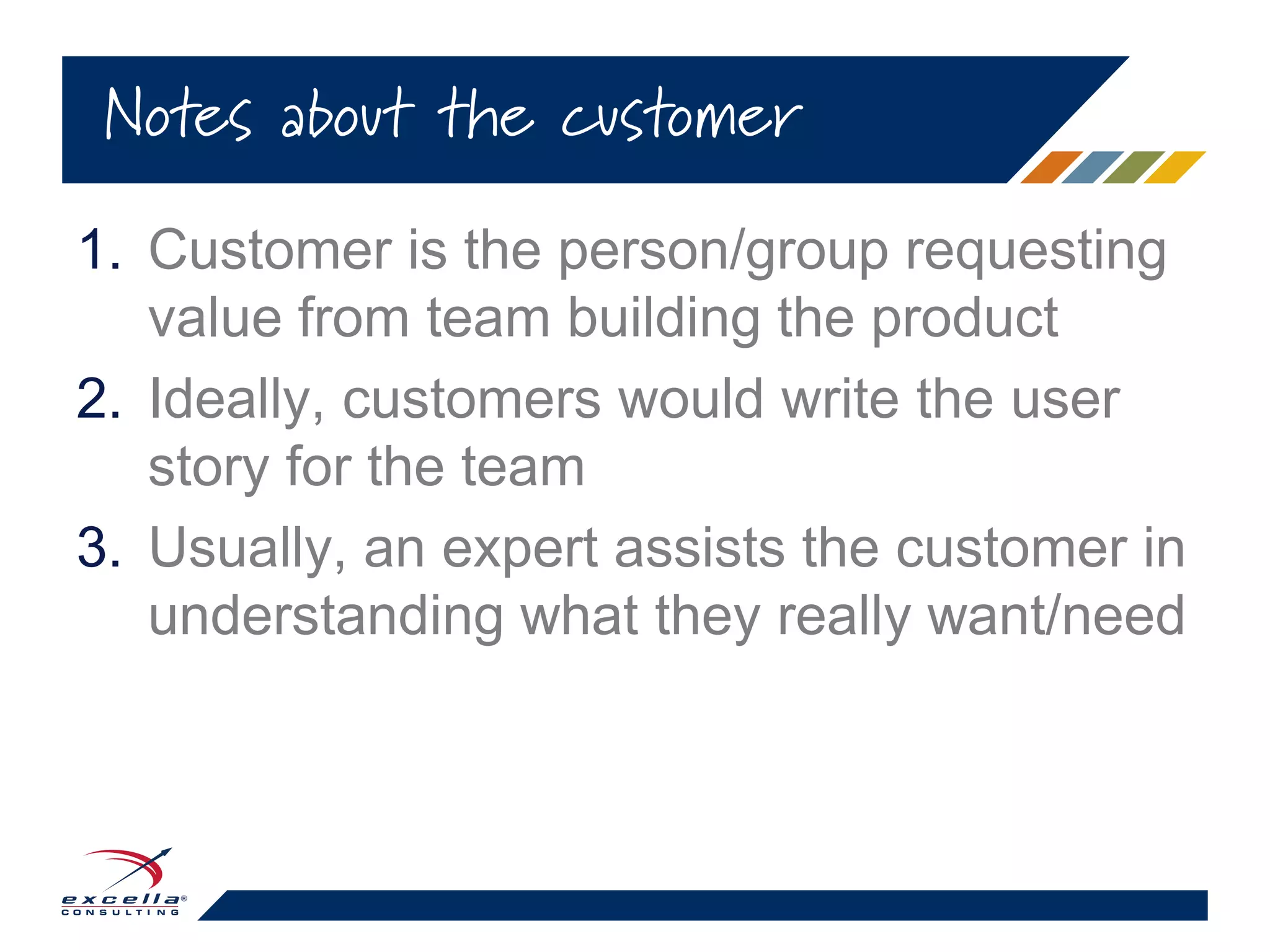
1. Customer isthe person/group requesting
value from team building the product
2. Ideally, customers would write the user
story for the team
3. Usually, an expert assists the customer in
understanding what they really want/need
Notes about the customer
31.
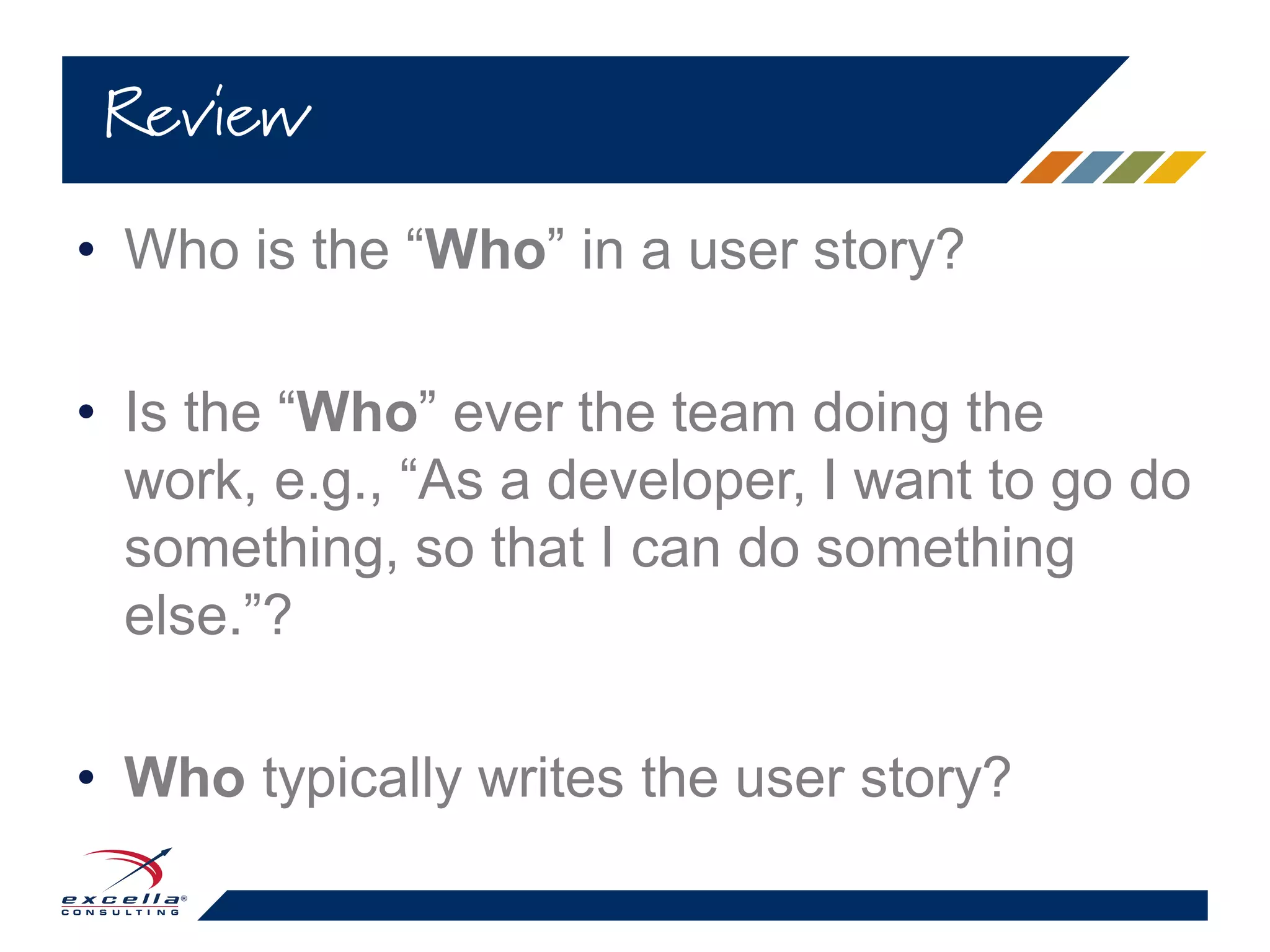
• Who isthe “Who” in a user story?
• Is the “Who” ever the team doing the
work, e.g., “As a developer, I want to go do
something, so that I can do something
else.”?
• Who typically writes the user story?
Review
32.
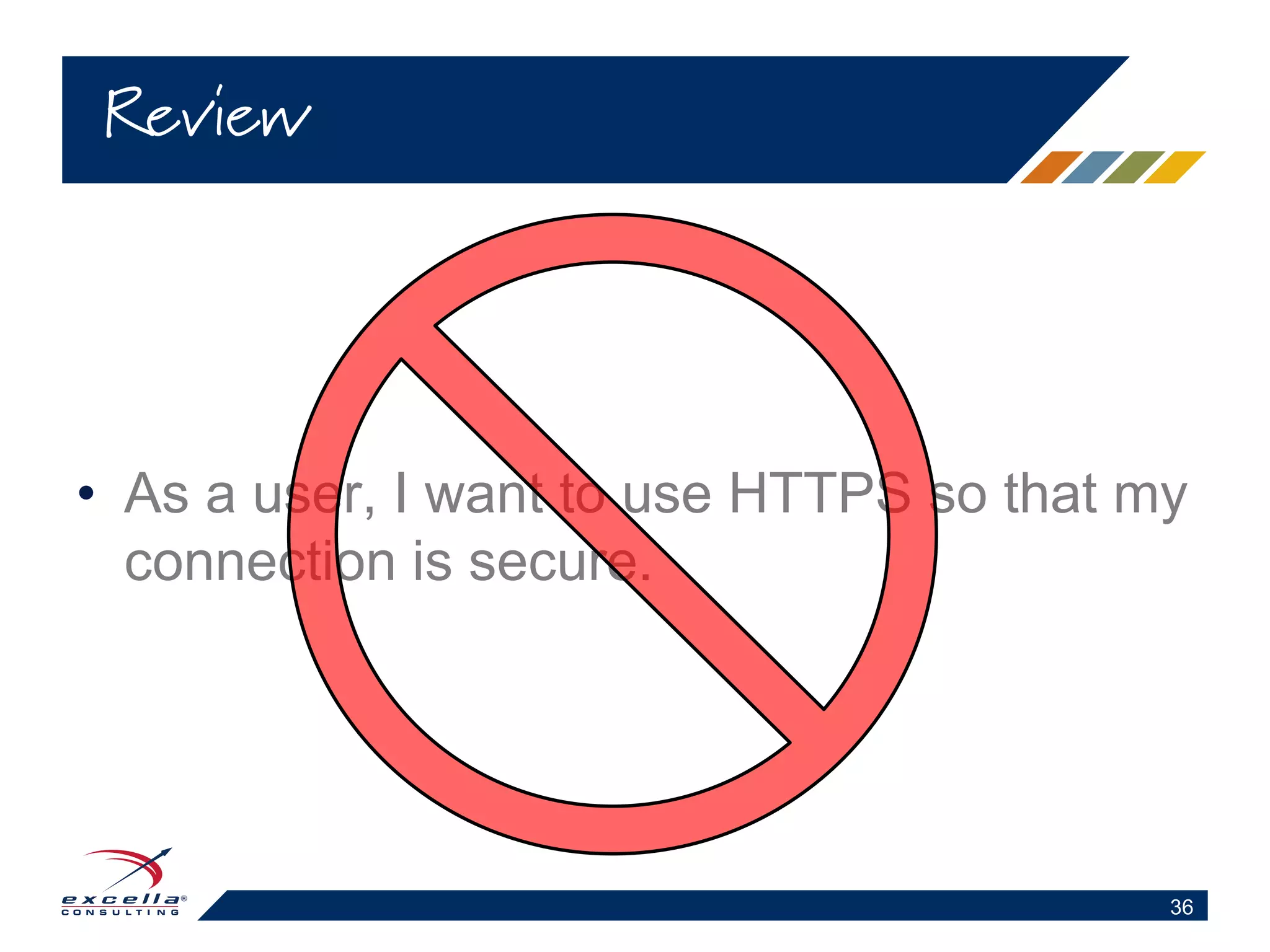
• As auser, I want to use HTTPS so that my
connection is secure.
Review
36
33.
• As adeveloper, I need to determine a
serialization strategy, so that I can send
the API the data it needs.
Review
37
34.
• As amobile teen user, I want to search on
my phone for music that I just heard on the
radio so that I can listen to it again
whenever I want.
Review
38
35.
• Types ofIssues (User Stories, Tasks, etc.)
• User Story Syntax
• Definition of Ready
• Definition of Done & Acceptance Criteria
• Splitting User Stories
• Tracking & Reporting
Outline
36.
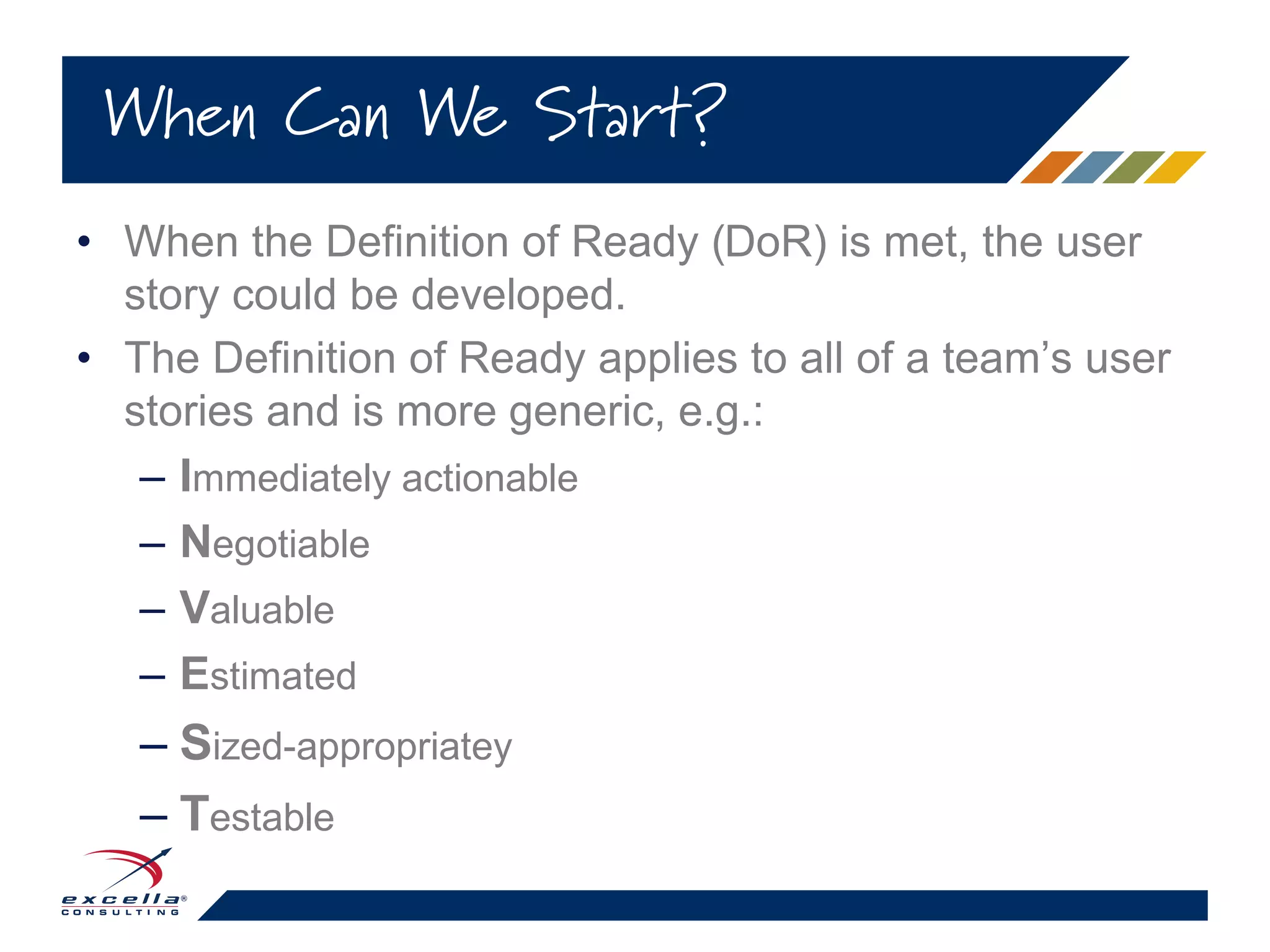
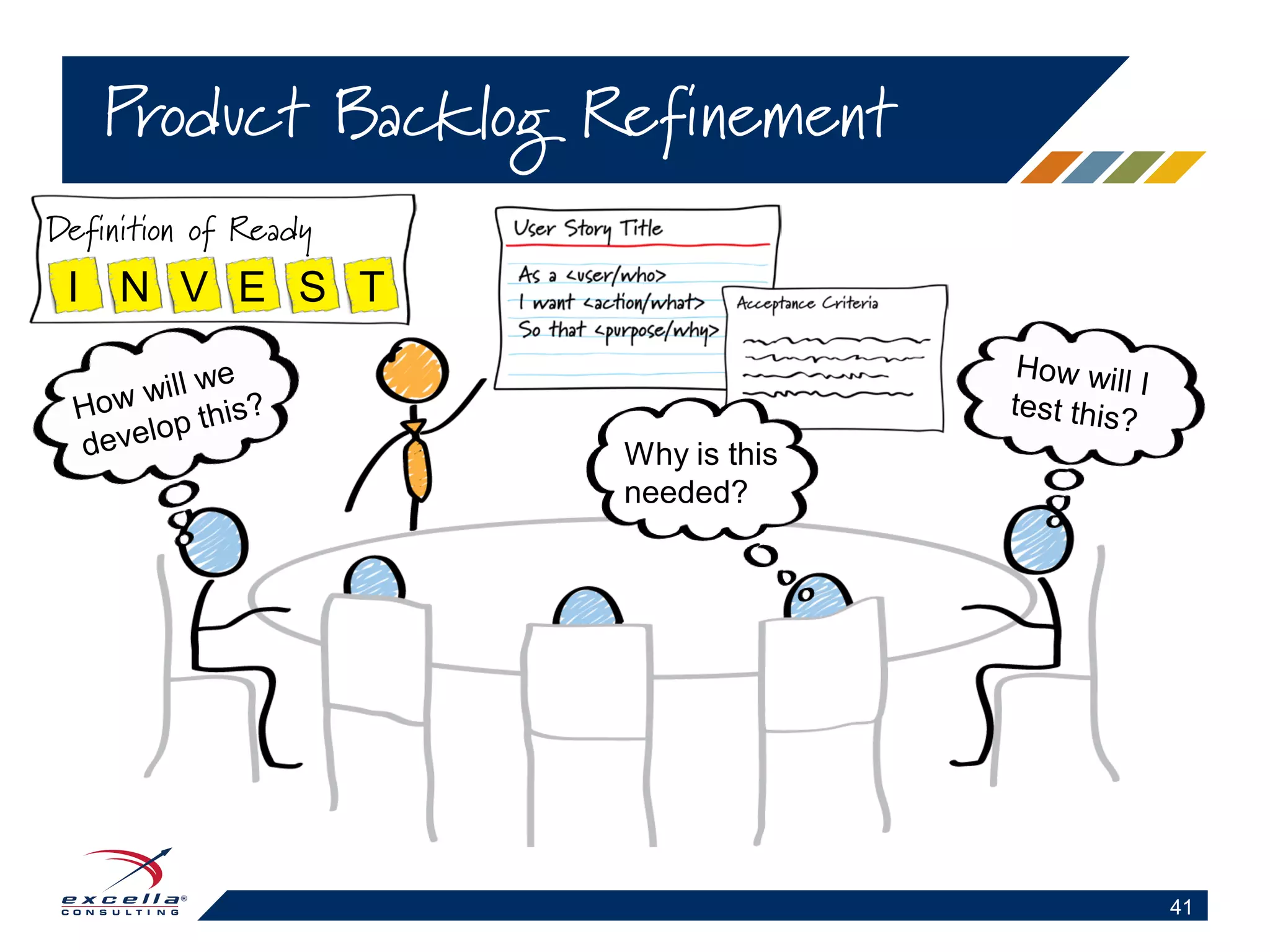
• When theDefinition of Ready (DoR) is met, the user
story could be developed.
• The Definition of Ready applies to all of a team’s user
stories and is more generic, e.g.:
– Immediately actionable
– Negotiable
– Valuable
– Estimated
– Sized-appropriatey
– Testable
When Can We Start?
• Types ofIssues (User Stories, Tasks, etc.)
• User Story Syntax
• Definition of Ready
• Definition of Done & Acceptance Criteria
• Splitting User Stories
• Tracking & Reporting
Outline
39.
• When theDefinition of Done (DoD) and
Acceptance Criteria (AC) are both met, the
user story is DONE.
• The DoD applies to all of a team’s user
stories and is more generic
• AC pertain to a specific story
When Are We Finished?
40.
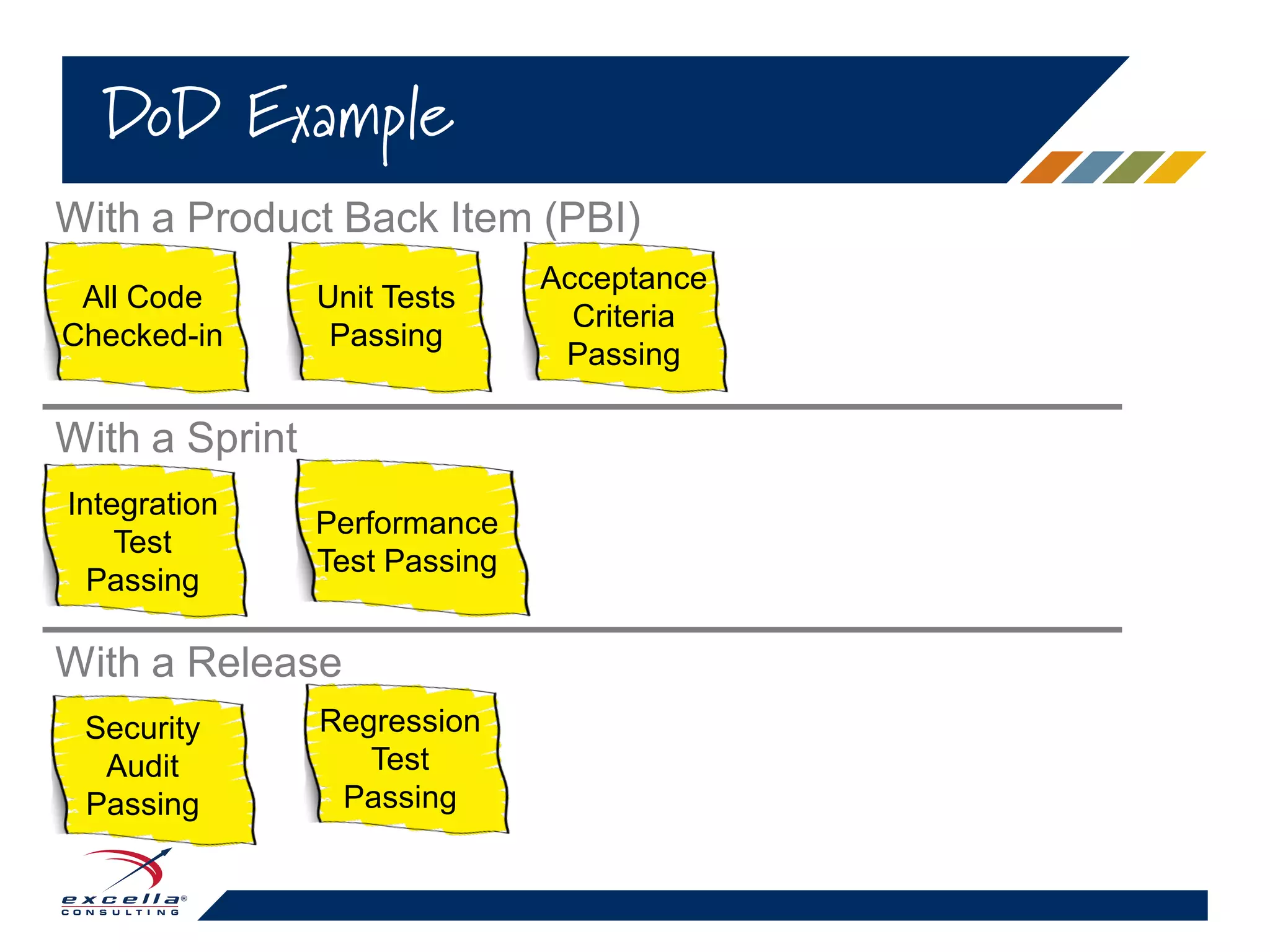
DoD Example
All Code
Checked-in
UnitTests
Passing
Acceptance
Criteria
Passing
Integration
Test
Passing
Performance
Test Passing
With a Product Back Item (PBI)
With a Sprint
With a Release
Security
Audit
Passing
Regression
Test
Passing
41.
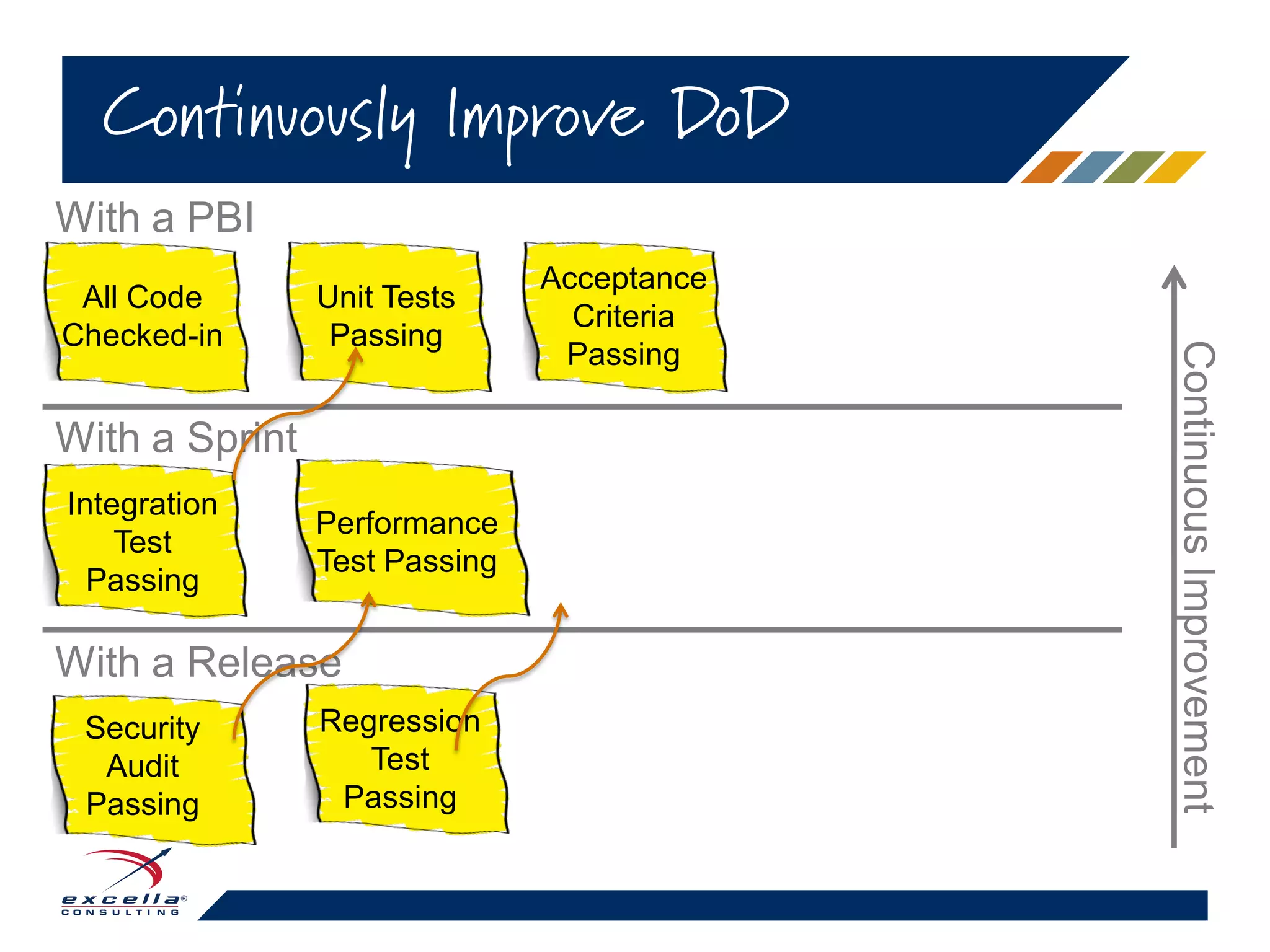
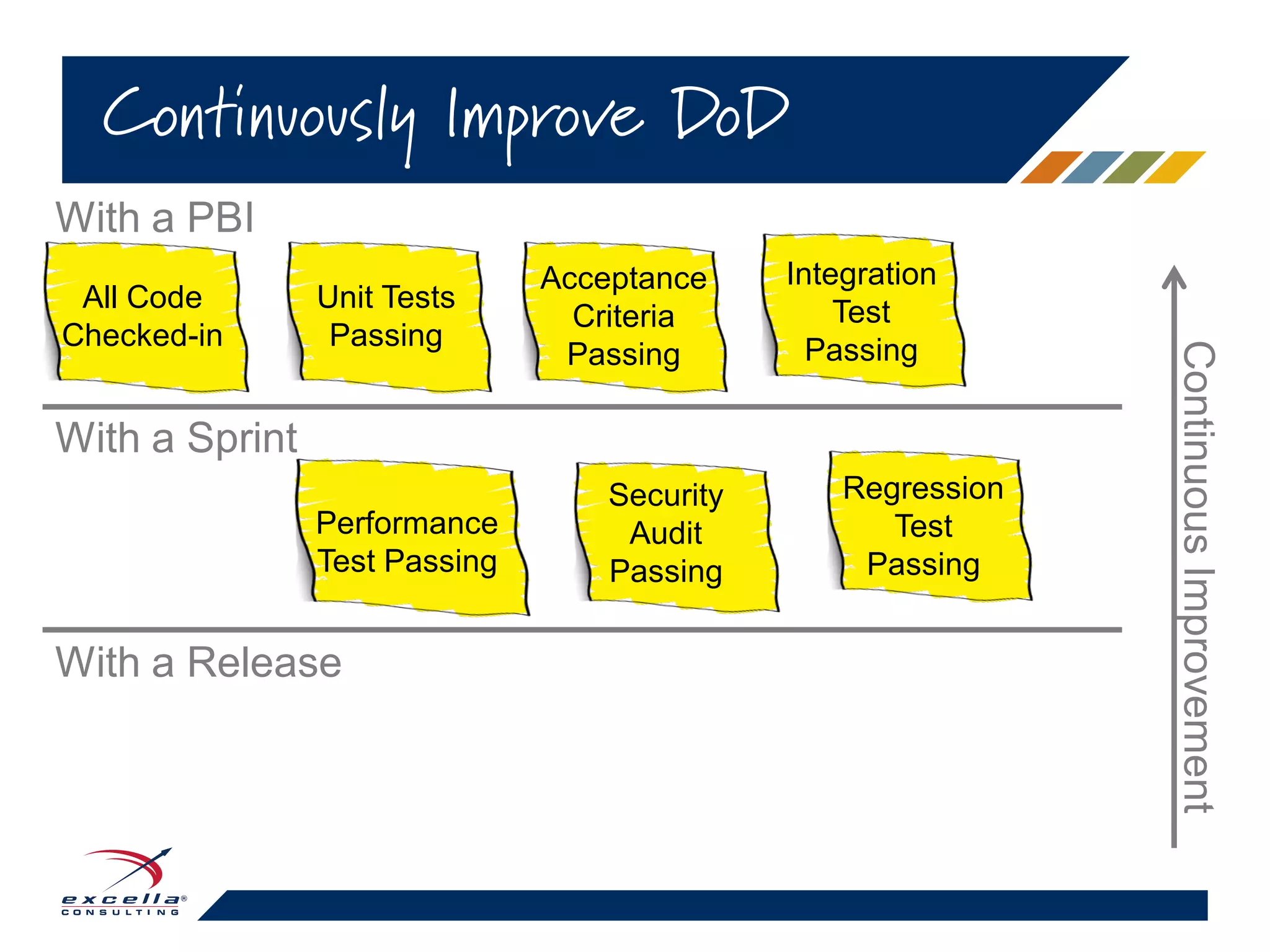
Continuously Improve DoD
AllCode
Checked-in
Unit Tests
Passing
Acceptance
Criteria
Passing
Integration
Test
Passing
Performance
Test Passing
With a PBI
With a Sprint
With a Release
Security
Audit
Passing
Regression
Test
Passing
ContinuousImprovement
42.
Continuously Improve DoD
AllCode
Checked-in
Unit Tests
Passing
Acceptance
Criteria
Passing
Integration
Test
Passing
Performance
Test Passing
With a PBI
With a Sprint
With a Release
Security
Audit
Passing
Regression
Test
Passing
ContinuousImprovement
43.
• Present TenseIndicative Statements, i.e., they are
either TRUE or FALSE.
Acceptance Criteria
44.
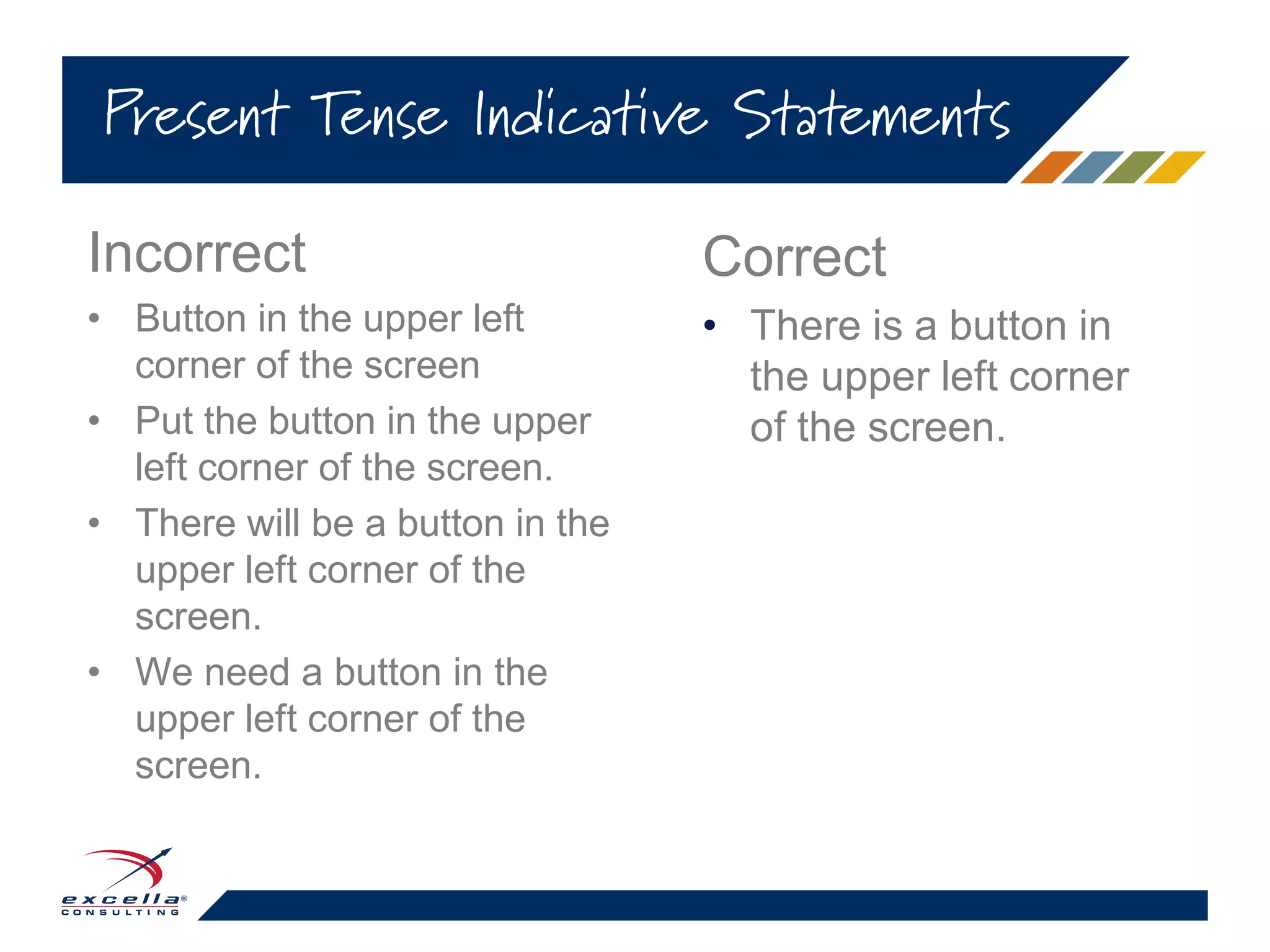
Correct
• There isa button in
the upper left corner
of the screen.
Present Tense Indicative Statements
Incorrect
• Button in the upper left
corner of the screen
• Put the button in the upper
left corner of the screen.
• There will be a button in the
upper left corner of the
screen.
• We need a button in the
upper left corner of the
screen.
45.
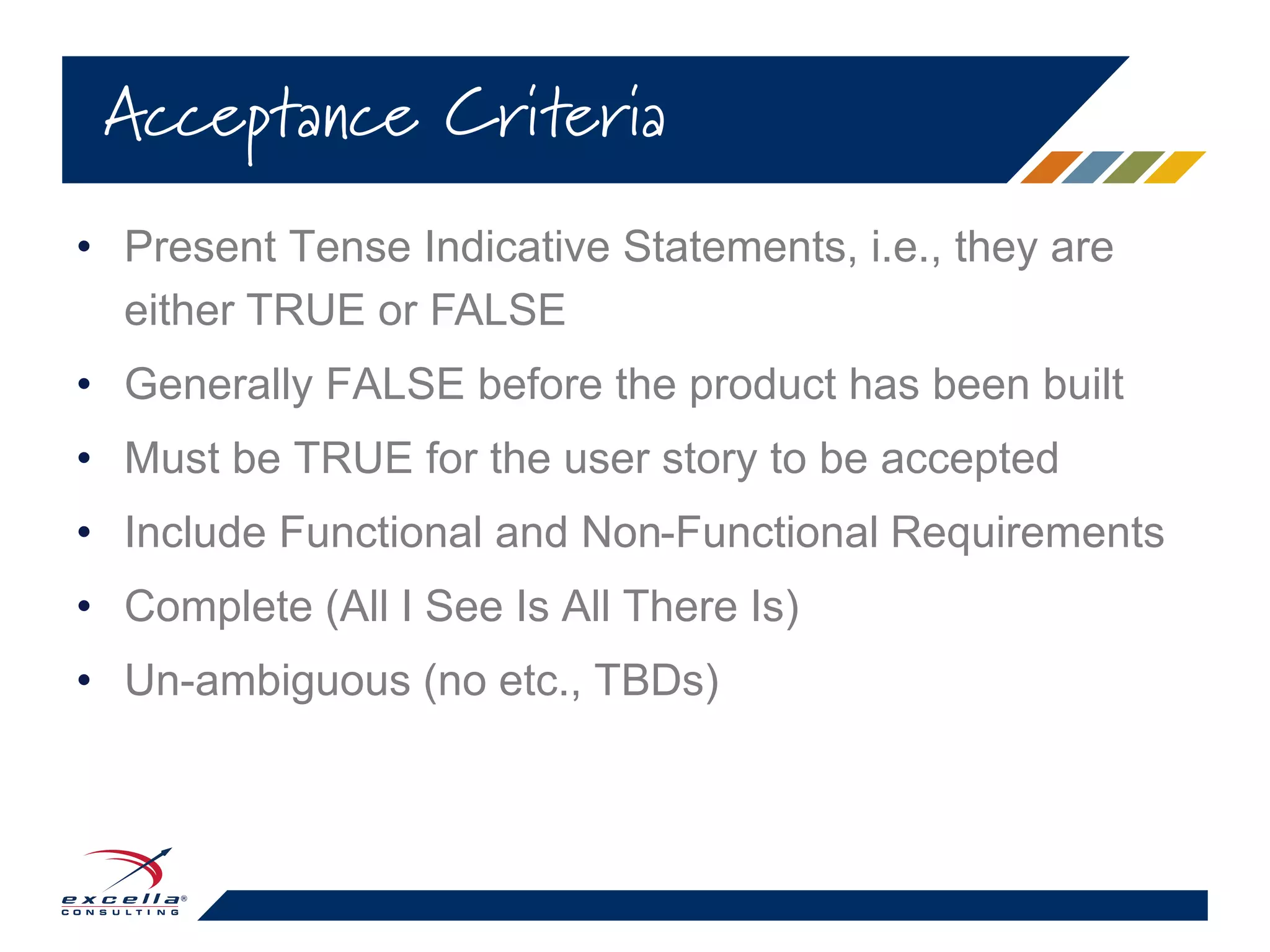
• Present TenseIndicative Statements, i.e., they are
either TRUE or FALSE
• Generally FALSE before the product has been built
• Must be TRUE for the user story to be accepted
• Include Functional and Non-Functional Requirements
• Complete (All I See Is All There Is)
• Un-ambiguous (no etc., TBDs)
Acceptance Criteria
46.
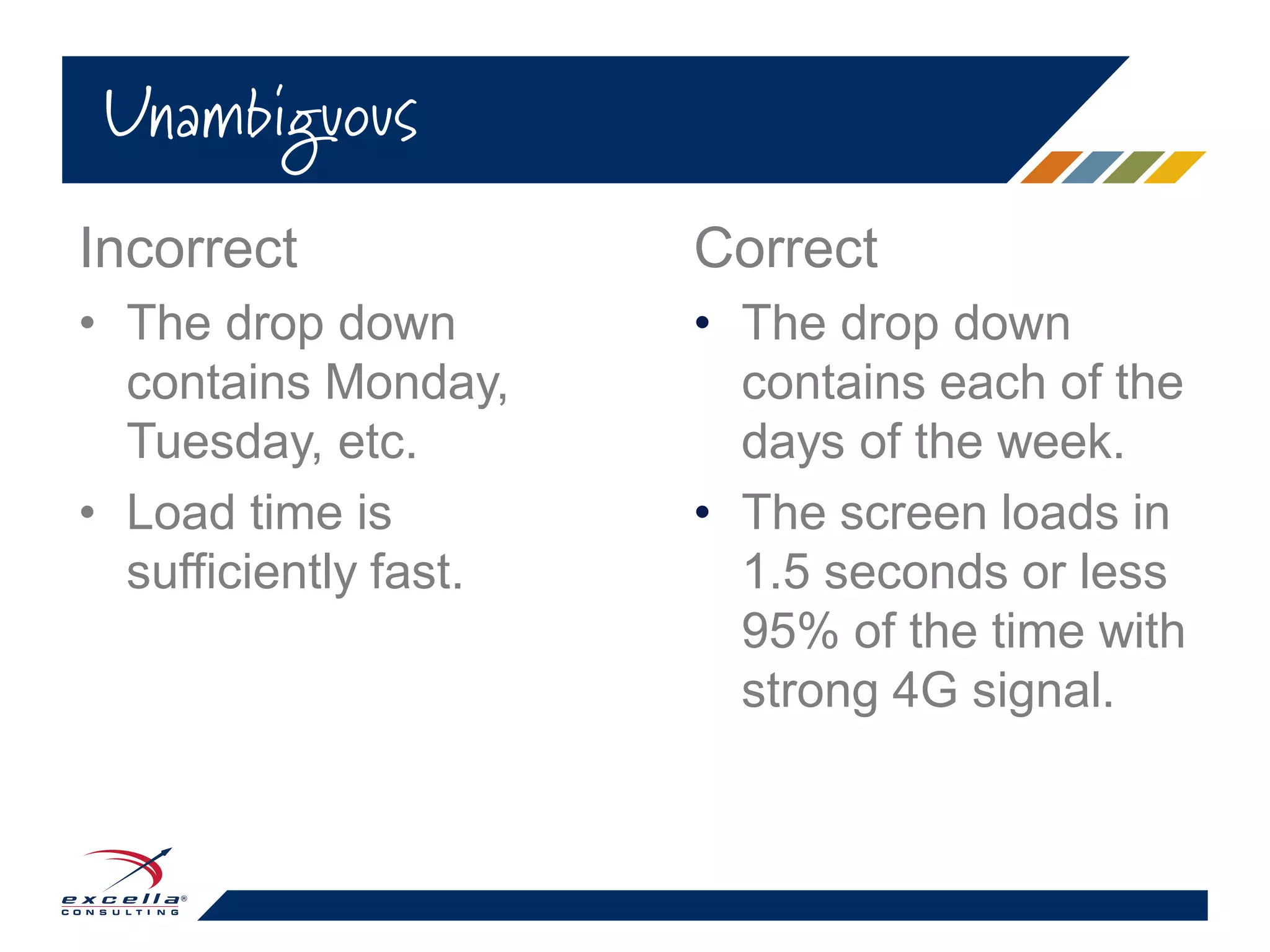
Correct
• The dropdown
contains each of the
days of the week.
• The screen loads in
1.5 seconds or less
95% of the time with
strong 4G signal.
Unambiguous
Incorrect
• The drop down
contains Monday,
Tuesday, etc.
• Load time is
sufficiently fast.
47.
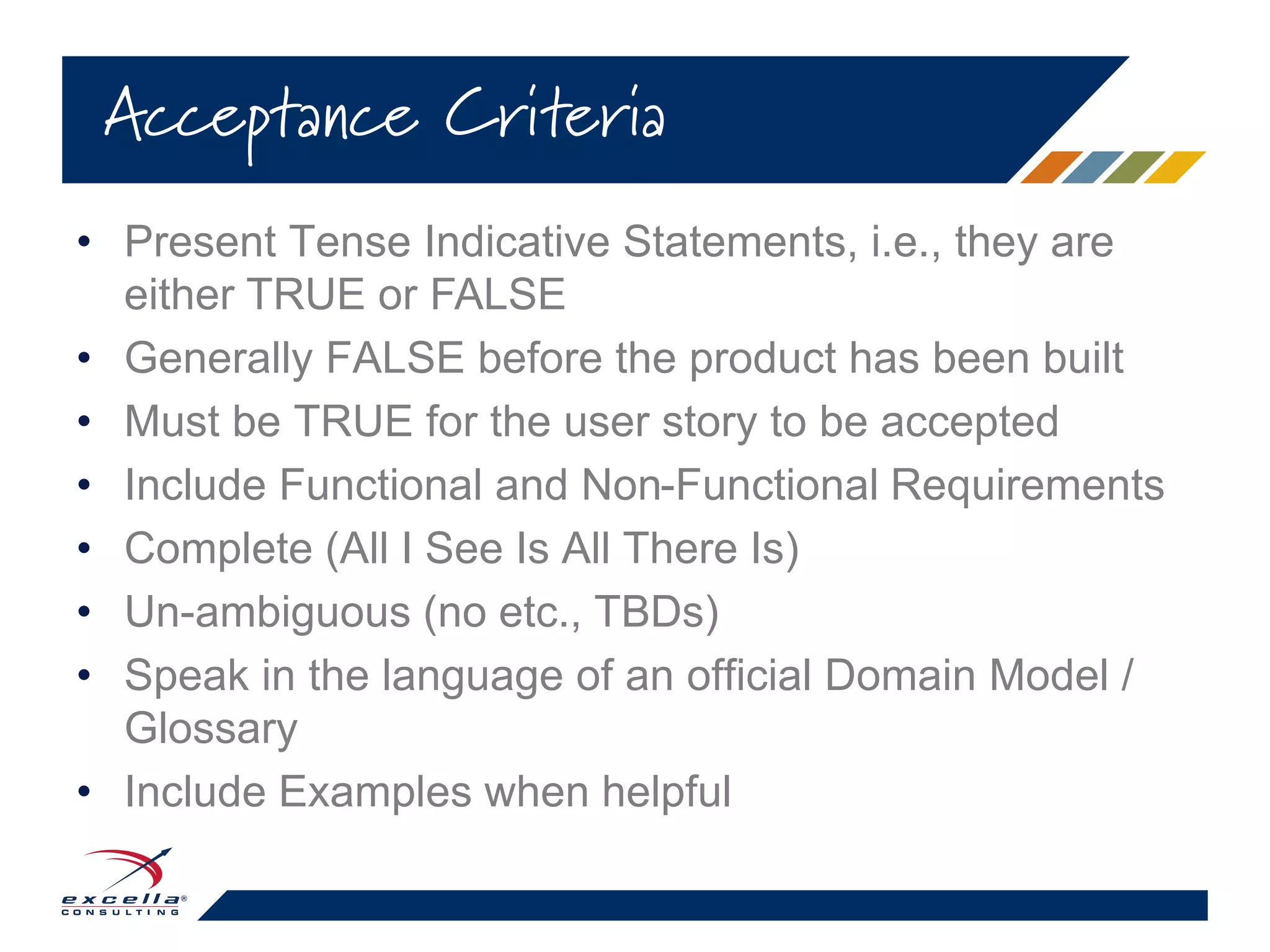
• Present TenseIndicative Statements, i.e., they are
either TRUE or FALSE
• Generally FALSE before the product has been built
• Must be TRUE for the user story to be accepted
• Include Functional and Non-Functional Requirements
• Complete (All I See Is All There Is)
• Un-ambiguous (no etc., TBDs)
• Speak in the language of an official Domain Model /
Glossary
• Include Examples when helpful
Acceptance Criteria
48.
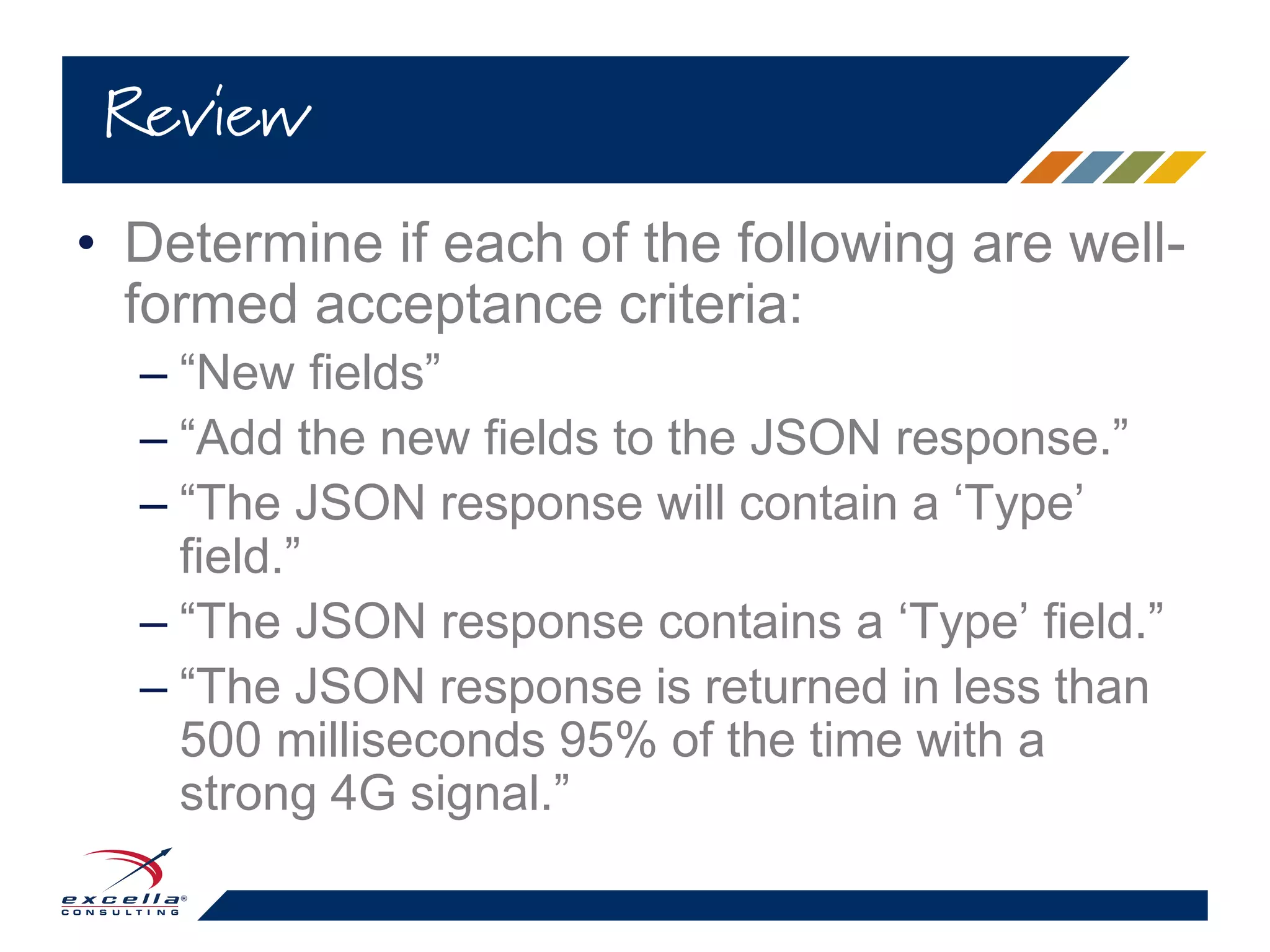
• Determine ifeach of the following are well-
formed acceptance criteria:
– “New fields”
– “Add the new fields to the JSON response.”
– “The JSON response will contain a ‘Type’
field.”
– “The JSON response contains a ‘Type’ field.”
– “The JSON response is returned in less than
500 milliseconds 95% of the time with a
strong 4G signal.”
Review
49.
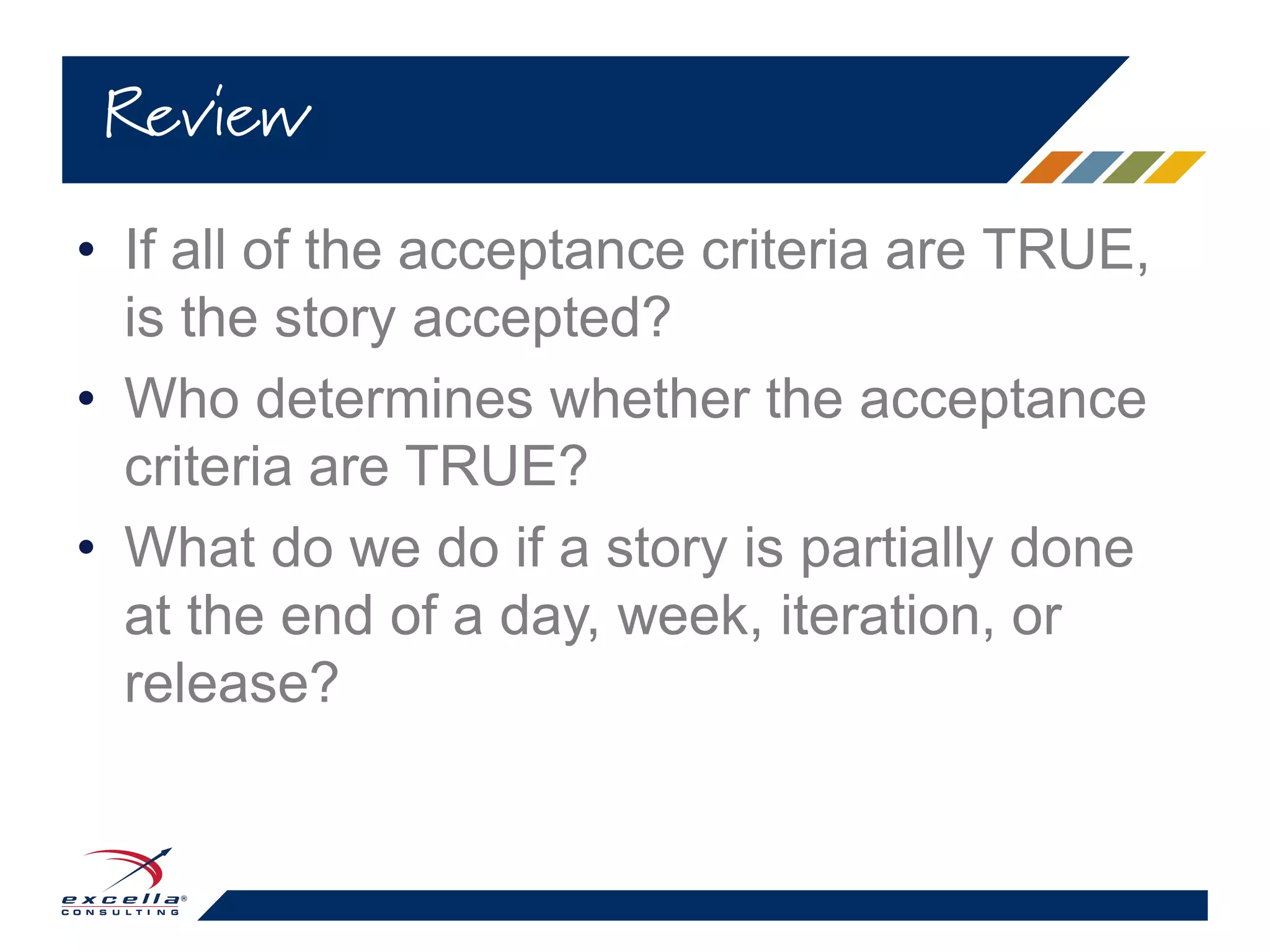
• If allof the acceptance criteria are TRUE,
is the story accepted?
• Who determines whether the acceptance
criteria are TRUE?
• What do we do if a story is partially done
at the end of a day, week, iteration, or
release?
Review
50.
• If weare using story points, should the
team receive some points for completing
some of the work?
Review
• Types ofIssues (User Stories, Tasks, etc.)
• User Story Syntax
• Definition of Ready
• Definition of Done & Acceptance Criteria
• Splitting User Stories
• Tracking & Reporting
Outline
60.
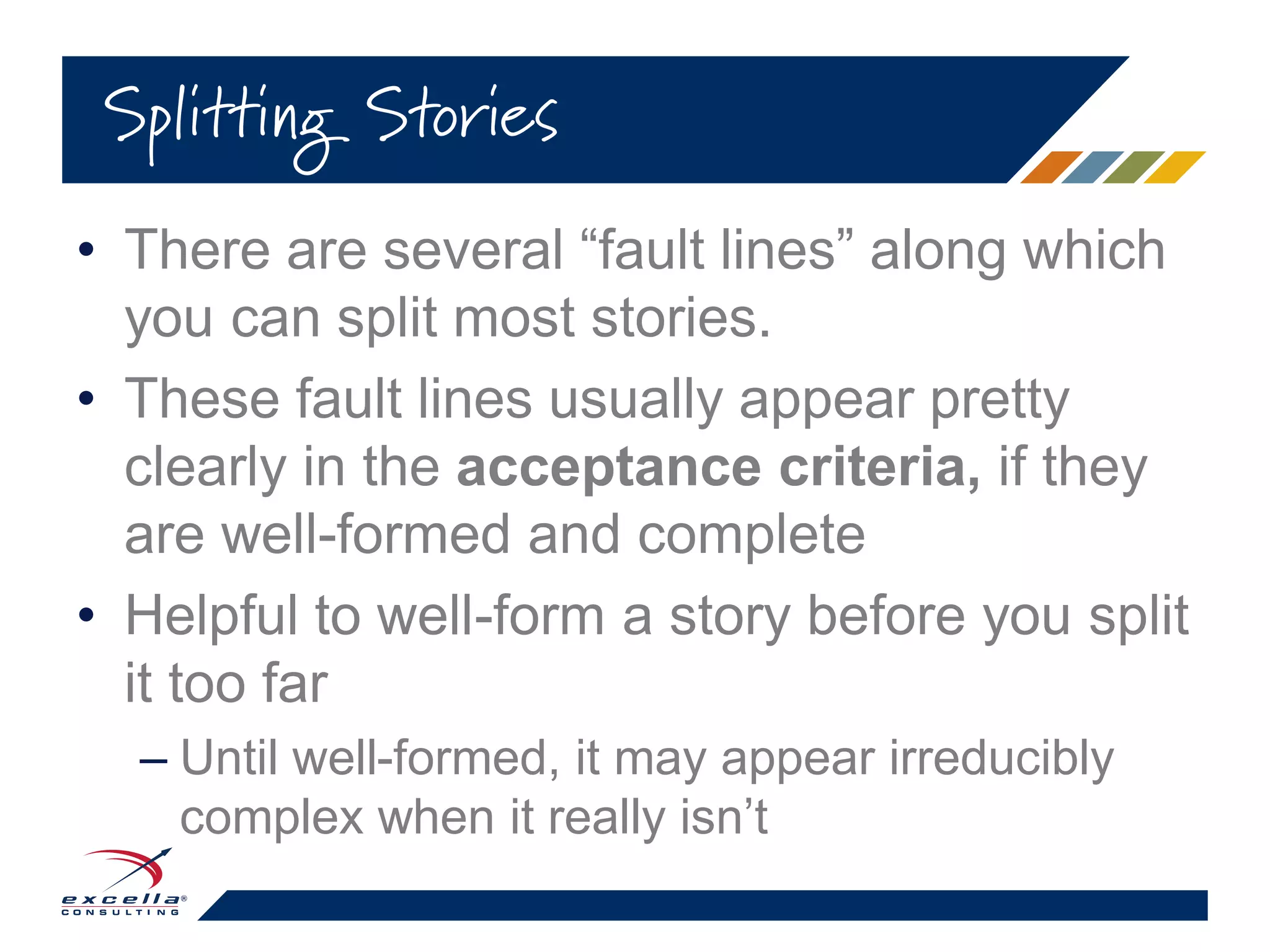
• There areseveral “fault lines” along which
you can split most stories.
• These fault lines usually appear pretty
clearly in the acceptance criteria, if they
are well-formed and complete
• Helpful to well-form a story before you split
it too far
– Until well-formed, it may appear irreducibly
complex when it really isn’t
Splitting Stories
61.
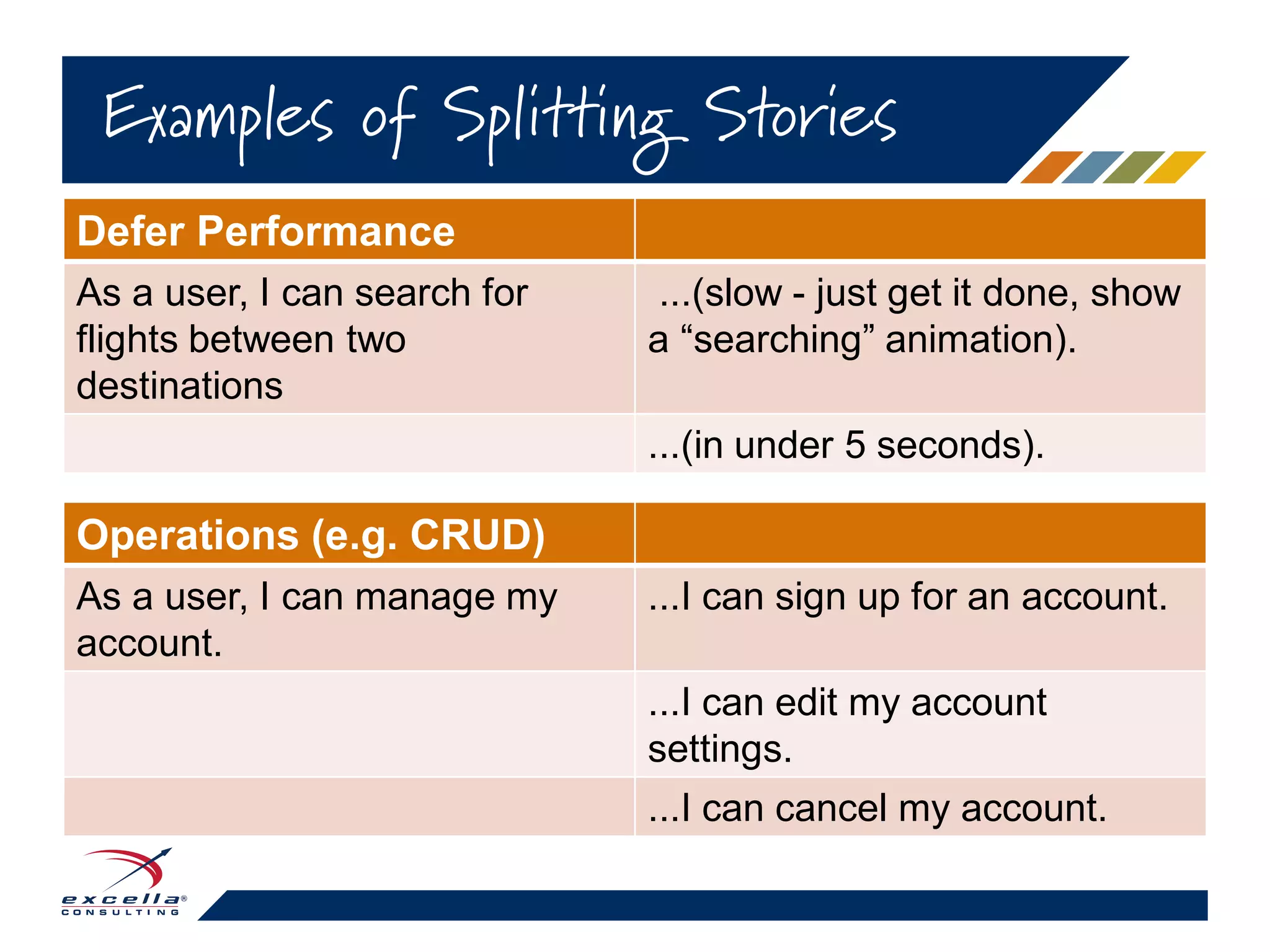
Defer Performance
As auser, I can search for
flights between two
destinations
...(slow - just get it done, show
a “searching” animation).
...(in under 5 seconds).
Examples of Splitting Stories
Operations (e.g. CRUD)
As a user, I can manage my
account.
...I can sign up for an account.
...I can edit my account
settings.
...I can cancel my account.
62.
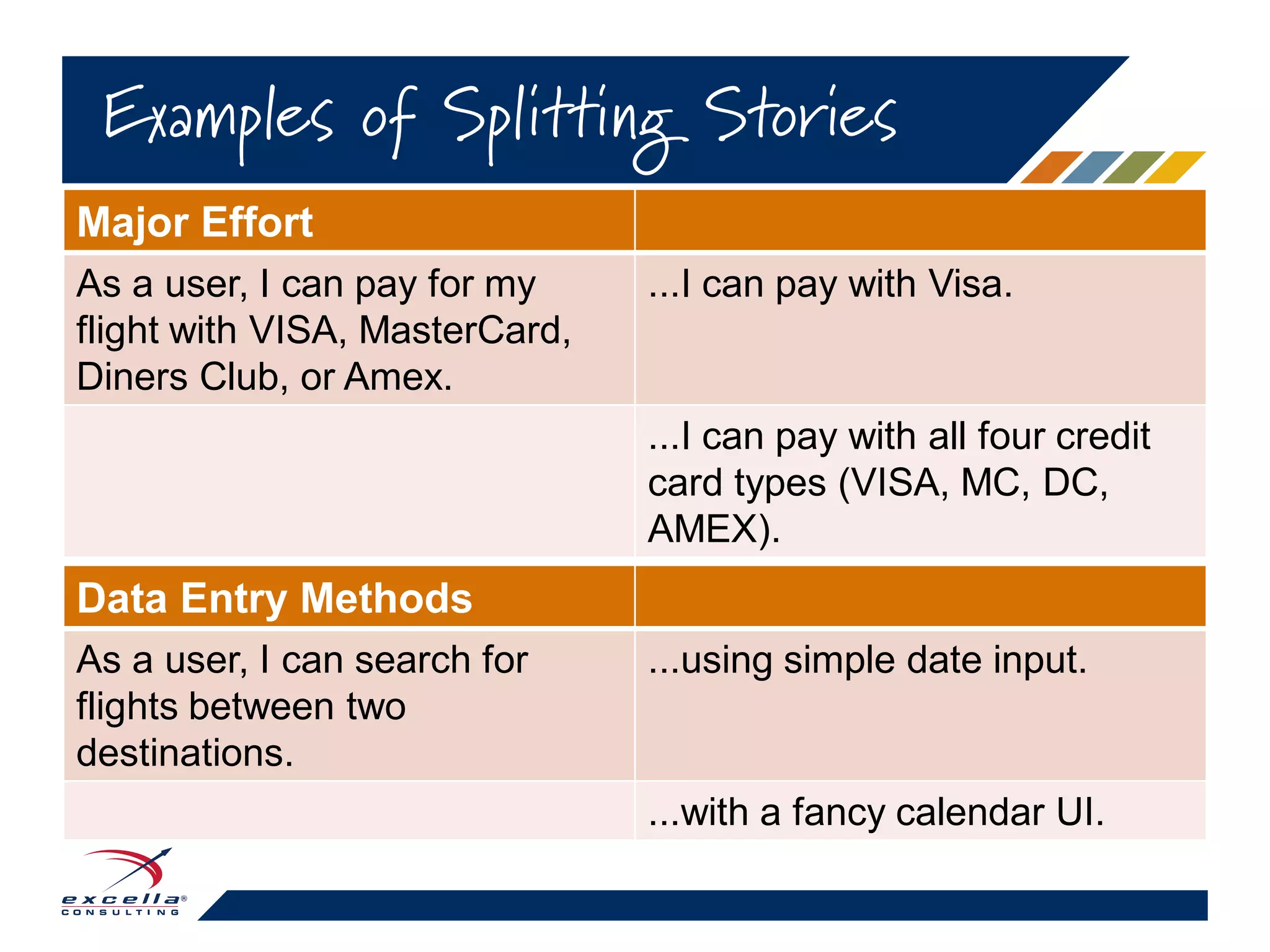
Major Effort
As auser, I can pay for my
flight with VISA, MasterCard,
Diners Club, or Amex.
...I can pay with Visa.
...I can pay with all four credit
card types (VISA, MC, DC,
AMEX).
Examples of Splitting Stories
Data Entry Methods
As a user, I can search for
flights between two
destinations.
...using simple date input.
...with a fancy calendar UI.
63.
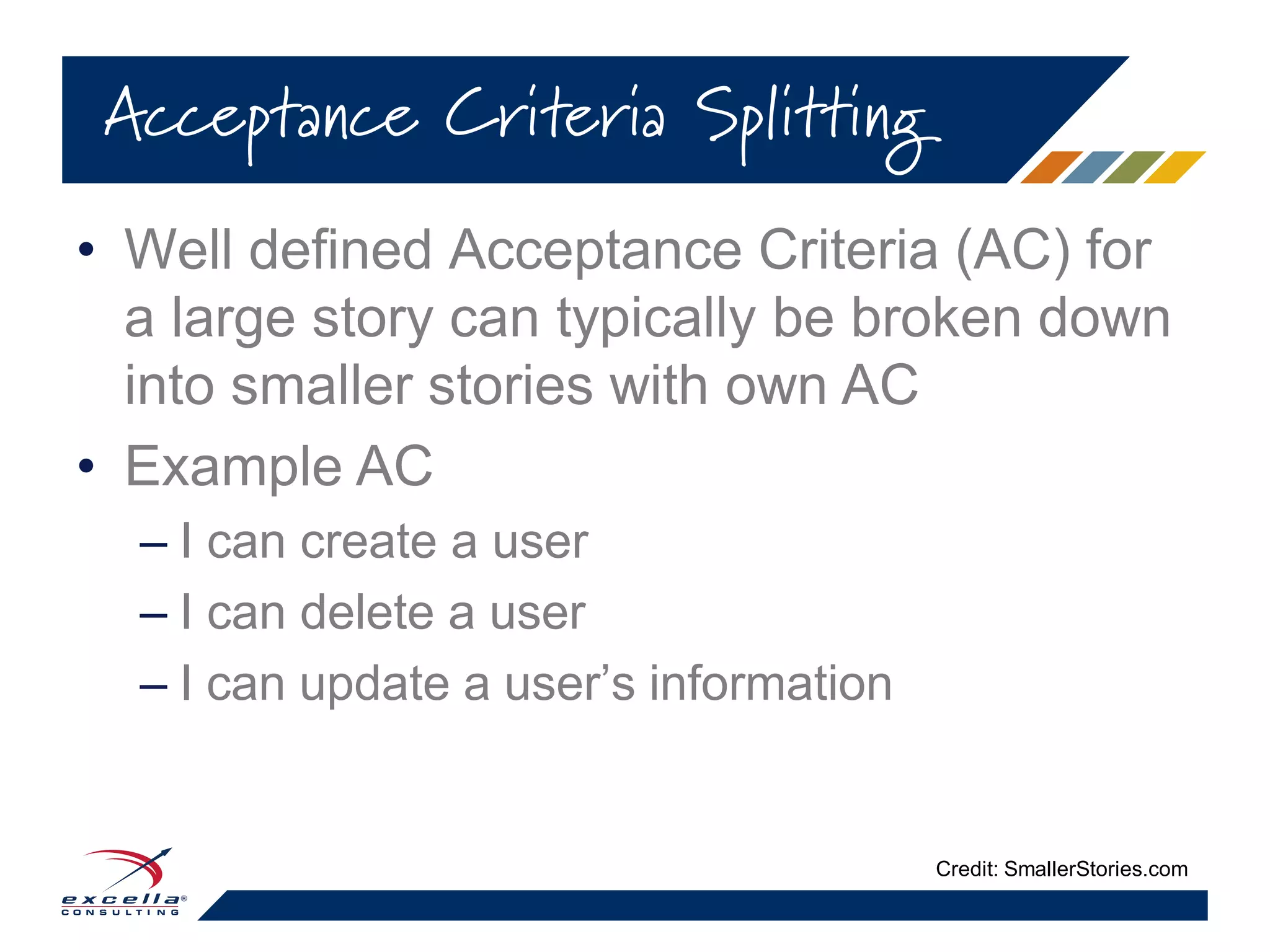
• Well definedAcceptance Criteria (AC) for
a large story can typically be broken down
into smaller stories with own AC
• Example AC
– I can create a user
– I can delete a user
– I can update a user’s information
Acceptance Criteria Splitting
Credit: SmallerStories.com
64.
• Form groupsof 3
• Discuss ways to split one or more of the
stories on the worksheet
Group Exercise
65.
• Look forconnector words:
– And, Or, If
– When, But, Then
– As well as, Commas
Conjunction Splitting
Credit: SmallerStories.com
66.
• Form groupsof 3
• Discuss ways to split one or more of the
stories on the worksheet
Group Exercise
67.
• Look forwords that could be replaced with
more specific terms
– Nouns, verbs, adjectives, adverbs can all be
generic
– For example
• Vehicle -> Car -> Honda Civic
• Animal -> Dog -> Pug
Generic Words Splitting
Credit: SmallerStories.com
68.
• Form groupsof 3
• Discuss ways to split one or more of the
stories on the worksheet
Group Exercise
69.
• Pretend UserStory is done
• What happens when the functionality is
used?
• If there is a sequence, then it may be
possible to break into smaller stories
Timeline Analysis Splitting
Credit: SmallerStories.com
70.
• Form groupsof 3
• Discuss ways to split one or more of the
stories on the worksheet
Group Exercise
71.
• Types ofIssues (User Stories, Tasks, etc.)
• User Story Syntax
• Definition of Ready
• Definition of Done & Acceptance Criteria
• Splitting User Stories
• Tracking & Reporting
Outline
72.
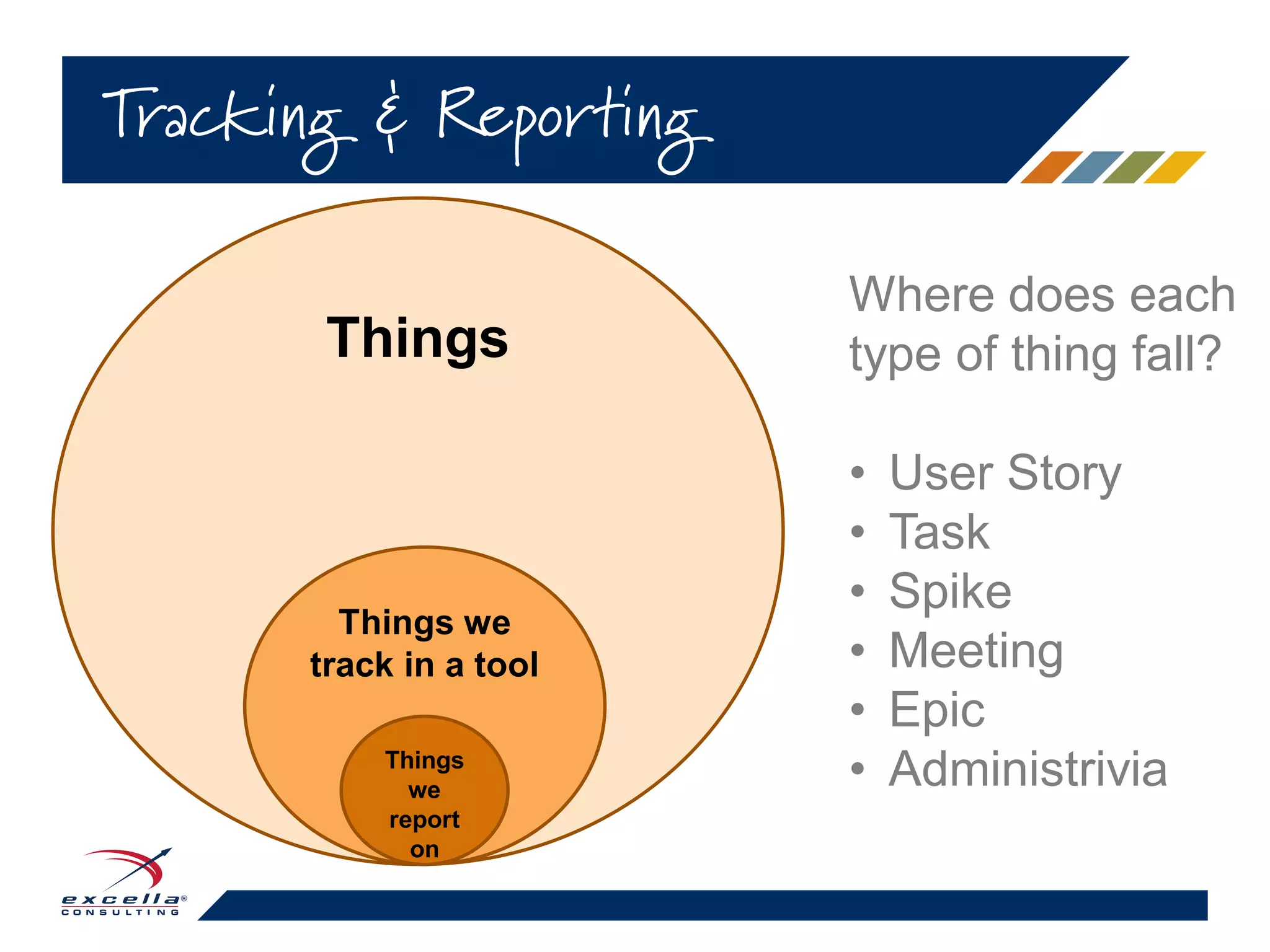
Tracking & Reporting
Things
Thingswe
track in a tool
Things
we
report
on
• User Story
• Task
• Spike
• Meeting
• Epic
• Administrivia
Where does each
type of thing fall?
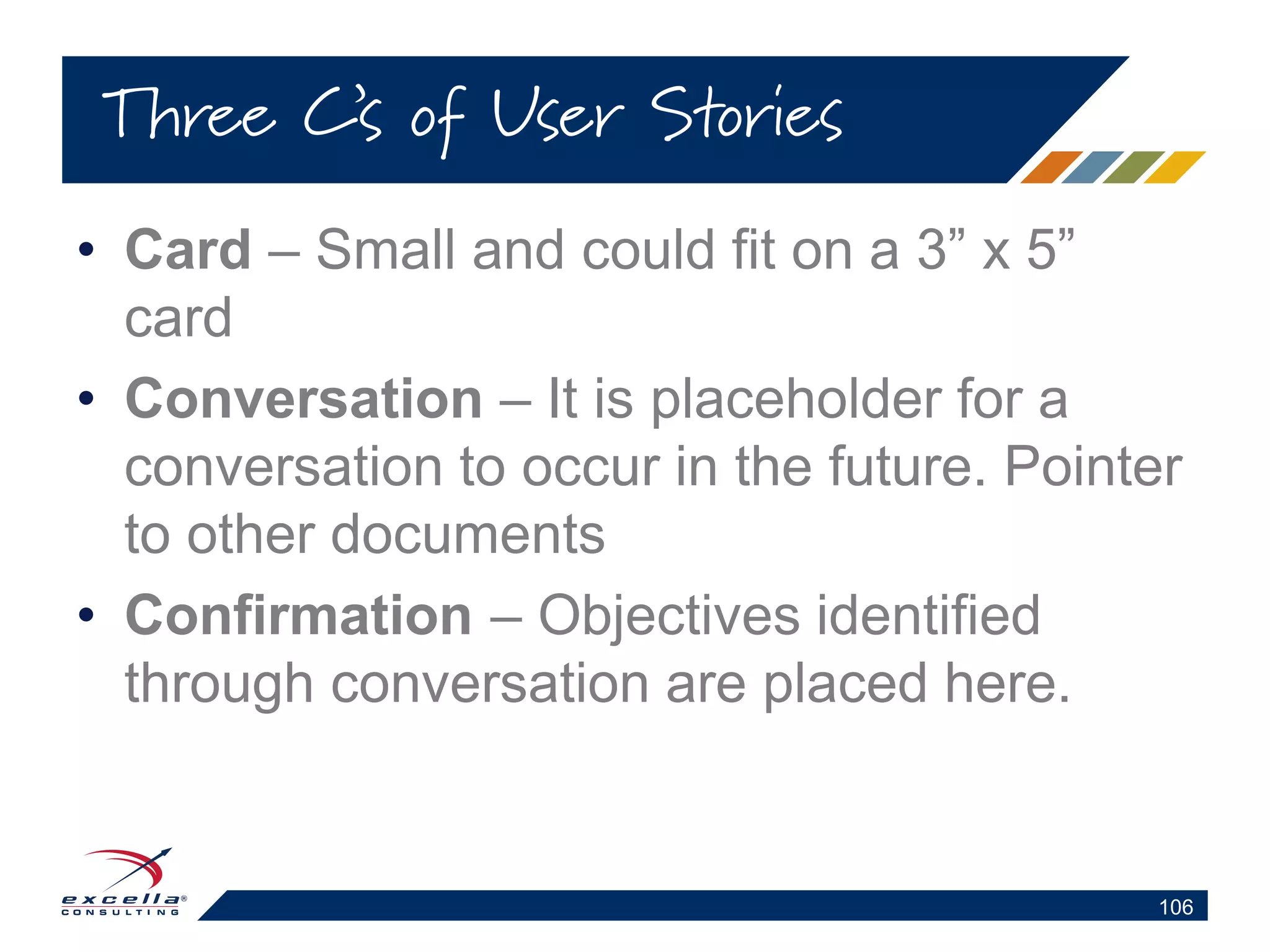
• Card –Small and could fit on a 3” x 5”
card
• Conversation – It is placeholder for a
conversation to occur in the future. Pointer
to other documents
• Confirmation – Objectives identified
through conversation are placed here.
Three C’s of User Stories
106
95.
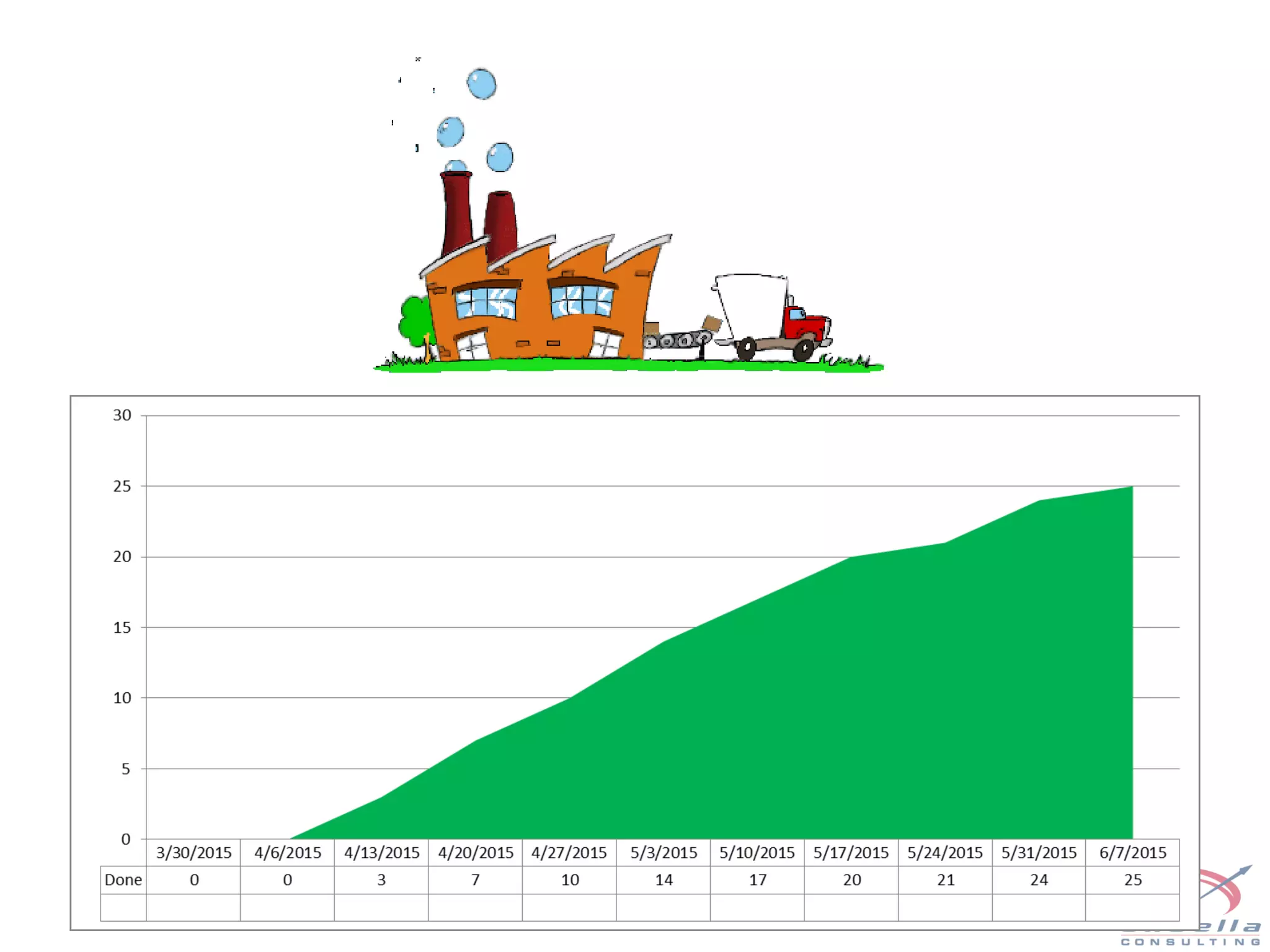
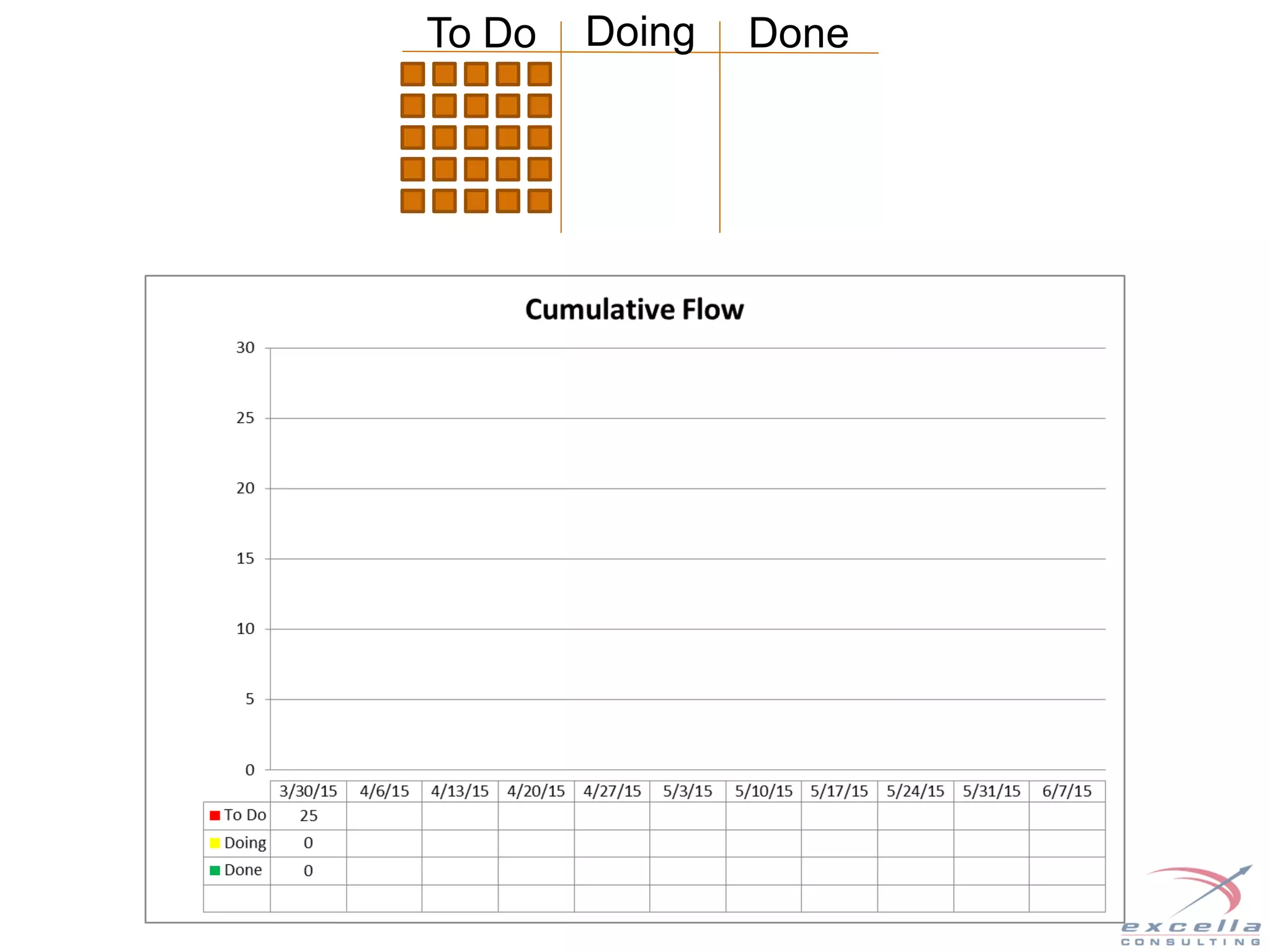
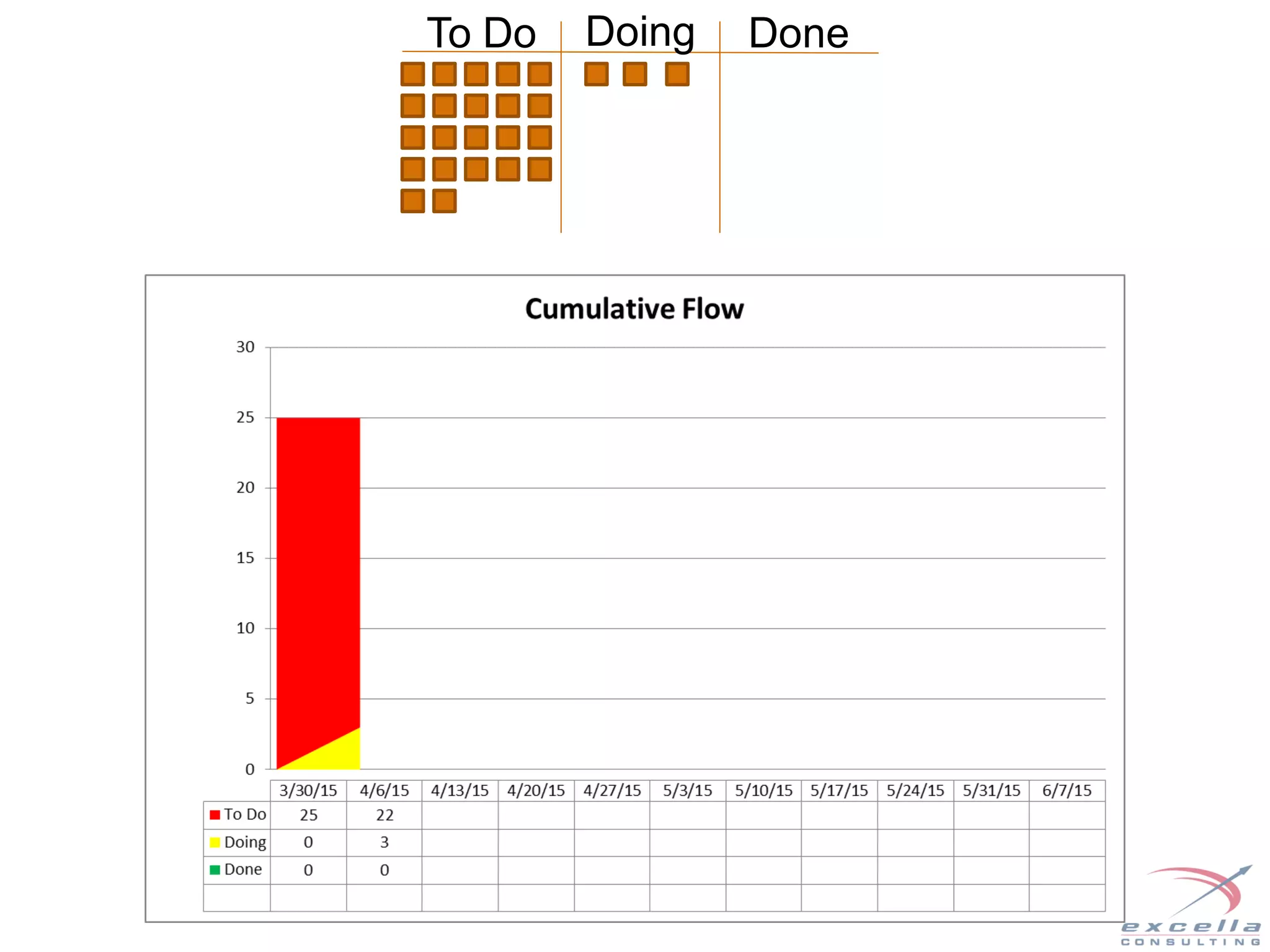
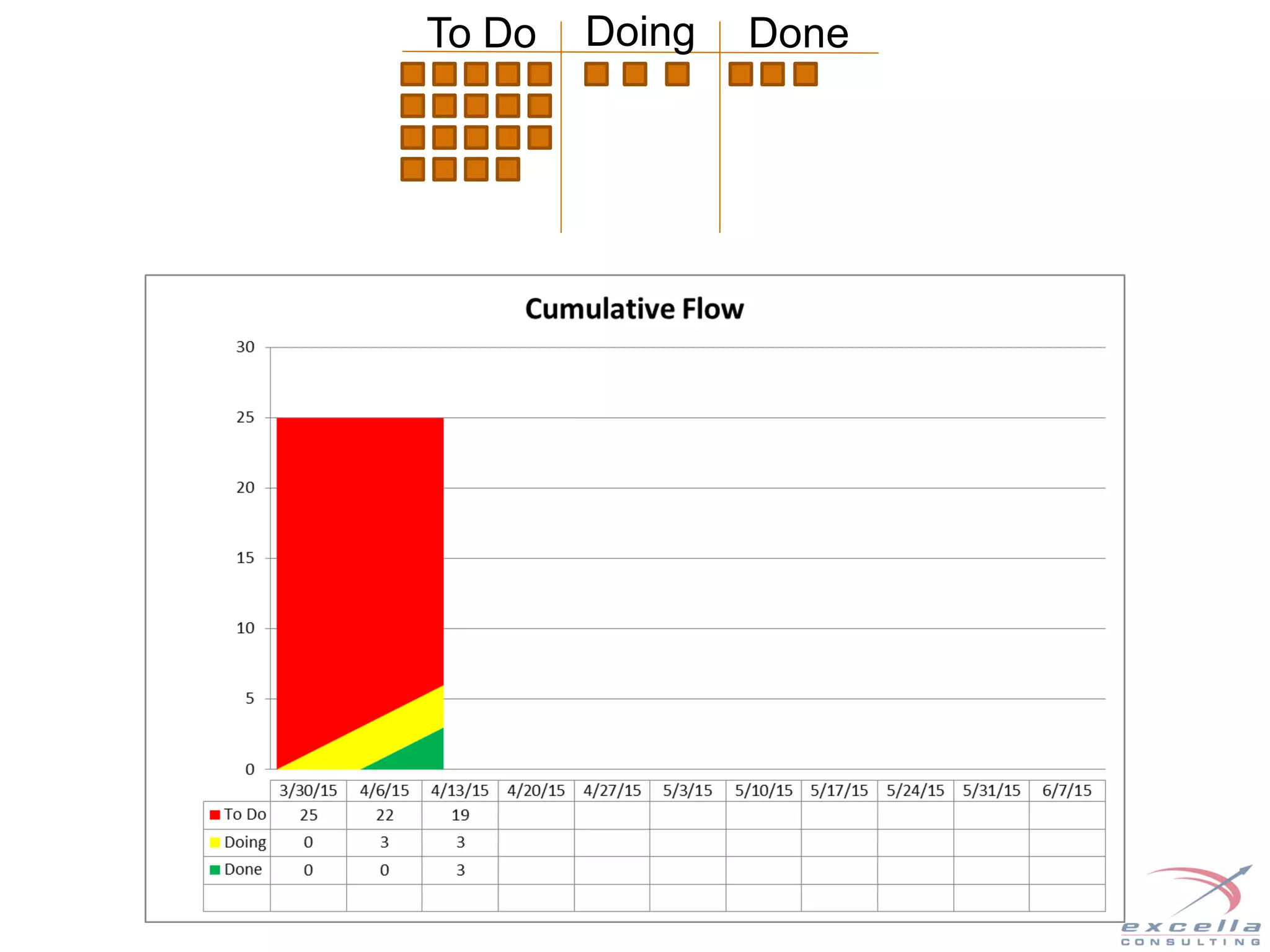
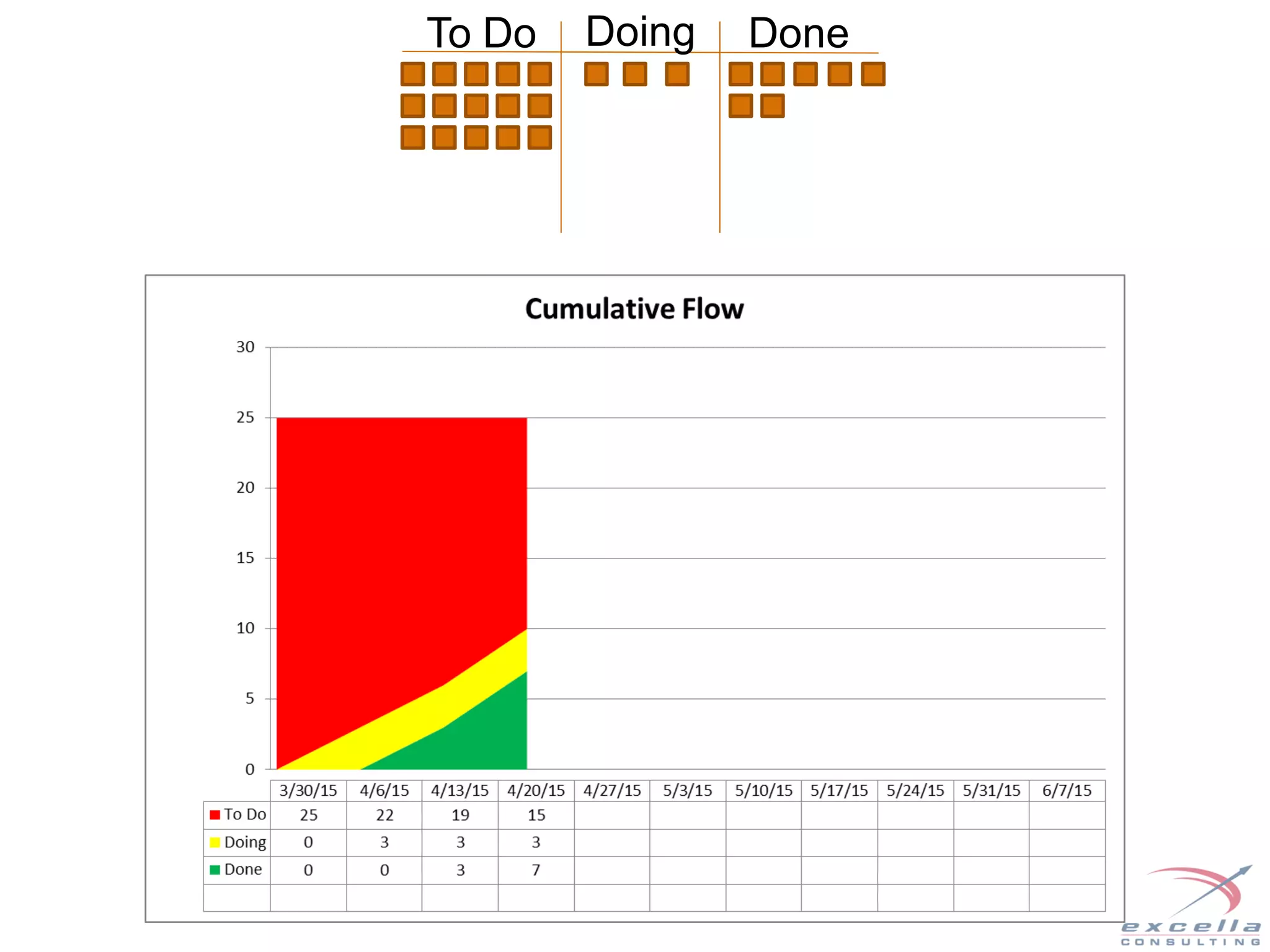
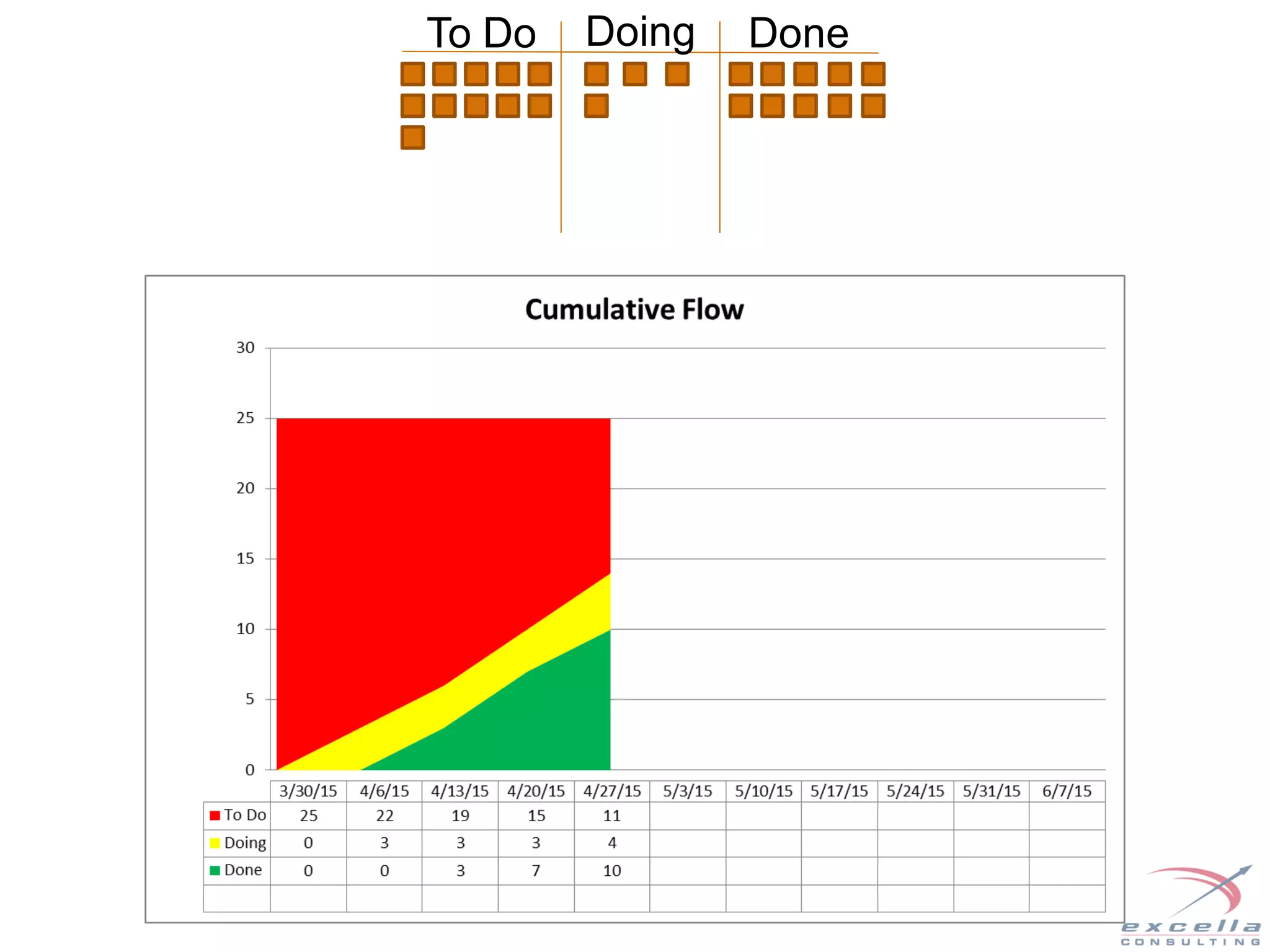
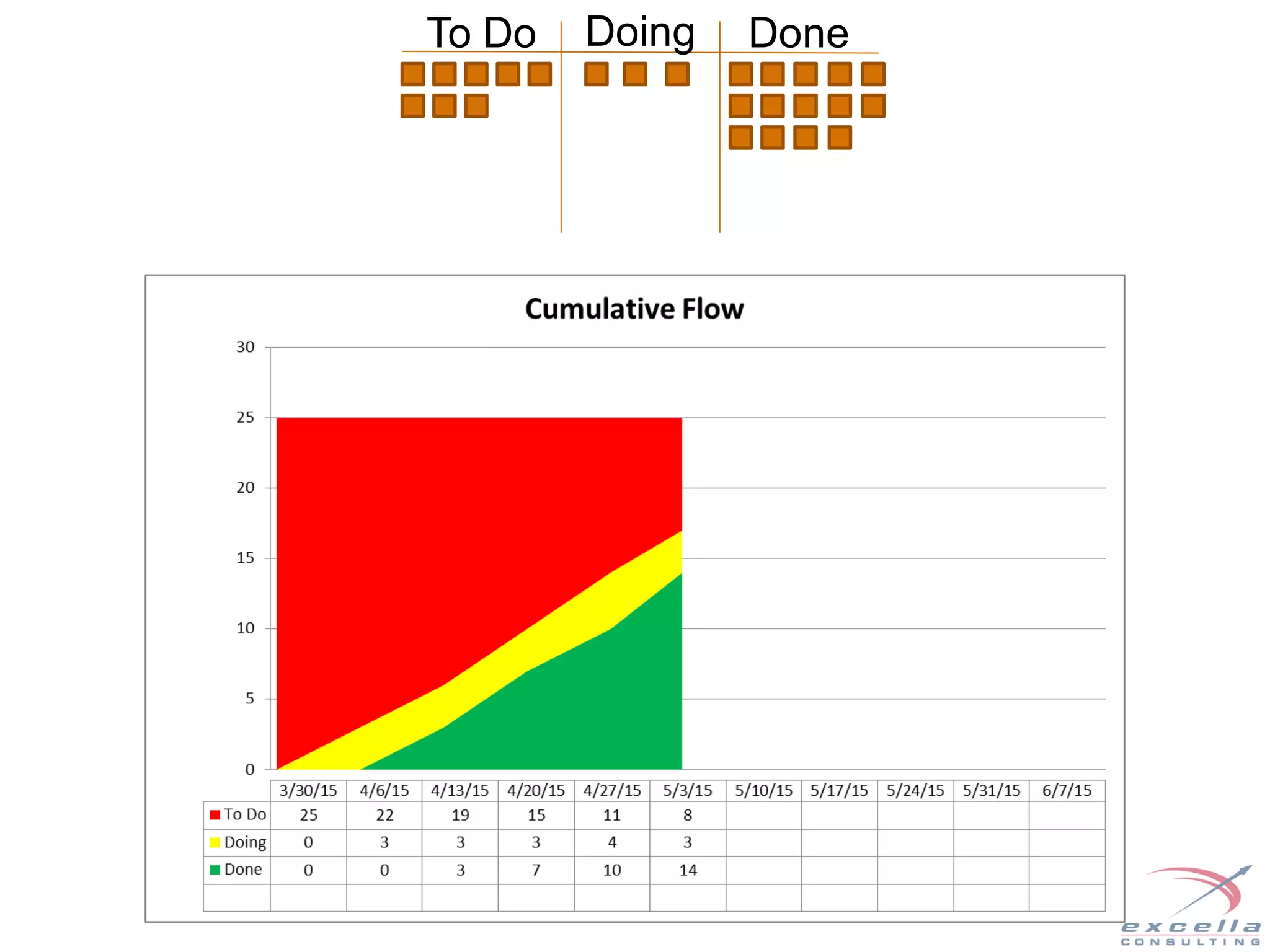
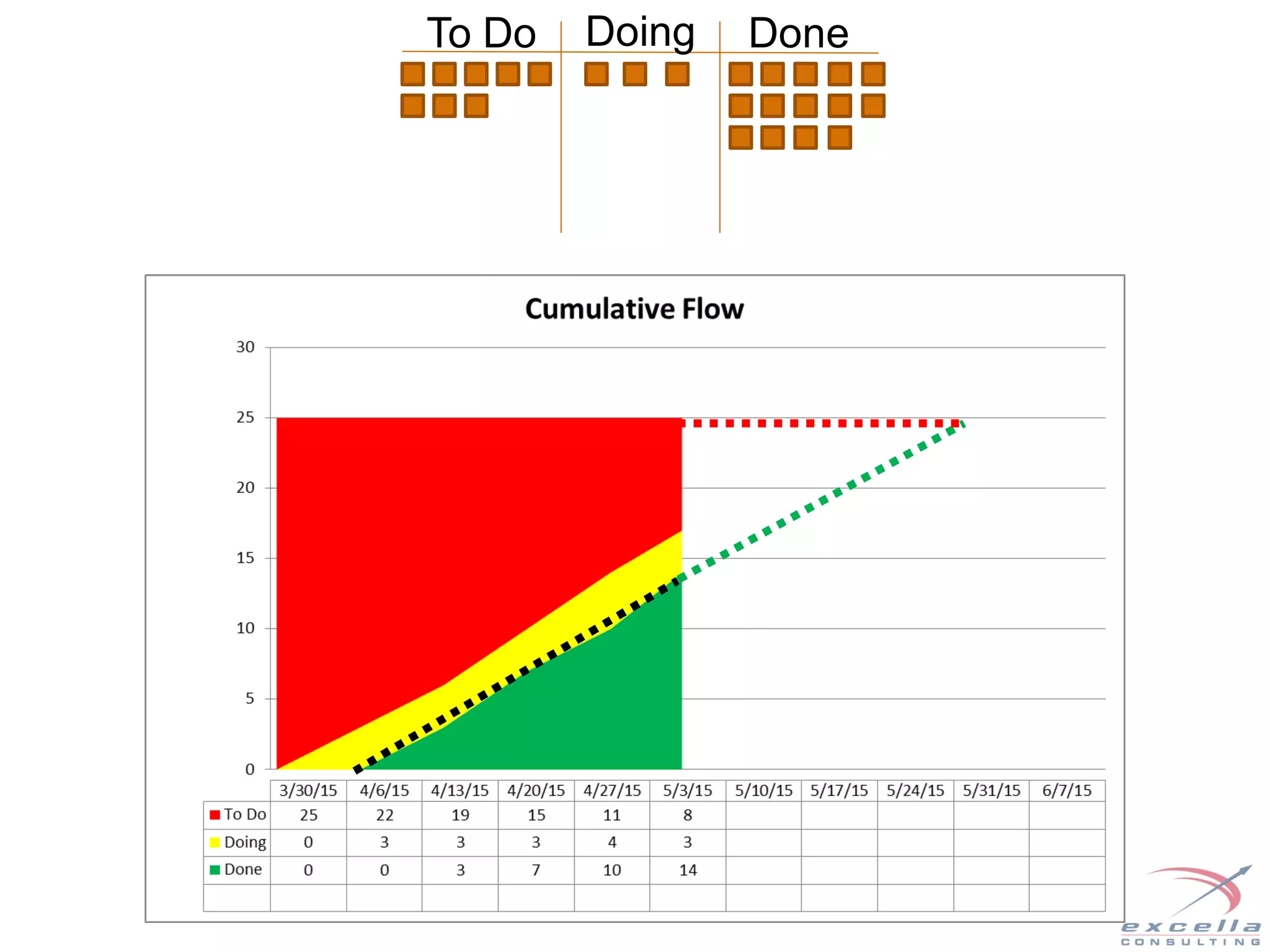
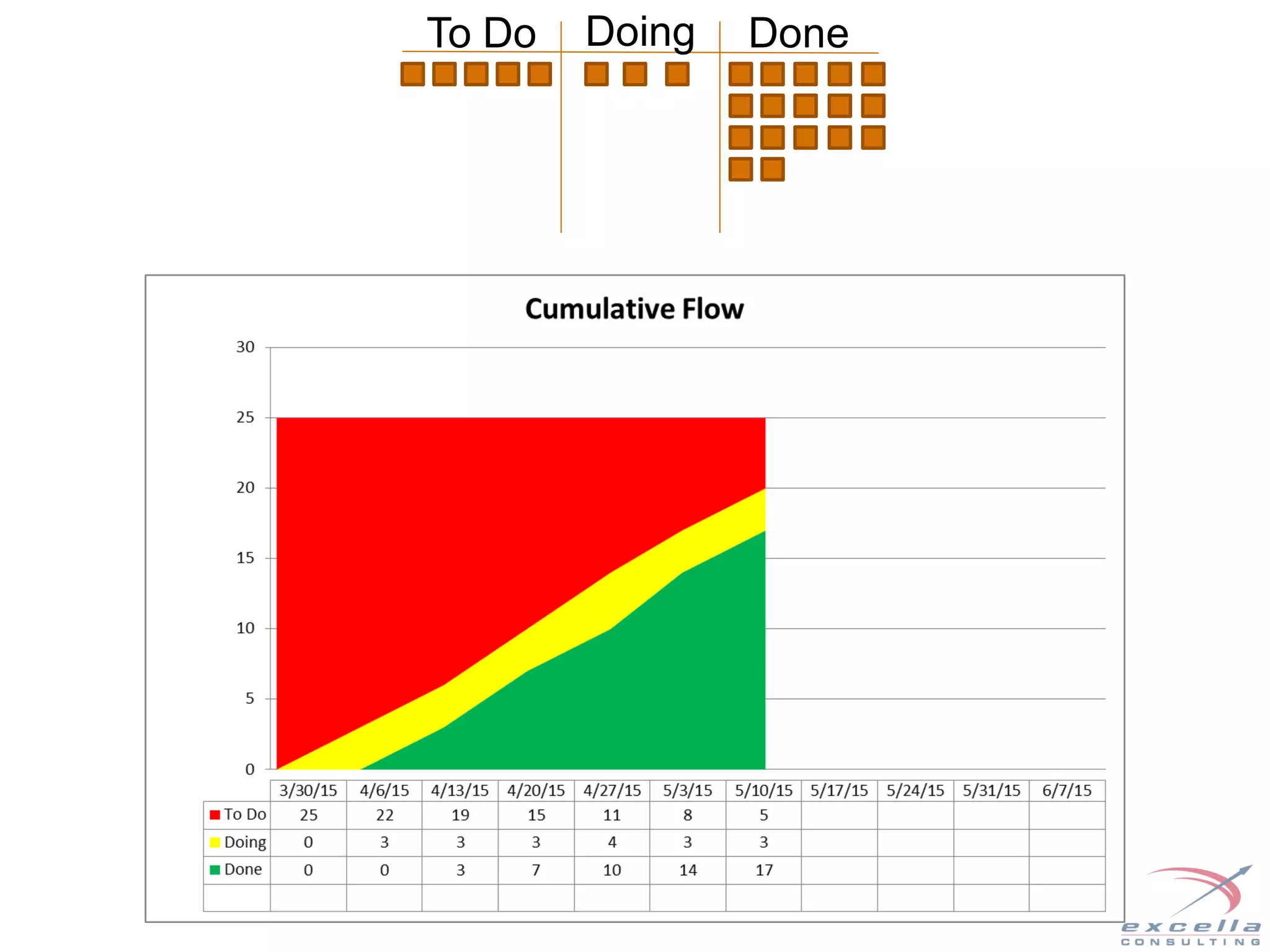
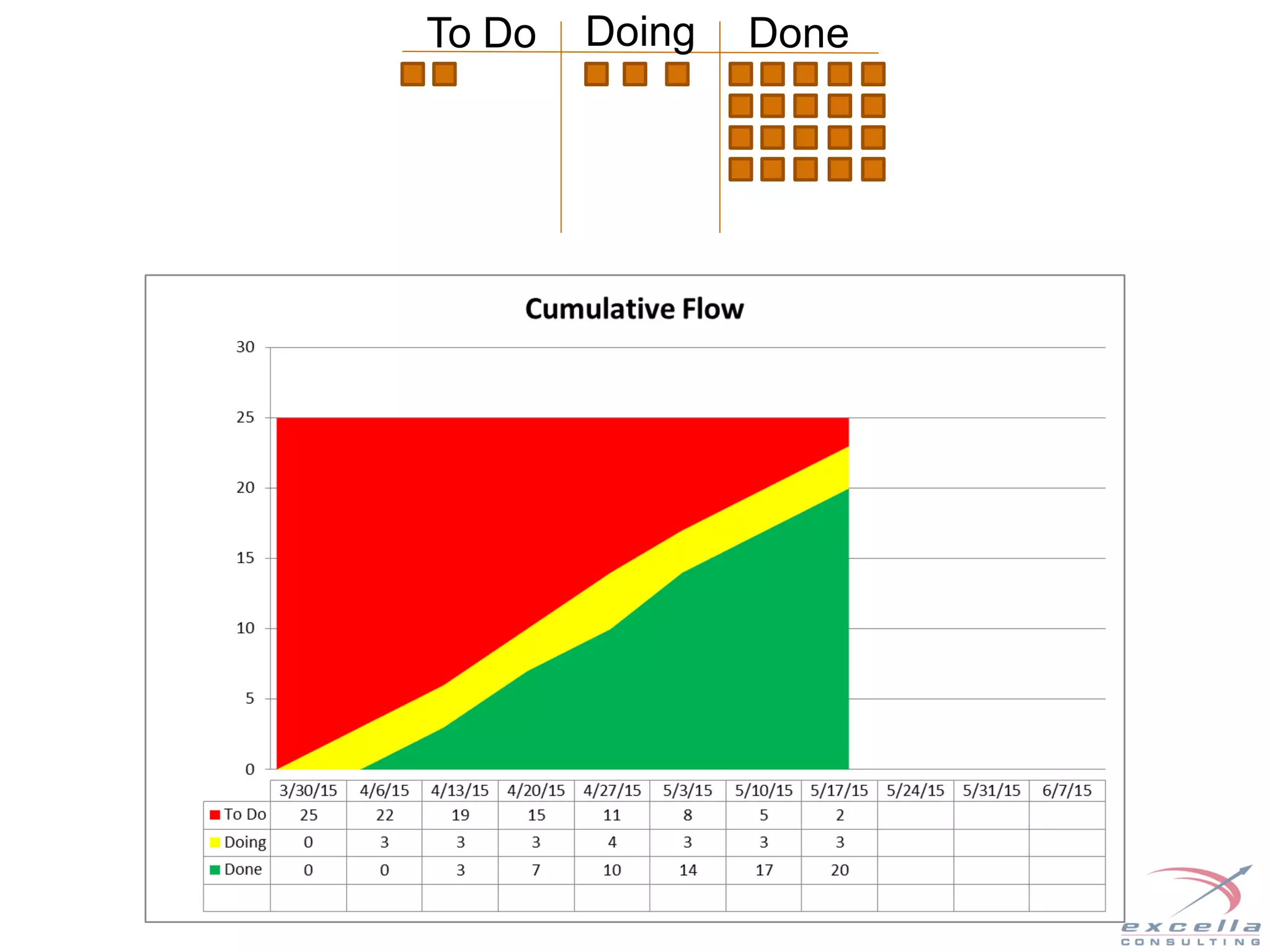
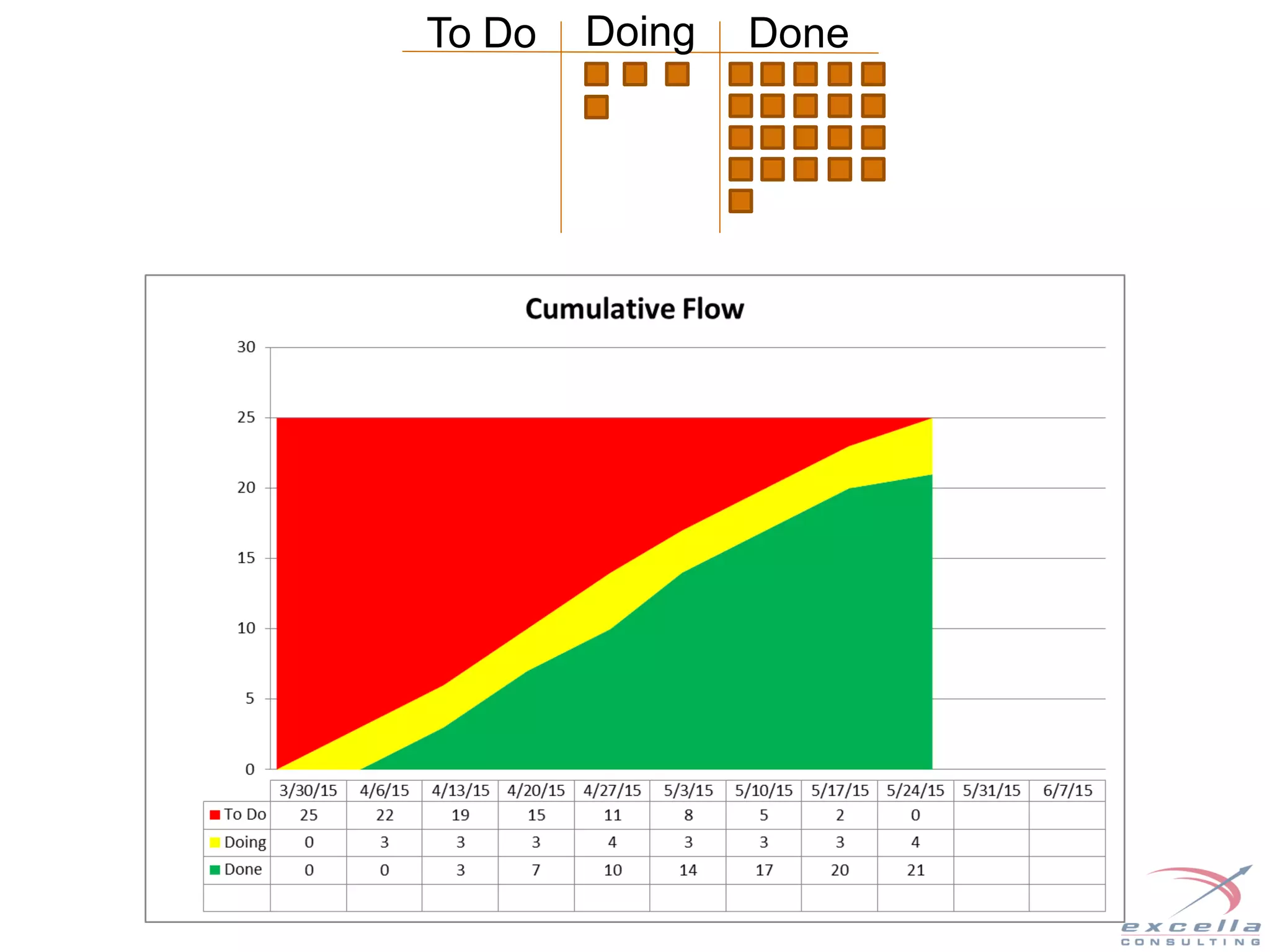
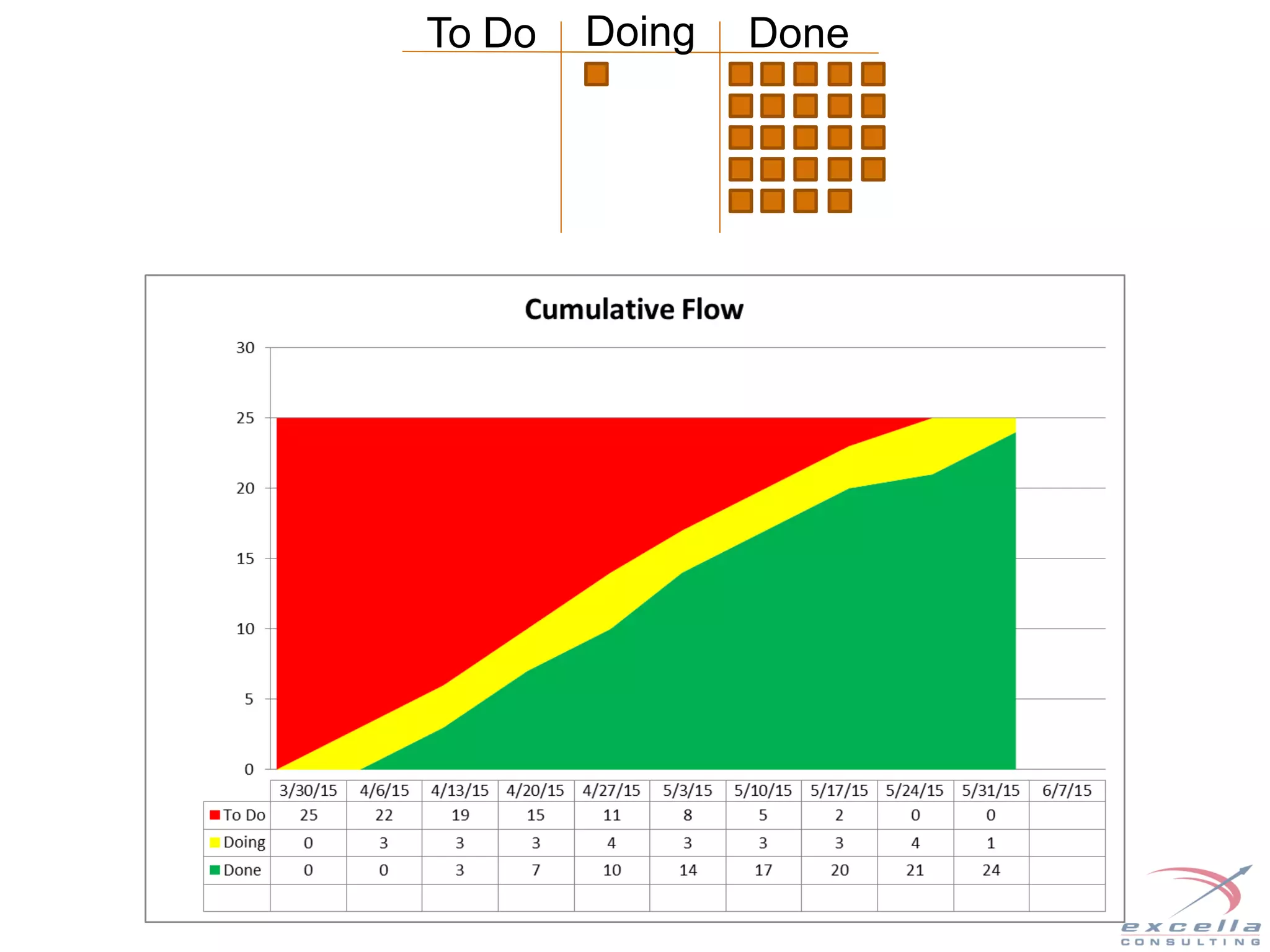
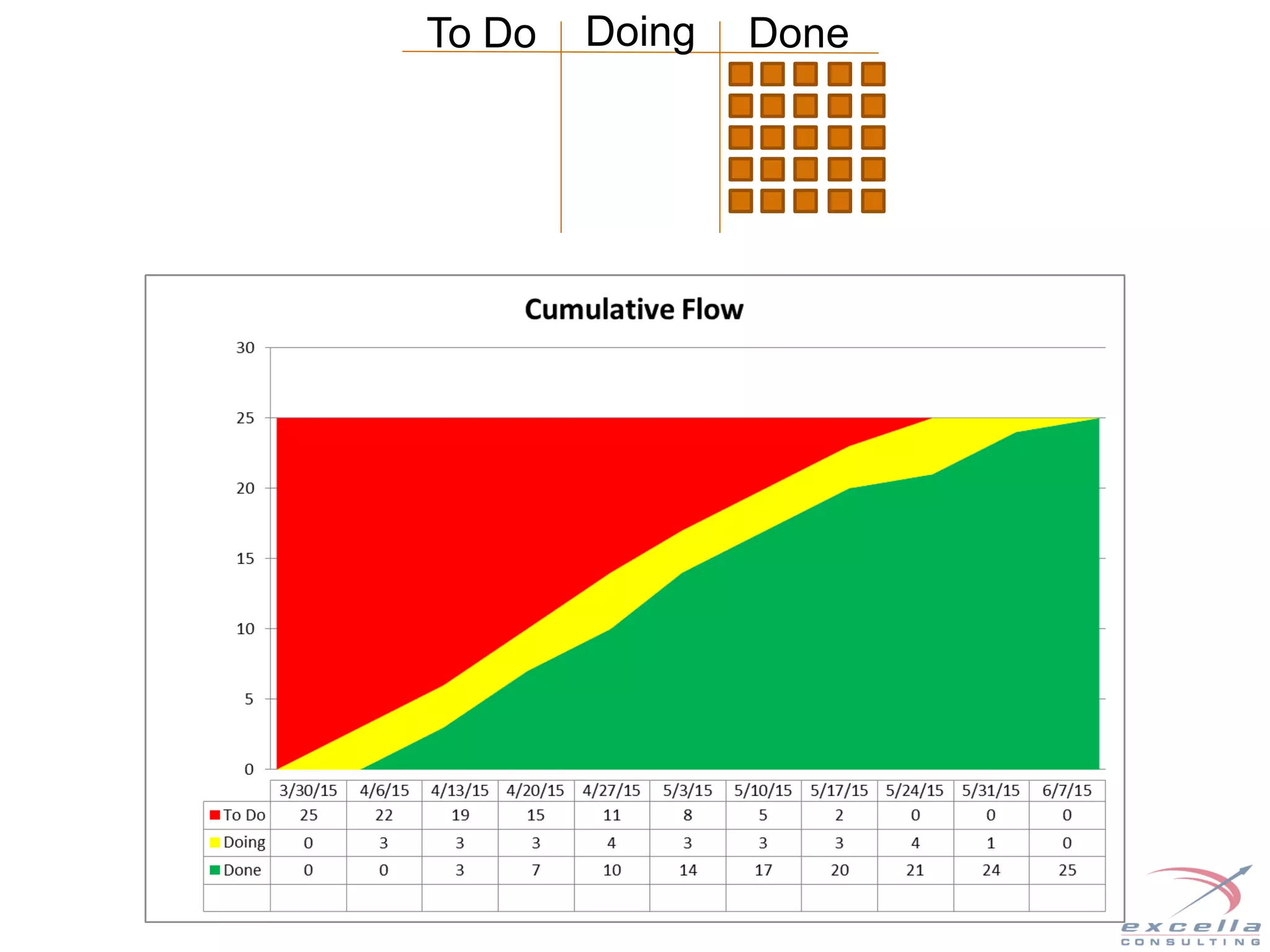
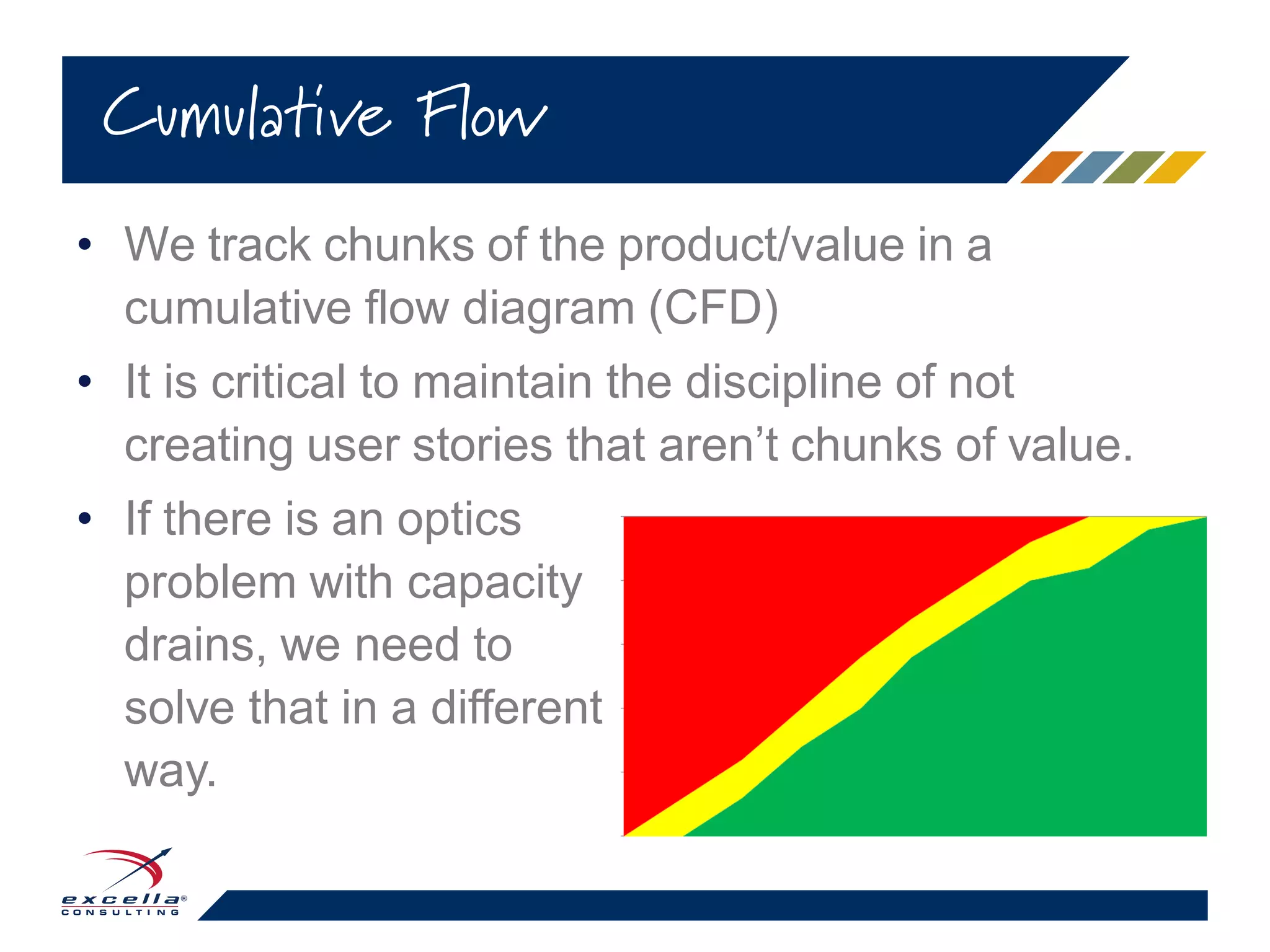
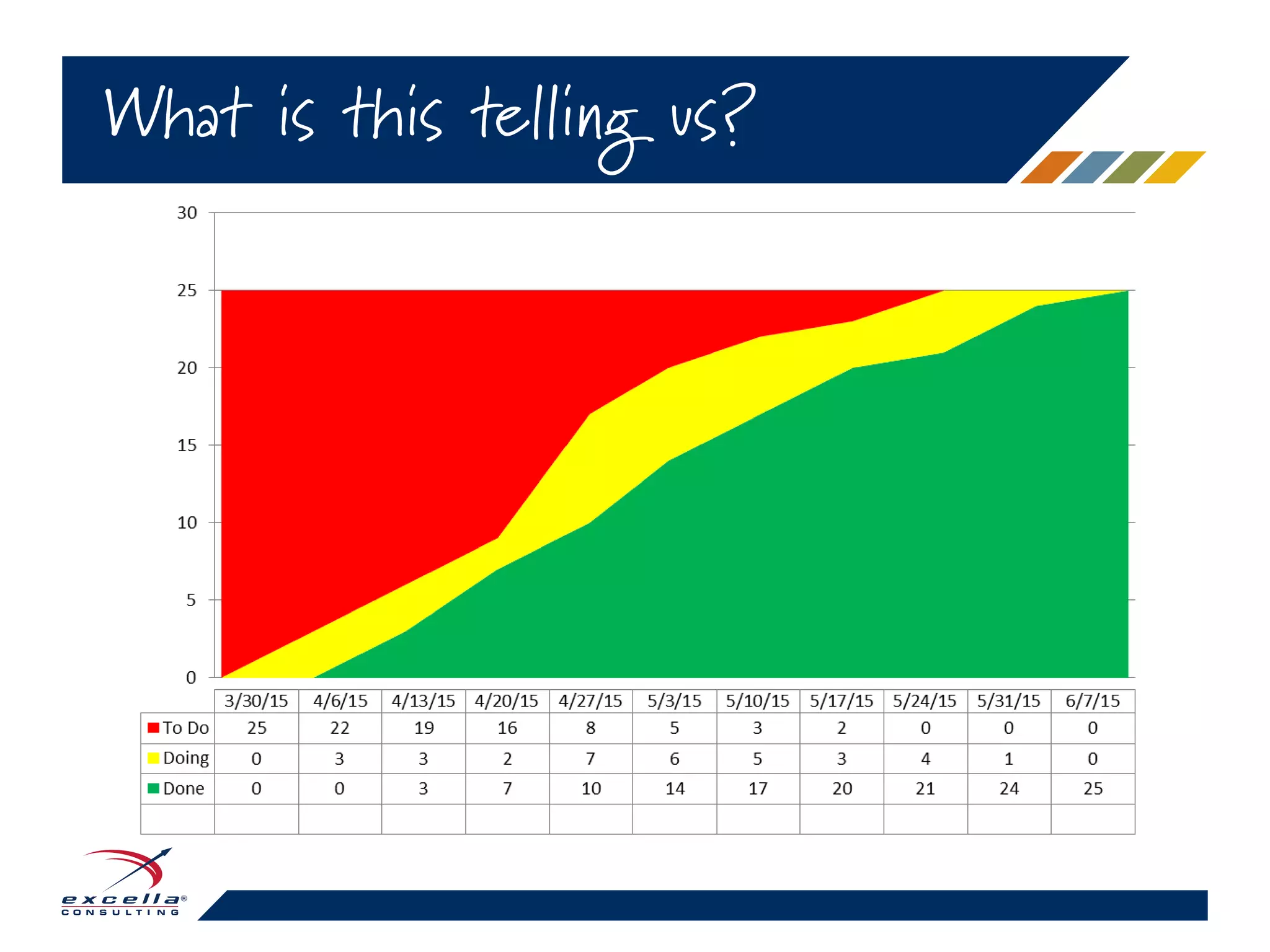
• We trackchunks of the product/value in a
cumulative flow diagram (CFD)
• It is critical to maintain the discipline of not
creating user stories that aren’t chunks of value.
• If there is an optics
problem with capacity
drains, we need to
solve that in a different
way.
Cumulative Flow
• Anything outsidethe teams control that
prevents the team from making progress
• Many use ‘impediment’ to denote anything
outside the team’s control that fully blocks
or just slows them down.
• When a blocker or a lesser impediment is
identified, the team should escalate the
issue so that it can be resolved.
Blockers