Featuring Insights on ...Q2 2014
Underwritten in part by
AP & WORKING CAPITAL
Increasing Revenues from Early Payments
Featuring Insights on…
Benefits of Dynamic Discounting
Reasons for Missed Discounts
The Perfect Payment Index
Early Payment Solution Providers
© 2014 PayStream Advisors, Inc | www.paystreamadvisors.com | info@paystreamadvisors.com
Executive Summary.......................................................................... 1
Opportunities in AP........................................................................... 5
What Is Dynamic Discount Management?....................................... 6
Working Capital and Payables ......................................................... 7
Electronic Payables and the Perfect Payment Index™..................... 11
Tradeshift Profile............................................................................... 13
Conclusion........................................................................................ 16
About PayStream Advisors .............................................................. 17
© 2014 PayStream Advisors, Inc | www.paystreamadvisors.com | info@paystreamadvisors.com
Executive Summary
Early payment discounts—the standard discount terms of “2% 10, net 30”—
seem like a thing of the past for most companies with a manual paper-based
process. Due to companies’ inability to approve invoices quickly, suppliers stopped
bothering to offer a discount. Fortunately, today there are viable alternatives. The
research in this report highlights those alternatives, explores market trends, and
serves as a guide to uncovering accounts payable practices that will increase
working capital and organizations’ bottom line.
Before we delve into early payment discounting and payment methods that
increase returns, it might be worthwhile to ask whether capturing discount is
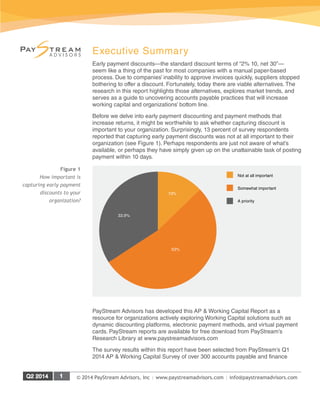
important to your organization. Surprisingly, 13 percent of survey respondents
reported that capturing early payment discounts was not at all important to their
organization (see Figure 1). Perhaps respondents are just not aware of what’s
available, or perhaps they have simply given up on the unattainable task of posting
payment within 10 days.
PayStream Advisors has developed this AP & Working Capital Report as a
resource for organizations actively exploring Working Capital solutions such as
dynamic discounting platforms, electronic payment methods, and virtual payment
cards. PayStream reports are available for free download from PayStream’s
Research Library at www.paystreamadvisors.com
The survey results within this report have been selected from PayStream’s Q1
2014 AP & Working Capital Survey of over 300 accounts payable and finance
Not at all important
Somewhat important
A priority
33.9%
13%
53%
Figure 1
How important is
capturing early payment
discounts to your
organization?
© 2014 PayStream Advisors, Inc | www.paystreamadvisors.com | info@paystreamadvisors.com
professionals at U.S. based organizations. Based on the number of survey
respondents, PayStream believes that the survey has a confidence level of +/- 5
percent.
Survey Respondents
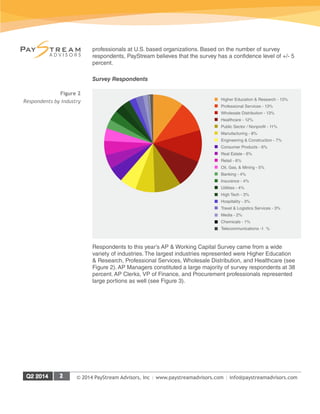
Respondents to this year’s AP & Working Capital Survey came from a wide
variety of industries. The largest industries represented were Higher Education
& Research, Professional Services, Wholesale Distribution, and Healthcare (see
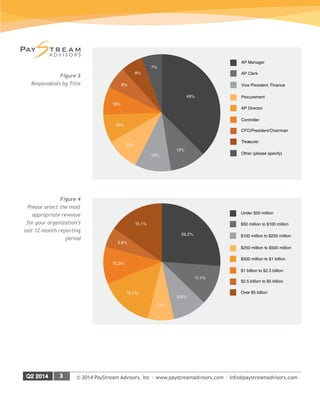
Figure 2). AP Managers constituted a large majority of survey respondents at 38
percent. AP Clerks, VP of Finance, and Procurement professionals represented
large portions as well (see Figure 3).
Figure 2
Respondents by Industry Higher Education & Research - 13%
Professional Services - 13%
Wholesale Distribution - 13%
Healthcare - 12%
Public Sector / Nonprofit - 11%
Manufacturing - 8%
Engineering & Construction - 7%
Consumer Products - 6%
Real Estate - 6%
Retail - 6%
Oil, Gas, & Mining - 5%
Banking - 4%
Insurance - 4%
Utilities - 4%
High Tech - 3%
Hospitality - 3%
Travel & Logistics Services - 3%
Media - 2%
Chemicals - 1%
Telecommunications -1 %
© 2014 PayStream Advisors, Inc | www.paystreamadvisors.com | info@paystreamadvisors.com
Figure 3
Respondents by Title
AP Manager
AP Clerk
Vice President, Finance
49%
13%
13%
10%
8%
8%
10%
12%
7%
Procurement
AP Director
Controller
CFO/President/Chairman
Treasurer
Other (please specify)
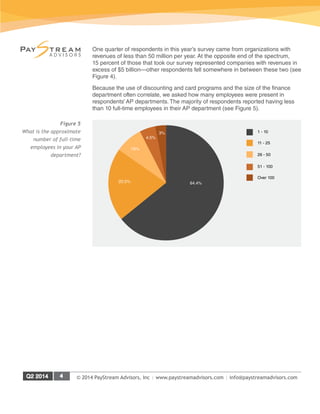
Figure 4
Please select the most
appropriate revenue
for your organization’s
last 12-month reporting
period
26.2%
11.1%
7.1%
9.5%
5.6%
15.1%
10.3%
15.1%
Under $50 million
$50 million to $100 million
$100 million to $250 million
$250 million to $500 million
$500 million to $1 billion
$1 billion to $2.5 billion
$2.5 billion to $5 billion
Over $5 billion
© 2014 PayStream Advisors, Inc | www.paystreamadvisors.com | info@paystreamadvisors.com
One quarter of respondents in this year’s survey came from organizations with
revenues of less than 50 million per year. At the opposite end of the spectrum,
15 percent of those that took our survey represented companies with revenues in
excess of $5 billion—other respondents fell somewhere in between these two (see
Figure 4).
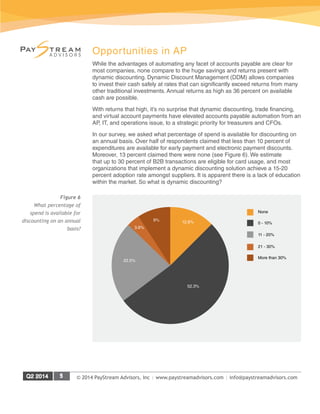
Because the use of discounting and card programs and the size of the finance
department often correlate, we asked how many employees were present in
respondents’ AP departments. The majority of respondents reported having less
than 10 full-time employees in their AP department (see Figure 5).
Figure 5
What is the approximate
number of full-time
employees in your AP
department?
4.5%
7.6%
64.4%
3%
20.5%
1 - 10
11 - 25
26 - 50
51 - 100
Over 100
© 2014 PayStream Advisors, Inc | www.paystreamadvisors.com | info@paystreamadvisors.com
Opportunities in AP
While the advantages of automating any facet of accounts payable are clear for
most companies, none compare to the huge savings and returns present with
dynamic discounting. Dynamic Discount Management (DDM) allows companies
to invest their cash safely at rates that can significantly exceed returns from many
other traditional investments. Annual returns as high as 36 percent on available
cash are possible.
With returns that high, it’s no surprise that dynamic discounting, trade financing,
and virtual account payments have elevated accounts payable automation from an
AP, IT, and operations issue, to a strategic priority for treasurers and CFOs.
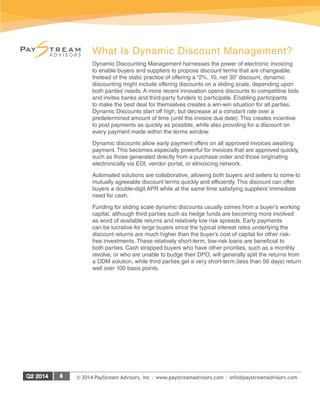
In our survey, we asked what percentage of spend is available for discounting on
an annual basis. Over half of respondents claimed that less than 10 percent of
expenditures are available for early payment and electronic payment discounts.
Moreover, 13 percent claimed there were none (see Figure 6). We estimate
that up to 30 percent of B2B transactions are eligible for card usage, and most
organizations that implement a dynamic discounting solution achieve a 15-20
percent adoption rate amongst suppliers. It is apparent there is a lack of education
within the market. So what is dynamic discounting?
Figure 6
What percentage of
spend is available for
discounting on an annual
basis? 3.6%
22.5%
12.6%9%
52.3%
None
0 - 10%
11 - 20%
21 - 30%
More than 30%
© 2014 PayStream Advisors, Inc | www.paystreamadvisors.com | info@paystreamadvisors.com
What Is Dynamic Discount Management?
Dynamic Discounting Management harnesses the power of electronic invoicing
to enable buyers and suppliers to propose discount terms that are changeable.
Instead of the static practice of offering a “2%, 10, net 30” discount, dynamic
discounting might include offering discounts on a sliding scale, depending upon
both parties’ needs. A more recent innovation opens discounts to competitive bids
and invites banks and third-party funders to participate. Enabling participants
to make the best deal for themselves creates a win-win situation for all parties.
Dynamic Discounts start off high, but decrease at a constant rate over a
predetermined amount of time (until the invoice due date). This creates incentive
to post payments as quickly as possible, while also providing for a discount on
every payment made within the terms window.
Dynamic discounts allow early payment offers on all approved invoices awaiting
payment. This becomes especially powerful for invoices that are approved quickly,
such as those generated directly from a purchase order and those originating
electronically via EDI, vendor portal, or eInvoicing network.
Automated solutions are collaborative, allowing both buyers and sellers to come to
mutually agreeable discount terms quickly and efficiently. This discount can offer
buyers a double-digit APR while at the same time satisfying suppliers’ immediate
need for cash.
Funding for sliding scale dynamic discounts usually comes from a buyer’s working
capital, although third parties such as hedge funds are becoming more involved
as word of available returns and relatively low risk spreads. Early payments
can be lucrative for large buyers since the typical interest rates underlying the
discount returns are much higher than the buyer’s cost of capital for other risk-
free investments. These relatively short-term, low-risk loans are beneficial to
both parties. Cash strapped buyers who have other priorities, such as a monthly
revolve, or who are unable to budge their DPO, will generally split the returns from
a DDM solution, while third parties get a very short-term (less than 56 days) return
well over 100 basis points.
© 2014 PayStream Advisors, Inc | www.paystreamadvisors.com | info@paystreamadvisors.com
Working Capital and Payables
DDM solutions provide suppliers with liquidity and buyers with increased returns
on purchases. In years prior, discounts were driven by suppliers as an incentive
to secure early payment and garner enhanced visibility into invoice status. With
modern DDM solutions, buyers proactively propose early settlement discounts
to suppliers in order to decrease purchasing costs and mold a more competitive
supplier landscape. The question is no longer “Can we pay the invoice in 10
days?” or “Can we find a supplier that will offer an early payment discount?” Now,
it is “Which supplier is willing to utilize my DDM solution?”
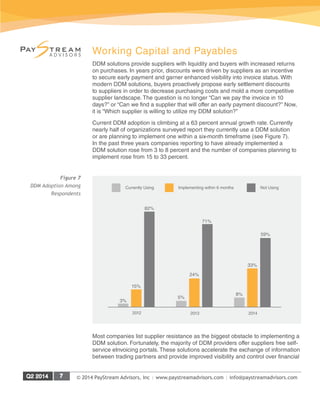
Current DDM adoption is climbing at a 63 percent annual growth rate. Currently
nearly half of organizations surveyed report they currently use a DDM solution
or are planning to implement one within a six-month timeframe (see Figure 7).
In the past three years companies reporting to have already implemented a
DDM solution rose from 3 to 8 percent and the number of companies planning to
implement rose from 15 to 33 percent.
Most companies list supplier resistance as the biggest obstacle to implementing a
DDM solution. Fortunately, the majority of DDM providers offer suppliers free self-
service eInvoicing portals. These solutions accelerate the exchange of information
between trading partners and provide improved visibility and control over financial
8%
33%
59%
2014
5%
24%
71%
2013
3%
15%
82%
2012
Currently Using Implementing within 6 months Not Using
Figure 7
DDM Adoption Among
Respondents
© 2014 PayStream Advisors, Inc | www.paystreamadvisors.com | info@paystreamadvisors.com
transactions. A key benefit for suppliers is the ability to check real-time statuses for
their invoices. For the buyer, this means a reduction in resources required to solve
discrepancies and respond to inquiries. Not only will there be a reduction in AP
costs in the short term due to reduced processing costs but increased returns on
purchases can total as much as 1 to 5 million dollars on 1 billion in spend.
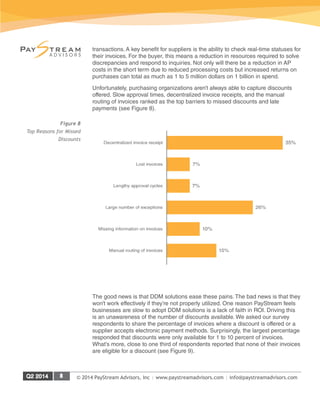
Unfortunately, purchasing organizations aren’t always able to capture discounts
offered. Slow approval times, decentralized invoice receipts, and the manual
routing of invoices ranked as the top barriers to missed discounts and late
payments (see Figure 8).
The good news is that DDM solutions ease these pains. The bad news is that they
won’t work effectively if they’re not properly utilized. One reason PayStream feels
businesses are slow to adopt DDM solutions is a lack of faith in ROI. Driving this
is an unawareness of the number of discounts available. We asked our survey
respondents to share the percentage of invoices where a discount is offered or a
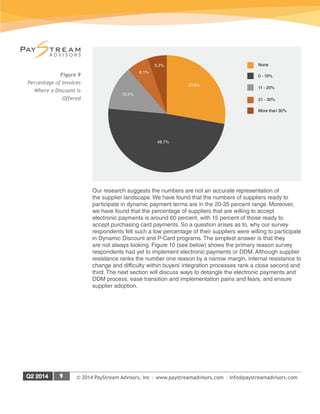
supplier accepts electronic payment methods. Surprisingly, the largest percentage
responded that discounts were only available for 1 to 10 percent of invoices.
What’s more, close to one third of respondents reported that none of their invoices
are eligible for a discount (see Figure 9).
Figure 8
Top Reasons for Missed
Discounts
© 2014 PayStream Advisors, Inc | www.paystreamadvisors.com | info@paystreamadvisors.com
Our research suggests the numbers are not an accurate representation of
the supplier landscape. We have found that the numbers of suppliers ready to
participate in dynamic payment terms are in the 20-35 percent range. Moreover,
we have found that the percentage of suppliers that are willing to accept
electronic payments is around 60 percent, with 15 percent of those ready to
accept purchasing card payments. So a question arises as to, why our survey
respondents felt such a low percentage of their suppliers were willing to participate
in Dynamic Discount and P-Card programs. The simplest answer is that they
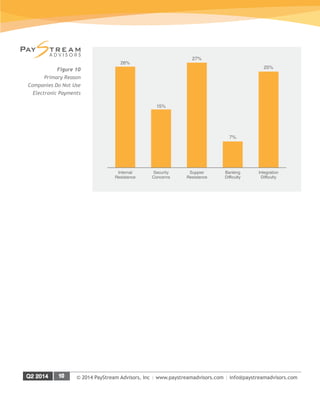
are not always looking. Figure 10 (see below) shows the primary reason survey
respondents had yet to implement electronic payments or DDM. Although supplier
resistance ranks the number one reason by a narrow margin, internal resistance to
change and difficulty within buyers’ integration processes rank a close second and
third. The next section will discuss ways to detangle the electronic payments and
DDM process, ease transition and implementation pains and fears, and ensure
supplier adoption.
Figure 9
Percentage of Invoices
Where a Discount is
Offered
52.3%
12.2%
48.7%
6.1%
5.2%
27.8%
None
0 - 10%
11 - 20%
21 - 30%
More than 30%
© 2014 PayStream Advisors, Inc | www.paystreamadvisors.com | info@paystreamadvisors.com
Figure 10
Primary Reason
Companies Do Not Use
Electronic Payments
26%
Internal
Resistance
Security
Concerns
15%
27%
Suppier
Resistance
7%
Banking
Difficulty
25%
Integration
Difficulty
© 2014 PayStream Advisors, Inc | www.paystreamadvisors.com | info@paystreamadvisors.com
Electronic Payables and the Perfect
Payment Index™
Electronic payments, the final step in a fully automated purchase to pay solution,
are critical to dynamic discounting and have numerous other benefits. They
further accelerate the payment cycle and remove the costs associated with
printing and mailing checks. Less paper reduces opportunities for fraud, and
supplier notification and vendor self-service options reduce the number of
supplier inquiries and exceptions. Online search and retrieval tools aid in payment
verification and collaborative dispute resolution, as well as increasing compliance
with regulatory requirements and assisting in audit trails. In our survey, we asked
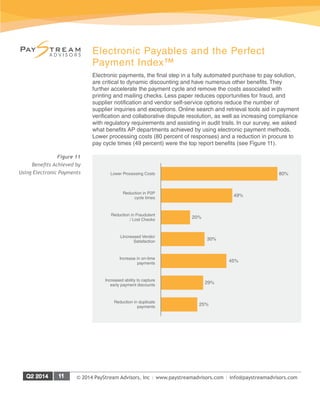
what benefits AP departments achieved by using electronic payment methods.
Lower processing costs (80 percent of responses) and a reduction in procure to
pay cycle times (49 percent) were the top report benefits (see Figure 11).
Figure 11
Benefits Achieved by
Using Electronic Payments 80%Lower Processing Costs
49%
Reduction in P2P
cycle times
20%
Reduction in Fraudulent
/ Lost Checks
30%
LIncreased Vendor
Satisfaction
45%
Increase in on-time
payments
25%
Reduction in duplicate
payments
29%
Increased ability to capture
early payment discounts
© 2014 PayStream Advisors, Inc | www.paystreamadvisors.com | info@paystreamadvisors.com
When moving towards DDM and electronic payments, it is important to formulate
a successful strategy. PayStream has built a tool to assist in this process called
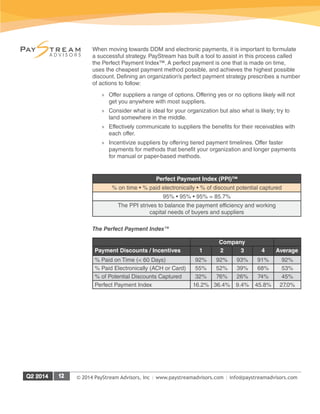
the Perfect Payment Index™. A perfect payment is one that is made on time,
uses the cheapest payment method possible, and achieves the highest possible
discount. Defining an organization’s perfect payment strategy prescribes a number
of actions to follow:
»» Offer suppliers a range of options. Offering yes or no options likely will not
get you anywhere with most suppliers.
»» Consider what is ideal for your organization but also what is likely; try to
land somewhere in the middle.
»» Effectively communicate to suppliers the benefits for their receivables with
each offer.
»» Incentivize suppliers by offering tiered payment timelines. Offer faster
payments for methods that benefit your organization and longer payments
for manual or paper-based methods.
Perfect Payment Index (PPI)™
% on time • % paid electronically • % of discount potential captured
95% • 95% • 95% = 85.7%
The PPI strives to balance the payment efficiency and working
capital needs of buyers and suppliers
The Perfect Payment Index™
Company
Payment Discounts / Incentives 1 2 3 4 Average
% Paid on Time (< 60 Days) 92% 92% 93% 91% 92%
% Paid Electronically (ACH or Card) 55% 52% 39% 68% 53%
% of Potential Discounts Captured 32% 76% 26% 74% 45%
Perfect Payment Index 16.2% 36.4% 9.4% 45.8% 27.0%
© 2014 PayStream Advisors, Inc | www.paystreamadvisors.com | info@paystreamadvisors.com
Tradeshift Profile
Tradeshift’s mission statement is simple—they aim to bring all companies, big
and small, together to transact, connect, and collaborate with each other. For
suppliers, they deliver free electronic invoicing, faster payments, and predictable
cash flow. For enterprises, Tradeshift empowers them to work more easily and
productively with their supplier network, anywhere in the world.
Something entirely unique to Tradeshift is that they didn’t just create a software
or cloud application, they created an online platform. From there, any number
of applications can be built and used on the platform - much like iOS or Google
Play applications. Tradeshift invites clients and third parties to develop custom
applications for the platform and even has an incubator project to assist software
start-ups. To the customer, this translates to endless customization opportunities.
When founding their company, Tradeshift realized that an eInvoicing network is
only as powerful as the number of suppliers that will join. In designing the supplier
interface, they kept this in mind every step of the way. The graphic interface is
incredibly clean and intuitively designed to facilitate maximum user adoption.
What’s more, the Tradeshift platform features responsive design—intelligently
changing appearance based on the size of a user’s screen.
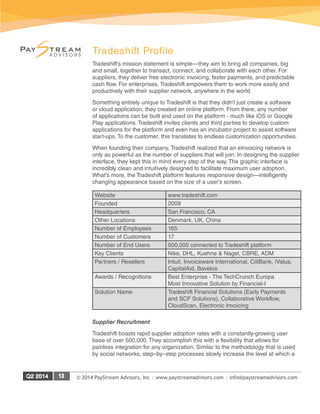
Website www.tradeshift.com
Founded 2009
Headquarters San Francisco, CA
Other Locations Denmark, UK, China
Number of Employees 165
Number of Customers 17
Number of End Users 500,000 connected to Tradeshift platform
Key Clients Nike, DHL, Kuehne & Nagel, CBRE, ADM
Partners / Resellers Intuit, Invoiceware International, CitiBank, iValua,
CapitalAid, Bavelos
Awards / Recognitions Best Enterprise - The TechCrunch Europa
Most Innovative Solution by Financial-I
Solution Name Tradeshift Financial Solutions (Early Payments
and SCF Solutions), Collaborative Workflow,
CloudScan, Electronic Invoicing
Supplier Recruitment
Tradeshift boasts rapid supplier adoption rates with a constantly-growing user
base of over 500,000. They accomplish this with a flexibility that allows for
painless integration for any organization. Similar to the methodology that is used
by social networks, step–by–step processes slowly increase the level at which a
© 2014 PayStream Advisors, Inc | www.paystreamadvisors.com | info@paystreamadvisors.com
supplier uses the platform. To start, suppliers need only create a single login for
every customer that uses Tradeshift—they don’t have to remember multiple logins
for multiple clients. Suppliers may continue to submit invoices via the method
they already use, whether it be through email in pdf format, or paper and post.
Tradeshift also offers a number of free value-add services to suppliers including
the ability to receive purchase orders, check statuses, and input invoices, as well
as gain access to working capital optimization tools such as DDM.
eInvoicing
Tradeshift’s eInvoicing solution is simple, clean, and easy to use. Through the use
of subtle hints, Tradeshift encourages suppliers to submit invoices electronically,
either through direct submission over the network or via an emailed pdf. The
buying organization’s business rules are projected onto the supplier during the
invoice creation process. When the invoice is reconciled to the supplier, they are
reminded that utilizing Tradeshift eInvoicing would eliminate this step in the future,
thus encouraging full supplier adoption.
Another unique function of Tradeshift is the use of personas and avatars within
a company. Users on the platform don’t interact with generic virtual silhouettes
from a company- they actually interact with a person, a picture, and a name that
represents their corresponding organization. This also comes in handy when
invoices are routed between individuals before being sent back for reconciliation-
the receiving supplier can still see to whom they originally sent the invoice.
Dynamic Discounting
Tradeshift offers a Dynamic Discounting solution that allows enterprise buyers to
set discount rates and payment terms appropriate for their goals and strategies.
Suppliers that are already on the Tradeshift network can be invited to participate
in dynamic discounting by their customers. Suppliers selected to be offered early
payments will see that offer in their To Do list as a review item. New suppliers can
decide whether they want to participate in future discounting opportunities during
their on-boarding process or at a later date. To help monitor their discounting
activities, suppliers are presented with a dashboard showing various metrics,
such as number of invoices paid early, total amount paid early, average days paid
early, etc. Similarly, Tradeshift enables access to reporting and analytics around
its early payments program offers and usage. Buying organizations are also able
to segment suppliers into “programs” based on industry, size, transaction volume,
etc.
Tradeshift also offers Supply Chain Finance capabilities through its partners.
Tradeshift works with certain third-party Financing partners (e.g., Citibank and
CapitalAid) who can interact directly with businesses on the network. For example,
Tradeshift can provide eligibility criteria to help them decide whom to offer
financing.
© 2014 PayStream Advisors, Inc | www.paystreamadvisors.com | info@paystreamadvisors.com
Reporting and Analytics
Tradeshift offers a range of reporting and analytics capabilities around invoicing,
workflow, and cash management. Also, an unlimited number of add-on custom
reporting functions are possible with custom app development through Tradeshift
Studio.
Implementation and Training
During implementation Tradeshift conducts a Terms Transformation Workshop
during which their experts work together with the client’s finance or treasury
group to develop a tailored program designed to capture as many early payment
discounts as possible. Tradeshift analyzes the client’s data to determine
appropriate supplier segments and to develop a tailored early payment program
to each segment. Each program may be customized with rates offered, cut-off
hurdles, custom messaging, etc.
Additionally, Tradeshift and its partner, Bavelos Group can offer a “Managed
Service” in which they take responsibility for achieving results. The
implementation of the Early Payment Program and use of Tradeshift software
to automate the approval cycle will be implemented in phases with the goal of
maximizing discounts. For example, based on an approximate $1B in applicable
spend, Tradeshift estimates an opportunity to capture approximately $1-$1.5M in
incremental early payment discount savings each year. The results in practice will
vary based on 1) applicable spend 2) your approval cycle time 3) payment terms
policy and 4) adoption of sourcing and accounts payable best practices.
For every project, Tradeshift assigns an experienced Delivery Manager to
oversee the project implementation and training phases, ensuring that the rollout
is successful, and that day-to-day operations can eventually be handed to the
customer. In terms of success, Tradeshift considers an implementation effective
when the goals set out within the Statement of Work have been fully executed and
meet the expected function and performance. Furthermore, once an enterprise’s
use of Tradeshift becomes part of their daily operations, Tradeshift maintains a
close long-term relationship with their customers to ensure that any arising issues
can be communicated and resolved. The length of implementation depends on
scope of the project and customer readiness; depending on the project, Tradeshift
can get customers started in as little as 2-4 weeks.
Tradeshift is designed to be intuitive for all users with a natural feel and smooth
learning curve, removing the need for extensive formal training. They do, however,
offer a range of specially designed courses aimed at ensuring successful client
usage of the platform and its maximum potential. These courses are based on a
“train-the-trainer” approach, a great way to achieve scalable results quickly.
© 2014 PayStream Advisors, Inc | www.paystreamadvisors.com | info@paystreamadvisors.com
Conclusion
Dynamic Discounting and a large percentage of payments being made
electronically is becoming quite mainstream. The potential for high, risk-free
returns and the opportunity cost of failing to act have become change agents in
many AP departments. Unlike operational improvements, DDM and ePayments
have a proven appeal to high-level executives and further secure a belief in AP
Automation.
Buyer-suggested discounts and tiered payment terms are, in large part, being
positively received, even from suppliers not previously known for offering
early payment discounts. In general, the growing perception of payables as
a cash management tool has replaced the old entitlement mentality, creating
a more amicable and sustainable environment with less opportunity for
misunderstandings and the claiming of unearned discounts.
As predicted, the trend toward Dynamic Discount Management has taken off and
PayStream predicts this trend will continue to become common practice among
AP organizations.
© 2014 PayStream Advisors, Inc | www.paystreamadvisors.com | info@paystreamadvisors.com
About PayStream Advisors
PayStream Advisors is a technology research and consulting firm that improves
the way companies plan, evaluate, and select emerging technologies to achieve
their business objectives. PayStream Advisors assists clients in sorting through
the growing complexities of IT applications related to business process automation
with the goal of making objective, analytical, and actionable recommendations.
Wherever business process automation technology is an issue, PayStream
Advisors is there to help. For more information, call (704) 523-7357 or visit us on
the web at www.paystreamadvisors.com.

AP & Working Capital – Increasing Revenues from Early Payments

  • 1.
    Featuring Insights on...Q2 2014 Underwritten in part by AP & WORKING CAPITAL Increasing Revenues from Early Payments Featuring Insights on… Benefits of Dynamic Discounting Reasons for Missed Discounts The Perfect Payment Index Early Payment Solution Providers
  • 2.
    © 2014 PayStreamAdvisors, Inc | www.paystreamadvisors.com | info@paystreamadvisors.com Executive Summary.......................................................................... 1 Opportunities in AP........................................................................... 5 What Is Dynamic Discount Management?....................................... 6 Working Capital and Payables ......................................................... 7 Electronic Payables and the Perfect Payment Index™..................... 11 Tradeshift Profile............................................................................... 13 Conclusion........................................................................................ 16 About PayStream Advisors .............................................................. 17
  • 3.
    © 2014 PayStreamAdvisors, Inc | www.paystreamadvisors.com | info@paystreamadvisors.com Executive Summary Early payment discounts—the standard discount terms of “2% 10, net 30”— seem like a thing of the past for most companies with a manual paper-based process. Due to companies’ inability to approve invoices quickly, suppliers stopped bothering to offer a discount. Fortunately, today there are viable alternatives. The research in this report highlights those alternatives, explores market trends, and serves as a guide to uncovering accounts payable practices that will increase working capital and organizations’ bottom line. Before we delve into early payment discounting and payment methods that increase returns, it might be worthwhile to ask whether capturing discount is important to your organization. Surprisingly, 13 percent of survey respondents reported that capturing early payment discounts was not at all important to their organization (see Figure 1). Perhaps respondents are just not aware of what’s available, or perhaps they have simply given up on the unattainable task of posting payment within 10 days. PayStream Advisors has developed this AP & Working Capital Report as a resource for organizations actively exploring Working Capital solutions such as dynamic discounting platforms, electronic payment methods, and virtual payment cards. PayStream reports are available for free download from PayStream’s Research Library at www.paystreamadvisors.com The survey results within this report have been selected from PayStream’s Q1 2014 AP & Working Capital Survey of over 300 accounts payable and finance Not at all important Somewhat important A priority 33.9% 13% 53% Figure 1 How important is capturing early payment discounts to your organization?
  • 4.
    © 2014 PayStreamAdvisors, Inc | www.paystreamadvisors.com | info@paystreamadvisors.com professionals at U.S. based organizations. Based on the number of survey respondents, PayStream believes that the survey has a confidence level of +/- 5 percent. Survey Respondents Respondents to this year’s AP & Working Capital Survey came from a wide variety of industries. The largest industries represented were Higher Education & Research, Professional Services, Wholesale Distribution, and Healthcare (see Figure 2). AP Managers constituted a large majority of survey respondents at 38 percent. AP Clerks, VP of Finance, and Procurement professionals represented large portions as well (see Figure 3). Figure 2 Respondents by Industry Higher Education & Research - 13% Professional Services - 13% Wholesale Distribution - 13% Healthcare - 12% Public Sector / Nonprofit - 11% Manufacturing - 8% Engineering & Construction - 7% Consumer Products - 6% Real Estate - 6% Retail - 6% Oil, Gas, & Mining - 5% Banking - 4% Insurance - 4% Utilities - 4% High Tech - 3% Hospitality - 3% Travel & Logistics Services - 3% Media - 2% Chemicals - 1% Telecommunications -1 %
  • 5.
    © 2014 PayStreamAdvisors, Inc | www.paystreamadvisors.com | info@paystreamadvisors.com Figure 3 Respondents by Title AP Manager AP Clerk Vice President, Finance 49% 13% 13% 10% 8% 8% 10% 12% 7% Procurement AP Director Controller CFO/President/Chairman Treasurer Other (please specify) Figure 4 Please select the most appropriate revenue for your organization’s last 12-month reporting period 26.2% 11.1% 7.1% 9.5% 5.6% 15.1% 10.3% 15.1% Under $50 million $50 million to $100 million $100 million to $250 million $250 million to $500 million $500 million to $1 billion $1 billion to $2.5 billion $2.5 billion to $5 billion Over $5 billion
  • 6.
    © 2014 PayStreamAdvisors, Inc | www.paystreamadvisors.com | info@paystreamadvisors.com One quarter of respondents in this year’s survey came from organizations with revenues of less than 50 million per year. At the opposite end of the spectrum, 15 percent of those that took our survey represented companies with revenues in excess of $5 billion—other respondents fell somewhere in between these two (see Figure 4). Because the use of discounting and card programs and the size of the finance department often correlate, we asked how many employees were present in respondents’ AP departments. The majority of respondents reported having less than 10 full-time employees in their AP department (see Figure 5). Figure 5 What is the approximate number of full-time employees in your AP department? 4.5% 7.6% 64.4% 3% 20.5% 1 - 10 11 - 25 26 - 50 51 - 100 Over 100
  • 7.
    © 2014 PayStreamAdvisors, Inc | www.paystreamadvisors.com | info@paystreamadvisors.com Opportunities in AP While the advantages of automating any facet of accounts payable are clear for most companies, none compare to the huge savings and returns present with dynamic discounting. Dynamic Discount Management (DDM) allows companies to invest their cash safely at rates that can significantly exceed returns from many other traditional investments. Annual returns as high as 36 percent on available cash are possible. With returns that high, it’s no surprise that dynamic discounting, trade financing, and virtual account payments have elevated accounts payable automation from an AP, IT, and operations issue, to a strategic priority for treasurers and CFOs. In our survey, we asked what percentage of spend is available for discounting on an annual basis. Over half of respondents claimed that less than 10 percent of expenditures are available for early payment and electronic payment discounts. Moreover, 13 percent claimed there were none (see Figure 6). We estimate that up to 30 percent of B2B transactions are eligible for card usage, and most organizations that implement a dynamic discounting solution achieve a 15-20 percent adoption rate amongst suppliers. It is apparent there is a lack of education within the market. So what is dynamic discounting? Figure 6 What percentage of spend is available for discounting on an annual basis? 3.6% 22.5% 12.6%9% 52.3% None 0 - 10% 11 - 20% 21 - 30% More than 30%
  • 8.
    © 2014 PayStreamAdvisors, Inc | www.paystreamadvisors.com | info@paystreamadvisors.com What Is Dynamic Discount Management? Dynamic Discounting Management harnesses the power of electronic invoicing to enable buyers and suppliers to propose discount terms that are changeable. Instead of the static practice of offering a “2%, 10, net 30” discount, dynamic discounting might include offering discounts on a sliding scale, depending upon both parties’ needs. A more recent innovation opens discounts to competitive bids and invites banks and third-party funders to participate. Enabling participants to make the best deal for themselves creates a win-win situation for all parties. Dynamic Discounts start off high, but decrease at a constant rate over a predetermined amount of time (until the invoice due date). This creates incentive to post payments as quickly as possible, while also providing for a discount on every payment made within the terms window. Dynamic discounts allow early payment offers on all approved invoices awaiting payment. This becomes especially powerful for invoices that are approved quickly, such as those generated directly from a purchase order and those originating electronically via EDI, vendor portal, or eInvoicing network. Automated solutions are collaborative, allowing both buyers and sellers to come to mutually agreeable discount terms quickly and efficiently. This discount can offer buyers a double-digit APR while at the same time satisfying suppliers’ immediate need for cash. Funding for sliding scale dynamic discounts usually comes from a buyer’s working capital, although third parties such as hedge funds are becoming more involved as word of available returns and relatively low risk spreads. Early payments can be lucrative for large buyers since the typical interest rates underlying the discount returns are much higher than the buyer’s cost of capital for other risk- free investments. These relatively short-term, low-risk loans are beneficial to both parties. Cash strapped buyers who have other priorities, such as a monthly revolve, or who are unable to budge their DPO, will generally split the returns from a DDM solution, while third parties get a very short-term (less than 56 days) return well over 100 basis points.
  • 9.
    © 2014 PayStreamAdvisors, Inc | www.paystreamadvisors.com | info@paystreamadvisors.com Working Capital and Payables DDM solutions provide suppliers with liquidity and buyers with increased returns on purchases. In years prior, discounts were driven by suppliers as an incentive to secure early payment and garner enhanced visibility into invoice status. With modern DDM solutions, buyers proactively propose early settlement discounts to suppliers in order to decrease purchasing costs and mold a more competitive supplier landscape. The question is no longer “Can we pay the invoice in 10 days?” or “Can we find a supplier that will offer an early payment discount?” Now, it is “Which supplier is willing to utilize my DDM solution?” Current DDM adoption is climbing at a 63 percent annual growth rate. Currently nearly half of organizations surveyed report they currently use a DDM solution or are planning to implement one within a six-month timeframe (see Figure 7). In the past three years companies reporting to have already implemented a DDM solution rose from 3 to 8 percent and the number of companies planning to implement rose from 15 to 33 percent. Most companies list supplier resistance as the biggest obstacle to implementing a DDM solution. Fortunately, the majority of DDM providers offer suppliers free self- service eInvoicing portals. These solutions accelerate the exchange of information between trading partners and provide improved visibility and control over financial 8% 33% 59% 2014 5% 24% 71% 2013 3% 15% 82% 2012 Currently Using Implementing within 6 months Not Using Figure 7 DDM Adoption Among Respondents
  • 10.
    © 2014 PayStreamAdvisors, Inc | www.paystreamadvisors.com | info@paystreamadvisors.com transactions. A key benefit for suppliers is the ability to check real-time statuses for their invoices. For the buyer, this means a reduction in resources required to solve discrepancies and respond to inquiries. Not only will there be a reduction in AP costs in the short term due to reduced processing costs but increased returns on purchases can total as much as 1 to 5 million dollars on 1 billion in spend. Unfortunately, purchasing organizations aren’t always able to capture discounts offered. Slow approval times, decentralized invoice receipts, and the manual routing of invoices ranked as the top barriers to missed discounts and late payments (see Figure 8). The good news is that DDM solutions ease these pains. The bad news is that they won’t work effectively if they’re not properly utilized. One reason PayStream feels businesses are slow to adopt DDM solutions is a lack of faith in ROI. Driving this is an unawareness of the number of discounts available. We asked our survey respondents to share the percentage of invoices where a discount is offered or a supplier accepts electronic payment methods. Surprisingly, the largest percentage responded that discounts were only available for 1 to 10 percent of invoices. What’s more, close to one third of respondents reported that none of their invoices are eligible for a discount (see Figure 9). Figure 8 Top Reasons for Missed Discounts
  • 11.
    © 2014 PayStreamAdvisors, Inc | www.paystreamadvisors.com | info@paystreamadvisors.com Our research suggests the numbers are not an accurate representation of the supplier landscape. We have found that the numbers of suppliers ready to participate in dynamic payment terms are in the 20-35 percent range. Moreover, we have found that the percentage of suppliers that are willing to accept electronic payments is around 60 percent, with 15 percent of those ready to accept purchasing card payments. So a question arises as to, why our survey respondents felt such a low percentage of their suppliers were willing to participate in Dynamic Discount and P-Card programs. The simplest answer is that they are not always looking. Figure 10 (see below) shows the primary reason survey respondents had yet to implement electronic payments or DDM. Although supplier resistance ranks the number one reason by a narrow margin, internal resistance to change and difficulty within buyers’ integration processes rank a close second and third. The next section will discuss ways to detangle the electronic payments and DDM process, ease transition and implementation pains and fears, and ensure supplier adoption. Figure 9 Percentage of Invoices Where a Discount is Offered 52.3% 12.2% 48.7% 6.1% 5.2% 27.8% None 0 - 10% 11 - 20% 21 - 30% More than 30%
  • 12.
    © 2014 PayStreamAdvisors, Inc | www.paystreamadvisors.com | info@paystreamadvisors.com Figure 10 Primary Reason Companies Do Not Use Electronic Payments 26% Internal Resistance Security Concerns 15% 27% Suppier Resistance 7% Banking Difficulty 25% Integration Difficulty
  • 13.
    © 2014 PayStreamAdvisors, Inc | www.paystreamadvisors.com | info@paystreamadvisors.com Electronic Payables and the Perfect Payment Index™ Electronic payments, the final step in a fully automated purchase to pay solution, are critical to dynamic discounting and have numerous other benefits. They further accelerate the payment cycle and remove the costs associated with printing and mailing checks. Less paper reduces opportunities for fraud, and supplier notification and vendor self-service options reduce the number of supplier inquiries and exceptions. Online search and retrieval tools aid in payment verification and collaborative dispute resolution, as well as increasing compliance with regulatory requirements and assisting in audit trails. In our survey, we asked what benefits AP departments achieved by using electronic payment methods. Lower processing costs (80 percent of responses) and a reduction in procure to pay cycle times (49 percent) were the top report benefits (see Figure 11). Figure 11 Benefits Achieved by Using Electronic Payments 80%Lower Processing Costs 49% Reduction in P2P cycle times 20% Reduction in Fraudulent / Lost Checks 30% LIncreased Vendor Satisfaction 45% Increase in on-time payments 25% Reduction in duplicate payments 29% Increased ability to capture early payment discounts
  • 14.
    © 2014 PayStreamAdvisors, Inc | www.paystreamadvisors.com | info@paystreamadvisors.com When moving towards DDM and electronic payments, it is important to formulate a successful strategy. PayStream has built a tool to assist in this process called the Perfect Payment Index™. A perfect payment is one that is made on time, uses the cheapest payment method possible, and achieves the highest possible discount. Defining an organization’s perfect payment strategy prescribes a number of actions to follow: »» Offer suppliers a range of options. Offering yes or no options likely will not get you anywhere with most suppliers. »» Consider what is ideal for your organization but also what is likely; try to land somewhere in the middle. »» Effectively communicate to suppliers the benefits for their receivables with each offer. »» Incentivize suppliers by offering tiered payment timelines. Offer faster payments for methods that benefit your organization and longer payments for manual or paper-based methods. Perfect Payment Index (PPI)™ % on time • % paid electronically • % of discount potential captured 95% • 95% • 95% = 85.7% The PPI strives to balance the payment efficiency and working capital needs of buyers and suppliers The Perfect Payment Index™ Company Payment Discounts / Incentives 1 2 3 4 Average % Paid on Time (< 60 Days) 92% 92% 93% 91% 92% % Paid Electronically (ACH or Card) 55% 52% 39% 68% 53% % of Potential Discounts Captured 32% 76% 26% 74% 45% Perfect Payment Index 16.2% 36.4% 9.4% 45.8% 27.0%
  • 15.
    © 2014 PayStreamAdvisors, Inc | www.paystreamadvisors.com | info@paystreamadvisors.com Tradeshift Profile Tradeshift’s mission statement is simple—they aim to bring all companies, big and small, together to transact, connect, and collaborate with each other. For suppliers, they deliver free electronic invoicing, faster payments, and predictable cash flow. For enterprises, Tradeshift empowers them to work more easily and productively with their supplier network, anywhere in the world. Something entirely unique to Tradeshift is that they didn’t just create a software or cloud application, they created an online platform. From there, any number of applications can be built and used on the platform - much like iOS or Google Play applications. Tradeshift invites clients and third parties to develop custom applications for the platform and even has an incubator project to assist software start-ups. To the customer, this translates to endless customization opportunities. When founding their company, Tradeshift realized that an eInvoicing network is only as powerful as the number of suppliers that will join. In designing the supplier interface, they kept this in mind every step of the way. The graphic interface is incredibly clean and intuitively designed to facilitate maximum user adoption. What’s more, the Tradeshift platform features responsive design—intelligently changing appearance based on the size of a user’s screen. Website www.tradeshift.com Founded 2009 Headquarters San Francisco, CA Other Locations Denmark, UK, China Number of Employees 165 Number of Customers 17 Number of End Users 500,000 connected to Tradeshift platform Key Clients Nike, DHL, Kuehne & Nagel, CBRE, ADM Partners / Resellers Intuit, Invoiceware International, CitiBank, iValua, CapitalAid, Bavelos Awards / Recognitions Best Enterprise - The TechCrunch Europa Most Innovative Solution by Financial-I Solution Name Tradeshift Financial Solutions (Early Payments and SCF Solutions), Collaborative Workflow, CloudScan, Electronic Invoicing Supplier Recruitment Tradeshift boasts rapid supplier adoption rates with a constantly-growing user base of over 500,000. They accomplish this with a flexibility that allows for painless integration for any organization. Similar to the methodology that is used by social networks, step–by–step processes slowly increase the level at which a
  • 16.
    © 2014 PayStreamAdvisors, Inc | www.paystreamadvisors.com | info@paystreamadvisors.com supplier uses the platform. To start, suppliers need only create a single login for every customer that uses Tradeshift—they don’t have to remember multiple logins for multiple clients. Suppliers may continue to submit invoices via the method they already use, whether it be through email in pdf format, or paper and post. Tradeshift also offers a number of free value-add services to suppliers including the ability to receive purchase orders, check statuses, and input invoices, as well as gain access to working capital optimization tools such as DDM. eInvoicing Tradeshift’s eInvoicing solution is simple, clean, and easy to use. Through the use of subtle hints, Tradeshift encourages suppliers to submit invoices electronically, either through direct submission over the network or via an emailed pdf. The buying organization’s business rules are projected onto the supplier during the invoice creation process. When the invoice is reconciled to the supplier, they are reminded that utilizing Tradeshift eInvoicing would eliminate this step in the future, thus encouraging full supplier adoption. Another unique function of Tradeshift is the use of personas and avatars within a company. Users on the platform don’t interact with generic virtual silhouettes from a company- they actually interact with a person, a picture, and a name that represents their corresponding organization. This also comes in handy when invoices are routed between individuals before being sent back for reconciliation- the receiving supplier can still see to whom they originally sent the invoice. Dynamic Discounting Tradeshift offers a Dynamic Discounting solution that allows enterprise buyers to set discount rates and payment terms appropriate for their goals and strategies. Suppliers that are already on the Tradeshift network can be invited to participate in dynamic discounting by their customers. Suppliers selected to be offered early payments will see that offer in their To Do list as a review item. New suppliers can decide whether they want to participate in future discounting opportunities during their on-boarding process or at a later date. To help monitor their discounting activities, suppliers are presented with a dashboard showing various metrics, such as number of invoices paid early, total amount paid early, average days paid early, etc. Similarly, Tradeshift enables access to reporting and analytics around its early payments program offers and usage. Buying organizations are also able to segment suppliers into “programs” based on industry, size, transaction volume, etc. Tradeshift also offers Supply Chain Finance capabilities through its partners. Tradeshift works with certain third-party Financing partners (e.g., Citibank and CapitalAid) who can interact directly with businesses on the network. For example, Tradeshift can provide eligibility criteria to help them decide whom to offer financing.
  • 17.
    © 2014 PayStreamAdvisors, Inc | www.paystreamadvisors.com | info@paystreamadvisors.com Reporting and Analytics Tradeshift offers a range of reporting and analytics capabilities around invoicing, workflow, and cash management. Also, an unlimited number of add-on custom reporting functions are possible with custom app development through Tradeshift Studio. Implementation and Training During implementation Tradeshift conducts a Terms Transformation Workshop during which their experts work together with the client’s finance or treasury group to develop a tailored program designed to capture as many early payment discounts as possible. Tradeshift analyzes the client’s data to determine appropriate supplier segments and to develop a tailored early payment program to each segment. Each program may be customized with rates offered, cut-off hurdles, custom messaging, etc. Additionally, Tradeshift and its partner, Bavelos Group can offer a “Managed Service” in which they take responsibility for achieving results. The implementation of the Early Payment Program and use of Tradeshift software to automate the approval cycle will be implemented in phases with the goal of maximizing discounts. For example, based on an approximate $1B in applicable spend, Tradeshift estimates an opportunity to capture approximately $1-$1.5M in incremental early payment discount savings each year. The results in practice will vary based on 1) applicable spend 2) your approval cycle time 3) payment terms policy and 4) adoption of sourcing and accounts payable best practices. For every project, Tradeshift assigns an experienced Delivery Manager to oversee the project implementation and training phases, ensuring that the rollout is successful, and that day-to-day operations can eventually be handed to the customer. In terms of success, Tradeshift considers an implementation effective when the goals set out within the Statement of Work have been fully executed and meet the expected function and performance. Furthermore, once an enterprise’s use of Tradeshift becomes part of their daily operations, Tradeshift maintains a close long-term relationship with their customers to ensure that any arising issues can be communicated and resolved. The length of implementation depends on scope of the project and customer readiness; depending on the project, Tradeshift can get customers started in as little as 2-4 weeks. Tradeshift is designed to be intuitive for all users with a natural feel and smooth learning curve, removing the need for extensive formal training. They do, however, offer a range of specially designed courses aimed at ensuring successful client usage of the platform and its maximum potential. These courses are based on a “train-the-trainer” approach, a great way to achieve scalable results quickly.
  • 18.
    © 2014 PayStreamAdvisors, Inc | www.paystreamadvisors.com | info@paystreamadvisors.com Conclusion Dynamic Discounting and a large percentage of payments being made electronically is becoming quite mainstream. The potential for high, risk-free returns and the opportunity cost of failing to act have become change agents in many AP departments. Unlike operational improvements, DDM and ePayments have a proven appeal to high-level executives and further secure a belief in AP Automation. Buyer-suggested discounts and tiered payment terms are, in large part, being positively received, even from suppliers not previously known for offering early payment discounts. In general, the growing perception of payables as a cash management tool has replaced the old entitlement mentality, creating a more amicable and sustainable environment with less opportunity for misunderstandings and the claiming of unearned discounts. As predicted, the trend toward Dynamic Discount Management has taken off and PayStream predicts this trend will continue to become common practice among AP organizations.
  • 19.
    © 2014 PayStreamAdvisors, Inc | www.paystreamadvisors.com | info@paystreamadvisors.com About PayStream Advisors PayStream Advisors is a technology research and consulting firm that improves the way companies plan, evaluate, and select emerging technologies to achieve their business objectives. PayStream Advisors assists clients in sorting through the growing complexities of IT applications related to business process automation with the goal of making objective, analytical, and actionable recommendations. Wherever business process automation technology is an issue, PayStream Advisors is there to help. For more information, call (704) 523-7357 or visit us on the web at www.paystreamadvisors.com.