Managed Services Offer the Path to Getting There
How Financial Institutions
Can Take Commercial Payments
to a Higher Level
© 2015 AOC Solutions
2
S U M M A R Y
How Financial Institutions Can Take Commercial Payments to a Higher Level
Financial institutions (FIs) know that to retain clients and attract
new ones they must offer robust commercial card solutions that
meet their clients’ business-to-business (B2B) payment needs.
The reality is that they can no longer limit their card products to
traditional plastic. A “card program” now means so much more.
Increasingly, FIs’ commercial clients — buying organizations —
are seeking Electronic Accounts Payable (EAP) solutions to
round out their payment strategies.
One of the biggest challenges for an FI is competing with other
FIs that have an edge in one or more areas, whether it’s larger
staffs, bigger budgets or more advanced technology to support
commercial clients.
The Upside and Downside to Electronic Accounts
Payable (EAP)
Most FIs have already identified EAP as their highest growth and
highest revenue opportunity. However, some currently do not
offer any EAP solution or, if they do, they might be relying on one
that does not fully meet their clients’ needs and needs of clients’
suppliers. Because one size does not fit all, an FI must ensure that
its EAP offering is multi-dimensional, supported by knowledgeable
people and effective processes. This is a lot to accomplish. FIs do not always have the time,
expertise and resources to focus on EAP, making it imperative to choose the right EAP partner
with the right managed services.
Fortunately, no matter the size of an FI, it can excel in this space without having to invest in
technology development or additional human resources.
ABOUT THE PAPER
To help FIs at any EAP
stage make the best
possible decisions about
its future direction,
this paper:
•	Provides EAP
growth trends.
•	Specifies three critical
components for
EAP success.
•	Describes different EAP
technology options
and features.
•	Explores considerations
related to managed
services when selecting
an EAP partner.
•	Lists potential fee
categories an FI
might encounter.
© 2015 AOC Solutions
3
How Financial Institutions Can Take Commercial Payments to a Higher Level
The Boom in Electronic Accounts Payable
As an electronic payment method, EAP solutions:
•	 Provide an additional “card” avenue to capture spend
not typically pushed through the traditional purchasing
card channel.
•	 Help reduce the volume of costly paper checks.
•	 Offer an alternative to ACH.
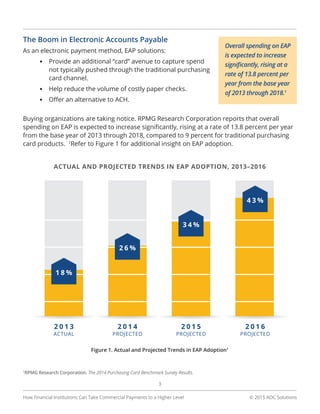
Buying organizations are taking notice. RPMG Research Corporation reports that overall
spending on EAP is expected to increase significantly, rising at a rate of 13.8 percent per year
from the base year of 2013 through 2018, compared to 9 percent for traditional purchasing
card products. 1
Refer to Figure 1 for additional insight on EAP adoption.
ACTUAL AND PROJECTED TRENDS IN EAP ADOPTION, 2013–2016
Figure 1. Actual and Projected Trends in EAP Adoption1
1
RPMG Research Corporation. The 2014 Purchasing Card Benchmark Survey Results.
Overall spending on EAP
is expected to increase
significantly, rising at a
rate of 13.8 percent per
year from the base year
of 2013 through 2018.1
© 2015 AOC Solutions
4
How Financial Institutions Can Take Commercial Payments to a Higher Level
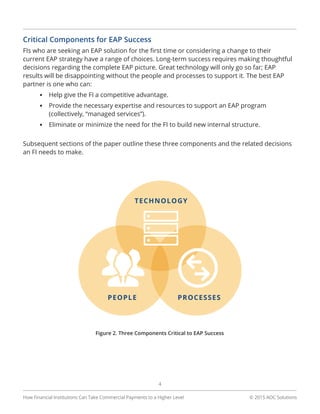
Critical Components for EAP Success
FIs who are seeking an EAP solution for the first time or considering a change to their
current EAP strategy have a range of choices. Long-term success requires making thoughtful
decisions regarding the complete EAP picture. Great technology will only go so far; EAP
results will be disappointing without the people and processes to support it. The best EAP
partner is one who can:
•	 Help give the FI a competitive advantage.
•	 Provide the necessary expertise and resources to support an EAP program
(collectively, “managed services”).
•	 Eliminate or minimize the need for the FI to build new internal structure.
Subsequent sections of the paper outline these three components and the related decisions
an FI needs to make.
Figure 2. Three Components Critical to EAP Success
© 2015 AOC Solutions
5
How Financial Institutions Can Take Commercial Payments to a Higher Level
Choices in EAP Technology
The race has been on as a variety of industry players (e.g., card networks, processors and
technology providers) have strived to develop and refine their respective EAP offerings, each
of which differs in functionality.
Following is a review of different technology features for an FI to consider.
Payment Options
EAP solutions are designed to accommodate a commercial client’s traditional purchase-to-
pay process with invoice approval occurring prior to payment. The difference is in how the
supplier is paid.
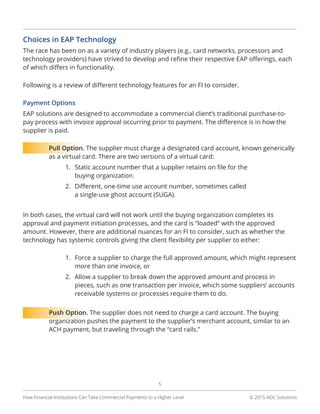
Pull Option. The supplier must charge a designated card account, known generically
as a virtual card. There are two versions of a virtual card:
1.	 Static account number that a supplier retains on file for the
buying organization.
2.	 Different, one-time use account number, sometimes called
a single-use ghost account (SUGA).
In both cases, the virtual card will not work until the buying organization completes its
approval and payment initiation processes, and the card is “loaded” with the approved
amount. However, there are additional nuances for an FI to consider, such as whether the
technology has systemic controls giving the client flexibility per supplier to either:
1.	 Force a supplier to charge the full approved amount, which might represent
more than one invoice, or
2.	 Allow a supplier to break down the approved amount and process in
pieces, such as one transaction per invoice, which some suppliers’ accounts
receivable systems or processes require them to do.
Push Option. The supplier does not need to charge a card account. The buying
organization pushes the payment to the supplier’s merchant account, similar to an
ACH payment, but traveling through the “card rails.”
© 2015 AOC Solutions
6
It would be logical to assume that push payments would be more popular among suppliers
since this option eliminates the step of processing a charge transaction. However, depending
on their accounts receivable process, many suppliers still prefer or require the pull option.
Other Payment Options. If a supplier will not accept
either card-based scenario, some EAP solutions can also
accommodate ACH, wire payments or even checks.
Client Usability Options
Related to payment options is the growing popularity among
commercial clients to be able to furnish, post-invoice approval, a
single file for processing. Also known as “one-file processing” or
“comprehensive payables,” this involves the FI parsing out
the correct payment method (virtual card, push payment, ACH,
wire or check) for each supplier.
With or without one-file processing, a common part of an EAP
solution is for the client to “batch” electronic files (e.g., payment
instruction files) to its EAP partner to initiate the payment process
to suppliers. As an alternative, some EAP solutions also have
the option for the client to use a Web service to initiate supplier
payments directly — without sending files to the EAP partner.
Remittance Advice Options
Some EAP solutions might require a supplier to access a designated portal for advice
retrieval. However, because some suppliers have “portal fatigue,” an FI should look for an
EAP solution that can provide other formats, such as email or fax, based on a supplier’s
preference. Further, if emails and/or fax are possible, an FI should determine if the advice
could be branded for the client.
How Financial Institutions Can Take Commercial Payments to a Higher Level
To meet the various
preferences of clients and
their suppliers, an FI should
consider a solution that:
•	Can handle all payment
types and options.
•	Offers flexible systemic
controls and remittance
advice delivery options.
•	Allows the client to
choose among different
methods for initiating
payments to suppliers.
© 2015 AOC Solutions
7
People and Process Considerations
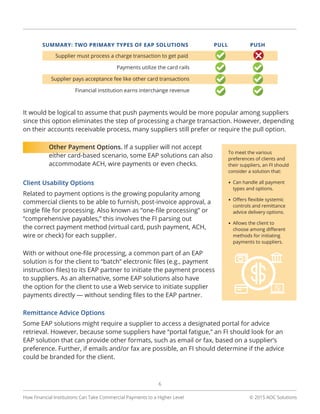
Evaluating EAP technology is just one part. Before selecting an EAP partner, an FI has
important decisions to make pertaining to program support (the people and processes).
To what extent does the FI want or need the EAP partner to be involved?
How Financial Institutions Can Take Commercial Payments to a Higher Level
KEY TASKS AND THE DIVISION OF RESPONSIBILITIES
© 2015 AOC Solutions
8
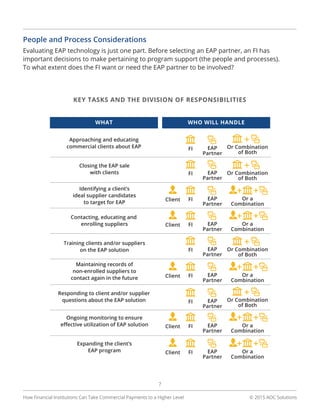
Common Initial Reactions by FIs and the Related Drawbacks
As an FI considers the key tasks, the following initial reactions are natural but, as outlined, can
be short-sighted and cause future issues.
How Financial Institutions Can Take Commercial Payments to a Higher Level
© 2015 AOC Solutions
9
How Financial Institutions Can Take Commercial Payments to a Higher Level
Benefits of Using EAP Managed Services
If an FI does choose to be responsible for the majority
of tasks, this likely means hiring additional staff with
the specialized expertise and building the necessary
infrastructure. Conversely, an FI could seek an EAP partner
with managed services — the expertise and willingness to
take the lead on these activities, which loosely fall into the
categories of:
•	 Implementation.
•	 Supplier enrollment.
•	 Relationship management.
•	 Client training and support.
Nearly every FI has some type of resource and/or economic constraints that can make this
appealing. While an EAP partner typically charges an FI for these added services, this route
could be far less expensive for the FI when all factors are considered. Moreover, there is
greater potential for EAP growth. One additional consideration is whether the EAP partner
will provide the FI with client leads to expand the FI’s EAP client base. As an FI evaluates the
options, it should be aware that some EAP providers do not offer the full range of managed
services — a fact that could narrow the pool of potential partners.
Fee Categories
Last, but not least, are the potential types of fees an FI might incur, including:
•	 One-time implementation fee.
•	 Fee per EAP transaction and the associated structure — basis points (bps) or flat fee.
•	 Fee for not meeting a certain minimum EAP activity level.
•	 Reporting fees.
•	 Service fees.
Managed services —
the necessary expertise
and resources to effectively
support an EAP program
— can be the component
that ultimately makes or
breaks an FI’s success
with EAP.
© 2015 AOC SolutionsHow Financial Institutions Can Take Commercial Payments to a Higher Level
Technology. People. Processes.
All three are critical components to an FI’s success with EAP.
An FI should be prepared to meet the challenges of today and
tomorrow. Many simply do not have the breadth and depth of
resources to optimize EAP programs on their own. An appropriate
EAP partner — one who offers robust technology plus a range of
managed services — can be a great answer for an FI who
is looking strengthen its competitive position within
the commercial payments industry. With the right
partnership, an FI can actually enhance
relationships with clients, improving — versus
damaging — customer service through a renewed
focus on clients’ needs.
C O N C L U S I O N
info@aocsolutions.com • www.aocsolutions.com • 703.234.6300
AOC Solutions Inc. • 14151 Newbrook Drive, Suite 200, Chantilly, Virginia 20151
©2015 AOC Solutions Inc. • All rights reserved • 04/2015
A B O U T A O C S O L U T I O N S
AOC Solutions, a technology leader and service provider, specializes in optimizing financial
performance for financial institutions and corporate end users, many of which are Fortune
500 companies. Our services, available through the three divisions below, transform
traditional business processes for financial management to help organizations significantly
reduce costs.
Commercial Payments – Our suite of products helps organizations streamline AP processes
and commercial card management to significantly reduce costs and, in some cases, increase
revenues. AOC’s global payments platform, EnCompassSM
, allows for multi-currency, multi-
language and respective localization, and it’s optimized for mobile devices.
Claims Payments – AOC offers a variety of solutions to its clients for healthcare, property &
casualty, worker’s compensation and warranty claims payments, allowing for delivery of claim
payment together with supporting documentation, such as an Explanation of Payment (EOP).
Managed Services – We help Commercial Payments and Claims Payments clients become
more efficient and successful through vendor/provider enrollment, contact center services,
invoice processing and training classes.

Taking Commercial Payments to the Next Level

  • 1.
    Managed Services Offerthe Path to Getting There How Financial Institutions Can Take Commercial Payments to a Higher Level
  • 2.
    © 2015 AOCSolutions 2 S U M M A R Y How Financial Institutions Can Take Commercial Payments to a Higher Level Financial institutions (FIs) know that to retain clients and attract new ones they must offer robust commercial card solutions that meet their clients’ business-to-business (B2B) payment needs. The reality is that they can no longer limit their card products to traditional plastic. A “card program” now means so much more. Increasingly, FIs’ commercial clients — buying organizations — are seeking Electronic Accounts Payable (EAP) solutions to round out their payment strategies. One of the biggest challenges for an FI is competing with other FIs that have an edge in one or more areas, whether it’s larger staffs, bigger budgets or more advanced technology to support commercial clients. The Upside and Downside to Electronic Accounts Payable (EAP) Most FIs have already identified EAP as their highest growth and highest revenue opportunity. However, some currently do not offer any EAP solution or, if they do, they might be relying on one that does not fully meet their clients’ needs and needs of clients’ suppliers. Because one size does not fit all, an FI must ensure that its EAP offering is multi-dimensional, supported by knowledgeable people and effective processes. This is a lot to accomplish. FIs do not always have the time, expertise and resources to focus on EAP, making it imperative to choose the right EAP partner with the right managed services. Fortunately, no matter the size of an FI, it can excel in this space without having to invest in technology development or additional human resources. ABOUT THE PAPER To help FIs at any EAP stage make the best possible decisions about its future direction, this paper: • Provides EAP growth trends. • Specifies three critical components for EAP success. • Describes different EAP technology options and features. • Explores considerations related to managed services when selecting an EAP partner. • Lists potential fee categories an FI might encounter.
  • 3.
    © 2015 AOCSolutions 3 How Financial Institutions Can Take Commercial Payments to a Higher Level The Boom in Electronic Accounts Payable As an electronic payment method, EAP solutions: • Provide an additional “card” avenue to capture spend not typically pushed through the traditional purchasing card channel. • Help reduce the volume of costly paper checks. • Offer an alternative to ACH. Buying organizations are taking notice. RPMG Research Corporation reports that overall spending on EAP is expected to increase significantly, rising at a rate of 13.8 percent per year from the base year of 2013 through 2018, compared to 9 percent for traditional purchasing card products. 1 Refer to Figure 1 for additional insight on EAP adoption. ACTUAL AND PROJECTED TRENDS IN EAP ADOPTION, 2013–2016 Figure 1. Actual and Projected Trends in EAP Adoption1 1 RPMG Research Corporation. The 2014 Purchasing Card Benchmark Survey Results. Overall spending on EAP is expected to increase significantly, rising at a rate of 13.8 percent per year from the base year of 2013 through 2018.1
  • 4.
    © 2015 AOCSolutions 4 How Financial Institutions Can Take Commercial Payments to a Higher Level Critical Components for EAP Success FIs who are seeking an EAP solution for the first time or considering a change to their current EAP strategy have a range of choices. Long-term success requires making thoughtful decisions regarding the complete EAP picture. Great technology will only go so far; EAP results will be disappointing without the people and processes to support it. The best EAP partner is one who can: • Help give the FI a competitive advantage. • Provide the necessary expertise and resources to support an EAP program (collectively, “managed services”). • Eliminate or minimize the need for the FI to build new internal structure. Subsequent sections of the paper outline these three components and the related decisions an FI needs to make. Figure 2. Three Components Critical to EAP Success
  • 5.
    © 2015 AOCSolutions 5 How Financial Institutions Can Take Commercial Payments to a Higher Level Choices in EAP Technology The race has been on as a variety of industry players (e.g., card networks, processors and technology providers) have strived to develop and refine their respective EAP offerings, each of which differs in functionality. Following is a review of different technology features for an FI to consider. Payment Options EAP solutions are designed to accommodate a commercial client’s traditional purchase-to- pay process with invoice approval occurring prior to payment. The difference is in how the supplier is paid. Pull Option. The supplier must charge a designated card account, known generically as a virtual card. There are two versions of a virtual card: 1. Static account number that a supplier retains on file for the buying organization. 2. Different, one-time use account number, sometimes called a single-use ghost account (SUGA). In both cases, the virtual card will not work until the buying organization completes its approval and payment initiation processes, and the card is “loaded” with the approved amount. However, there are additional nuances for an FI to consider, such as whether the technology has systemic controls giving the client flexibility per supplier to either: 1. Force a supplier to charge the full approved amount, which might represent more than one invoice, or 2. Allow a supplier to break down the approved amount and process in pieces, such as one transaction per invoice, which some suppliers’ accounts receivable systems or processes require them to do. Push Option. The supplier does not need to charge a card account. The buying organization pushes the payment to the supplier’s merchant account, similar to an ACH payment, but traveling through the “card rails.”
  • 6.
    © 2015 AOCSolutions 6 It would be logical to assume that push payments would be more popular among suppliers since this option eliminates the step of processing a charge transaction. However, depending on their accounts receivable process, many suppliers still prefer or require the pull option. Other Payment Options. If a supplier will not accept either card-based scenario, some EAP solutions can also accommodate ACH, wire payments or even checks. Client Usability Options Related to payment options is the growing popularity among commercial clients to be able to furnish, post-invoice approval, a single file for processing. Also known as “one-file processing” or “comprehensive payables,” this involves the FI parsing out the correct payment method (virtual card, push payment, ACH, wire or check) for each supplier. With or without one-file processing, a common part of an EAP solution is for the client to “batch” electronic files (e.g., payment instruction files) to its EAP partner to initiate the payment process to suppliers. As an alternative, some EAP solutions also have the option for the client to use a Web service to initiate supplier payments directly — without sending files to the EAP partner. Remittance Advice Options Some EAP solutions might require a supplier to access a designated portal for advice retrieval. However, because some suppliers have “portal fatigue,” an FI should look for an EAP solution that can provide other formats, such as email or fax, based on a supplier’s preference. Further, if emails and/or fax are possible, an FI should determine if the advice could be branded for the client. How Financial Institutions Can Take Commercial Payments to a Higher Level To meet the various preferences of clients and their suppliers, an FI should consider a solution that: • Can handle all payment types and options. • Offers flexible systemic controls and remittance advice delivery options. • Allows the client to choose among different methods for initiating payments to suppliers.
  • 7.
    © 2015 AOCSolutions 7 People and Process Considerations Evaluating EAP technology is just one part. Before selecting an EAP partner, an FI has important decisions to make pertaining to program support (the people and processes). To what extent does the FI want or need the EAP partner to be involved? How Financial Institutions Can Take Commercial Payments to a Higher Level KEY TASKS AND THE DIVISION OF RESPONSIBILITIES
  • 8.
    © 2015 AOCSolutions 8 Common Initial Reactions by FIs and the Related Drawbacks As an FI considers the key tasks, the following initial reactions are natural but, as outlined, can be short-sighted and cause future issues. How Financial Institutions Can Take Commercial Payments to a Higher Level
  • 9.
    © 2015 AOCSolutions 9 How Financial Institutions Can Take Commercial Payments to a Higher Level Benefits of Using EAP Managed Services If an FI does choose to be responsible for the majority of tasks, this likely means hiring additional staff with the specialized expertise and building the necessary infrastructure. Conversely, an FI could seek an EAP partner with managed services — the expertise and willingness to take the lead on these activities, which loosely fall into the categories of: • Implementation. • Supplier enrollment. • Relationship management. • Client training and support. Nearly every FI has some type of resource and/or economic constraints that can make this appealing. While an EAP partner typically charges an FI for these added services, this route could be far less expensive for the FI when all factors are considered. Moreover, there is greater potential for EAP growth. One additional consideration is whether the EAP partner will provide the FI with client leads to expand the FI’s EAP client base. As an FI evaluates the options, it should be aware that some EAP providers do not offer the full range of managed services — a fact that could narrow the pool of potential partners. Fee Categories Last, but not least, are the potential types of fees an FI might incur, including: • One-time implementation fee. • Fee per EAP transaction and the associated structure — basis points (bps) or flat fee. • Fee for not meeting a certain minimum EAP activity level. • Reporting fees. • Service fees. Managed services — the necessary expertise and resources to effectively support an EAP program — can be the component that ultimately makes or breaks an FI’s success with EAP.
  • 10.
    © 2015 AOCSolutionsHow Financial Institutions Can Take Commercial Payments to a Higher Level Technology. People. Processes. All three are critical components to an FI’s success with EAP. An FI should be prepared to meet the challenges of today and tomorrow. Many simply do not have the breadth and depth of resources to optimize EAP programs on their own. An appropriate EAP partner — one who offers robust technology plus a range of managed services — can be a great answer for an FI who is looking strengthen its competitive position within the commercial payments industry. With the right partnership, an FI can actually enhance relationships with clients, improving — versus damaging — customer service through a renewed focus on clients’ needs. C O N C L U S I O N
  • 11.
    info@aocsolutions.com • www.aocsolutions.com• 703.234.6300 AOC Solutions Inc. • 14151 Newbrook Drive, Suite 200, Chantilly, Virginia 20151 ©2015 AOC Solutions Inc. • All rights reserved • 04/2015 A B O U T A O C S O L U T I O N S AOC Solutions, a technology leader and service provider, specializes in optimizing financial performance for financial institutions and corporate end users, many of which are Fortune 500 companies. Our services, available through the three divisions below, transform traditional business processes for financial management to help organizations significantly reduce costs. Commercial Payments – Our suite of products helps organizations streamline AP processes and commercial card management to significantly reduce costs and, in some cases, increase revenues. AOC’s global payments platform, EnCompassSM , allows for multi-currency, multi- language and respective localization, and it’s optimized for mobile devices. Claims Payments – AOC offers a variety of solutions to its clients for healthcare, property & casualty, worker’s compensation and warranty claims payments, allowing for delivery of claim payment together with supporting documentation, such as an Explanation of Payment (EOP). Managed Services – We help Commercial Payments and Claims Payments clients become more efficient and successful through vendor/provider enrollment, contact center services, invoice processing and training classes.