PRESENTED BY
A.F. MD. ANWARUL AZIM
SENIOR PRINCIPAL OFFICER
CORPORATE INVESTMENT DIVISION
HEAD OFFICE
WORKING CAPITAL ASSESSMENT
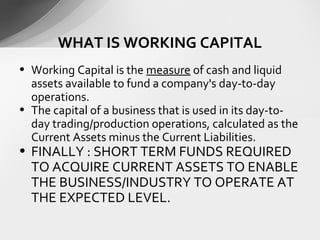
• Working Capital is the measure of cash and liquid
assets available to fund a company's day-to-day
operations.
• The capital of a business that is used in its day-to-
day trading/production operations, calculated as the
Current Assets minus the Current Liabilities.
• FINALLY : SHORT TERM FUNDS REQUIRED
TO ACQUIRE CURRENT ASSETS TO ENABLE
THE BUSINESS/INDUSTRY TO OPERATE AT
THE EXPECTED LEVEL.
WHAT IS WORKING CAPITAL
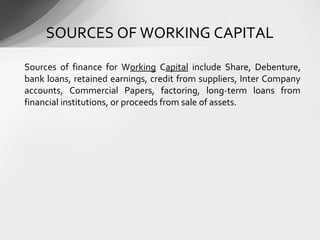
SOURCES OF WORKING CAPITAL
Sources of finance for Working Capital include Share, Debenture,
bank loans, retained earnings, credit from suppliers, Inter Company
accounts, Commercial Papers, factoring, long-term loans from
financial institutions, or proceeds from sale of assets.
• Nature of Business
• Length of Operating Cycle
• Operating Cycle Fluctuation
• Scale of Operation &Operating Efficiency
• Seasonal Factors
• Technology and Production Cycle
• Credit Allowed & Credit Avail
• Availability of Raw Materials
• Level of Competition
• Inflation
• Growth Prospects
FACTORS AFFECTING THE WORKING CAPITAL
• Current Asset & Current Liability Method
• Tied-up Period & Operation Cycle Method
• Annual Turnover Method
• Tied-up Period & Operation Cycle Method
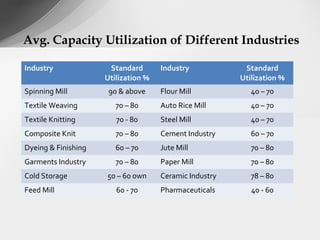
– Capacity utilization is needed to assess WC
– Capacity utilization varies from industry to industry
– Spinning Mills run at higher capacity (90% & above)
– Appropriate capacity utilization to be considered
– Tied-up periods for various activities are needed to
assess WC
– Appropriate tied-up period for various activities to be
considered
METHODS OF WORKING CAPITAL ASSESSMENT
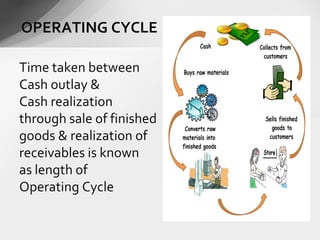
Time taken between
Cash outlay &
Cash realization
through sale of finished
goods & realization of
receivables is known
as length of
Operating Cycle
OPERATING CYCLE
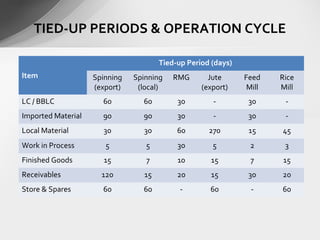
TIED-UP PERIODS & OPERATION CYCLE
Item
Tied-up Period (days)
Spinning
(export)
Spinning
(local)
RMG Jute
(export)
Feed
Mill
Rice
Mill
LC / BBLC 60 60 30 - 30 -
Imported Material 90 90 30 - 30 -
Local Material 30 30 60 270 15 45
Work in Process 5 5 30 5 2 3
Finished Goods 15 7 10 15 7 15
Receivables 120 15 20 15 30 20
Store & Spares 60 60 - 60 - 60
WORKING CAPITAL ANALYSIS
[EXPORT ORIENTED RMG]
Item Tied-up
(day)
Capacity Utilization (%)
100 80 70
Raw Material (LC) 30 56.2 45.0 39.3
Raw Material (Inventory) 30 56.2 45.0 39.3
Accessories (Inventory) 60 42.1 33.7 29.5
Working in Process 30 125.7 100.6 88.0
Finished Goods 10 41.9 33.5 29.3
Receivables 20 83.8 67.0 58.7
Total 180 405.9 324.8 284.1
Less Clients equity (0%) 0 0 0
Net Requirement 406 325 284
Assumptions:
– Knit Garments (30-line): 36,000 pcs/day
– Yarn Required (2.5 kg/dz): 7,500 kg
– Price of Yarn: US$ 3.2 per kg
– Yarn Cost (7500*3.2*78): Tk. 1.872 million/day
– Accessories (US$ 3/dz): Tk. 0.702 million/day
– Exchange Rate: Tk. 78/US$
– Wages & Salaries: Tk. 15 million/month
– Fuel & Gas: Tk. 2.00 million/month
– Knitting Charge (Tk. 15/kg) Tk. 0.112 million/day
– Dyeing Charge (US$ 1.6/kg) Tk. 0.936 million/day
– WIP= (56.2+21.06+15+2+(0.112+0.936)*30 Tk. 125.7 million/day
WORKING CAPITAL ANALYSIS
[EXPORT ORIENTED RMG]
The assessment requires to extract actual and authenticated data to calculate
WC. Remember, to assess the real requirement of the project, you will require
to reach into the heart of the business. Consider yourself wearing the shoes of
the key person of the business.
Avg. Capacity Utilization of Different Industries
Industry Standard
Utilization %
Industry Standard
Utilization %
Spinning Mill 90 & above Flour Mill 40 – 70
Textile Weaving 70 – 80 Auto Rice Mill 40 – 70
Textile Knitting 70 - 80 Steel Mill 40 – 70
Composite Knit 70 – 80 Cement Industry 60 – 70
Dyeing & Finishing 60 – 70 Jute Mill 70 – 80
Garments Industry 70 – 80 Paper Mill 70 – 80
Cold Storage 50 – 60 own Ceramic Industry 78 – 80
Feed Mill 60 - 70 Pharmaceuticals 40 - 60
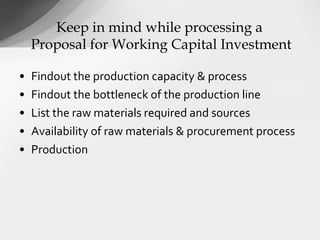
• Findout the production capacity & process
• Findout the bottleneck of the production line
• List the raw materials required and sources
• Availability of raw materials & procurement process
• Production
Keep in mind while processing a
Proposal for Working Capital Investment
Working Capital Assessment

Working Capital Assessment

  • 1.
    PRESENTED BY A.F. MD.ANWARUL AZIM SENIOR PRINCIPAL OFFICER CORPORATE INVESTMENT DIVISION HEAD OFFICE WORKING CAPITAL ASSESSMENT
  • 2.
    • Working Capitalis the measure of cash and liquid assets available to fund a company's day-to-day operations. • The capital of a business that is used in its day-to- day trading/production operations, calculated as the Current Assets minus the Current Liabilities. • FINALLY : SHORT TERM FUNDS REQUIRED TO ACQUIRE CURRENT ASSETS TO ENABLE THE BUSINESS/INDUSTRY TO OPERATE AT THE EXPECTED LEVEL. WHAT IS WORKING CAPITAL
  • 3.
    SOURCES OF WORKINGCAPITAL Sources of finance for Working Capital include Share, Debenture, bank loans, retained earnings, credit from suppliers, Inter Company accounts, Commercial Papers, factoring, long-term loans from financial institutions, or proceeds from sale of assets.
  • 4.
    • Nature ofBusiness • Length of Operating Cycle • Operating Cycle Fluctuation • Scale of Operation &Operating Efficiency • Seasonal Factors • Technology and Production Cycle • Credit Allowed & Credit Avail • Availability of Raw Materials • Level of Competition • Inflation • Growth Prospects FACTORS AFFECTING THE WORKING CAPITAL
  • 5.
    • Current Asset& Current Liability Method • Tied-up Period & Operation Cycle Method • Annual Turnover Method • Tied-up Period & Operation Cycle Method – Capacity utilization is needed to assess WC – Capacity utilization varies from industry to industry – Spinning Mills run at higher capacity (90% & above) – Appropriate capacity utilization to be considered – Tied-up periods for various activities are needed to assess WC – Appropriate tied-up period for various activities to be considered METHODS OF WORKING CAPITAL ASSESSMENT
  • 6.
    Time taken between Cashoutlay & Cash realization through sale of finished goods & realization of receivables is known as length of Operating Cycle OPERATING CYCLE
  • 7.
    TIED-UP PERIODS &OPERATION CYCLE Item Tied-up Period (days) Spinning (export) Spinning (local) RMG Jute (export) Feed Mill Rice Mill LC / BBLC 60 60 30 - 30 - Imported Material 90 90 30 - 30 - Local Material 30 30 60 270 15 45 Work in Process 5 5 30 5 2 3 Finished Goods 15 7 10 15 7 15 Receivables 120 15 20 15 30 20 Store & Spares 60 60 - 60 - 60
  • 8.
    WORKING CAPITAL ANALYSIS [EXPORTORIENTED RMG] Item Tied-up (day) Capacity Utilization (%) 100 80 70 Raw Material (LC) 30 56.2 45.0 39.3 Raw Material (Inventory) 30 56.2 45.0 39.3 Accessories (Inventory) 60 42.1 33.7 29.5 Working in Process 30 125.7 100.6 88.0 Finished Goods 10 41.9 33.5 29.3 Receivables 20 83.8 67.0 58.7 Total 180 405.9 324.8 284.1 Less Clients equity (0%) 0 0 0 Net Requirement 406 325 284
  • 9.
    Assumptions: – Knit Garments(30-line): 36,000 pcs/day – Yarn Required (2.5 kg/dz): 7,500 kg – Price of Yarn: US$ 3.2 per kg – Yarn Cost (7500*3.2*78): Tk. 1.872 million/day – Accessories (US$ 3/dz): Tk. 0.702 million/day – Exchange Rate: Tk. 78/US$ – Wages & Salaries: Tk. 15 million/month – Fuel & Gas: Tk. 2.00 million/month – Knitting Charge (Tk. 15/kg) Tk. 0.112 million/day – Dyeing Charge (US$ 1.6/kg) Tk. 0.936 million/day – WIP= (56.2+21.06+15+2+(0.112+0.936)*30 Tk. 125.7 million/day WORKING CAPITAL ANALYSIS [EXPORT ORIENTED RMG] The assessment requires to extract actual and authenticated data to calculate WC. Remember, to assess the real requirement of the project, you will require to reach into the heart of the business. Consider yourself wearing the shoes of the key person of the business.
  • 10.
    Avg. Capacity Utilizationof Different Industries Industry Standard Utilization % Industry Standard Utilization % Spinning Mill 90 & above Flour Mill 40 – 70 Textile Weaving 70 – 80 Auto Rice Mill 40 – 70 Textile Knitting 70 - 80 Steel Mill 40 – 70 Composite Knit 70 – 80 Cement Industry 60 – 70 Dyeing & Finishing 60 – 70 Jute Mill 70 – 80 Garments Industry 70 – 80 Paper Mill 70 – 80 Cold Storage 50 – 60 own Ceramic Industry 78 – 80 Feed Mill 60 - 70 Pharmaceuticals 40 - 60
  • 11.
    • Findout theproduction capacity & process • Findout the bottleneck of the production line • List the raw materials required and sources • Availability of raw materials & procurement process • Production Keep in mind while processing a Proposal for Working Capital Investment