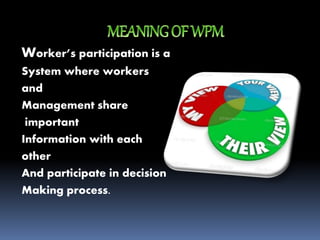
Worker’s participation is a
System where workers
and
Management share
important
Information with each
other
And participate in decision
Making process.
 Increase worker's SATISFACTION from work .
 Increase PRODUCTIVITY with joint efforts .
 Generate a “WE” feeling among workers to
achieve organizational goals.
 To promote DEMOCRATIC practice.
 To promote HARMONY & PEACE between
worker & management.
 To manage RESISTANCETO CHANGE and
SMOOTH IMPLEMENTATION of decision.
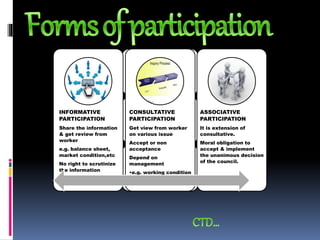
INFORMATIVE
PARTICIPATION
Share the information
& get review from
worker
e.g. balance sheet,
market condition,etc
No right to scrutinize
the information
CONSULTATIVE
PARTICIPATION
Get view from worker
on various issue
Accept or non
acceptance
Depend on
management
•e.g. working condition
etc
ASSOCIATIVE
PARTICIPATION
It is extension of
consultative.
Moral obligation to
accept & implement
the unanimous decision
of the council.
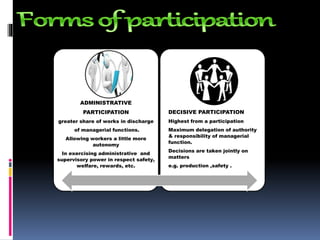
ADMINISTRATIVE
PARTICIPATION
greater share of works in discharge
of managerial functions.
Allowing workers a little more
autonomy
In exercising administrative and
supervisory power in respect safety,
welfare, rewards, etc.
DECISIVE PARTICIPATION
Highest from a participation
Maximum delegation of authority
& responsibility of managerial
function.
Decisions are taken jointly on
matters
e.g. production ,safety .
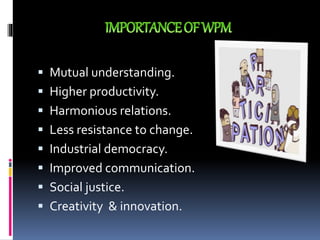
 Mutual understanding.
 Higher productivity.
 Harmonious relations.
 Less resistance to change.
 Industrial democracy.
 Improved communication.
 Social justice.
 Creativity & innovation.
1. Clarity of Objectives
2. Free Flow of Information
3. Democratic Attitude
4. Mutual Faith
5. Strong & Democratic union
6. ProvidingTraining
7. Continue Process
8. Participation of OutsideTrade Union
leader to be avoided.
INDIRECT
REPRESENTATIVE:
Introduced by govt.
through legal
Provisions or
Notifications.
E.g.Works Committee,
Joint management
council ,Worker’s
director etc..
DIRECT
PARTICIPATION:
Opportunity for
each & every worker
to participate in
management
through mechanism
E.g. Suggestions
scheme, Small
group activity,
Quality circles etc…
Royal govt .policy on labour
and wpm
 In 1920 constituted JOINT
COMMITTES in their printing
& railways.
 This policy adopt byTISCO in
same period.
 Mutual discussion &
consolation of issue failing
which they were to be
resolved by ARBITRATION.
 In 1922 joint committees of
workers & management were
formed in Bengal, madras &
other states.
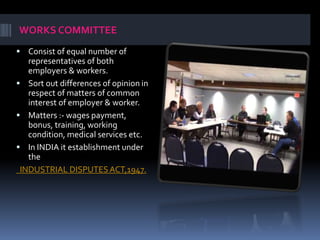
WORKS COMMITTEE
 Consist of equal number of
representatives of both
employers & workers.
 Sort out differences of opinion in
respect of matters of common
interest of employer & worker.
 Matters :- wages payment,
bonus, training, working
condition, medical services etc.
 In INDIA it establishment under
the
INDUSTRIAL DISPUTESACT,1947.
WORKER DIRECTORS
JOINT MANAGEMENT
COUNCIL
 Worker’s representatives are
taken on the BOD.
 The elected by all the workers
through secret ballot.
 After nationalization of banks
the govt. advised all the
nationalized bank to appoint
employee directors to their
BOD.
 Limitations :- worker's director
would be in a minority .
 They are not properly trained in
management functions.
 It consist of representatives of
employer & management.
 This study of schemes of wpm in
countries like U.K., France,
Belgium, &Yugoslavia.
 It was considered by Indian
labour conference (ILC).
 The decision are not binding on
either party.
 Matter :- labour welfare, safety
measures, training, working hour
etc…
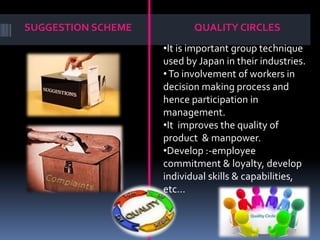
SUGGESTION SCHEME QUALITY CIRCLES
•It is important group technique
used by Japan in their industries.
•To involvement of workers in
decision making process and
hence participation in
management.
•It improves the quality of
product & manpower.
•Develop :-employee
commitment & loyalty, develop
individual skills & capabilities,
etc…
 BHEL stands for “Bharat Heavy Electricals
Limited “
 According to BHEL ,WPM is the process, by
which authority & responsibility of managing
industry are share with workers.
 A works committee formed consisting of
elected representatives of workers &
management .(in 1966)
 In 1978 BHEL, Bhopal introduced the
Management employees ’communication
meeting (MECOMs).
ctd…………
 Experience .
 Possibilities .
 People building and mutual development.
Worker’s participation in management

Worker’s participation in management

  • 2.
    Worker’s participation isa System where workers and Management share important Information with each other And participate in decision Making process.
  • 3.
     Increase worker'sSATISFACTION from work .  Increase PRODUCTIVITY with joint efforts .  Generate a “WE” feeling among workers to achieve organizational goals.  To promote DEMOCRATIC practice.  To promote HARMONY & PEACE between worker & management.  To manage RESISTANCETO CHANGE and SMOOTH IMPLEMENTATION of decision.
  • 4.
    INFORMATIVE PARTICIPATION Share the information &get review from worker e.g. balance sheet, market condition,etc No right to scrutinize the information CONSULTATIVE PARTICIPATION Get view from worker on various issue Accept or non acceptance Depend on management •e.g. working condition etc ASSOCIATIVE PARTICIPATION It is extension of consultative. Moral obligation to accept & implement the unanimous decision of the council.
  • 5.
    ADMINISTRATIVE PARTICIPATION greater share ofworks in discharge of managerial functions. Allowing workers a little more autonomy In exercising administrative and supervisory power in respect safety, welfare, rewards, etc. DECISIVE PARTICIPATION Highest from a participation Maximum delegation of authority & responsibility of managerial function. Decisions are taken jointly on matters e.g. production ,safety .
  • 6.
     Mutual understanding. Higher productivity.  Harmonious relations.  Less resistance to change.  Industrial democracy.  Improved communication.  Social justice.  Creativity & innovation.
  • 7.
    1. Clarity ofObjectives 2. Free Flow of Information 3. Democratic Attitude 4. Mutual Faith 5. Strong & Democratic union 6. ProvidingTraining 7. Continue Process 8. Participation of OutsideTrade Union leader to be avoided.
  • 8.
    INDIRECT REPRESENTATIVE: Introduced by govt. throughlegal Provisions or Notifications. E.g.Works Committee, Joint management council ,Worker’s director etc.. DIRECT PARTICIPATION: Opportunity for each & every worker to participate in management through mechanism E.g. Suggestions scheme, Small group activity, Quality circles etc…
  • 9.
    Royal govt .policyon labour and wpm  In 1920 constituted JOINT COMMITTES in their printing & railways.  This policy adopt byTISCO in same period.  Mutual discussion & consolation of issue failing which they were to be resolved by ARBITRATION.  In 1922 joint committees of workers & management were formed in Bengal, madras & other states.
  • 10.
    WORKS COMMITTEE  Consistof equal number of representatives of both employers & workers.  Sort out differences of opinion in respect of matters of common interest of employer & worker.  Matters :- wages payment, bonus, training, working condition, medical services etc.  In INDIA it establishment under the INDUSTRIAL DISPUTESACT,1947.
  • 11.
    WORKER DIRECTORS JOINT MANAGEMENT COUNCIL Worker’s representatives are taken on the BOD.  The elected by all the workers through secret ballot.  After nationalization of banks the govt. advised all the nationalized bank to appoint employee directors to their BOD.  Limitations :- worker's director would be in a minority .  They are not properly trained in management functions.  It consist of representatives of employer & management.  This study of schemes of wpm in countries like U.K., France, Belgium, &Yugoslavia.  It was considered by Indian labour conference (ILC).  The decision are not binding on either party.  Matter :- labour welfare, safety measures, training, working hour etc…
  • 12.
    SUGGESTION SCHEME QUALITYCIRCLES •It is important group technique used by Japan in their industries. •To involvement of workers in decision making process and hence participation in management. •It improves the quality of product & manpower. •Develop :-employee commitment & loyalty, develop individual skills & capabilities, etc…
  • 13.
     BHEL standsfor “Bharat Heavy Electricals Limited “  According to BHEL ,WPM is the process, by which authority & responsibility of managing industry are share with workers.  A works committee formed consisting of elected representatives of workers & management .(in 1966)  In 1978 BHEL, Bhopal introduced the Management employees ’communication meeting (MECOMs). ctd…………
  • 14.
     Experience . Possibilities .  People building and mutual development.