
WORKERS PARTICIPATION
IN MANAGEMENT
DEFINITION
 According to Keith Davis, Participation refers to the
mental and emotional involvement of a person in a group
situation which encourages him to contribute to group goals
and share the responsibility of achievement.
 Workers’ participation in management means giving
scope for workers to influence the managerial decision-
making process at different levels by various forms in the
organization.
OBJECTIVES OF WORKERS’
PARTICIPATION
 Aware of Democratic right to influence the managerial decisions
 Raise worker’ level of motivation and commitment (own
decisions)
 Cross-fertilisation and speedy communication of ideas
 Avoid conflict and foster better co-operation between labour and
management.
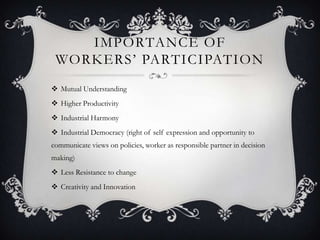
IMPORTANCE OF
WORKERS’ PARTICIPATION
 Mutual Understanding
 Higher Productivity
 Industrial Harmony
 Industrial Democracy (right of self expression and opportunity to
communicate views on policies, worker as responsible partner in decision
making)
 Less Resistance to change
 Creativity and Innovation
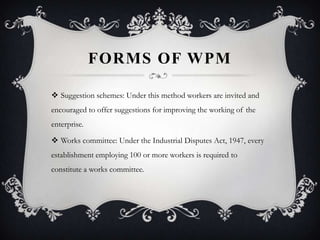
FORMS OF WPM
 Suggestion schemes: Under this method workers are invited and
encouraged to offer suggestions for improving the working of the
enterprise.
 Works committee: Under the Industrial Disputes Act, 1947, every
establishment employing 100 or more workers is required to
constitute a works committee.
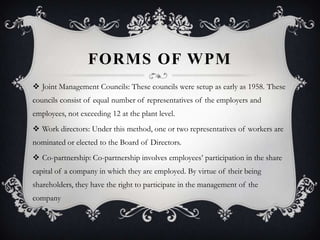
FORMS OF WPM
 Joint Management Councils: These councils were setup as early as 1958. These
councils consist of equal number of representatives of the employers and
employees, not exceeding 12 at the plant level.
 Work directors: Under this method, one or two representatives of workers are
nominated or elected to the Board of Directors.
 Co-partnership: Co-partnership involves employees’ participation in the share
capital of a company in which they are employed. By virtue of their being
shareholders, they have the right to participate in the management of the
company
THANK YOU

Workers participation in management

  • 1.
  • 2.
    DEFINITION  According toKeith Davis, Participation refers to the mental and emotional involvement of a person in a group situation which encourages him to contribute to group goals and share the responsibility of achievement.  Workers’ participation in management means giving scope for workers to influence the managerial decision- making process at different levels by various forms in the organization.
  • 3.
    OBJECTIVES OF WORKERS’ PARTICIPATION Aware of Democratic right to influence the managerial decisions  Raise worker’ level of motivation and commitment (own decisions)  Cross-fertilisation and speedy communication of ideas  Avoid conflict and foster better co-operation between labour and management.
  • 4.
    IMPORTANCE OF WORKERS’ PARTICIPATION Mutual Understanding  Higher Productivity  Industrial Harmony  Industrial Democracy (right of self expression and opportunity to communicate views on policies, worker as responsible partner in decision making)  Less Resistance to change  Creativity and Innovation
  • 5.
    FORMS OF WPM Suggestion schemes: Under this method workers are invited and encouraged to offer suggestions for improving the working of the enterprise.  Works committee: Under the Industrial Disputes Act, 1947, every establishment employing 100 or more workers is required to constitute a works committee.
  • 6.
    FORMS OF WPM Joint Management Councils: These councils were setup as early as 1958. These councils consist of equal number of representatives of the employers and employees, not exceeding 12 at the plant level.  Work directors: Under this method, one or two representatives of workers are nominated or elected to the Board of Directors.  Co-partnership: Co-partnership involves employees’ participation in the share capital of a company in which they are employed. By virtue of their being shareholders, they have the right to participate in the management of the company
  • 7.