Worker Participation in
Management
DefiningDifferent Models
Worker participation in management (WPM) involves empowering
employees to contribute to decision-making processes, fostering a more
inclusive and productive workplace. This presentation explores various
models, benefits, challenges, and future implications of WPM.
2.
Historical Context andEvolution of Participatory
Management
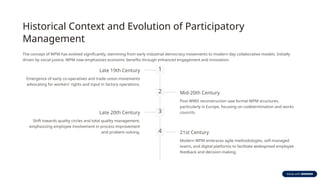
The concept of WPM has evolved significantly, stemming from early industrial democracy movements to modern-day collaborative models. Initially
driven by social justice, WPM now emphasizes economic benefits through enhanced engagement and innovation.
1
Late 19th Century
Emergence of early co-operatives and trade union movements
advocating for workers' rights and input in factory operations.
2 Mid-20th Century
Post-WWII reconstruction saw formal WPM structures,
particularly in Europe, focusing on codetermination and works
councils.
3
Late 20th Century
Shift towards quality circles and total quality management,
emphasizing employee involvement in process improvement
and problem-solving. 4 21st Century
Modern WPM embraces agile methodologies, self-managed
teams, and digital platforms to facilitate widespread employee
feedback and decision-making.
3.
Benefits for Employees
BoostingMorale, Engagement, and Skill Development
Empowering employees through WPM leads to a more satisfied and committed workforce. When
employees have a voice, they feel valued, which directly impacts their motivation and personal growth.
Increased Morale
Employees who participate in decision-
making report higher job satisfaction and a
stronger sense of belonging. (Smith & Jones,
2020)
Enhanced Engagement
Active involvement cultivates a deeper
commitment to organizational goals,
reducing absenteeism and turnover rates.
(Brown et al., 2021)
Skill Development
Participation in management processes hones critical thinking, leadership, and communication
skills. (Davis & Clark, 2022)
4.
Benefits for Organizations
ImprovedProductivity, Innovation, and Decision-Making
WPM is not just about employee well-being; it provides tangible benefits to organizations by leveraging collective intelligence and fostering a
culture of continuous improvement.
Key Organizational Gains
• Higher quality output and service delivery.
• Faster problem-solving and conflict resolution.
• Reduced resistance to change and better adaptation to market
shifts.
• Enhanced organizational reputation and attractiveness to top
talent.
Productivity Surge
Organizations with high WPM
demonstrate a 15-20%
increase in productivity.
(Harvard Business Review,
2019)
Innovation Catalyst
Employee involvement leads
to more creative solutions
and diverse perspectives,
fostering breakthrough
innovations. (MIT Sloan, 2020)
Superior Decisions
Collective input in decision-making results in more robust and
sustainable outcomes. (Journal of Management Studies, 2021)
5.
Challenges and Barriersto Successful Implementation
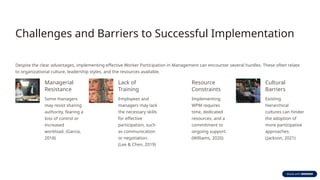
Despite the clear advantages, implementing effective Worker Participation in Management can encounter several hurdles. These often relate
to organizational culture, leadership styles, and the resources available.
Managerial
Resistance
Some managers
may resist sharing
authority, fearing a
loss of control or
increased
workload. (Garcia,
2018)
Lack of
Training
Employees and
managers may lack
the necessary skills
for effective
participation, such
as communication
or negotiation.
(Lee & Chen, 2019)
Resource
Constraints
Implementing
WPM requires
time, dedicated
resources, and a
commitment to
ongoing support.
(Williams, 2020)
Cultural
Barriers
Existing
hierarchical
cultures can hinder
the adoption of
more participative
approaches.
(Jackson, 2021)
6.
Case Studies: Real-WorldExamples of Effective Worker
Participation
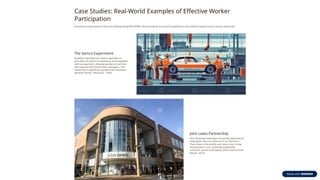
Numerous organizations have successfully integrated WPM, demonstrating its practical application and positive impact across various industries.
The Semco Experiment
Brazilian manufacturer Semco operates on
principles of radical transparency and employee
self-management, allowing workers to set their
own salaries and choose their managers. This
model led to significant growth and innovation.
(Ricardo Semler, "Maverick", 1993)
John Lewis Partnership
This UK-based retail giant is entirely owned by its
employees, who are referred to as "Partners."
They share in the profits and have a say in how
the business is run, fostering exceptional
customer service and loyalty. (John Lewis Annual
Report, 2023)
7.
Best Practices forImplementing Worker Participation
Successful WPM implementation requires a strategic and thoughtful approach, focusing on clear communication, robust training, and a supportive
culture.
01
Establish Clear Objectives
Define what WPM aims to achieve, whether it's
boosting innovation, improving morale, or
enhancing decision quality.
02
Provide Comprehensive Training
Equip both employees and managers with the
skills needed for effective participation,
including communication, problem-solving, and
conflict resolution.
03
Foster Open Communication
Create channels for transparent dialogue and
feedback, ensuring all voices are heard and
valued.
04
Start Small, Scale Gradually
Begin with pilot projects or specific departments to learn and adapt
before widespread implementation.
05
Measure and Adapt
Regularly assess the effectiveness of WPM initiatives and make
adjustments based on feedback and results.
8.
Objective of WPM
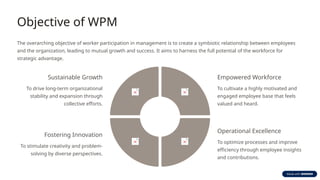
Theoverarching objective of worker participation in management is to create a symbiotic relationship between employees
and the organization, leading to mutual growth and success. It aims to harness the full potential of the workforce for
strategic advantage.
Sustainable Growth
To drive long-term organizational
stability and expansion through
collective efforts.
Empowered Workforce
To cultivate a highly motivated and
engaged employee base that feels
valued and heard.
Operational Excellence
To optimize processes and improve
efficiency through employee insights
and contributions.
Fostering Innovation
To stimulate creativity and problem-
solving by diverse perspectives.
9.
The Future ofWork
Why Worker Participation in Management is More Critical Than Ever
As the global economy evolves, WPM becomes an indispensable strategy for resilience, agility, and competitive advantage.
It prepares organizations for a dynamic future.
Global Competition
WPM fosters agility and adaptability, crucial for navigating complex international markets.
Technological Disruption
Engaged employees are better equipped to embrace new technologies and drive digital transformation.
Talent Retention
A participative culture attracts and retains top talent, especially younger generations seeking purpose and influence.
Ethical Governance
WPM enhances corporate social responsibility and builds trust with stakeholders.
10.
Levels of WorkerParticipation
A Spectrum of Engagement
Worker participation is not a one-size-fits-all concept. It exists on a spectrum, with varying degrees of employee involvement
in decision-making.
Understanding these levels helps organizations tailor WPM initiatives to their specific culture and strategic goals, moving
from simply informing employees to fully empowering them in governance.