NATURE, TYPES AND
FORMS OF
ORGANIZATIONS
WHAT IS AN ORGANIZATION?
 It is a social setting composed of several groups of
people who bond and work together to achieve a
common purpose.
TYPES OF ORGANIZATIONS
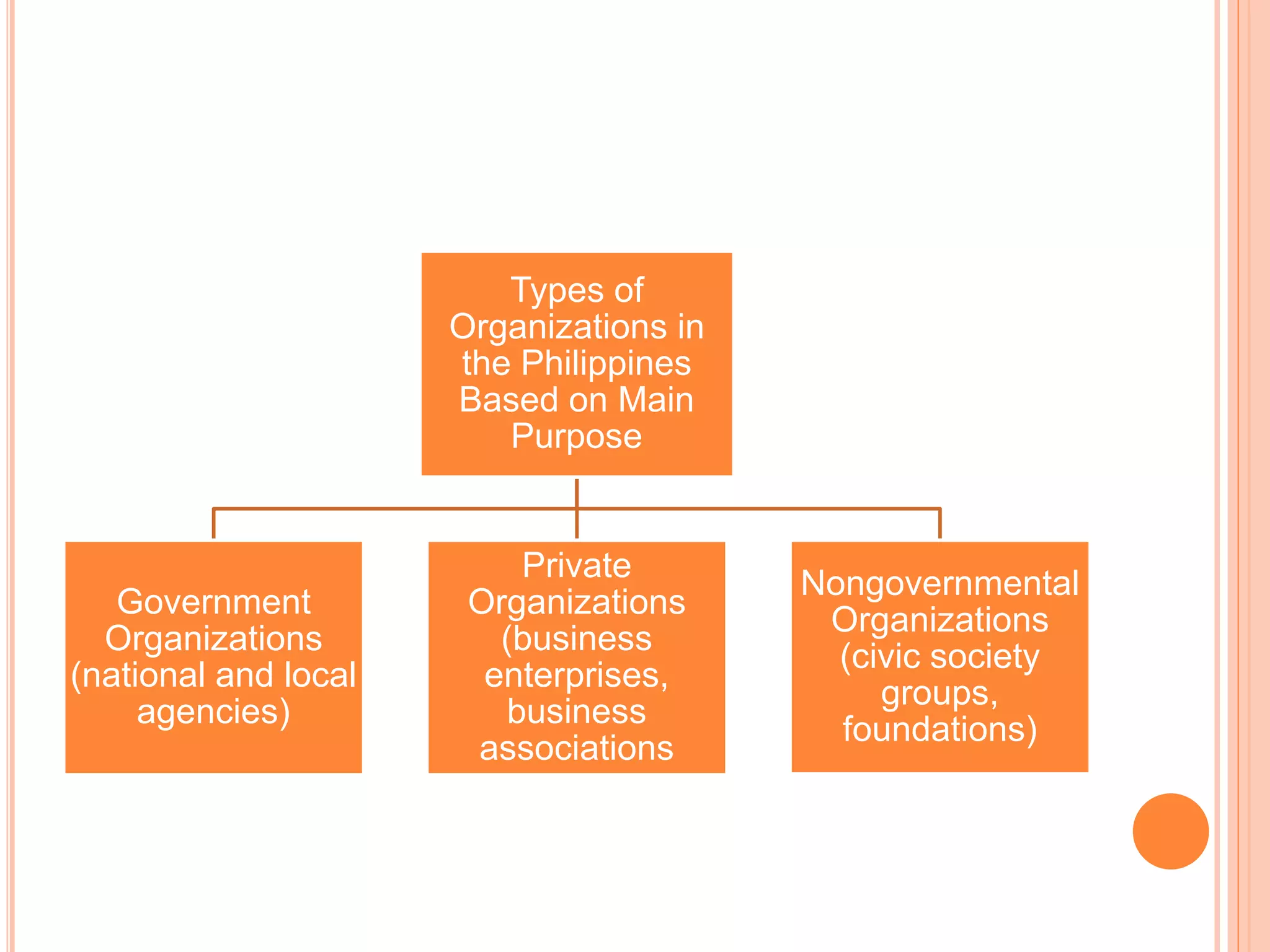
Types of
Organizations in
the Philippines
Based on Main
Purpose
Government
Organizations
(national and local
agencies)
Private
Organizations
(business
enterprises,
business
associations
Nongovernmental
Organizations
(civic society
groups,
foundations)
GOVERNMENT ORGANIZATIONS
 May be in the form of national government
agencies or local government units (LGUs).
 National government agencies are mandated by
law to perform specific duties and responsibilities
and provide services for people nationwide.
 LGUs are also mandated by law to perform specific
duties and provide services but only for people
within their respective areas of jurisdiction.
PRIVATE ORGANIZATIONS
 May be categorized into business associations that
promote the interests of the industry players or
business enterprises, which earn profits.
FORMS OF BUSINESS ORGANIZATION
Sole Proprietorship
– is a business firm owned and
operated by a single person.
Partnership
– form of business organization
owned and operated by two or more
persons.
Limited Partnership
– form of business organization
also owned by two or more persons,
but with limited liabilities during a
financial loss.
Corporation – a business firm owned by
individuals or other corporations.
 It is an artificial being created by operation
of law, having the right to succession, and
the powers, attributes, and properties
expressedly authorized by law or incident
to its existence.
 it has legal and a distinct personality apart
from those who own it.
Stocks – the shares or certificates of ownership
of a corporation
Stockholders – owners of a corporation
Types of Corporation:
 Private or close corporation
– owned by a few individuals, usually
relatives or friends.
 Open corporation
– owned by any individual who buys shares
of stocks which are openly traded in the stock
markets.
COOPERATIVES – is a firm owned by a
group of people who have common
objective and who collectively bear the
risks of the enterprise and share its
profits.
-are formed to make their
member individually profitable or to save
money.
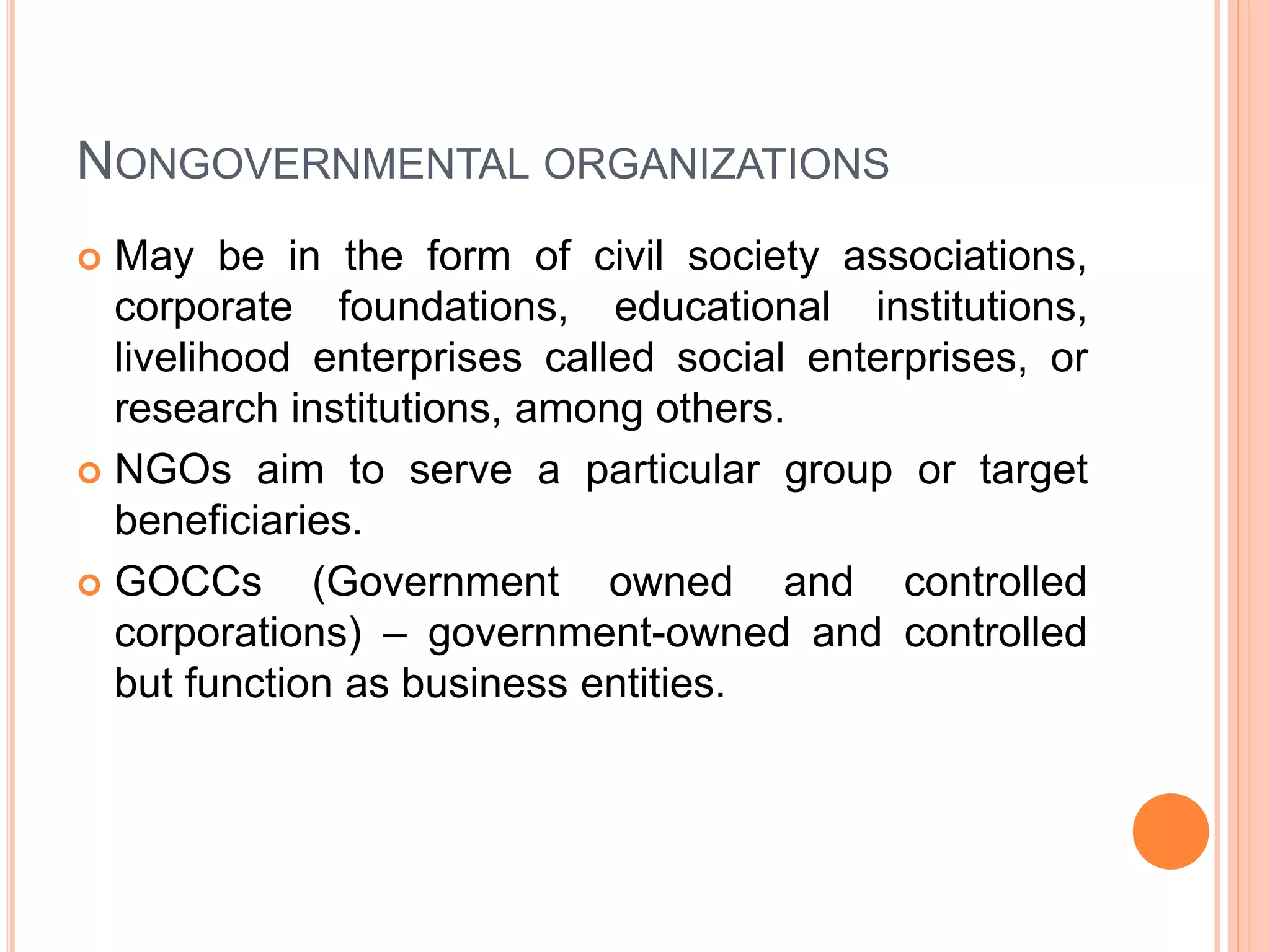
NONGOVERNMENTAL ORGANIZATIONS
 May be in the form of civil society associations,
corporate foundations, educational institutions,
livelihood enterprises called social enterprises, or
research institutions, among others.
 NGOs aim to serve a particular group or target
beneficiaries.
 GOCCs (Government owned and controlled
corporations) – government-owned and controlled
but function as business entities.
TYPES
ORGANIZATION
MAIN
PURPOSE
STRUCTURAL
FORMS
KEY
CHARACTERIST
ICS
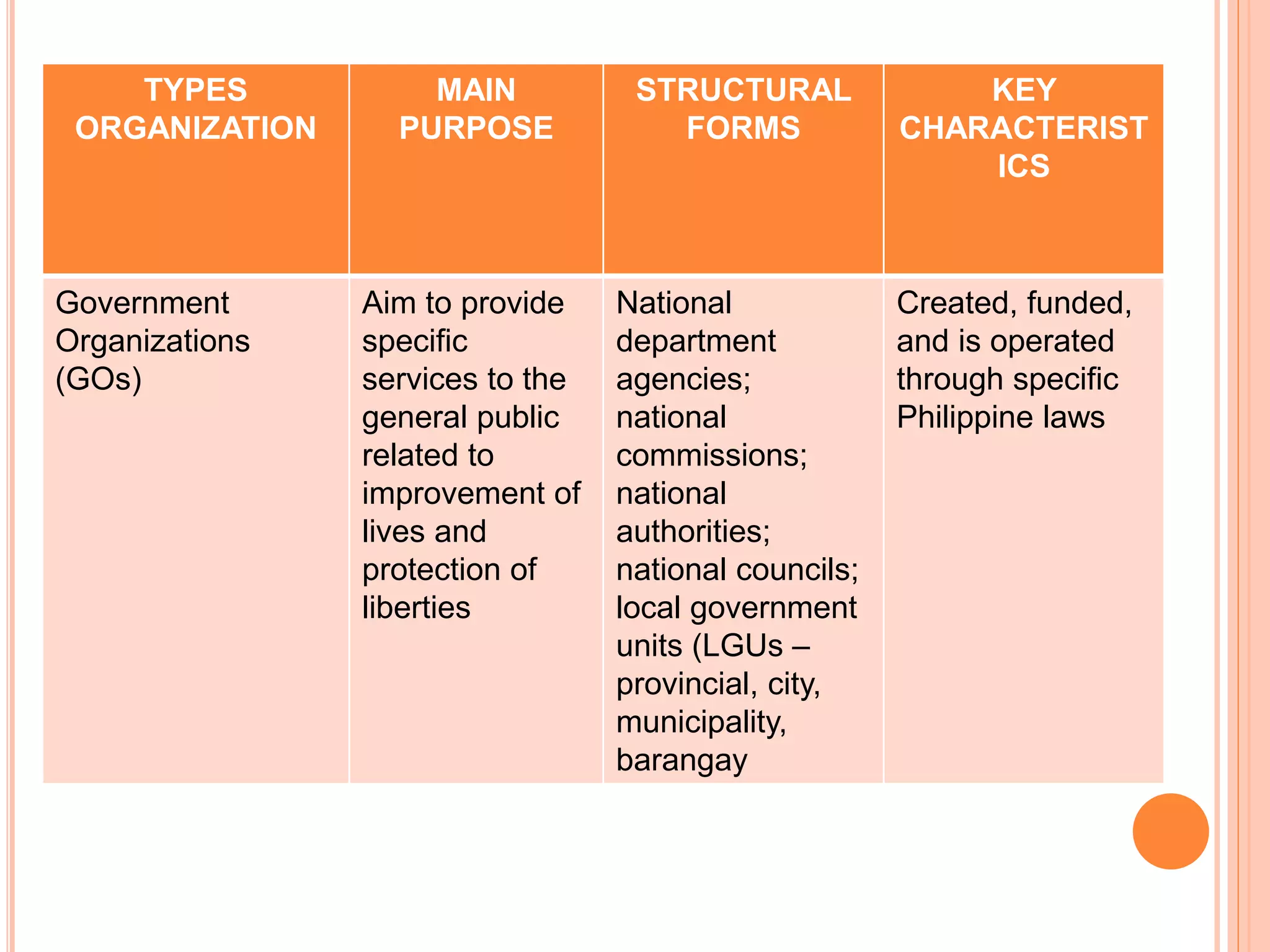
Government
Organizations
(GOs)
Aim to provide
specific
services to the
general public
related to
improvement of
lives and
protection of
liberties
National
department
agencies;
national
commissions;
national
authorities;
national councils;
local government
units (LGUs –
provincial, city,
municipality,
barangay
Created, funded,
and is operated
through specific
Philippine laws
TYPES
ORGANIZATION
MAIN
PURPOSE
STRUCTURAL
FORMS
KEY
CHARACTERISTI
CS
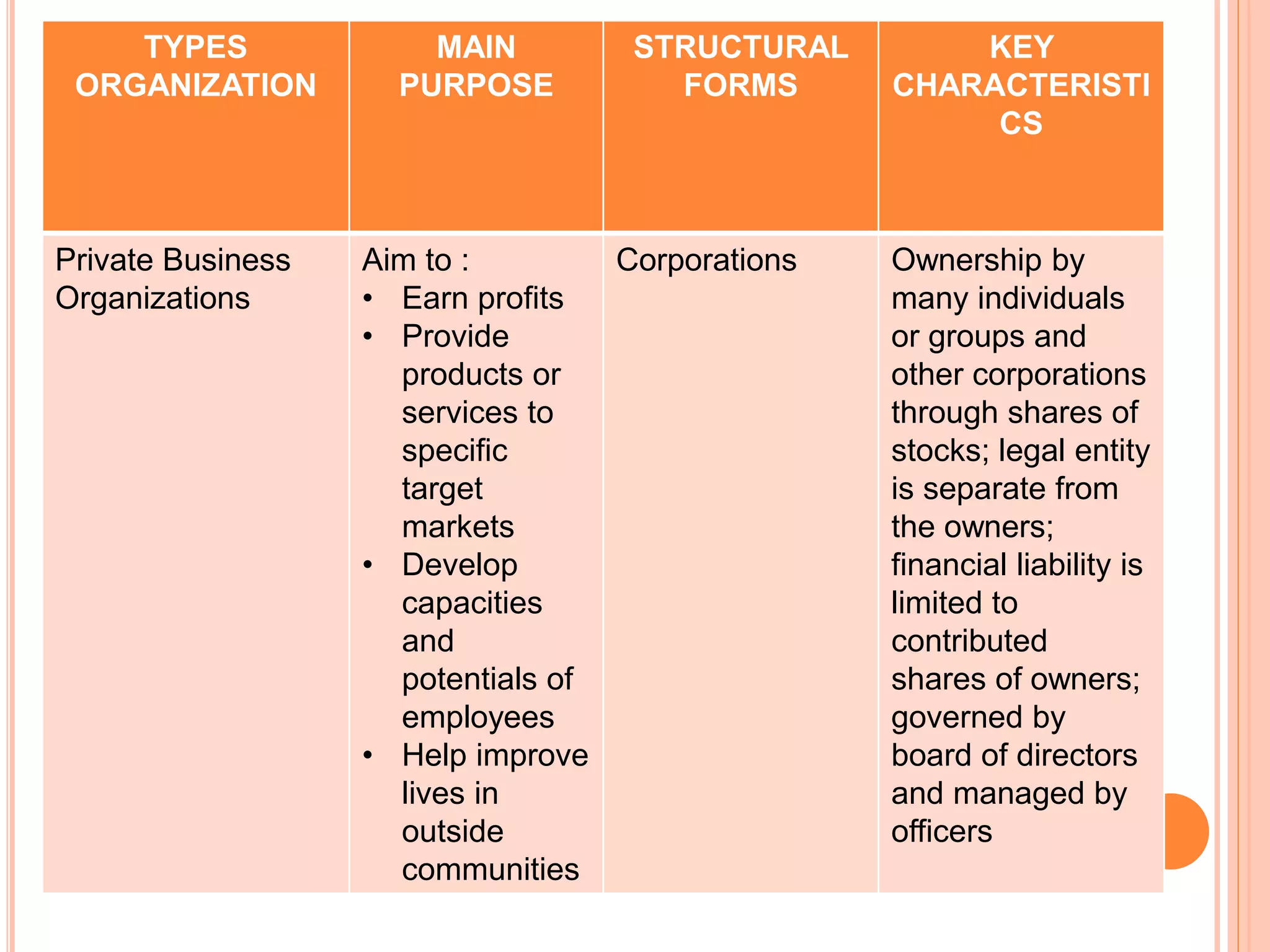
Private Business
Organizations
Aim to :
• Earn profits
• Provide
products or
services to
specific
target
markets
• Develop
capacities
and
potentials of
employees
• Help improve
lives in
outside
communities
Corporations Ownership by
many individuals
or groups and
other corporations
through shares of
stocks; legal entity
is separate from
the owners;
financial liability is
limited to
contributed
shares of owners;
governed by
board of directors
and managed by
officers
TYPES
ORGANIZATION
MAIN
PURPOSE
STRUCTURAL
FORMS
KEY
CHARACTERISTI
CS
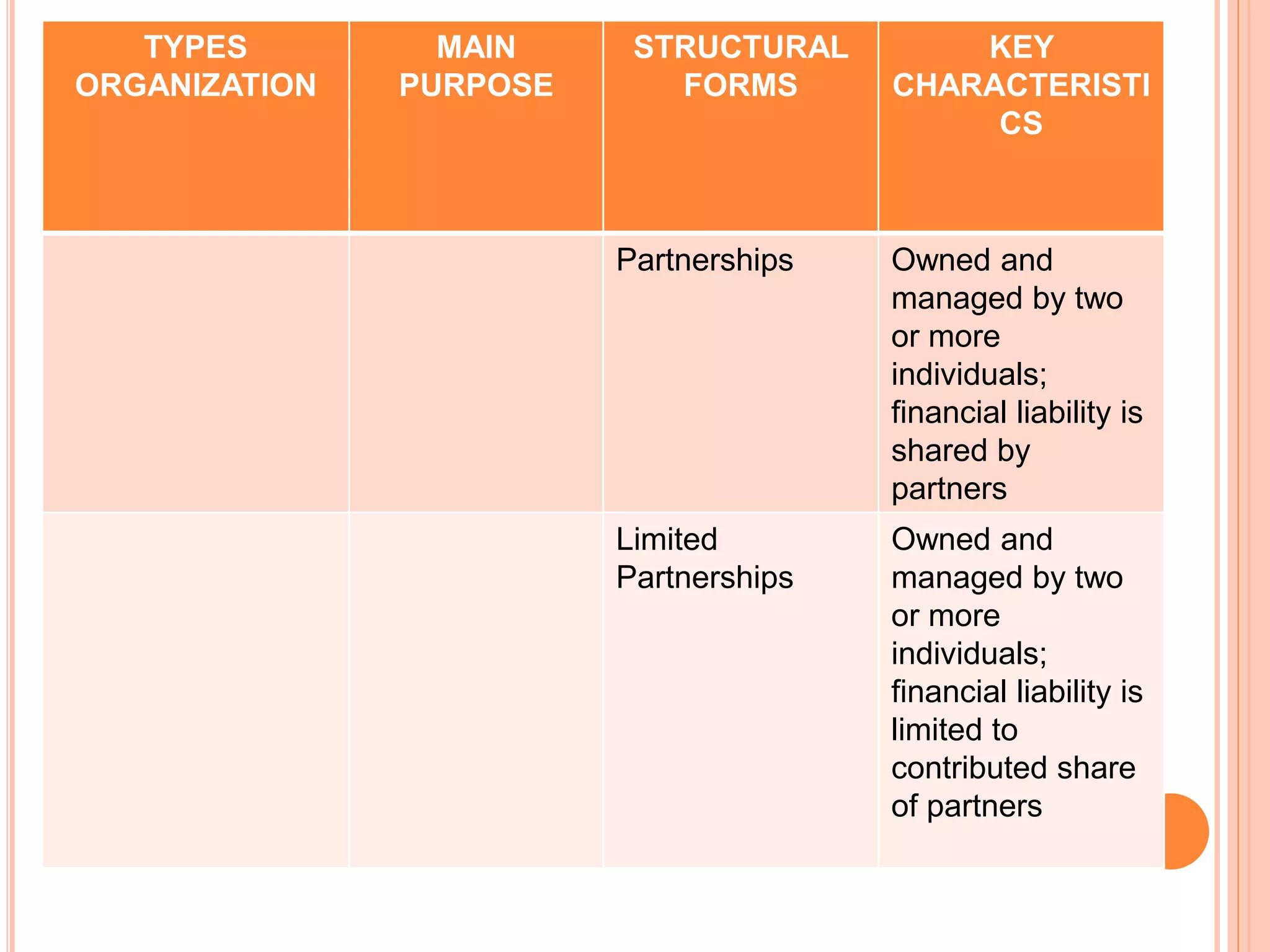
Partnerships Owned and
managed by two
or more
individuals;
financial liability is
shared by
partners
Limited
Partnerships
Owned and
managed by two
or more
individuals;
financial liability is
limited to
contributed share
of partners
TYPES
ORGANIZATION
MAIN
PURPOSE
STRUCTURAL
FORMS
KEY
CHARACTERISTI
CS
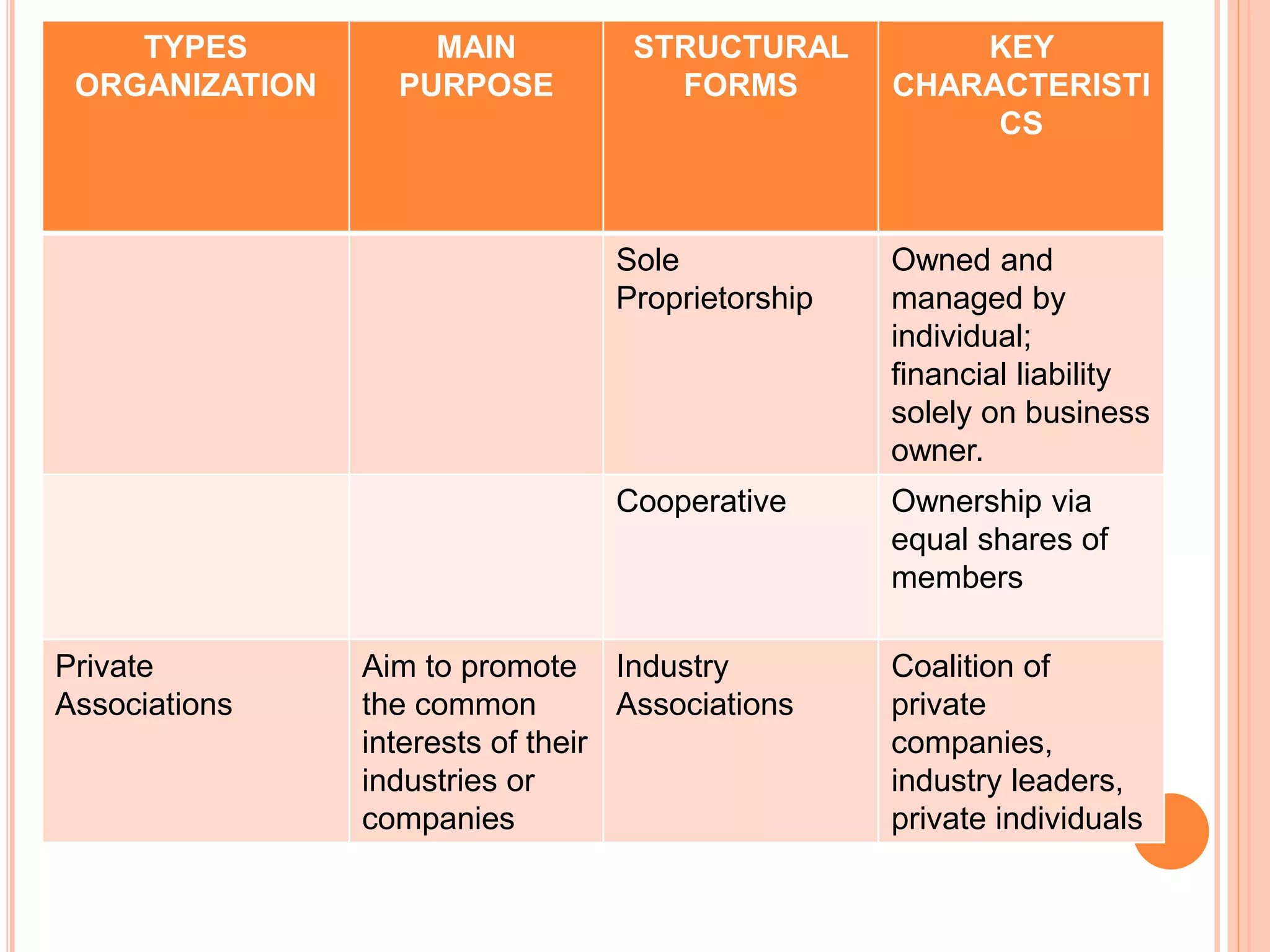
Sole
Proprietorship
Owned and
managed by
individual;
financial liability
solely on business
owner.
Cooperative Ownership via
equal shares of
members
Private
Associations
Aim to promote
the common
interests of their
industries or
companies
Industry
Associations
Coalition of
private
companies,
industry leaders,
private individuals
TYPES
ORGANIZATION
MAIN PURPOSE STRUCTUR
AL FORMS
KEY
CHARACTERISTI
CS
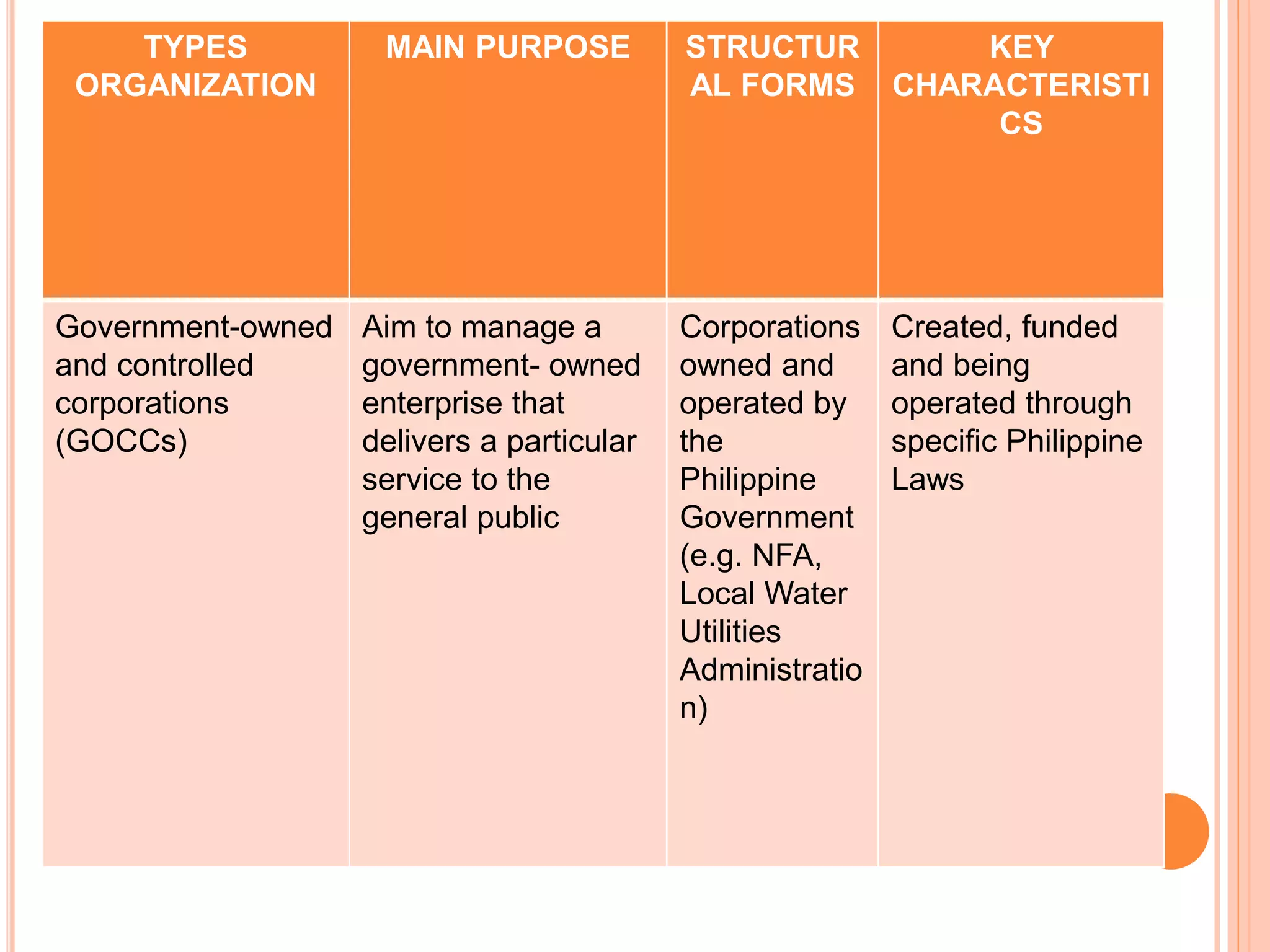
Government-owned
and controlled
corporations
(GOCCs)
Aim to manage a
government- owned
enterprise that
delivers a particular
service to the
general public
Corporations
owned and
operated by
the
Philippine
Government
(e.g. NFA,
Local Water
Utilities
Administratio
n)
Created, funded
and being
operated through
specific Philippine
Laws
TYPES
ORGANIZATION
MAIN PURPOSE STRUCTUR
AL FORMS
KEY
CHARACTERISTI
CS
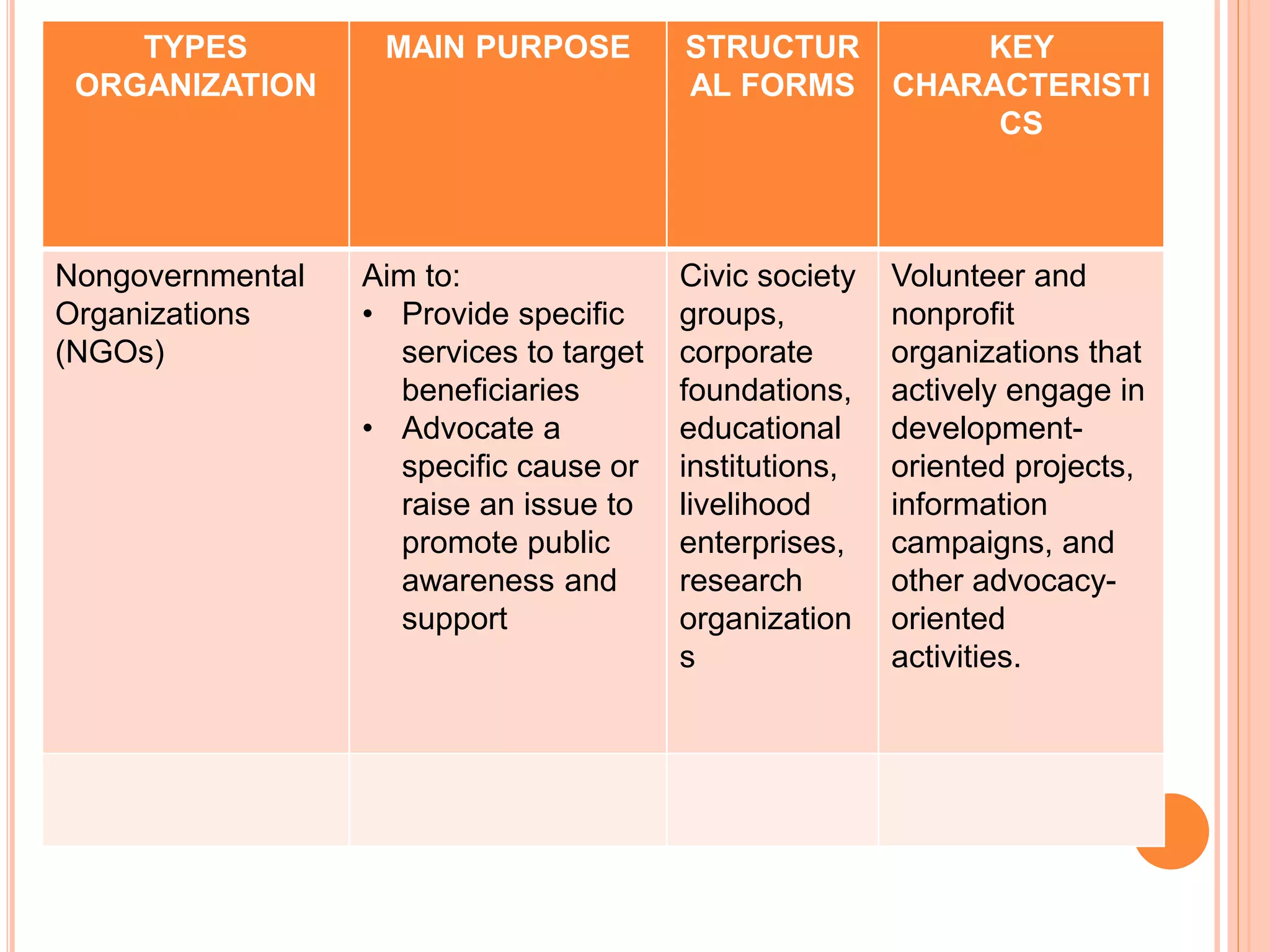
Nongovernmental
Organizations
(NGOs)
Aim to:
• Provide specific
services to target
beneficiaries
• Advocate a
specific cause or
raise an issue to
promote public
awareness and
support
Civic society
groups,
corporate
foundations,
educational
institutions,
livelihood
enterprises,
research
organization
s
Volunteer and
nonprofit
organizations that
actively engage in
development-
oriented projects,
information
campaigns, and
other advocacy-
oriented
activities.
The
End!!^_^

Nature, Types and Forms of Organization

  • 1.
    NATURE, TYPES AND FORMSOF ORGANIZATIONS
  • 2.
    WHAT IS ANORGANIZATION?  It is a social setting composed of several groups of people who bond and work together to achieve a common purpose.
  • 3.
  • 4.
    Types of Organizations in thePhilippines Based on Main Purpose Government Organizations (national and local agencies) Private Organizations (business enterprises, business associations Nongovernmental Organizations (civic society groups, foundations)
  • 5.
    GOVERNMENT ORGANIZATIONS  Maybe in the form of national government agencies or local government units (LGUs).  National government agencies are mandated by law to perform specific duties and responsibilities and provide services for people nationwide.  LGUs are also mandated by law to perform specific duties and provide services but only for people within their respective areas of jurisdiction.
  • 6.
    PRIVATE ORGANIZATIONS  Maybe categorized into business associations that promote the interests of the industry players or business enterprises, which earn profits.
  • 7.
    FORMS OF BUSINESSORGANIZATION Sole Proprietorship – is a business firm owned and operated by a single person.
  • 8.
    Partnership – form ofbusiness organization owned and operated by two or more persons.
  • 9.
    Limited Partnership – formof business organization also owned by two or more persons, but with limited liabilities during a financial loss.
  • 10.
    Corporation – abusiness firm owned by individuals or other corporations.  It is an artificial being created by operation of law, having the right to succession, and the powers, attributes, and properties expressedly authorized by law or incident to its existence.  it has legal and a distinct personality apart from those who own it. Stocks – the shares or certificates of ownership of a corporation Stockholders – owners of a corporation
  • 11.
    Types of Corporation: Private or close corporation – owned by a few individuals, usually relatives or friends.  Open corporation – owned by any individual who buys shares of stocks which are openly traded in the stock markets.
  • 12.
    COOPERATIVES – isa firm owned by a group of people who have common objective and who collectively bear the risks of the enterprise and share its profits. -are formed to make their member individually profitable or to save money.
  • 13.
    NONGOVERNMENTAL ORGANIZATIONS  Maybe in the form of civil society associations, corporate foundations, educational institutions, livelihood enterprises called social enterprises, or research institutions, among others.  NGOs aim to serve a particular group or target beneficiaries.  GOCCs (Government owned and controlled corporations) – government-owned and controlled but function as business entities.
  • 14.
    TYPES ORGANIZATION MAIN PURPOSE STRUCTURAL FORMS KEY CHARACTERIST ICS Government Organizations (GOs) Aim to provide specific servicesto the general public related to improvement of lives and protection of liberties National department agencies; national commissions; national authorities; national councils; local government units (LGUs – provincial, city, municipality, barangay Created, funded, and is operated through specific Philippine laws
  • 15.
    TYPES ORGANIZATION MAIN PURPOSE STRUCTURAL FORMS KEY CHARACTERISTI CS Private Business Organizations Aim to: • Earn profits • Provide products or services to specific target markets • Develop capacities and potentials of employees • Help improve lives in outside communities Corporations Ownership by many individuals or groups and other corporations through shares of stocks; legal entity is separate from the owners; financial liability is limited to contributed shares of owners; governed by board of directors and managed by officers
  • 16.
    TYPES ORGANIZATION MAIN PURPOSE STRUCTURAL FORMS KEY CHARACTERISTI CS Partnerships Owned and managedby two or more individuals; financial liability is shared by partners Limited Partnerships Owned and managed by two or more individuals; financial liability is limited to contributed share of partners
  • 17.
    TYPES ORGANIZATION MAIN PURPOSE STRUCTURAL FORMS KEY CHARACTERISTI CS Sole Proprietorship Owned and managed by individual; financialliability solely on business owner. Cooperative Ownership via equal shares of members Private Associations Aim to promote the common interests of their industries or companies Industry Associations Coalition of private companies, industry leaders, private individuals
  • 18.
    TYPES ORGANIZATION MAIN PURPOSE STRUCTUR ALFORMS KEY CHARACTERISTI CS Government-owned and controlled corporations (GOCCs) Aim to manage a government- owned enterprise that delivers a particular service to the general public Corporations owned and operated by the Philippine Government (e.g. NFA, Local Water Utilities Administratio n) Created, funded and being operated through specific Philippine Laws
  • 19.
    TYPES ORGANIZATION MAIN PURPOSE STRUCTUR ALFORMS KEY CHARACTERISTI CS Nongovernmental Organizations (NGOs) Aim to: • Provide specific services to target beneficiaries • Advocate a specific cause or raise an issue to promote public awareness and support Civic society groups, corporate foundations, educational institutions, livelihood enterprises, research organization s Volunteer and nonprofit organizations that actively engage in development- oriented projects, information campaigns, and other advocacy- oriented activities.
  • 20.