Work Smarter (not
Harder)
Sarah Crain
K-12 Literacy Coordinator
Gifted Education Resource Teacher
8th Annual Symposium
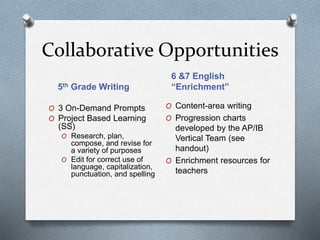
Collaborative Opportunities
5th Grade Writing
6 &7 English
“Enrichment”
O 3 On-Demand Prompts
O Project Based Learning
(SS)
O Research, plan,
compose, and revise for
a variety of purposes
O Edit for correct use of
language, capitalization,
punctuation, and spelling
O Content-area writing
O Progression charts
developed by the AP/IB
Vertical Team (see
handout)
O Enrichment resources for
teachers
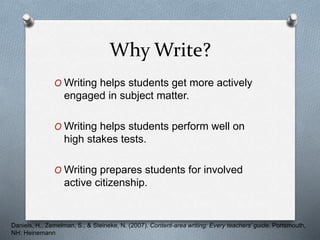
Why Write?
O Writing helps students get more actively
engaged in subject matter.
O Writing helps students perform well on
high stakes tests.
O Writing prepares students for involved
active citizenship.
Daniels, H., Zemelman, S., & Steineke, N. (2007). Content-area writing: Every teachers' guide. Portsmouth,
NH: Heinemann
Yes, but…
Why does writing take SO MUCH time to grade?
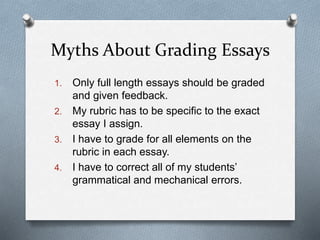
Myths About Grading Essays
1. Only full length essays should be graded
and given feedback.
2. My rubric has to be specific to the exact
essay I assign.
3. I have to grade for all elements on the
rubric in each essay.
4. I have to correct all of my students’
grammatical and mechanical errors.
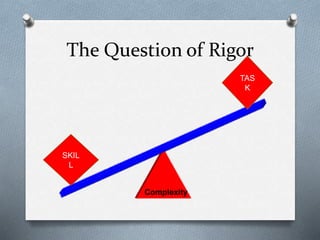
The Question of Rigor
SKIL
L
Complexity
TAS
K
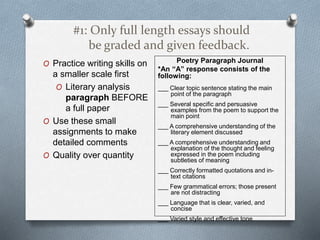
#1: Only full length essays should
be graded and given feedback.
O Practice writing skills on
a smaller scale first
O Literary analysis
paragraph BEFORE
a full paper
O Use these small
assignments to make
detailed comments
O Quality over quantity
Poetry Paragraph Journal
*An “A” response consists of the
following:
___ Clear topic sentence stating the main
point of the paragraph
___ Several specific and persuasive
examples from the poem to support the
main point
___ A comprehensive understanding of the
literary element discussed
___ A comprehensive understanding and
explanation of the thought and feeling
expressed in the poem including
subtleties of meaning
___ Correctly formatted quotations and in-
text citations
___ Few grammatical errors; those present
are not distracting
___ Language that is clear, varied, and
concise
___ Varied style and effective tone
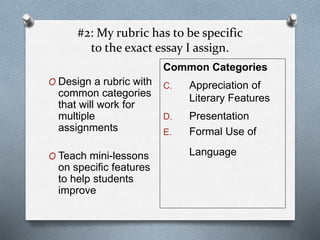
#2: My rubric has to be specific
to the exact essay I assign.
O Design a rubric with
common categories
that will work for
multiple
assignments
O Teach mini-lessons
on specific features
to help students
improve
Common Categories
C. Appreciation of
Literary Features
D. Presentation
E. Formal Use of
Language
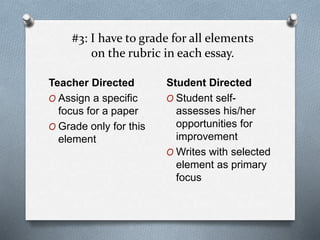
#3: I have to grade for all elements
on the rubric in each essay.
Teacher Directed
O Assign a specific
focus for a paper
O Grade only for this
element
Student Directed
O Student self-
assesses his/her
opportunities for
improvement
O Writes with selected
element as primary
focus
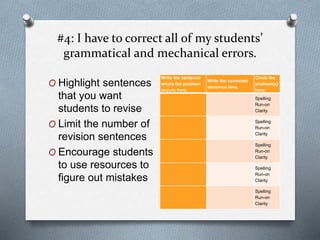
#4: I have to correct all of my students’
grammatical and mechanical errors.
O Highlight sentences
that you want
students to revise
O Limit the number of
revision sentences
O Encourage students
to use resources to
figure out mistakes
Write the sentence
where the problem
occurs here.
Write the corrected
sentence here.
Circle the
problem(s)
here.
Spelling
Run-on
Clarity
Spelling
Run-on
Clarity
Spelling
Run-on
Clarity
Spelling
Run-on
Clarity
Spelling
Run-on
Clarity
What can I do for you?
Sarah Crain
crainse@staffordschools.net

Work smarter (not harder)

  • 1.
    Work Smarter (not Harder) SarahCrain K-12 Literacy Coordinator Gifted Education Resource Teacher 8th Annual Symposium
  • 2.
    Collaborative Opportunities 5th GradeWriting 6 &7 English “Enrichment” O 3 On-Demand Prompts O Project Based Learning (SS) O Research, plan, compose, and revise for a variety of purposes O Edit for correct use of language, capitalization, punctuation, and spelling O Content-area writing O Progression charts developed by the AP/IB Vertical Team (see handout) O Enrichment resources for teachers
  • 3.
    Why Write? O Writinghelps students get more actively engaged in subject matter. O Writing helps students perform well on high stakes tests. O Writing prepares students for involved active citizenship. Daniels, H., Zemelman, S., & Steineke, N. (2007). Content-area writing: Every teachers' guide. Portsmouth, NH: Heinemann
  • 4.
  • 5.
    Why does writingtake SO MUCH time to grade?
  • 6.
    Myths About GradingEssays 1. Only full length essays should be graded and given feedback. 2. My rubric has to be specific to the exact essay I assign. 3. I have to grade for all elements on the rubric in each essay. 4. I have to correct all of my students’ grammatical and mechanical errors.
  • 7.
    The Question ofRigor SKIL L Complexity TAS K
  • 8.
    #1: Only fulllength essays should be graded and given feedback. O Practice writing skills on a smaller scale first O Literary analysis paragraph BEFORE a full paper O Use these small assignments to make detailed comments O Quality over quantity Poetry Paragraph Journal *An “A” response consists of the following: ___ Clear topic sentence stating the main point of the paragraph ___ Several specific and persuasive examples from the poem to support the main point ___ A comprehensive understanding of the literary element discussed ___ A comprehensive understanding and explanation of the thought and feeling expressed in the poem including subtleties of meaning ___ Correctly formatted quotations and in- text citations ___ Few grammatical errors; those present are not distracting ___ Language that is clear, varied, and concise ___ Varied style and effective tone
  • 9.
    #2: My rubrichas to be specific to the exact essay I assign. O Design a rubric with common categories that will work for multiple assignments O Teach mini-lessons on specific features to help students improve Common Categories C. Appreciation of Literary Features D. Presentation E. Formal Use of Language
  • 10.
    #3: I haveto grade for all elements on the rubric in each essay. Teacher Directed O Assign a specific focus for a paper O Grade only for this element Student Directed O Student self- assesses his/her opportunities for improvement O Writes with selected element as primary focus
  • 11.
    #4: I haveto correct all of my students’ grammatical and mechanical errors. O Highlight sentences that you want students to revise O Limit the number of revision sentences O Encourage students to use resources to figure out mistakes Write the sentence where the problem occurs here. Write the corrected sentence here. Circle the problem(s) here. Spelling Run-on Clarity Spelling Run-on Clarity Spelling Run-on Clarity Spelling Run-on Clarity Spelling Run-on Clarity
  • 12.
    What can Ido for you? Sarah Crain crainse@staffordschools.net