WRITING SKILLS PRESENTATION
 Writing

is a skill, some have it inborn itself
and others just need to polish their skill.

 Writing

skills can be enhanced by attending
certain classes. For this one require a calm
and lovely environment .

 Writers

room is the best place for developing
and enhancing your writing skills. Writers
room is a popular workspace in New York
city.
 General

objectives:
 Trainees will be able to give a lesson in
developing writing skills.
 Trainees will be able to integrate writing
with listening, speaking and reading.
 Written

language is complex at the level of
clause while spoken language is complex in
the way clauses are linked together
 Written language is also reinforced by the
tendency of create nouns from verbs
 Writing is often decontextualised
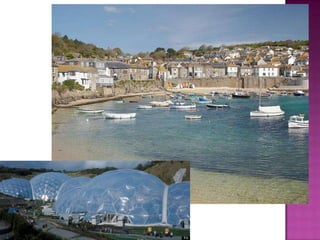
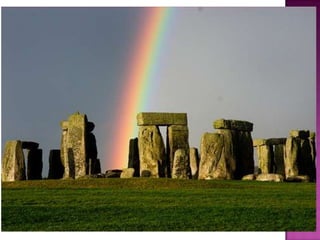
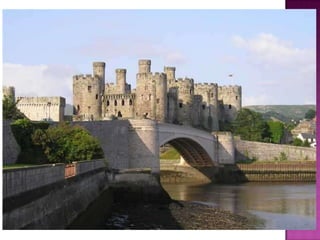
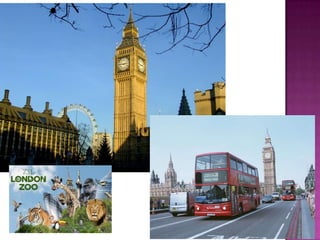
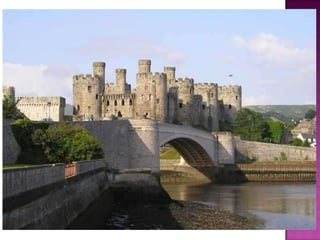
 Look

at the images of Britain on the next few
slides. Jot down any word that you think
could be useful in writing about these places.
 Ability

to put sounds down on graphic form
according to the conventional sound-spelling
rules.
 Ability to spell English words correctly, including
using correct punctuation and capitalization.
 Ability to do writing practice, such as dictation,
grammar exercises, constructing dialogues
according to the model, simple translation
exercises.
 Ability to write short compositions, including
functional writing skills, such as writing simple
letters, taking notes, writing outlines and
summaries.
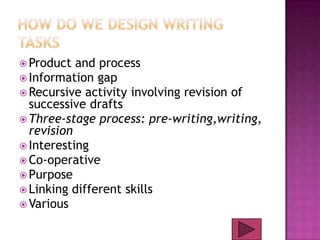
 Product

and process
 Information gap
 Recursive activity involving revision of
successive drafts
 Three-stage process: pre-writing,writing,
revision
 Interesting
 Co-operative
 Purpose
 Linking different skills
 Various
Sentence writing
Parallel writing
Cohesion and coherence
Oral composition
Why do we write?
To communicate with friends (informal writing)
To communicate formally, e.g. with a company
To make our opinions known in a newspaper (letter to the editor)
To leave messages (note)
To tell a story
To keep a personal account of events (a diary, blog etc.)
To sell or publices something in a newspaper (an advert)
To show how to do something (instructions)
To put words to music (lyrics)
To present facts or opinions (essay)
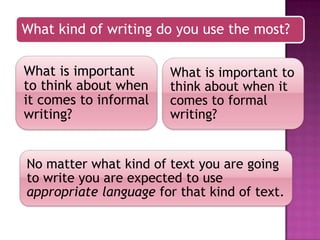
What kind of writing do you use the most?
What is important
to think about when
it comes to informal
writing?

What is important to
think about when it
comes to formal
writing?

No matter what kind of text you are going
to write you are expected to use
appropriate language for that kind of text.
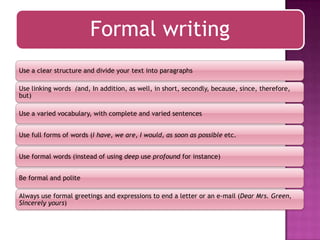
Formal writing
Use a clear structure and divide your text into paragraphs
Use linking words (and, In addition, as well, in short, secondly, because, since, therefore,
but)
Use a varied vocabulary, with complete and varied sentences
Use full forms of words (I have, we are, I would, as soon as possible etc.
Use formal words (instead of using deep use profound for instance)
Be formal and polite
Always use formal greetings and expressions to end a letter or an e-mail (Dear Mrs. Green,
Sincerely yours)
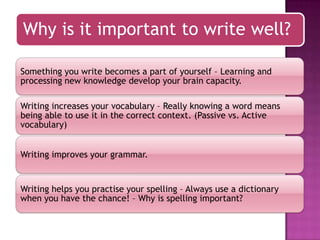
Why is it important to write well?
Something you write becomes a part of yourself – Learning and
processing new knowledge develop your brain capacity.
Writing increases your vocabulary – Really knowing a word means
being able to use it in the correct context. (Passive vs. Active
vocabulary)
Writing improves your grammar.

Writing helps you practise your spelling – Always use a dictionary
when you have the chance! – Why is spelling important?
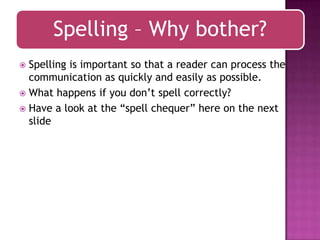
Spelling – Why bother?
Spelling is important so that a reader can process the
communication as quickly and easily as possible.
 What happens if you don‟t spell correctly?
 Have a look at the “spell chequer” here on the next
slide

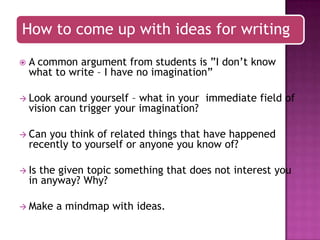
How to come up with ideas for writing


A common argument from students is ”I don‟t know
what to write – I have no imagination”

 Look

around yourself – what in your immediate field of
vision can trigger your imagination?

 Can

you think of related things that have happened
recently to yourself or anyone you know of?

 Is

the given topic something that does not interest you
in anyway? Why?

 Make

a mindmap with ideas.
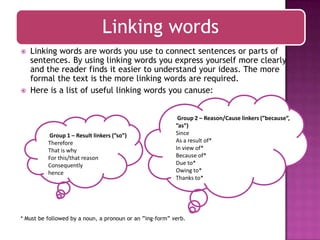
Linking words




Linking words are words you use to connect sentences or parts of
sentences. By using linking words you express yourself more clearly
and the reader finds it easier to understand your ideas. The more
formal the text is the more linking words are required.
Here is a list of useful linking words you canuse:

Group 1 – Result linkers (”so”)
Therefore
That is why
For this/that reason
Consequently
hence

Group 2 – Reason/Cause linkers (”because”,
”as”)
Since
As a result of*
In view of*
Because of*
Due to*
Owing to*
Thanks to*

* Must be followed by a noun, a pronoun or an ”ing-form” verb.
The objectives:

1 The primary focus is on grammatical rules and
writing skills.
2 Students are expected to translate accurately all
the given texts.
 The

GTM uses a lexico-grammatical and task based
syllabus: there is a strong focus on vocabulary and
grammatical rules that are learned contextually
from the given texts to be translated. Therefore
the syllabus is build primarily on the grammatical
points illustrated in the text-book.
A

student in this method is viewed as a
processor and passive holder for the
information given to him. This means that he
does not influence the process of learning or
even other students. In fact learners are
totally dependent on the teacher.


1. Explanation and analysis

(a) a process
(b) an opinion or point of view
(c) event(s) and phenomena
(d) instructions and directions
2. Argument
(a) persuasion
(b) refutation
(c) examining both sides of a point
3. Description and summary
(a) a thing
(b) a person
(c) a place
(d) an event
(e) concepts
4. Narration
(a) a series of events; a report
(b) biography or autobiography
(c) historical events
(d) fiction or nonfiction



Written practice
Written communicative activities
(a)
1.

2.
3.

Join the following pairs of sentences using
„and‟ or „but‟
Concorde is an ideal way to travel.
Concorde is expensive.
Concorde is fast. Concorde is comfortable.
Travellers like Concorde. People living near
airports don‟t like Concorde
Relaying instructions
Exchanging letters
Writing games
Fluency writing
Story construction
Writing reports and advertisements
(a)
(b)

Describe people and identify(guess people)
Describe events and identify
Stage 1 Students are put into groups of six.
Stage 2 Each member of the group is given a letter (A-F).
Stage 3 Each group is given one of the pictures from the
sequence . All the members of the group should write two
sentences about their picture together, using past tenses.
Each member of the group now has the same two
sentences.
Stage 4 The teacher now collects the four pictures, and re-forms
groups so that all the A‟s are together, all the B‟s and so on.
The new groups must now put their sentences together to
form a coherent story. They should be reminded that they
will probably have to make changes from the original
sentences, especially in terms of tense and the use of
cohesive devices ,etc.
Stage 5 The groups now read out their stories and the class
compares them. In the event of any confusion the teacher
can show the original picture sequence.
..
 In

the GTM the teacher role is central as he
controles and determens every thing in the
classroom whether it is content, tasks or else, as
well as correcting immediatly the errors made by
the students. This makes learners totally
dependent on the teacher as the source of
information and direction as well.


Allah, A. (2010). The grammar translation method. http://www.slideshare.net/FatenMallat/thegrammar-translation-method?qid=6d26ab85-1f83-4189-941484875f966d41&v=default&b=&from_search=6



Fat, G. (2013). Developing writing skills. http://www.slideshare.net/gracefat/14-developingwriting-skills?qid=57ef9969-e1c9-42de-91e4-637490d02793&v=qf1&b=&from_search=3



Michecaro, (2012) How to improve your writing skills. http://www.slideshare.net/michecaro/howto-improve-your-writing-14129280?qid=57ef9969-e1c9-42de-91e4637490d02793&v=qf1&b=&from_search=4



Sinciar, E. (2013). Writing skills. http://www.slideshare.net/EmmaSinclair/writingskillsl1?qid=6d26ab85-1f83-4189-9414-84875f966d41&v=default&b=&from_search=1



Writers Room, (2012). Creative writing at workshop.
http://www.slideshare.net/writersroom/writers-room?qid=67cb3549-c5af-43fb-944acc63b6f55885&v=qf1&b=&from_search=8

Professional studies

  • 1.
  • 2.
     Writing is askill, some have it inborn itself and others just need to polish their skill.  Writing skills can be enhanced by attending certain classes. For this one require a calm and lovely environment .  Writers room is the best place for developing and enhancing your writing skills. Writers room is a popular workspace in New York city.
  • 4.
     General objectives:  Traineeswill be able to give a lesson in developing writing skills.  Trainees will be able to integrate writing with listening, speaking and reading.
  • 5.
     Written language iscomplex at the level of clause while spoken language is complex in the way clauses are linked together  Written language is also reinforced by the tendency of create nouns from verbs  Writing is often decontextualised
  • 6.
     Look at theimages of Britain on the next few slides. Jot down any word that you think could be useful in writing about these places.
  • 10.
     Ability to putsounds down on graphic form according to the conventional sound-spelling rules.  Ability to spell English words correctly, including using correct punctuation and capitalization.  Ability to do writing practice, such as dictation, grammar exercises, constructing dialogues according to the model, simple translation exercises.  Ability to write short compositions, including functional writing skills, such as writing simple letters, taking notes, writing outlines and summaries.
  • 12.
     Product and process Information gap  Recursive activity involving revision of successive drafts  Three-stage process: pre-writing,writing, revision  Interesting  Co-operative  Purpose  Linking different skills  Various
  • 13.
    Sentence writing Parallel writing Cohesionand coherence Oral composition
  • 14.
    Why do wewrite? To communicate with friends (informal writing) To communicate formally, e.g. with a company To make our opinions known in a newspaper (letter to the editor) To leave messages (note) To tell a story To keep a personal account of events (a diary, blog etc.) To sell or publices something in a newspaper (an advert) To show how to do something (instructions) To put words to music (lyrics) To present facts or opinions (essay)
  • 15.
    What kind ofwriting do you use the most? What is important to think about when it comes to informal writing? What is important to think about when it comes to formal writing? No matter what kind of text you are going to write you are expected to use appropriate language for that kind of text.
  • 16.
    Formal writing Use aclear structure and divide your text into paragraphs Use linking words (and, In addition, as well, in short, secondly, because, since, therefore, but) Use a varied vocabulary, with complete and varied sentences Use full forms of words (I have, we are, I would, as soon as possible etc. Use formal words (instead of using deep use profound for instance) Be formal and polite Always use formal greetings and expressions to end a letter or an e-mail (Dear Mrs. Green, Sincerely yours)
  • 18.
    Why is itimportant to write well? Something you write becomes a part of yourself – Learning and processing new knowledge develop your brain capacity. Writing increases your vocabulary – Really knowing a word means being able to use it in the correct context. (Passive vs. Active vocabulary) Writing improves your grammar. Writing helps you practise your spelling – Always use a dictionary when you have the chance! – Why is spelling important?
  • 19.
    Spelling – Whybother? Spelling is important so that a reader can process the communication as quickly and easily as possible.  What happens if you don‟t spell correctly?  Have a look at the “spell chequer” here on the next slide 
  • 21.
    How to comeup with ideas for writing  A common argument from students is ”I don‟t know what to write – I have no imagination”  Look around yourself – what in your immediate field of vision can trigger your imagination?  Can you think of related things that have happened recently to yourself or anyone you know of?  Is the given topic something that does not interest you in anyway? Why?  Make a mindmap with ideas.
  • 22.
    Linking words   Linking wordsare words you use to connect sentences or parts of sentences. By using linking words you express yourself more clearly and the reader finds it easier to understand your ideas. The more formal the text is the more linking words are required. Here is a list of useful linking words you canuse: Group 1 – Result linkers (”so”) Therefore That is why For this/that reason Consequently hence Group 2 – Reason/Cause linkers (”because”, ”as”) Since As a result of* In view of* Because of* Due to* Owing to* Thanks to* * Must be followed by a noun, a pronoun or an ”ing-form” verb.
  • 23.
    The objectives: 1 Theprimary focus is on grammatical rules and writing skills. 2 Students are expected to translate accurately all the given texts.
  • 24.
     The GTM usesa lexico-grammatical and task based syllabus: there is a strong focus on vocabulary and grammatical rules that are learned contextually from the given texts to be translated. Therefore the syllabus is build primarily on the grammatical points illustrated in the text-book.
  • 26.
    A student in thismethod is viewed as a processor and passive holder for the information given to him. This means that he does not influence the process of learning or even other students. In fact learners are totally dependent on the teacher.
  • 28.
     1. Explanation andanalysis (a) a process (b) an opinion or point of view (c) event(s) and phenomena (d) instructions and directions 2. Argument (a) persuasion (b) refutation (c) examining both sides of a point 3. Description and summary (a) a thing (b) a person (c) a place (d) an event (e) concepts 4. Narration (a) a series of events; a report (b) biography or autobiography (c) historical events (d) fiction or nonfiction
  • 29.
  • 30.
    (a) 1. 2. 3. Join the followingpairs of sentences using „and‟ or „but‟ Concorde is an ideal way to travel. Concorde is expensive. Concorde is fast. Concorde is comfortable. Travellers like Concorde. People living near airports don‟t like Concorde
  • 31.
    Relaying instructions Exchanging letters Writinggames Fluency writing Story construction Writing reports and advertisements
  • 32.
    (a) (b) Describe people andidentify(guess people) Describe events and identify
  • 35.
    Stage 1 Studentsare put into groups of six. Stage 2 Each member of the group is given a letter (A-F). Stage 3 Each group is given one of the pictures from the sequence . All the members of the group should write two sentences about their picture together, using past tenses. Each member of the group now has the same two sentences. Stage 4 The teacher now collects the four pictures, and re-forms groups so that all the A‟s are together, all the B‟s and so on. The new groups must now put their sentences together to form a coherent story. They should be reminded that they will probably have to make changes from the original sentences, especially in terms of tense and the use of cohesive devices ,etc. Stage 5 The groups now read out their stories and the class compares them. In the event of any confusion the teacher can show the original picture sequence. ..
  • 36.
     In the GTMthe teacher role is central as he controles and determens every thing in the classroom whether it is content, tasks or else, as well as correcting immediatly the errors made by the students. This makes learners totally dependent on the teacher as the source of information and direction as well.
  • 37.
     Allah, A. (2010).The grammar translation method. http://www.slideshare.net/FatenMallat/thegrammar-translation-method?qid=6d26ab85-1f83-4189-941484875f966d41&v=default&b=&from_search=6  Fat, G. (2013). Developing writing skills. http://www.slideshare.net/gracefat/14-developingwriting-skills?qid=57ef9969-e1c9-42de-91e4-637490d02793&v=qf1&b=&from_search=3  Michecaro, (2012) How to improve your writing skills. http://www.slideshare.net/michecaro/howto-improve-your-writing-14129280?qid=57ef9969-e1c9-42de-91e4637490d02793&v=qf1&b=&from_search=4  Sinciar, E. (2013). Writing skills. http://www.slideshare.net/EmmaSinclair/writingskillsl1?qid=6d26ab85-1f83-4189-9414-84875f966d41&v=default&b=&from_search=1  Writers Room, (2012). Creative writing at workshop. http://www.slideshare.net/writersroom/writers-room?qid=67cb3549-c5af-43fb-944acc63b6f55885&v=qf1&b=&from_search=8