PRINCIPLE
“ONE CHANCE”
(Do your best all the time)
PHILOSOPHY
“ABC”
A good student
Be the best student
Coping student
POLICY
1. Talk ONLY in ENGLISH.
2. Do not talk when the teacher is talking. Note
down the teacher is saying.
3. Pay attention to your classmate and listen
carefully for their ideas while talking in dyad,
triad, group or individual recitation.
4. Exchange papers properly either clockwise or
counterclockwise.
5. Check papers properly.
6. Submit work as scheduled.
7. Remember to work quietly or softly.
8. Listen for the instructions carefully.
9. Do not go out or stand during discussion
REQUIREMENTS
Spelling Booklet
Formal Theme Workbook
Lecture / Assessment/ Vocabulary notebook –
(covered in blue and plastic cover, sewn)
¼ index card
Book (by the end of June)
Art Materials
Folder with plastic cover
Note: to be checked at the End of June, Third meeting
REQUIREMENTS
Book report
Vocabulary notebook
Dream Journal
Activity Sheets
English 7
UNIT I – COMMUNICATING WITH GOOD ENGLISH
a. Making dynamic introductions
b. Speaking Good English
1. Intonation and stress
2. Pausing and phrasing
c. Non - Verbal communication
II. ORAL LANGUAGE AND FLUENCY
a. Correct Stress and Intonation
b. Appropriate Volume and Correct Enunciation
c. Flexibility Tone
d. Pronunciation of Critical Vowels and Consonant
sound
English 7
UNIT II – UNDERSTANDING FILIPINO CULTURE
IV. READING COMPREHENSION
a. Riddles and Proverbs
b. Punch lines and Jokes
c. Cause and Effect
V. LITERATURE
Literary Types
a. Folk Narratives
1. Myth
2. Fable
3. Legend
English 7
VIII. WRITING
a. Purpose of Writing
b. Kinds of Paragraphs
IX. GRAMMAR
a. Subject-verb agreement
b. Pronoun-antecedent Agreement
c. Simple and Compound Sentences
X. RESEARCH
a. Introduction to Research and Purposes
b. Chapter I and II: Guidelines for Writing
English 8
I. LISTENING COMPREHENSION
a. Informative Listening
(Legends)
b. Inferences
II. LITERATURE
a. Chinese Literature
b. The Great Chinese Philosophers: (Lao-Tzu &
Confucius)
c. The Judgment Between Two Mothers
d. Japanese Literature
e. The Story of the Aged Mother
III. WRITING
a. Journal Entries
b. Dialogs
c. Experiential writing
d. Book report
IV. GRAMMAR
Nouns
1. Kinds
2. Cases
3. Forms
Pronouns
1. Kinds
2. Cases
(Pronoun – Antecedent Agreement)
V. RESEARCH
A. Definitions of Research
B. Purposes of Research (Aims,
Objectives and Goals)
C. Characteristics of Good Research
(Chapter 1: Introduction to Research)
Format of notebook
a. For the cover page, write the subject at
the center and below, your own name.
b. Make sure to insert book mark every
time.
c. Divide the notebook into three
partitions.
d. Label the first partition as the assessment
e. Label the second half as lecture.
f. In the first page of the notebook, at the
first line, write your name at the top left
corner of the page.
Format of notebook
a. Consecutively, write your age,
learning styles, interests and past
achievements.
b. In the second page, write a simple
prayer for the said subject.
c. Call your teacher for any assistance.
Format of notebook
During the Assessment
a. Before the assessment, reserve at least three
pages for Rewards and Points.
b. Label the top part of the page according to
Assessment 1,2, 3 respectively.
c. Consecutively, at the top right of the page, the
date and the score for the said activity.
d. Listen carefully for the teacher’s instructions.
Format of notebook
During the Lecture
a. Write at the top right of the page, the date and
topic of the lecture. Put in some of your own
learning.
b. One must write also at the back of the pages.
c. Listen carefully for the teacher’s instructions.
Format of Spelling
a. Be sure to check that the logo of the spelling
booklet is the school seal.
b. Write at the top part of the page, the schedule of
the said test with your score.
c. Spell the word as the teacher pronounced. You are
only allowed to spell the word after the teacher says
“go!”
d. Spell each word correctly with the correct
numbering.
e. Nobody must talk during the spelling proper. You
must raise your hand to clarify.
Criteria for Formal Theme
You will be judged according to the following criteria.
a. How well you write in cursive form.
b. How good when presenting your essay
(Introduction)
c. How well you are to capture and maintain the
interests of the readers.
d. How well you lengthen or expound on your ideas
(Content)
e. How well you are in organizing your thoughts
f. How well you put closure to your work (ending)
g. How good you are in constructing basic sentence
patterns. How good you use words by contexts.
Format for Activity Sheet
a. Write at the top left, your own complete name
and beside it, your own year and section.
b. Write the criteria at the top right.
c. Write the name of the activity at the middle after
a and b with the date in the parenthesis.
d. Do what is instructed.
e. After checking the activity, put the activity to the
folder.
Format for Dream Journal
a. Write at the top left, your own complete name
and beside it, your own year and section.
b. Write the criteria at the top right.
c. Write “Dream Entry #” at the middle with the the
certain date in the parenthesis.
d. Write the name of the book below the Dream
Entry #.
e. Do what is instructed.
f. After checking the activity, put the activity to the
folder.
Format for Book Report
a. Be creative as much as possible when making the
book report, in any form.
b. The pages of the book report must be at least 5
pages and must not appear bulky.
c. Write the following parts.
Name of the author, short paragraph about the
author, setting (time and place of the events – at
least two with short descriptive paragraph),
characters (at least five people – with short
descriptive paragraphs about their role in the story)
Format for Book Report
a. Following parts:
Short summary (at least 3 paragraphs)
Introduction, how the story began
Middle, what part is the point of interest
Ending, how the story ended
Lesson (Enumerate at least five things to remember
about the said – book – bullet form)
Message to the Author (Talk to the author)
Format for Book Report
b. For the cover page, at the middle, write the title
of the book and your own name below.
c. Below it, write the rubrics and score. Make sure
that the cover of your notebook can be written using
a ball pen or a pentel pen.
d. Make sure that the cover page is smooth and not
dark.
Criteria for Grading Book Report (50 pts)
a. How well the design represented the book itself
b. How elaborate is the design made
c. How well the whole structure of book report is
d. How detailed / complete the book report is
e. How coherent / aligned the book report to the
book is
f. How organized the book report is
Format for Vocabulary Notebook
a. Write all the words given / posted by the teacher
in the teacher. No required arrangement.
b. Number each word. At least collect 20 words
posted by the teacher in the board for the each
whole quarter.
c. For each word, write a short one – line definition,
in complete sentence.
d. After reaching at he maximum of 20 words. Get
ten words for the said – vocabulary. Use each
word to create ten sentences.
e. Let your teacher check afterwards.
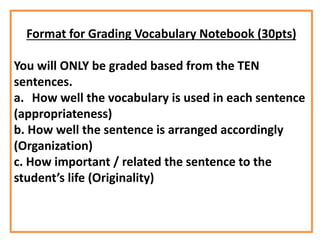
Format for Grading Vocabulary Notebook (30pts)
You will ONLY be graded based from the TEN
sentences.
a. How well the vocabulary is used in each sentence
(appropriateness)
b. How well the sentence is arranged accordingly
(Organization)
c. How important / related the sentence to the
student’s life (Originality)
Dyad, Triad and Group Discussion
a. Know the kind of the discussion.
Dyad – by two, Triad – by three,
Group by readiness – arranged by the adviser
Group by interest – chosen by the students
b. Talk softly during the discussion or else the time
for discussion will be shortened by the teacher.
c. Listen for the goal and objective of the discussion.
d. Know the proper hand signal to stop the
discussion. Raise your hand so students may take
notice.
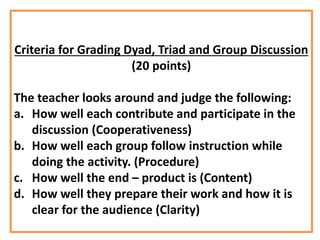
Criteria for Grading Dyad, Triad and Group Discussion
(20 points)
The teacher looks around and judge the following:
a. How well each contribute and participate in the
discussion (Cooperativeness)
b. How well each group follow instruction while
doing the activity. (Procedure)
c. How well the end – product is (Content)
d. How well they prepare their work and how it is
clear for the audience (Clarity)
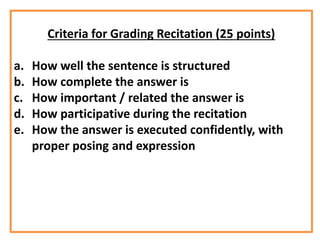
Criteria for Grading Recitation (25 points)
a. How well the sentence is structured
b. How complete the answer is
c. How important / related the answer is
d. How participative during the recitation
e. How the answer is executed confidently, with
proper posing and expression
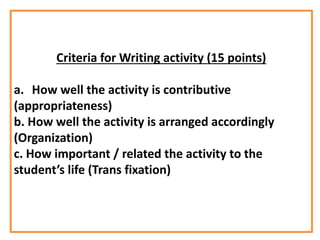
Criteria for Writing activity (15 points)
a. How well the activity is contributive
(appropriateness)
b. How well the activity is arranged accordingly
(Organization)
c. How important / related the activity to the
student’s life (Trans fixation)
Criteria for Drawing activity (15 points)
a. How well drawing is contributive to the lesson
(appropriateness)
b. How well the activity is arranged and designed
accordingly – use of colors and lines
(Organization)
c. How important / related the activity to the
student’s life (Trans fixation)
Introduce yourself

English intro

  • 1.
  • 2.
    PHILOSOPHY “ABC” A good student Bethe best student Coping student
  • 3.
    POLICY 1. Talk ONLYin ENGLISH. 2. Do not talk when the teacher is talking. Note down the teacher is saying. 3. Pay attention to your classmate and listen carefully for their ideas while talking in dyad, triad, group or individual recitation. 4. Exchange papers properly either clockwise or counterclockwise. 5. Check papers properly. 6. Submit work as scheduled. 7. Remember to work quietly or softly. 8. Listen for the instructions carefully. 9. Do not go out or stand during discussion
  • 4.
    REQUIREMENTS Spelling Booklet Formal ThemeWorkbook Lecture / Assessment/ Vocabulary notebook – (covered in blue and plastic cover, sewn) ¼ index card Book (by the end of June) Art Materials Folder with plastic cover Note: to be checked at the End of June, Third meeting
  • 5.
  • 6.
    English 7 UNIT I– COMMUNICATING WITH GOOD ENGLISH a. Making dynamic introductions b. Speaking Good English 1. Intonation and stress 2. Pausing and phrasing c. Non - Verbal communication II. ORAL LANGUAGE AND FLUENCY a. Correct Stress and Intonation b. Appropriate Volume and Correct Enunciation c. Flexibility Tone d. Pronunciation of Critical Vowels and Consonant sound
  • 7.
    English 7 UNIT II– UNDERSTANDING FILIPINO CULTURE IV. READING COMPREHENSION a. Riddles and Proverbs b. Punch lines and Jokes c. Cause and Effect V. LITERATURE Literary Types a. Folk Narratives 1. Myth 2. Fable 3. Legend
  • 8.
    English 7 VIII. WRITING a.Purpose of Writing b. Kinds of Paragraphs IX. GRAMMAR a. Subject-verb agreement b. Pronoun-antecedent Agreement c. Simple and Compound Sentences X. RESEARCH a. Introduction to Research and Purposes b. Chapter I and II: Guidelines for Writing
  • 9.
    English 8 I. LISTENINGCOMPREHENSION a. Informative Listening (Legends) b. Inferences II. LITERATURE a. Chinese Literature b. The Great Chinese Philosophers: (Lao-Tzu & Confucius) c. The Judgment Between Two Mothers d. Japanese Literature e. The Story of the Aged Mother
  • 10.
    III. WRITING a. JournalEntries b. Dialogs c. Experiential writing d. Book report IV. GRAMMAR Nouns 1. Kinds 2. Cases 3. Forms Pronouns 1. Kinds 2. Cases (Pronoun – Antecedent Agreement)
  • 11.
    V. RESEARCH A. Definitionsof Research B. Purposes of Research (Aims, Objectives and Goals) C. Characteristics of Good Research (Chapter 1: Introduction to Research)
  • 12.
    Format of notebook a.For the cover page, write the subject at the center and below, your own name. b. Make sure to insert book mark every time. c. Divide the notebook into three partitions. d. Label the first partition as the assessment e. Label the second half as lecture. f. In the first page of the notebook, at the first line, write your name at the top left corner of the page.
  • 13.
    Format of notebook a.Consecutively, write your age, learning styles, interests and past achievements. b. In the second page, write a simple prayer for the said subject. c. Call your teacher for any assistance.
  • 14.
    Format of notebook Duringthe Assessment a. Before the assessment, reserve at least three pages for Rewards and Points. b. Label the top part of the page according to Assessment 1,2, 3 respectively. c. Consecutively, at the top right of the page, the date and the score for the said activity. d. Listen carefully for the teacher’s instructions.
  • 15.
    Format of notebook Duringthe Lecture a. Write at the top right of the page, the date and topic of the lecture. Put in some of your own learning. b. One must write also at the back of the pages. c. Listen carefully for the teacher’s instructions.
  • 16.
    Format of Spelling a.Be sure to check that the logo of the spelling booklet is the school seal. b. Write at the top part of the page, the schedule of the said test with your score. c. Spell the word as the teacher pronounced. You are only allowed to spell the word after the teacher says “go!” d. Spell each word correctly with the correct numbering. e. Nobody must talk during the spelling proper. You must raise your hand to clarify.
  • 17.
    Criteria for FormalTheme You will be judged according to the following criteria. a. How well you write in cursive form. b. How good when presenting your essay (Introduction) c. How well you are to capture and maintain the interests of the readers. d. How well you lengthen or expound on your ideas (Content) e. How well you are in organizing your thoughts f. How well you put closure to your work (ending) g. How good you are in constructing basic sentence patterns. How good you use words by contexts.
  • 18.
    Format for ActivitySheet a. Write at the top left, your own complete name and beside it, your own year and section. b. Write the criteria at the top right. c. Write the name of the activity at the middle after a and b with the date in the parenthesis. d. Do what is instructed. e. After checking the activity, put the activity to the folder.
  • 19.
    Format for DreamJournal a. Write at the top left, your own complete name and beside it, your own year and section. b. Write the criteria at the top right. c. Write “Dream Entry #” at the middle with the the certain date in the parenthesis. d. Write the name of the book below the Dream Entry #. e. Do what is instructed. f. After checking the activity, put the activity to the folder.
  • 20.
    Format for BookReport a. Be creative as much as possible when making the book report, in any form. b. The pages of the book report must be at least 5 pages and must not appear bulky. c. Write the following parts. Name of the author, short paragraph about the author, setting (time and place of the events – at least two with short descriptive paragraph), characters (at least five people – with short descriptive paragraphs about their role in the story)
  • 21.
    Format for BookReport a. Following parts: Short summary (at least 3 paragraphs) Introduction, how the story began Middle, what part is the point of interest Ending, how the story ended Lesson (Enumerate at least five things to remember about the said – book – bullet form) Message to the Author (Talk to the author)
  • 22.
    Format for BookReport b. For the cover page, at the middle, write the title of the book and your own name below. c. Below it, write the rubrics and score. Make sure that the cover of your notebook can be written using a ball pen or a pentel pen. d. Make sure that the cover page is smooth and not dark.
  • 23.
    Criteria for GradingBook Report (50 pts) a. How well the design represented the book itself b. How elaborate is the design made c. How well the whole structure of book report is d. How detailed / complete the book report is e. How coherent / aligned the book report to the book is f. How organized the book report is
  • 24.
    Format for VocabularyNotebook a. Write all the words given / posted by the teacher in the teacher. No required arrangement. b. Number each word. At least collect 20 words posted by the teacher in the board for the each whole quarter. c. For each word, write a short one – line definition, in complete sentence. d. After reaching at he maximum of 20 words. Get ten words for the said – vocabulary. Use each word to create ten sentences. e. Let your teacher check afterwards.
  • 25.
    Format for GradingVocabulary Notebook (30pts) You will ONLY be graded based from the TEN sentences. a. How well the vocabulary is used in each sentence (appropriateness) b. How well the sentence is arranged accordingly (Organization) c. How important / related the sentence to the student’s life (Originality)
  • 26.
    Dyad, Triad andGroup Discussion a. Know the kind of the discussion. Dyad – by two, Triad – by three, Group by readiness – arranged by the adviser Group by interest – chosen by the students b. Talk softly during the discussion or else the time for discussion will be shortened by the teacher. c. Listen for the goal and objective of the discussion. d. Know the proper hand signal to stop the discussion. Raise your hand so students may take notice.
  • 27.
    Criteria for GradingDyad, Triad and Group Discussion (20 points) The teacher looks around and judge the following: a. How well each contribute and participate in the discussion (Cooperativeness) b. How well each group follow instruction while doing the activity. (Procedure) c. How well the end – product is (Content) d. How well they prepare their work and how it is clear for the audience (Clarity)
  • 28.
    Criteria for GradingRecitation (25 points) a. How well the sentence is structured b. How complete the answer is c. How important / related the answer is d. How participative during the recitation e. How the answer is executed confidently, with proper posing and expression
  • 29.
    Criteria for Writingactivity (15 points) a. How well the activity is contributive (appropriateness) b. How well the activity is arranged accordingly (Organization) c. How important / related the activity to the student’s life (Trans fixation)
  • 30.
    Criteria for Drawingactivity (15 points) a. How well drawing is contributive to the lesson (appropriateness) b. How well the activity is arranged and designed accordingly – use of colors and lines (Organization) c. How important / related the activity to the student’s life (Trans fixation)
  • 31.