Page 1
Department of Management Studies
JNNCE, Shimoga – 577204 (Karnataka)
Seminar On
Work-Life Balance
Under the Guidance of
Mrs. Ashwini H.A.
Assistant Professor
Department of Management Studies
JNNCE, Shimoga
Presented By
Mr. Dhinda Mohammed Sharif
I Semester, MBA
Department of Management Studies
JNNCE, Shimoga
Page 2
Page 3
 Introduction of Work-Life Balance
 Definition
 Evolution
 Dimensions of Work-Life Balance
 Reasons for Work-Life Balance
 Solutions to Work-Life Balance
 Corporate initiative towards Work-Life Balance
 Benefits
 Problems due to Imbalance
 Components of Work-Life Balance
 Conclusion
 Bibliography
Page 4
Work-Life Balance is a broad concept including proper
prioritizing between “work” (career and ambition) on one hand
and “life” (health, pleasure, leisure, family and spiritual
development) on the other.
The study of work life balance involves the examination of
people’s ability to manage simultaneously the multi-faceted
demands of life. It is assisted by employers who institute policies,
procedures, actions and expectations that enable employees to
easily engage in more balanced lives.
Page 5
“Work- life Balance is about creating and maintaining
supportive a healthy work environments, which will enable
employees to have balance between work and personal
responsibilities, thus strengthens employee loyalty and
productivity”.
Page 6
The expression "work–life balance" was first used in the United
Kingdom in the late 1970s to describe the balance between an
individual's work and personal life.
In the United States, this phrase was first used in 1986. The U.S.
government understood that there is a need to counter work with leisure
time. In fact, they issued measures that reduces the working hours for
some government employees.
Many Corporations began to implement life enhancing policies
such as maternity leave, flexible scheduling, telecommunicating and
employee assistance though these programs started out as women
oriented but eventually they shifted to accommodate both men and
women’s needs.
Page 7
I. Individual Related Factors:
Demographical Factors
+ Age
+ Gender
+ Marital Status
Economic Factors
+ Financial Condition
+ Financial Responsibility
Behavioral Factors
+ Personality
+ Attitude
+ Emotional Intelligence
+ Stress
Page 8
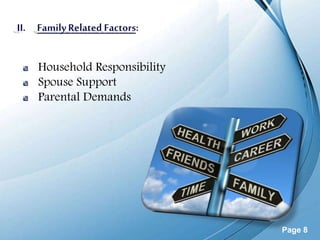
II. FamilyRelated Factors:
Household Responsibility
Spouse Support
Parental Demands
Page 9
III. Work & Organization Related Factors:
Work Intensity
Contextual Demand
Work Schedule
Page 10
Organization Climate
Leadership Style
Organization Culture
Page 11
• Competition
• Individual Career Ambitions
Page 12
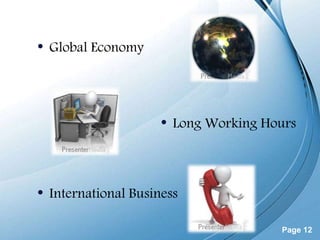
• International Business
• Global Economy
• Long Working Hours
Page 13
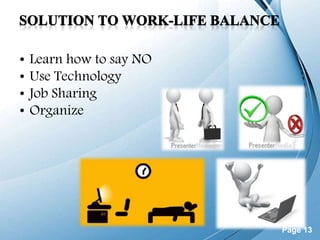
• Learn how to say NO
• Use Technology
• Job Sharing
• Organize
Page 14
• Know it won’t always be perfect
• On-Job Training
• Job Rotation
• Vacation
Page 15
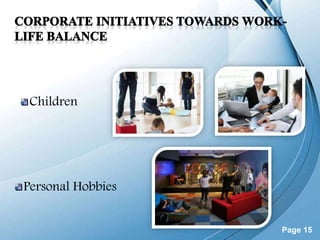
Children
Personal Hobbies
Page 16
Making employees feeling comfortable
Family
Health
Page 17
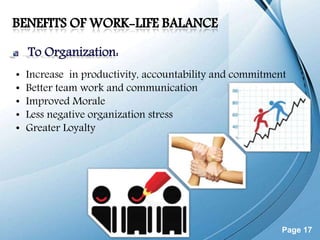
To Organization:
• Increase in productivity, accountability and commitment
• Better team work and communication
• Improved Morale
• Less negative organization stress
• Greater Loyalty
Page 18
To Individual:
• Reduce Stress
• Increase Productivity
• More value and balance in Life
• Improve On-the-Job & Off-the-Job relationship
Page 19
Individual Level = Low Happiness
• Dissatisfaction with the Job and Family
• Lower Motivation
• Low Emotional Balance
• Low Degree of immunity against infections and
diseases
Page 20
Company Level = Low Competitiveness
• Low Productivity
• Negative Image
• Increased Absenteeism
• Talent Drain
• Reduce Turn-over rates
Page 21
1. SelfManagement:
Sufficiently managing one’s self can be challenging particularly in getting proper
sleep, exercise and nutrition.
3. Stress Management:
By nature, societies tend to become more complex over time. In the face of
increasing complexity,stress on the individualis predictable.
2. Time Management:
Effective time management involves making optimal use of your day and the
supporting resources.
Page 22
4. Change Management:
In our fast paced world, change is virtually the only constant. Continually
adopting new methods and re-adaptingothers is vitalto asuccessful career.
6. Leisure Management:
Leisure management acknowledges the importance of rest and relaxation. It is
a time spent away from business, work or education.
5. Technology Management:
Effectively managing technology means ensuring that technology serves you,
rather than abuses you. Technology has always been with us, since the first walking
stick.
Page 23
Work and employment keeps a person
engaged to the maximum extent in his life. Work
place is also an area where a person spends max
time in his day hence his life.
Individuals and organizations need to realize
that “loving what you do is happiness” and it is this
that leads to growth of employees and the
organization.
Greater the employees are able to balance
work life greater will be their productivity.
Page 24
Page 25
https://en.wikipedia.org/wiki/Work%E2%80%93life_balance
https://work-lifebalance.com/
https://ukessays.com/essays/work-lifebalance/advantage-and-
disadvantages/
Page 26
Page 27

Work Life Balance

  • 1.
    Page 1 Department ofManagement Studies JNNCE, Shimoga – 577204 (Karnataka) Seminar On Work-Life Balance Under the Guidance of Mrs. Ashwini H.A. Assistant Professor Department of Management Studies JNNCE, Shimoga Presented By Mr. Dhinda Mohammed Sharif I Semester, MBA Department of Management Studies JNNCE, Shimoga
  • 2.
  • 3.
    Page 3  Introductionof Work-Life Balance  Definition  Evolution  Dimensions of Work-Life Balance  Reasons for Work-Life Balance  Solutions to Work-Life Balance  Corporate initiative towards Work-Life Balance  Benefits  Problems due to Imbalance  Components of Work-Life Balance  Conclusion  Bibliography
  • 4.
    Page 4 Work-Life Balanceis a broad concept including proper prioritizing between “work” (career and ambition) on one hand and “life” (health, pleasure, leisure, family and spiritual development) on the other. The study of work life balance involves the examination of people’s ability to manage simultaneously the multi-faceted demands of life. It is assisted by employers who institute policies, procedures, actions and expectations that enable employees to easily engage in more balanced lives.
  • 5.
    Page 5 “Work- lifeBalance is about creating and maintaining supportive a healthy work environments, which will enable employees to have balance between work and personal responsibilities, thus strengthens employee loyalty and productivity”.
  • 6.
    Page 6 The expression"work–life balance" was first used in the United Kingdom in the late 1970s to describe the balance between an individual's work and personal life. In the United States, this phrase was first used in 1986. The U.S. government understood that there is a need to counter work with leisure time. In fact, they issued measures that reduces the working hours for some government employees. Many Corporations began to implement life enhancing policies such as maternity leave, flexible scheduling, telecommunicating and employee assistance though these programs started out as women oriented but eventually they shifted to accommodate both men and women’s needs.
  • 7.
    Page 7 I. IndividualRelated Factors: Demographical Factors + Age + Gender + Marital Status Economic Factors + Financial Condition + Financial Responsibility Behavioral Factors + Personality + Attitude + Emotional Intelligence + Stress
  • 8.
    Page 8 II. FamilyRelatedFactors: Household Responsibility Spouse Support Parental Demands
  • 9.
    Page 9 III. Work& Organization Related Factors: Work Intensity Contextual Demand Work Schedule
  • 10.
    Page 10 Organization Climate LeadershipStyle Organization Culture
  • 11.
    Page 11 • Competition •Individual Career Ambitions
  • 12.
    Page 12 • InternationalBusiness • Global Economy • Long Working Hours
  • 13.
    Page 13 • Learnhow to say NO • Use Technology • Job Sharing • Organize
  • 14.
    Page 14 • Knowit won’t always be perfect • On-Job Training • Job Rotation • Vacation
  • 15.
  • 16.
    Page 16 Making employeesfeeling comfortable Family Health
  • 17.
    Page 17 To Organization: •Increase in productivity, accountability and commitment • Better team work and communication • Improved Morale • Less negative organization stress • Greater Loyalty
  • 18.
    Page 18 To Individual: •Reduce Stress • Increase Productivity • More value and balance in Life • Improve On-the-Job & Off-the-Job relationship
  • 19.
    Page 19 Individual Level= Low Happiness • Dissatisfaction with the Job and Family • Lower Motivation • Low Emotional Balance • Low Degree of immunity against infections and diseases
  • 20.
    Page 20 Company Level= Low Competitiveness • Low Productivity • Negative Image • Increased Absenteeism • Talent Drain • Reduce Turn-over rates
  • 21.
    Page 21 1. SelfManagement: Sufficientlymanaging one’s self can be challenging particularly in getting proper sleep, exercise and nutrition. 3. Stress Management: By nature, societies tend to become more complex over time. In the face of increasing complexity,stress on the individualis predictable. 2. Time Management: Effective time management involves making optimal use of your day and the supporting resources.
  • 22.
    Page 22 4. ChangeManagement: In our fast paced world, change is virtually the only constant. Continually adopting new methods and re-adaptingothers is vitalto asuccessful career. 6. Leisure Management: Leisure management acknowledges the importance of rest and relaxation. It is a time spent away from business, work or education. 5. Technology Management: Effectively managing technology means ensuring that technology serves you, rather than abuses you. Technology has always been with us, since the first walking stick.
  • 23.
    Page 23 Work andemployment keeps a person engaged to the maximum extent in his life. Work place is also an area where a person spends max time in his day hence his life. Individuals and organizations need to realize that “loving what you do is happiness” and it is this that leads to growth of employees and the organization. Greater the employees are able to balance work life greater will be their productivity.
  • 24.
  • 25.
  • 26.
  • 27.