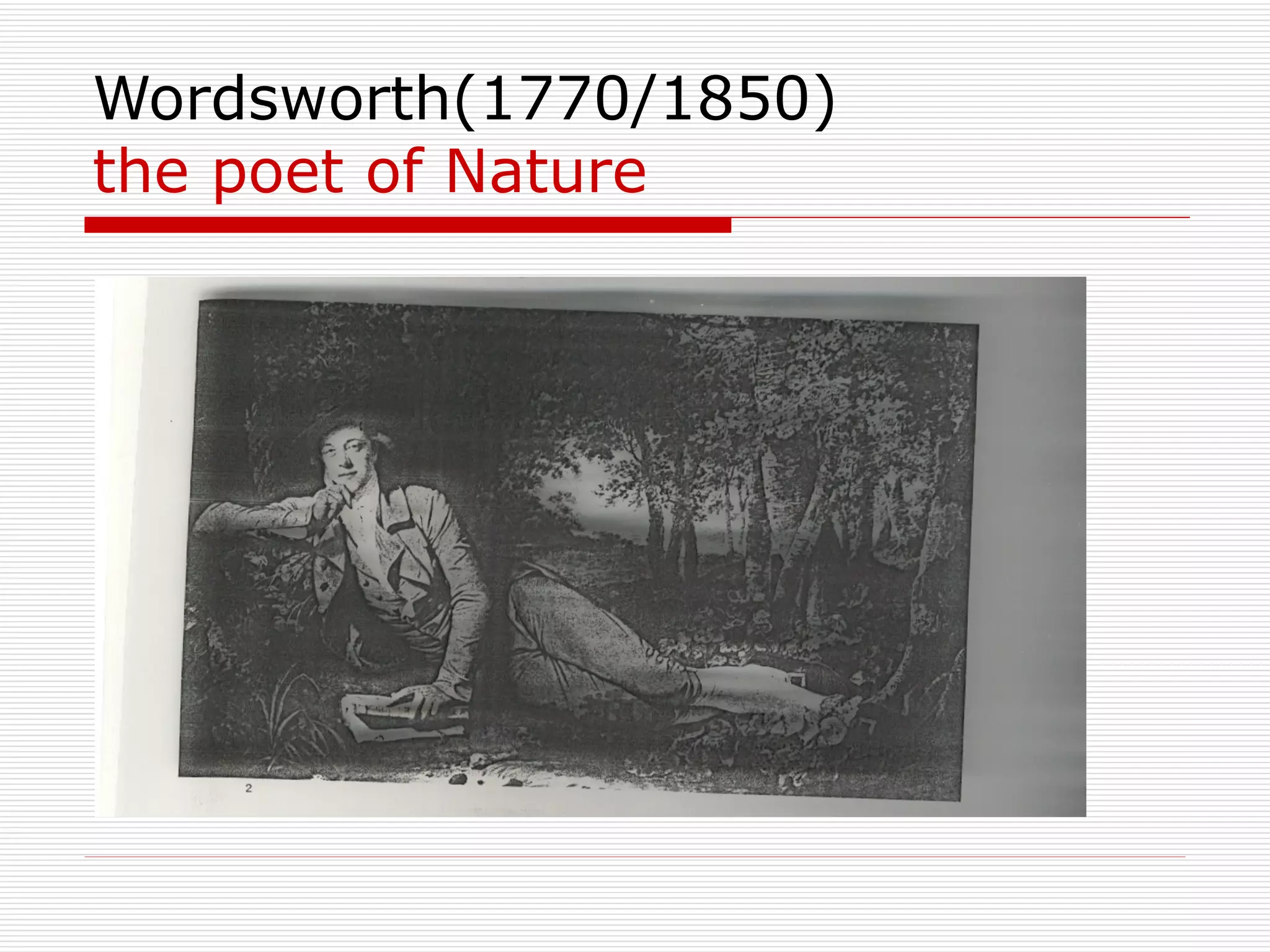
Wordsworth(1770/1850) the poet of Nature
Autobiographical poet At the centre of his interest: connexion child-nature A man had to be as happy as a child He started his career protesting against the evil of war/ industrialization, the upper class indifference to the suffering of rural people
1789 French Revolution He had to leave France Shocked by the bloody F.R. England against Napoleon :war As a reaction W. became  a reactionary ( Tory) He went to the  Lake district  with his sister Dorothy He met Coleridge : a new philosophy,poetry “ The Lyrical Ballads”
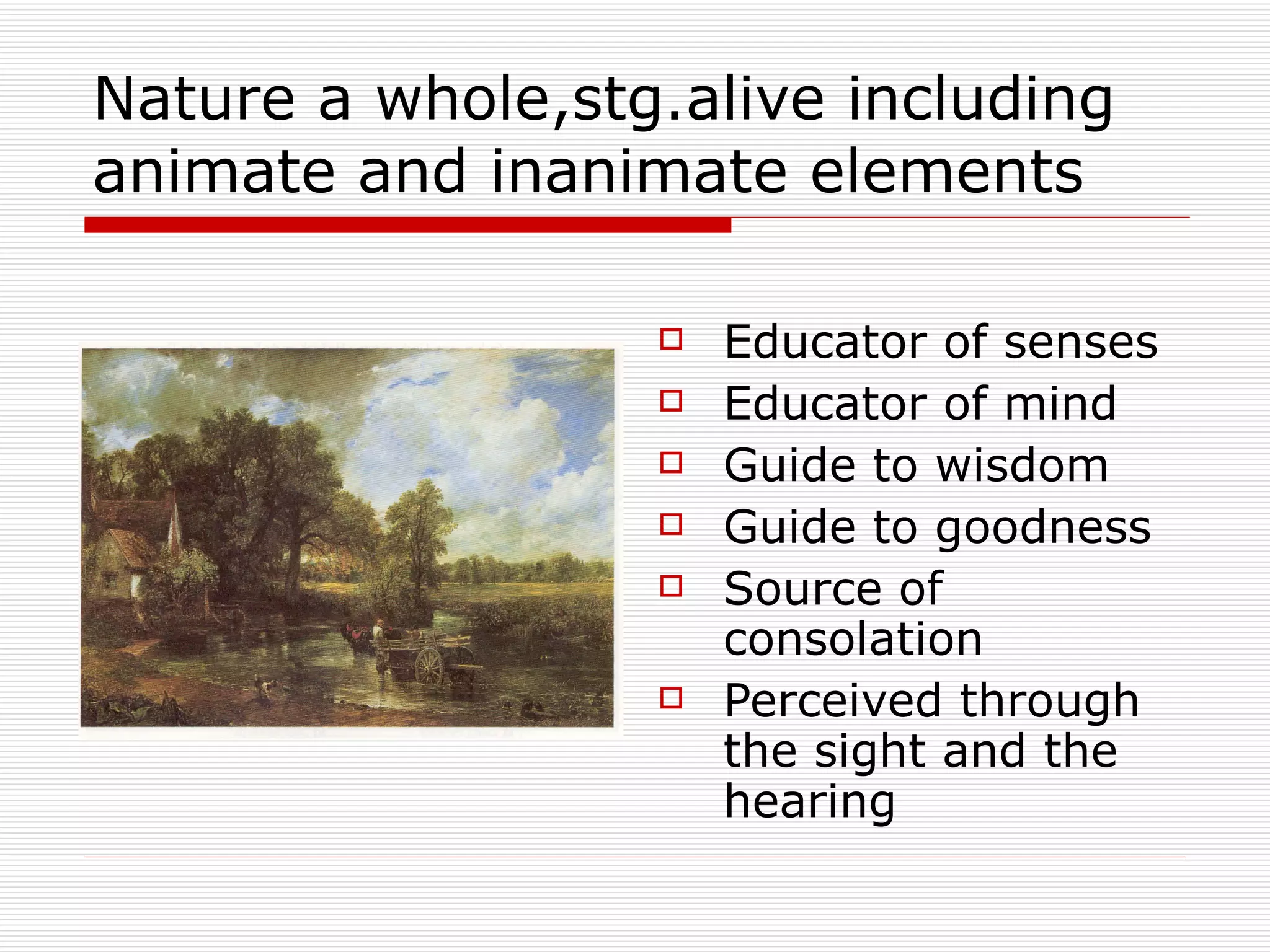
Nature a whole,stg.alive including animate and inanimate elements Educator of senses Educator of mind Guide to wisdom Guide to goodness Source of consolation Perceived through the sight and the hearing
Influenced by Hartley A child = simple sensations caused by by physical experiences/simple ideas A man = complex ideas -associations The poet elaborates and memorizes complex ideas (pag 293) creates a poem
The poet Poetry = record of a state of mind +  imagination  Imagination allows the poet to perceive, to see with the eyes of the soul It allows to see the relation man (child)- nature The poet  is endowed with Imagination The poet  Is superior to other men The poet  Is the VATE, THE TEACHER
The Lyrical Ballads ( 1798–1880 manifesto of the Romantic Movement W. 19 poems Starting point rural people, natural elements seen through the eyes of Imagination  to fuse the real with the ideal Coleridge 4 poems Opposite starting point  to make the ideal seem real
Language and style The language had to be simple,  but his best poems are written in an elevated style A minimum of stylization He didn’t work in any poetical tradition At the end of his life he was: respectable,  conservative / a Tory) 1843 “ laureate poet” Criticized by the poets of the second generation

Wordsworth

  • 1.
  • 2.
    Autobiographical poet Atthe centre of his interest: connexion child-nature A man had to be as happy as a child He started his career protesting against the evil of war/ industrialization, the upper class indifference to the suffering of rural people
  • 3.
    1789 French RevolutionHe had to leave France Shocked by the bloody F.R. England against Napoleon :war As a reaction W. became a reactionary ( Tory) He went to the Lake district with his sister Dorothy He met Coleridge : a new philosophy,poetry “ The Lyrical Ballads”
  • 4.
    Nature a whole,stg.aliveincluding animate and inanimate elements Educator of senses Educator of mind Guide to wisdom Guide to goodness Source of consolation Perceived through the sight and the hearing
  • 5.
    Influenced by HartleyA child = simple sensations caused by by physical experiences/simple ideas A man = complex ideas -associations The poet elaborates and memorizes complex ideas (pag 293) creates a poem
  • 6.
    The poet Poetry= record of a state of mind + imagination Imagination allows the poet to perceive, to see with the eyes of the soul It allows to see the relation man (child)- nature The poet is endowed with Imagination The poet Is superior to other men The poet Is the VATE, THE TEACHER
  • 7.
    The Lyrical Ballads( 1798–1880 manifesto of the Romantic Movement W. 19 poems Starting point rural people, natural elements seen through the eyes of Imagination to fuse the real with the ideal Coleridge 4 poems Opposite starting point to make the ideal seem real
  • 8.
    Language and styleThe language had to be simple, but his best poems are written in an elevated style A minimum of stylization He didn’t work in any poetical tradition At the end of his life he was: respectable, conservative / a Tory) 1843 “ laureate poet” Criticized by the poets of the second generation