Performer - Culture & Literature
Marina Spiazzi, Marina Tavella,
Margaret Layton © 2012
The Romantic spirit
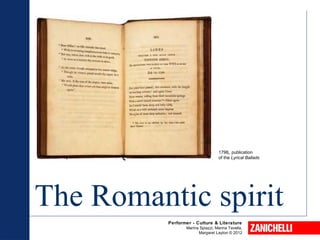
1798, publication
of the Lyrical Ballads
The Romantic spirit
Performer - Culture&Literature
the period in which new
ideas and attitudes arose
in reaction to the
dominant 18th
-century
ideals of order, calm,
harmony, balance,
rationality
1. The word ‘Romantic’
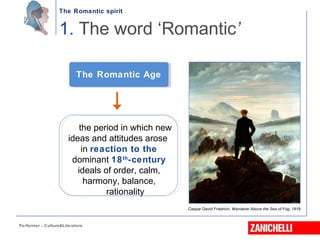
Caspar David Friedrich, Wanderer Above the Sea of Fog, 1818
The Romantic AgeThe Romantic Age
The Romantic spirit
Performer - Culture&Literature
Enlightened trends
• Emphasised reason and judgement.
• Focused on society as a whole.
• Followed authority.
• Interested in science and technology.
Romantic trends
• Emphasised imagination and emotion.
• Valued individuals.
• Looked for freedom.
• Represented common people.
• Interested in the supernatural.
2. Romanticism vs
Enlightenment
The Romantic spirit
Performer - Culture&Literature
3. English Romanticism
English
Romanticism
influenced by the French Revolution
and the English Industrial Revolution.
a revolt of the English imagination
against the neoclassical reason.
The Romantics:
•expressed a negative attitude towards the existing
social or political conditions;
•placed the individual at the centre of art;
•argued that poetry should be free from all rules.
The Romantic spirit
Performer - Culture&Literature
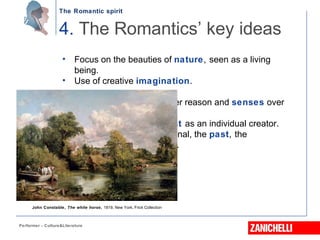
• Focus on the beauties of nature, seen as a living
being.
• Use of creative imagination.
• Exaltation of emotion over reason and senses over
intellect.
• A new view of the artist as an individual creator.
• Fascination with the irrational, the past, the
mysterious, the exotic.
4. The Romantics’ key ideas
John Constable, The white horse, 1819, New York, Frick Collection
The Romantic spirit
Performer - Culture&Literature
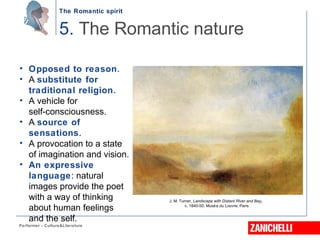
• Opposed to reason.
• A substitute for
traditional religion.
• A vehicle for
self-consciousness.
• A source of
sensations.
• A provocation to a state
of imagination and vision.
• An expressive
language: natural
images provide the poet
with a way of thinking
about human feelings
and the self.
5. The Romantic nature
J. M. Turner, Landscape with Distant River and Bay,
c. 1840-50; Musée du Louvre, Paris
The Romantic spirit
Performer - Culture&Literature
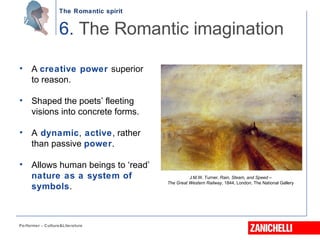
• A creative power superior
to reason.
• Shaped the poets’ fleeting
visions into concrete forms.
• A dynamic, active, rather
than passive power.
• Allows human beings to ‘read’
nature as a system of
symbols.
6. The Romantic imagination
J.M.W. Turner, Rain, Steam, and Speed –
The Great Western Railway, 1844, London, The National Gallery
The Romantic spirit
Performer - Culture&Literature
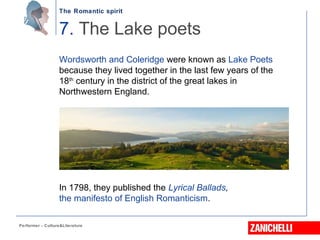
Wordsworth and Coleridge were known as Lake Poets
because they lived together in the last few years of the
18th
century in the district of the great lakes in
Northwestern England.
In 1798, they published the Lyrical Ballads,
the manifesto of English Romanticism.
7. The Lake poets
The Romantic spirit
Performer - Culture&Literature
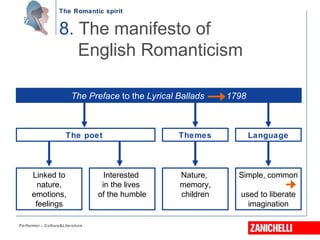
8. The manifesto of
English Romanticism
Linked to
nature,
emotions,
feelings
Interested
in the lives
of the humble
Nature,
memory,
children
Simple, common
used to liberate
imagination
Themes LanguageThe poet
The Preface to the Lyrical Ballads 1798
The Romantic spirit
Performer - Culture&Literature
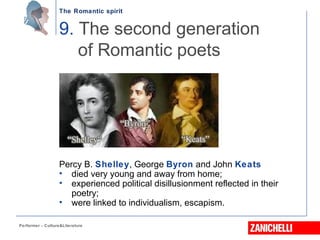
Percy B. Shelley, George Byron and John Keats
• died very young and away from home;
• experienced political disillusionment reflected in their
poetry;
• were linked to individualism, escapism.
9. The second generation
of Romantic poets
The Romantic spirit
Performer - Culture&Literature
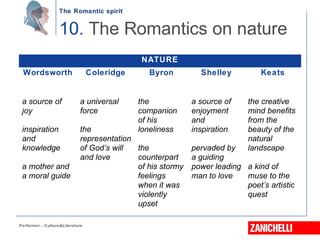
10. The Romantics on nature
NATURE
Wordsworth Coleridge Byron Shelley Keats
a source of
joy
inspiration
and
knowledge
a mother and
a moral guide
a universal
force
the
representation
of God’s will
and love
the
companion
of his
loneliness
the
counterpart
of his stormy
feelings
when it was
violently
upset
a source of
enjoyment
and
inspiration
pervaded by
a guiding
power leading
man to love
the creative
mind benefits
from the
beauty of the
natural
landscape
a kind of
muse to the
poet’s artistic
quest
The Romantic spirit
Performer - Culture&Literature
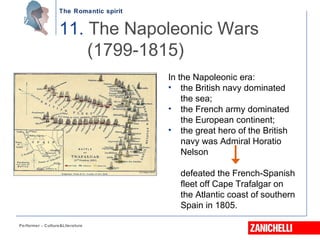
In the Napoleonic era:
• the British navy dominated
the sea;
• the French army dominated
the European continent;
• the great hero of the British
navy was Admiral Horatio
Nelson
defeated the French-Spanish
fleet off Cape Trafalgar on
the Atlantic coast of southern
Spain in 1805.
11. The Napoleonic Wars
(1799-1815)
The Romantic spirit
Performer - Culture&Literature
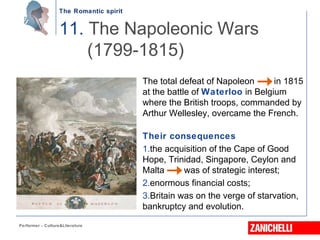
The total defeat of Napoleon in 1815
at the battle of Waterloo in Belgium
where the British troops, commanded by
Arthur Wellesley, overcame the French.
Their consequences
1.the acquisition of the Cape of Good
Hope, Trinidad, Singapore, Ceylon and
Malta was of strategic interest;
2.enormous financial costs;
3.Britain was on the verge of starvation,
bankruptcy and evolution.
11. The Napoleonic Wars
(1799-1815)
The Romantic spirit
Performer - Culture&Literature
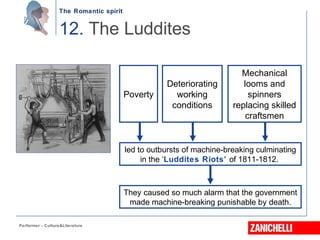
12. The Luddites
They caused so much alarm that the government
made machine-breaking punishable by death.
Deteriorating
working
conditions
Mechanical
looms and
spinners
replacing skilled
craftsmen
Poverty
led to outbursts of machine-breaking culminating
in the ‘Luddites Riots’ of 1811-1812.
The Romantic spirit
Performer - Culture&Literature
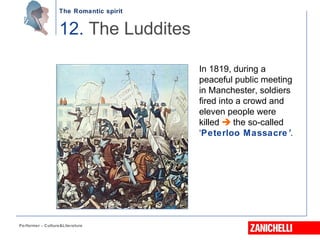
In 1819, during a
peaceful public meeting
in Manchester, soldiers
fired into a crowd and
eleven people were
killed  the so-called
‘Peterloo Massacre’.
12. The Luddites
The Romantic spirit
Performer - Culture&Literature
The period between 1811 and 1820: the Regency.
The Prince Regent, later to become George IV, acted
as monarch during the illness of his father George III
(1760-1820).
In 1830 William IV succeeded his brother and his
short reign saw a new political awareness leading to the
new age of reforms.
13. The Regency

The romantic spirit

  • 1.
    Performer - Culture& Literature Marina Spiazzi, Marina Tavella, Margaret Layton © 2012 The Romantic spirit 1798, publication of the Lyrical Ballads
  • 2.
    The Romantic spirit Performer- Culture&Literature the period in which new ideas and attitudes arose in reaction to the dominant 18th -century ideals of order, calm, harmony, balance, rationality 1. The word ‘Romantic’ Caspar David Friedrich, Wanderer Above the Sea of Fog, 1818 The Romantic AgeThe Romantic Age
  • 3.
    The Romantic spirit Performer- Culture&Literature Enlightened trends • Emphasised reason and judgement. • Focused on society as a whole. • Followed authority. • Interested in science and technology. Romantic trends • Emphasised imagination and emotion. • Valued individuals. • Looked for freedom. • Represented common people. • Interested in the supernatural. 2. Romanticism vs Enlightenment
  • 4.
    The Romantic spirit Performer- Culture&Literature 3. English Romanticism English Romanticism influenced by the French Revolution and the English Industrial Revolution. a revolt of the English imagination against the neoclassical reason. The Romantics: •expressed a negative attitude towards the existing social or political conditions; •placed the individual at the centre of art; •argued that poetry should be free from all rules.
  • 5.
    The Romantic spirit Performer- Culture&Literature • Focus on the beauties of nature, seen as a living being. • Use of creative imagination. • Exaltation of emotion over reason and senses over intellect. • A new view of the artist as an individual creator. • Fascination with the irrational, the past, the mysterious, the exotic. 4. The Romantics’ key ideas John Constable, The white horse, 1819, New York, Frick Collection
  • 6.
    The Romantic spirit Performer- Culture&Literature • Opposed to reason. • A substitute for traditional religion. • A vehicle for self-consciousness. • A source of sensations. • A provocation to a state of imagination and vision. • An expressive language: natural images provide the poet with a way of thinking about human feelings and the self. 5. The Romantic nature J. M. Turner, Landscape with Distant River and Bay, c. 1840-50; Musée du Louvre, Paris
  • 7.
    The Romantic spirit Performer- Culture&Literature • A creative power superior to reason. • Shaped the poets’ fleeting visions into concrete forms. • A dynamic, active, rather than passive power. • Allows human beings to ‘read’ nature as a system of symbols. 6. The Romantic imagination J.M.W. Turner, Rain, Steam, and Speed – The Great Western Railway, 1844, London, The National Gallery
  • 8.
    The Romantic spirit Performer- Culture&Literature Wordsworth and Coleridge were known as Lake Poets because they lived together in the last few years of the 18th century in the district of the great lakes in Northwestern England. In 1798, they published the Lyrical Ballads, the manifesto of English Romanticism. 7. The Lake poets
  • 9.
    The Romantic spirit Performer- Culture&Literature 8. The manifesto of English Romanticism Linked to nature, emotions, feelings Interested in the lives of the humble Nature, memory, children Simple, common used to liberate imagination Themes LanguageThe poet The Preface to the Lyrical Ballads 1798
  • 10.
    The Romantic spirit Performer- Culture&Literature Percy B. Shelley, George Byron and John Keats • died very young and away from home; • experienced political disillusionment reflected in their poetry; • were linked to individualism, escapism. 9. The second generation of Romantic poets
  • 11.
    The Romantic spirit Performer- Culture&Literature 10. The Romantics on nature NATURE Wordsworth Coleridge Byron Shelley Keats a source of joy inspiration and knowledge a mother and a moral guide a universal force the representation of God’s will and love the companion of his loneliness the counterpart of his stormy feelings when it was violently upset a source of enjoyment and inspiration pervaded by a guiding power leading man to love the creative mind benefits from the beauty of the natural landscape a kind of muse to the poet’s artistic quest
  • 12.
    The Romantic spirit Performer- Culture&Literature In the Napoleonic era: • the British navy dominated the sea; • the French army dominated the European continent; • the great hero of the British navy was Admiral Horatio Nelson defeated the French-Spanish fleet off Cape Trafalgar on the Atlantic coast of southern Spain in 1805. 11. The Napoleonic Wars (1799-1815)
  • 13.
    The Romantic spirit Performer- Culture&Literature The total defeat of Napoleon in 1815 at the battle of Waterloo in Belgium where the British troops, commanded by Arthur Wellesley, overcame the French. Their consequences 1.the acquisition of the Cape of Good Hope, Trinidad, Singapore, Ceylon and Malta was of strategic interest; 2.enormous financial costs; 3.Britain was on the verge of starvation, bankruptcy and evolution. 11. The Napoleonic Wars (1799-1815)
  • 14.
    The Romantic spirit Performer- Culture&Literature 12. The Luddites They caused so much alarm that the government made machine-breaking punishable by death. Deteriorating working conditions Mechanical looms and spinners replacing skilled craftsmen Poverty led to outbursts of machine-breaking culminating in the ‘Luddites Riots’ of 1811-1812.
  • 15.
    The Romantic spirit Performer- Culture&Literature In 1819, during a peaceful public meeting in Manchester, soldiers fired into a crowd and eleven people were killed  the so-called ‘Peterloo Massacre’. 12. The Luddites
  • 16.
    The Romantic spirit Performer- Culture&Literature The period between 1811 and 1820: the Regency. The Prince Regent, later to become George IV, acted as monarch during the illness of his father George III (1760-1820). In 1830 William IV succeeded his brother and his short reign saw a new political awareness leading to the new age of reforms. 13. The Regency

Editor's Notes