

Topic: Preface to Lyrical
Ballads
By William Wordsworth
Welcome
to this Class in the
Department of English
Uttara University
Conducted By:
Monir Hossen
Lecturer
Department of English
Uttara University
Email: monir.eng.cou@gmail.com
Introdution
William Wordsworth was an influential British Poet because he
contributed a lot of masterpieces and masterworks in the field of
poetry. Being an orphan at the age of 13 was not a hindrance to him
to reach his goals and dreams in life, instead he used it as an
inspiration to make his life better together wit his beloved and
neurotic sister Dorothy. Lyrical Ballad was his first masterpiece that
gives a lot of privileges to him as a poet. In the following years he
started to write large and philosophical poems. William Wordsworth
made a big impact in the field of poetry and was a successful poet
during his time and became a patriotic, conservative public man.
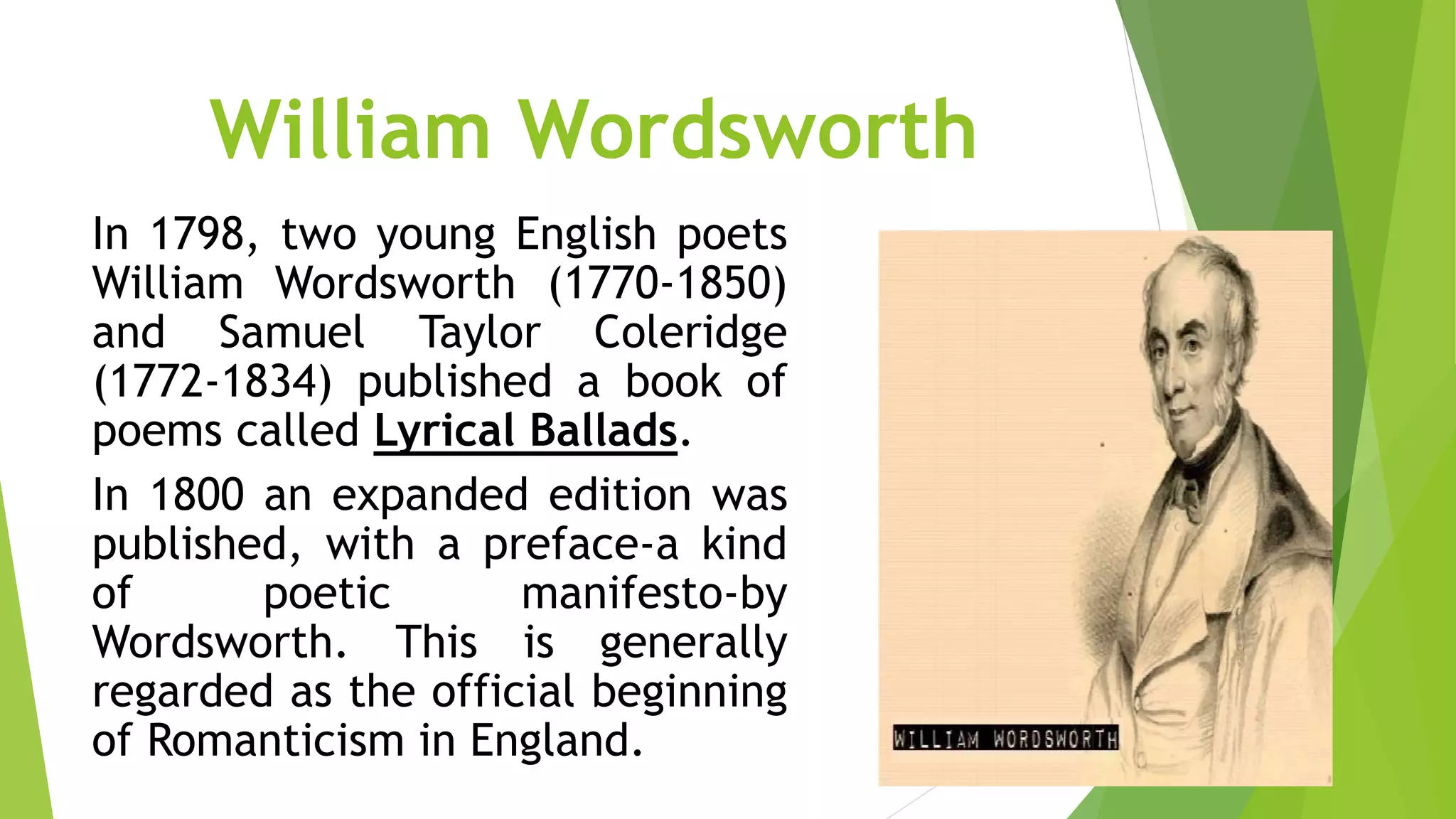
William Wordsworth
In 1798, two young English poets
William Wordsworth (1770-1850)
and Samuel Taylor Coleridge
(1772-1834) published a book of
poems called Lyrical Ballads.
In 1800 an expanded edition was
published, with a preface-a kind
of poetic manifesto-by
Wordsworth. This is generally
regarded as the official beginning
of Romanticism in England.
Biography of Wordsworth
 British Poet
 Born April 7, 1770 in Cockermouth,
Cumberland, in the Lake District
 Continued his studies at Cambridge University.
 He made his debut as a writer in 1787, when he
published a sonnet in The European Magazine.
 Poet of Nature
 Critical Thinker
The Poet of Nature
Definition of Poetry
“Poetry is the spontaneous overflow of
powerful feelings: it takes its origin from
emotion recollected in tranquility.”
William Wordsworth, Lyrical Ballads
Ideas of about Poem
 Poems are different
 Manner in which we associate ideas in a state of
excitement
 Low and rustic life
 Poems have a purpose
 Feelings more important than action
 Poetry – the image of man and nature
 Poetry gives pleasure
 Poetry is universal
Definition of a Poet
 A poet:
→ “is a man speaking to men”
→ Knows a lot—“greater knowledge of human nature”
→ Is tuned in to emotions—his own and others’: “a lively
sensibility”
→ Has a good memory and can imagine distant things as
if they are present
→ And has “greater promptness to think and feel without
immediate external excitement”
Language of Poetry
"There neither is, nor can be, any
essential difference between the
language of prose and metrical
composition."
About poetry
“Poetry is the breath and finer
spirit of all knowledge; it is the
impassioned expression which is
in the countenance of all
science.”
Thank you

Preface to Lyrical Ballads Presented By Monir Hossen

  • 1.
    Topic: Preface toLyrical Ballads By William Wordsworth Welcome to this Class in the Department of English Uttara University
  • 2.
    Conducted By: Monir Hossen Lecturer Departmentof English Uttara University Email: monir.eng.cou@gmail.com
  • 3.
    Introdution William Wordsworth wasan influential British Poet because he contributed a lot of masterpieces and masterworks in the field of poetry. Being an orphan at the age of 13 was not a hindrance to him to reach his goals and dreams in life, instead he used it as an inspiration to make his life better together wit his beloved and neurotic sister Dorothy. Lyrical Ballad was his first masterpiece that gives a lot of privileges to him as a poet. In the following years he started to write large and philosophical poems. William Wordsworth made a big impact in the field of poetry and was a successful poet during his time and became a patriotic, conservative public man.
  • 4.
    William Wordsworth In 1798,two young English poets William Wordsworth (1770-1850) and Samuel Taylor Coleridge (1772-1834) published a book of poems called Lyrical Ballads. In 1800 an expanded edition was published, with a preface-a kind of poetic manifesto-by Wordsworth. This is generally regarded as the official beginning of Romanticism in England.
  • 5.
    Biography of Wordsworth British Poet  Born April 7, 1770 in Cockermouth, Cumberland, in the Lake District  Continued his studies at Cambridge University.  He made his debut as a writer in 1787, when he published a sonnet in The European Magazine.  Poet of Nature  Critical Thinker
  • 6.
  • 7.
    Definition of Poetry “Poetryis the spontaneous overflow of powerful feelings: it takes its origin from emotion recollected in tranquility.” William Wordsworth, Lyrical Ballads
  • 8.
    Ideas of aboutPoem  Poems are different  Manner in which we associate ideas in a state of excitement  Low and rustic life  Poems have a purpose  Feelings more important than action  Poetry – the image of man and nature  Poetry gives pleasure  Poetry is universal
  • 9.
    Definition of aPoet  A poet: → “is a man speaking to men” → Knows a lot—“greater knowledge of human nature” → Is tuned in to emotions—his own and others’: “a lively sensibility” → Has a good memory and can imagine distant things as if they are present → And has “greater promptness to think and feel without immediate external excitement”
  • 10.
    Language of Poetry "Thereneither is, nor can be, any essential difference between the language of prose and metrical composition."
  • 11.
    About poetry “Poetry isthe breath and finer spirit of all knowledge; it is the impassioned expression which is in the countenance of all science.”
  • 12.