 William Wordsworth (7 April 1770 – 23 April 1850) was a
  major English Romantic poet who, with Samuel Taylor
  Coleridge, helped to launch the Romantic Age in English
  literature with the 1798 joint publication Lyrical Ballads.
 Wordsworth's magnum opus is generally considered to be The
  Prelude, a semiautobiographical poem of his early years which he
  revised and expanded a number of times. It was posthumously
  titled and published, prior to which it was generally known as
  the poem "to Coleridge". Wordsworth was Britain's Poet Laureate
  from 1843 until his death in 1850.
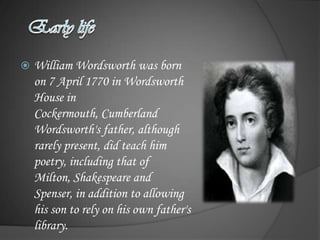
   William Wordsworth was born
    on 7 April 1770 in Wordsworth
    House in
    Cockermouth, Cumberland
    Wordsworth's father, although
    rarely present, did teach him
    poetry, including that of
    Milton, Shakespeare and
    Spenser, in addition to allowing
    his son to rely on his own father's
    library.
EDUCATION
   After the death of their mother, in 1778, John Wordsworth
    sent William to Hawkshead Grammar School in Lancashire
    and Dorothy to live with relatives in Yorkshire; Although
    Hawkshead was Wordsworth's first serious experience with
    education, he had been taught to read by his mother and had
    attended a tiny school of low quality in Cockermouth. After
    the Cockermouth school, he was sent to a school in Penrith
    for the children of upper-class families and taught by Ann
    Birkett Wordsworth was taught both the Bible and the
    Spectator, but little else. It was at the school that
    Wordsworth was to meet the Hutchinson's, including Mary,
    who would be his future wife.
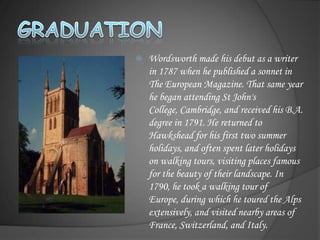
   Wordsworth made his debut as a writer
    in 1787 when he published a sonnet in
    The European Magazine. That same year
    he began attending St John's
    College, Cambridge, and received his B.A.
    degree in 1791. He returned to
    Hawkshead for his first two summer
    holidays, and often spent later holidays
    on walking tours, visiting places famous
    for the beauty of their landscape. In
    1790, he took a walking tour of
    Europe, during which he toured the Alps
    extensively, and visited nearby areas of
    France, Switzerland, and Italy.
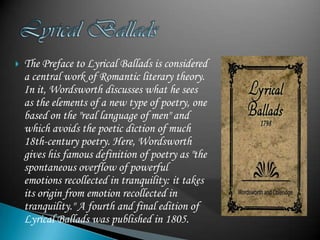
   The Preface to Lyrical Ballads is considered
    a central work of Romantic literary theory.
    In it, Wordsworth discusses what he sees
    as the elements of a new type of poetry, one
    based on the "real language of men" and
    which avoids the poetic diction of much
    18th-century poetry. Here, Wordsworth
    gives his famous definition of poetry as "the
    spontaneous overflow of powerful
    emotions recollected in tranquility: it takes
    its origin from emotion recollected in
    tranquility." A fourth and final edition of
    Lyrical Ballads was published in 1805.
In 1814 he published The Excursion as the second part of the
three-part The Recluse. He had not completed the first and third
parts, and never would. He did, however, write a poetic Prospectus
to "The Recluse" in which he lays out the structure and intent of the
poem. The Prospectus contains some of Wordsworth's most famous
lines on the relation between the human mind and nature:

 My voice proclaims
 How exquisitely the individual Mind
 (And the progressive powers perhaps no less
Of the whole species) to the external World
Is fitted:--and how exquisitely, too,
Theme this but little heard of among Men,
The external World is fitted to the Mind.
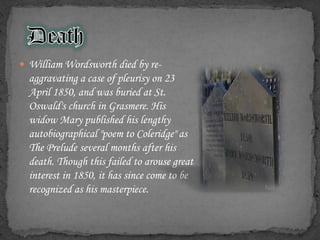
 William Wordsworth died by re-
  aggravating a case of pleurisy on 23
  April 1850, and was buried at St.
  Oswald's church in Grasmere. His
  widow Mary published his lengthy
  autobiographical "poem to Coleridge" as
  The Prelude several months after his
  death. Though this failed to arouse great
  interest in 1850, it has since come to be
  recognized as his masterpiece.
www.wikipedia.com
www.victorianweb.com/quotes/authors/w/william_wordsworth.html

William wordsworth, daffodils

  • 2.
     William Wordsworth(7 April 1770 – 23 April 1850) was a major English Romantic poet who, with Samuel Taylor Coleridge, helped to launch the Romantic Age in English literature with the 1798 joint publication Lyrical Ballads.  Wordsworth's magnum opus is generally considered to be The Prelude, a semiautobiographical poem of his early years which he revised and expanded a number of times. It was posthumously titled and published, prior to which it was generally known as the poem "to Coleridge". Wordsworth was Britain's Poet Laureate from 1843 until his death in 1850.
  • 3.
    William Wordsworth was born on 7 April 1770 in Wordsworth House in Cockermouth, Cumberland Wordsworth's father, although rarely present, did teach him poetry, including that of Milton, Shakespeare and Spenser, in addition to allowing his son to rely on his own father's library.
  • 4.
    EDUCATION  After the death of their mother, in 1778, John Wordsworth sent William to Hawkshead Grammar School in Lancashire and Dorothy to live with relatives in Yorkshire; Although Hawkshead was Wordsworth's first serious experience with education, he had been taught to read by his mother and had attended a tiny school of low quality in Cockermouth. After the Cockermouth school, he was sent to a school in Penrith for the children of upper-class families and taught by Ann Birkett Wordsworth was taught both the Bible and the Spectator, but little else. It was at the school that Wordsworth was to meet the Hutchinson's, including Mary, who would be his future wife.
  • 5.
    Wordsworth made his debut as a writer in 1787 when he published a sonnet in The European Magazine. That same year he began attending St John's College, Cambridge, and received his B.A. degree in 1791. He returned to Hawkshead for his first two summer holidays, and often spent later holidays on walking tours, visiting places famous for the beauty of their landscape. In 1790, he took a walking tour of Europe, during which he toured the Alps extensively, and visited nearby areas of France, Switzerland, and Italy.
  • 6.
    The Preface to Lyrical Ballads is considered a central work of Romantic literary theory. In it, Wordsworth discusses what he sees as the elements of a new type of poetry, one based on the "real language of men" and which avoids the poetic diction of much 18th-century poetry. Here, Wordsworth gives his famous definition of poetry as "the spontaneous overflow of powerful emotions recollected in tranquility: it takes its origin from emotion recollected in tranquility." A fourth and final edition of Lyrical Ballads was published in 1805.
  • 7.
    In 1814 hepublished The Excursion as the second part of the three-part The Recluse. He had not completed the first and third parts, and never would. He did, however, write a poetic Prospectus to "The Recluse" in which he lays out the structure and intent of the poem. The Prospectus contains some of Wordsworth's most famous lines on the relation between the human mind and nature: My voice proclaims How exquisitely the individual Mind (And the progressive powers perhaps no less Of the whole species) to the external World Is fitted:--and how exquisitely, too, Theme this but little heard of among Men, The external World is fitted to the Mind.
  • 9.
     William Wordsworthdied by re- aggravating a case of pleurisy on 23 April 1850, and was buried at St. Oswald's church in Grasmere. His widow Mary published his lengthy autobiographical "poem to Coleridge" as The Prelude several months after his death. Though this failed to arouse great interest in 1850, it has since come to be recognized as his masterpiece.
  • 10.