WordPress Security
Copenhagen September 2013
• Thor Kristiansen
– Self-employed WP-Developer and Business
Consultant
– Long time meditator
• First WP Blog: The Pure View: http://pureview.dk
– 200-400 visitors a day, 90% traffic is US, non-profit
– Former Sr. Business Analyst & QA Mgr. at
Dell
– Portfolio website: http://shivaweb.dk
• Security Stats
• Example Hack
• Top Security Tips
• Recommended Plugins & Services
• Resources
Security Stats
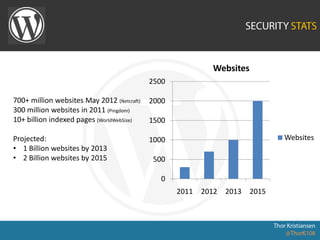
700+ million websites May 2012 (Netcraft)
300 million websites in 2011 (Pingdom)
10+ billion indexed pages (WorldWebSize)
Projected:
• 1 Billion websites by 2013
• 2 Billion websites by 2015
0
500
1000
1500
2000
2500
2011 2012 2013 2015
Websites
Websites
WordPress Stats
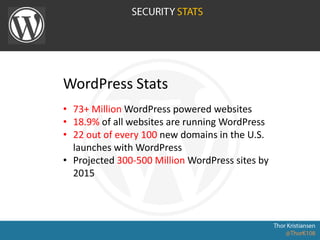
• 73+ Million WordPress powered websites
• 18.9% of all websites are running WordPress
• 22 out of every 100 new domains in the U.S.
launches with WordPress
• Projected 300-500 Million WordPress sites by
2015
Web Malware Stats
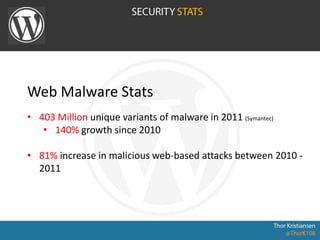
• 403 Million unique variants of malware in 2011 (Symantec)
• 140% growth since 2010
• 81% increase in malicious web-based attacks between 2010 -
2011
In Summary – Be Scared!
Hack Example
Link Injection
Hacker bots look for known exploits (SQL Injection, folder
permissions, etc)
This allows them to insert spam files/links into
your WordPress Themes, plugins, and core files.
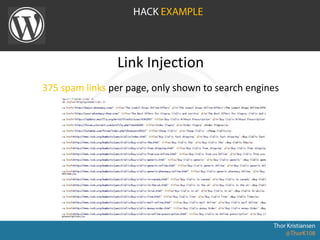
Link Injection
375 spam links per page, only shown to search engines
Securing WordPress
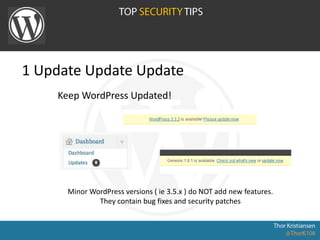
1 Update Update Update
Keep WordPress Updated!
Minor WordPress versions ( ie 3.5.x ) do NOT add new features.
They contain bug fixes and security patches
1 Update Update Update
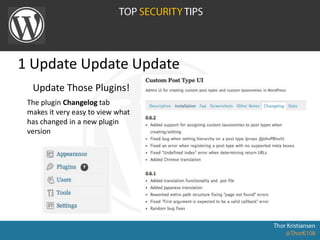
Update Those Plugins!
The plugin Changelog tab
makes it very easy to view what
has changed in a new plugin
version
1. Update Update Update
NO EXCUSES! UPDATE!
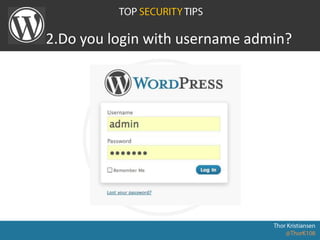
2.Do you login with username admin?
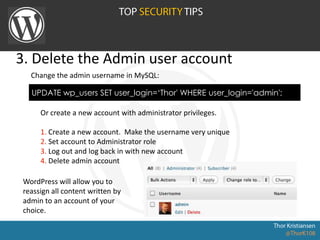
3. Delete the Admin user account
UPDATE wp_users SET user_login=‘Thor' WHERE user_login='admin';
Change the admin username in MySQL:
Or create a new account with administrator privileges.
1. Create a new account. Make the username very unique
2. Set account to Administrator role
3. Log out and log back in with new account
4. Delete admin account
WordPress will allow you to
reassign all content written by
admin to an account of your
choice.
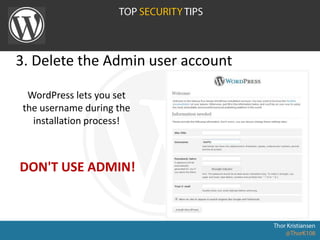
3. Delete the Admin user account
WordPress lets you set
the username during the
installation process!
DON'T USE ADMIN!
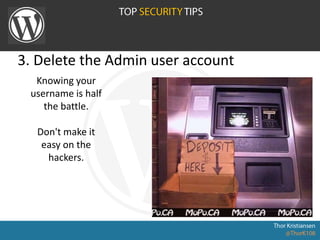
3. Delete the Admin user account
Knowing your
username is half
the battle.
Don't make it
easy on the
hackers.
4. File and Folder Permissions
What folder permissions should you use?
Good Rule of Thumb:
• Files should be set to 644
• Folders should be set to 755
Start with the default settings above
If your host requires 777…SWITCH HOSTS!
4. File and Folder Permissions
find [your path here] -type d -exec chmod 755 {} ;
find [your path here] -type f -exec chmod 644 {} ;
Or via SSH with the following commands
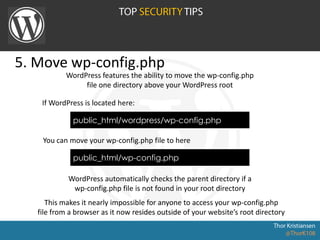
5. Move wp-config.php
WordPress features the ability to move the wp-config.php
file one directory above your WordPress root
This makes it nearly impossible for anyone to access your wp-config.php
file from a browser as it now resides outside of your website’s root directory
You can move your wp-config.php file to here
WordPress automatically checks the parent directory if a
wp-config.php file is not found in your root directory
public_html/wordpress/wp-config.php
If WordPress is located here:
public_html/wp-config.php
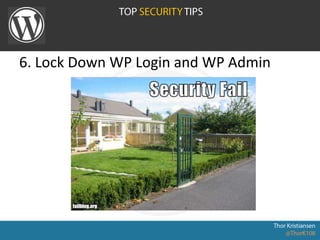
6. Lock Down WP Login and WP Admin
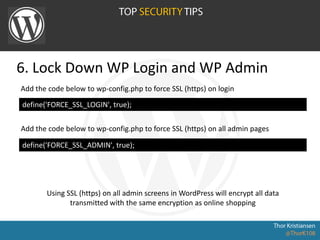
define('FORCE_SSL_LOGIN', true);
Add the code below to wp-config.php to force SSL (https) on login
Add the code below to wp-config.php to force SSL (https) on all admin pages
define('FORCE_SSL_ADMIN', true);
Using SSL (https) on all admin screens in WordPress will encrypt all data
transmitted with the same encryption as online shopping
6. Lock Down WP Login and WP Admin
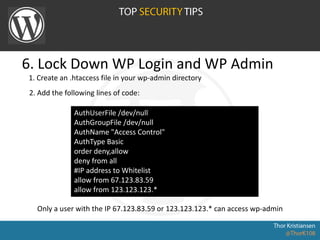
AuthUserFile /dev/null
AuthGroupFile /dev/null
AuthName "Access Control"
AuthType Basic
order deny,allow
deny from all
#IP address to Whitelist
allow from 67.123.83.59
allow from 123.123.123.*
1. Create an .htaccess file in your wp-admin directory
Only a user with the IP 67.123.83.59 or 123.123.123.* can access wp-admin
2. Add the following lines of code:
7. Use Trusted Sources for Themes & Plugins
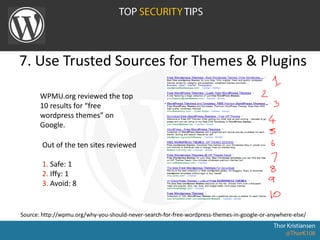
WPMU.org reviewed the top
10 results for “free
wordpress themes” on
Google.
Out of the ten sites reviewed
1. Safe: 1
2. Iffy: 1
3. Avoid: 8
Source: http://wpmu.org/why-you-should-never-search-for-free-wordpress-themes-in-google-or-anywhere-else/
7. Use Trusted Sources for Themes & Plugins
Source: http://wpmu.org/why-you-should-never-search-for-free-wordpress-themes-in-google-or-anywhere-else/
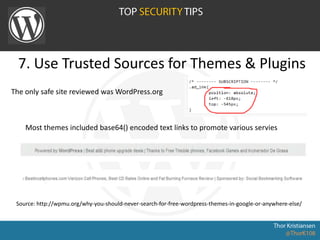
The only safe site reviewed was WordPress.org
Most themes included base64() encoded text links to promote various servies
8. Be Secure Locally
Think of your local environment as if it was a medieval castle and you’re the queen or
king. Your kingdom must be protected!
Keep your computer up to date
• Ensure you’re patching or installing updates ASAP
• Automatic updates rock!
Install an anti-virus solution
• Ensure you’re keeping definitions current
• Automatic updates aren’t a bad idea here either!
Yes, personal firewalls still apply!
8. Be Secure Locally
It’s your information, but who’s watching & listening? You may be a network geek at
home, but what happens at Starbucks?
Your Internet Connection
Use SSL whenever possible, especially on an unverified connection.
• HTTPS is a great way to ensure your transactions & traffic are traveling with security in mind.
Connecting To Your Site(s)
Consider using sFTP or SSH vs. FTP
•Still widely marketed, but did you know your credentials are passed unencrypted when using FTP?
•If unavoidable, do not allow anonymous logins, limit connections, practice least privilege.
•Don’t store your credentials in your FTP client.
9. Use Common Sense
• Use a strong password
• BAD: bradisawesome
• GOOD: SCrEE79joLly$
• A=@, E=3, S=$, O=0 (This is not unique, they know this)
• Update passwords regularly (Monthly, make a schedule)
• Know your admins, limit number of accounts (WP, FTP, Hosting, etc)
• Backup, Backup, Backup (Use BackupBuddy for scheduled backups)
• http://strongpasswordgenerator.com/
Plugins & Services
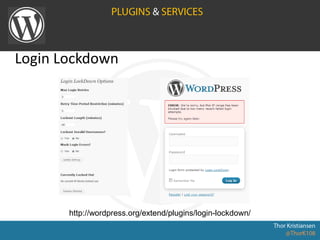
Login Lockdown
http://wordpress.org/extend/plugins/login-lockdown/
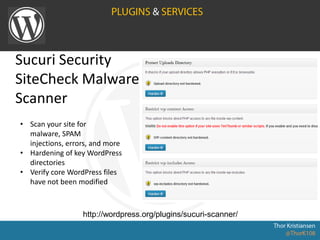
Sucuri Security
SiteCheck Malware
Scanner
http://wordpress.org/plugins/sucuri-scanner/
• Scan your site for
malware, SPAM
injections, errors, and more
• Hardening of key WordPress
directories
• Verify core WordPress files
have not been modified
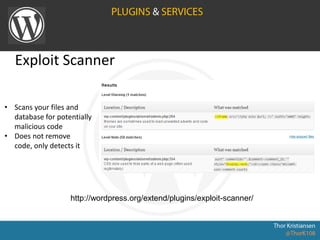
Exploit Scanner
http://wordpress.org/extend/plugins/exploit-scanner/
• Scans your files and
database for potentially
malicious code
• Does not remove
code, only detects it
• Free Website Malware Scanner: http://sitecheck.sucuri.net/scanner/
• Website monitoring
• Hack cleanup services
• Sucuri Security Plugin
• Free to clients
• Web Application Firewall
• Integrity Monitoring
• Auditing
• Hardening
http://Sucuri.net
• Security Related Articles
• http://codex.wordpress.org/Hardening_WordPress
• http://blog.sucuri.net/2012/04/lockdown-wordpress-a-security-webinar-with-dre-armeda.html
• http://blog.sucuri.net/2012/04/ask-sucuri-how-to-stop-the-hacker-and-ensure-your-site-is-
locked.html
• http://blog.sucuri.net/2012/04/ask-sucuri-what-should-i-know-when-engaging-a-web-
malware-company.html
• Clean a Hacked Site
• http://codex.wordpress.org/FAQ_My_site_was_hacked
• http://www.marketingtechblog.com/wordpress-hacked/
• Support Forums
• Hacked: http://wordpress.org/tags/hacked
• Malware: http://wordpress.org/tags/malware
• Mail: Thor@pureview.dk
• Twitter: @ThorK108
• Linkedin: in/ThorKristiansen
• Web: Shivaweb.dk
• Facebook: Wordpress Fan

WordPress Security - WordPress Meetup Copenhagen 2013

  • 1.
  • 2.
    • Thor Kristiansen –Self-employed WP-Developer and Business Consultant – Long time meditator • First WP Blog: The Pure View: http://pureview.dk – 200-400 visitors a day, 90% traffic is US, non-profit – Former Sr. Business Analyst & QA Mgr. at Dell – Portfolio website: http://shivaweb.dk
  • 3.
    • Security Stats •Example Hack • Top Security Tips • Recommended Plugins & Services • Resources
  • 4.
  • 5.
    700+ million websitesMay 2012 (Netcraft) 300 million websites in 2011 (Pingdom) 10+ billion indexed pages (WorldWebSize) Projected: • 1 Billion websites by 2013 • 2 Billion websites by 2015 0 500 1000 1500 2000 2500 2011 2012 2013 2015 Websites Websites
  • 6.
    WordPress Stats • 73+Million WordPress powered websites • 18.9% of all websites are running WordPress • 22 out of every 100 new domains in the U.S. launches with WordPress • Projected 300-500 Million WordPress sites by 2015
  • 7.
    Web Malware Stats •403 Million unique variants of malware in 2011 (Symantec) • 140% growth since 2010 • 81% increase in malicious web-based attacks between 2010 - 2011
  • 8.
    In Summary –Be Scared!
  • 9.
  • 10.
    Link Injection Hacker botslook for known exploits (SQL Injection, folder permissions, etc) This allows them to insert spam files/links into your WordPress Themes, plugins, and core files.
  • 11.
    Link Injection 375 spamlinks per page, only shown to search engines
  • 12.
  • 13.
    1 Update UpdateUpdate Keep WordPress Updated! Minor WordPress versions ( ie 3.5.x ) do NOT add new features. They contain bug fixes and security patches
  • 14.
    1 Update UpdateUpdate Update Those Plugins! The plugin Changelog tab makes it very easy to view what has changed in a new plugin version
  • 15.
    1. Update UpdateUpdate NO EXCUSES! UPDATE!
  • 16.
    2.Do you loginwith username admin?
  • 18.
    3. Delete theAdmin user account UPDATE wp_users SET user_login=‘Thor' WHERE user_login='admin'; Change the admin username in MySQL: Or create a new account with administrator privileges. 1. Create a new account. Make the username very unique 2. Set account to Administrator role 3. Log out and log back in with new account 4. Delete admin account WordPress will allow you to reassign all content written by admin to an account of your choice.
  • 19.
    3. Delete theAdmin user account WordPress lets you set the username during the installation process! DON'T USE ADMIN!
  • 20.
    3. Delete theAdmin user account Knowing your username is half the battle. Don't make it easy on the hackers.
  • 21.
    4. File andFolder Permissions What folder permissions should you use? Good Rule of Thumb: • Files should be set to 644 • Folders should be set to 755 Start with the default settings above If your host requires 777…SWITCH HOSTS!
  • 22.
    4. File andFolder Permissions find [your path here] -type d -exec chmod 755 {} ; find [your path here] -type f -exec chmod 644 {} ; Or via SSH with the following commands
  • 23.
    5. Move wp-config.php WordPressfeatures the ability to move the wp-config.php file one directory above your WordPress root This makes it nearly impossible for anyone to access your wp-config.php file from a browser as it now resides outside of your website’s root directory You can move your wp-config.php file to here WordPress automatically checks the parent directory if a wp-config.php file is not found in your root directory public_html/wordpress/wp-config.php If WordPress is located here: public_html/wp-config.php
  • 24.
    6. Lock DownWP Login and WP Admin
  • 25.
    6. Lock DownWP Login and WP Admin define('FORCE_SSL_LOGIN', true); Add the code below to wp-config.php to force SSL (https) on login Add the code below to wp-config.php to force SSL (https) on all admin pages define('FORCE_SSL_ADMIN', true); Using SSL (https) on all admin screens in WordPress will encrypt all data transmitted with the same encryption as online shopping
  • 26.
    6. Lock DownWP Login and WP Admin AuthUserFile /dev/null AuthGroupFile /dev/null AuthName "Access Control" AuthType Basic order deny,allow deny from all #IP address to Whitelist allow from 67.123.83.59 allow from 123.123.123.* 1. Create an .htaccess file in your wp-admin directory Only a user with the IP 67.123.83.59 or 123.123.123.* can access wp-admin 2. Add the following lines of code:
  • 27.
    7. Use TrustedSources for Themes & Plugins WPMU.org reviewed the top 10 results for “free wordpress themes” on Google. Out of the ten sites reviewed 1. Safe: 1 2. Iffy: 1 3. Avoid: 8 Source: http://wpmu.org/why-you-should-never-search-for-free-wordpress-themes-in-google-or-anywhere-else/
  • 28.
    7. Use TrustedSources for Themes & Plugins Source: http://wpmu.org/why-you-should-never-search-for-free-wordpress-themes-in-google-or-anywhere-else/ The only safe site reviewed was WordPress.org Most themes included base64() encoded text links to promote various servies
  • 29.
    8. Be SecureLocally Think of your local environment as if it was a medieval castle and you’re the queen or king. Your kingdom must be protected! Keep your computer up to date • Ensure you’re patching or installing updates ASAP • Automatic updates rock! Install an anti-virus solution • Ensure you’re keeping definitions current • Automatic updates aren’t a bad idea here either! Yes, personal firewalls still apply!
  • 30.
    8. Be SecureLocally It’s your information, but who’s watching & listening? You may be a network geek at home, but what happens at Starbucks? Your Internet Connection Use SSL whenever possible, especially on an unverified connection. • HTTPS is a great way to ensure your transactions & traffic are traveling with security in mind. Connecting To Your Site(s) Consider using sFTP or SSH vs. FTP •Still widely marketed, but did you know your credentials are passed unencrypted when using FTP? •If unavoidable, do not allow anonymous logins, limit connections, practice least privilege. •Don’t store your credentials in your FTP client.
  • 31.
    9. Use CommonSense • Use a strong password • BAD: bradisawesome • GOOD: SCrEE79joLly$ • A=@, E=3, S=$, O=0 (This is not unique, they know this) • Update passwords regularly (Monthly, make a schedule) • Know your admins, limit number of accounts (WP, FTP, Hosting, etc) • Backup, Backup, Backup (Use BackupBuddy for scheduled backups) • http://strongpasswordgenerator.com/
  • 32.
  • 33.
  • 34.
    Sucuri Security SiteCheck Malware Scanner http://wordpress.org/plugins/sucuri-scanner/ •Scan your site for malware, SPAM injections, errors, and more • Hardening of key WordPress directories • Verify core WordPress files have not been modified
  • 35.
    Exploit Scanner http://wordpress.org/extend/plugins/exploit-scanner/ • Scansyour files and database for potentially malicious code • Does not remove code, only detects it
  • 36.
    • Free WebsiteMalware Scanner: http://sitecheck.sucuri.net/scanner/ • Website monitoring • Hack cleanup services • Sucuri Security Plugin • Free to clients • Web Application Firewall • Integrity Monitoring • Auditing • Hardening http://Sucuri.net
  • 37.
    • Security RelatedArticles • http://codex.wordpress.org/Hardening_WordPress • http://blog.sucuri.net/2012/04/lockdown-wordpress-a-security-webinar-with-dre-armeda.html • http://blog.sucuri.net/2012/04/ask-sucuri-how-to-stop-the-hacker-and-ensure-your-site-is- locked.html • http://blog.sucuri.net/2012/04/ask-sucuri-what-should-i-know-when-engaging-a-web- malware-company.html • Clean a Hacked Site • http://codex.wordpress.org/FAQ_My_site_was_hacked • http://www.marketingtechblog.com/wordpress-hacked/ • Support Forums • Hacked: http://wordpress.org/tags/hacked • Malware: http://wordpress.org/tags/malware
  • 38.
    • Mail: Thor@pureview.dk •Twitter: @ThorK108 • Linkedin: in/ThorKristiansen • Web: Shivaweb.dk • Facebook: Wordpress Fan