

WELCOME
Women Entrepreneurship
By
R.Lakshmi Ramya (T21081)
B.L.Sowjanya (T21063)
Priyanka Pathro (T21073)
Entrepreneurship Management
We need to understand…
 Whether women can contribute significantly towards
the national economy
 Do they have equal potential?
 If so, why are there fewer women entrepreneurs today?
 What are their difficulties?
 How can we address them?
Introduction
Women –goal
oriented, flexible, tolerant, creative, realistic, e
nthusiastic and energetic.
Manage their houses.
Multi-tasking
Type of business they start.
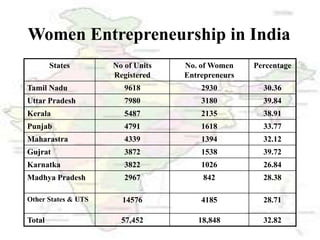
Women Entrepreneurship in India
Earlier there were 3 Ks
• Kitchen
• Kids
• Knitting
Then came 3 Ps
• Powder
• Pappad
• Pickles
At present there are 4 Es
• Electricity
• Electronics
• Energy
• Engineering
Women Entrepreneurship in India
States No of Units
Registered
No. of Women
Entrepreneurs
Percentage
Tamil Nadu 9618 2930 30.36
Uttar Pradesh 7980 3180 39.84
Kerala 5487 2135 38.91
Punjab 4791 1618 33.77
Maharastra 4339 1394 32.12
Gujrat 3872 1538 39.72
Karnatka 3822 1026 26.84
Madhya Pradesh 2967 842 28.38
Other States & UTS 14576 4185 28.71
Total 57,452 18,848 32.82
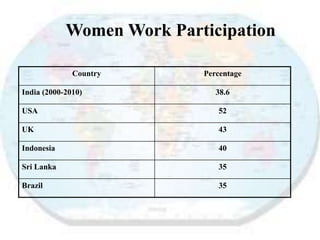
Women Work Participation
Country Percentage
India (2000-2010) 38.6
USA 52
UK 43
Indonesia 40
Sri Lanka 35
Brazil 35
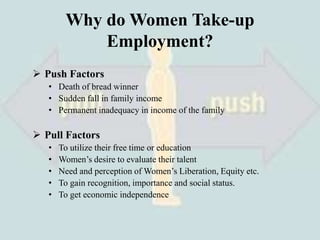
Why do Women Take-up
Employment?
 Push Factors
• Death of bread winner
• Sudden fall in family income
• Permanent inadequacy in income of the family
 Pull Factors
• To utilize their free time or education
• Women’s desire to evaluate their talent
• Need and perception of Women’s Liberation, Equity etc.
• To gain recognition, importance and social status.
• To get economic independence
Entrepreneurship Management
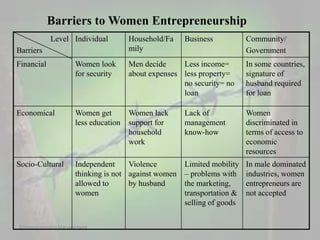
Barriers to Women Entrepreneurship
Level
Barriers
Individual Household/Fa
mily
Business Community/
Government
Financial Women look
for security
Men decide
about expenses
Less income=
less property=
no security= no
loan
In some countries,
signature of
husband required
for loan
Economical Women get
less education
Women lack
support for
household
work
Lack of
management
know-how
Women
discriminated in
terms of access to
economic
resources
Socio-Cultural Independent
thinking is not
allowed to
women
Violence
against women
by husband
Limited mobility
– problems with
the marketing,
transportation &
selling of goods
In male dominated
industries, women
entrepreneurs are
not accepted
Key differences between male and
female entrepreneurs
Achievement motivation
Basic departure points
Funding sources
Professional experience
Personality traits
Cont…
Strength of the business
Ego and its implication of business
Scalability and wealth creation
Tendency towards risk and profits
Facilitating entrepreneurship for
women
• Facilitating finance
• Facilitating education and training
• Instruments to support regional networks
these are facilitated to understand the
market dynamics, business culture and
finance, management of human resources, policy
and trade network
Entrepreneurship Management
 Educate/train the women entrepreneurs
 Help then in setting up of home based businesses
 Make easy finance available
 Develop special schemes for women
entrepreneurs
 Achieve self reliance and place women
entrepreneurs at par with their male counterparts
 Develop gender sensitivity
 Examine the processes of gender inequality
 Acquire skills of identification of potential
women entrepreneurs
How can the problem be overcome?
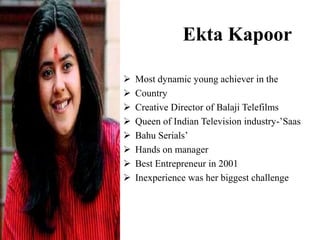
Ekta Kapoor
 Most dynamic young achiever in the
 Country
 Creative Director of Balaji Telefilms
 Queen of Indian Television industry-’Saas
 Bahu Serials’
 Hands on manager
 Best Entrepreneur in 2001
 Inexperience was her biggest challenge
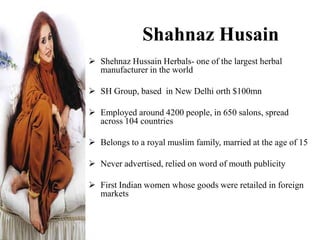
Shahnaz Husain
 Shehnaz Hussain Herbals- one of the largest herbal
manufacturer in the world
 SH Group, based in New Delhi orth $100mn
 Employed around 4200 people, in 650 salons, spread
across 104 countries
 Belongs to a royal muslim family, married at the age of 15
 Never advertised, relied on word of mouth publicity
 First Indian women whose goods were retailed in foreign
markets
Women entre

Women entre

  • 1.
  • 2.
    Women Entrepreneurship By R.Lakshmi Ramya(T21081) B.L.Sowjanya (T21063) Priyanka Pathro (T21073)
  • 3.
    Entrepreneurship Management We needto understand…  Whether women can contribute significantly towards the national economy  Do they have equal potential?  If so, why are there fewer women entrepreneurs today?  What are their difficulties?  How can we address them?
  • 4.
    Introduction Women –goal oriented, flexible,tolerant, creative, realistic, e nthusiastic and energetic. Manage their houses. Multi-tasking Type of business they start.
  • 5.
    Women Entrepreneurship inIndia Earlier there were 3 Ks • Kitchen • Kids • Knitting Then came 3 Ps • Powder • Pappad • Pickles At present there are 4 Es • Electricity • Electronics • Energy • Engineering
  • 6.
    Women Entrepreneurship inIndia States No of Units Registered No. of Women Entrepreneurs Percentage Tamil Nadu 9618 2930 30.36 Uttar Pradesh 7980 3180 39.84 Kerala 5487 2135 38.91 Punjab 4791 1618 33.77 Maharastra 4339 1394 32.12 Gujrat 3872 1538 39.72 Karnatka 3822 1026 26.84 Madhya Pradesh 2967 842 28.38 Other States & UTS 14576 4185 28.71 Total 57,452 18,848 32.82
  • 7.
    Women Work Participation CountryPercentage India (2000-2010) 38.6 USA 52 UK 43 Indonesia 40 Sri Lanka 35 Brazil 35
  • 8.
    Why do WomenTake-up Employment?  Push Factors • Death of bread winner • Sudden fall in family income • Permanent inadequacy in income of the family  Pull Factors • To utilize their free time or education • Women’s desire to evaluate their talent • Need and perception of Women’s Liberation, Equity etc. • To gain recognition, importance and social status. • To get economic independence
  • 9.
    Entrepreneurship Management Barriers toWomen Entrepreneurship Level Barriers Individual Household/Fa mily Business Community/ Government Financial Women look for security Men decide about expenses Less income= less property= no security= no loan In some countries, signature of husband required for loan Economical Women get less education Women lack support for household work Lack of management know-how Women discriminated in terms of access to economic resources Socio-Cultural Independent thinking is not allowed to women Violence against women by husband Limited mobility – problems with the marketing, transportation & selling of goods In male dominated industries, women entrepreneurs are not accepted
  • 10.
    Key differences betweenmale and female entrepreneurs Achievement motivation Basic departure points Funding sources Professional experience Personality traits
  • 11.
    Cont… Strength of thebusiness Ego and its implication of business Scalability and wealth creation Tendency towards risk and profits
  • 12.
    Facilitating entrepreneurship for women •Facilitating finance • Facilitating education and training • Instruments to support regional networks these are facilitated to understand the market dynamics, business culture and finance, management of human resources, policy and trade network
  • 13.
    Entrepreneurship Management  Educate/trainthe women entrepreneurs  Help then in setting up of home based businesses  Make easy finance available  Develop special schemes for women entrepreneurs  Achieve self reliance and place women entrepreneurs at par with their male counterparts  Develop gender sensitivity  Examine the processes of gender inequality  Acquire skills of identification of potential women entrepreneurs How can the problem be overcome?
  • 14.
    Ekta Kapoor  Mostdynamic young achiever in the  Country  Creative Director of Balaji Telefilms  Queen of Indian Television industry-’Saas  Bahu Serials’  Hands on manager  Best Entrepreneur in 2001  Inexperience was her biggest challenge
  • 15.
    Shahnaz Husain  ShehnazHussain Herbals- one of the largest herbal manufacturer in the world  SH Group, based in New Delhi orth $100mn  Employed around 4200 people, in 650 salons, spread across 104 countries  Belongs to a royal muslim family, married at the age of 15  Never advertised, relied on word of mouth publicity  First Indian women whose goods were retailed in foreign markets