Self presentation and the
                meaning of friendship
    Social Media – Dr. Giorgos Cheliotis (gcheliotis@nus.edu.sg)
Communications and New Media, National University of Singapore
The Dunbar Number
      We saw already that SNS’s can help generate more
      social capital… but skeptics insist that it is not possible
      to have as many ‘real friends’ as one would think by
      looking at one’s online social network profile

      Robin Dunbar (1996) noted that gossip has taken
      over the social function of grooming and Judith
      Donath (2007) (re-) introduced the concept of
      social grooming to explain the role of SNS’s and
      ‘friendship’ within them.

      Dunbar further argued that although language is
      more efficient for tie maintenance than actual
      grooming, there are cognitive limits:

               Dunbar number = approx. 150


 2         CNM Social Media Module – Giorgos Cheliotis (gcheliotis@nus.edu.sg)
So what do SNS ‘friends’ mean?


                                                             How popular can one really
                                                              be without mass media
                                                              airtime?
                                                             Is ‘friending’ deceiving, a
                                                              cheap imitation of real
                                                              friendship?
                                                             Is it perhaps a matter of
                                                              interpretation?
                                                             Why do we add people as
                                                              ‘friends’ in SNS?
                                                             What drives some users to
                                                              compete on ‘friend’
                                                              numbers?


 3       CNM Social Media Module – Giorgos Cheliotis (gcheliotis@nus.edu.sg)
Signaling
 A lot of what we (think we) know about others comes from the
 interpretation of situational, social and cultural cues (signals)

                  Signals are useful and reliable but can also be deceiving.


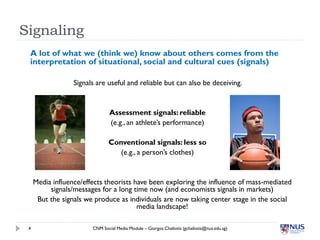
                                Assessment signals: reliable
                                (e.g., an athlete’s performance)

                               Conventional signals: less so
                                  (e.g., a person’s clothes)


     Media influence/effects theorists have been exploring the influence of mass-mediated
          signals/messages for a long time now (and economists signals in markets)
      But the signals we produce as individuals are now taking center stage in the social
                                        media landscape!

 4                      CNM Social Media Module – Giorgos Cheliotis (gcheliotis@nus.edu.sg)
Signaling identity/status
   The most common
    conventional signals on
    SNS’s relate to one’s
    identity and perceived
    social status
   The list of friends on an
    SNS is also a form of signal
    that helps establish identity
    and trust
   But is it easier to deceive
    online compared to face-
    to-face interaction?
   If so, is there real value in
    maintaining long lists of
    online friends?
    5                 CNM Social Media Module – Giorgos Cheliotis (gcheliotis@nus.edu.sg)
The ‘supernets’ hypothesis
   Strong ties bring reliability to a social network
   Weak ties greatly expand its scope

Questions:
    Does the ease of maintaining both strong and weak ties in an SNS
    help shift the focus of a social network from the strong ties to the
    extended network consisting of both strong and weak ties?
    (thus also stretching the cognitive limits of the Dunbar number)
    How can a third party observer ascertain the strength of a person’s
    ties on an SNS?
    (degree of interaction better indicator than articulated list of ‘friends’)


    6                      CNM Social Media Module – Giorgos Cheliotis (gcheliotis@nus.edu.sg)
Social grooming

                                                            A possible interpretation or
                                                             conceptualization of user
                                                             behavior in SNS
                                                            Small public displays of care for
                                                             the maintenance of one’s
                                                             extended social network
                                                             (supernet)
                                                            Lower in cost compared to
                                                             grooming in nature because
                                                             language is medium and CMC
                                                             helps spread display of care to
                                                             many online users


 7       CNM Social Media Module – Giorgos Cheliotis (gcheliotis@nus.edu.sg)
Social grooming and ‘wasteful’ behavior
   Signaling can explain seemingly wasteful behavior in nature
   Similarly in social networks and SNS a lot of what may seem
    wasteful is not necessarily so
       Regularly updating one’s profile to communicate identity/fashion sense
        and events/experience to one’s entire social network
       Sharing funny videos, updates and ‘gifts’ from online social games such as
        Farmville and others
       ‘Trivial’ updates on Twitter and other SNS about seemingly unimportant
        things, such as food updates.
       Extending one’s friends/followers, becoming fan of others online,
        ‘favoriting’ online content
       Using/spreading memes and lingo that may be detrimental to broader
        understanding but signal affiliation with a certain subculture


    8                  CNM Social Media Module – Giorgos Cheliotis (gcheliotis@nus.edu.sg)
Issues
   Do existing SNS’s help signal reliability/strength of ties?
       Focus on friend lists, not degree of interaction
       Having many mutual ‘friends’ can be deceiving
   Does online signaling have negative consequences?
       Teens (and adults) have difficulty deciphering which signals are
        appropriate in accordance to different community mores
       Grooming can be desirable or annoying!
       SNS’s do not make it easy to separate communication between
        different social circles and private/public sphere
   Is the supernet hypothesis defensible?
       Critics maintain that empirical evidence suggests we still
        communicate with small circle online
       But CMC’s ability to spread information to extended network
        felt in daily experience (e.g., unexpected comments from weak
        ties on our updates)


    9                   CNM Social Media Module – Giorgos Cheliotis (gcheliotis@nus.edu.sg)
What can we then say of ‘friendship’?
     Is the extensive use of the term diluting the meaning of friendship?
     Do we need to conceptualize ‘friending’ behavior differently online?
     Are SNS’s conducive to maintaining a complex web of ties of different
      strengths or do they create more problems than they solve?
     What can we learn from different approaches thus far?


 10                  CNM Social Media Module – Giorgos Cheliotis (gcheliotis@nus.edu.sg)
About friendship online and offline
   Online ‘friending’ not necessarily equivalent to traditional
    notion of friendship
        Friendship always needs to be considered in the cultural and social context in
         which it is examined
        Online platforms create new contexts for friendship
   But it is similar…
        ‘Friend’ is a signal, it has a “performative quality” (Boyd, 2006) and is also
         used often offline for more than ‘real friendship’
        It is also not always truthful (e.g., saving face)
   Explicit articulation in SNS poses some unique challenges
        People maintain hierarchies and circles of friends offline, may be
         verbalized when social/situational context allows for it
        Online management of such circles and hierarchies can be much more
         challenging (friendship more often performed to others)
        CMC properties complicating behavior: persistence, searchability,
         replicability, invisible audiences

    11                   CNM Social Media Module – Giorgos Cheliotis (gcheliotis@nus.edu.sg)
Lessons from Friendster
   The technological affordances of the platform often co-shape
    the meaning of friendship in the communities that use it
        see ‘gateway friends’ and ‘collectors’, i.e. often fake profiles of famous
         personalities and authentic profiles of ‘hub users’ that would be used by other
         users to make new connections
        hubs, whether real people or purposely set up ‘fake’ profiles, add value by greatly
         increasing reach in one step
   Embracing unexpected user practices that add value to the
    users may be smarter than reacting to them
        myspace embraced such ‘fake’/non-person profiles and profited
   Encouragement of collecting friends can lead to suspicion and
    public perception of dilution of friendship
        Some users start competing on friendship numbers while others shun such
         practice as pretentious or label it as attention seeking

    12                    CNM Social Media Module – Giorgos Cheliotis (gcheliotis@nus.edu.sg)
Reasons for ‘friending’?

                                                                                 Want to be
        Hmmm
                                                                                  friends?
        … do I?


 How often has this happened to you?


 13                CNM Social Media Module – Giorgos Cheliotis (gcheliotis@nus.edu.sg)
Motivations for friending…
   connect with actual friends
   connect with acquaintances, colleagues, etc.
                                                                                   •   Some common
   avoid rejecting, save face, easier to say ‘yes’                                    behaviors emerge
    (more important when reciprocity is required)
                                                                                   •   Generally inconsistent
   looking popular                                                                    use of SNS across
   building fan base/audience                                                         people
   tracking conversations of interest                                             •   Complicates behavior
                                                                                       and interpretation
   signaling affinity with certain types of people
   expanding network to meet more people
   more…?


         Users do not necessarily want to reveal their true intentions or their
    hierarchies of friends. Care must be taken to ensure that users understand the
       consequences of revealing and can manage their social circles accordingly


    14                   CNM Social Media Module – Giorgos Cheliotis (gcheliotis@nus.edu.sg)
Thoughts on Design

 SNS design can promote different friending
 behaviors; what is desirable depends on context
 and intentions of SNS
 Where technological affordances do not meet user
 needs, users will start using features in hitherto
 unintended ways
 Online platforms need to constantly evolve in
 response to user needs and ideally also involve
 users in decision-making                                                             How do you wish to
                                                                                   ‘friend’ and communicate
 Consider how to help users signal strength of ties,                                 online and how do the
 type of relationship and trust in person                                                 SNS’s you use
 Help users fine-tune what they reveal to whom and                                     accommodate your
 address different social circles as appropriate                                       preferred behavior?


 15                  CNM Social Media Module – Giorgos Cheliotis (gcheliotis@nus.edu.sg)
Credits and licensing
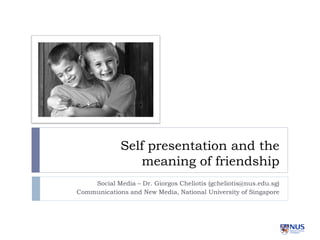
   Front page photo by StuSeeger (license: CC BY)
   Fans photo by wvs (license: CC BY-NC)
   Faces photo by stollerdos (license: CC BY-NC)
   Grooming birds photo by iansand (license: CC BY-NC)
   Friends on swing photo by cake-face (license: CC BY-NC-ND)


         Original content in this presentation is licensed under the Creative Commons
             Singapore Attribution 3.0 license unless stated otherwise (see above)


    16                      CNM Social Media Module – Giorgos Cheliotis (gcheliotis@nus.edu.sg)

Self Presentation And Friendship

  • 1.
    Self presentation andthe meaning of friendship Social Media – Dr. Giorgos Cheliotis (gcheliotis@nus.edu.sg) Communications and New Media, National University of Singapore
  • 2.
    The Dunbar Number We saw already that SNS’s can help generate more social capital… but skeptics insist that it is not possible to have as many ‘real friends’ as one would think by looking at one’s online social network profile Robin Dunbar (1996) noted that gossip has taken over the social function of grooming and Judith Donath (2007) (re-) introduced the concept of social grooming to explain the role of SNS’s and ‘friendship’ within them. Dunbar further argued that although language is more efficient for tie maintenance than actual grooming, there are cognitive limits: Dunbar number = approx. 150 2 CNM Social Media Module – Giorgos Cheliotis (gcheliotis@nus.edu.sg)
  • 3.
    So what doSNS ‘friends’ mean?  How popular can one really be without mass media airtime?  Is ‘friending’ deceiving, a cheap imitation of real friendship?  Is it perhaps a matter of interpretation?  Why do we add people as ‘friends’ in SNS?  What drives some users to compete on ‘friend’ numbers? 3 CNM Social Media Module – Giorgos Cheliotis (gcheliotis@nus.edu.sg)
  • 4.
    Signaling A lotof what we (think we) know about others comes from the interpretation of situational, social and cultural cues (signals) Signals are useful and reliable but can also be deceiving. Assessment signals: reliable (e.g., an athlete’s performance) Conventional signals: less so (e.g., a person’s clothes) Media influence/effects theorists have been exploring the influence of mass-mediated signals/messages for a long time now (and economists signals in markets) But the signals we produce as individuals are now taking center stage in the social media landscape! 4 CNM Social Media Module – Giorgos Cheliotis (gcheliotis@nus.edu.sg)
  • 5.
    Signaling identity/status  The most common conventional signals on SNS’s relate to one’s identity and perceived social status  The list of friends on an SNS is also a form of signal that helps establish identity and trust  But is it easier to deceive online compared to face- to-face interaction?  If so, is there real value in maintaining long lists of online friends? 5 CNM Social Media Module – Giorgos Cheliotis (gcheliotis@nus.edu.sg)
  • 6.
    The ‘supernets’ hypothesis  Strong ties bring reliability to a social network  Weak ties greatly expand its scope Questions: Does the ease of maintaining both strong and weak ties in an SNS help shift the focus of a social network from the strong ties to the extended network consisting of both strong and weak ties? (thus also stretching the cognitive limits of the Dunbar number) How can a third party observer ascertain the strength of a person’s ties on an SNS? (degree of interaction better indicator than articulated list of ‘friends’) 6 CNM Social Media Module – Giorgos Cheliotis (gcheliotis@nus.edu.sg)
  • 7.
    Social grooming  A possible interpretation or conceptualization of user behavior in SNS  Small public displays of care for the maintenance of one’s extended social network (supernet)  Lower in cost compared to grooming in nature because language is medium and CMC helps spread display of care to many online users 7 CNM Social Media Module – Giorgos Cheliotis (gcheliotis@nus.edu.sg)
  • 8.
    Social grooming and‘wasteful’ behavior  Signaling can explain seemingly wasteful behavior in nature  Similarly in social networks and SNS a lot of what may seem wasteful is not necessarily so  Regularly updating one’s profile to communicate identity/fashion sense and events/experience to one’s entire social network  Sharing funny videos, updates and ‘gifts’ from online social games such as Farmville and others  ‘Trivial’ updates on Twitter and other SNS about seemingly unimportant things, such as food updates.  Extending one’s friends/followers, becoming fan of others online, ‘favoriting’ online content  Using/spreading memes and lingo that may be detrimental to broader understanding but signal affiliation with a certain subculture 8 CNM Social Media Module – Giorgos Cheliotis (gcheliotis@nus.edu.sg)
  • 9.
    Issues  Do existing SNS’s help signal reliability/strength of ties?  Focus on friend lists, not degree of interaction  Having many mutual ‘friends’ can be deceiving  Does online signaling have negative consequences?  Teens (and adults) have difficulty deciphering which signals are appropriate in accordance to different community mores  Grooming can be desirable or annoying!  SNS’s do not make it easy to separate communication between different social circles and private/public sphere  Is the supernet hypothesis defensible?  Critics maintain that empirical evidence suggests we still communicate with small circle online  But CMC’s ability to spread information to extended network felt in daily experience (e.g., unexpected comments from weak ties on our updates) 9 CNM Social Media Module – Giorgos Cheliotis (gcheliotis@nus.edu.sg)
  • 10.
    What can wethen say of ‘friendship’?  Is the extensive use of the term diluting the meaning of friendship?  Do we need to conceptualize ‘friending’ behavior differently online?  Are SNS’s conducive to maintaining a complex web of ties of different strengths or do they create more problems than they solve?  What can we learn from different approaches thus far? 10 CNM Social Media Module – Giorgos Cheliotis (gcheliotis@nus.edu.sg)
  • 11.
    About friendship onlineand offline  Online ‘friending’ not necessarily equivalent to traditional notion of friendship  Friendship always needs to be considered in the cultural and social context in which it is examined  Online platforms create new contexts for friendship  But it is similar…  ‘Friend’ is a signal, it has a “performative quality” (Boyd, 2006) and is also used often offline for more than ‘real friendship’  It is also not always truthful (e.g., saving face)  Explicit articulation in SNS poses some unique challenges  People maintain hierarchies and circles of friends offline, may be verbalized when social/situational context allows for it  Online management of such circles and hierarchies can be much more challenging (friendship more often performed to others)  CMC properties complicating behavior: persistence, searchability, replicability, invisible audiences 11 CNM Social Media Module – Giorgos Cheliotis (gcheliotis@nus.edu.sg)
  • 12.
    Lessons from Friendster  The technological affordances of the platform often co-shape the meaning of friendship in the communities that use it  see ‘gateway friends’ and ‘collectors’, i.e. often fake profiles of famous personalities and authentic profiles of ‘hub users’ that would be used by other users to make new connections  hubs, whether real people or purposely set up ‘fake’ profiles, add value by greatly increasing reach in one step  Embracing unexpected user practices that add value to the users may be smarter than reacting to them  myspace embraced such ‘fake’/non-person profiles and profited  Encouragement of collecting friends can lead to suspicion and public perception of dilution of friendship  Some users start competing on friendship numbers while others shun such practice as pretentious or label it as attention seeking 12 CNM Social Media Module – Giorgos Cheliotis (gcheliotis@nus.edu.sg)
  • 13.
    Reasons for ‘friending’? Want to be Hmmm friends? … do I? How often has this happened to you? 13 CNM Social Media Module – Giorgos Cheliotis (gcheliotis@nus.edu.sg)
  • 14.
    Motivations for friending…  connect with actual friends  connect with acquaintances, colleagues, etc. • Some common  avoid rejecting, save face, easier to say ‘yes’ behaviors emerge (more important when reciprocity is required) • Generally inconsistent  looking popular use of SNS across  building fan base/audience people  tracking conversations of interest • Complicates behavior and interpretation  signaling affinity with certain types of people  expanding network to meet more people  more…? Users do not necessarily want to reveal their true intentions or their hierarchies of friends. Care must be taken to ensure that users understand the consequences of revealing and can manage their social circles accordingly 14 CNM Social Media Module – Giorgos Cheliotis (gcheliotis@nus.edu.sg)
  • 15.
    Thoughts on Design SNS design can promote different friending behaviors; what is desirable depends on context and intentions of SNS Where technological affordances do not meet user needs, users will start using features in hitherto unintended ways Online platforms need to constantly evolve in response to user needs and ideally also involve users in decision-making How do you wish to ‘friend’ and communicate Consider how to help users signal strength of ties, online and how do the type of relationship and trust in person SNS’s you use Help users fine-tune what they reveal to whom and accommodate your address different social circles as appropriate preferred behavior? 15 CNM Social Media Module – Giorgos Cheliotis (gcheliotis@nus.edu.sg)
  • 16.
    Credits and licensing  Front page photo by StuSeeger (license: CC BY)  Fans photo by wvs (license: CC BY-NC)  Faces photo by stollerdos (license: CC BY-NC)  Grooming birds photo by iansand (license: CC BY-NC)  Friends on swing photo by cake-face (license: CC BY-NC-ND) Original content in this presentation is licensed under the Creative Commons Singapore Attribution 3.0 license unless stated otherwise (see above) 16 CNM Social Media Module – Giorgos Cheliotis (gcheliotis@nus.edu.sg)