Twitter as a Metajournalism Service: A
Co-Tweet Network Analysis of the 2009
Gaza Conflict
K. Hazel Kwon, PhD
Drexel University
kk627@drexel.edu
Onook Oh, MA
University of Oregon
onook@uoregon.edu
Manish Agrawal, PhD
University of South Florida
magrawal@coba.usf.edu
H.R. Rao, PhD
SUNY at Buffalo
mgmtrao@buffalo.edu
ABSTRACT
Twitter is understood as a metajournalism service, a collective
information system in which various types of information are
retold and reinterpreted by users. The current study explores
the use of Twitter during the 2009 Gaza conflict to find out
what kinds of information providers are prominent in Twitter
news sharing and how different types of sources are
integrated. Temporal analysis revealed that traditional big
journalism still plays the most important news provider,
whose role is becoming more prominent as time passes ever
since the issue broke out. On the other hand, the co-tweet
network analysis revealed that, despite the central role of big
media, grassroot information providers, for example online
citizen journalism and NGOs, were well-integrated with those
traditional actors, playing supplementary sources to
understand the issue better. We conclude that Twitter shows
symbiosis between mainstream and alternatives.
BACKGROUND: TWITTER AS METAJOURNALISM
SERVICE
 A popular micro-blogging service
 One-to-many instant messaging service
 Effective social reporting in emergency/extreme situations
(Farhi, 2009, Li & Rao, 2010, Oh et al., 2010a).
 Defined as a collaborative journalism service, or
METAJOURNALISM service
o A symbiosis between the traditional mainstream media
and ordinary citizens’ practices
o Horizontal and vertical Communication coexist
o Importance of re-distributing and re-interpreting
function
o Gatewatching, or information gatherer
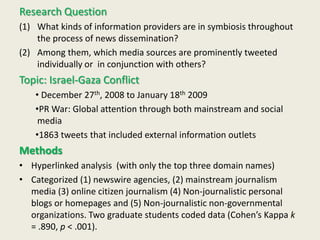
Research Question
(1) What kinds of information providers are in symbiosis throughout
the process of news dissemination?
(2) Among them, which media sources are prominently tweeted
individually or in conjunction with others?
Topic: Israel-Gaza Conflict
• December 27th, 2008 to January 18th 2009
•PR War: Global attention through both mainstream and social
media
•1863 tweets that included external information outlets
Methods
• Hyperlinked analysis (with only the top three domain names)
• Categorized (1) newswire agencies, (2) mainstream journalism
media (3) online citizen journalism (4) Non-journalistic personal
blogs or homepages and (5) Non-journalistic non-governmental
organizations. Two graduate students coded data (Cohen’s Kappa k
= .890, p < .001).
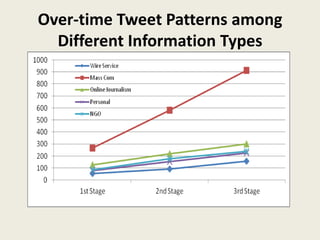
Over-time Tweet Patterns among
Different Information Types
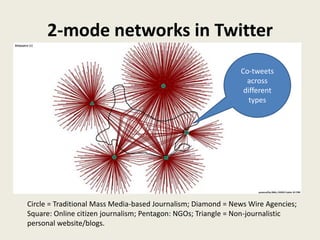
2-mode networks in Twitter
Circle = Traditional Mass Media-based Journalism; Diamond = News Wire Agencies;
Square: Online citizen journalism; Pentagon: NGOs; Triangle = Non-journalistic
personal website/blogs.
Co-tweets
across
different
types
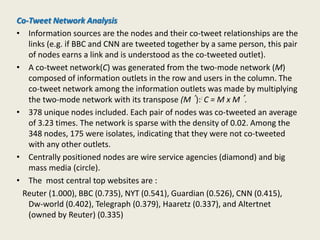
Co-Tweet Network Analysis
• Information sources are the nodes and their co-tweet relationships are the
links (e.g. if BBC and CNN are tweeted together by a same person, this pair
of nodes earns a link and is understood as the co-tweeted outlet).
• A co-tweet network(C) was generated from the two-mode network (M)
composed of information outlets in the row and users in the column. The
co-tweet network among the information outlets was made by multiplying
the two-mode network with its transpose (M´):: C = M x M´.
• 378 unique nodes included. Each pair of nodes was co-tweeted an average
of 3.23 times. The network is sparse with the density of 0.02. Among the
348 nodes, 175 were isolates, indicating that they were not co-tweeted
with any other outlets.
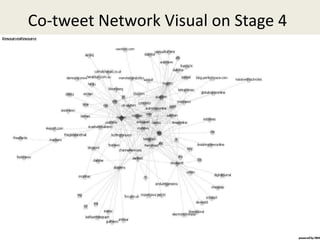
• Centrally positioned nodes are wire service agencies (diamond) and big
mass media (circle).
• The most central top websites are :
Reuter (1.000), BBC (0.735), NYT (0.541), Guardian (0.526), CNN (0.415),
Dw-world (0.402), Telegraph (0.379), Haaretz (0.337), and Altertnet
(owned by Reuter) (0.335)
Co-tweet Network Visual on Stage 4
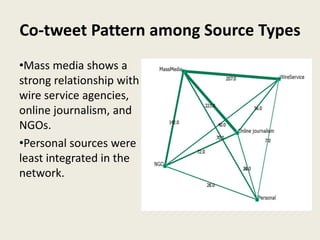
Co-tweet Pattern among Source Types
•Mass media shows a
strong relationship with
wire service agencies,
online journalism, and
NGOs.
•Personal sources were
least integrated in the
network.
Conclusion
 Temporal analysis :
o The sold and influential status of traditional journalism
media on Twitter.
o This tendency is becoming more remarkable over time.
o The role of professional journalism entity to create
investigative storytelling.
 Co-tweet network analysis:
o The traditional sources are coexistent along with other
new, alternative comers.
o Strong co-tweet relationships with online citizen
journalism and NGOs : Active use of non-traditional news
sources, as supplementary sources.
o Possibility of diversifying interpretations of the event.

Gaza Co-Tweet

  • 1.
    Twitter as aMetajournalism Service: A Co-Tweet Network Analysis of the 2009 Gaza Conflict K. Hazel Kwon, PhD Drexel University kk627@drexel.edu Onook Oh, MA University of Oregon onook@uoregon.edu Manish Agrawal, PhD University of South Florida magrawal@coba.usf.edu H.R. Rao, PhD SUNY at Buffalo mgmtrao@buffalo.edu
  • 2.
    ABSTRACT Twitter is understoodas a metajournalism service, a collective information system in which various types of information are retold and reinterpreted by users. The current study explores the use of Twitter during the 2009 Gaza conflict to find out what kinds of information providers are prominent in Twitter news sharing and how different types of sources are integrated. Temporal analysis revealed that traditional big journalism still plays the most important news provider, whose role is becoming more prominent as time passes ever since the issue broke out. On the other hand, the co-tweet network analysis revealed that, despite the central role of big media, grassroot information providers, for example online citizen journalism and NGOs, were well-integrated with those traditional actors, playing supplementary sources to understand the issue better. We conclude that Twitter shows symbiosis between mainstream and alternatives.
  • 3.
    BACKGROUND: TWITTER ASMETAJOURNALISM SERVICE  A popular micro-blogging service  One-to-many instant messaging service  Effective social reporting in emergency/extreme situations (Farhi, 2009, Li & Rao, 2010, Oh et al., 2010a).  Defined as a collaborative journalism service, or METAJOURNALISM service o A symbiosis between the traditional mainstream media and ordinary citizens’ practices o Horizontal and vertical Communication coexist o Importance of re-distributing and re-interpreting function o Gatewatching, or information gatherer
  • 4.
    Research Question (1) Whatkinds of information providers are in symbiosis throughout the process of news dissemination? (2) Among them, which media sources are prominently tweeted individually or in conjunction with others? Topic: Israel-Gaza Conflict • December 27th, 2008 to January 18th 2009 •PR War: Global attention through both mainstream and social media •1863 tweets that included external information outlets Methods • Hyperlinked analysis (with only the top three domain names) • Categorized (1) newswire agencies, (2) mainstream journalism media (3) online citizen journalism (4) Non-journalistic personal blogs or homepages and (5) Non-journalistic non-governmental organizations. Two graduate students coded data (Cohen’s Kappa k = .890, p < .001).
  • 5.
    Over-time Tweet Patternsamong Different Information Types
  • 6.
    2-mode networks inTwitter Circle = Traditional Mass Media-based Journalism; Diamond = News Wire Agencies; Square: Online citizen journalism; Pentagon: NGOs; Triangle = Non-journalistic personal website/blogs. Co-tweets across different types
  • 7.
    Co-Tweet Network Analysis •Information sources are the nodes and their co-tweet relationships are the links (e.g. if BBC and CNN are tweeted together by a same person, this pair of nodes earns a link and is understood as the co-tweeted outlet). • A co-tweet network(C) was generated from the two-mode network (M) composed of information outlets in the row and users in the column. The co-tweet network among the information outlets was made by multiplying the two-mode network with its transpose (M´):: C = M x M´. • 378 unique nodes included. Each pair of nodes was co-tweeted an average of 3.23 times. The network is sparse with the density of 0.02. Among the 348 nodes, 175 were isolates, indicating that they were not co-tweeted with any other outlets. • Centrally positioned nodes are wire service agencies (diamond) and big mass media (circle). • The most central top websites are : Reuter (1.000), BBC (0.735), NYT (0.541), Guardian (0.526), CNN (0.415), Dw-world (0.402), Telegraph (0.379), Haaretz (0.337), and Altertnet (owned by Reuter) (0.335)
  • 8.
  • 9.
    Co-tweet Pattern amongSource Types •Mass media shows a strong relationship with wire service agencies, online journalism, and NGOs. •Personal sources were least integrated in the network.
  • 10.
    Conclusion  Temporal analysis: o The sold and influential status of traditional journalism media on Twitter. o This tendency is becoming more remarkable over time. o The role of professional journalism entity to create investigative storytelling.  Co-tweet network analysis: o The traditional sources are coexistent along with other new, alternative comers. o Strong co-tweet relationships with online citizen journalism and NGOs : Active use of non-traditional news sources, as supplementary sources. o Possibility of diversifying interpretations of the event.