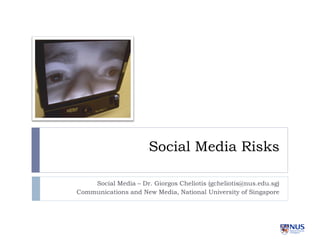
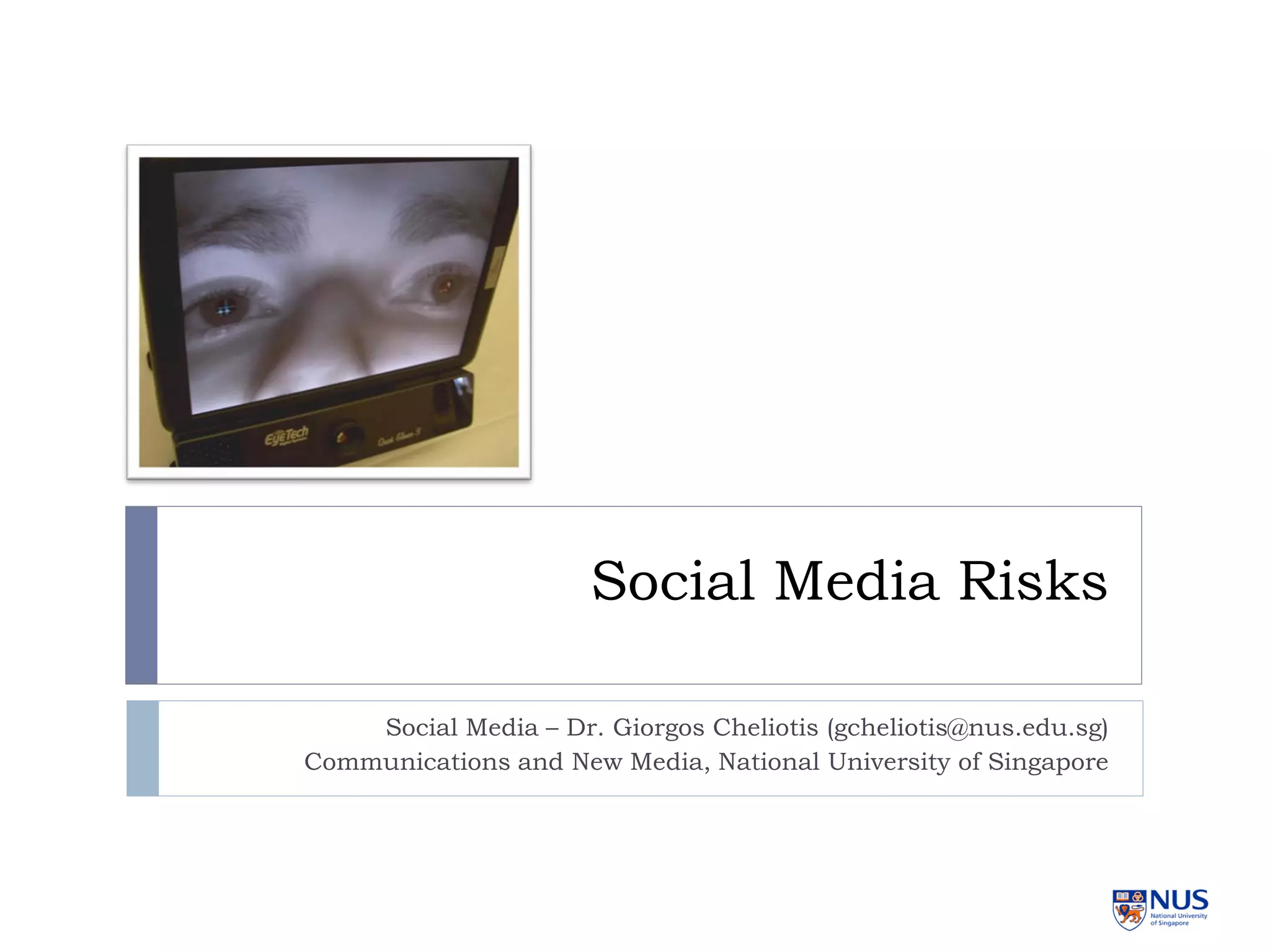
Social Media Risks

    Social Media – Dr. Giorgos Cheliotis (gcheliotis@nus.edu.sg)
Communications and New Media, National University of Singapore
Introduction
   Millions of Internet users use social media platforms daily for self-expression,
    communication and collaboration
   As social media becomes daily routine, we have to learn how to deal with the risks
    of computer-mediated communication
   Some of these risks are more unique to social media, while some are relevant to
    nearly any form of communication but may take new forms online
   Users continuously explore new ways of negotiating their need for privacy and
    safety, with their desire to communicate with more people and in more public ways
   As all social media is hosted somewhere and facilitated by communication
    technologies, risks are also relevant to the intermediaries that operate online
    platforms and communication networks
   In the meantime, law is evolving and trying to catch up with new technologies and
    new online behavior, while inevitably leaving many gray areas that both users and
    service providers try to navigate


    2                   CNM Social Media Module – Giorgos Cheliotis (gcheliotis@nus.edu.sg)
Types of user risks in social media space
               Risks
               • Involuntary information revelation                      • Reduced anonymity and increased
Privacy and    • Involuntary transfer of ownership of                      traceability, especially in platforms
   safety        personal data or content to third party                   encouraging use of real offline identity
               • Commercial exploitation of user data                    • Network effects (privacy risks deriving
               • Mismanaging visibility and searchability                  from one’s online network of contacts)
                 of personal data online                                 • Stalking (online and offline)
               • Identity theft                                          • Surveillance by state and third parties

               • Harsh criticism and other negative                      • Complexity of translating and separating
    Self         reactions to one’s online profile by                      offline roles and one’s image online
                 friends and others                                      • Peer pressure to involuntarily disclose
presentation   • Usage of sensitive and/or inappropriate                   personal information to online network
                 personal or third-party content in self                   (e.g., top friends, religion, relationship
                 presentation (incl. copyright infringement)               status, etc.)

               • Ease and speed of posting increases                     • Users can run afoul of laws that were
                 potential for social blunders                             previously more often applied to mass
   Self        • Common private behavior crosses easily                    media, professional content producers
expression       to public sphere where it may be                          and public persons (e.g., defamation and
                 considered inappropriate or offensive                     sedition laws)
               • Insufficient separation of social circles               • Copyright infringement
  3                    CNM Social Media Module – Giorgos Cheliotis (gcheliotis@nus.edu.sg)
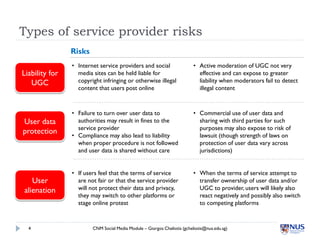
Types of service provider risks
                Risks
                • Internet service providers and social                   • Active moderation of UGC not very
Liability for     media sites can be held liable for                        effective and can expose to greater
   UGC            copyright infringing or otherwise illegal                 liability when moderators fail to detect
                  content that users post online                            illegal content


                • Failure to turn over user data to                       • Commercial use of user data and
User data         authorities may result in fines to the                    sharing with third parties for such
                  service provider                                          purposes may also expose to risk of
protection      • Compliance may also lead to liability                     lawsuit (though strength of laws on
                  when proper procedure is not followed                     protection of user data vary across
                  and user data is shared without care                      jurisdictions)


                • If users feel that the terms of service                 • When the terms of service attempt to
   User           are not fair or that the service provider                 transfer ownership of user data and/or
alienation        will not protect their data and privacy,                  UGC to provider, users will likely also
                  they may switch to other platforms or                     react negatively and possibly also switch
                  stage online protest                                      to competing platforms


  4                     CNM Social Media Module – Giorgos Cheliotis (gcheliotis@nus.edu.sg)
Key privacy issues (1 of 2)
    Defaults: many users leave privacy
     settings at their default values, exposing
     themselves to risks that they may not
     fully appreciate
    Cognitive and user interface issues: users
     that do change their privacy settings
     have difficulty remembering what values
     they set them to and may find it
     cumbersome to manage these frequently
    Mismatch of user needs and provided
     functions: binary simplicity of SNS (friend
     or not) and lack of contextual cues
     (whom am I addressing now?) make it
     difficult to express graded understanding
     of ‘friendship’ and manage different social
     circles appropriately*
    * SNS’s are starting to accommodate for such needs, but at the cost of
      increased cognitive and UI complexity

     5                                 CNM Social Media Module – Giorgos Cheliotis (gcheliotis@nus.edu.sg)
Key privacy issues (2 of 2)
    Peer pressure and herding: users imitate
     others or succumb to social pressure,
     revealing more information than they
     perhaps should
    Privacy paradox: identifiability,
     searchability, and the regular sharing of
     one’s daily experience online helps
     others find and connect to the user, but
     always at the expense of lost privacy
    Network risks: one’s online ‘friends’ may
     invite unknown others to one’s network
     (as friends-of-friends who may be able to
     view one’s updates, or by forwarding
     content and data outside one’s managed
     network)

    * SNS’s are starting to accommodate for such needs, but at the cost of
      increased cognitive and UI complexity

     6                                 CNM Social Media Module – Giorgos Cheliotis (gcheliotis@nus.edu.sg)
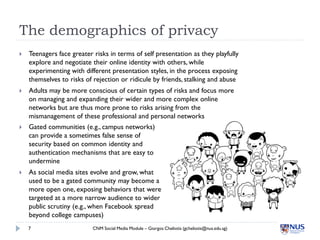
The demographics of privacy
   Teenagers face greater risks in terms of self presentation as they playfully
    explore and negotiate their online identity with others, while
    experimenting with different presentation styles, in the process exposing
    themselves to risks of rejection or ridicule by friends, stalking and abuse
   Adults may be more conscious of certain types of risks and focus more
    on managing and expanding their wider and more complex online
    networks but are thus more prone to risks arising from the
    mismanagement of these professional and personal networks
   Gated communities (e.g., campus networks)
    can provide a sometimes false sense of
    security based on common identity and
    authentication mechanisms that are easy to
    undermine
   As social media sites evolve and grow, what
    used to be a gated community may become a
    more open one, exposing behaviors that were
    targeted at a more narrow audience to wider
    public scrutiny (e.g., when Facebook spread
    beyond college campuses)
    7                      CNM Social Media Module – Giorgos Cheliotis (gcheliotis@nus.edu.sg)
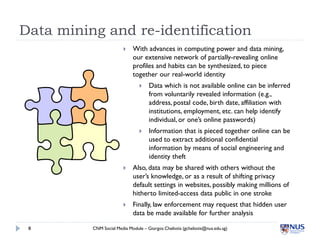
Data mining and re-identification
                            With advances in computing power and data mining,
                             our extensive network of partially-revealing online
                             profiles and habits can be synthesized, to piece
                             together our real-world identity
                                    Data which is not available online can be inferred
                                     from voluntarily revealed information (e.g.,
                                     address, postal code, birth date, affiliation with
                                     institutions, employment, etc. can help identify
                                     individual, or one’s online passwords)
                                    Information that is pieced together online can be
                                     used to extract additional confidential
                                     information by means of social engineering and
                                     identity theft
                            Also, data may be shared with others without the
                             user’s knowledge, or as a result of shifting privacy
                             default settings in websites, possibly making millions of
                             hitherto limited-access data public in one stroke
                            Finally, law enforcement may request that hidden user
                             data be made available for further analysis

 8        CNM Social Media Module – Giorgos Cheliotis (gcheliotis@nus.edu.sg)
Limits to self-expression and resulting liability
   In interactions with close friends we often share freely content and ideas and let our
    guard down, jest about topics that we might not take lightly in public, feel free to
    comment on issues and individuals and may criticize everything and everyone, fairly or
    unfairly, without always carefully backing up our claims or even considering their validity
    outside of a closely-knit group (group-think)
   When the same types of interactions that may be valuable in bonding with friends and
    like-minded people take place online, we expose ourselves to a number of risks that
    were hitherto of concern only to professional journalists, mass media producers and
    public personalities.
   Any public or semi-public online communication is also a
    publication in the sense that it is recorded in a specific
    format and is traceable online, even long after it was
    performed
   Private communication can also be similarly recorded,
    with or without the participating parties’ knowledge
   Resulting to much greater risk of copyright infringement
    and possible violations of laws regulating (offline and
    online) speech


    9                      CNM Social Media Module – Giorgos Cheliotis (gcheliotis@nus.edu.sg)
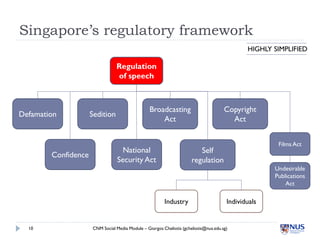
Singapore’s regulatory framework
                                                                                              HIGHLY SIMPLIFIED

                                Regulation
                                of speech


                                                 Broadcasting                         Copyright
Defamation           Sedition
                                                     Act                                Act


                                                                                                      Films Act
                                   National                              Self
        Confidence
                                 Security Act                         regulation
                                                                                                     Undesirable
                                                                                                     Publications
                                                                                                         Act

                                                        Industry                       Individuals


  10                 CNM Social Media Module – Giorgos Cheliotis (gcheliotis@nus.edu.sg)
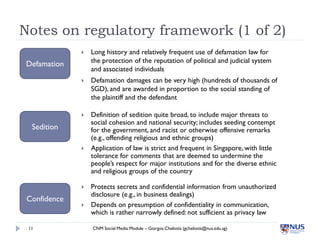
Notes on regulatory framework (1 of 2)
                 Long history and relatively frequent use of defamation law for
                  the protection of the reputation of political and judicial system
Defamation
                  and associated individuals
                 Defamation damages can be very high (hundreds of thousands of
                  SGD), and are awarded in proportion to the social standing of
                  the plaintiff and the defendant

                 Definition of sedition quite broad, to include major threats to
                  social cohesion and national security; includes seeding contempt
  Sedition        for the government, and racist or otherwise offensive remarks
                  (e.g., offending religious and ethnic groups)
                 Application of law is strict and frequent in Singapore, with little
                  tolerance for comments that are deemed to undermine the
                  people’s respect for major institutions and for the diverse ethnic
                  and religious groups of the country

                 Protects secrets and confidential information from unauthorized
                  disclosure (e.g., in business dealings)
 Confidence
                 Depends on presumption of confidentiality in communication,
                  which is rather narrowly defined: not sufficient as privacy law

 11               CNM Social Media Module – Giorgos Cheliotis (gcheliotis@nus.edu.sg)
Notes on regulatory framework (2 of 2)
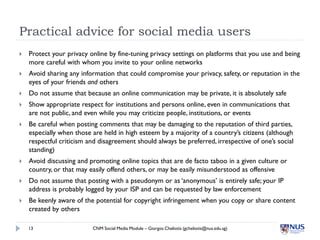
                  Enforcement rather strict, but with an increasing recognition of
                   the need for new licensing models (e.g., Creative Commons) and
 Copyright
                   the development of a more open ecosystem for innovation
                  Some disparity between official pro-copyright stance and popular
                   attitudes towards copying and sharing copyrighted content, as in
                   other countries around the world

                  Aimed more at regulating rights to broadcast in traditional mass
   Broad-          media, which are more proactively controlled by the MDA
 casting Act      Recognition of the impracticality of full-on Internet content
                   regulation led to introduction of a ‘class license’ which allows
                   anyone and everyone to post and disseminate content online
                  License could be revoked in principle for those who repeatedly
                   post illegal content (resulting possibly to termination of Internet
                   access), although there is no such precedent yet

                  Gives government greater power to forbid the publication of
  Internal         content that is deemed a threat to national security (in addition
Security Act       to other laws, such as the Undesirable Publications Act and the
                   Government Secrets Act)

 12                CNM Social Media Module – Giorgos Cheliotis (gcheliotis@nus.edu.sg)
Practical advice for social media users
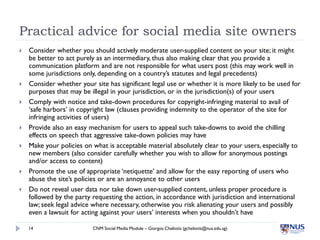
   Protect your privacy online by fine-tuning privacy settings on platforms that you use and being
    more careful with whom you invite to your online networks
   Avoid sharing any information that could compromise your privacy, safety, or reputation in the
    eyes of your friends and others
   Do not assume that because an online communication may be private, it is absolutely safe
   Show appropriate respect for institutions and persons online, even in communications that
    are not public, and even while you may criticize people, institutions, or events
   Be careful when posting comments that may be damaging to the reputation of third parties,
    especially when those are held in high esteem by a majority of a country’s citizens (although
    respectful criticism and disagreement should always be preferred, irrespective of one’s social
    standing)
   Avoid discussing and promoting online topics that are de facto taboo in a given culture or
    country, or that may easily offend others, or may be easily misunderstood as offensive
   Do not assume that posting with a pseudonym or as ‘anonymous’ is entirely safe; your IP
    address is probably logged by your ISP and can be requested by law enforcement
   Be keenly aware of the potential for copyright infringement when you copy or share content
    created by others

    13                    CNM Social Media Module – Giorgos Cheliotis (gcheliotis@nus.edu.sg)
Practical advice for social media site owners
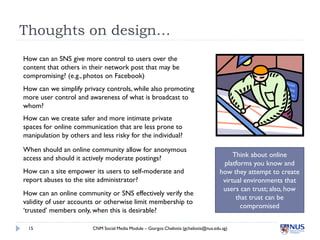
   Consider whether you should actively moderate user-supplied content on your site; it might
    be better to act purely as an intermediary, thus also making clear that you provide a
    communication platform and are not responsible for what users post (this may work well in
    some jurisdictions only, depending on a country’s statutes and legal precedents)
   Consider whether your site has significant legal use or whether it is more likely to be used for
    purposes that may be illegal in your jurisdiction, or in the jurisdiction(s) of your users
   Comply with notice and take-down procedures for copyright-infringing material to avail of
    ‘safe harbors’ in copyright law (clauses providing indemnity to the operator of the site for
    infringing activities of users)
   Provide also an easy mechanism for users to appeal such take-downs to avoid the chilling
    effects on speech that aggressive take-down policies may have
   Make your policies on what is acceptable material absolutely clear to your users, especially to
    new members (also consider carefully whether you wish to allow for anonymous postings
    and/or access to content)
   Promote the use of appropriate ‘netiquette’ and allow for the easy reporting of users who
    abuse the site’s policies or are an annoyance to other users
   Do not reveal user data nor take down user-supplied content, unless proper procedure is
    followed by the party requesting the action, in accordance with jurisdiction and international
    law; seek legal advice where necessary, otherwise you risk alienating your users and possibly
    even a lawsuit for acting against your users’ interests when you shouldn’t have

    14                    CNM Social Media Module – Giorgos Cheliotis (gcheliotis@nus.edu.sg)
Thoughts on design…
How can an SNS give more control to users over the
content that others in their network post that may be
compromising? (e.g., photos on Facebook)
How can we simplify privacy controls, while also promoting
more user control and awareness of what is broadcast to
whom?
How can we create safer and more intimate private
spaces for online communication that are less prone to
manipulation by others and less risky for the individual?

When should an online community allow for anonymous
access and should it actively moderate postings?                                            Think about online
                                                                                        platforms you know and
How can a site empower its users to self-moderate and                                  how they attempt to create
report abuses to the site administrator?                                                virtual environments that
                                                                                        users can trust; also, how
How can an online community or SNS effectively verify the
                                                                                             that trust can be
validity of user accounts or otherwise limit membership to
                                                                                               compromised
‘trusted’ members only, when this is desirable?

 15                     CNM Social Media Module – Giorgos Cheliotis (gcheliotis@nus.edu.sg)
Credits and licensing
   Front page photo by cobalt123 (license: CC BY-NC)
   Privacy photo by alancleaver_2000 (license: CC BY)
   Drawing of network of different ages by lucas.leite (license: CC BY-NC-ND)


         Original content in this presentation is licensed under the Creative Commons
             Singapore Attribution 3.0 license unless stated otherwise (see above)


    16                      CNM Social Media Module – Giorgos Cheliotis (gcheliotis@nus.edu.sg)

Social Media Risks

  • 1.
    Social Media Risks Social Media – Dr. Giorgos Cheliotis (gcheliotis@nus.edu.sg) Communications and New Media, National University of Singapore
  • 2.
    Introduction  Millions of Internet users use social media platforms daily for self-expression, communication and collaboration  As social media becomes daily routine, we have to learn how to deal with the risks of computer-mediated communication  Some of these risks are more unique to social media, while some are relevant to nearly any form of communication but may take new forms online  Users continuously explore new ways of negotiating their need for privacy and safety, with their desire to communicate with more people and in more public ways  As all social media is hosted somewhere and facilitated by communication technologies, risks are also relevant to the intermediaries that operate online platforms and communication networks  In the meantime, law is evolving and trying to catch up with new technologies and new online behavior, while inevitably leaving many gray areas that both users and service providers try to navigate 2 CNM Social Media Module – Giorgos Cheliotis (gcheliotis@nus.edu.sg)
  • 3.
    Types of userrisks in social media space Risks • Involuntary information revelation • Reduced anonymity and increased Privacy and • Involuntary transfer of ownership of traceability, especially in platforms safety personal data or content to third party encouraging use of real offline identity • Commercial exploitation of user data • Network effects (privacy risks deriving • Mismanaging visibility and searchability from one’s online network of contacts) of personal data online • Stalking (online and offline) • Identity theft • Surveillance by state and third parties • Harsh criticism and other negative • Complexity of translating and separating Self reactions to one’s online profile by offline roles and one’s image online friends and others • Peer pressure to involuntarily disclose presentation • Usage of sensitive and/or inappropriate personal information to online network personal or third-party content in self (e.g., top friends, religion, relationship presentation (incl. copyright infringement) status, etc.) • Ease and speed of posting increases • Users can run afoul of laws that were potential for social blunders previously more often applied to mass Self • Common private behavior crosses easily media, professional content producers expression to public sphere where it may be and public persons (e.g., defamation and considered inappropriate or offensive sedition laws) • Insufficient separation of social circles • Copyright infringement 3 CNM Social Media Module – Giorgos Cheliotis (gcheliotis@nus.edu.sg)
  • 4.
    Types of serviceprovider risks Risks • Internet service providers and social • Active moderation of UGC not very Liability for media sites can be held liable for effective and can expose to greater UGC copyright infringing or otherwise illegal liability when moderators fail to detect content that users post online illegal content • Failure to turn over user data to • Commercial use of user data and User data authorities may result in fines to the sharing with third parties for such service provider purposes may also expose to risk of protection • Compliance may also lead to liability lawsuit (though strength of laws on when proper procedure is not followed protection of user data vary across and user data is shared without care jurisdictions) • If users feel that the terms of service • When the terms of service attempt to User are not fair or that the service provider transfer ownership of user data and/or alienation will not protect their data and privacy, UGC to provider, users will likely also they may switch to other platforms or react negatively and possibly also switch stage online protest to competing platforms 4 CNM Social Media Module – Giorgos Cheliotis (gcheliotis@nus.edu.sg)
  • 5.
    Key privacy issues(1 of 2)  Defaults: many users leave privacy settings at their default values, exposing themselves to risks that they may not fully appreciate  Cognitive and user interface issues: users that do change their privacy settings have difficulty remembering what values they set them to and may find it cumbersome to manage these frequently  Mismatch of user needs and provided functions: binary simplicity of SNS (friend or not) and lack of contextual cues (whom am I addressing now?) make it difficult to express graded understanding of ‘friendship’ and manage different social circles appropriately* * SNS’s are starting to accommodate for such needs, but at the cost of increased cognitive and UI complexity 5 CNM Social Media Module – Giorgos Cheliotis (gcheliotis@nus.edu.sg)
  • 6.
    Key privacy issues(2 of 2)  Peer pressure and herding: users imitate others or succumb to social pressure, revealing more information than they perhaps should  Privacy paradox: identifiability, searchability, and the regular sharing of one’s daily experience online helps others find and connect to the user, but always at the expense of lost privacy  Network risks: one’s online ‘friends’ may invite unknown others to one’s network (as friends-of-friends who may be able to view one’s updates, or by forwarding content and data outside one’s managed network) * SNS’s are starting to accommodate for such needs, but at the cost of increased cognitive and UI complexity 6 CNM Social Media Module – Giorgos Cheliotis (gcheliotis@nus.edu.sg)
  • 7.
    The demographics ofprivacy  Teenagers face greater risks in terms of self presentation as they playfully explore and negotiate their online identity with others, while experimenting with different presentation styles, in the process exposing themselves to risks of rejection or ridicule by friends, stalking and abuse  Adults may be more conscious of certain types of risks and focus more on managing and expanding their wider and more complex online networks but are thus more prone to risks arising from the mismanagement of these professional and personal networks  Gated communities (e.g., campus networks) can provide a sometimes false sense of security based on common identity and authentication mechanisms that are easy to undermine  As social media sites evolve and grow, what used to be a gated community may become a more open one, exposing behaviors that were targeted at a more narrow audience to wider public scrutiny (e.g., when Facebook spread beyond college campuses) 7 CNM Social Media Module – Giorgos Cheliotis (gcheliotis@nus.edu.sg)
  • 8.
    Data mining andre-identification  With advances in computing power and data mining, our extensive network of partially-revealing online profiles and habits can be synthesized, to piece together our real-world identity  Data which is not available online can be inferred from voluntarily revealed information (e.g., address, postal code, birth date, affiliation with institutions, employment, etc. can help identify individual, or one’s online passwords)  Information that is pieced together online can be used to extract additional confidential information by means of social engineering and identity theft  Also, data may be shared with others without the user’s knowledge, or as a result of shifting privacy default settings in websites, possibly making millions of hitherto limited-access data public in one stroke  Finally, law enforcement may request that hidden user data be made available for further analysis 8 CNM Social Media Module – Giorgos Cheliotis (gcheliotis@nus.edu.sg)
  • 9.
    Limits to self-expressionand resulting liability  In interactions with close friends we often share freely content and ideas and let our guard down, jest about topics that we might not take lightly in public, feel free to comment on issues and individuals and may criticize everything and everyone, fairly or unfairly, without always carefully backing up our claims or even considering their validity outside of a closely-knit group (group-think)  When the same types of interactions that may be valuable in bonding with friends and like-minded people take place online, we expose ourselves to a number of risks that were hitherto of concern only to professional journalists, mass media producers and public personalities.  Any public or semi-public online communication is also a publication in the sense that it is recorded in a specific format and is traceable online, even long after it was performed  Private communication can also be similarly recorded, with or without the participating parties’ knowledge  Resulting to much greater risk of copyright infringement and possible violations of laws regulating (offline and online) speech 9 CNM Social Media Module – Giorgos Cheliotis (gcheliotis@nus.edu.sg)
  • 10.
    Singapore’s regulatory framework HIGHLY SIMPLIFIED Regulation of speech Broadcasting Copyright Defamation Sedition Act Act Films Act National Self Confidence Security Act regulation Undesirable Publications Act Industry Individuals 10 CNM Social Media Module – Giorgos Cheliotis (gcheliotis@nus.edu.sg)
  • 11.
    Notes on regulatoryframework (1 of 2)  Long history and relatively frequent use of defamation law for the protection of the reputation of political and judicial system Defamation and associated individuals  Defamation damages can be very high (hundreds of thousands of SGD), and are awarded in proportion to the social standing of the plaintiff and the defendant  Definition of sedition quite broad, to include major threats to social cohesion and national security; includes seeding contempt Sedition for the government, and racist or otherwise offensive remarks (e.g., offending religious and ethnic groups)  Application of law is strict and frequent in Singapore, with little tolerance for comments that are deemed to undermine the people’s respect for major institutions and for the diverse ethnic and religious groups of the country  Protects secrets and confidential information from unauthorized disclosure (e.g., in business dealings) Confidence  Depends on presumption of confidentiality in communication, which is rather narrowly defined: not sufficient as privacy law 11 CNM Social Media Module – Giorgos Cheliotis (gcheliotis@nus.edu.sg)
  • 12.
    Notes on regulatoryframework (2 of 2)  Enforcement rather strict, but with an increasing recognition of the need for new licensing models (e.g., Creative Commons) and Copyright the development of a more open ecosystem for innovation  Some disparity between official pro-copyright stance and popular attitudes towards copying and sharing copyrighted content, as in other countries around the world  Aimed more at regulating rights to broadcast in traditional mass Broad- media, which are more proactively controlled by the MDA casting Act  Recognition of the impracticality of full-on Internet content regulation led to introduction of a ‘class license’ which allows anyone and everyone to post and disseminate content online  License could be revoked in principle for those who repeatedly post illegal content (resulting possibly to termination of Internet access), although there is no such precedent yet  Gives government greater power to forbid the publication of Internal content that is deemed a threat to national security (in addition Security Act to other laws, such as the Undesirable Publications Act and the Government Secrets Act) 12 CNM Social Media Module – Giorgos Cheliotis (gcheliotis@nus.edu.sg)
  • 13.
    Practical advice forsocial media users  Protect your privacy online by fine-tuning privacy settings on platforms that you use and being more careful with whom you invite to your online networks  Avoid sharing any information that could compromise your privacy, safety, or reputation in the eyes of your friends and others  Do not assume that because an online communication may be private, it is absolutely safe  Show appropriate respect for institutions and persons online, even in communications that are not public, and even while you may criticize people, institutions, or events  Be careful when posting comments that may be damaging to the reputation of third parties, especially when those are held in high esteem by a majority of a country’s citizens (although respectful criticism and disagreement should always be preferred, irrespective of one’s social standing)  Avoid discussing and promoting online topics that are de facto taboo in a given culture or country, or that may easily offend others, or may be easily misunderstood as offensive  Do not assume that posting with a pseudonym or as ‘anonymous’ is entirely safe; your IP address is probably logged by your ISP and can be requested by law enforcement  Be keenly aware of the potential for copyright infringement when you copy or share content created by others 13 CNM Social Media Module – Giorgos Cheliotis (gcheliotis@nus.edu.sg)
  • 14.
    Practical advice forsocial media site owners  Consider whether you should actively moderate user-supplied content on your site; it might be better to act purely as an intermediary, thus also making clear that you provide a communication platform and are not responsible for what users post (this may work well in some jurisdictions only, depending on a country’s statutes and legal precedents)  Consider whether your site has significant legal use or whether it is more likely to be used for purposes that may be illegal in your jurisdiction, or in the jurisdiction(s) of your users  Comply with notice and take-down procedures for copyright-infringing material to avail of ‘safe harbors’ in copyright law (clauses providing indemnity to the operator of the site for infringing activities of users)  Provide also an easy mechanism for users to appeal such take-downs to avoid the chilling effects on speech that aggressive take-down policies may have  Make your policies on what is acceptable material absolutely clear to your users, especially to new members (also consider carefully whether you wish to allow for anonymous postings and/or access to content)  Promote the use of appropriate ‘netiquette’ and allow for the easy reporting of users who abuse the site’s policies or are an annoyance to other users  Do not reveal user data nor take down user-supplied content, unless proper procedure is followed by the party requesting the action, in accordance with jurisdiction and international law; seek legal advice where necessary, otherwise you risk alienating your users and possibly even a lawsuit for acting against your users’ interests when you shouldn’t have 14 CNM Social Media Module – Giorgos Cheliotis (gcheliotis@nus.edu.sg)
  • 15.
    Thoughts on design… Howcan an SNS give more control to users over the content that others in their network post that may be compromising? (e.g., photos on Facebook) How can we simplify privacy controls, while also promoting more user control and awareness of what is broadcast to whom? How can we create safer and more intimate private spaces for online communication that are less prone to manipulation by others and less risky for the individual? When should an online community allow for anonymous access and should it actively moderate postings? Think about online platforms you know and How can a site empower its users to self-moderate and how they attempt to create report abuses to the site administrator? virtual environments that users can trust; also, how How can an online community or SNS effectively verify the that trust can be validity of user accounts or otherwise limit membership to compromised ‘trusted’ members only, when this is desirable? 15 CNM Social Media Module – Giorgos Cheliotis (gcheliotis@nus.edu.sg)
  • 16.
    Credits and licensing  Front page photo by cobalt123 (license: CC BY-NC)  Privacy photo by alancleaver_2000 (license: CC BY)  Drawing of network of different ages by lucas.leite (license: CC BY-NC-ND) Original content in this presentation is licensed under the Creative Commons Singapore Attribution 3.0 license unless stated otherwise (see above) 16 CNM Social Media Module – Giorgos Cheliotis (gcheliotis@nus.edu.sg)