Community and Ties

    Social Media – Dr. Giorgos Cheliotis (gcheliotis@nus.edu.sg)
Communications and New Media, National University of Singapore
Community


        Term traditionally associated with a particular place
         and the people that live in it
        Conjuring images of harmonious living in small
         villages or urban residential districts, with strong
         networks of trust and mutual support that are
         cultivated over generations
        Deriving strength from shared interest, culture,
         religion, creed, race, national identity or social status


 2              CNM Social Media Module – Giorgos Cheliotis (gcheliotis@nus.edu.sg)
How has our sense of community changed?

   With every major socioeconomic and political shift our
    understanding of community has been challenged
       Industrialization
       Urbanization
       Revolution
       Migration
       Poverty
       Marginalization
   In the era of computer-mediated communication we are
    also forced to rethink ‘community’

    3                 CNM Social Media Module – Giorgos Cheliotis (gcheliotis@nus.edu.sg)
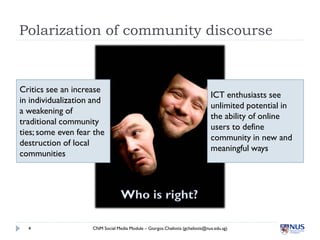
Polarization of community discourse


Critics see an increase
                                                                              ICT enthusiasts see
in individualization and
                                                                              unlimited potential in
a weakening of
                                                                              the ability of online
traditional community
                                                                              users to define
ties; some even fear the
                                                                              community in new and
destruction of local
                                                                              meaningful ways
communities


  4                 CNM Social Media Module – Giorgos Cheliotis (gcheliotis@nus.edu.sg)
Common arguments from both sides
                Mark as true or false based on your understanding!


        Relationships on the Internet                   The Internet helps create
         are weak, short-lived and                        and manage many useful
         interest-based only                              weak ties
        Low motivation to                               People will help even those
         reciprocate; lack of                             they barely know
         commitment or solidarity                        The maintenance of strong
        Difficult to create sense of                     ties is assisted by ICT
         community online                                Online communities do
        Strong, intimate ties not                        develop norms, identity,
         possible                                         attachment and reciprocity
        Online involvement                              Online participation can
         antagonizes offline                              increase diversity of ties
         communities                                     Online communities can
        Online communities are not                       complement/support offline
         like offline communities                         activities

 5                 CNM Social Media Module – Giorgos Cheliotis (gcheliotis@nus.edu.sg)
1. Narrowly specialized or broadly supportive?
Main findings

   The ideal broadly supportive ‘real life’ community is somewhat
    of a myth in modern urban societies
   Some online communities do focus on a topic of interest and
    information exchange – narrower; but information is not the
    only thing that is exchanged online (example: support groups)
   Greater willingness to engage with strangers (forming weak
    ties) in CMC due to lack of (offline) status and situational cues
   Recognition: any sign of support will be viewed by entire online
    community; quicker and broader recognition
   Lower risk: easier to withdraw from problematic situations
    online


    6                 CNM Social Media Module – Giorgos Cheliotis (gcheliotis@nus.edu.sg)
2. Reciprocity and attachment
Main findings

   Reciprocity is essential; yet many online interactions are indeed
    based on weak ties which may reduce incentives to reciprocate
   Social dilemma: why reciprocate if it is unlikely that others will?
   However, online users do have reasons to take the first step
    and to reciprocate: increase in self-esteem, respect from others
    and status attainment in community
   Group/organizational attachment visible in some online
    communities; directly related to generalized trust and
    reciprocity which in turn become community norms (“the
    person I may help may never be in a position to help me, but
    someone else might be”, Rheingold 1993)


    7                 CNM Social Media Module – Giorgos Cheliotis (gcheliotis@nus.edu.sg)
3. Are strong, intimate ties possible?
Main findings
   CMC does encourage formation of weak ties which come with
    few strings attached. Strong ties on the other hand must
    exhibit certain characteristics: emotional investment, desire for
    frequent interaction, long-term relationship, sense of mutuality
    and knowing each other, often also shared social characteristics
   Yet there are many examples of forming – and even more for
    maintaining – existing strong ties online
   The antagonism offline-online makes less sense here – Internet
    just one of several channels people use to maintain strong ties
   Some issues with lack of physical and social cues online; easier
    to misunderstand, unnecessary stress and polarization
   Ease of terminating relationship online also an issue
   But Internet generally does not preclude intimacy

    8                 CNM Social Media Module – Giorgos Cheliotis (gcheliotis@nus.edu.sg)
4. How does online community affect offline?
Main findings

   Time spent in front of the computer is often time spent
    (physically) in isolation (mobile/portable devices changing that)
   However, community involvement is not a zero-sum game;
    spending more time in an online community does not
    necessarily mean that offline ties will suffer – can also lead to
    increase in total time spent interacting with same people
   Strong ties are supported by CMC (see also previous slide)
   We must think in terms of relationships managed both offline
    and online rather than online vs. offline ties
   Multiplex relationships: use of multiple media in interaction can
    aid in strengthening existing ties or in maintaining relationship
    when physically distant

    9                 CNM Social Media Module – Giorgos Cheliotis (gcheliotis@nus.edu.sg)
5. Diversity
Main findings
   Traditional communities constrained by space, social status,
    roles and personal identity
   On the Internet we tend to participate in multiple
    communities in parallel: greater diversity of ties (this also
    relates again to the ‘weak ties’ argument)
   For a highly mobile population, allegiance to a diverse set of
    online communities can be even greater than for (the usually
    less diverse) offline communities we participate in
   Caveat: forming ties online based on shared interests may lead
    to greater homogeneity of a different type (birds of a feather
    flock together)
   Therefore, both offline/local and online communities can
    contribute to diversity, in distinct ways


    10               CNM Social Media Module – Giorgos Cheliotis (gcheliotis@nus.edu.sg)
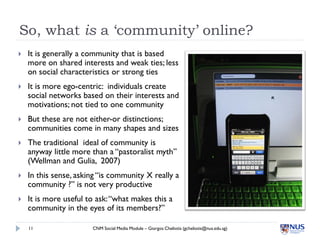
So, what is a ‘community’ online?
   It is generally a community that is based
    more on shared interests and weak ties; less
    on social characteristics or strong ties
   It is more ego-centric: individuals create
    social networks based on their interests and
    motivations; not tied to one community
   But these are not either-or distinctions;
    communities come in many shapes and sizes
   The traditional ideal of community is
    anyway little more than a “pastoralist myth”
    (Wellman and Gulia, 2007)
   In this sense, asking “is community X really a
    community ?” is not very productive
   It is more useful to ask: “what makes this a
    community in the eyes of its members?”

    11                 CNM Social Media Module – Giorgos Cheliotis (gcheliotis@nus.edu.sg)
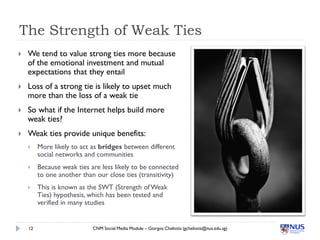
The Strength of Weak Ties
   We tend to value strong ties more because
    of the emotional investment and mutual
    expectations that they entail
   Loss of a strong tie is likely to upset much
    more than the loss of a weak tie
   So what if the Internet helps build more
    weak ties?
   Weak ties provide unique benefits:
        More likely to act as bridges between different
         social networks and communities
        Because weak ties are less likely to be connected
         to one another than our close ties (transitivity)
        This is known as the SWT (Strength of Weak
         Ties) hypothesis, which has been tested and
         verified in many studies


    12                      CNM Social Media Module – Giorgos Cheliotis (gcheliotis@nus.edu.sg)
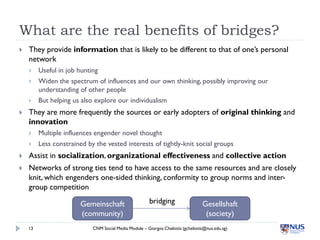
What are the real benefits of bridges?
   They provide information that is likely to be different to that of one’s personal
    network
        Useful in job hunting
        Widen the spectrum of influences and our own thinking, possibly improving our
         understanding of other people
        But helping us also explore our individualism
   They are more frequently the sources or early adopters of original thinking and
    innovation
        Multiple influences engender novel thought
        Less constrained by the vested interests of tightly-knit social groups
   Assist in socialization, organizational effectiveness and collective action
   Networks of strong ties tend to have access to the same resources and are closely
    knit, which engenders one-sided thinking, conformity to group norms and inter-
    group competition

                        Gemeinschaft                    bridging                  Gesellshaft
                        (community)                                                (society)
    13                      CNM Social Media Module – Giorgos Cheliotis (gcheliotis@nus.edu.sg)
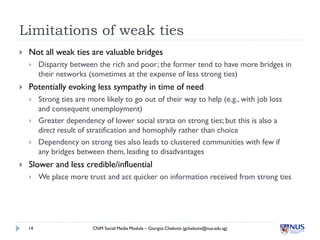
Limitations of weak ties
   Not all weak ties are valuable bridges
        Disparity between the rich and poor; the former tend to have more bridges in
         their networks (sometimes at the expense of less strong ties)
   Potentially evoking less sympathy in time of need
        Strong ties are more likely to go out of their way to help (e.g., with job loss
         and consequent unemployment)
        Greater dependency of lower social strata on strong ties; but this is also a
         direct result of stratification and homophily rather than choice
        Dependency on strong ties also leads to clustered communities with few if
         any bridges between them, leading to disadvantages
   Slower and less credible/influential
        We place more trust and act quicker on information received from strong ties


    14                    CNM Social Media Module – Giorgos Cheliotis (gcheliotis@nus.edu.sg)
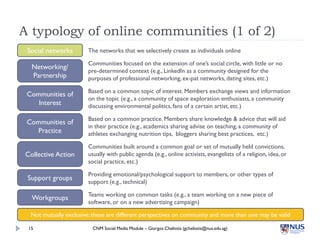
A typology of online communities (1 of 2)
 Social networks        The networks that we selectively create as individuals online

                        Communities focused on the extension of one’s social circle, with little or no
  Networking/
                        pre-determined context (e.g., LinkedIn as a community designed for the
  Partnership           purposes of professional networking, ex-pat networks, dating sites, etc.)

                        Based on a common topic of interest. Members exchange views and information
 Communities of
                        on the topic (e.g., a community of space exploration enthusiasts, a community
    Interest            discussing environmental politics, fans of a certain artist, etc.)

                        Based on a common practice. Members share knowledge & advice that will aid
 Communities of
                        in their practice (e.g., academics sharing advise on teaching, a community of
   Practice             athletes exchanging nutrition tips, bloggers sharing best practices, etc.)

                        Communities built around a common goal or set of mutually held convictions,
Collective Action       usually with public agenda (e.g., online activists, evangelists of a religion, idea, or
                        social practice, etc.)

                        Providing emotional/psychological support to members, or other types of
 Support groups
                        support (e.g., technical)

                        Teams working on common tasks (e.g., a team working on a new piece of
  Workgroups
                        software, or on a new advertizing campaign)

  Not mutually exclusive; these are different perspectives on community and more than one may be valid

 15                      CNM Social Media Module – Giorgos Cheliotis (gcheliotis@nus.edu.sg)
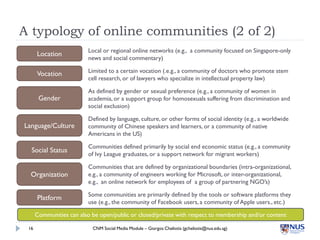
A typology of online communities (2 of 2)
                          Local or regional online networks (e.g., a community focused on Singapore-only
      Location
                          news and social commentary)

      Vocation            Limited to a certain vocation (.e.g., a community of doctors who promote stem
                          cell research, or of lawyers who specialize in intellectual property law)

                          As defined by gender or sexual preference (e.g., a community of women in
       Gender             academia, or a support group for homosexuals suffering from discrimination and
                          social exclusion)

                          Defined by language, culture, or other forms of social identity (e.g., a worldwide
Language/Culture          community of Chinese speakers and learners, or a community of native
                          Americans in the US)

                          Communities defined primarily by social end economic status (e.g., a community
  Social Status
                          of Ivy League graduates, or a support network for migrant workers)

                          Communities that are defined by organizational boundaries (intra-organizational,
  Organization            e.g., a community of engineers working for Microsoft, or inter-organizational,
                          e.g., an online network for employees of a group of partnering NGO’s)

                          Some communities are primarily defined by the tools or software platforms they
      Platform
                          use (e.g., the community of Facebook users, a community of Apple users., etc.)

      Communities can also be open/public or closed/private with respect to membership and/or content

 16                        CNM Social Media Module – Giorgos Cheliotis (gcheliotis@nus.edu.sg)
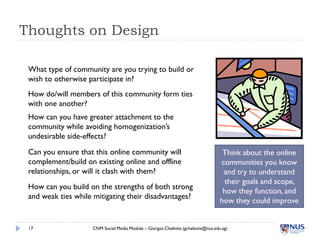
Thoughts on Design

 What type of community are you trying to build or
 wish to otherwise participate in?
 How do/will members of this community form ties
 with one another?
 How can you have greater attachment to the
 community while avoiding homogenization’s
 undesirable side-effects?
 Can you ensure that this online community will                                     Think about the online
 complement/build on existing online and offline                                   communities you know
 relationships, or will it clash with them?                                         and try to understand
                                                                                    their goals and scope,
 How can you build on the strengths of both strong
                                                                                    how they function, and
 and weak ties while mitigating their disadvantages?
                                                                                   how they could improve


 17                 CNM Social Media Module – Giorgos Cheliotis (gcheliotis@nus.edu.sg)
Credits and licensing
   Frontpage photo by h.kopdelaney (license: CC BY-ND)
   Polarization/opposite faces photo by Cayusa (license: CC BY-NC)
   OLPC/iPhone chat photo by curiouslee (license: CC BY-NC)
   Bond/tie photo by ChrisK4u (license: CC BY-ND)


         Original content in this presentation is licensed under the Creative Commons
             Singapore Attribution 3.0 license unless stated otherwise (see above)


    18                      CNM Social Media Module – Giorgos Cheliotis (gcheliotis@nus.edu.sg)

Community And Ties

  • 1.
    Community and Ties Social Media – Dr. Giorgos Cheliotis (gcheliotis@nus.edu.sg) Communications and New Media, National University of Singapore
  • 2.
    Community  Term traditionally associated with a particular place and the people that live in it  Conjuring images of harmonious living in small villages or urban residential districts, with strong networks of trust and mutual support that are cultivated over generations  Deriving strength from shared interest, culture, religion, creed, race, national identity or social status 2 CNM Social Media Module – Giorgos Cheliotis (gcheliotis@nus.edu.sg)
  • 3.
    How has oursense of community changed?  With every major socioeconomic and political shift our understanding of community has been challenged  Industrialization  Urbanization  Revolution  Migration  Poverty  Marginalization  In the era of computer-mediated communication we are also forced to rethink ‘community’ 3 CNM Social Media Module – Giorgos Cheliotis (gcheliotis@nus.edu.sg)
  • 4.
    Polarization of communitydiscourse Critics see an increase ICT enthusiasts see in individualization and unlimited potential in a weakening of the ability of online traditional community users to define ties; some even fear the community in new and destruction of local meaningful ways communities 4 CNM Social Media Module – Giorgos Cheliotis (gcheliotis@nus.edu.sg)
  • 5.
    Common arguments fromboth sides Mark as true or false based on your understanding!  Relationships on the Internet  The Internet helps create are weak, short-lived and and manage many useful interest-based only weak ties  Low motivation to  People will help even those reciprocate; lack of they barely know commitment or solidarity  The maintenance of strong  Difficult to create sense of ties is assisted by ICT community online  Online communities do  Strong, intimate ties not develop norms, identity, possible attachment and reciprocity  Online involvement  Online participation can antagonizes offline increase diversity of ties communities  Online communities can  Online communities are not complement/support offline like offline communities activities 5 CNM Social Media Module – Giorgos Cheliotis (gcheliotis@nus.edu.sg)
  • 6.
    1. Narrowly specializedor broadly supportive? Main findings  The ideal broadly supportive ‘real life’ community is somewhat of a myth in modern urban societies  Some online communities do focus on a topic of interest and information exchange – narrower; but information is not the only thing that is exchanged online (example: support groups)  Greater willingness to engage with strangers (forming weak ties) in CMC due to lack of (offline) status and situational cues  Recognition: any sign of support will be viewed by entire online community; quicker and broader recognition  Lower risk: easier to withdraw from problematic situations online 6 CNM Social Media Module – Giorgos Cheliotis (gcheliotis@nus.edu.sg)
  • 7.
    2. Reciprocity andattachment Main findings  Reciprocity is essential; yet many online interactions are indeed based on weak ties which may reduce incentives to reciprocate  Social dilemma: why reciprocate if it is unlikely that others will?  However, online users do have reasons to take the first step and to reciprocate: increase in self-esteem, respect from others and status attainment in community  Group/organizational attachment visible in some online communities; directly related to generalized trust and reciprocity which in turn become community norms (“the person I may help may never be in a position to help me, but someone else might be”, Rheingold 1993) 7 CNM Social Media Module – Giorgos Cheliotis (gcheliotis@nus.edu.sg)
  • 8.
    3. Are strong,intimate ties possible? Main findings  CMC does encourage formation of weak ties which come with few strings attached. Strong ties on the other hand must exhibit certain characteristics: emotional investment, desire for frequent interaction, long-term relationship, sense of mutuality and knowing each other, often also shared social characteristics  Yet there are many examples of forming – and even more for maintaining – existing strong ties online  The antagonism offline-online makes less sense here – Internet just one of several channels people use to maintain strong ties  Some issues with lack of physical and social cues online; easier to misunderstand, unnecessary stress and polarization  Ease of terminating relationship online also an issue  But Internet generally does not preclude intimacy 8 CNM Social Media Module – Giorgos Cheliotis (gcheliotis@nus.edu.sg)
  • 9.
    4. How doesonline community affect offline? Main findings  Time spent in front of the computer is often time spent (physically) in isolation (mobile/portable devices changing that)  However, community involvement is not a zero-sum game; spending more time in an online community does not necessarily mean that offline ties will suffer – can also lead to increase in total time spent interacting with same people  Strong ties are supported by CMC (see also previous slide)  We must think in terms of relationships managed both offline and online rather than online vs. offline ties  Multiplex relationships: use of multiple media in interaction can aid in strengthening existing ties or in maintaining relationship when physically distant 9 CNM Social Media Module – Giorgos Cheliotis (gcheliotis@nus.edu.sg)
  • 10.
    5. Diversity Main findings  Traditional communities constrained by space, social status, roles and personal identity  On the Internet we tend to participate in multiple communities in parallel: greater diversity of ties (this also relates again to the ‘weak ties’ argument)  For a highly mobile population, allegiance to a diverse set of online communities can be even greater than for (the usually less diverse) offline communities we participate in  Caveat: forming ties online based on shared interests may lead to greater homogeneity of a different type (birds of a feather flock together)  Therefore, both offline/local and online communities can contribute to diversity, in distinct ways 10 CNM Social Media Module – Giorgos Cheliotis (gcheliotis@nus.edu.sg)
  • 11.
    So, what isa ‘community’ online?  It is generally a community that is based more on shared interests and weak ties; less on social characteristics or strong ties  It is more ego-centric: individuals create social networks based on their interests and motivations; not tied to one community  But these are not either-or distinctions; communities come in many shapes and sizes  The traditional ideal of community is anyway little more than a “pastoralist myth” (Wellman and Gulia, 2007)  In this sense, asking “is community X really a community ?” is not very productive  It is more useful to ask: “what makes this a community in the eyes of its members?” 11 CNM Social Media Module – Giorgos Cheliotis (gcheliotis@nus.edu.sg)
  • 12.
    The Strength ofWeak Ties  We tend to value strong ties more because of the emotional investment and mutual expectations that they entail  Loss of a strong tie is likely to upset much more than the loss of a weak tie  So what if the Internet helps build more weak ties?  Weak ties provide unique benefits:  More likely to act as bridges between different social networks and communities  Because weak ties are less likely to be connected to one another than our close ties (transitivity)  This is known as the SWT (Strength of Weak Ties) hypothesis, which has been tested and verified in many studies 12 CNM Social Media Module – Giorgos Cheliotis (gcheliotis@nus.edu.sg)
  • 13.
    What are thereal benefits of bridges?  They provide information that is likely to be different to that of one’s personal network  Useful in job hunting  Widen the spectrum of influences and our own thinking, possibly improving our understanding of other people  But helping us also explore our individualism  They are more frequently the sources or early adopters of original thinking and innovation  Multiple influences engender novel thought  Less constrained by the vested interests of tightly-knit social groups  Assist in socialization, organizational effectiveness and collective action  Networks of strong ties tend to have access to the same resources and are closely knit, which engenders one-sided thinking, conformity to group norms and inter- group competition Gemeinschaft bridging Gesellshaft (community) (society) 13 CNM Social Media Module – Giorgos Cheliotis (gcheliotis@nus.edu.sg)
  • 14.
    Limitations of weakties  Not all weak ties are valuable bridges  Disparity between the rich and poor; the former tend to have more bridges in their networks (sometimes at the expense of less strong ties)  Potentially evoking less sympathy in time of need  Strong ties are more likely to go out of their way to help (e.g., with job loss and consequent unemployment)  Greater dependency of lower social strata on strong ties; but this is also a direct result of stratification and homophily rather than choice  Dependency on strong ties also leads to clustered communities with few if any bridges between them, leading to disadvantages  Slower and less credible/influential  We place more trust and act quicker on information received from strong ties 14 CNM Social Media Module – Giorgos Cheliotis (gcheliotis@nus.edu.sg)
  • 15.
    A typology ofonline communities (1 of 2) Social networks The networks that we selectively create as individuals online Communities focused on the extension of one’s social circle, with little or no Networking/ pre-determined context (e.g., LinkedIn as a community designed for the Partnership purposes of professional networking, ex-pat networks, dating sites, etc.) Based on a common topic of interest. Members exchange views and information Communities of on the topic (e.g., a community of space exploration enthusiasts, a community Interest discussing environmental politics, fans of a certain artist, etc.) Based on a common practice. Members share knowledge & advice that will aid Communities of in their practice (e.g., academics sharing advise on teaching, a community of Practice athletes exchanging nutrition tips, bloggers sharing best practices, etc.) Communities built around a common goal or set of mutually held convictions, Collective Action usually with public agenda (e.g., online activists, evangelists of a religion, idea, or social practice, etc.) Providing emotional/psychological support to members, or other types of Support groups support (e.g., technical) Teams working on common tasks (e.g., a team working on a new piece of Workgroups software, or on a new advertizing campaign) Not mutually exclusive; these are different perspectives on community and more than one may be valid 15 CNM Social Media Module – Giorgos Cheliotis (gcheliotis@nus.edu.sg)
  • 16.
    A typology ofonline communities (2 of 2) Local or regional online networks (e.g., a community focused on Singapore-only Location news and social commentary) Vocation Limited to a certain vocation (.e.g., a community of doctors who promote stem cell research, or of lawyers who specialize in intellectual property law) As defined by gender or sexual preference (e.g., a community of women in Gender academia, or a support group for homosexuals suffering from discrimination and social exclusion) Defined by language, culture, or other forms of social identity (e.g., a worldwide Language/Culture community of Chinese speakers and learners, or a community of native Americans in the US) Communities defined primarily by social end economic status (e.g., a community Social Status of Ivy League graduates, or a support network for migrant workers) Communities that are defined by organizational boundaries (intra-organizational, Organization e.g., a community of engineers working for Microsoft, or inter-organizational, e.g., an online network for employees of a group of partnering NGO’s) Some communities are primarily defined by the tools or software platforms they Platform use (e.g., the community of Facebook users, a community of Apple users., etc.) Communities can also be open/public or closed/private with respect to membership and/or content 16 CNM Social Media Module – Giorgos Cheliotis (gcheliotis@nus.edu.sg)
  • 17.
    Thoughts on Design What type of community are you trying to build or wish to otherwise participate in? How do/will members of this community form ties with one another? How can you have greater attachment to the community while avoiding homogenization’s undesirable side-effects? Can you ensure that this online community will Think about the online complement/build on existing online and offline communities you know relationships, or will it clash with them? and try to understand their goals and scope, How can you build on the strengths of both strong how they function, and and weak ties while mitigating their disadvantages? how they could improve 17 CNM Social Media Module – Giorgos Cheliotis (gcheliotis@nus.edu.sg)
  • 18.
    Credits and licensing  Frontpage photo by h.kopdelaney (license: CC BY-ND)  Polarization/opposite faces photo by Cayusa (license: CC BY-NC)  OLPC/iPhone chat photo by curiouslee (license: CC BY-NC)  Bond/tie photo by ChrisK4u (license: CC BY-ND) Original content in this presentation is licensed under the Creative Commons Singapore Attribution 3.0 license unless stated otherwise (see above) 18 CNM Social Media Module – Giorgos Cheliotis (gcheliotis@nus.edu.sg)