Deities and
Places of
Worship
I. Introduction to
Deities and Places of
Worship
II. Images of Deities
III. Places of Worship
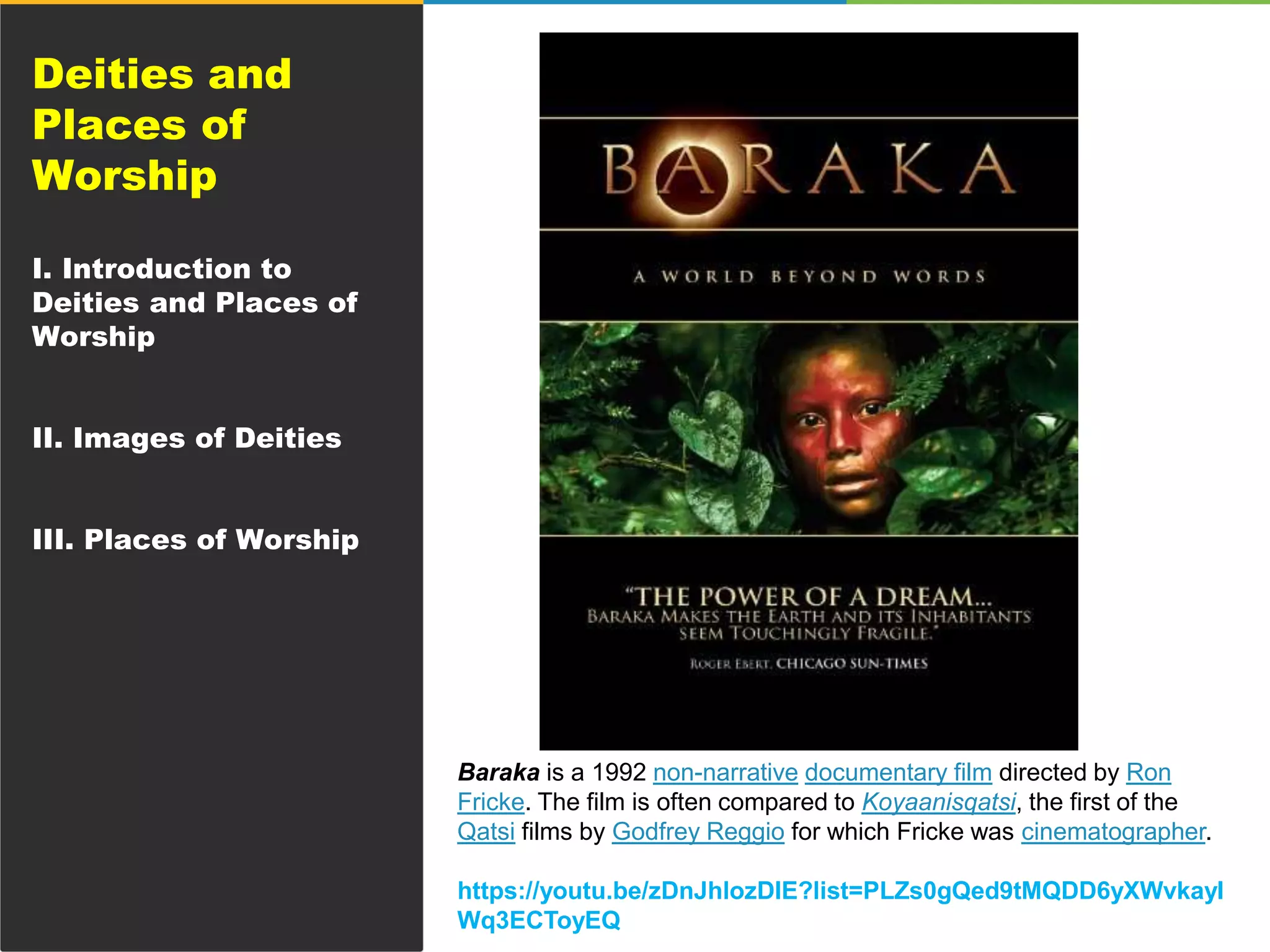
Baraka is a 1992 non-narrative documentary film directed by Ron
Fricke. The film is often compared to Koyaanisqatsi, the first of the
Qatsi films by Godfrey Reggio for which Fricke was cinematographer.
https://youtu.be/zDnJhlozDIE?list=PLZs0gQed9tMQDD6yXWvkayI
Wq3ECToyEQ
Deities and
Places of
Worship
Introduction to Deities and
Places of Worship
Images of Deities
Places of Worship
Introduction to Deities and Places of Worship
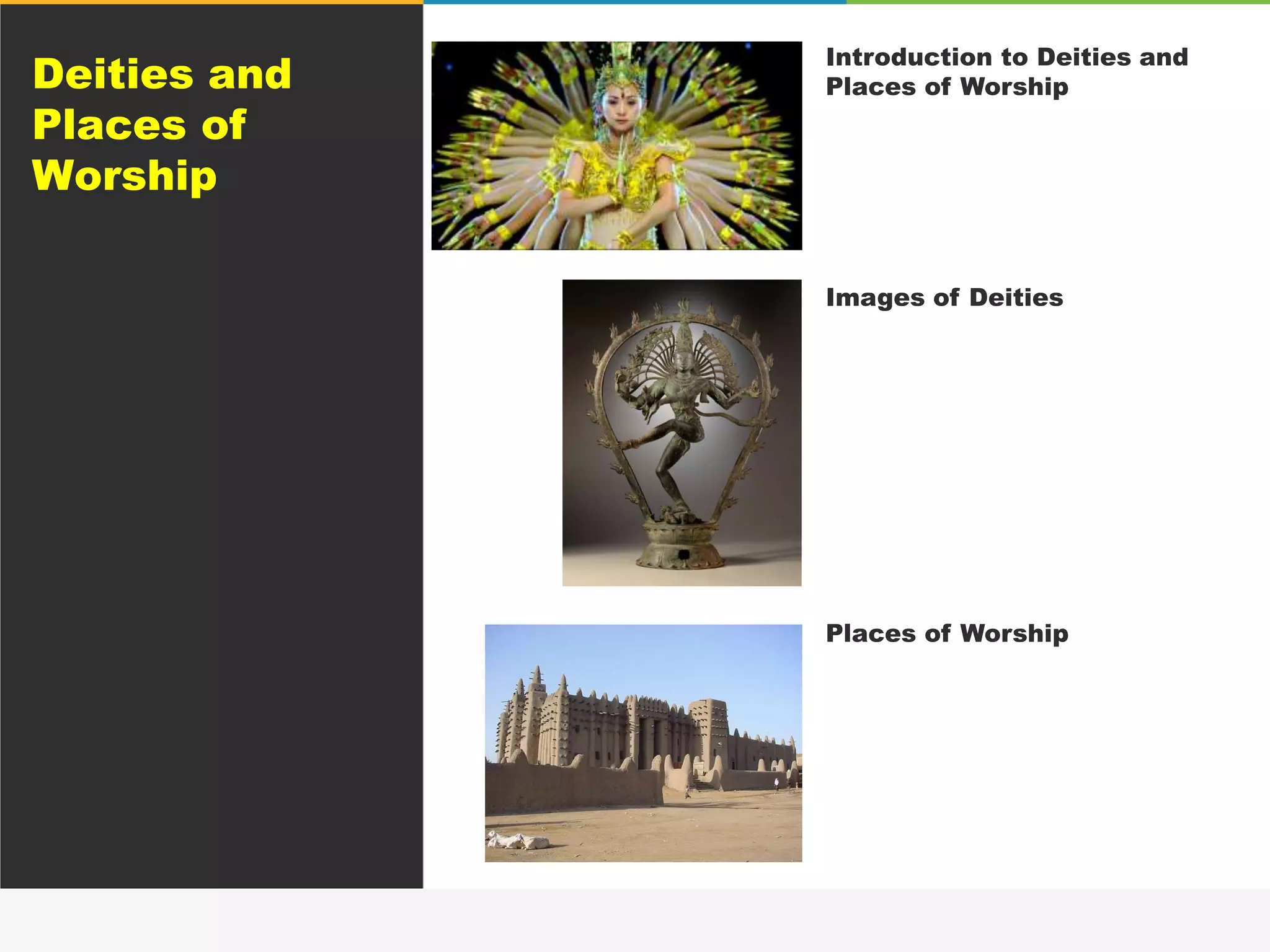
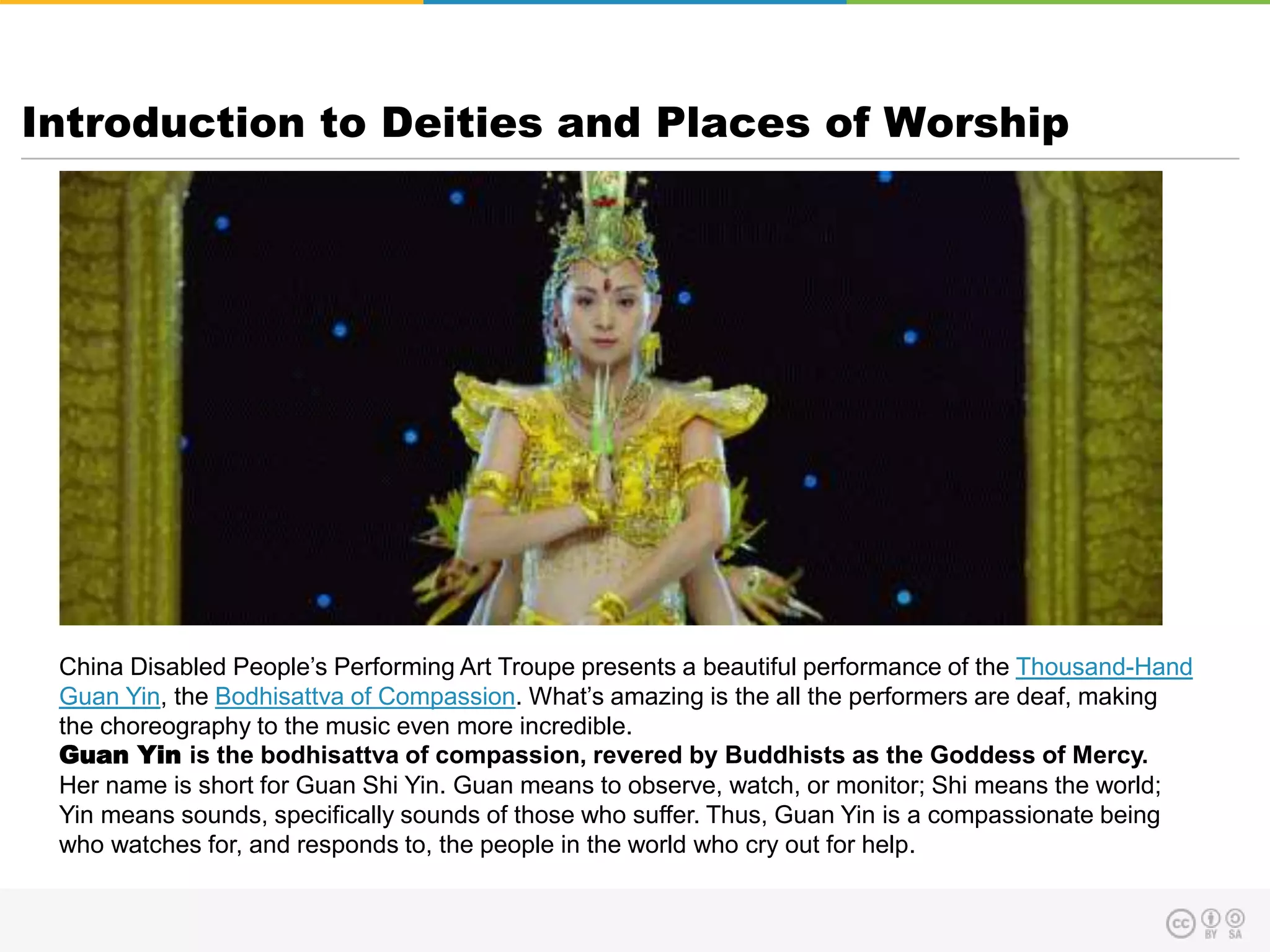
China Disabled People’s Performing Art Troupe presents a beautiful performance of the Thousand-Hand
Guan Yin, the Bodhisattva of Compassion. What’s amazing is the all the performers are deaf, making
the choreography to the music even more incredible.
Guan Yin is the bodhisattva of compassion, revered by Buddhists as the Goddess of Mercy.
Her name is short for Guan Shi Yin. Guan means to observe, watch, or monitor; Shi means the world;
Yin means sounds, specifically sounds of those who suffer. Thus, Guan Yin is a compassionate being
who watches for, and responds to, the people in the world who cry out for help.
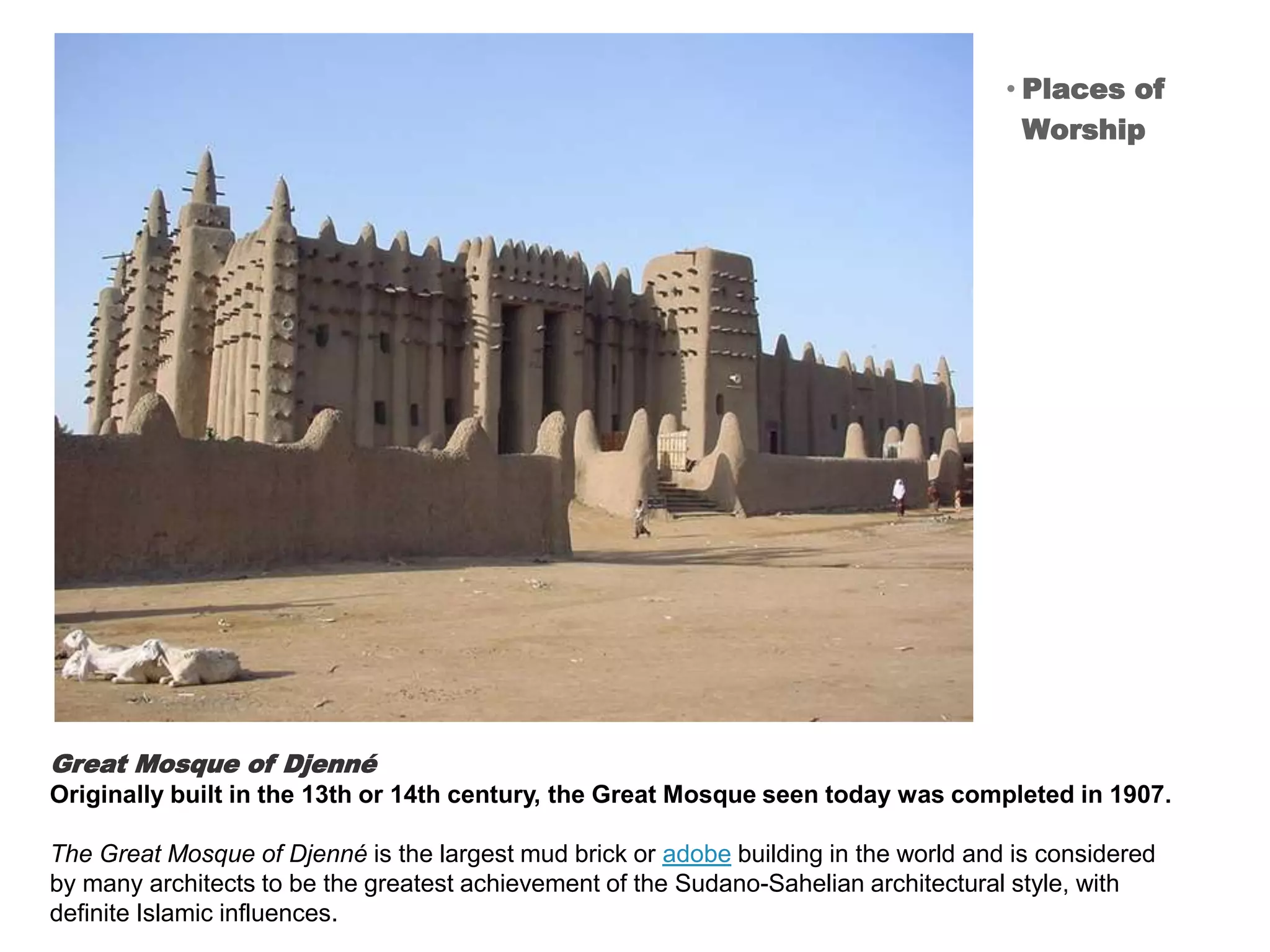
Great Mosque of Djenné
Originally built in the 13th or 14th century, the Great Mosque seen today was completed in 1907.
The Great Mosque of Djenné is the largest mud brick or adobe building in the world and is considered
by many architects to be the greatest achievement of the Sudano-Sahelian architectural style, with
definite Islamic influences.
• Places of
Worship
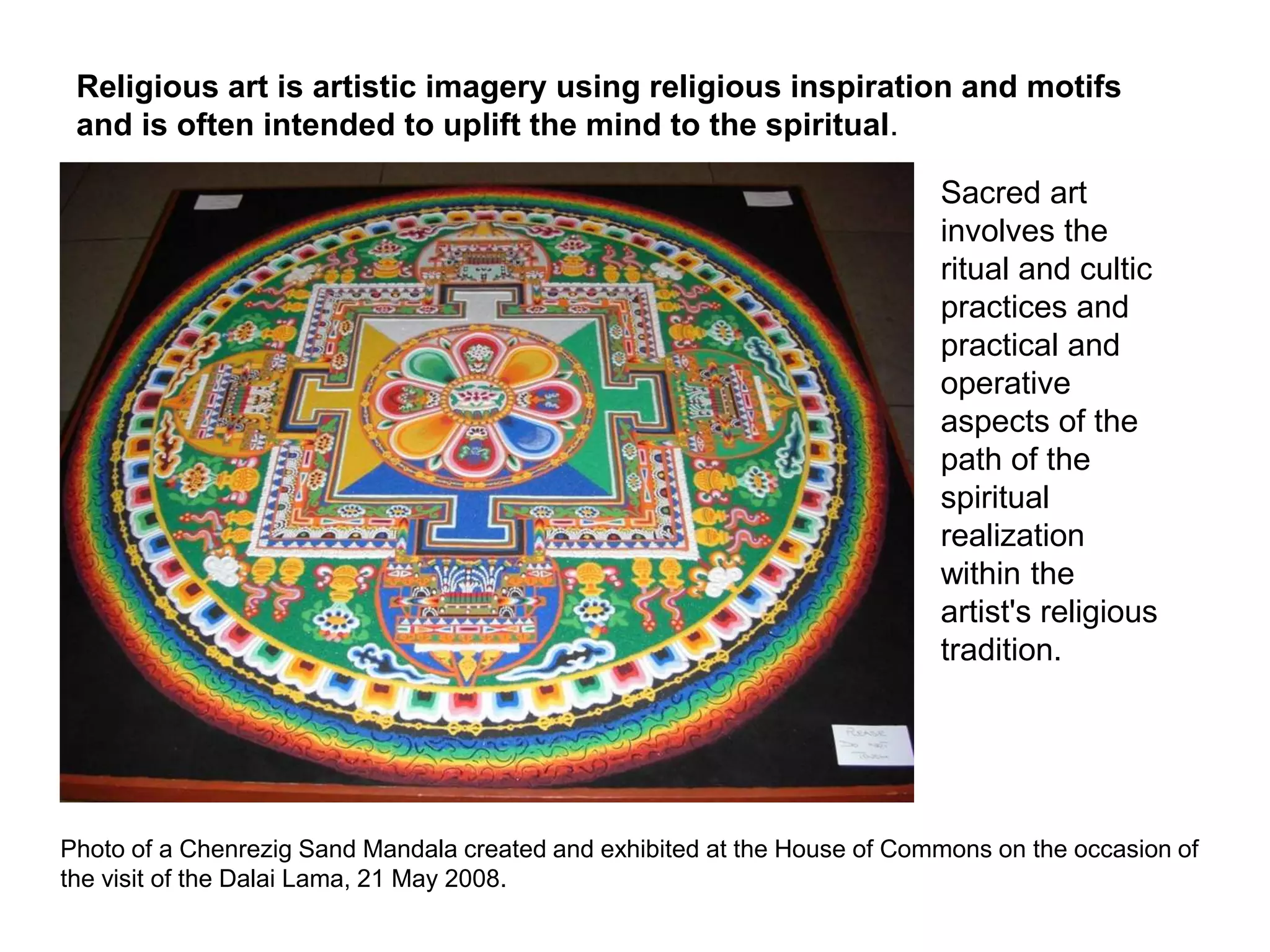
Religious art is artistic imagery using religious inspiration and motifs
and is often intended to uplift the mind to the spiritual.
Sacred art
involves the
ritual and cultic
practices and
practical and
operative
aspects of the
path of the
spiritual
realization
within the
artist's religious
tradition.
Photo of a Chenrezig Sand Mandala created and exhibited at the House of Commons on the occasion of
the visit of the Dalai Lama, 21 May 2008.
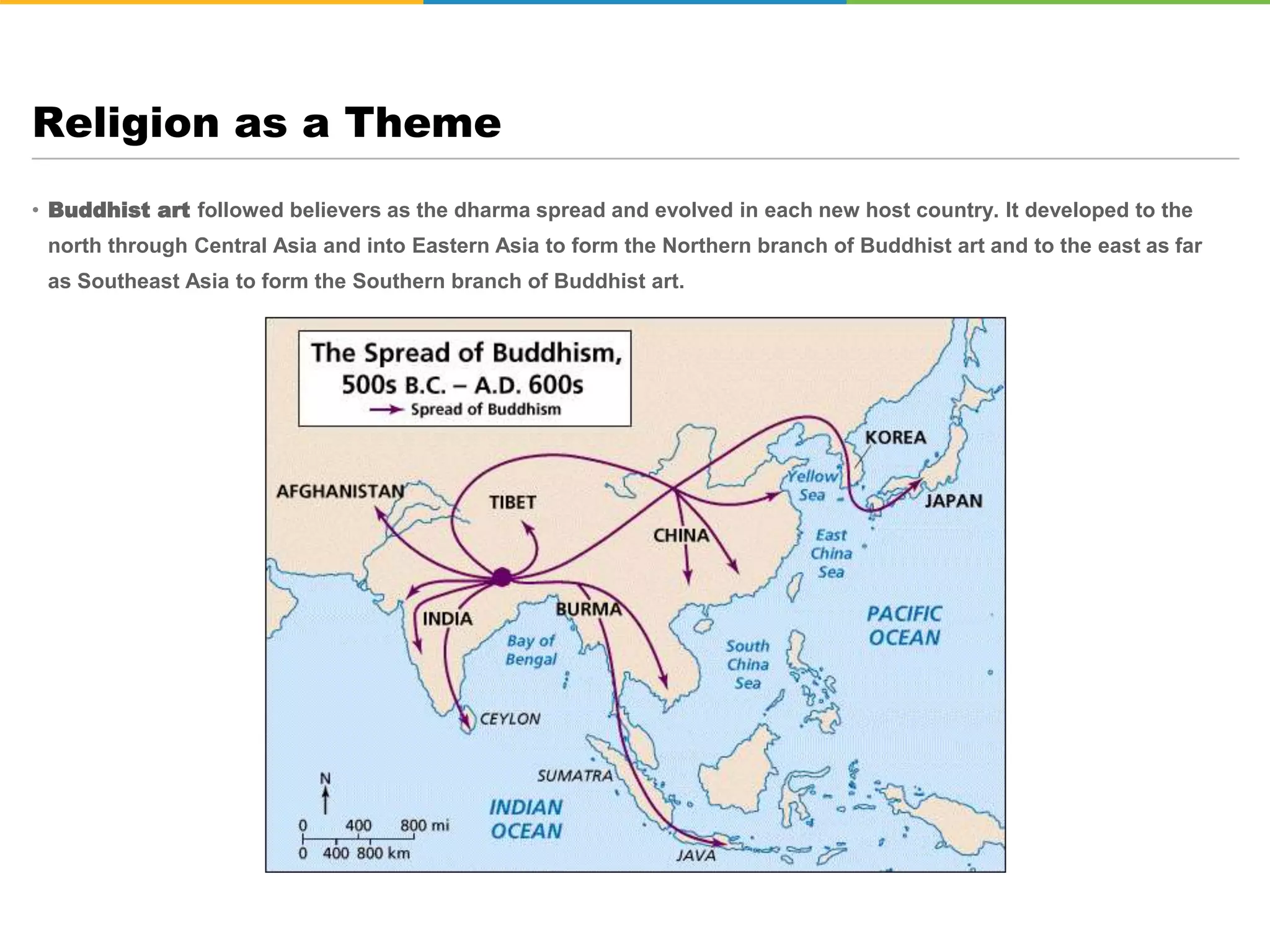
• Buddhist art followed believers as the dharma spread and evolved in each new host country. It developed to the
north through Central Asia and into Eastern Asia to form the Northern branch of Buddhist art and to the east as far
as Southeast Asia to form the Southern branch of Buddhist art.
Religion as a Theme
• In India, Buddhist art flourished and even influenced the development of Hindu art.
Religion as a Theme
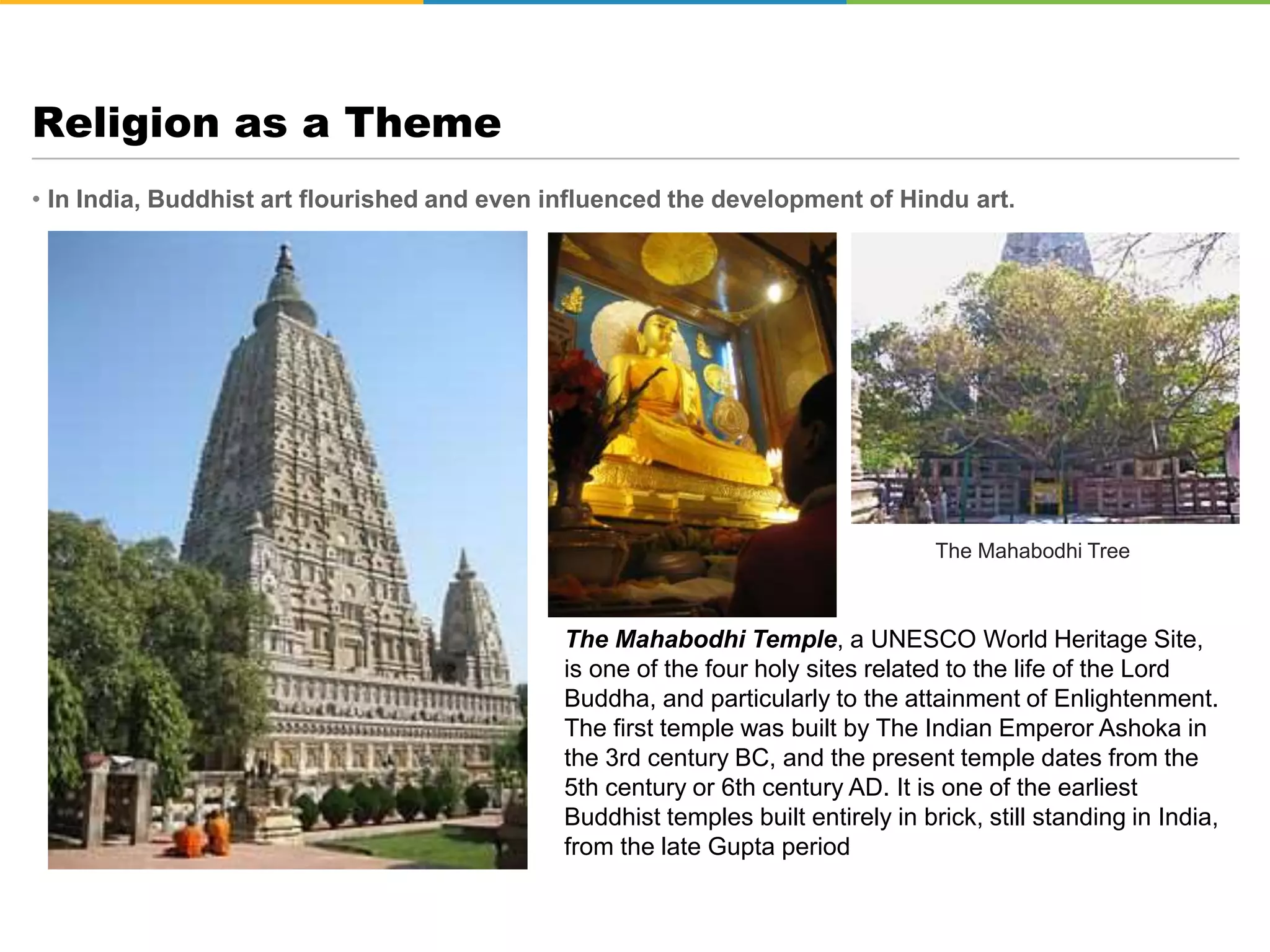
The Mahabodhi Temple, a UNESCO World Heritage Site,
is one of the four holy sites related to the life of the Lord
Buddha, and particularly to the attainment of Enlightenment.
The first temple was built by The Indian Emperor Ashoka in
the 3rd century BC, and the present temple dates from the
5th century or 6th century AD. It is one of the earliest
Buddhist temples built entirely in brick, still standing in India,
from the late Gupta period
The Mahabodhi Tree
• In India, Buddhist art flourished and even influenced the development of Hindu art.
Religion as a Theme
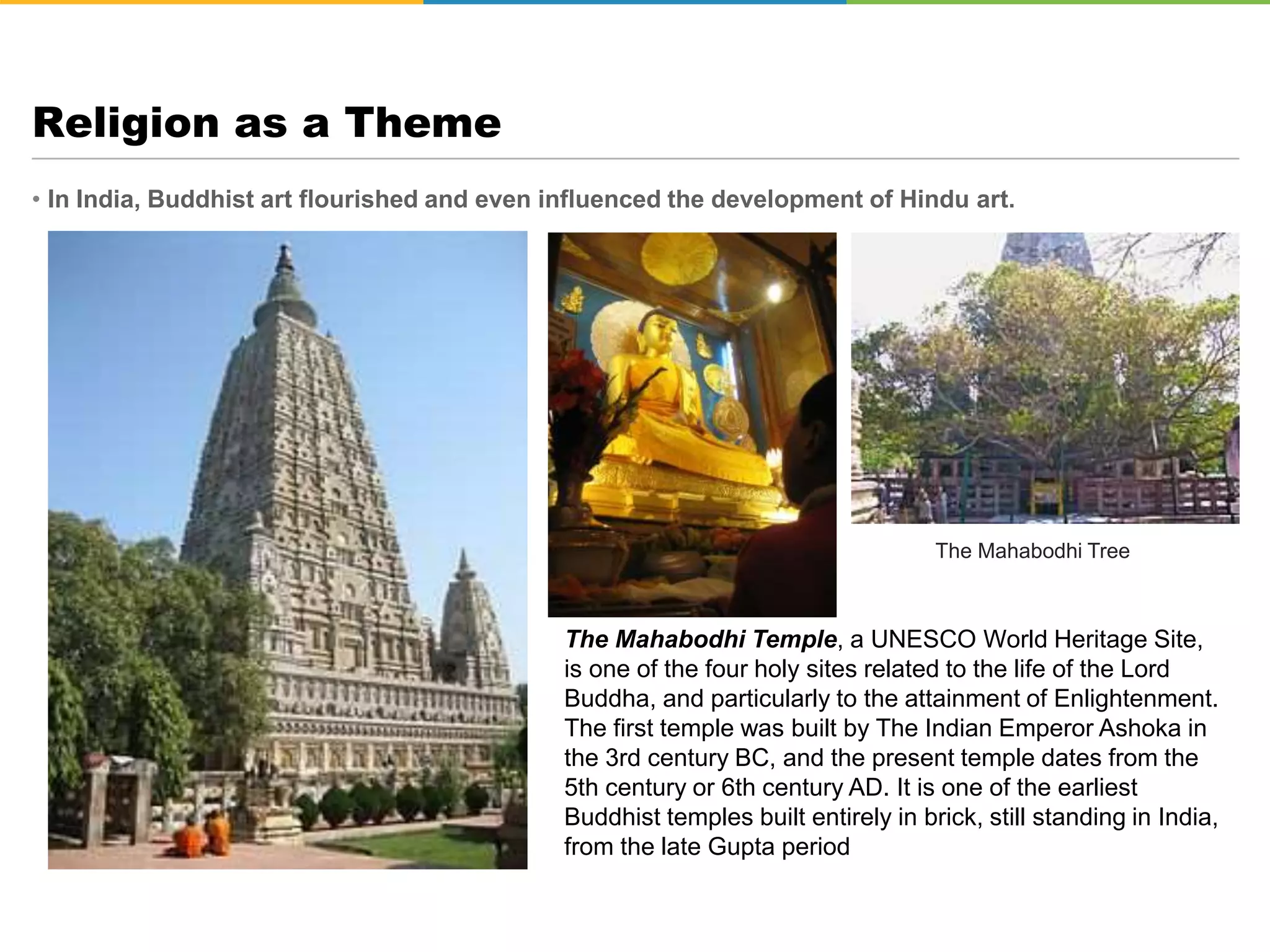
The Mahabodhi Temple, a UNESCO World Heritage Site,
is one of the four holy sites related to the life of the Lord
Buddha, and particularly to the attainment of Enlightenment.
The first temple was built by The Indian Emperor Ashoka in
the 3rd century BC, and the present temple dates from the
5th century or 6th century AD. It is one of the earliest
Buddhist temples built entirely in brick, still standing in India,
from the late Gupta period
The Mahabodhi Tree
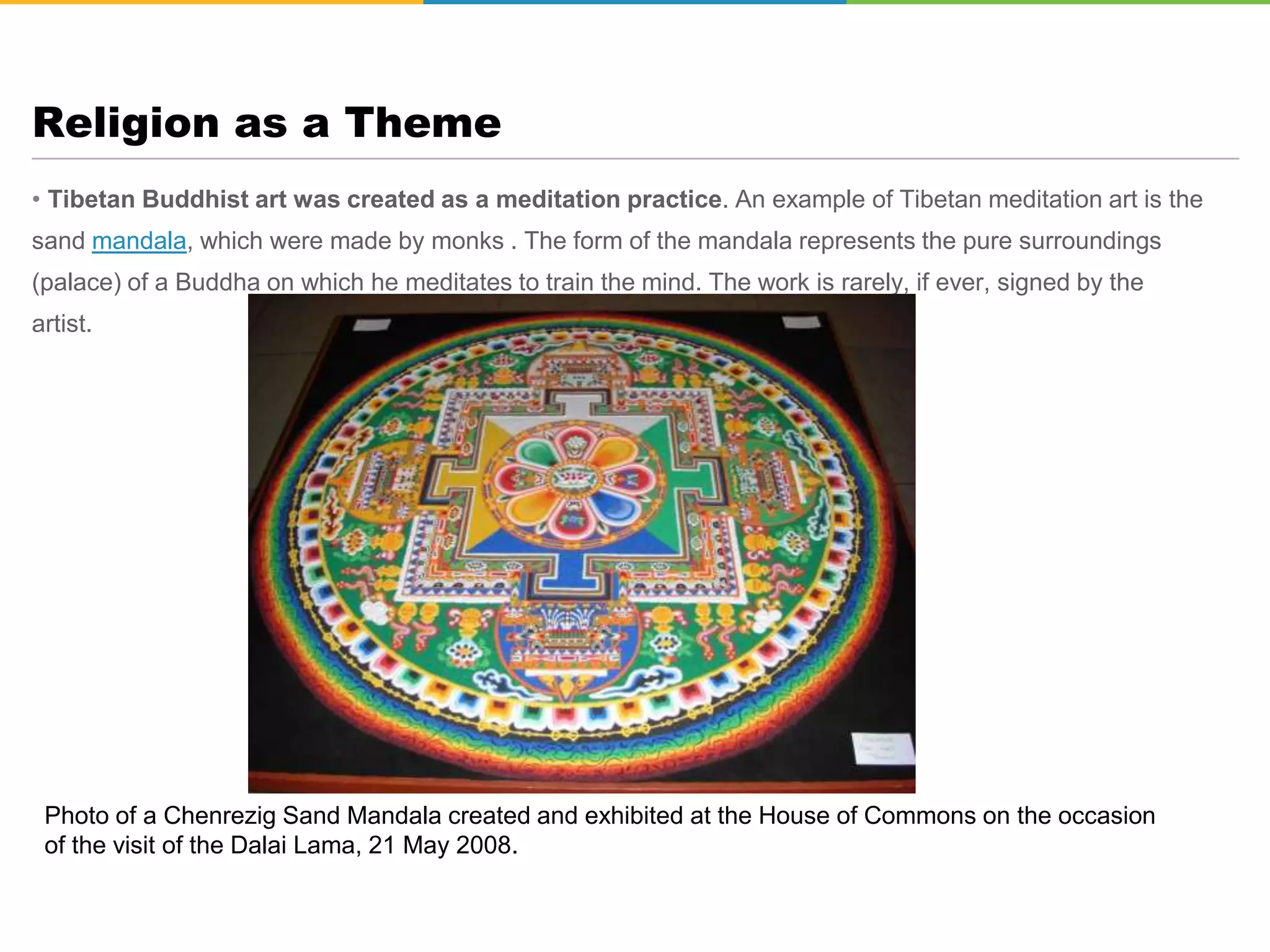
• Tibetan Buddhist art was created as a meditation practice. An example of Tibetan meditation art is the
sand mandala, which were made by monks . The form of the mandala represents the pure surroundings
(palace) of a Buddha on which he meditates to train the mind. The work is rarely, if ever, signed by the
artist.
Religion as a Theme
Photo of a Chenrezig Sand Mandala created and exhibited at the House of Commons on the occasion
of the visit of the Dalai Lama, 21 May 2008.
• Tibetan sand mandala, made by monks . The form of the mandala represents the pure surroundings
(palace) of a Buddha on which he meditates to train the mind. The work is rarely, if ever, signed by the
artist.
Religion as a Theme
Stop Motion Timelapse of Tibetan Monks Creating a Sand Mandala at Seret & Sons Gallery
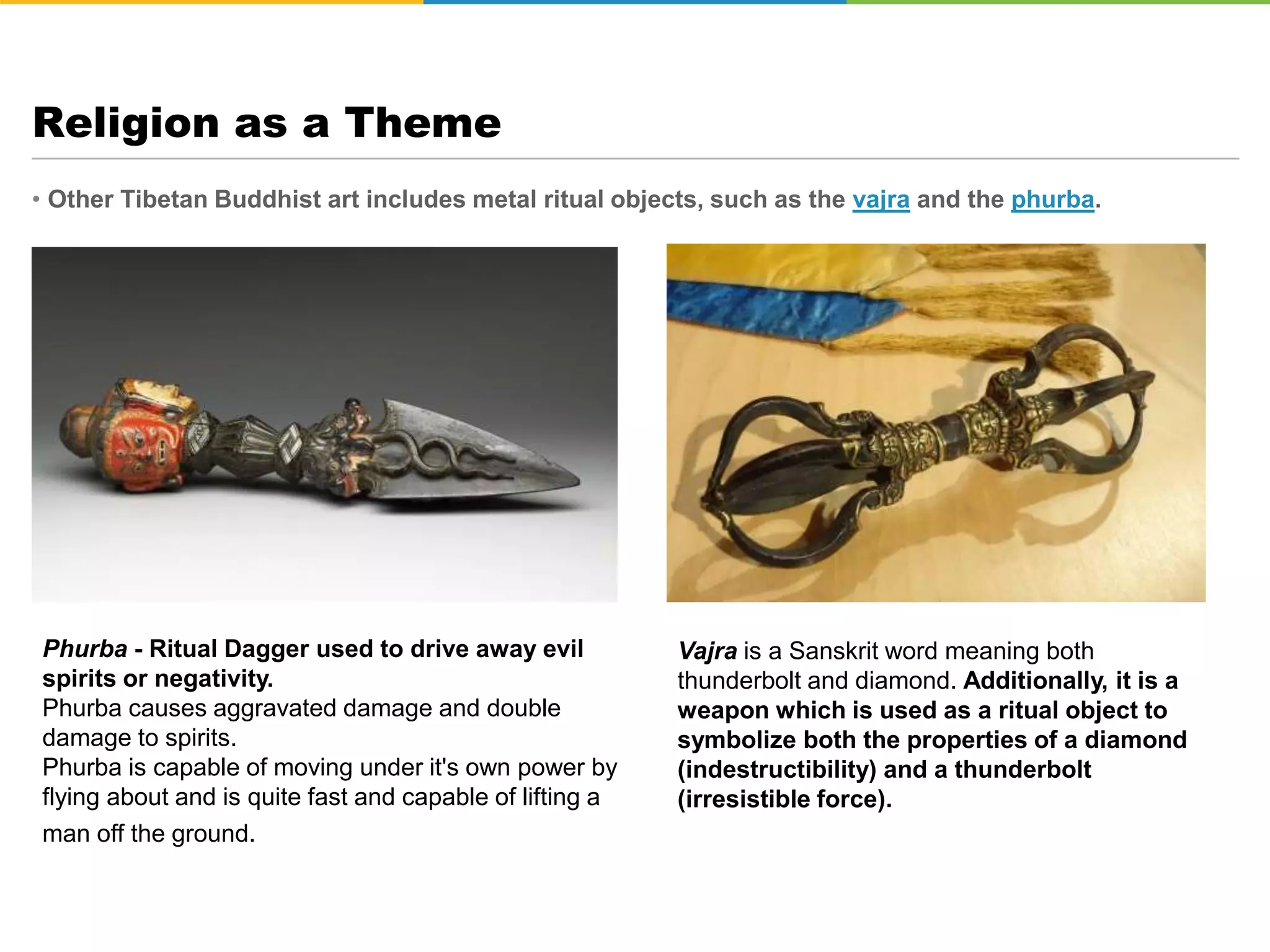
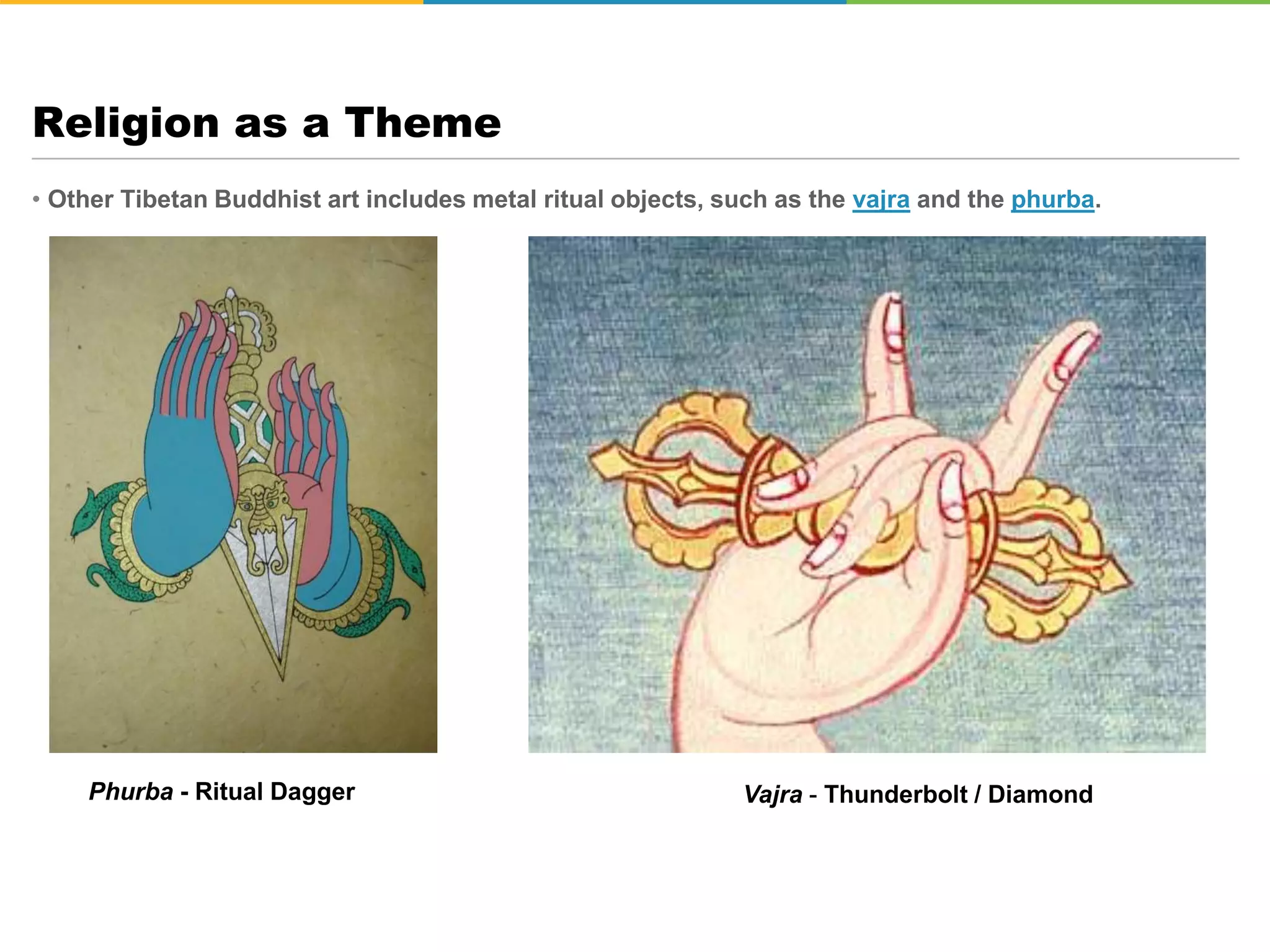
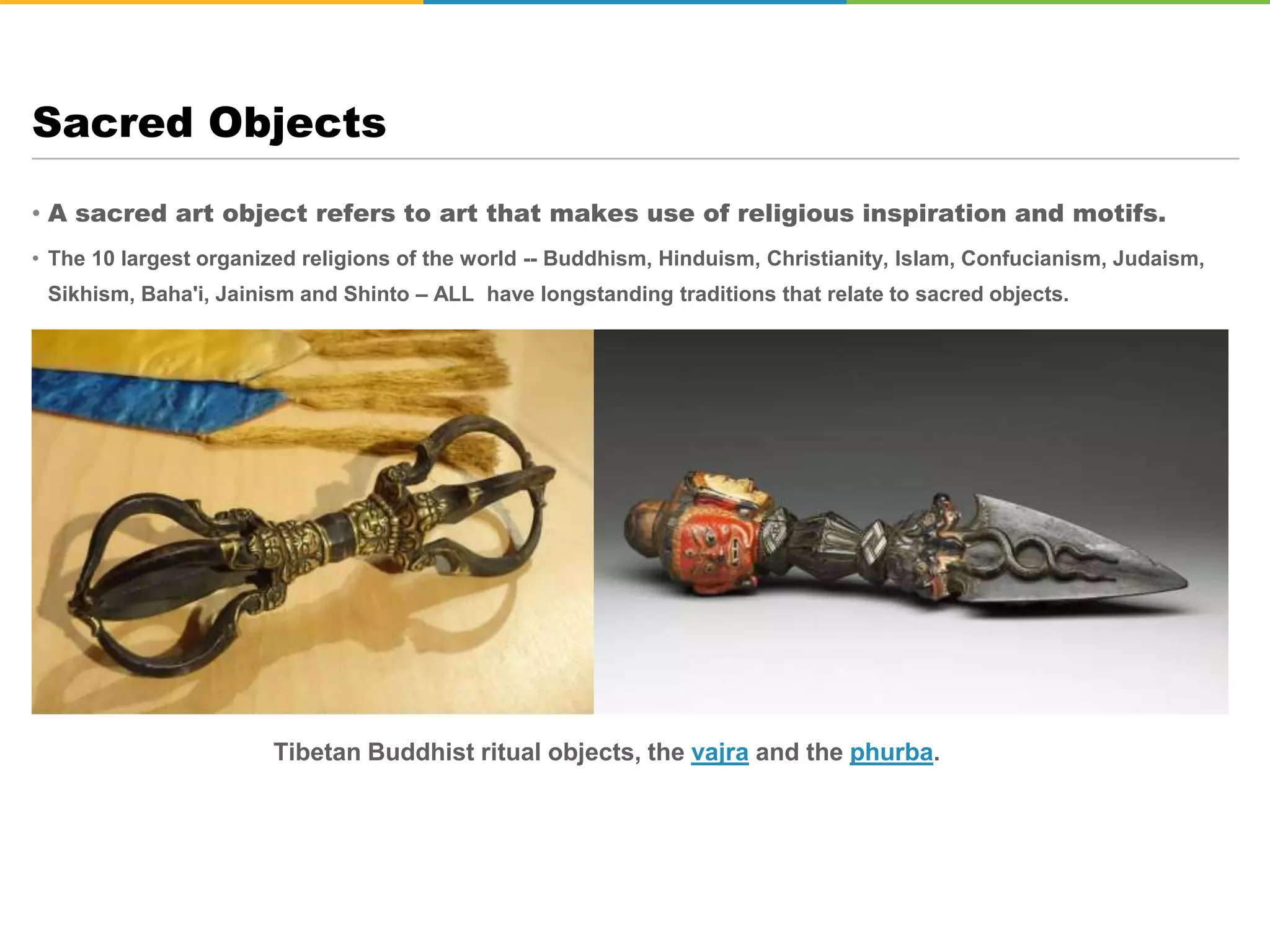
• Other Tibetan Buddhist art includes metal ritual objects, such as the vajra and the phurba.
Religion as a Theme
Phurba - Ritual Dagger used to drive away evil
spirits or negativity.
Phurba causes aggravated damage and double
damage to spirits.
Phurba is capable of moving under it's own power by
flying about and is quite fast and capable of lifting a
man off the ground.
Vajra is a Sanskrit word meaning both
thunderbolt and diamond. Additionally, it is a
weapon which is used as a ritual object to
symbolize both the properties of a diamond
(indestructibility) and a thunderbolt
(irresistible force).
• Other Tibetan Buddhist art includes metal ritual objects, such as the vajra and the phurba.
Religion as a Theme
Phurba - Ritual Dagger Vajra - Thunderbolt / Diamond
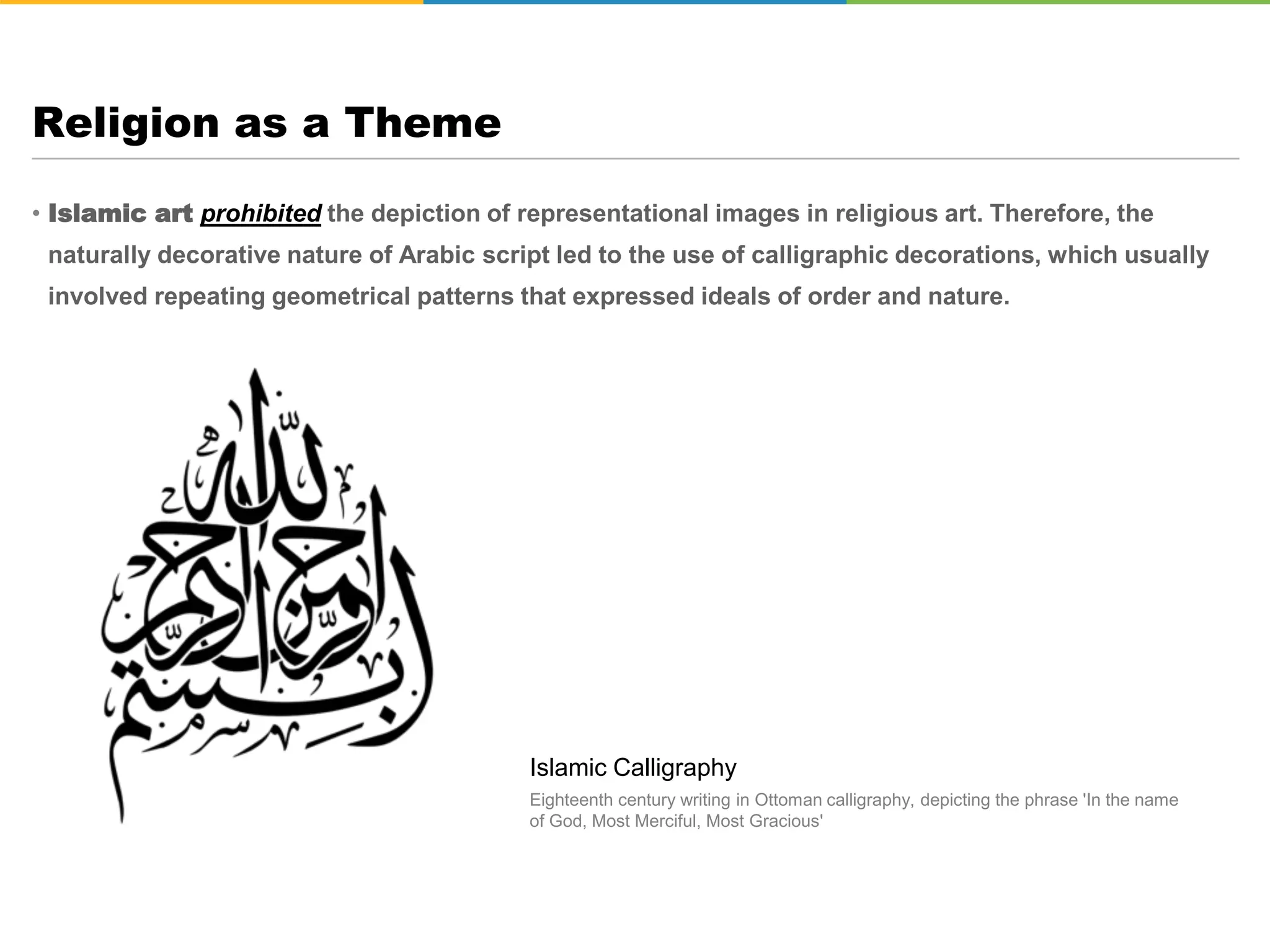
• Islamic art prohibited the depiction of representational images in religious art. Therefore, the
naturally decorative nature of Arabic script led to the use of calligraphic decorations, which usually
involved repeating geometrical patterns that expressed ideals of order and nature.
Religion as a Theme
Islamic Calligraphy
Eighteenth century writing in Ottoman calligraphy, depicting the phrase 'In the name
of God, Most Merciful, Most Gracious'
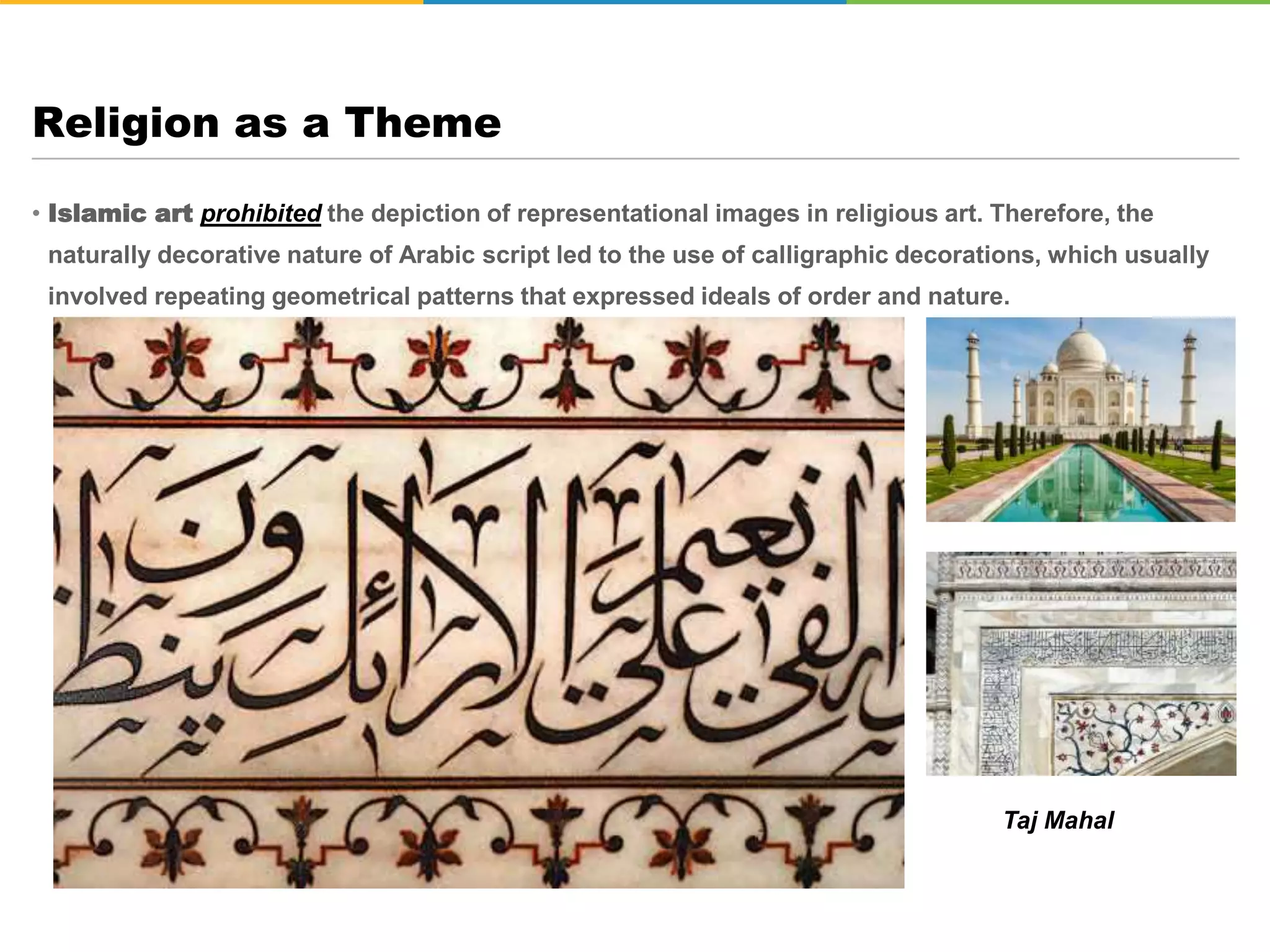
• Islamic art prohibited the depiction of representational images in religious art. Therefore, the
naturally decorative nature of Arabic script led to the use of calligraphic decorations, which usually
involved repeating geometrical patterns that expressed ideals of order and nature.
Religion as a Theme
Taj Mahal
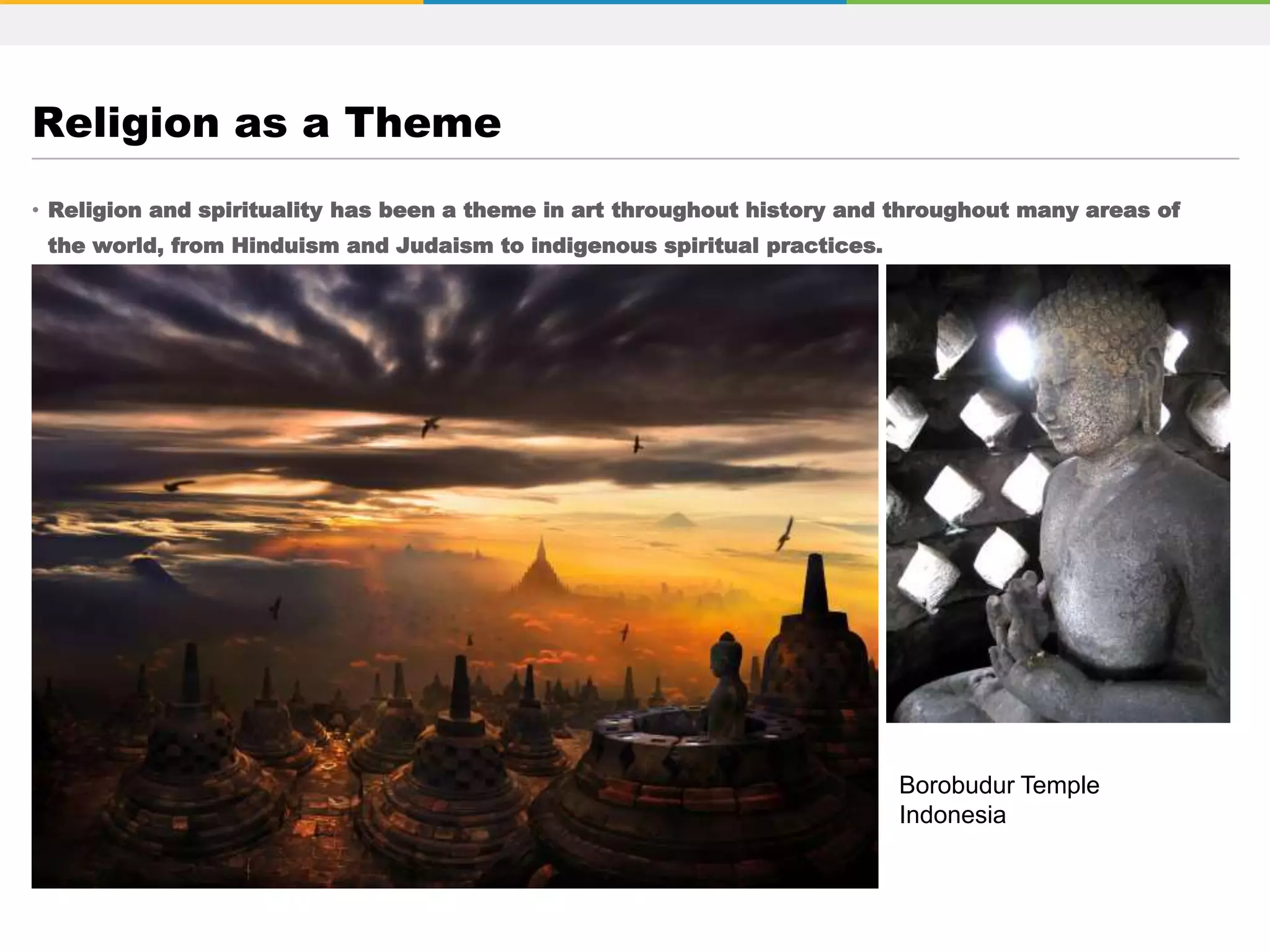
• Religion and spirituality has been a theme in art throughout history and throughout many areas of
the world, from Hinduism and Judaism to indigenous spiritual practices.
Religion as a Theme
Borobudur Temple
Indonesia
• Animism
• Polytheism
• Pantheism
• Monotheism
• Humans and Their Deities
• Ceremonies
• Offerings
• Sacrifices
• Prayers
• The Cosmos
Images of Deities
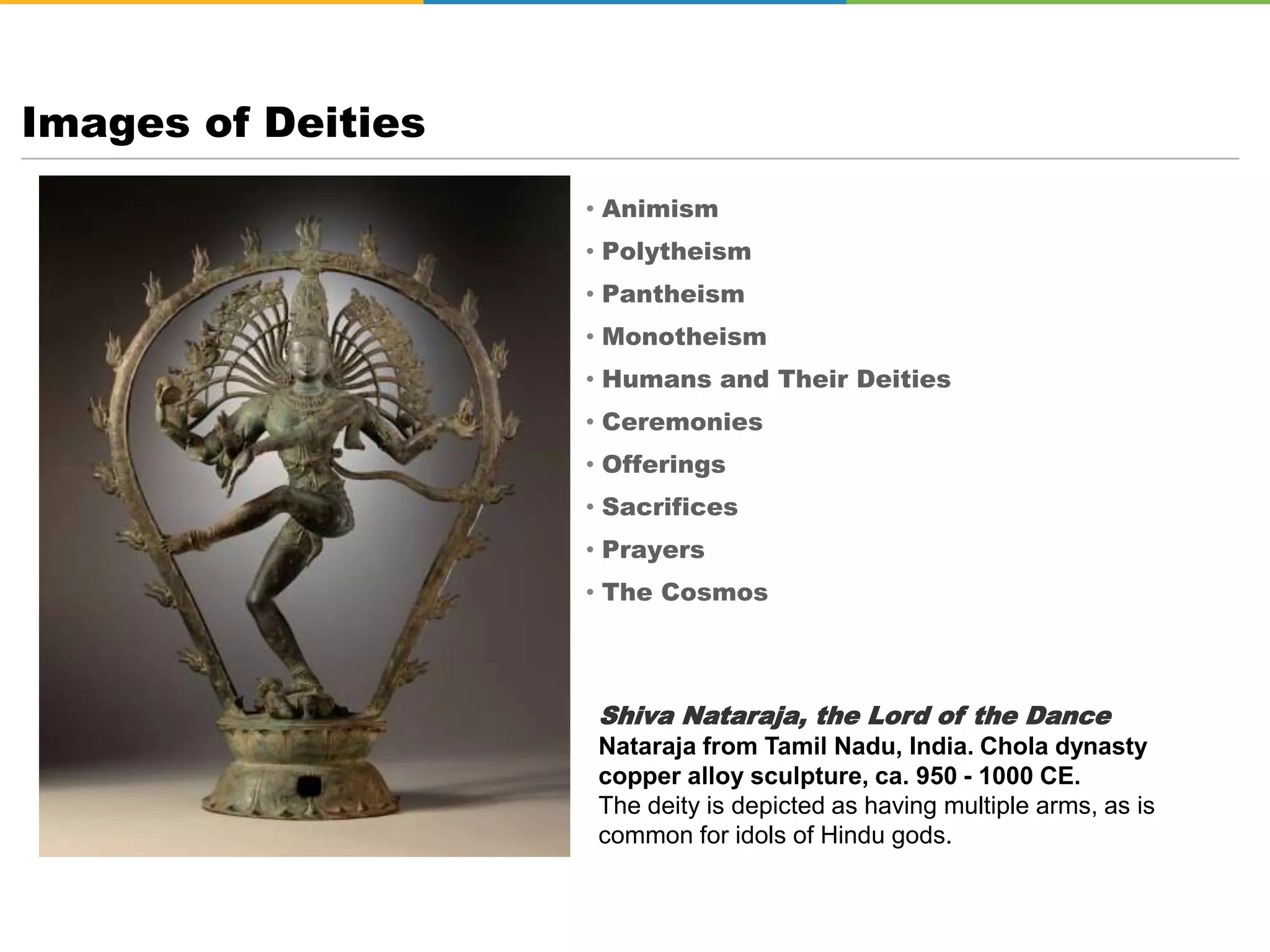
Shiva Nataraja, the Lord of the Dance
Nataraja from Tamil Nadu, India. Chola dynasty
copper alloy sculpture, ca. 950 - 1000 CE.
The deity is depicted as having multiple arms, as is
common for idols of Hindu gods.
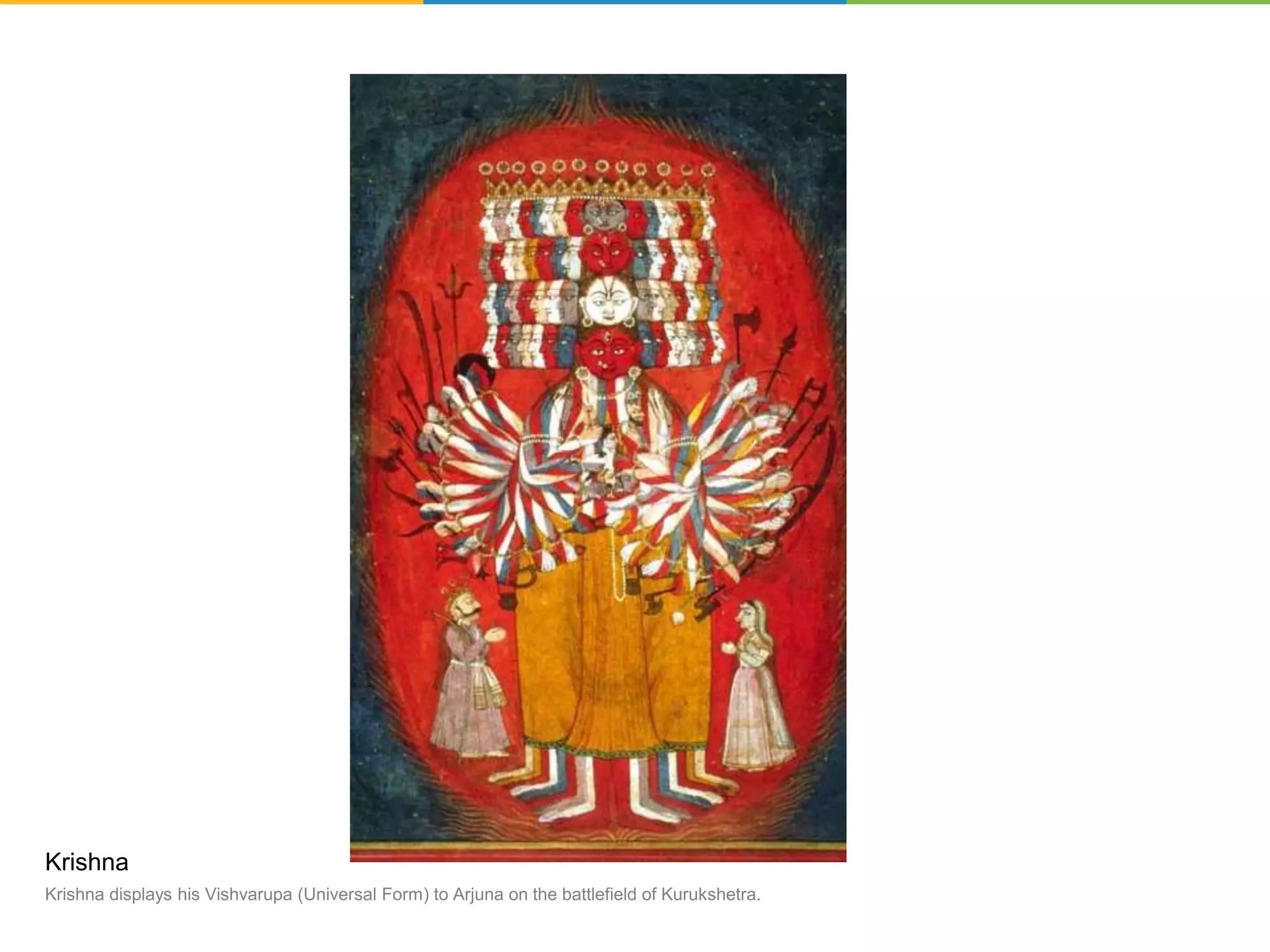
Krishna
Krishna displays his Vishvarupa (Universal Form) to Arjuna on the battlefield of Kurukshetra.
• Reverence for the sacred in Nature.
• Animism is the religious belief attributing a spiritual essence to natural phenomena, including
animals, plants, and inanimate objects
Animism
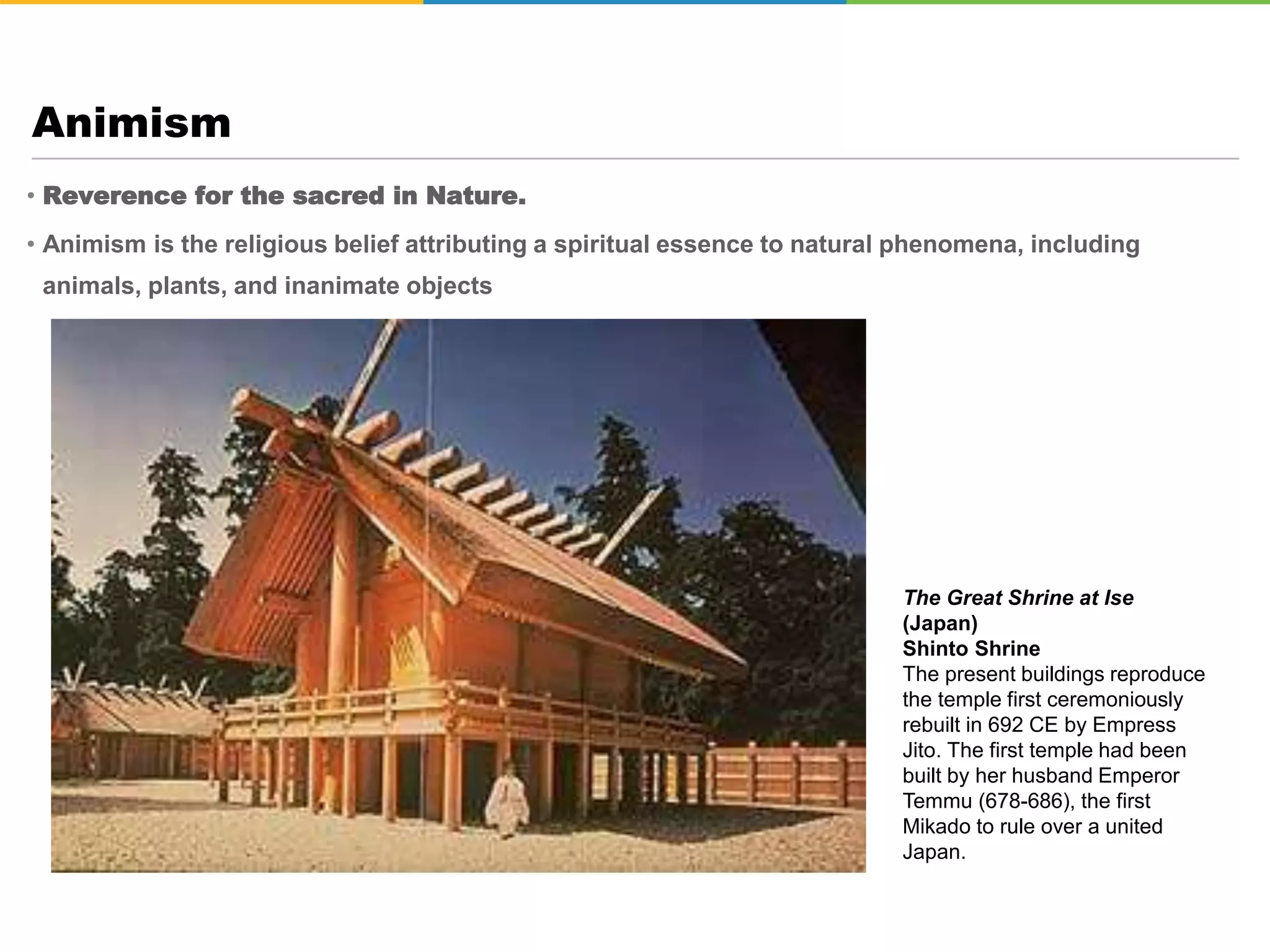
The Great Shrine at Ise
(Japan)
Shinto Shrine
The present buildings reproduce
the temple first ceremoniously
rebuilt in 692 CE by Empress
Jito. The first temple had been
built by her husband Emperor
Temmu (678-686), the first
Mikado to rule over a united
Japan.
• In terms of its features, ANIMISM is defined as a set of beliefs based on the existence of non-human spiritual
beings: that there is no separation between the spiritual and material world and souls exist not only in humans, but
also in all other entities of the natural environment.
Animism
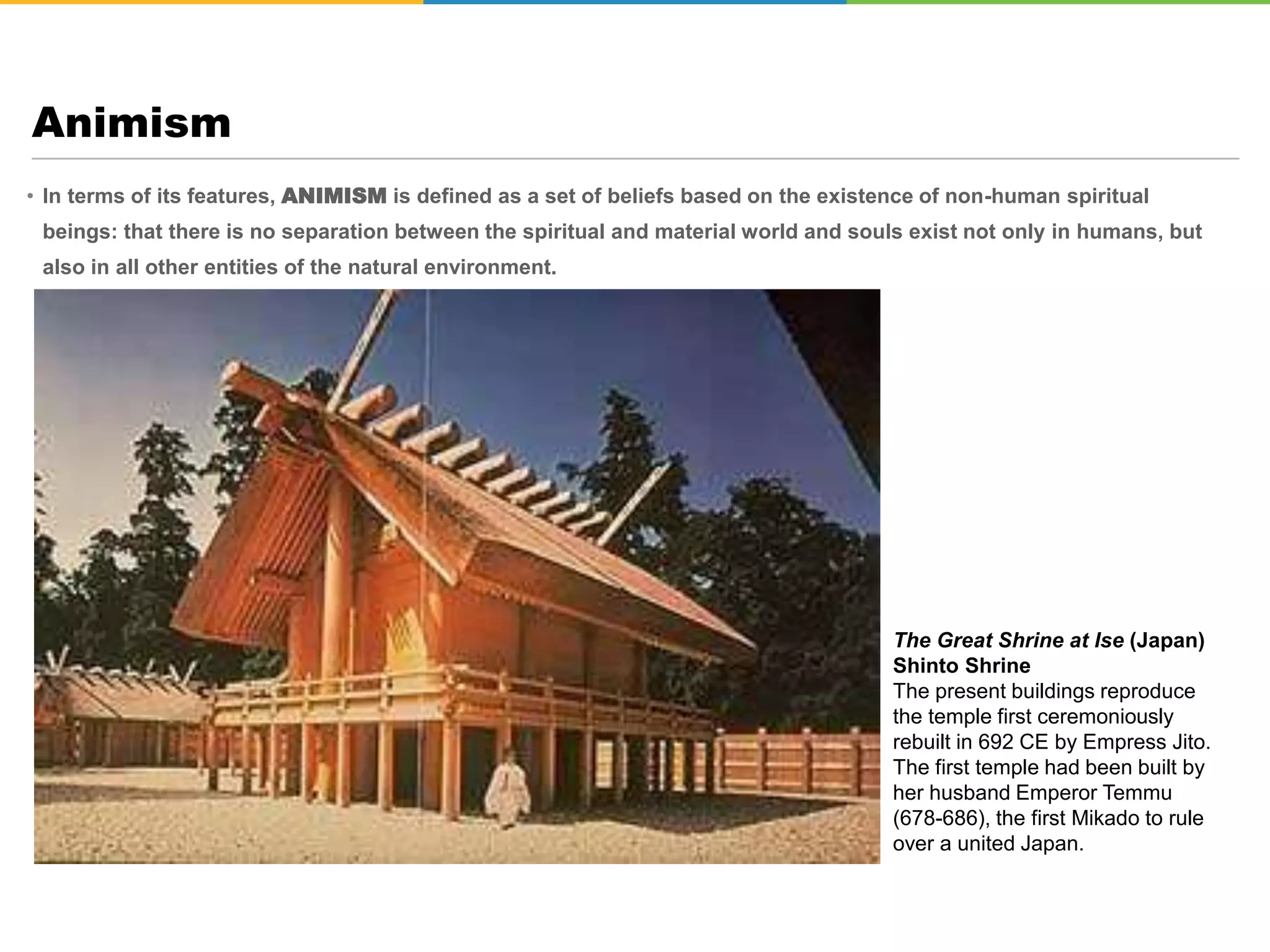
The Great Shrine at Ise (Japan)
Shinto Shrine
The present buildings reproduce
the temple first ceremoniously
rebuilt in 692 CE by Empress Jito.
The first temple had been built by
her husband Emperor Temmu
(678-686), the first Mikado to rule
over a united Japan.
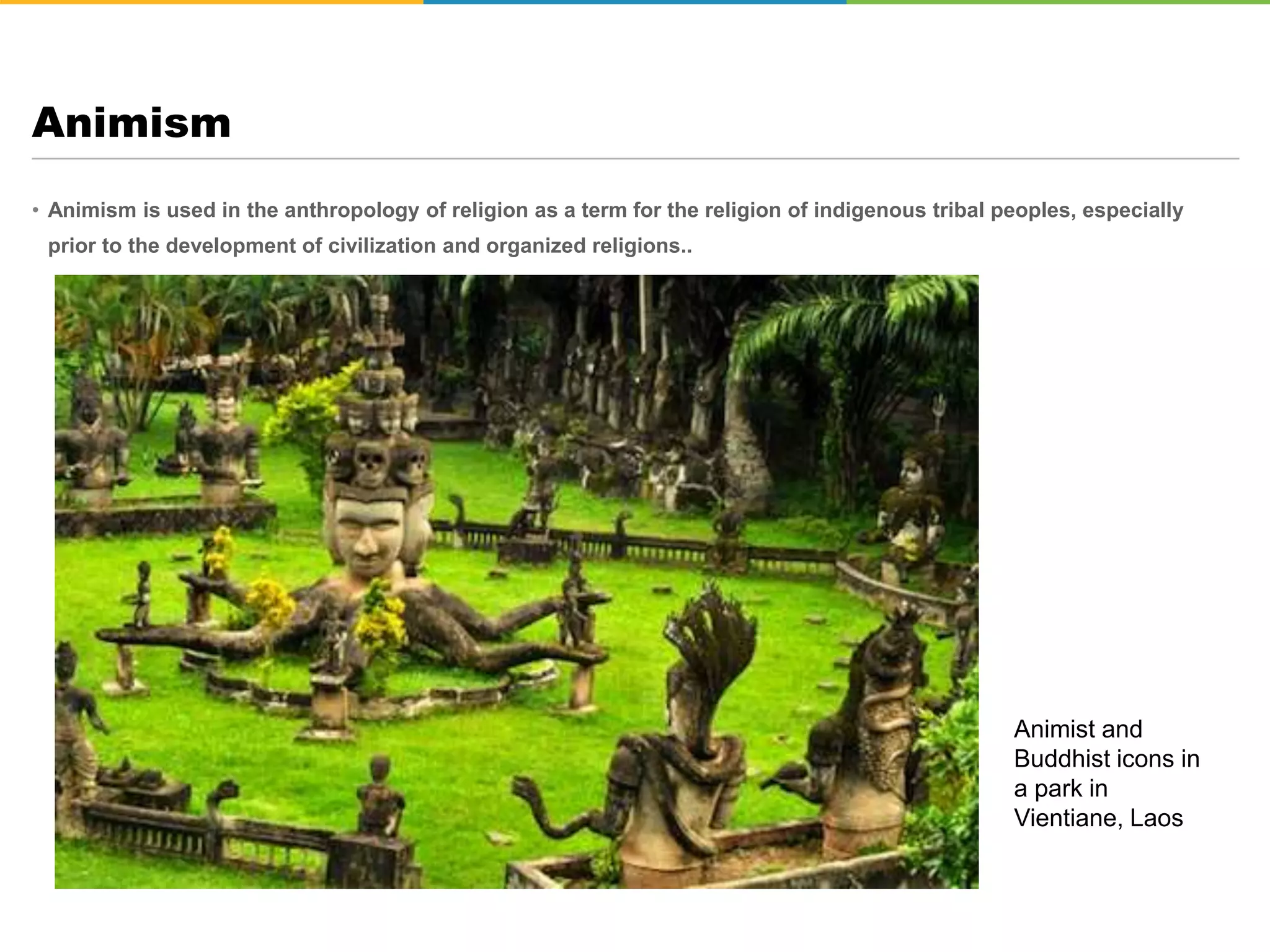
• Animism is used in the anthropology of religion as a term for the religion of indigenous tribal peoples, especially
prior to the development of civilization and organized religions..
Animism
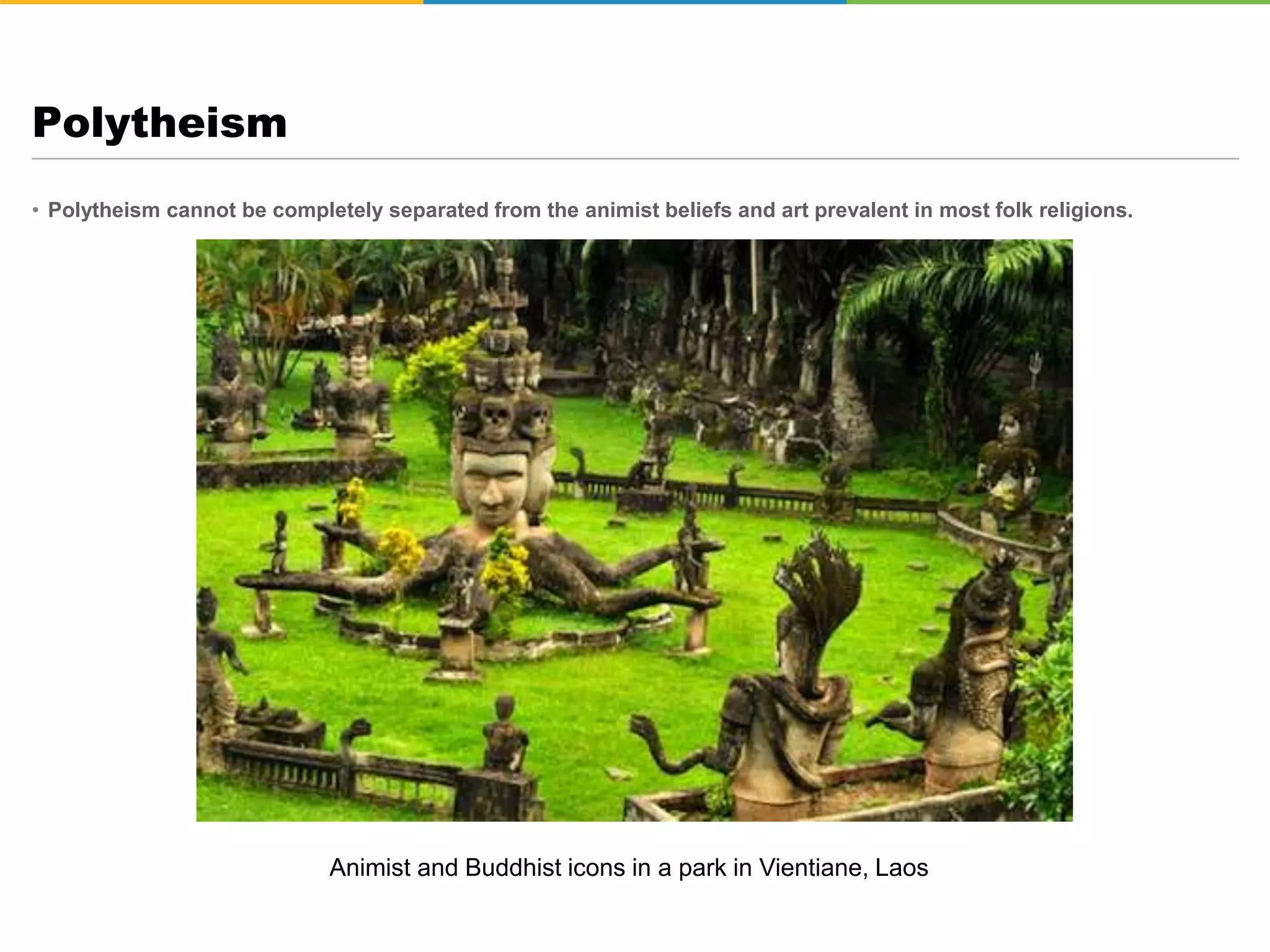
Animist and
Buddhist icons in
a park in
Vientiane, Laos
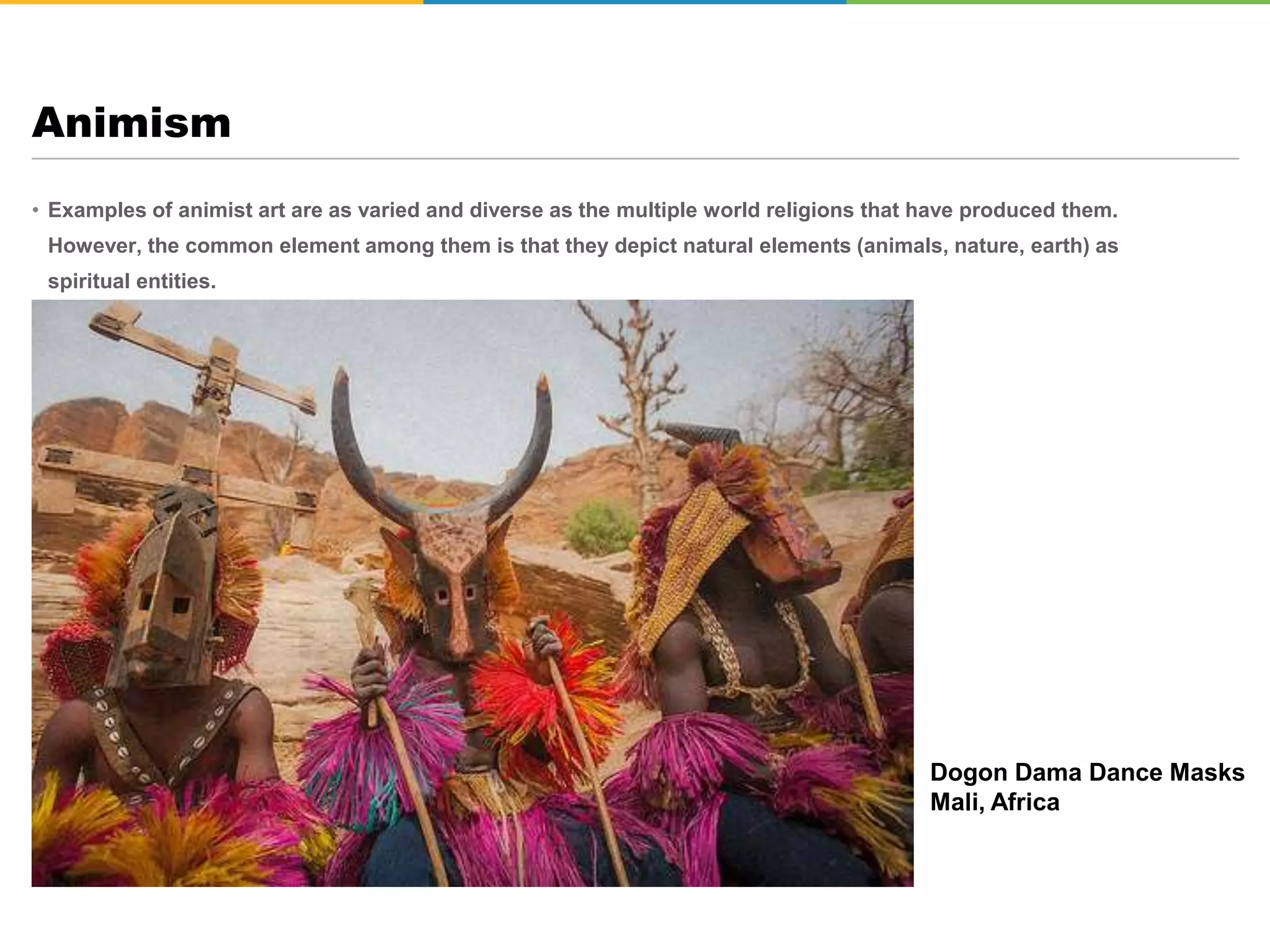
• Examples of animist art are as varied and diverse as the multiple world religions that have produced them.
However, the common element among them is that they depict natural elements (animals, nature, earth) as
spiritual entities.
Animism
Dogon Dama Dance Masks
Mali, Africa
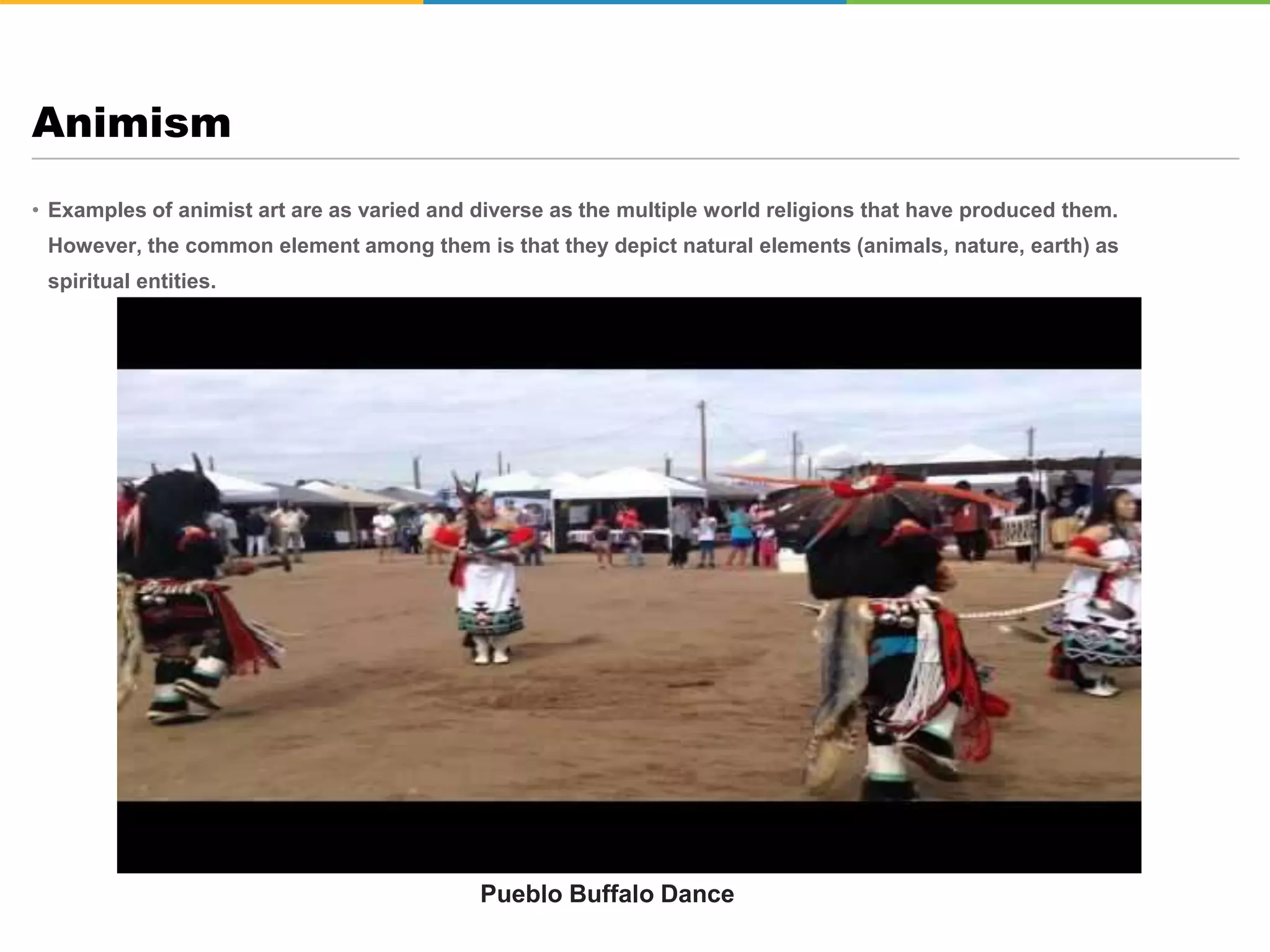
• Examples of animist art are as varied and diverse as the multiple world religions that have produced them.
However, the common element among them is that they depict natural elements (animals, nature, earth) as
spiritual entities.
Animism
Pueblo Buffalo Dance
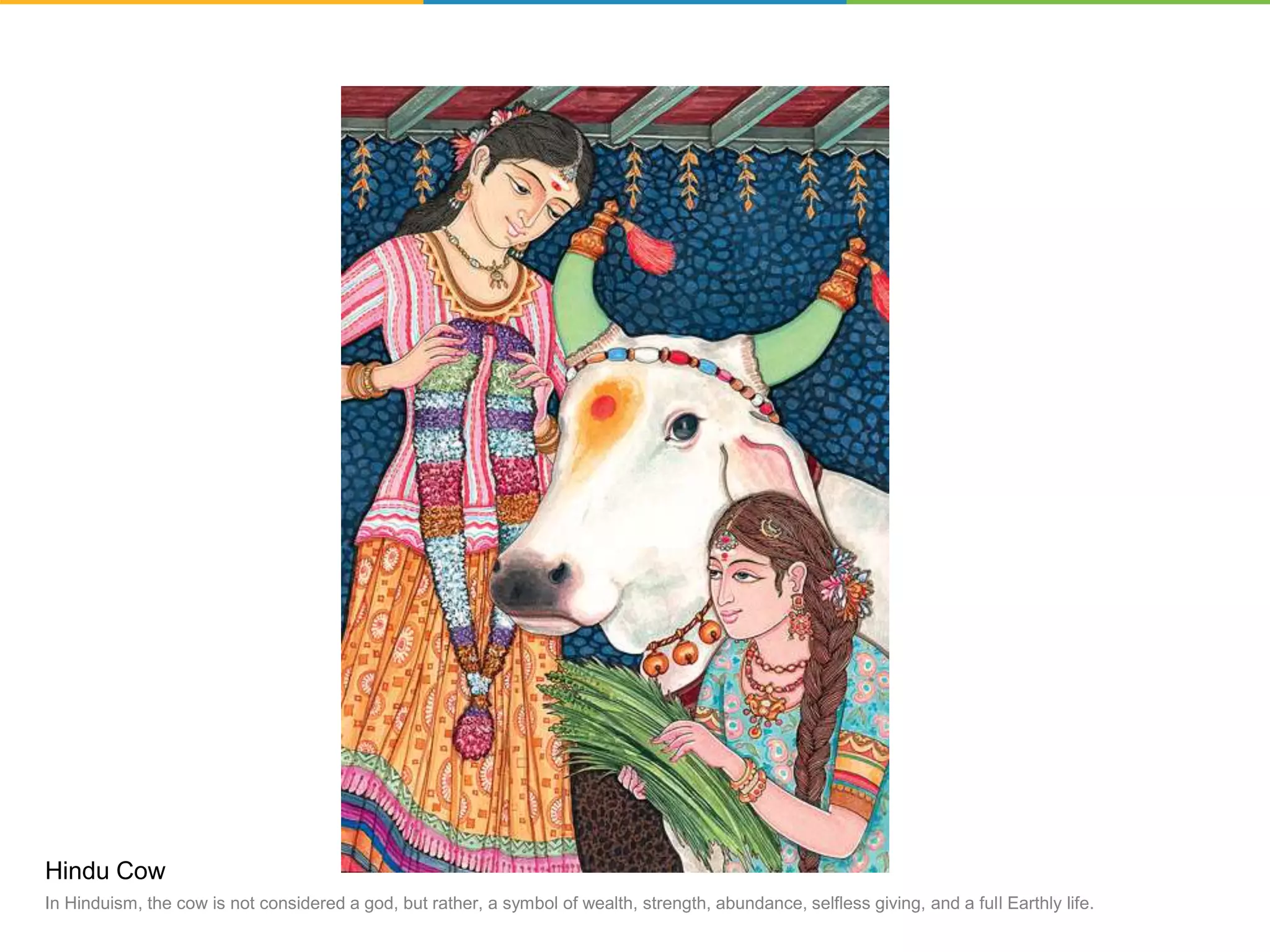
Hindu Cow
In Hinduism, the cow is not considered a god, but rather, a symbol of wealth, strength, abundance, selfless giving, and a full Earthly life.
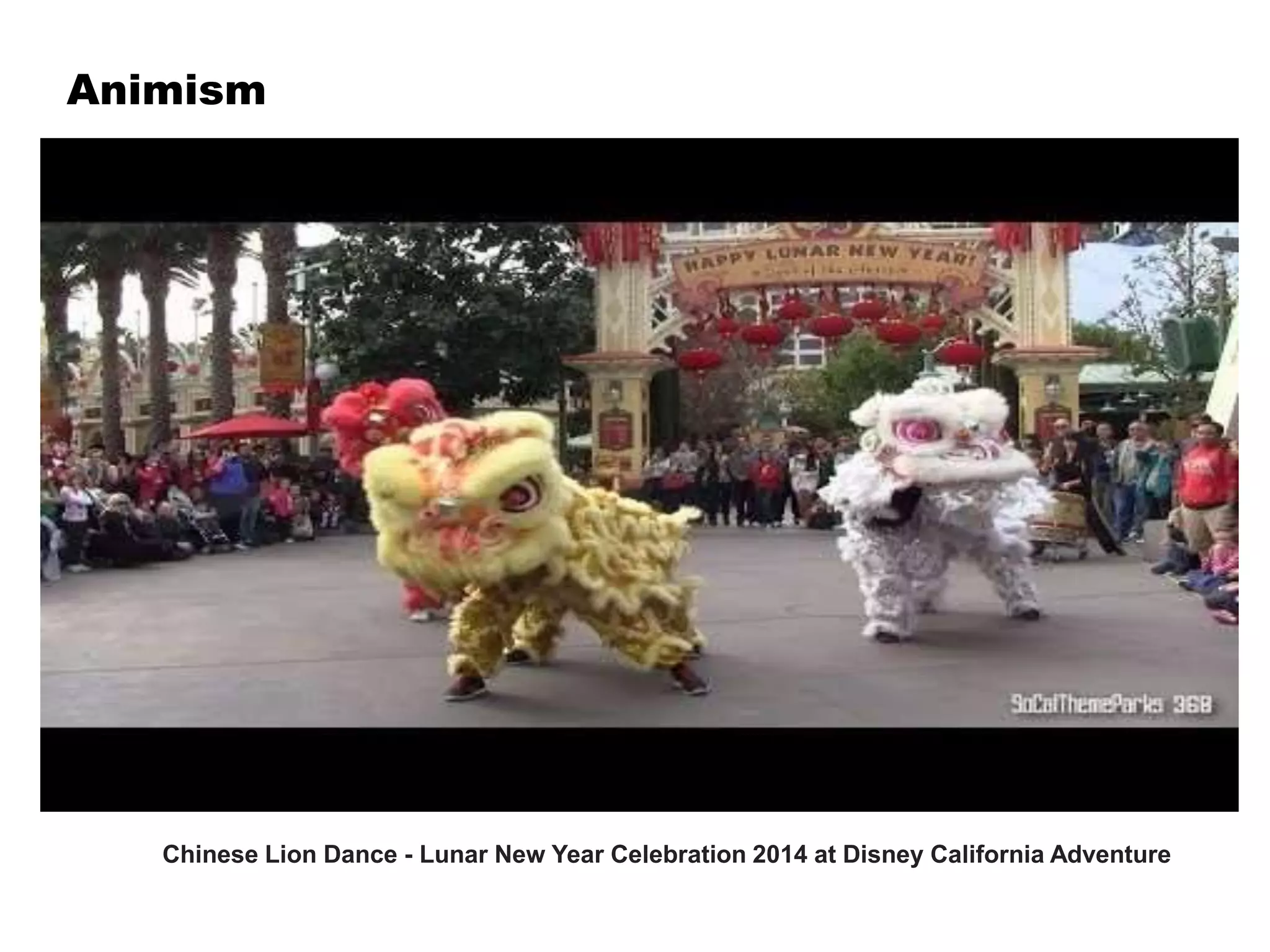
Chinese Lion Dance - Lunar New Year Celebration 2014 at Disney California Adventure
Animism
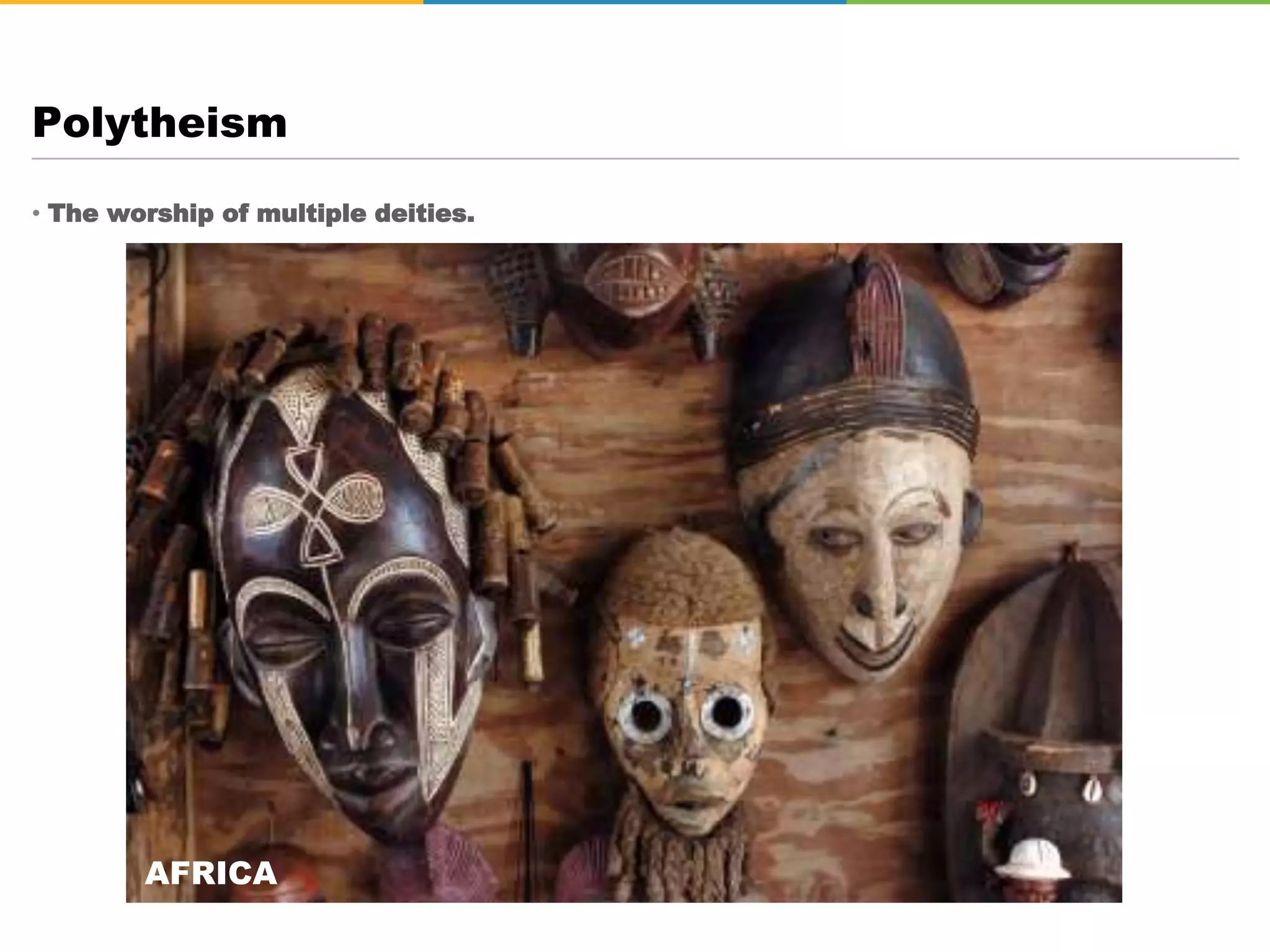
• The worship of multiple deities.
Polytheism
AFRICA
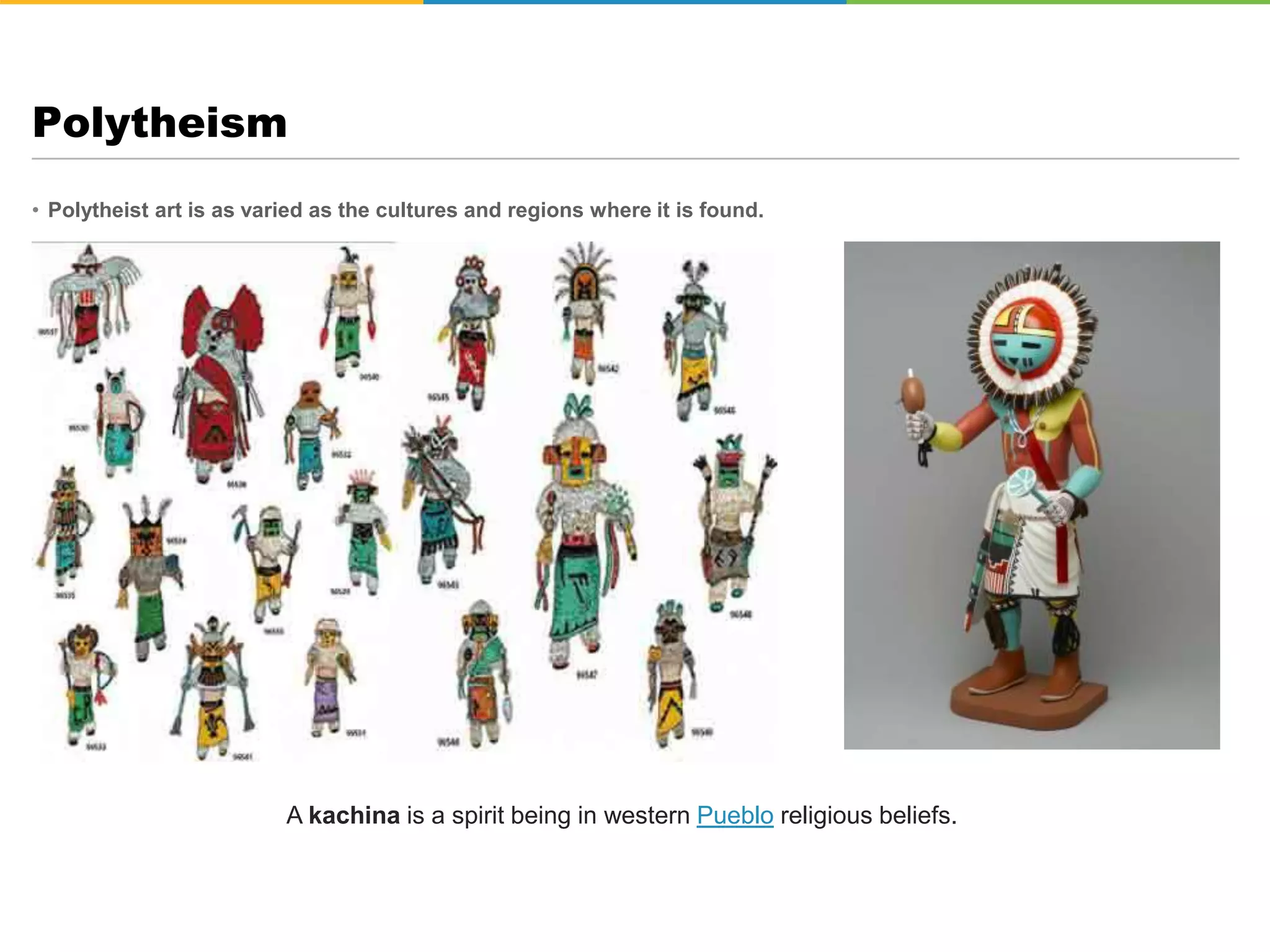
• Polytheist art is as varied as the cultures and regions where it is found.
Polytheism
A kachina is a spirit being in western Pueblo religious beliefs.
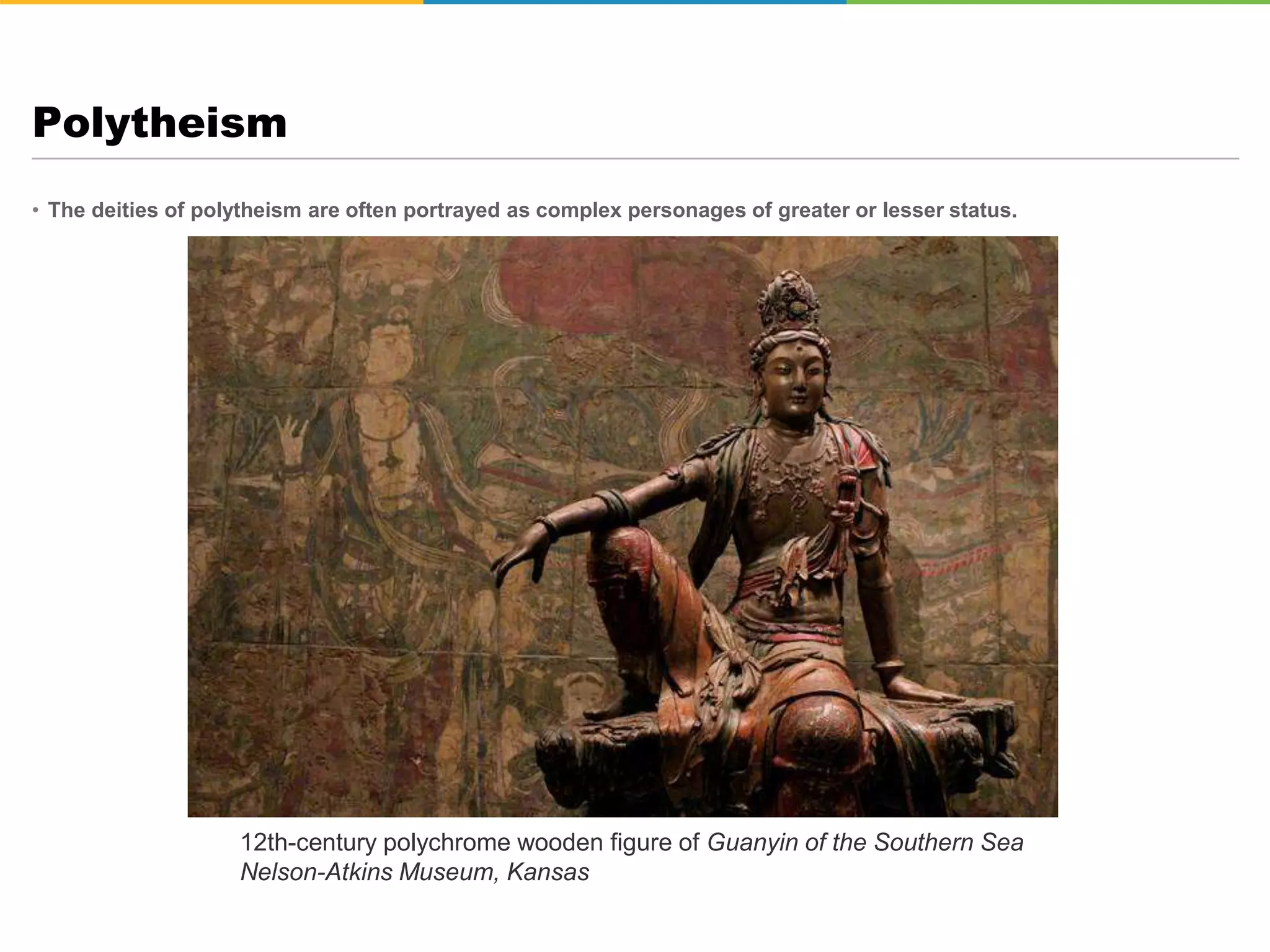
• The deities of polytheism are often portrayed as complex personages of greater or lesser status.
Polytheism
12th-century polychrome wooden figure of Guanyin of the Southern Sea
Nelson-Atkins Museum, Kansas
• Polytheism cannot be completely separated from the animist beliefs and art prevalent in most folk religions.
Polytheism
Animist and Buddhist icons in a park in Vientiane, Laos
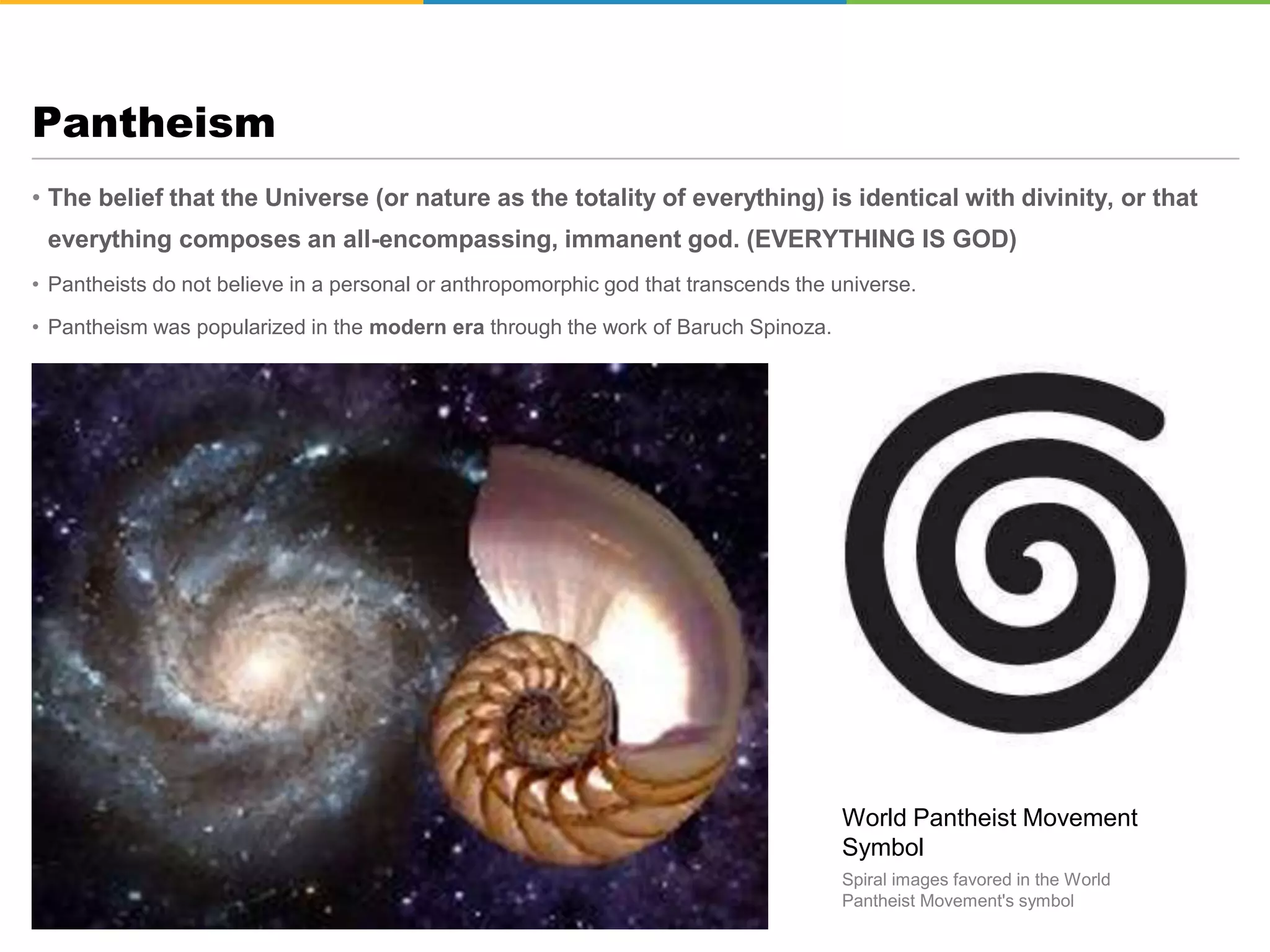
• The belief that the Universe (or nature as the totality of everything) is identical with divinity, or that
everything composes an all-encompassing, immanent god. (EVERYTHING IS GOD)
• Pantheists do not believe in a personal or anthropomorphic god that transcends the universe.
• Pantheism was popularized in the modern era through the work of Baruch Spinoza.
Pantheism
World Pantheist Movement
Symbol
Spiral images favored in the World
Pantheist Movement's symbol
• Belief in ONE deity only.
Monotheism
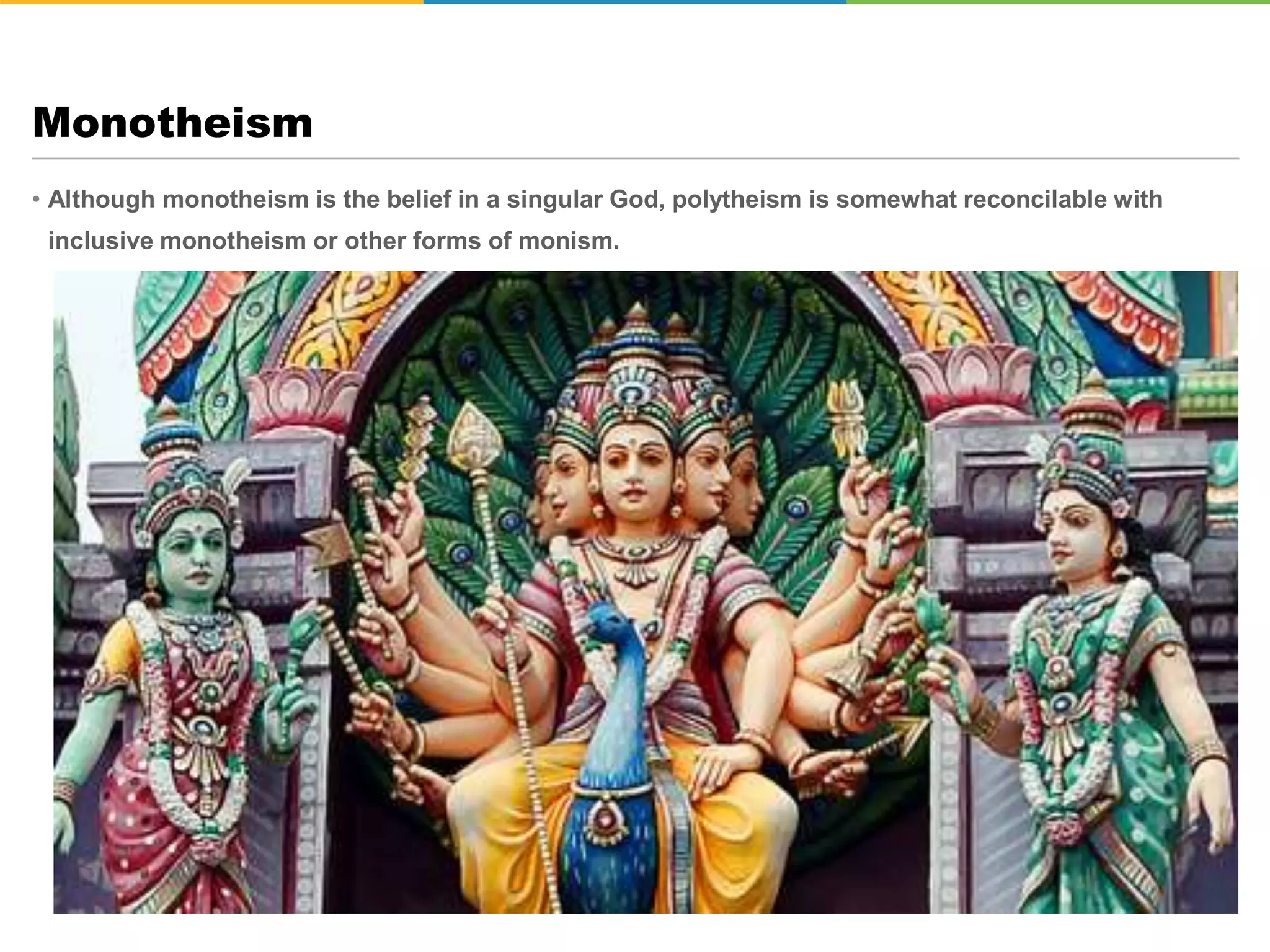
• Although monotheism is the belief in a singular God, polytheism is somewhat reconcilable with
inclusive monotheism or other forms of monism.
Monotheism
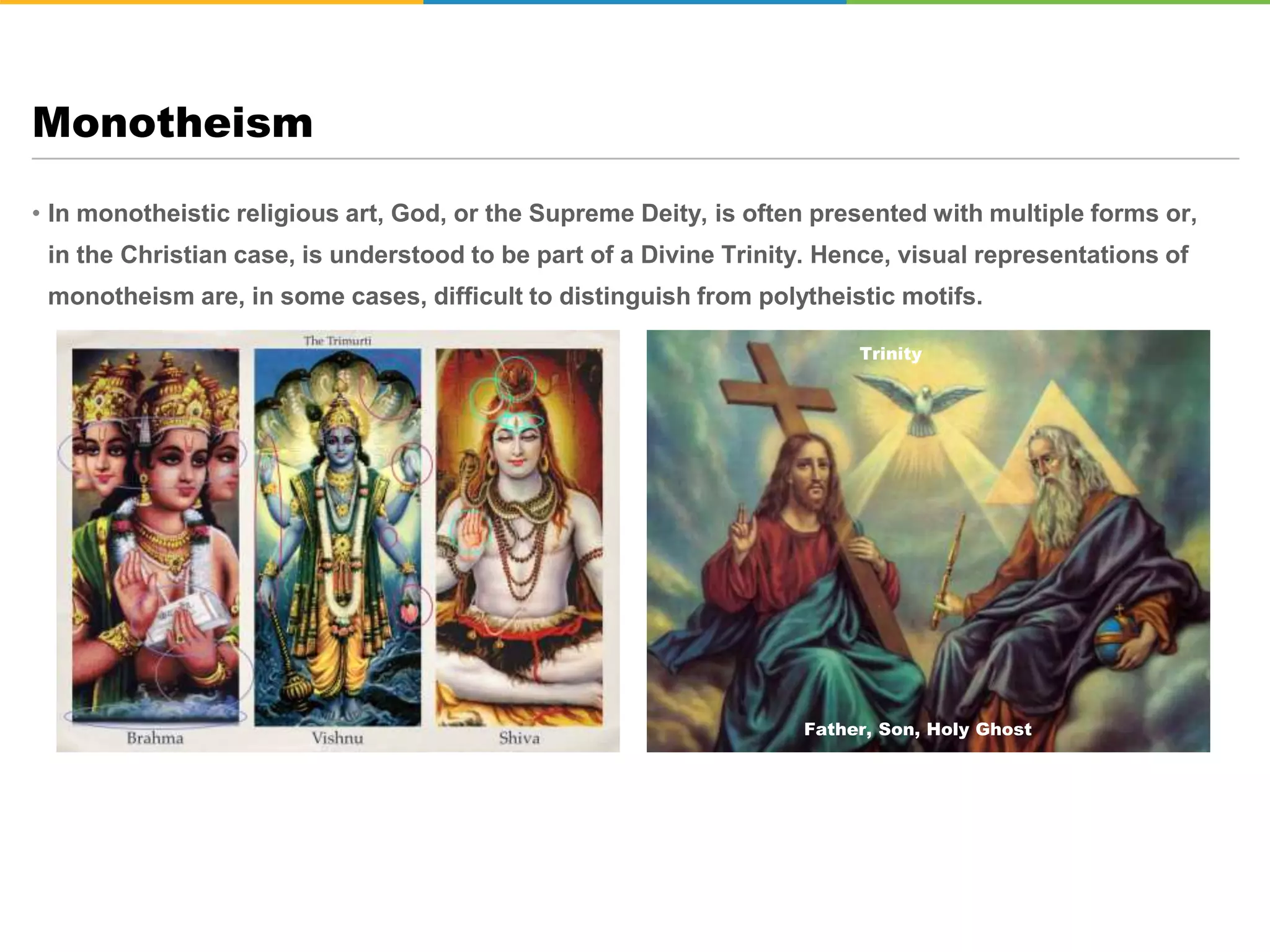
• In monotheistic religious art, God, or the Supreme Deity, is often presented with multiple forms or,
in the Christian case, is understood to be part of a Divine Trinity. Hence, visual representations of
monotheism are, in some cases, difficult to distinguish from polytheistic motifs.
Monotheism
Trinity
Father, Son, Holy Ghost
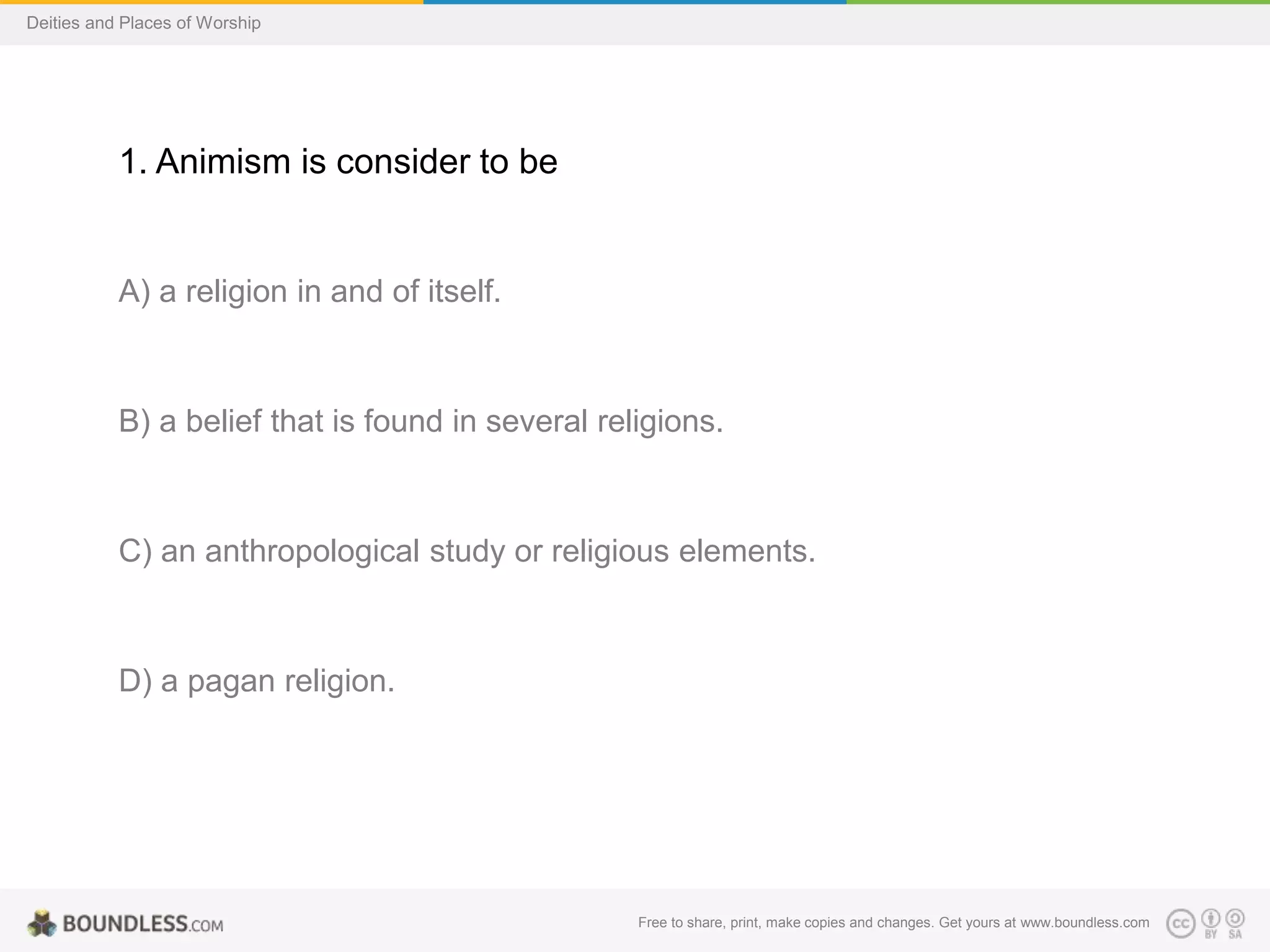
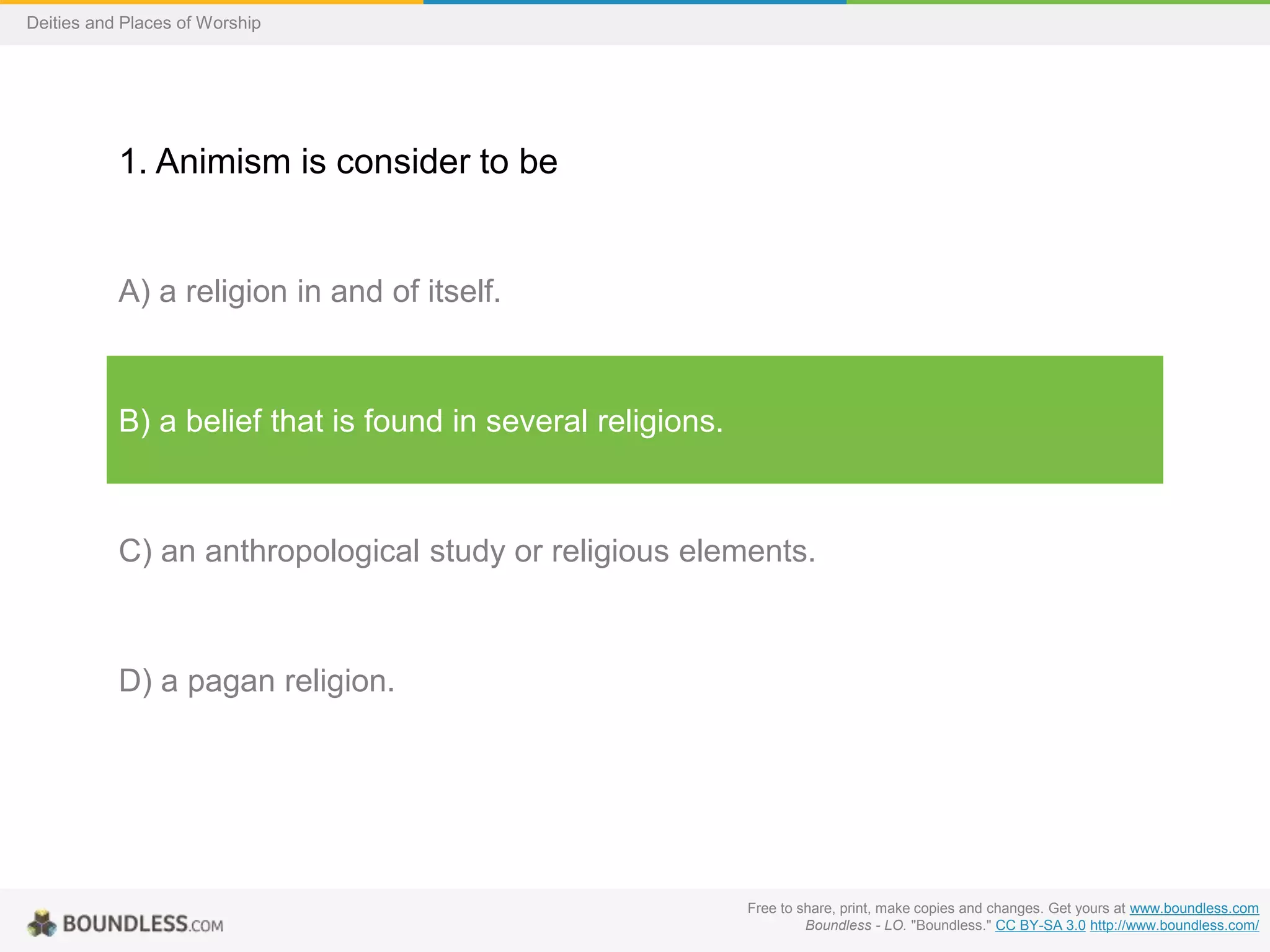
1. Animism is consider to be
A) a religion in and of itself.
B) a belief that is found in several religions.
C) an anthropological study or religious elements.
D) a pagan religion.
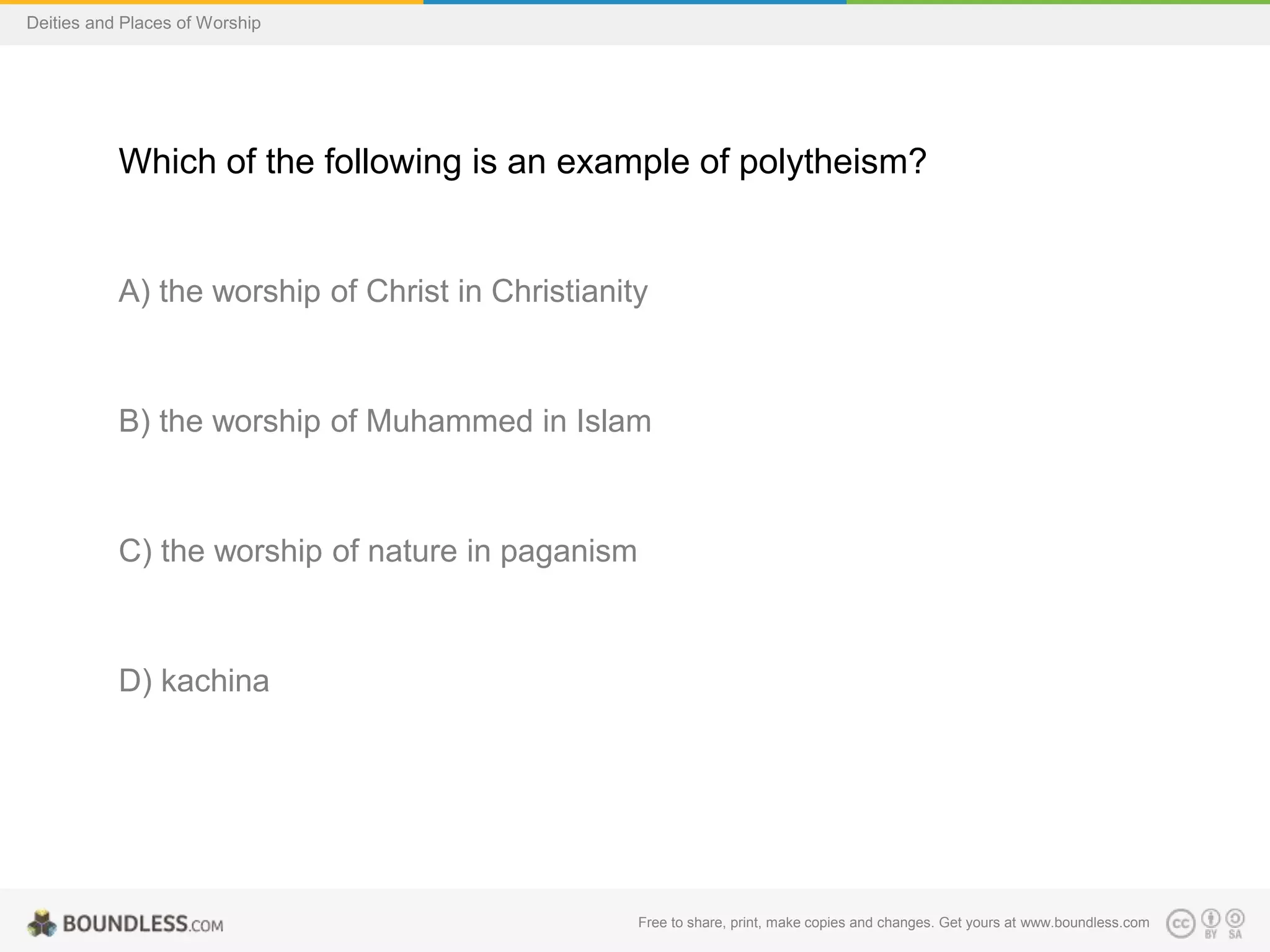
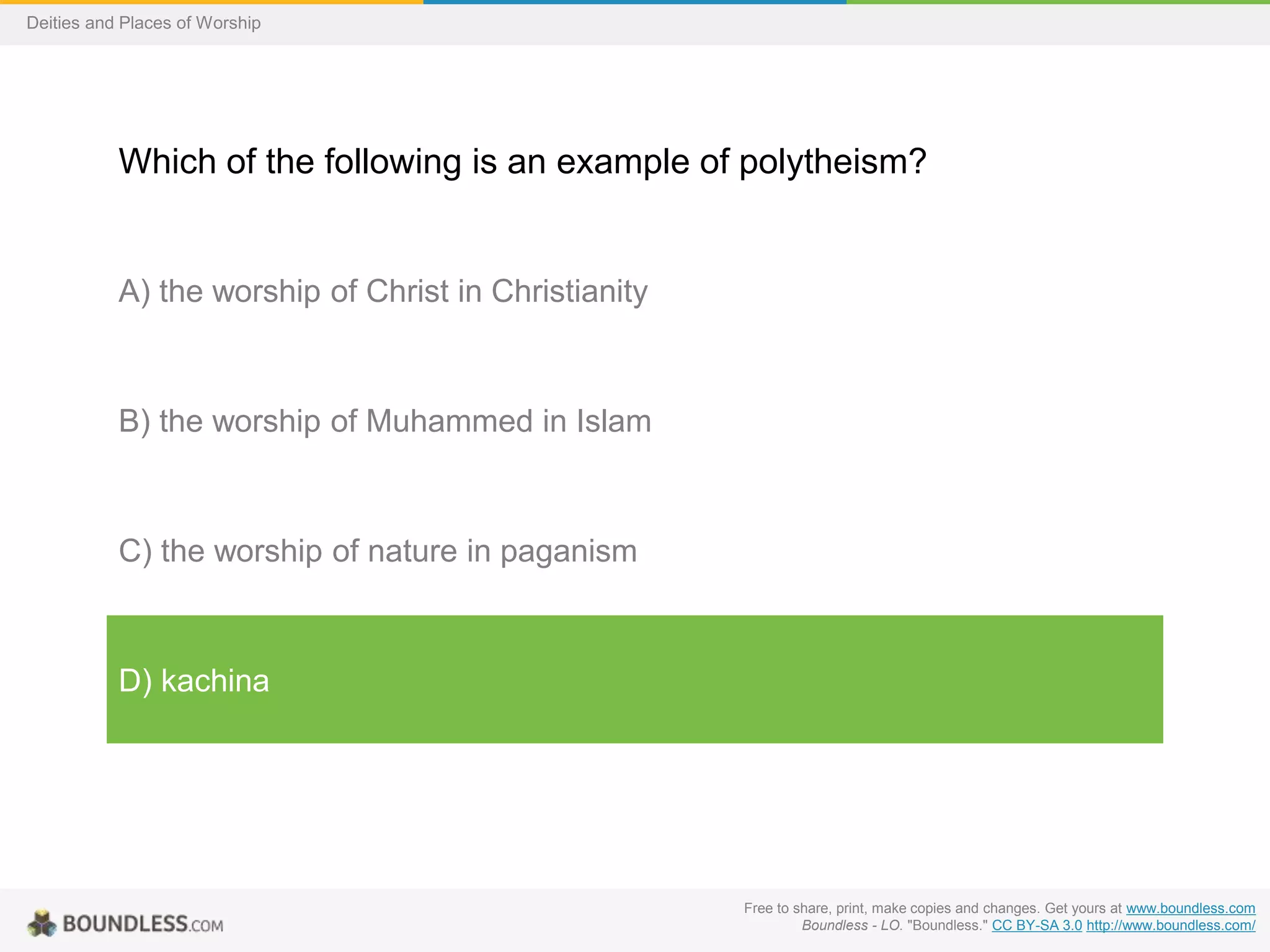
2. Which of the following is an example of polytheism?
A) the worship of Christ in Christianity
B) the worship of Muhammed in Islam
C) the worship of nature in paganism
D) kachina
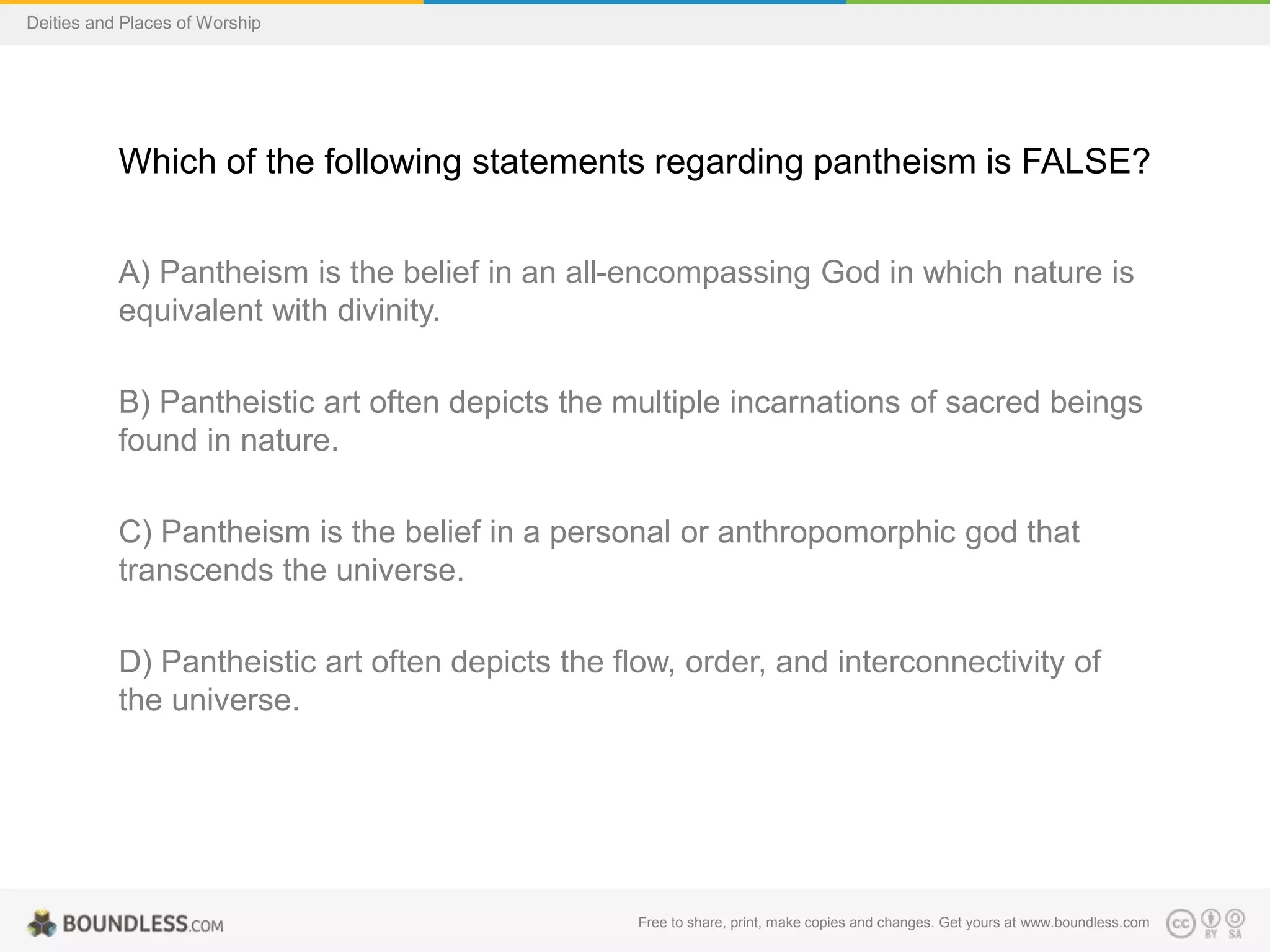
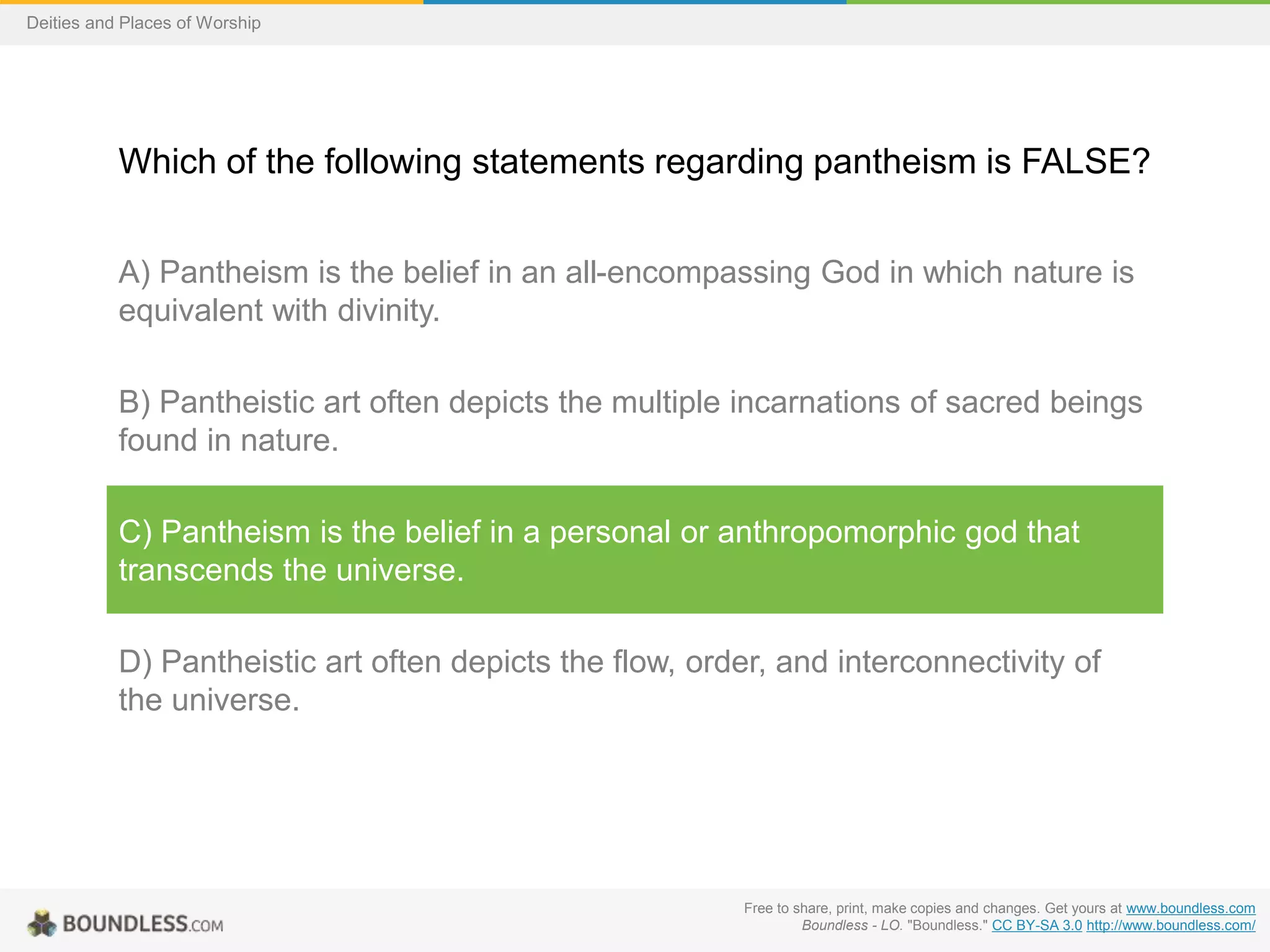
3. Which of the following statements regarding pantheism is
FALSE?
A) Pantheism is the belief in an all-encompassing God in which nature is
equivalent with divinity.
B) Pantheistic art often depicts the multiple incarnations of sacred beings
found in nature.
C) Pantheism is the belief in a personal or anthropomorphic god that
transcends the universe.
D) Pantheistic art often depicts the flow, order, and interconnectivity of
the universe.
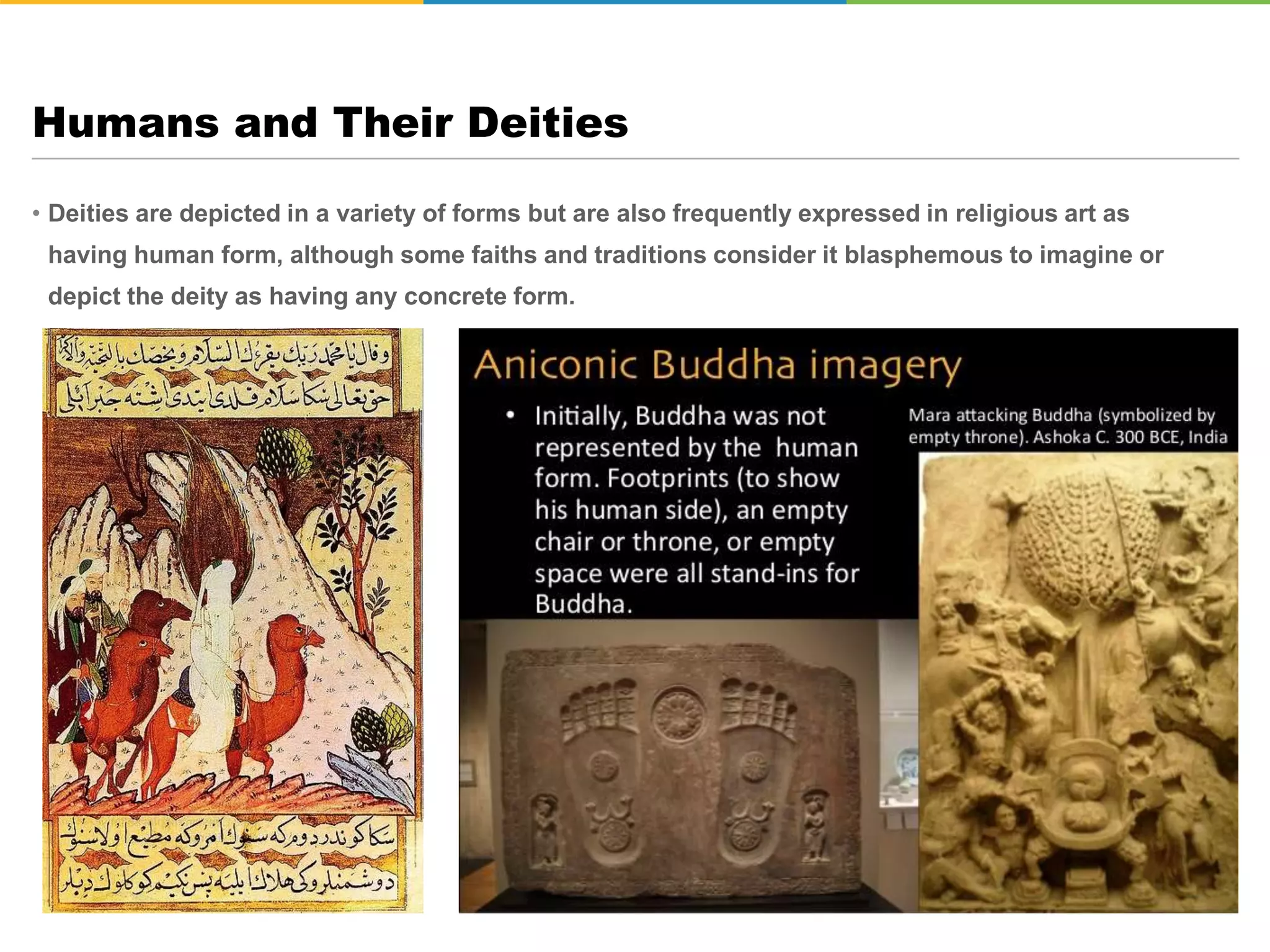
• Deities are depicted in a variety of forms but are also frequently expressed in religious art as
having human form, although some faiths and traditions consider it blasphemous to imagine or
depict the deity as having any concrete form.
Humans and Their Deities
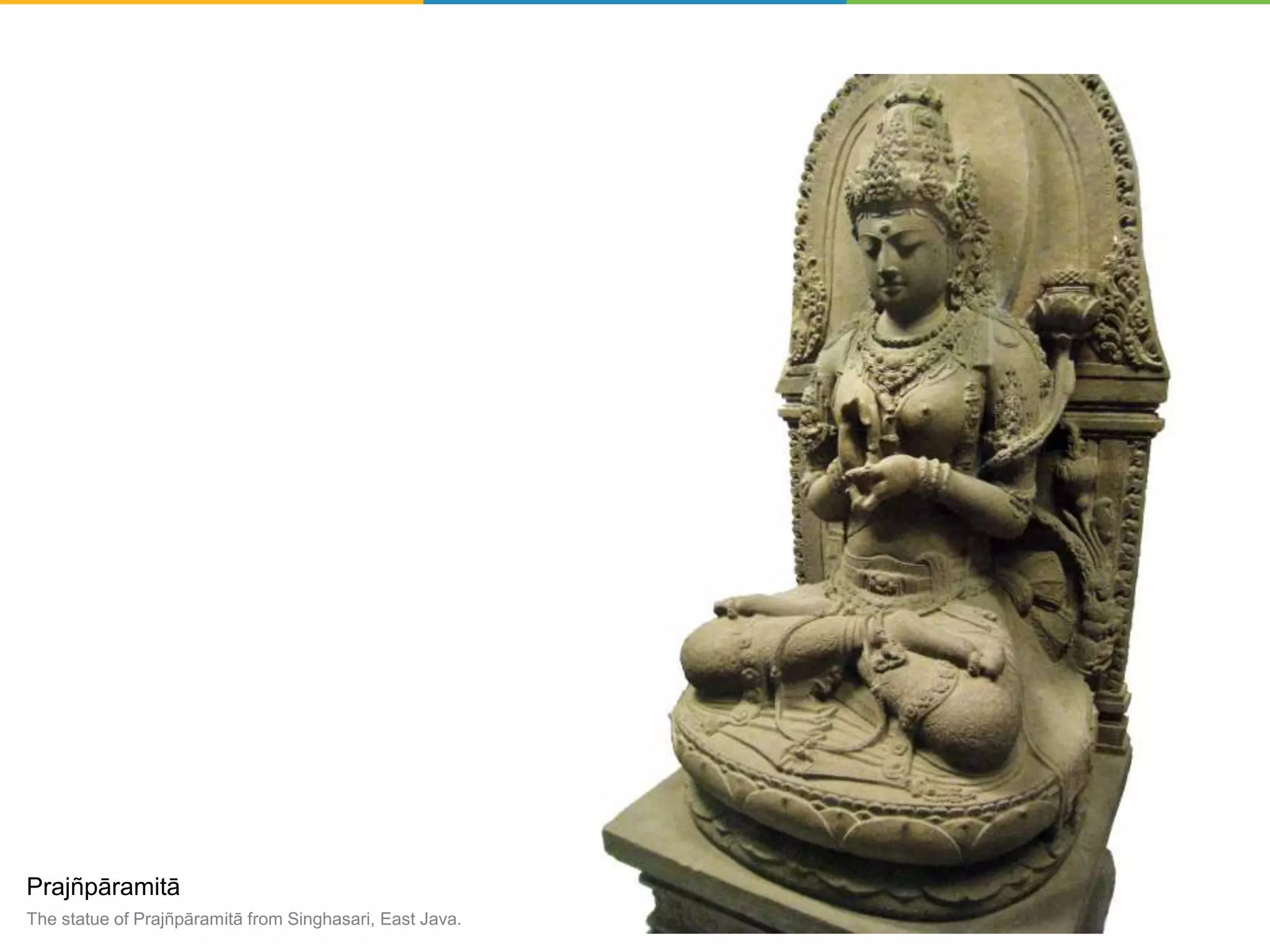
Prajñpāramitā
The statue of Prajñpāramitā from Singhasari, East Java.
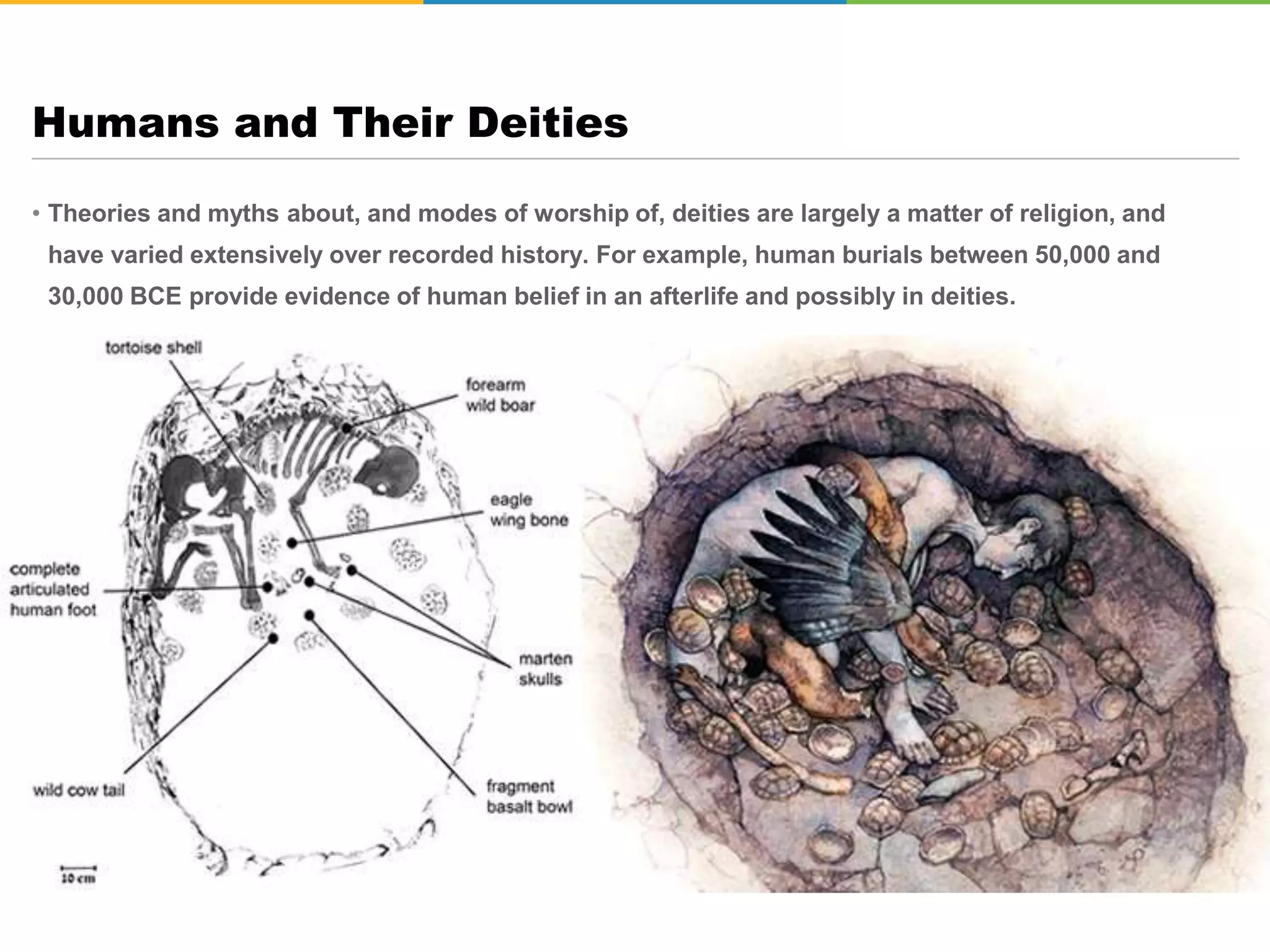
• Theories and myths about, and modes of worship of, deities are largely a matter of religion, and
have varied extensively over recorded history. For example, human burials between 50,000 and
30,000 BCE provide evidence of human belief in an afterlife and possibly in deities.
Humans and Their Deities
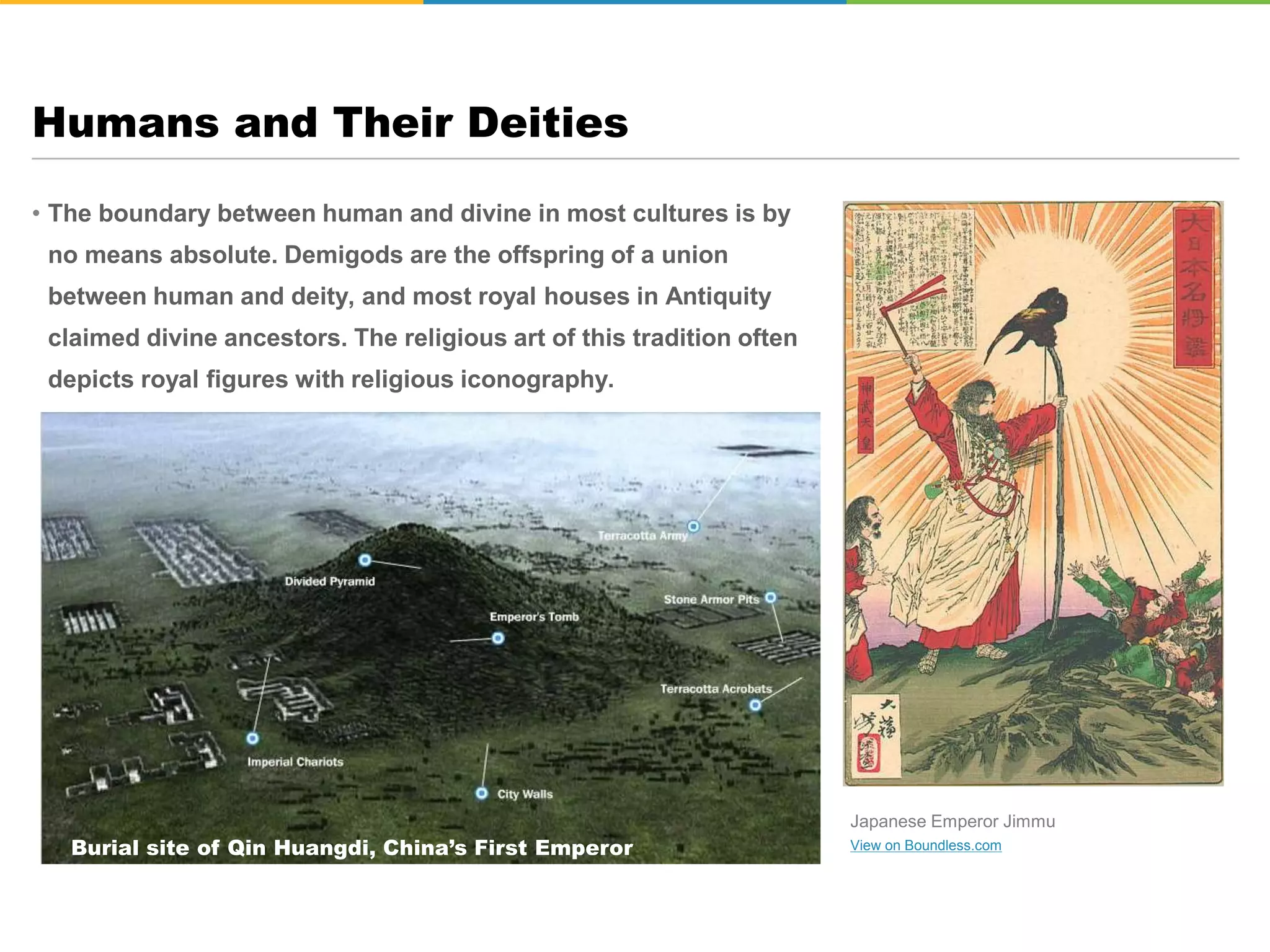
• The boundary between human and divine in most cultures is by
no means absolute. Demigods are the offspring of a union
between human and deity, and most royal houses in Antiquity
claimed divine ancestors. The religious art of this tradition often
depicts royal figures with religious iconography.
Humans and Their Deities
Japanese Emperor Jimmu
View on Boundless.comBurial site of Qin Huangdi, China’s First Emperor
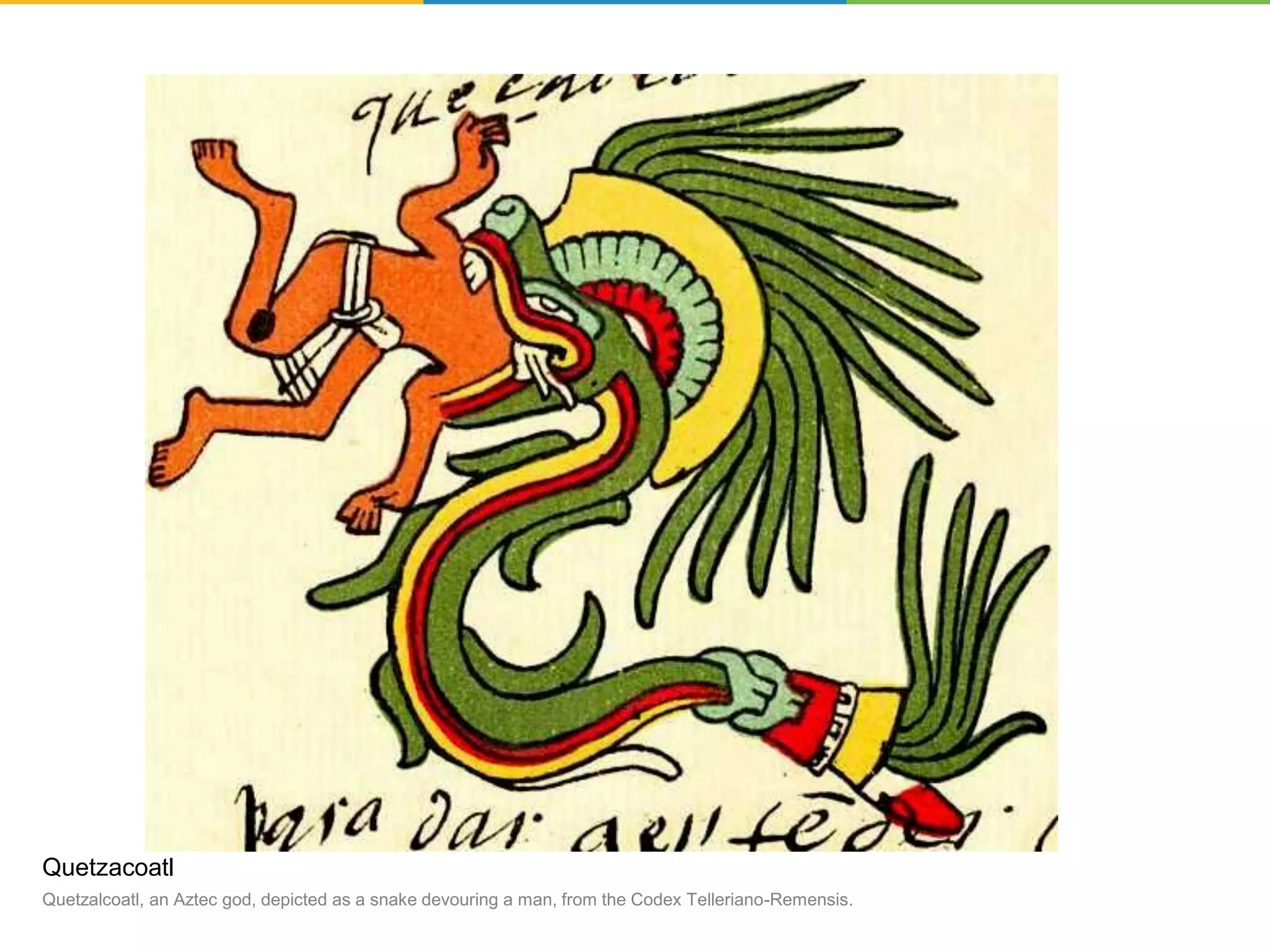
Quetzacoatl
Quetzalcoatl, an Aztec god, depicted as a snake devouring a man, from the Codex Telleriano-Remensis.
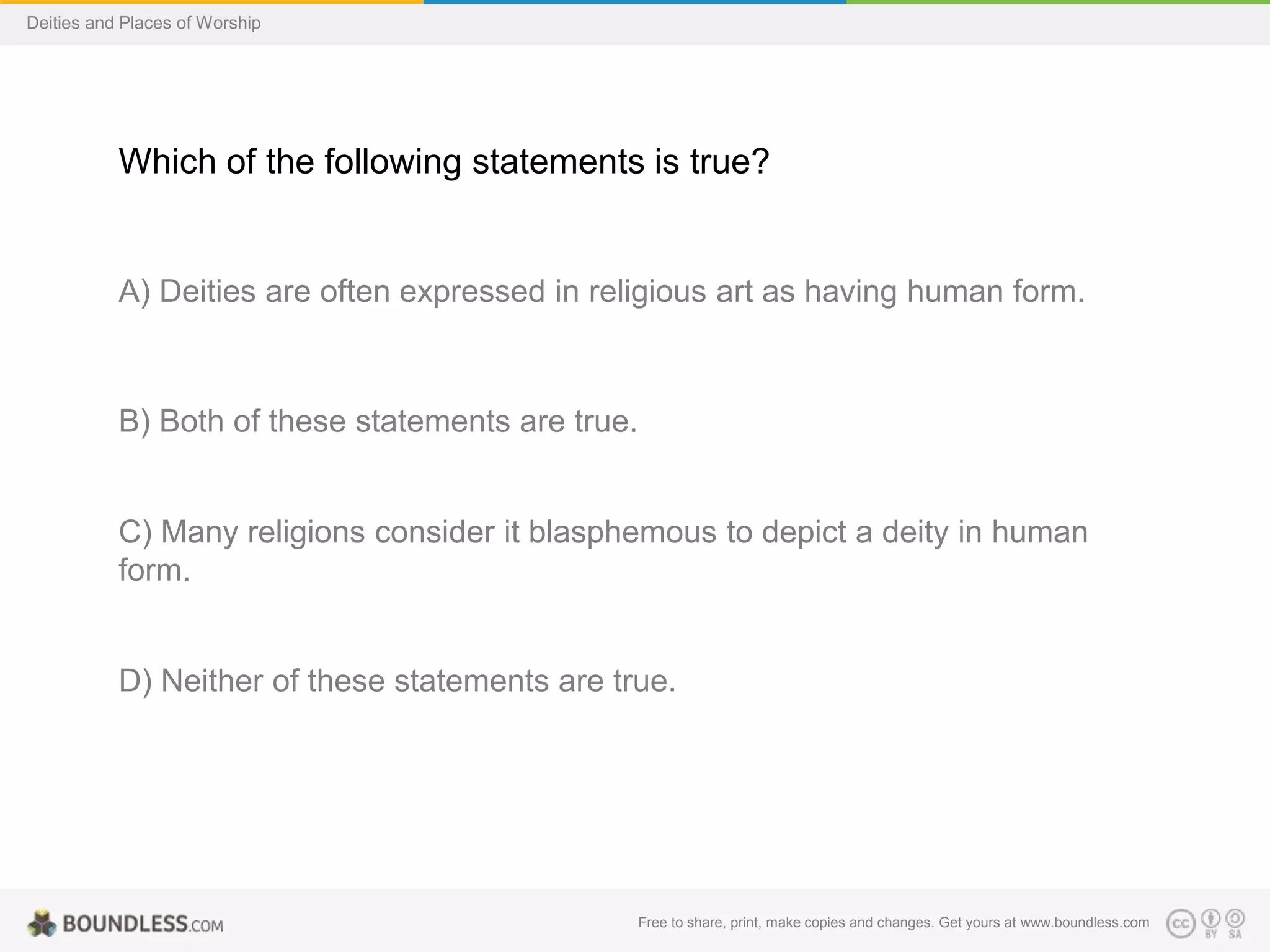
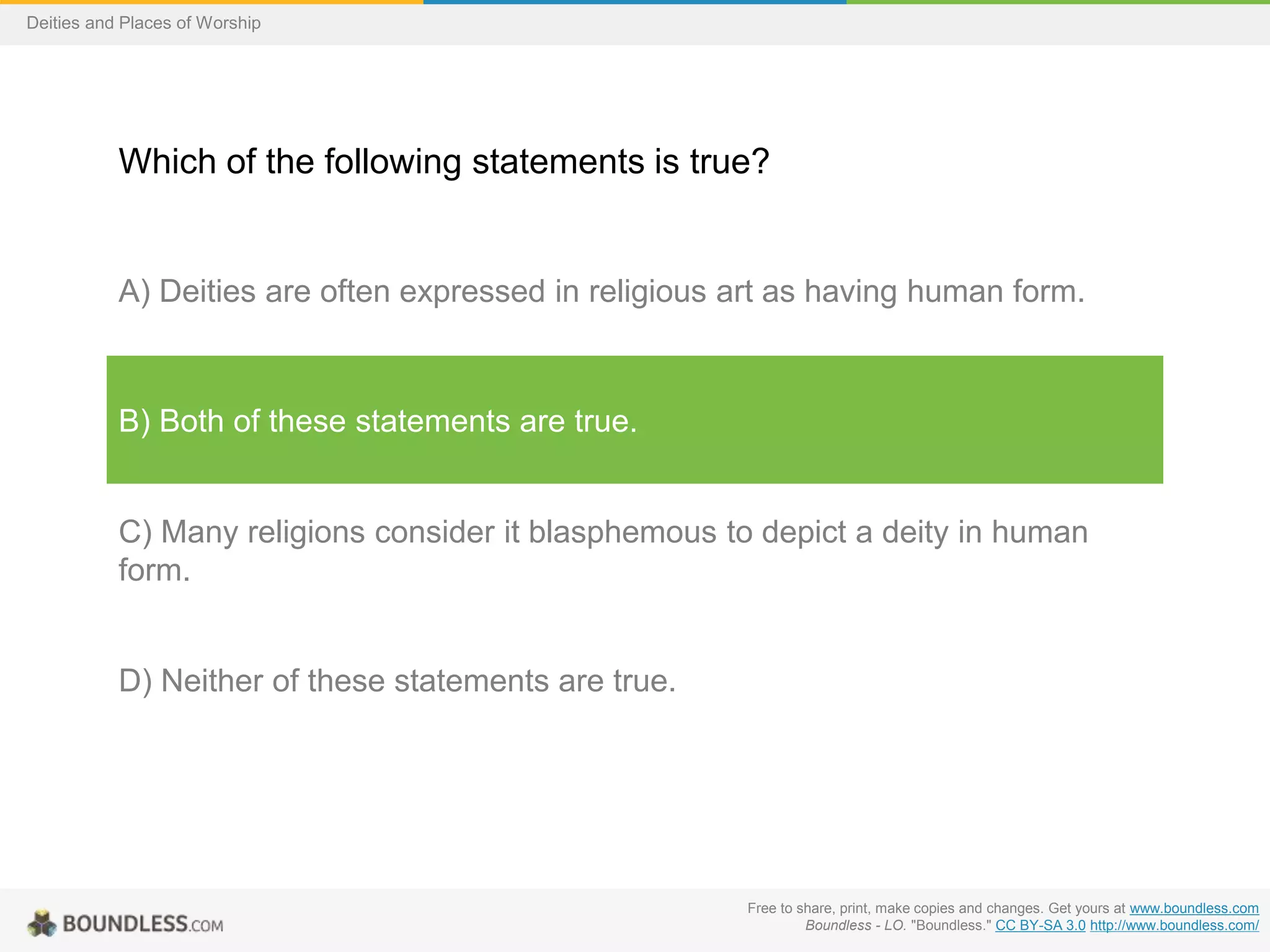
4. Which of the following statements is true?
A) Deities are often expressed in religious art as having human form.
B) Both of these statements are true.
C) Many religions consider it blasphemous to depict a deity in human
form.
D) Neither of these statements are true.
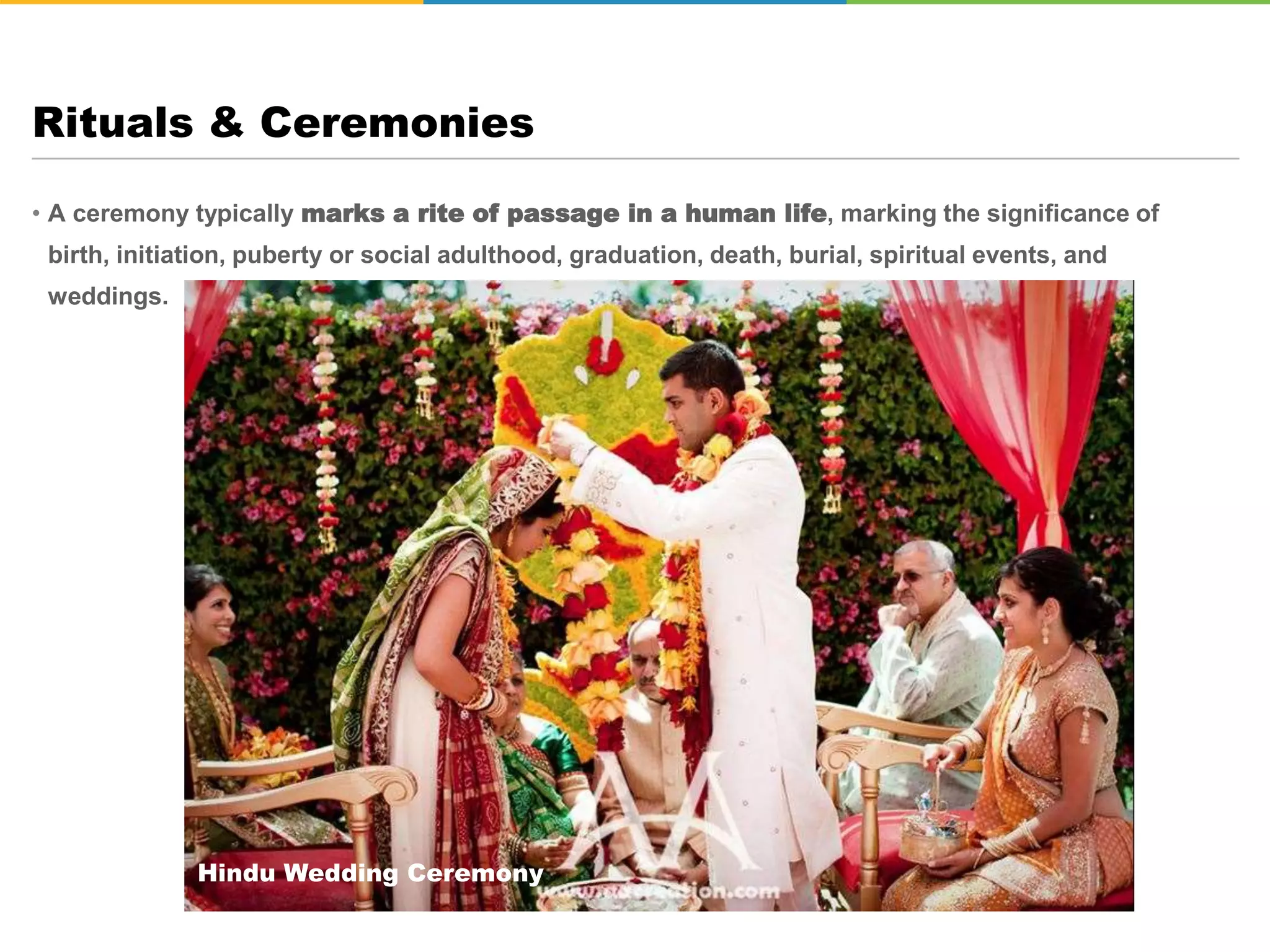
• A ceremony typically marks a rite of passage in a human life, marking the significance of
birth, initiation, puberty or social adulthood, graduation, death, burial, spiritual events, and
weddings.
Rituals & Ceremonies
Hindu Wedding Ceremony
• A ceremony typically marks a rite of passage in a human life, marking the significance of
birth, initiation, puberty or social adulthood, graduation, death, burial, spiritual events, and
weddings.
Rituals & Ceremonies
Hindu Wedding Ceremony
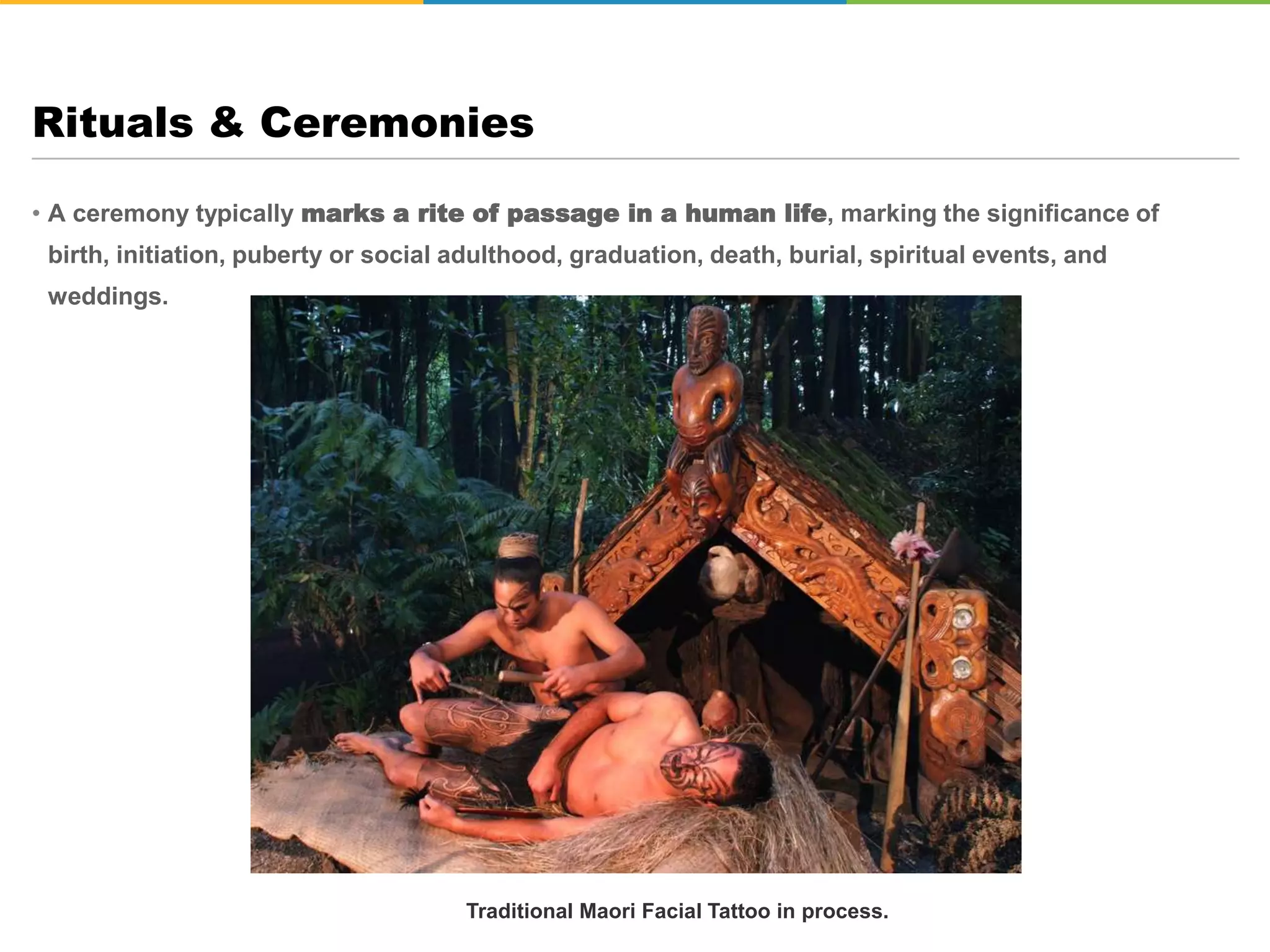
Traditional Maori Facial Tattoo in process.
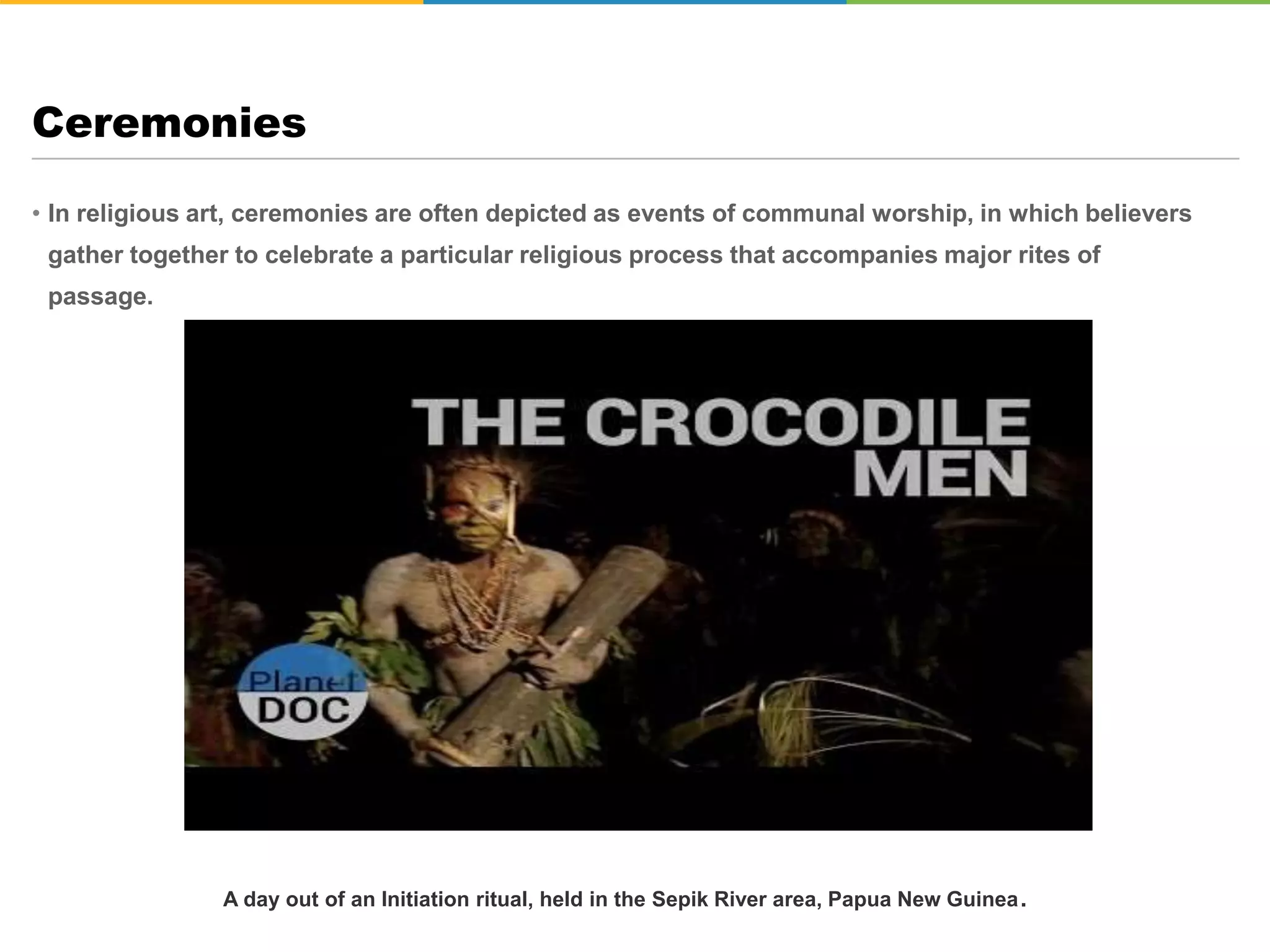
• In religious art, ceremonies are often depicted as events of communal worship, in which believers
gather together to celebrate a particular religious process that accompanies major rites of
passage.
Ceremonies
Hindu Wedding Ceremony
A day out of an Initiation ritual, held in the Sepik River area, Papua New Guinea.
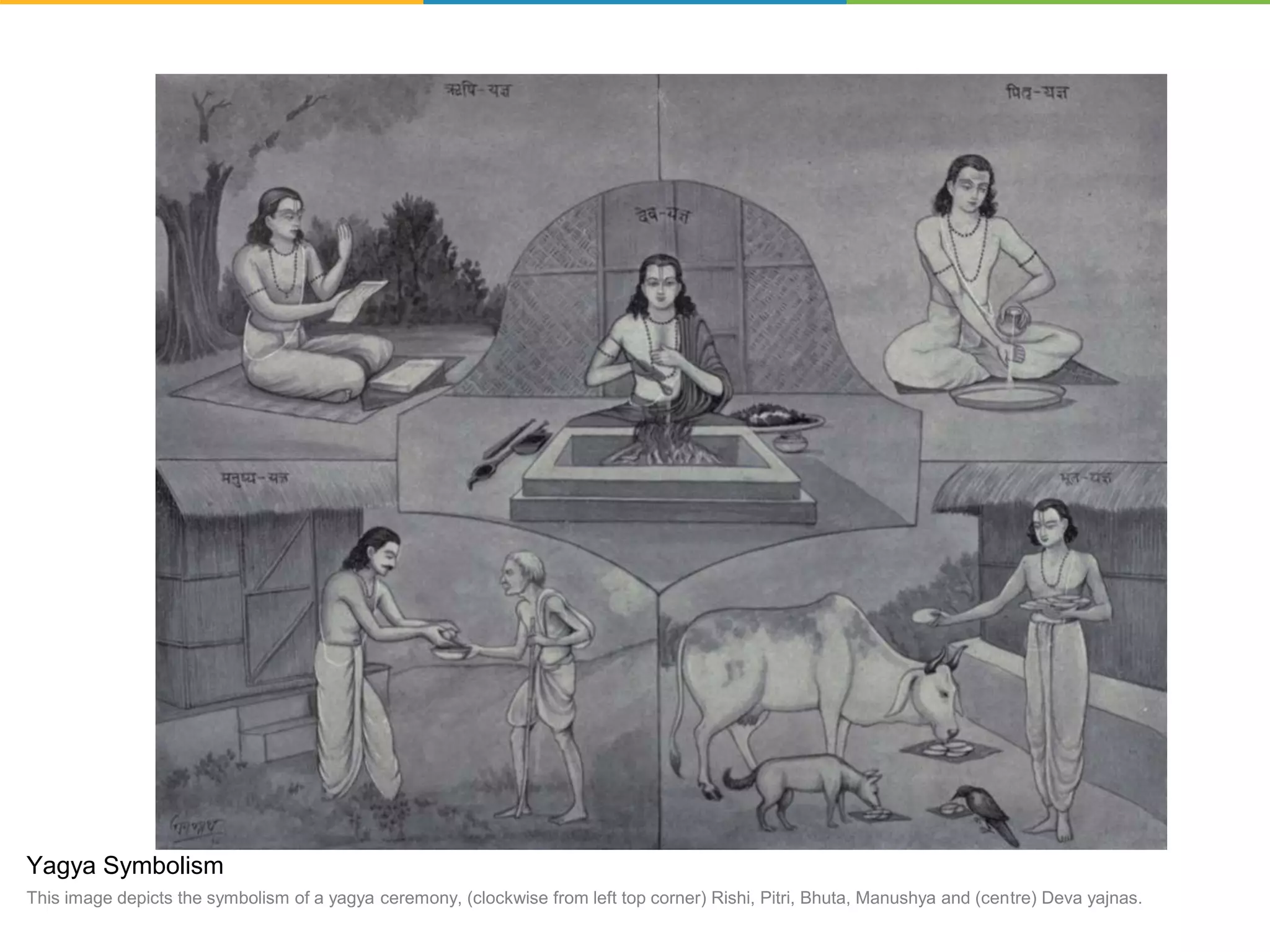
Yagya Symbolism
This image depicts the symbolism of a yagya ceremony, (clockwise from left top corner) Rishi, Pitri, Bhuta, Manushya and (centre) Deva yajnas.
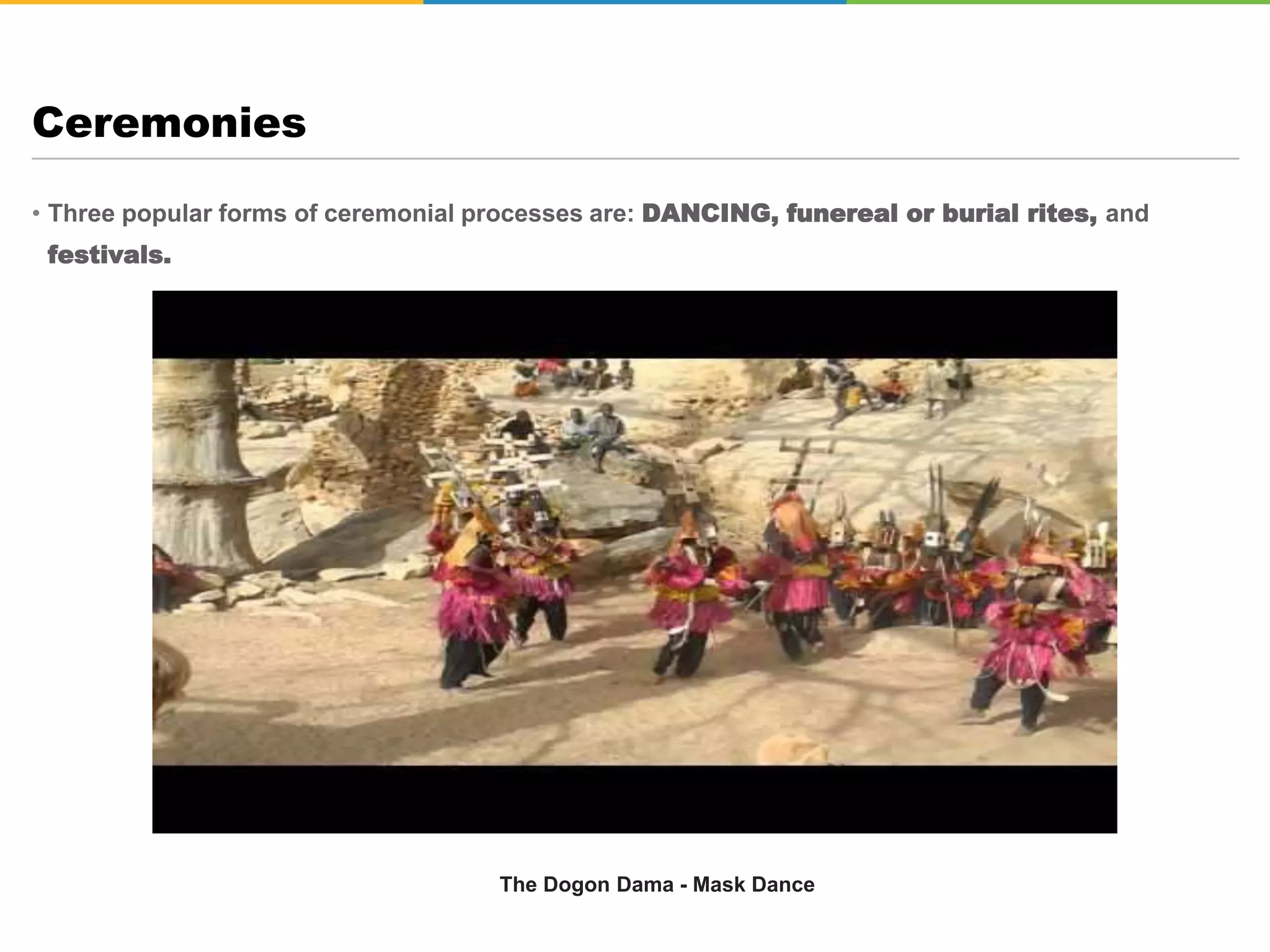
• Three popular forms of ceremonial processes are: DANCING, funereal or burial rites, and
festivals.
Ceremonies
The Dogon Dama - Mask Dance
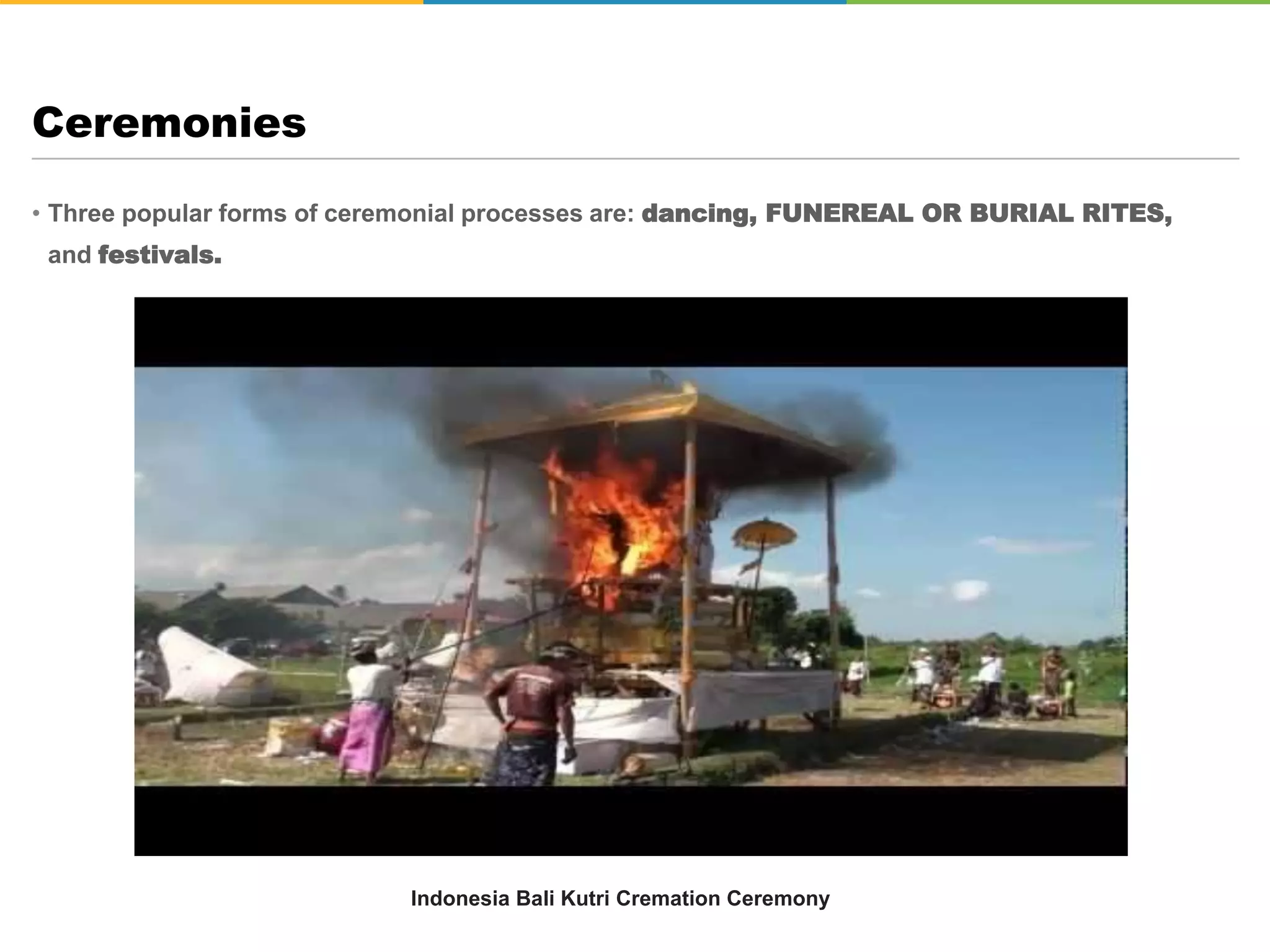
• Three popular forms of ceremonial processes are: dancing, FUNEREAL OR BURIAL RITES,
and festivals.
Ceremonies
Indonesia Bali Kutri Cremation Ceremony
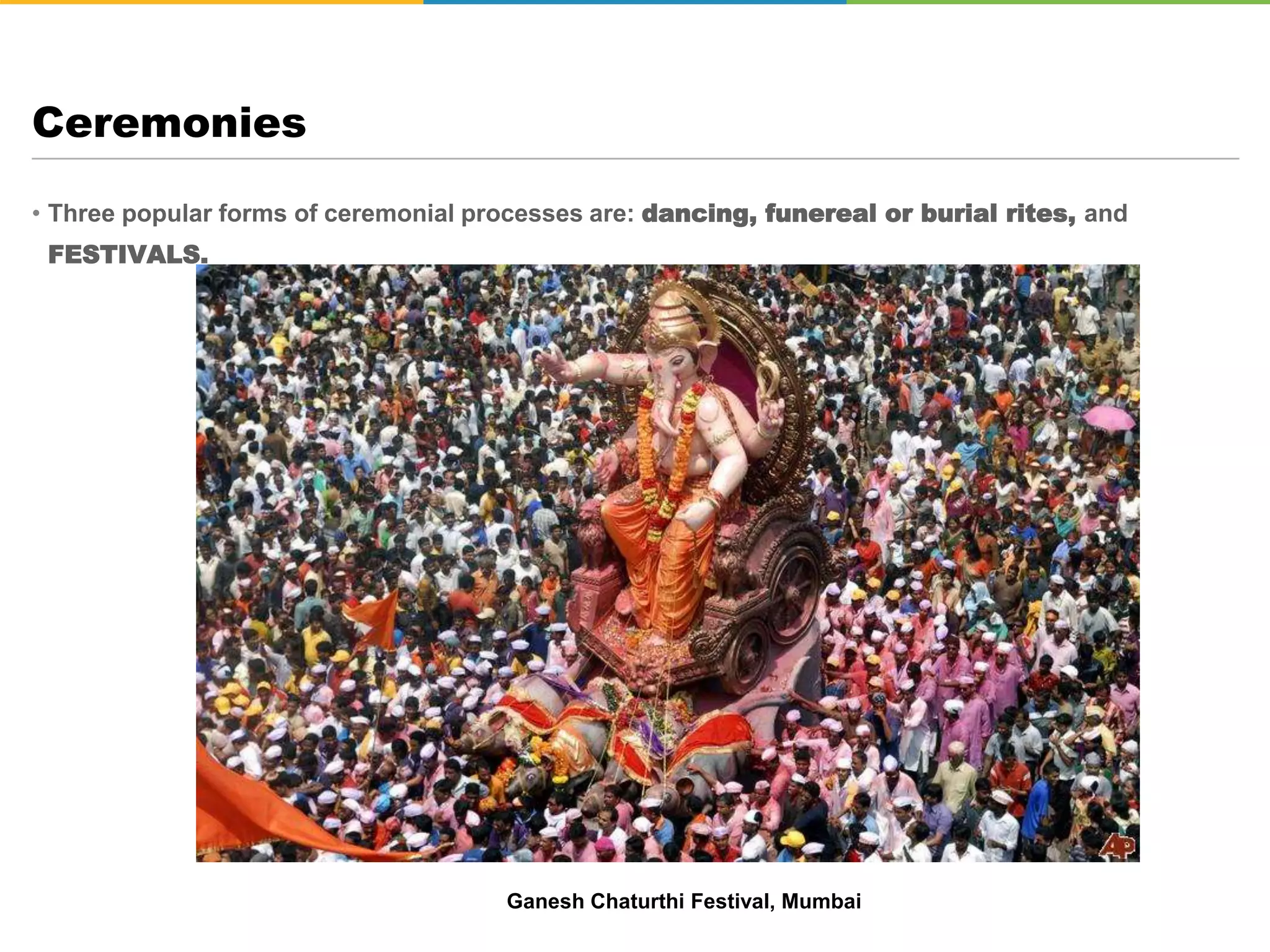
• Three popular forms of ceremonial processes are: dancing, funereal or burial rites, and
FESTIVALS.
Ceremonies
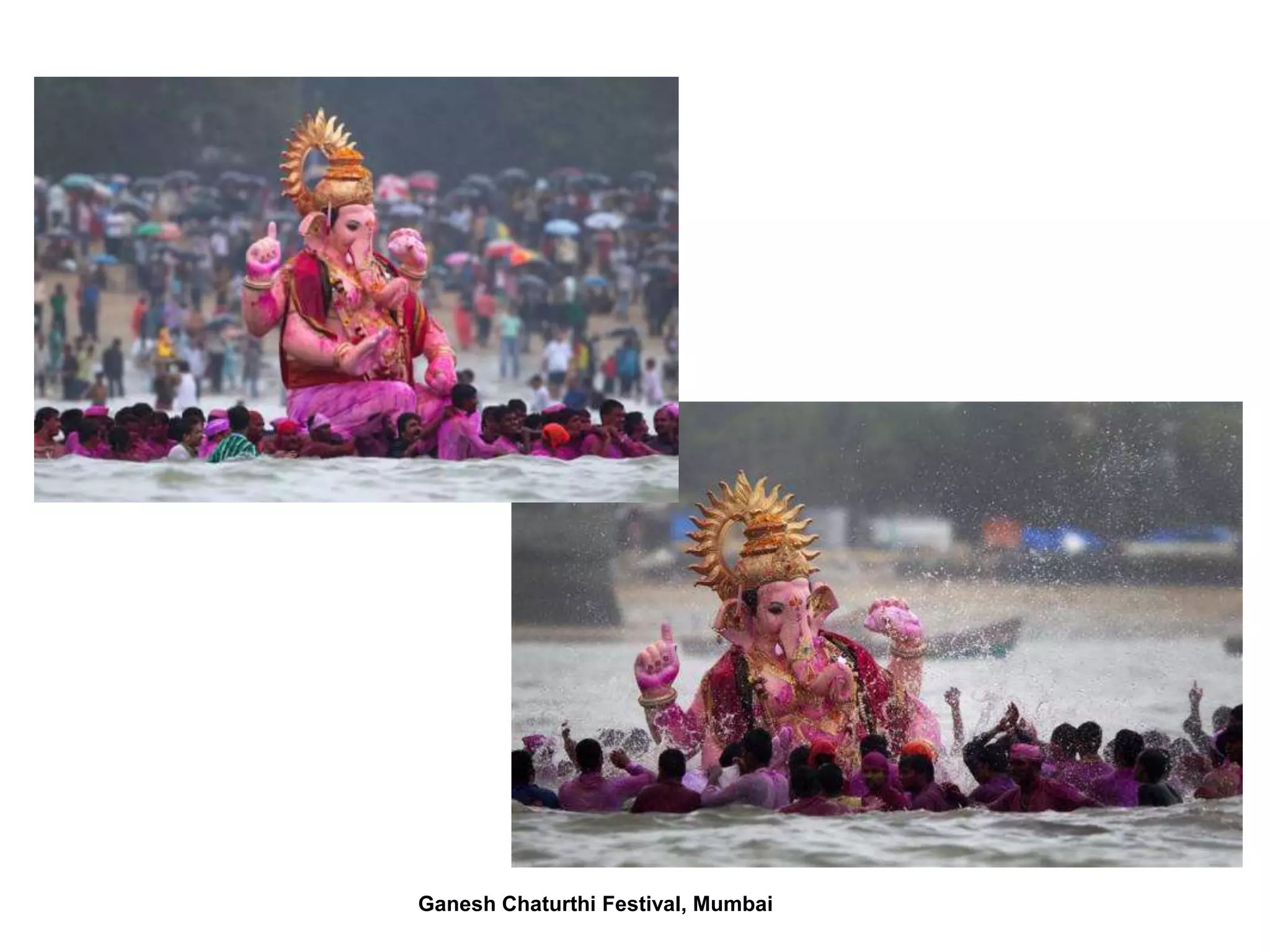
Ganesh Chaturthi Festival, Mumbai
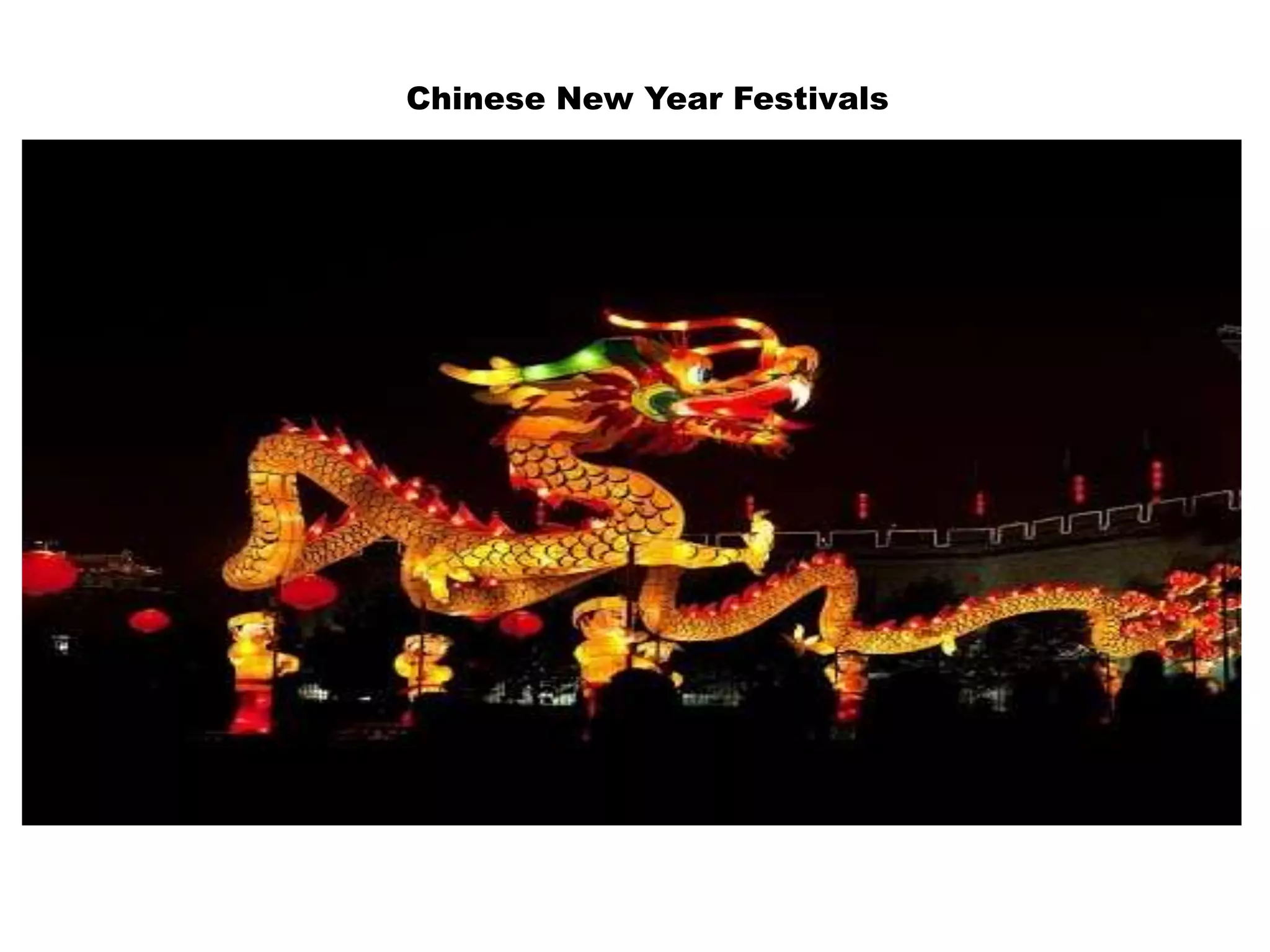
Chinese New Year Festivals
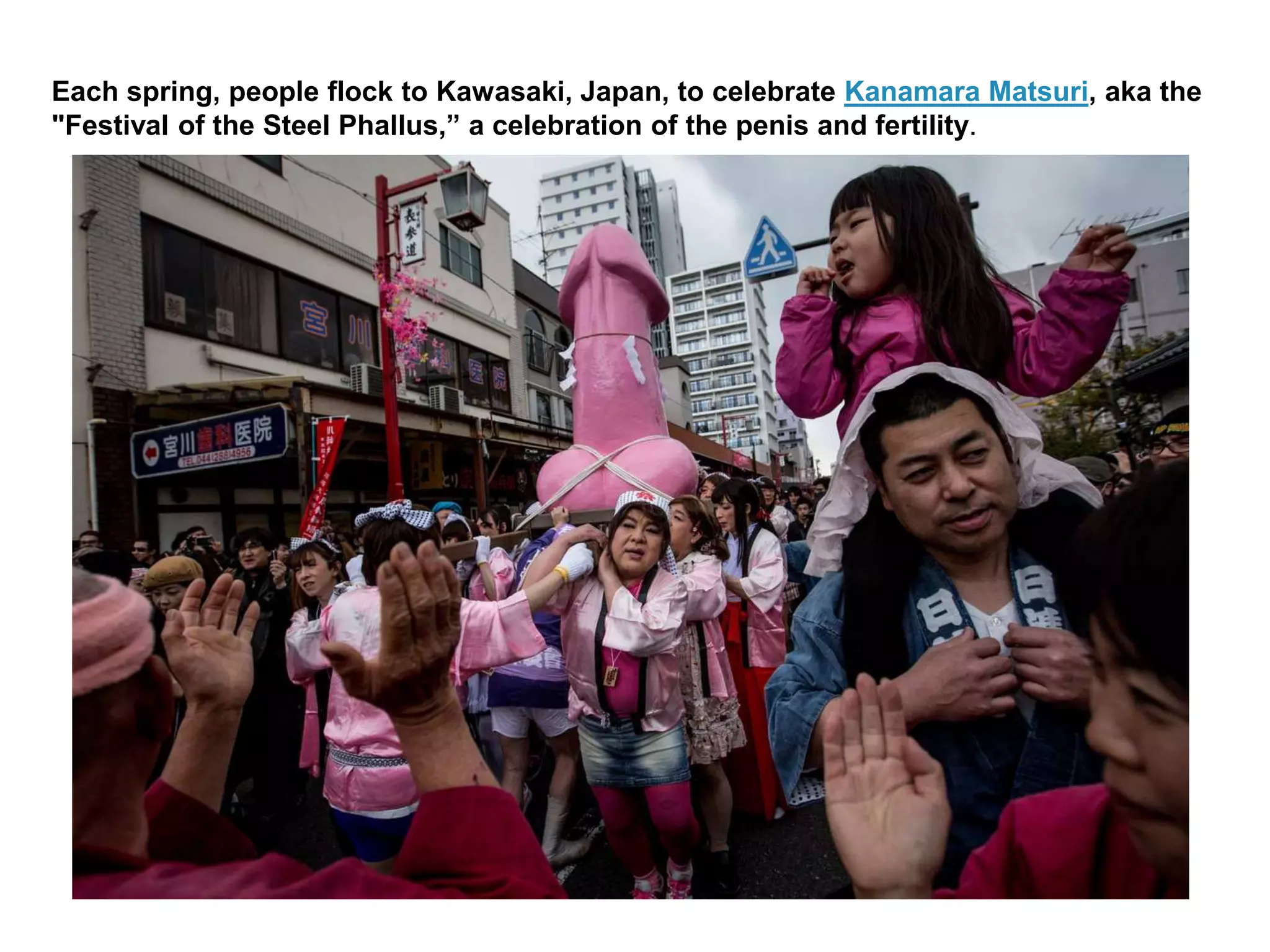
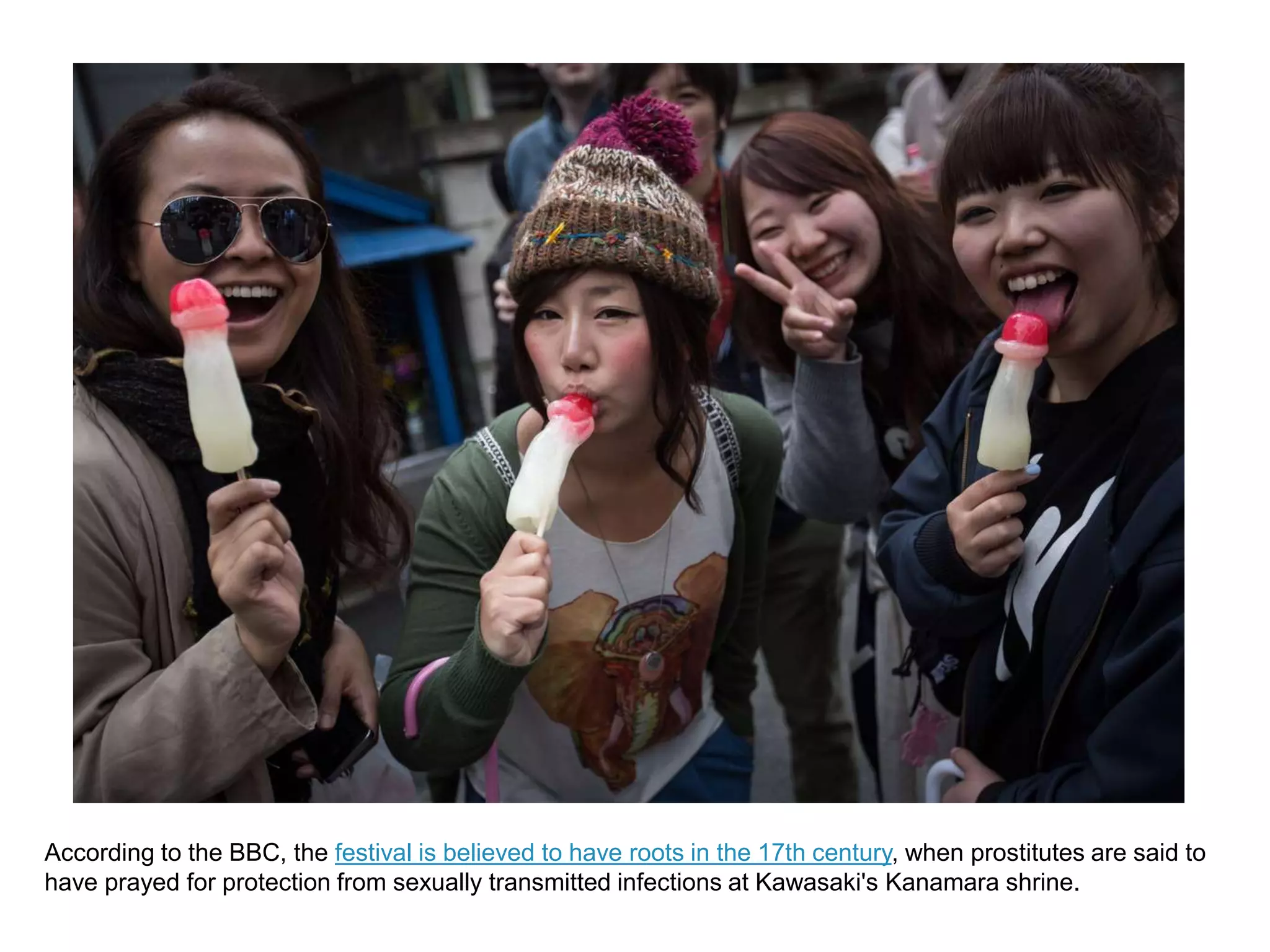
Each spring, people flock to Kawasaki, Japan, to celebrate Kanamara Matsuri, aka the
"Festival of the Steel Phallus,” a celebration of the penis and fertility.
According to the BBC, the festival is believed to have roots in the 17th century, when prostitutes are said to
have prayed for protection from sexually transmitted infections at Kawasaki's Kanamara shrine.
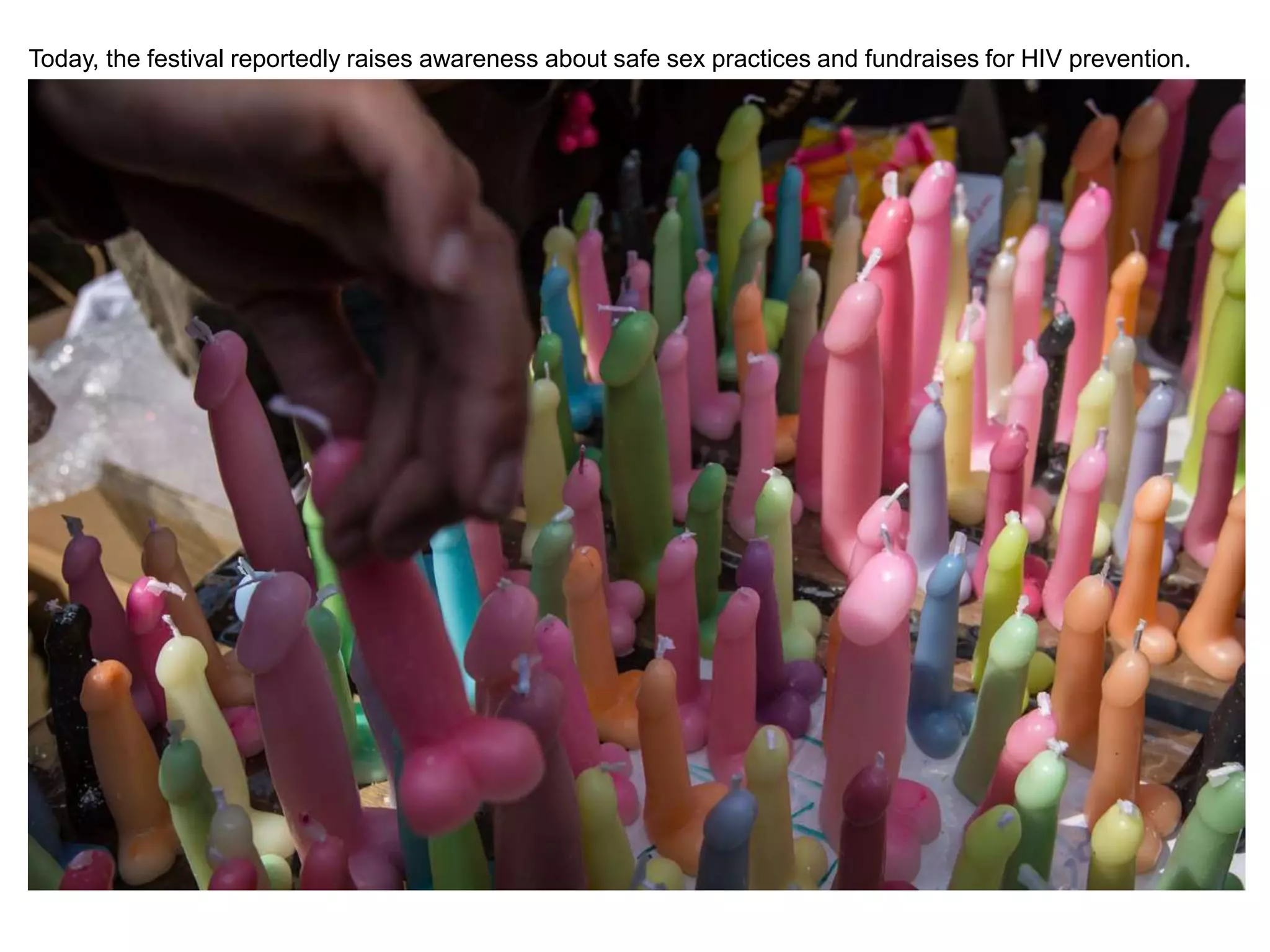
Today, the festival reportedly raises awareness about safe sex practices and fundraises for HIV prevention.
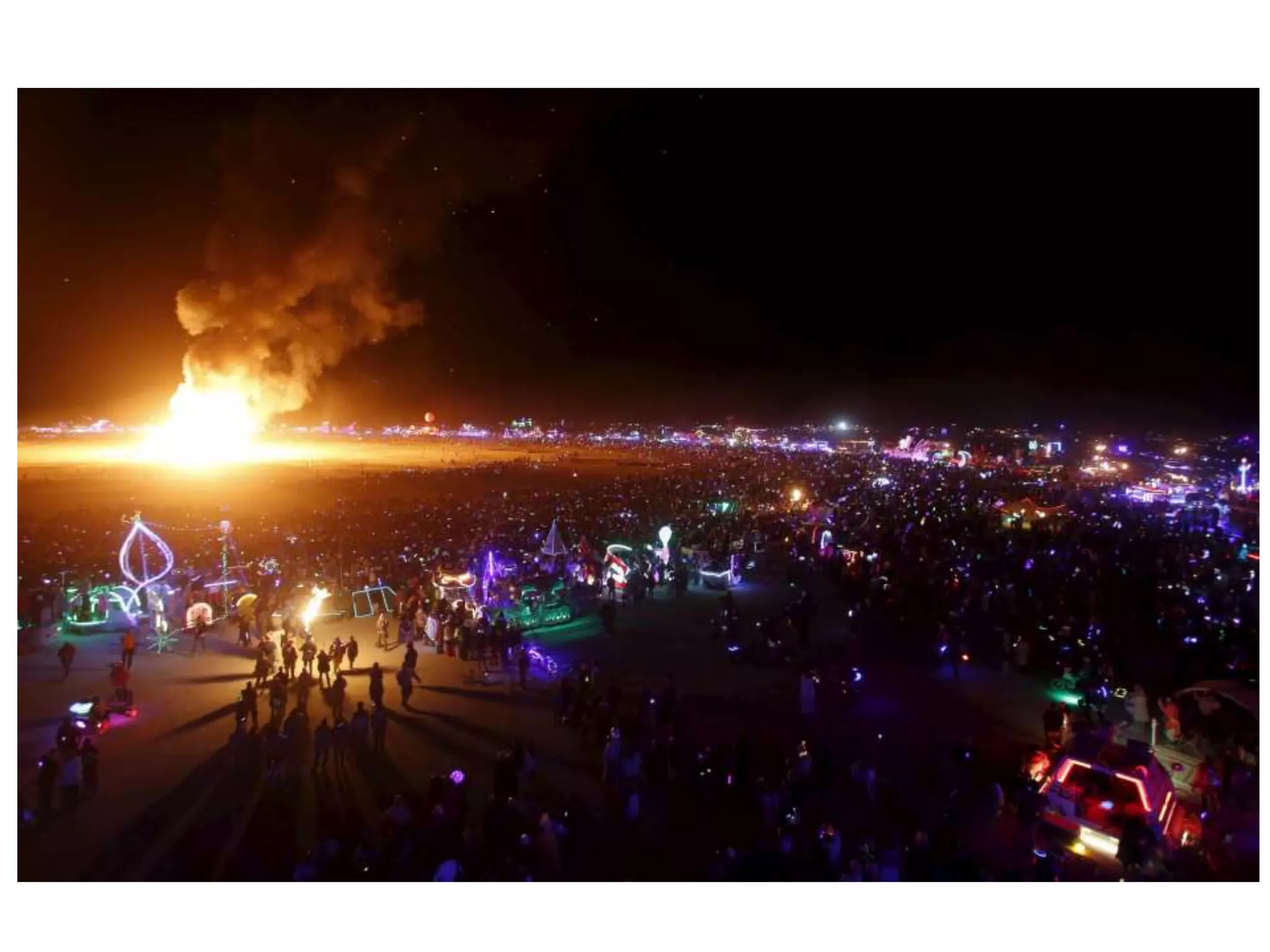
Burning Man Festival: Every year, participants in the Burning Man Festival descend on the playa of
Nevada's Black Rock Desert to form a temporary city—a self-reliant community populated by performers,
artists, free spirits, and more.
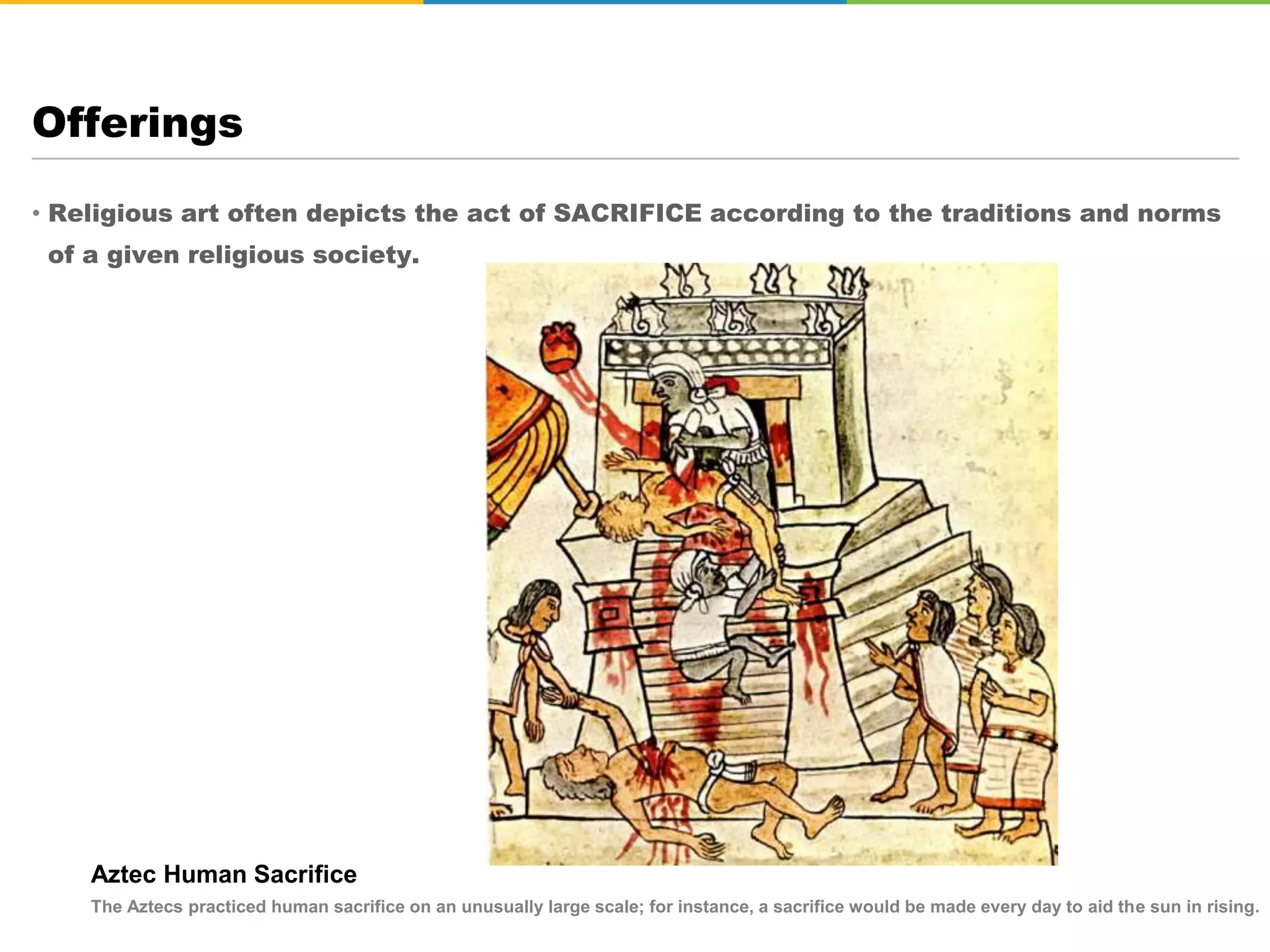
• Religious art often depicts the act of SACRIFICE according to the traditions and norms
of a given religious society.
Offerings
Aztec Human Sacrifice
The Aztecs practiced human sacrifice on an unusually large scale; for instance, a sacrifice would be made every day to aid the sun in rising.
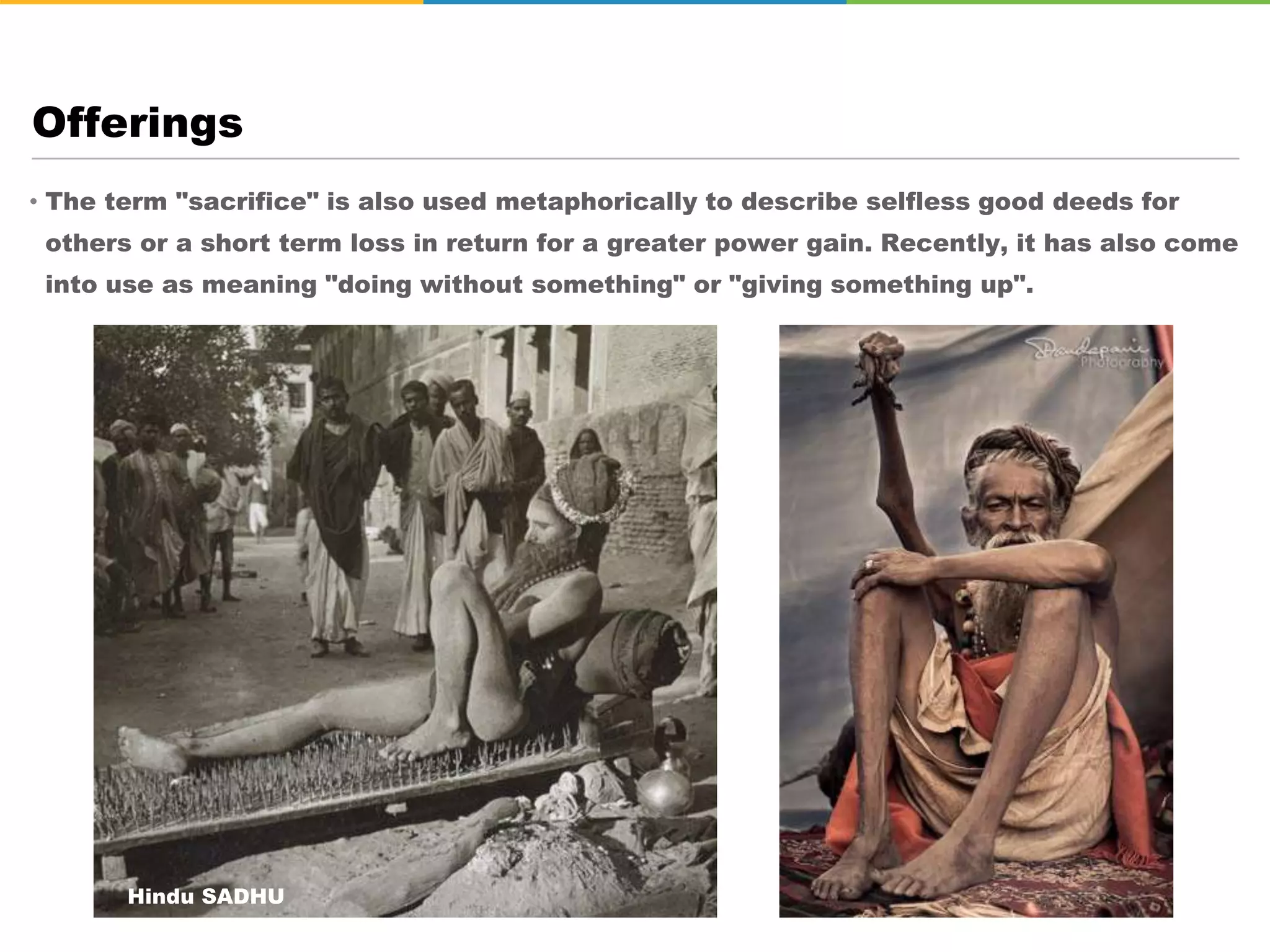
• The term "sacrifice" is also used metaphorically to describe selfless good deeds for
others or a short term loss in return for a greater power gain. Recently, it has also come
into use as meaning "doing without something" or "giving something up".
Offerings
Hindu SADHU
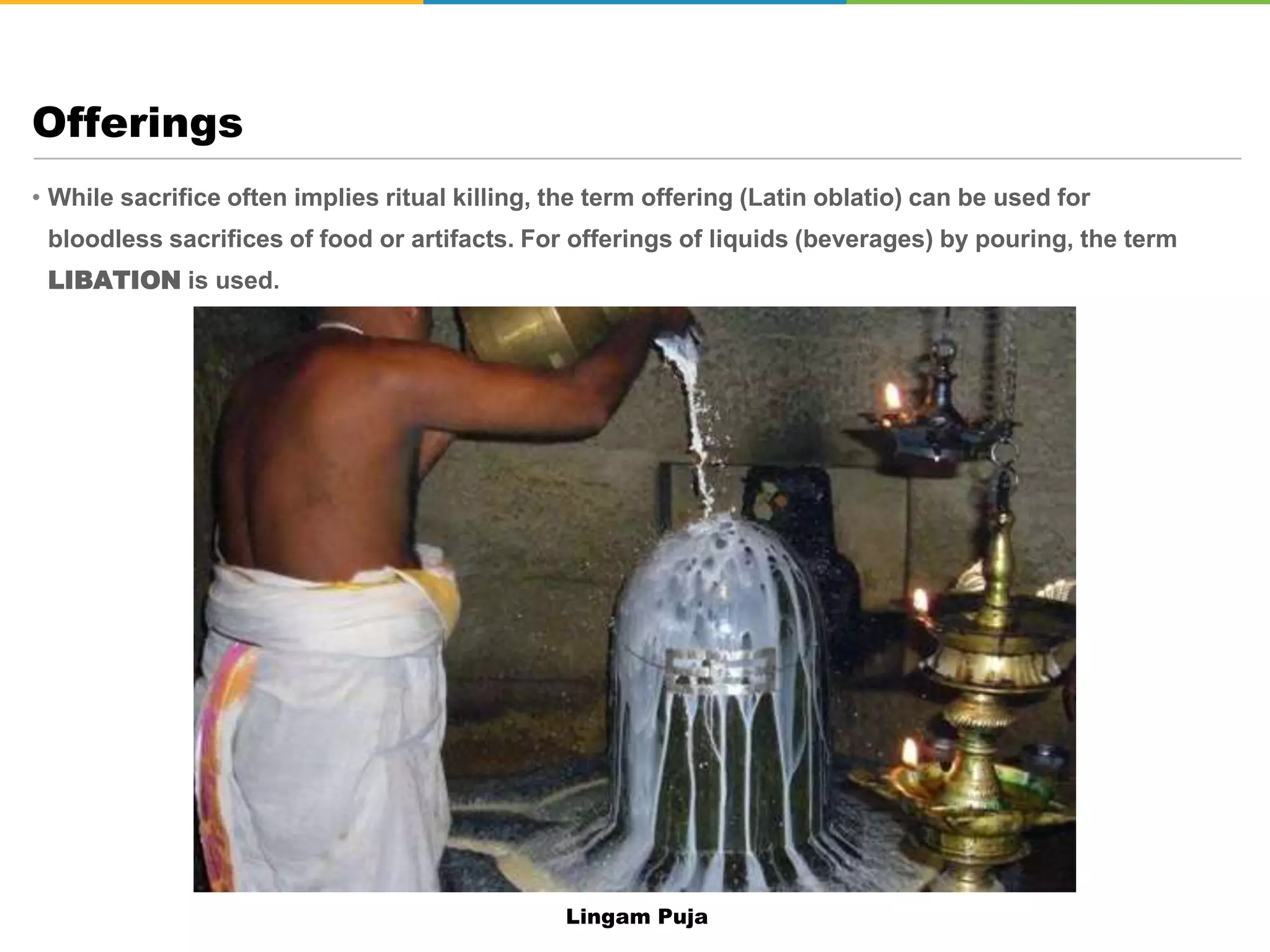
• While sacrifice often implies ritual killing, the term offering (Latin oblatio) can be used for
bloodless sacrifices of food or artifacts. For offerings of liquids (beverages) by pouring, the term
LIBATION is used.
Offerings
Lingam Puja
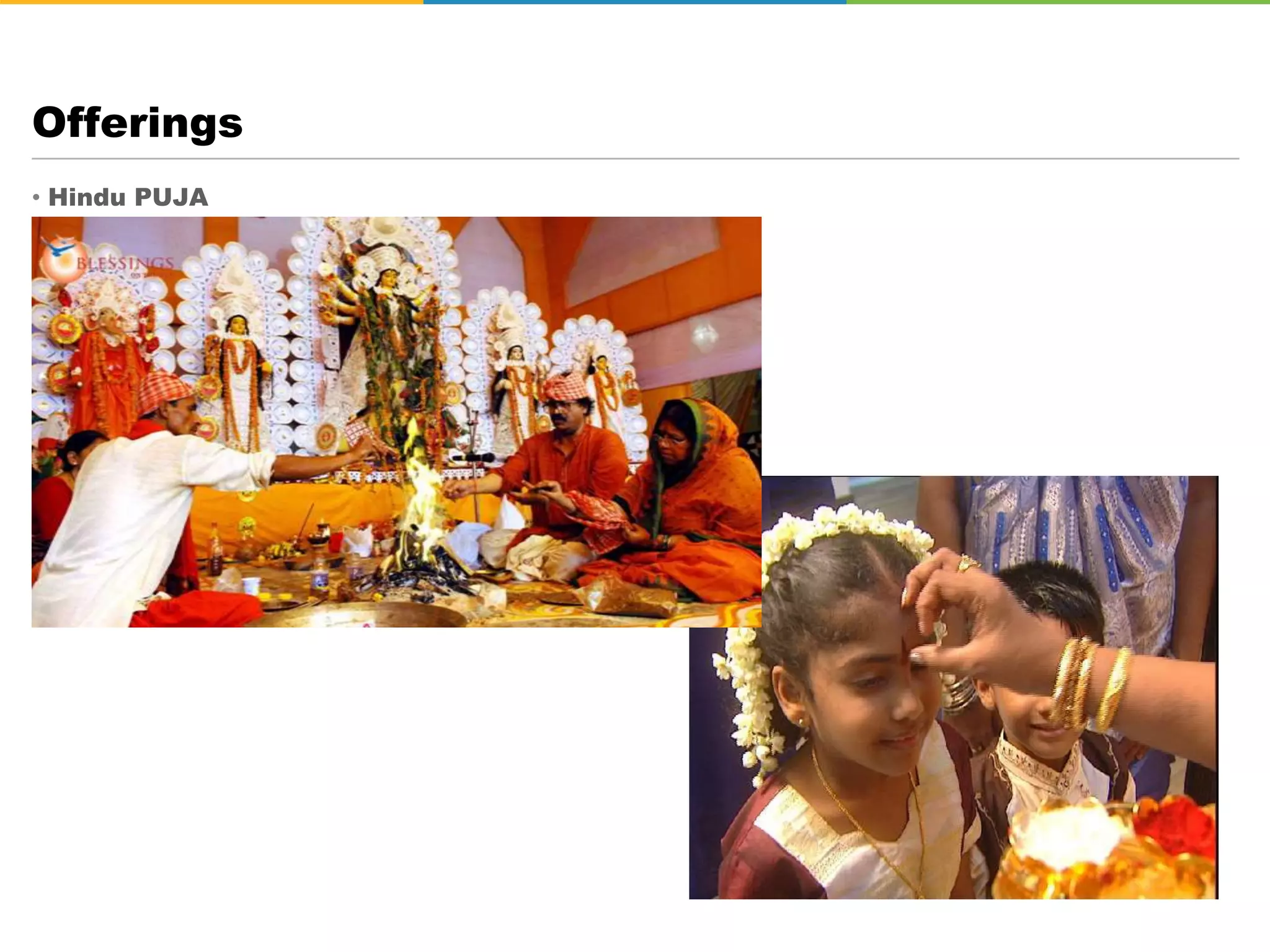
• Hindu PUJA
Offerings
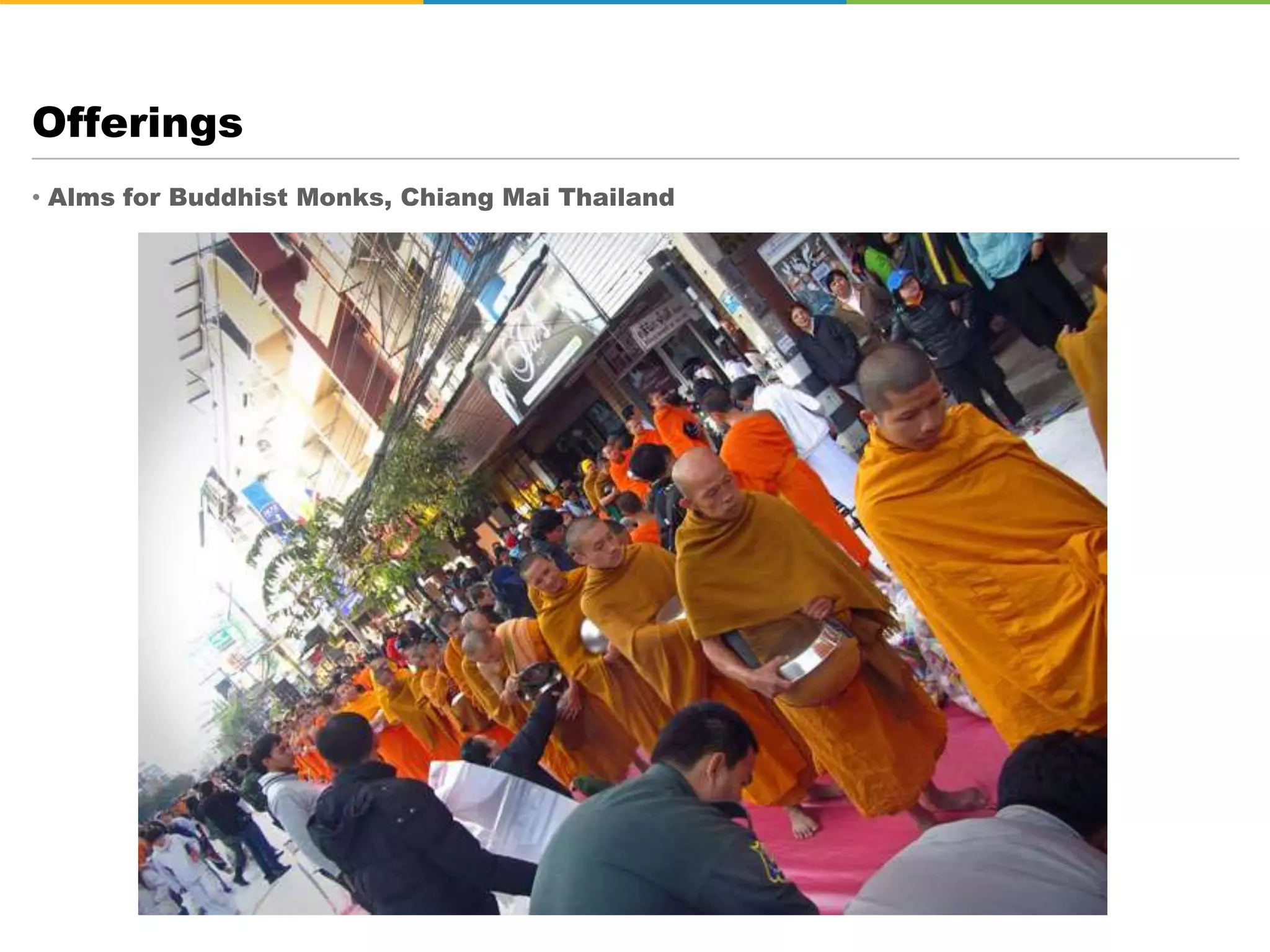
• Alms for Buddhist Monks, Chiang Mai Thailand
Offerings
• Images of animal sacrifice are prevalent in religious art from various cultures, including ancient
polytheist religions, Christian, Judaic, and Islam.
• Animal sacrifice is the ritual killing of an animal as part of a religion; it is practiced by
adherents of many religions as a means of appeasing a god or gods or changing the course of
nature. Human sacrifice was also practiced by many ancient cultures.
Sacrifices
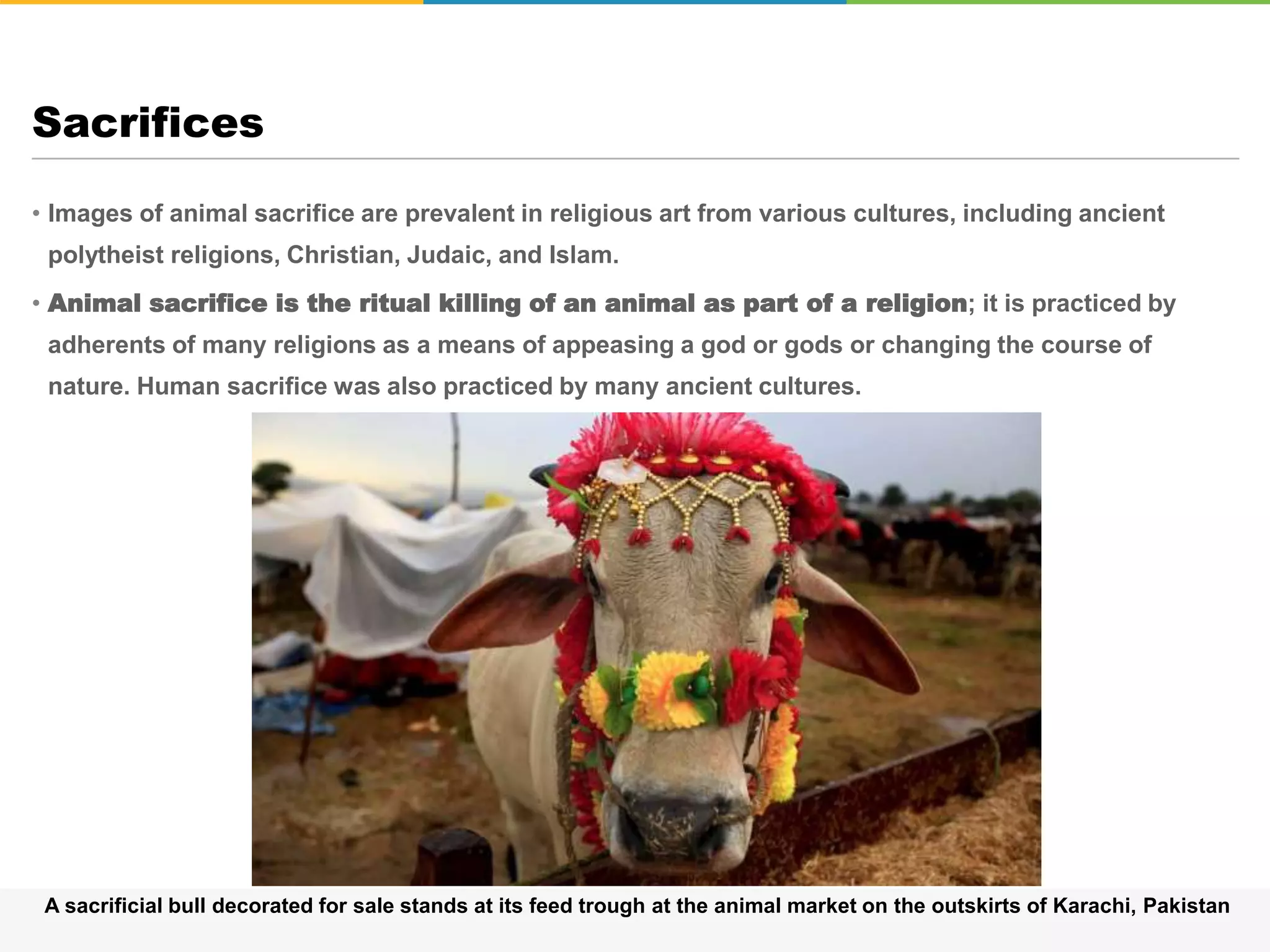
A sacrificial bull decorated for sale stands at its feed trough at the animal market on the outskirts of Karachi, Pakistan
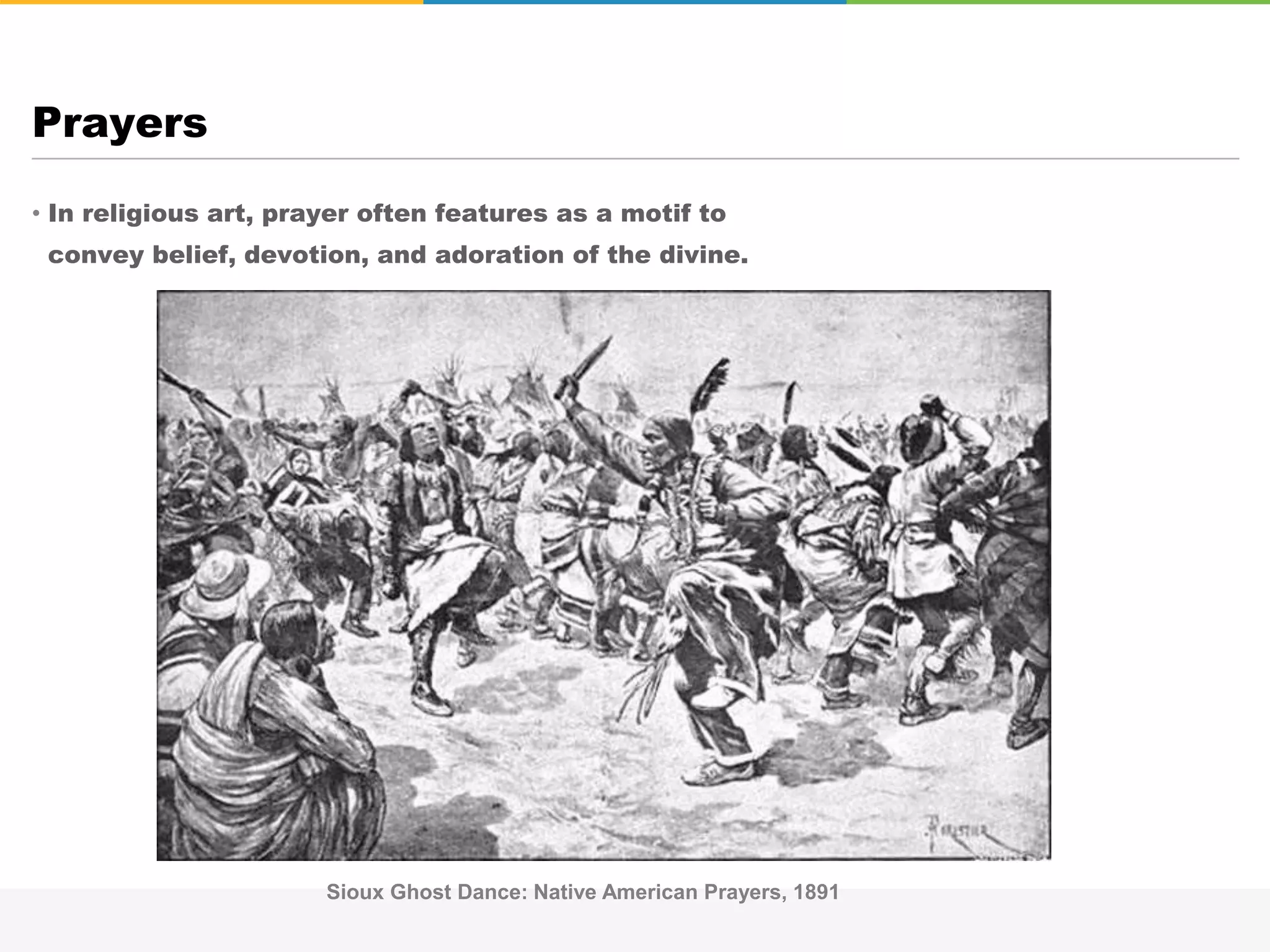
• In religious art, prayer often features as a motif to
convey belief, devotion, and adoration of the divine.
Prayers
Sioux Ghost Dance: Native American Prayers, 1891
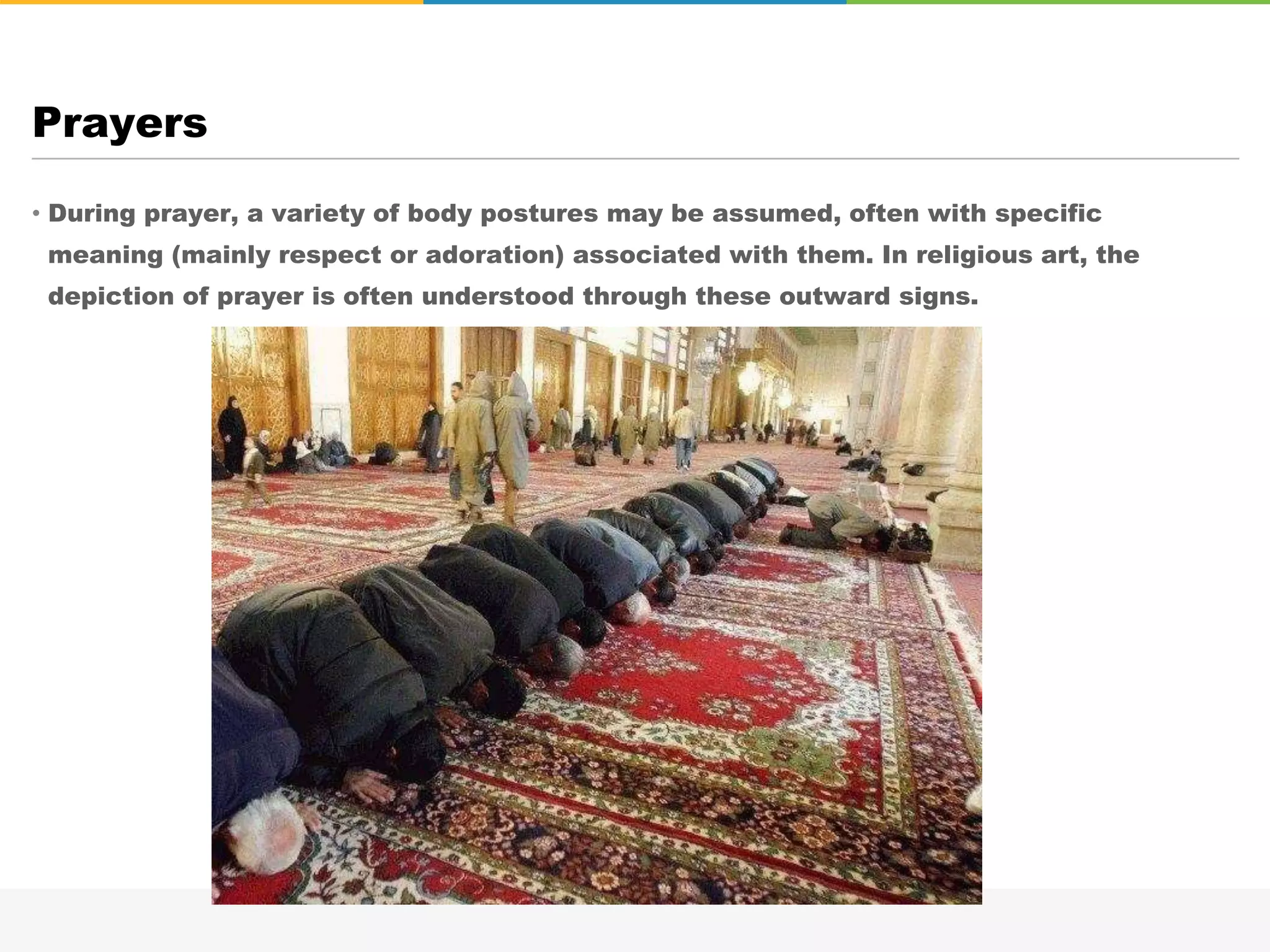
• During prayer, a variety of body postures may be assumed, often with specific
meaning (mainly respect or adoration) associated with them. In religious art, the
depiction of prayer is often understood through these outward signs.
Prayers
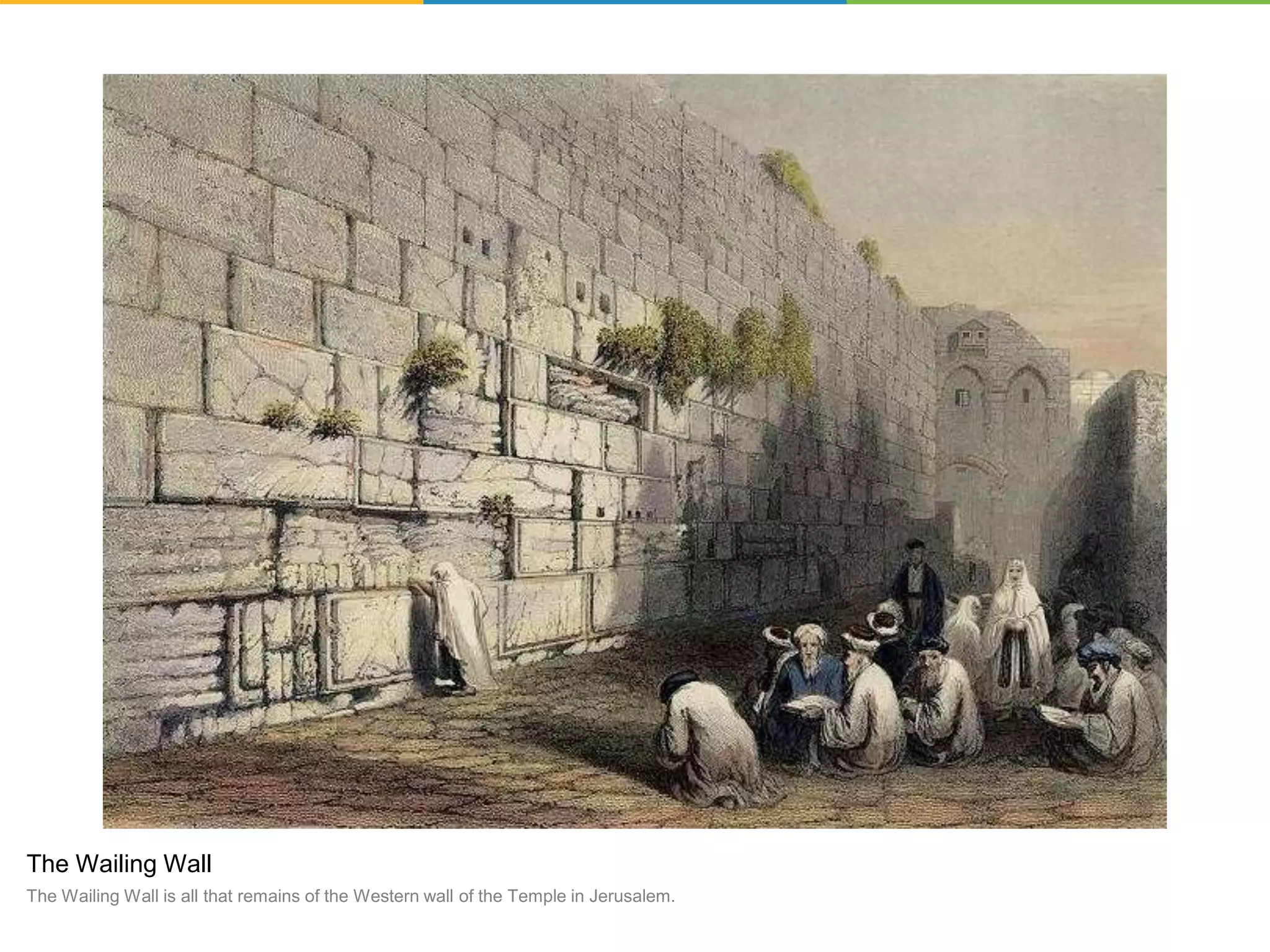
The Wailing Wall
The Wailing Wall is all that remains of the Western wall of the Temple in Jerusalem.
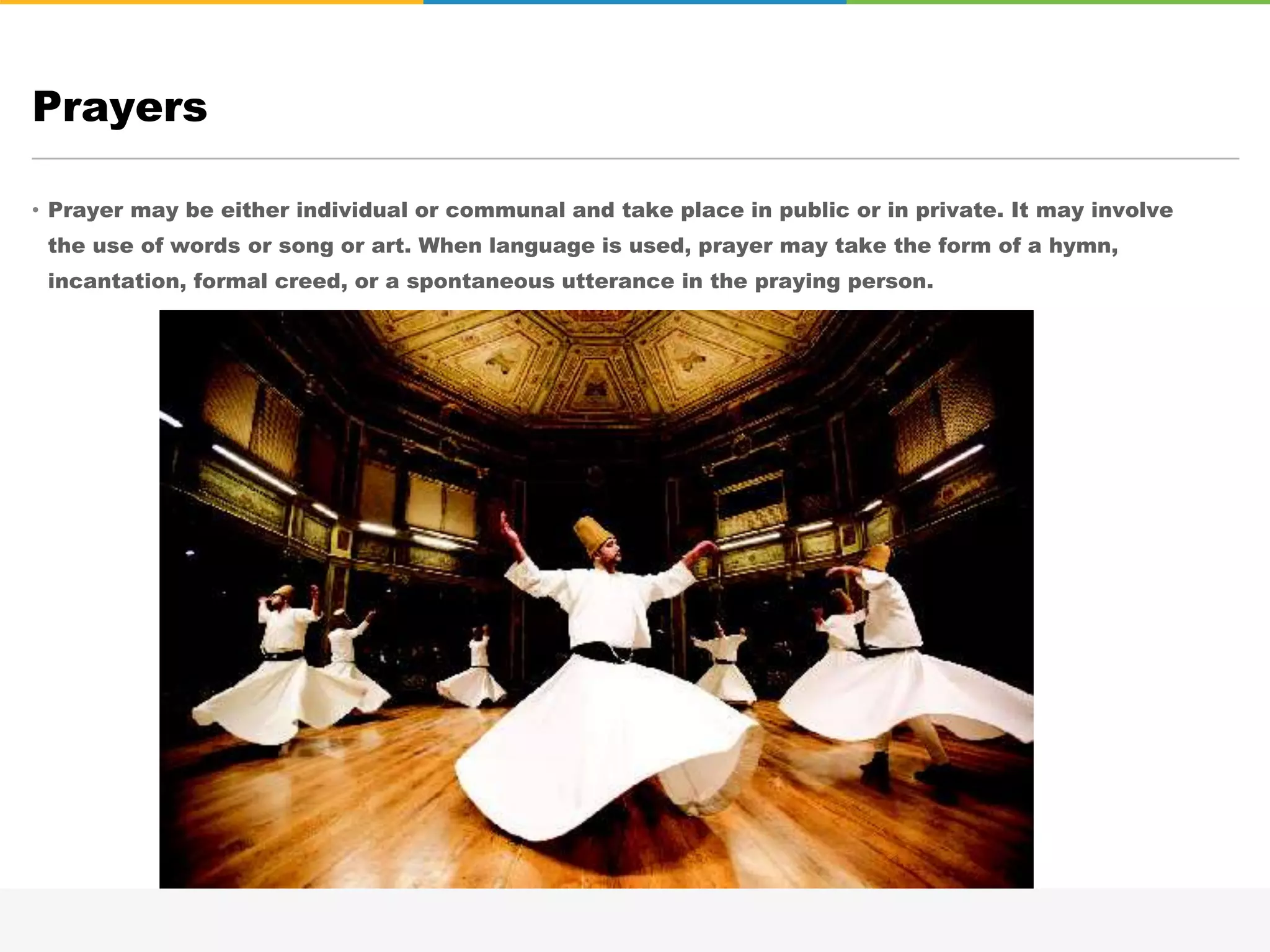
• Prayer may be either individual or communal and take place in public or in private. It may involve
the use of words or song or art. When language is used, prayer may take the form of a hymn,
incantation, formal creed, or a spontaneous utterance in the praying person.
Prayers
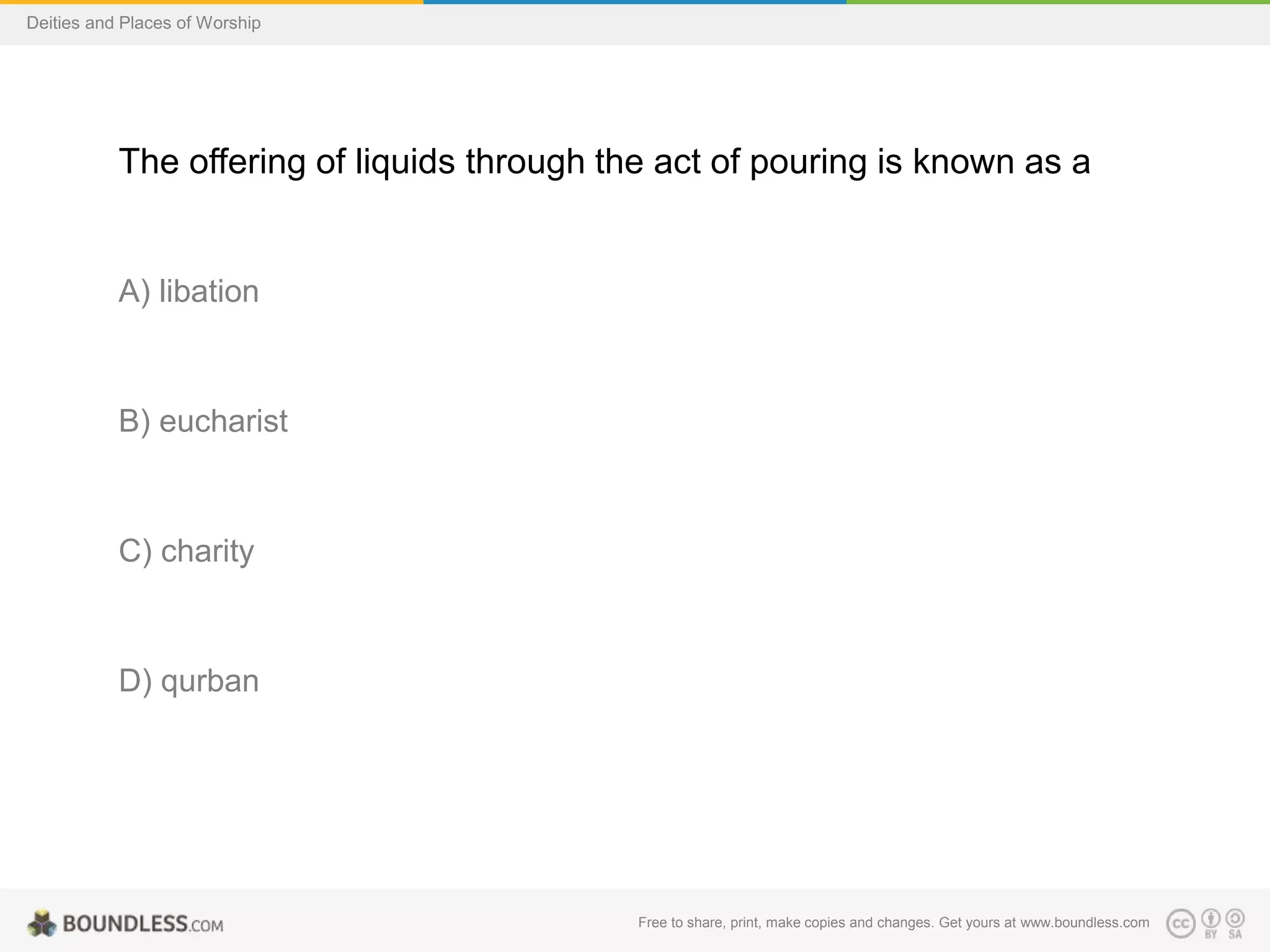
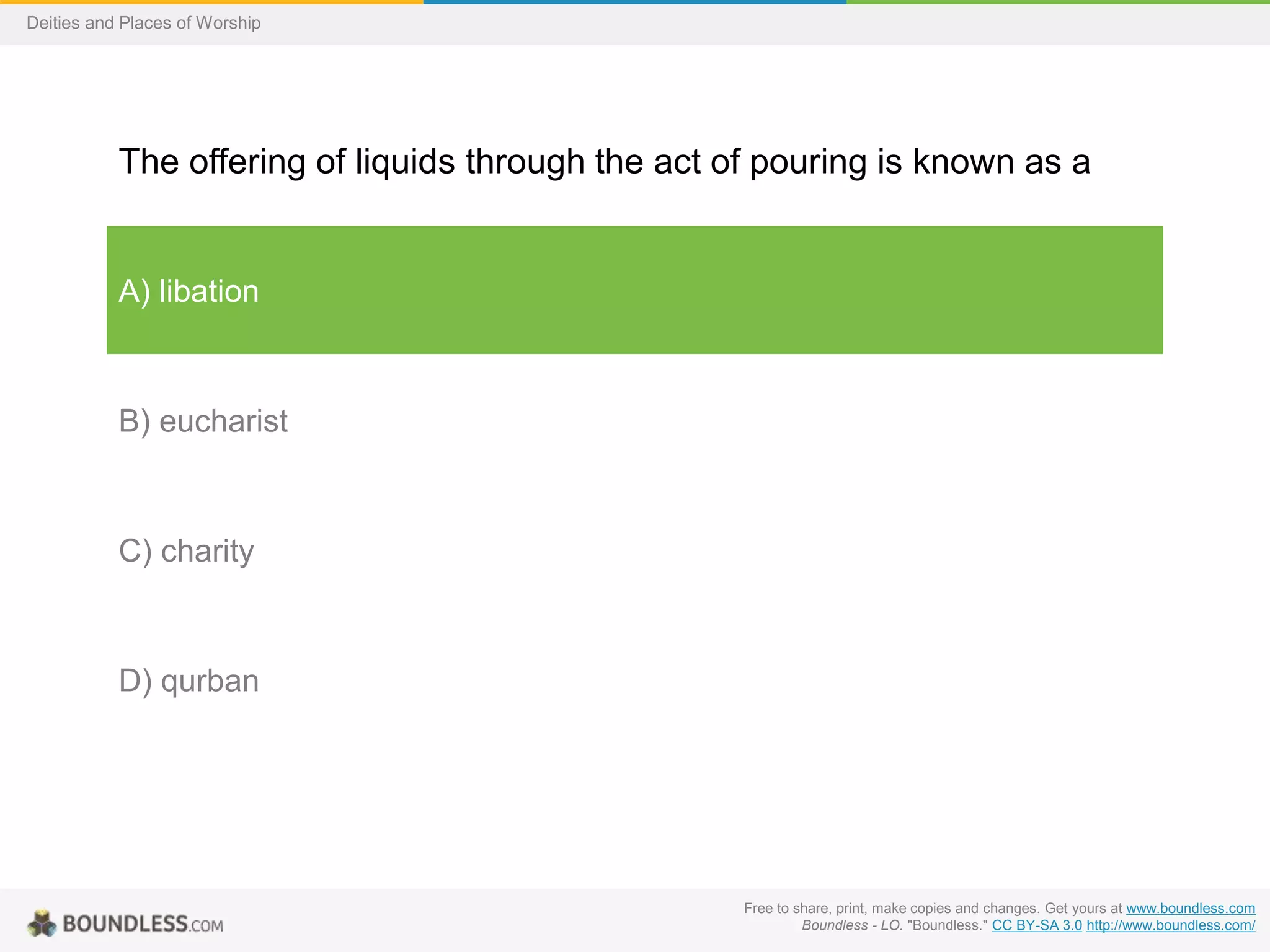
5. The offering of liquids through the act of pouring is known as a
A) libation
B) eucharist
C) charity
D) qurban
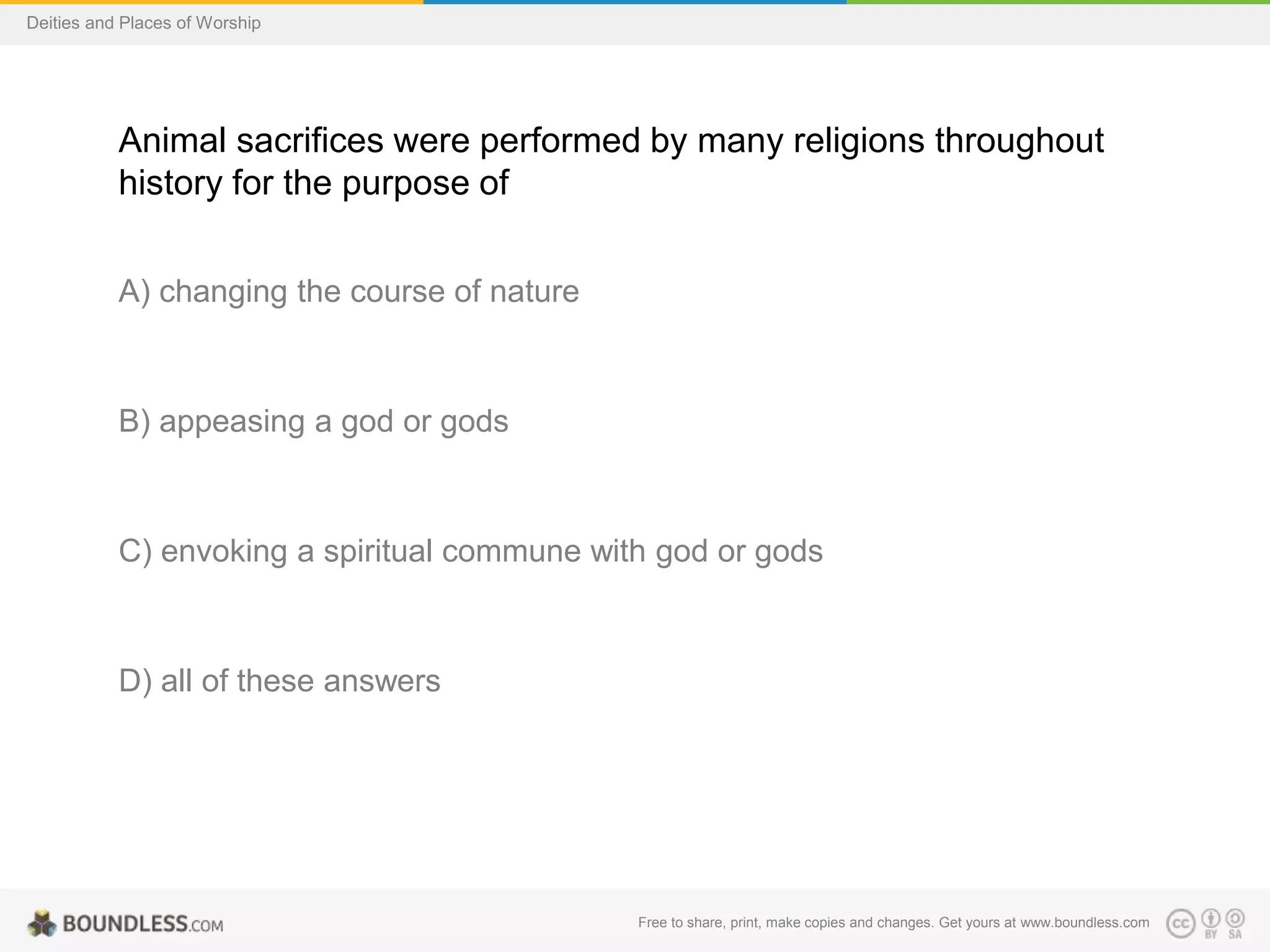
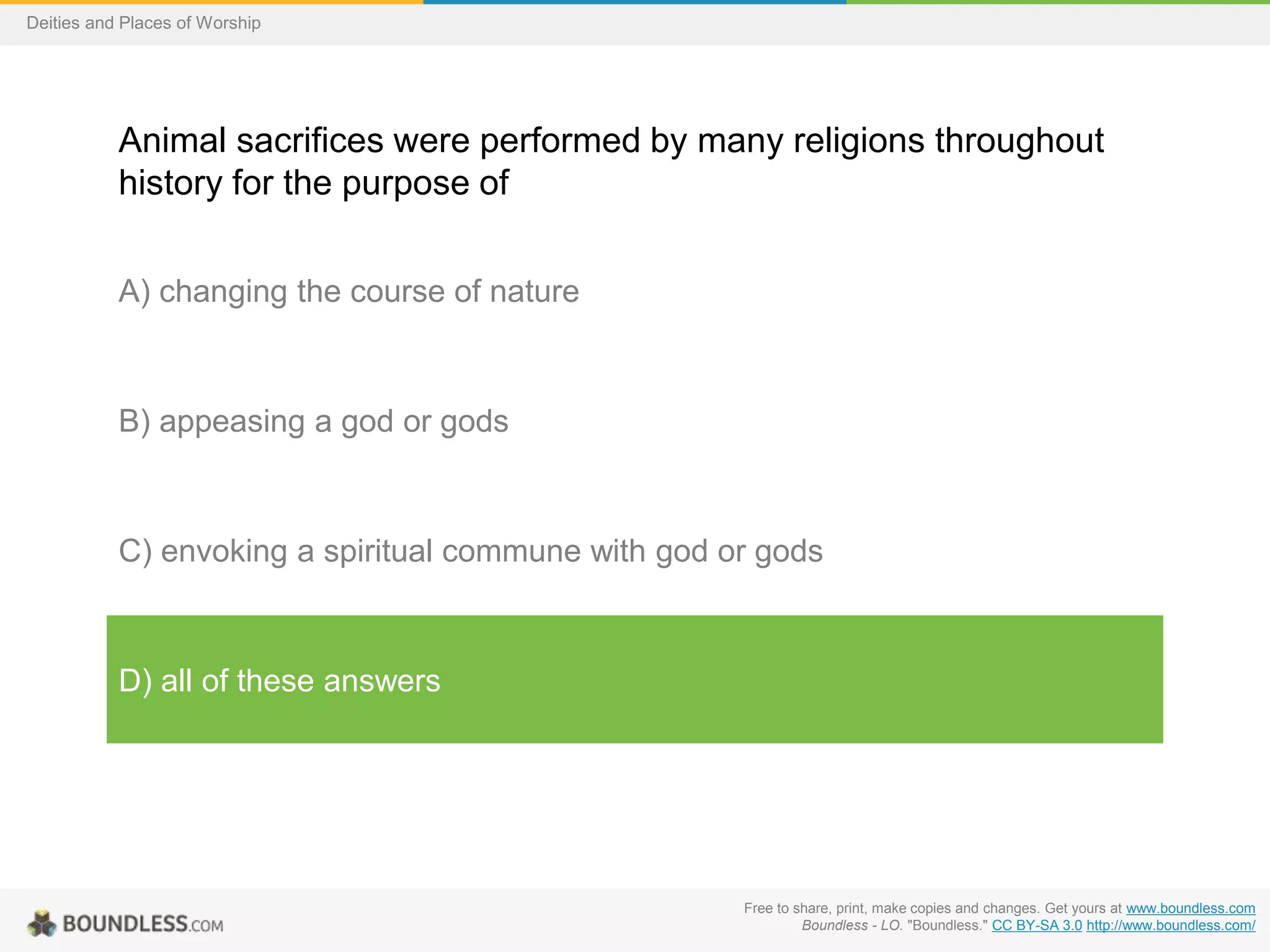
6. Animal sacrifices were performed by many religions throughout
history for the purpose of
A) changing the course of nature
B) appeasing a god or gods
C) envoking a spiritual commune with god or gods
D) all of these answers
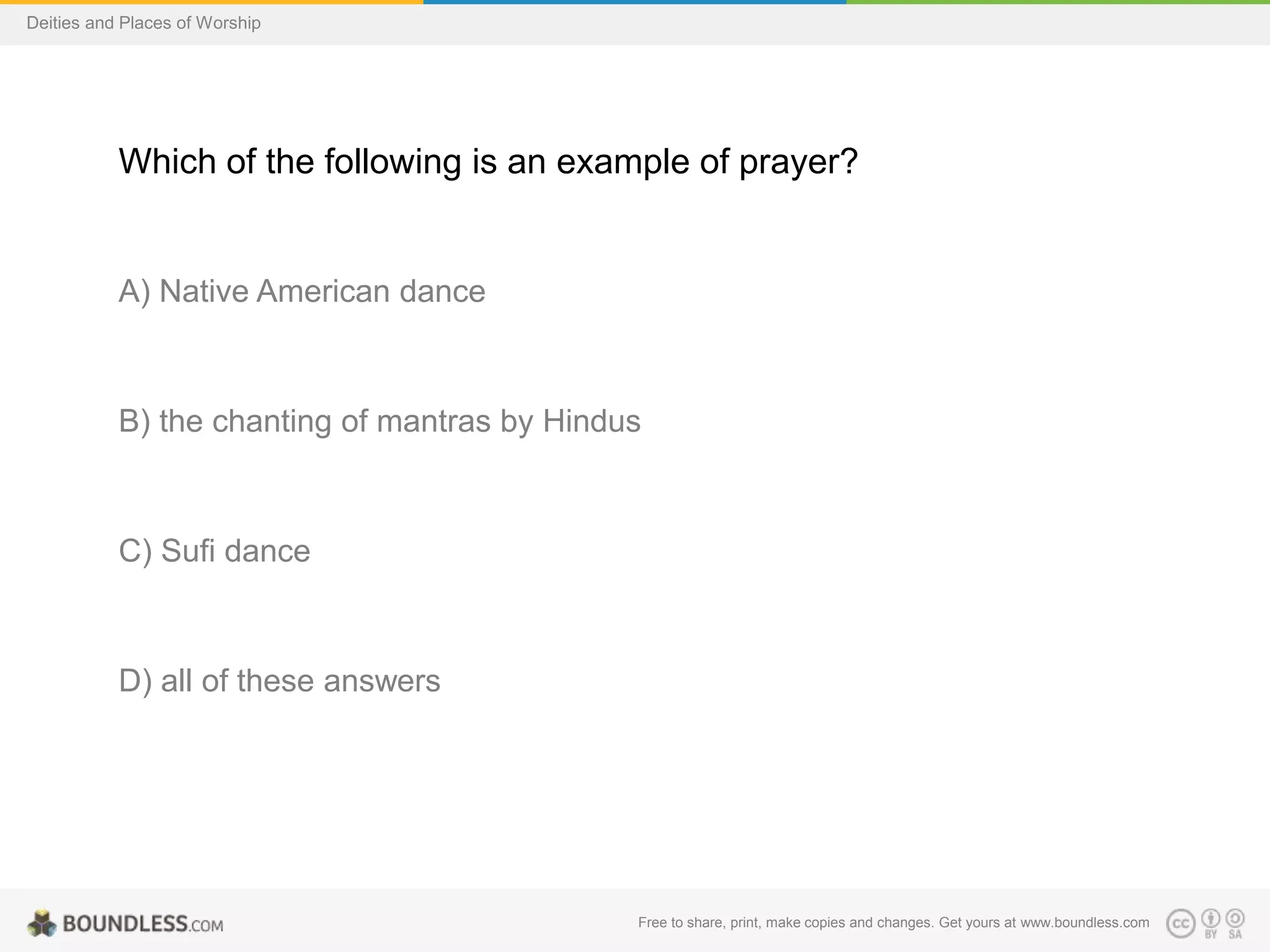
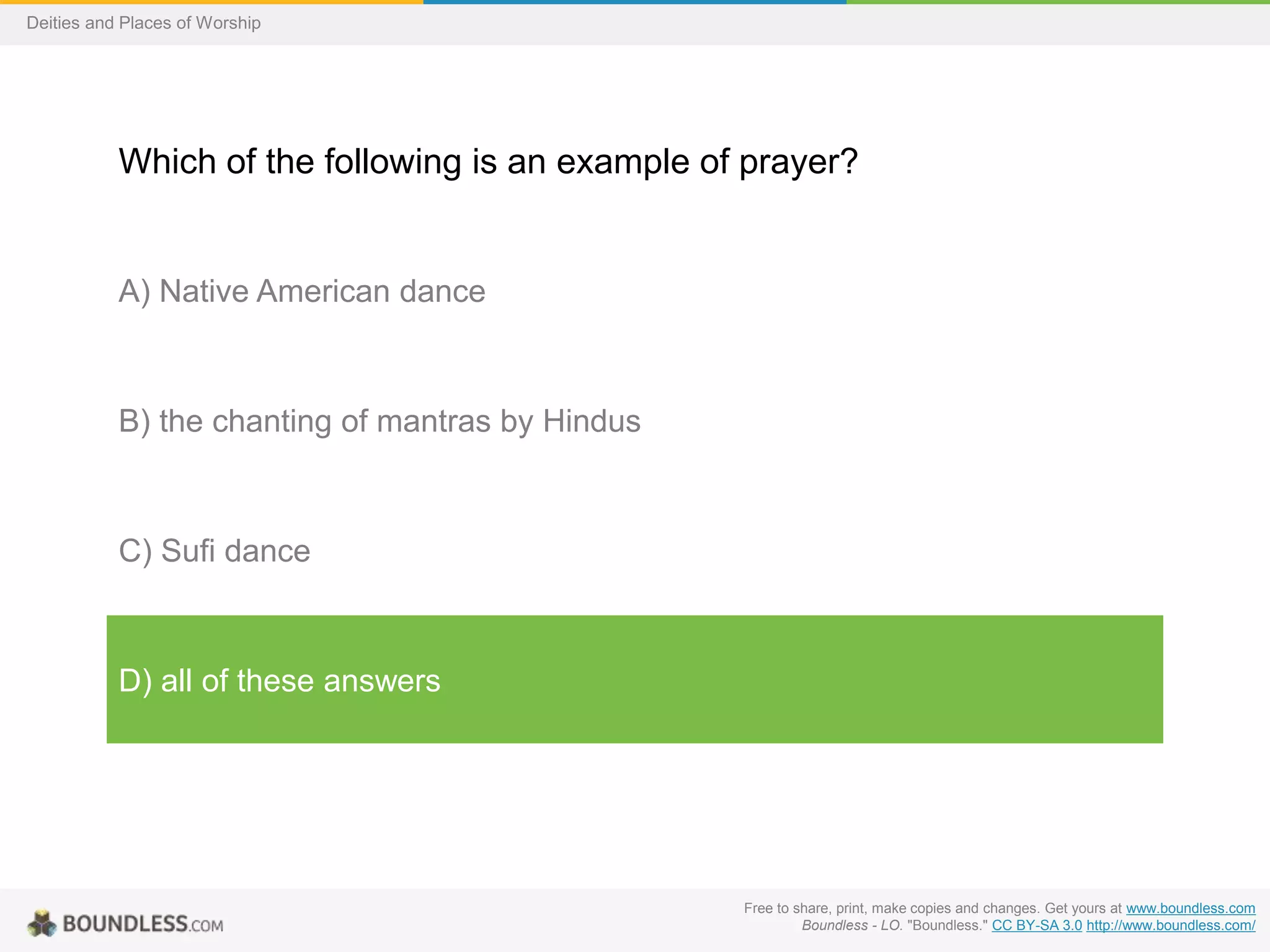
7. Which of the following is an example of prayer?
A) Native American dance
B) the chanting of mantras by Hindus
C) Sufi dance
D) all of these answers
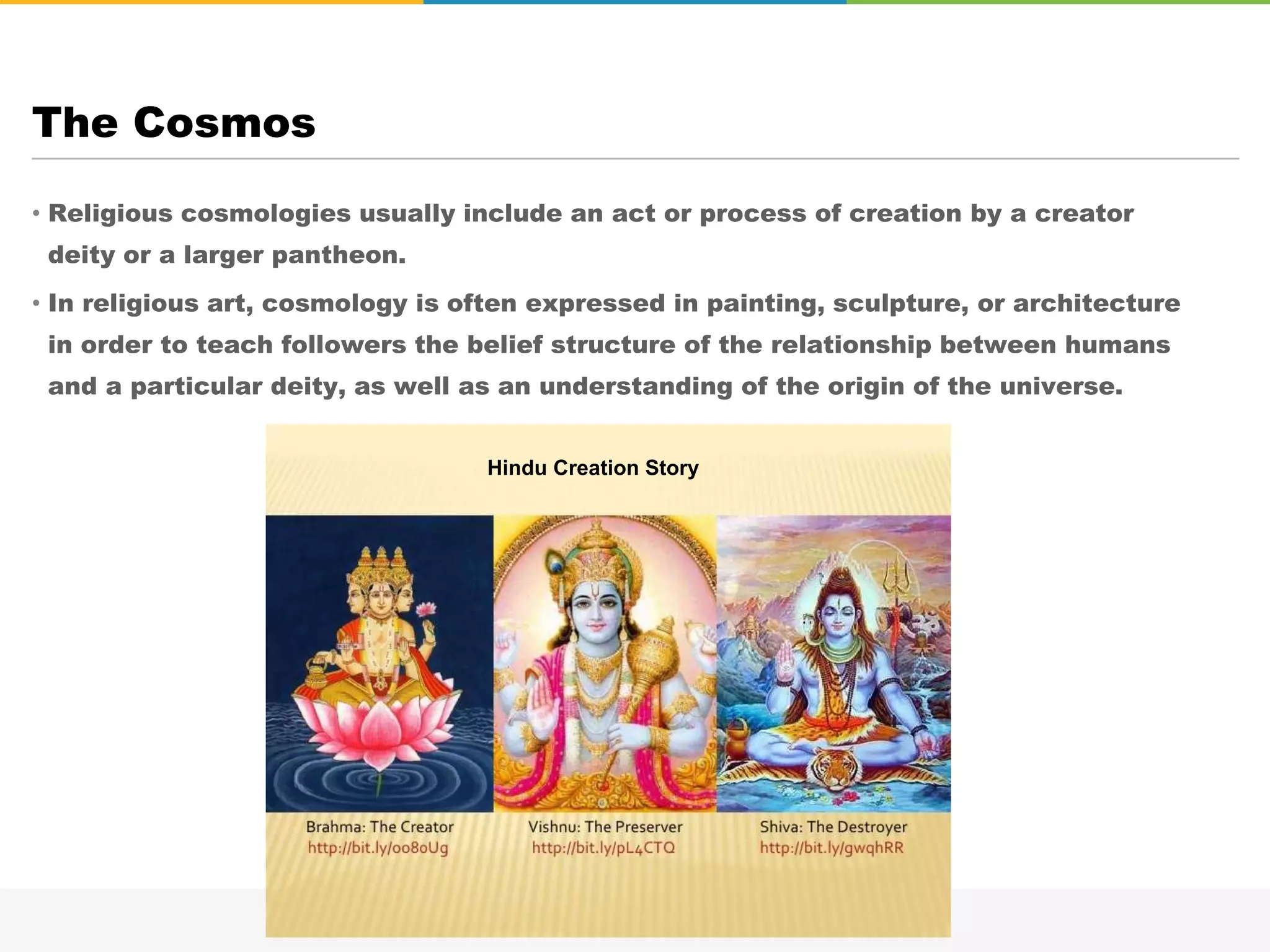
• Religious cosmologies usually include an act or process of creation by a creator
deity or a larger pantheon.
• In religious art, cosmology is often expressed in painting, sculpture, or architecture
in order to teach followers the belief structure of the relationship between humans
and a particular deity, as well as an understanding of the origin of the universe.
The Cosmos
Hindu Creation Story
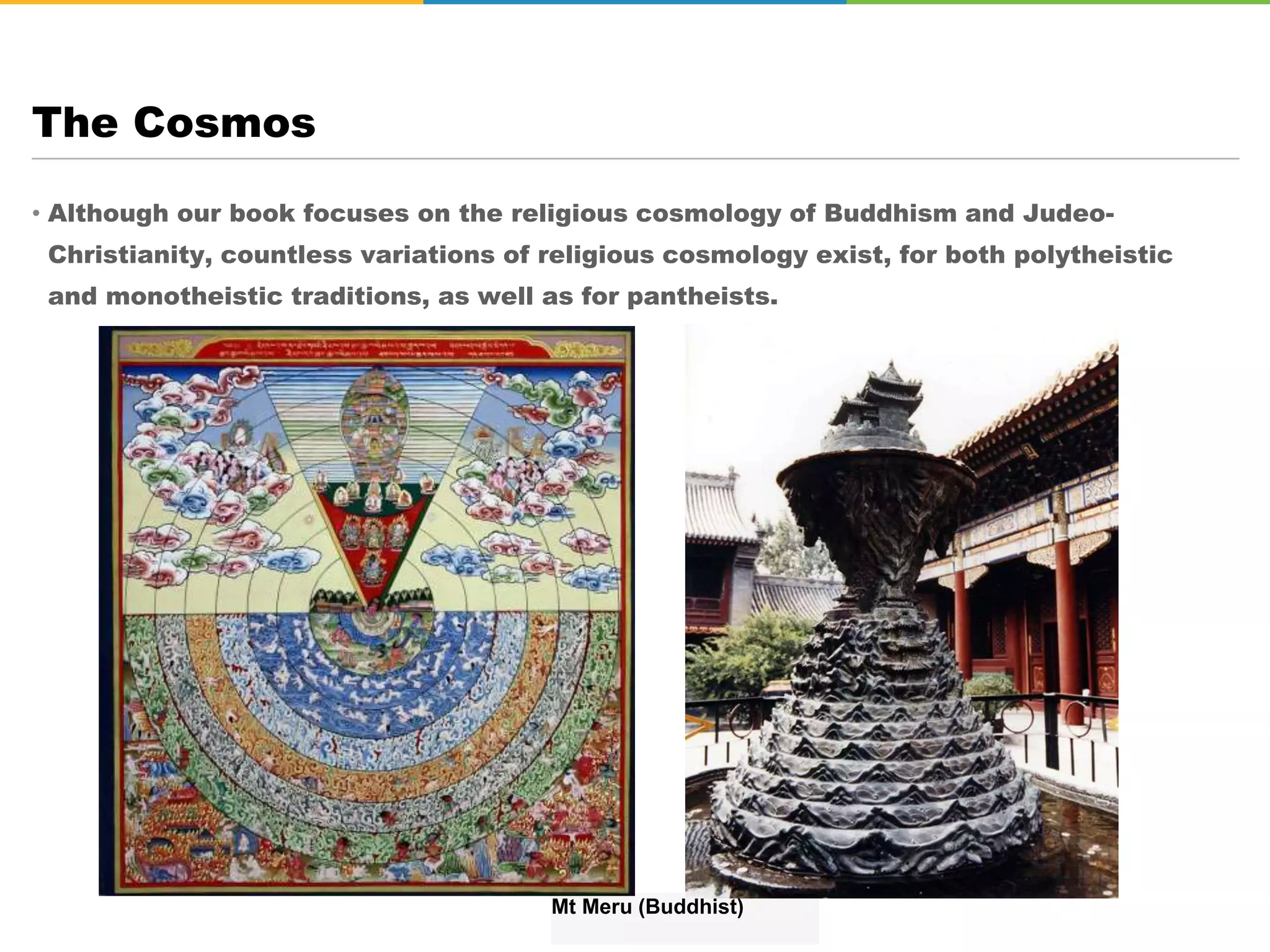
• Although our book focuses on the religious cosmology of Buddhism and Judeo-
Christianity, countless variations of religious cosmology exist, for both polytheistic
and monotheistic traditions, as well as for pantheists.
The Cosmos
Mt Meru (Buddhist)
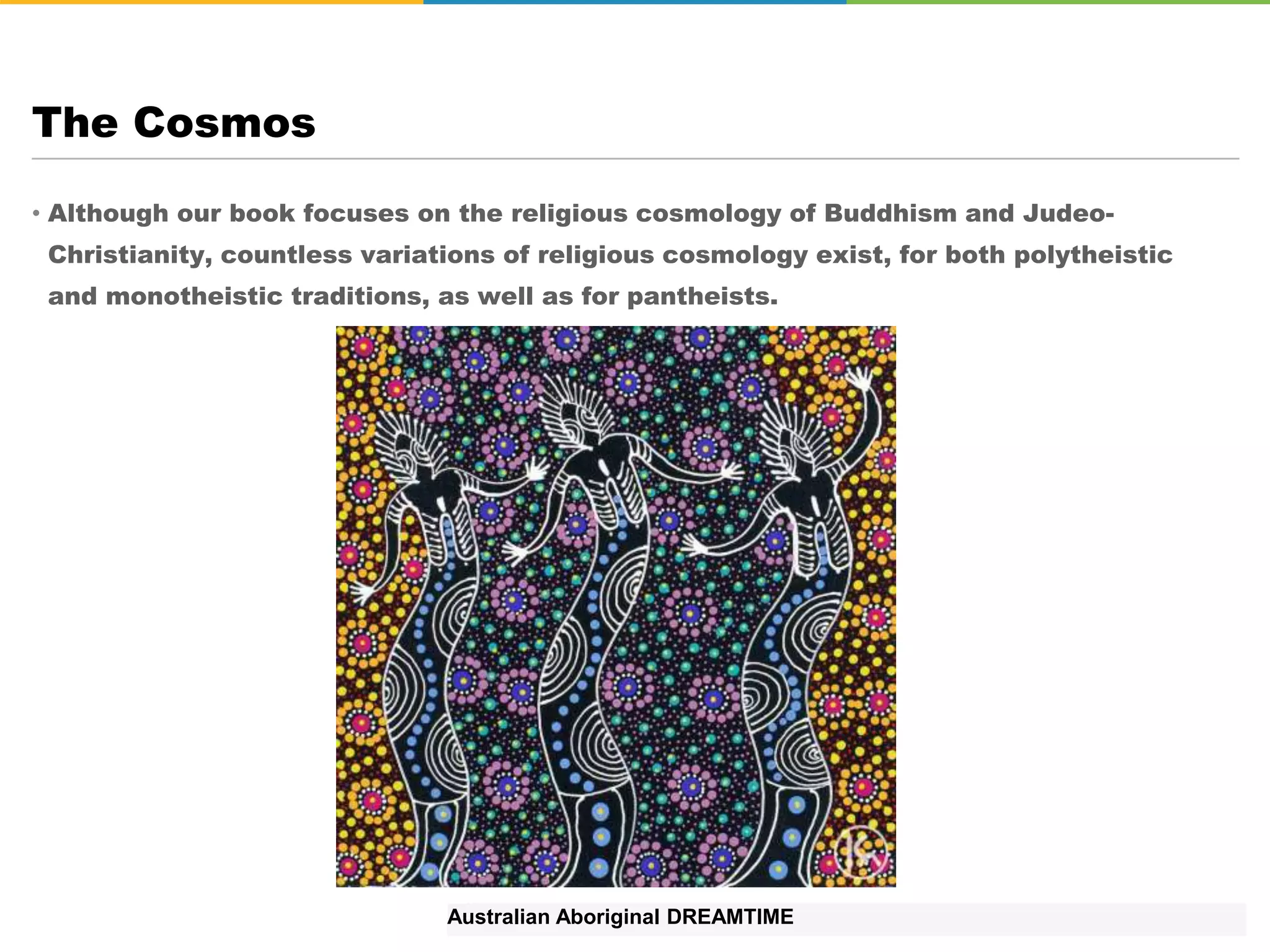
• Although our book focuses on the religious cosmology of Buddhism and Judeo-
Christianity, countless variations of religious cosmology exist, for both polytheistic
and monotheistic traditions, as well as for pantheists.
The Cosmos
Australian Aboriginal DREAMTIME
• Sacred Objects
• Elements of Nature
• Geometric Symbolism
• Sacred Ceremonies and Pilgrimages
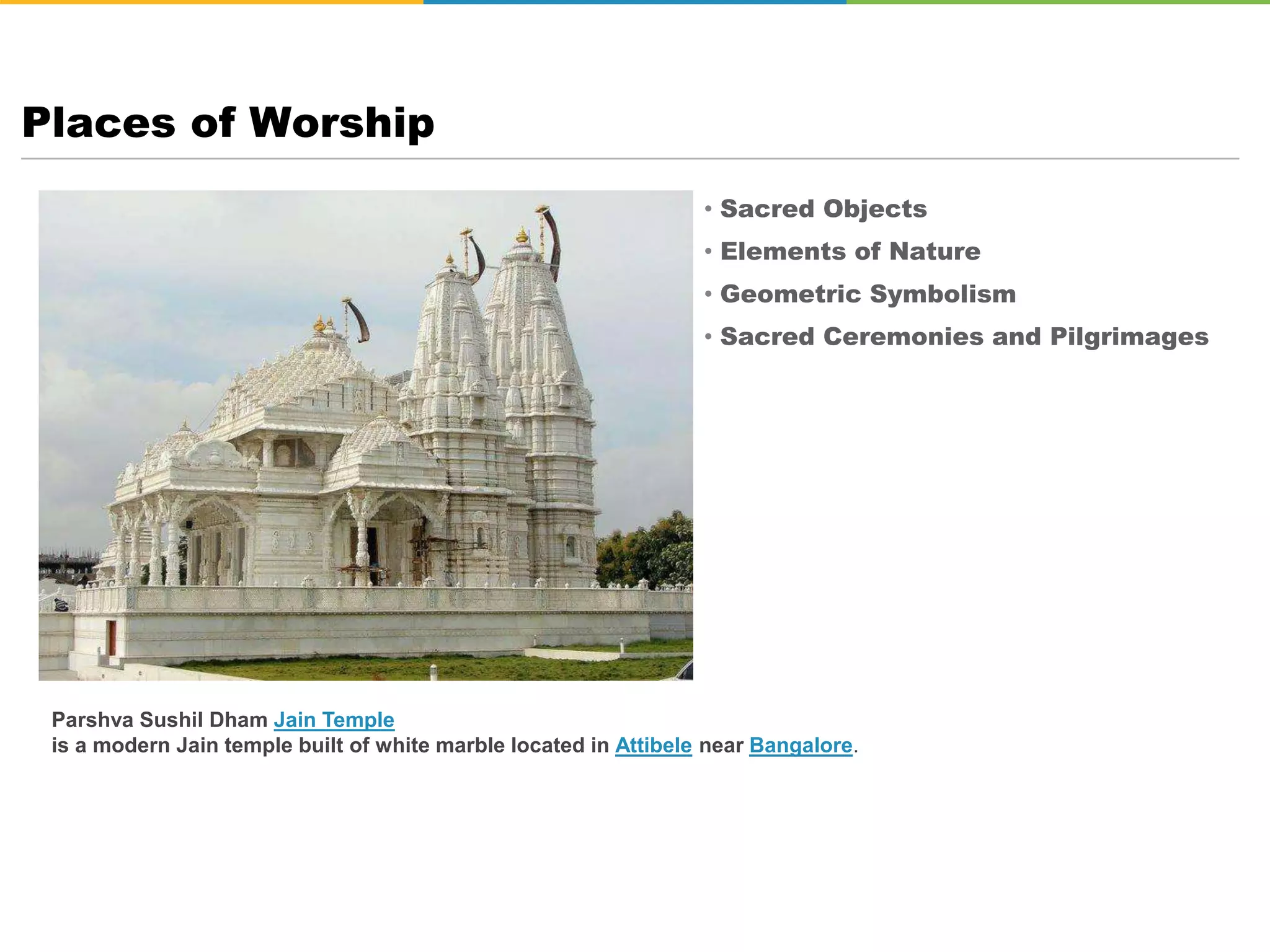
Places of Worship
Parshva Sushil Dham Jain Temple
is a modern Jain temple built of white marble located in Attibele near Bangalore.
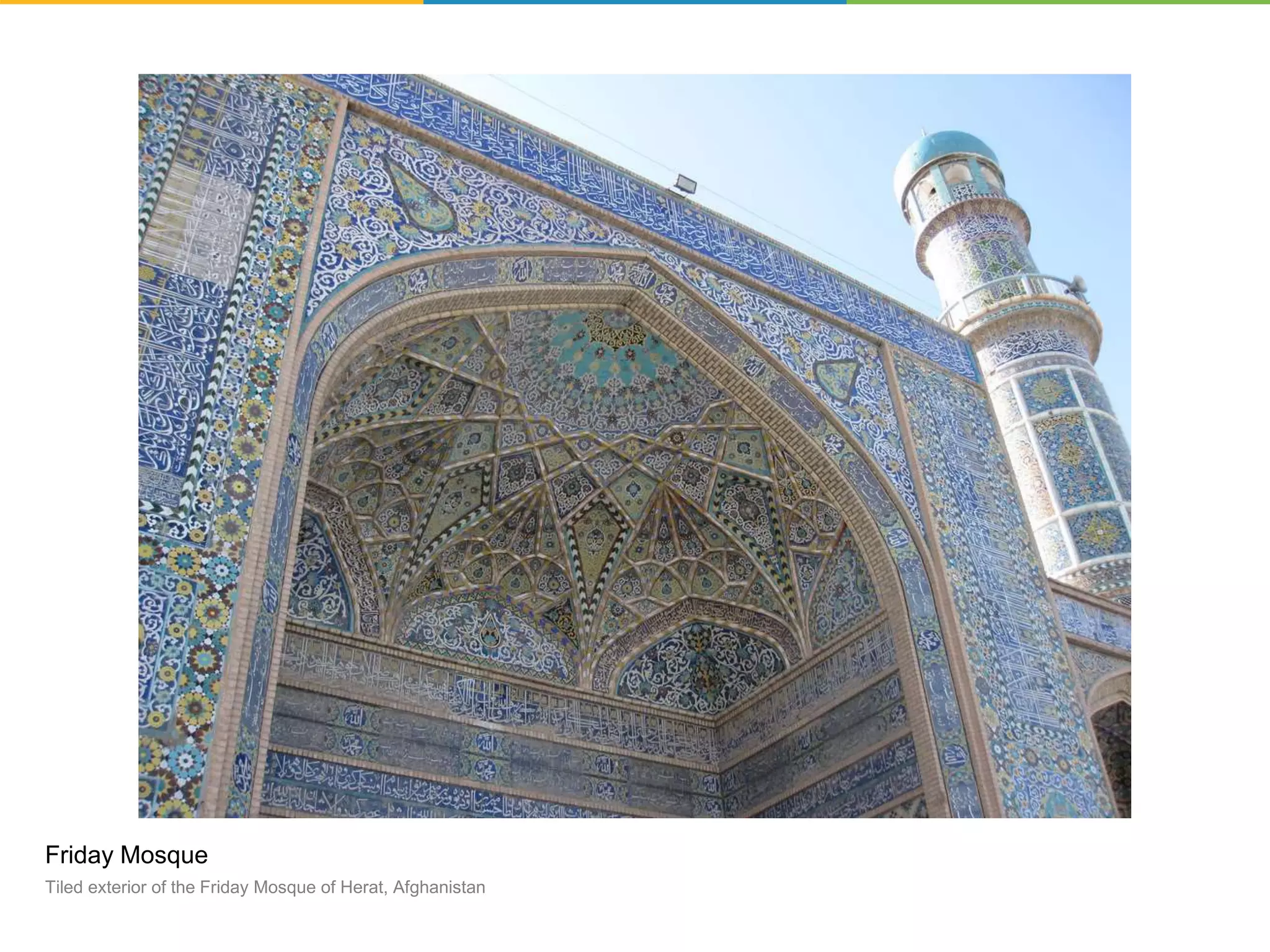
Friday Mosque
Tiled exterior of the Friday Mosque of Herat, Afghanistan
• A sacred art object refers to art that makes use of religious inspiration and motifs.
• The 10 largest organized religions of the world -- Buddhism, Hinduism, Christianity, Islam, Confucianism, Judaism,
Sikhism, Baha'i, Jainism and Shinto – ALL have longstanding traditions that relate to sacred objects.
Sacred Objects
Tibetan Buddhist ritual objects, the vajra and the phurba.
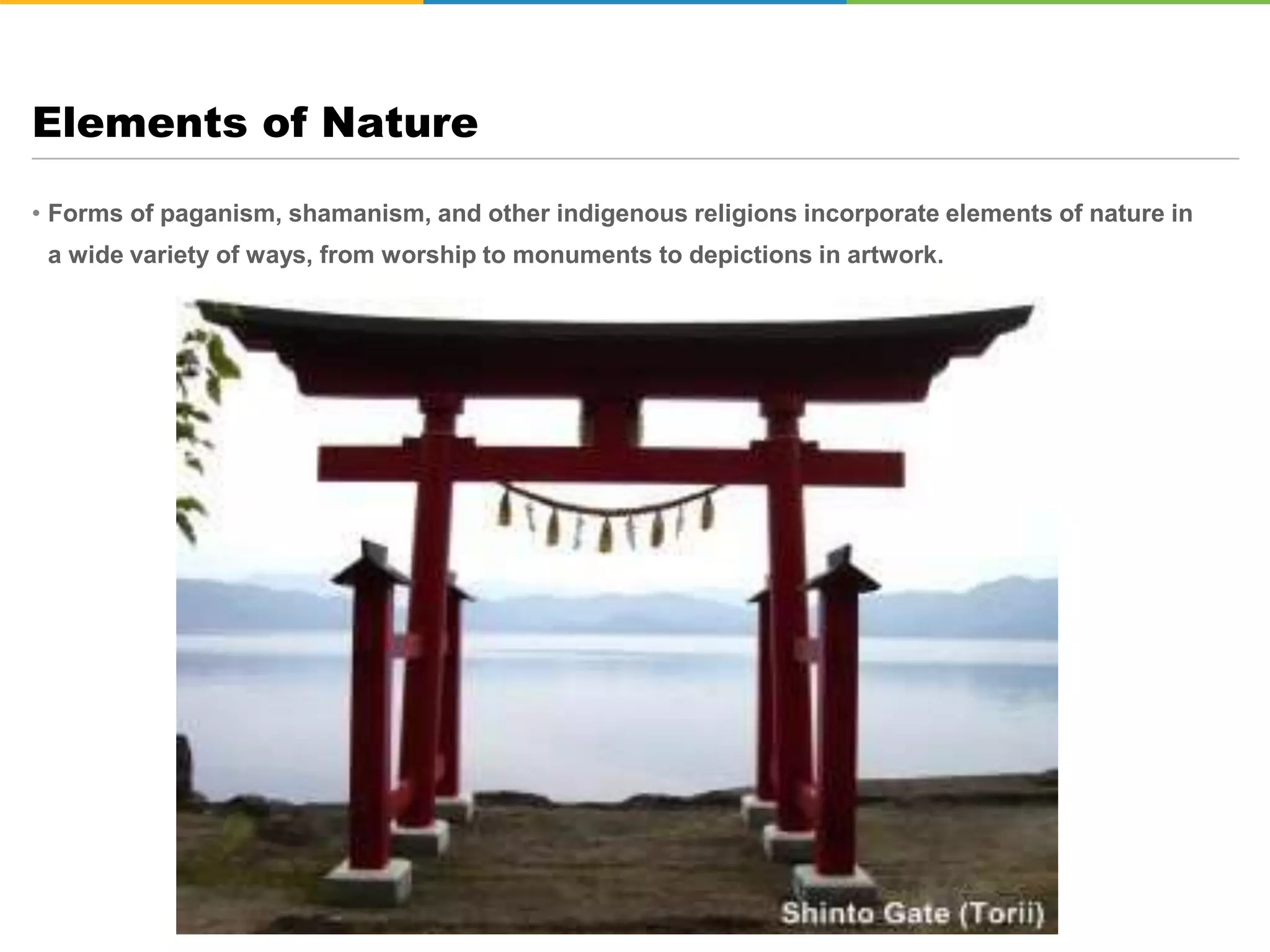
• Forms of paganism, shamanism, and other indigenous religions incorporate elements of nature in
a wide variety of ways, from worship to monuments to depictions in artwork.
Elements of Nature
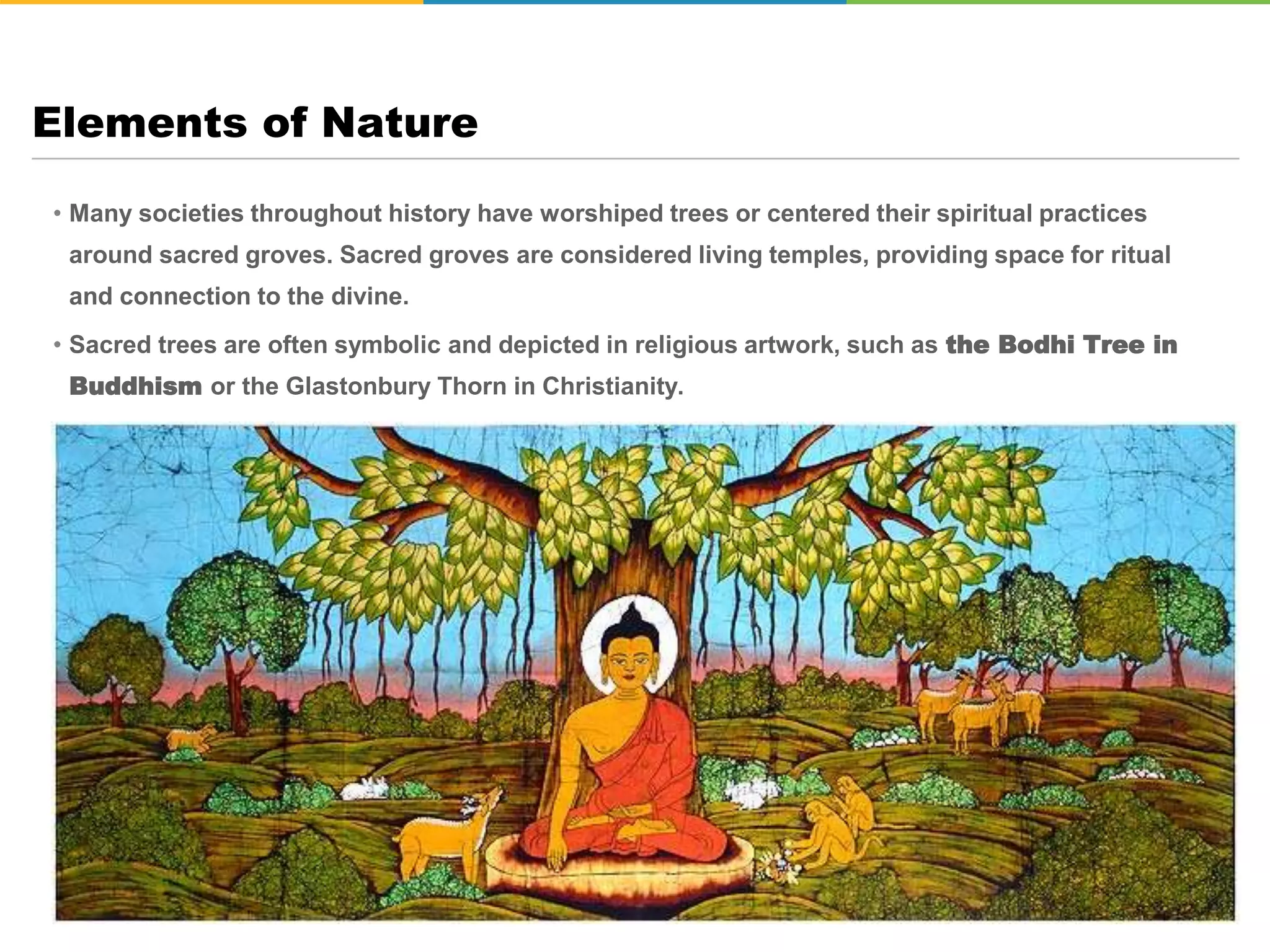
• Many societies throughout history have worshiped trees or centered their spiritual practices
around sacred groves. Sacred groves are considered living temples, providing space for ritual
and connection to the divine.
• Sacred trees are often symbolic and depicted in religious artwork, such as the Bodhi Tree in
Buddhism or the Glastonbury Thorn in Christianity.
Elements of Nature
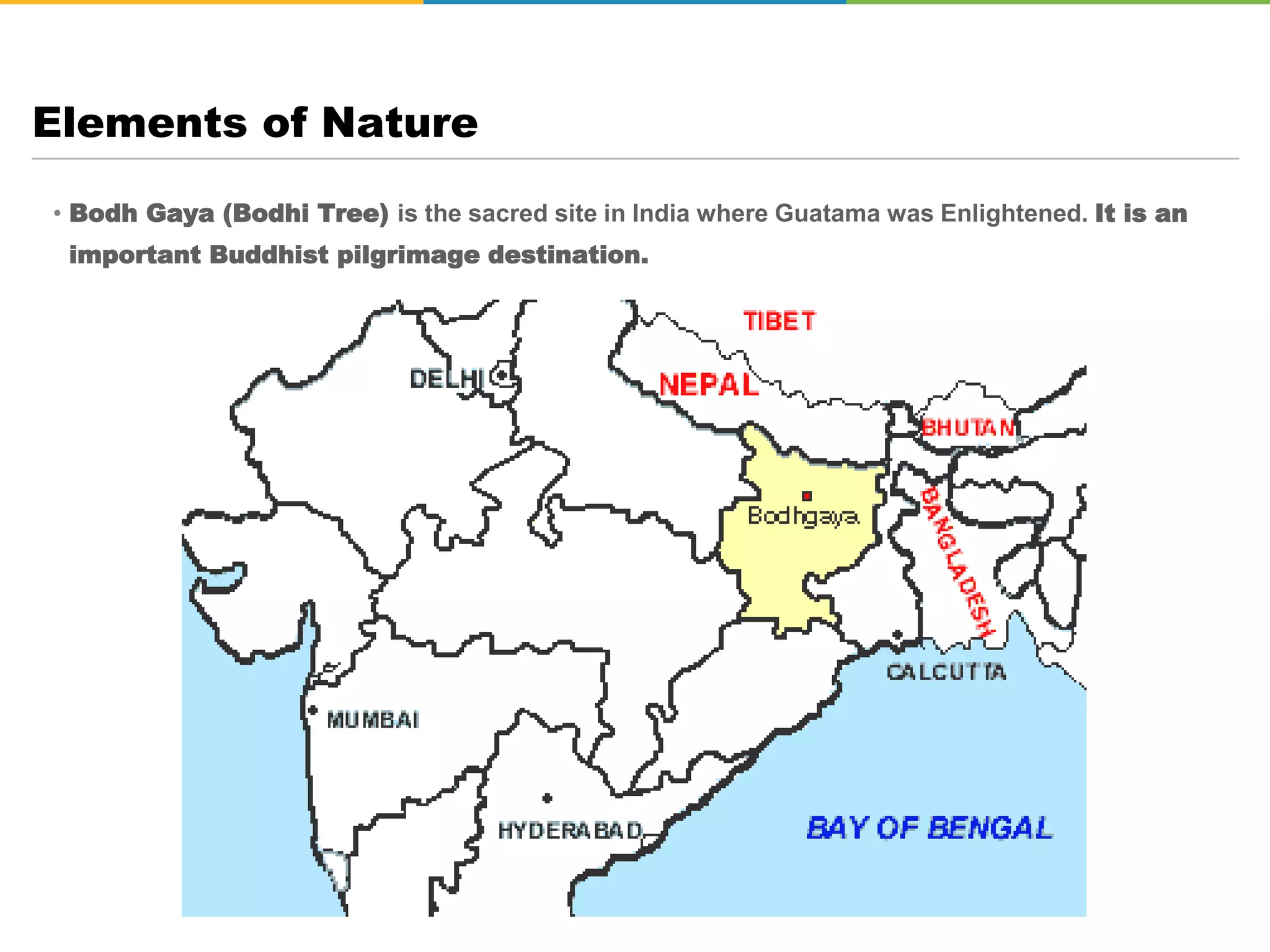
• Bodh Gaya (Bodhi Tree) is the sacred site in India where Guatama was Enlightened. It is an
important Buddhist pilgrimage destination.
Elements of Nature
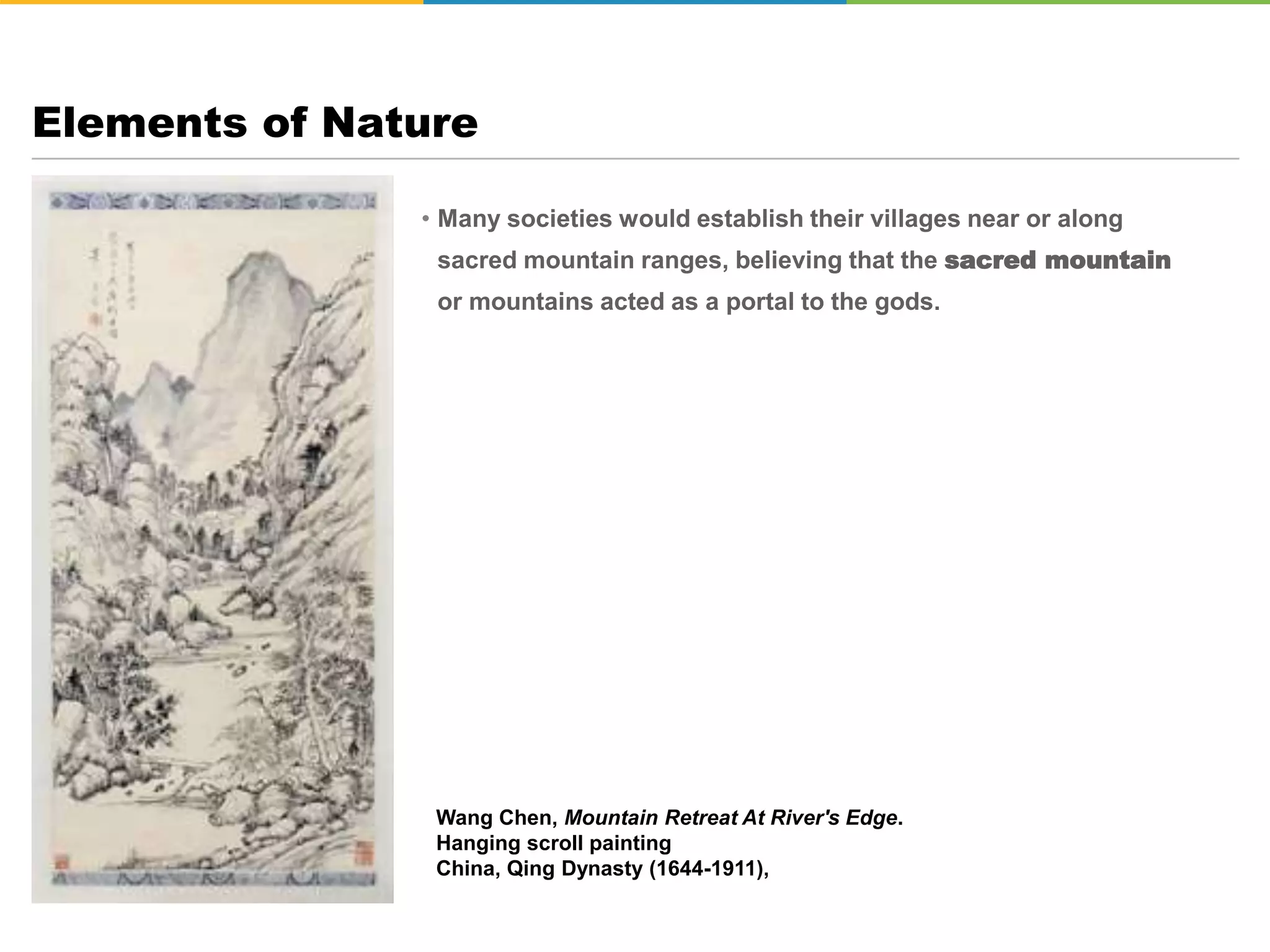
• Many societies would establish their villages near or along
sacred mountain ranges, believing that the sacred mountain
or mountains acted as a portal to the gods.
Elements of Nature
Wang Chen, Mountain Retreat At River's Edge.
Hanging scroll painting
China, Qing Dynasty (1644-1911),
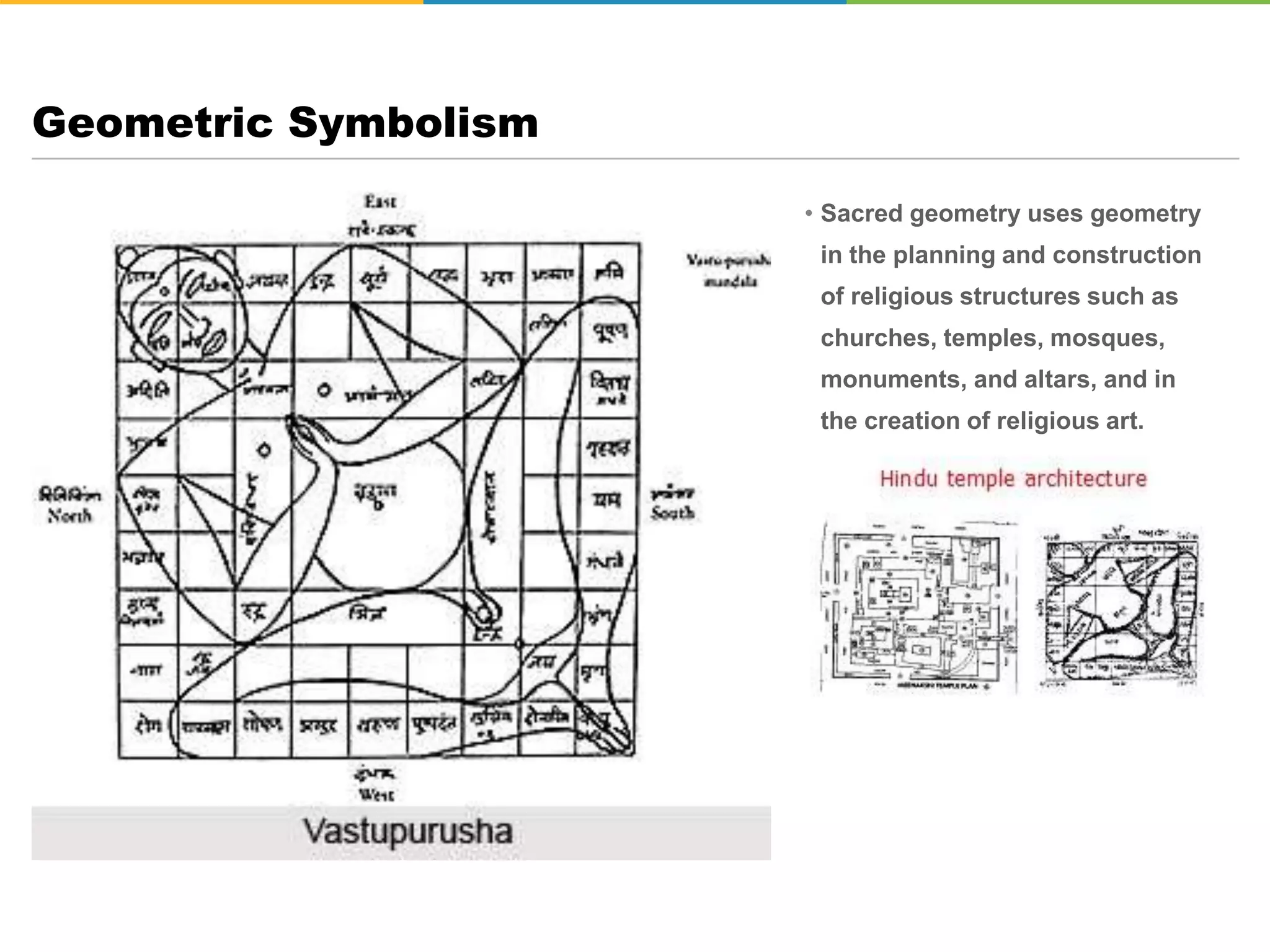
• Sacred geometry uses geometry
in the planning and construction
of religious structures such as
churches, temples, mosques,
monuments, and altars, and in
the creation of religious art.
Geometric Symbolism
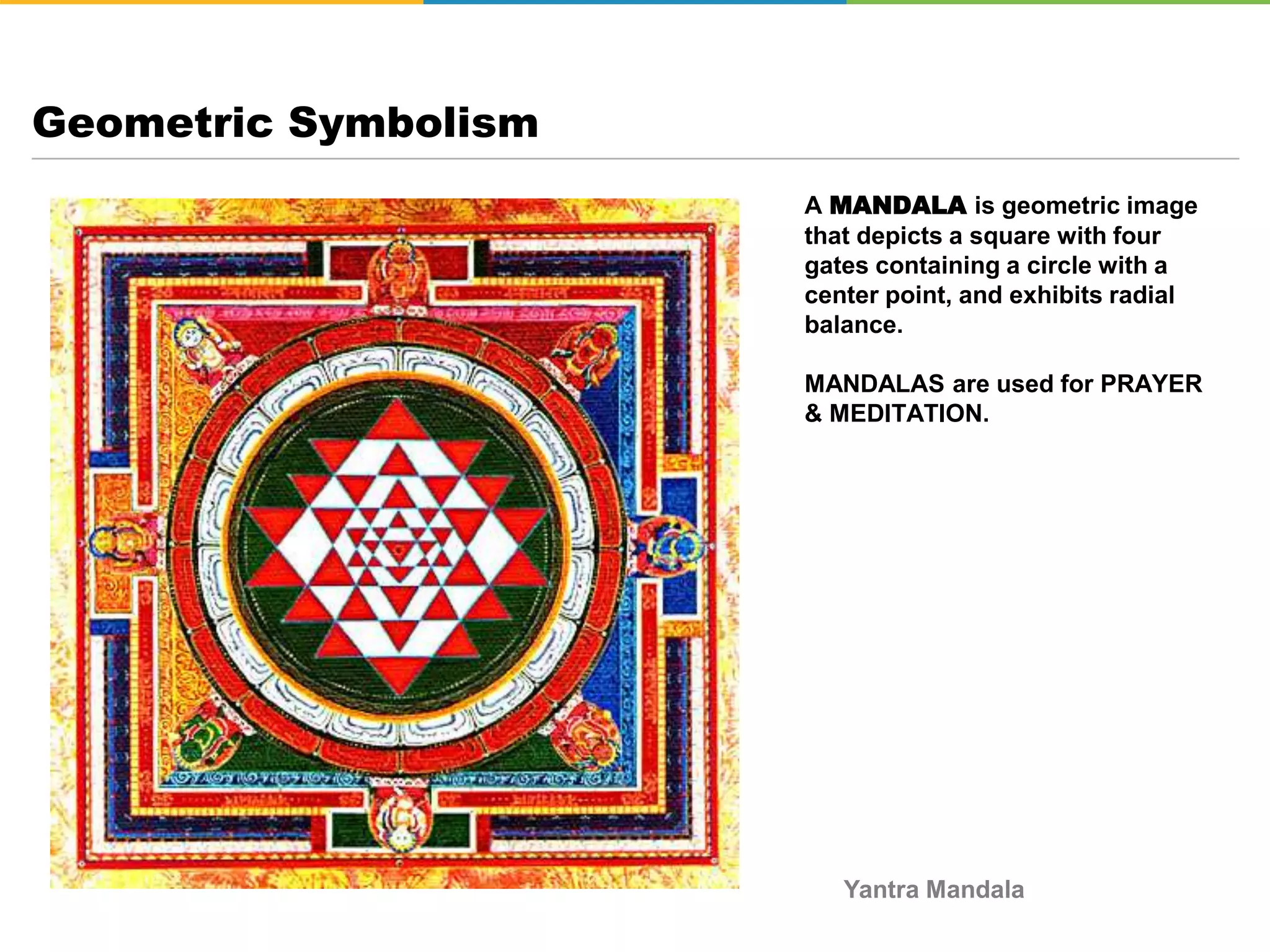
A MANDALA is geometric image
that depicts a square with four
gates containing a circle with a
center point, and exhibits radial
balance.
MANDALAS are used for PRAYER
& MEDITATION.
Geometric Symbolism
Yantra Mandala
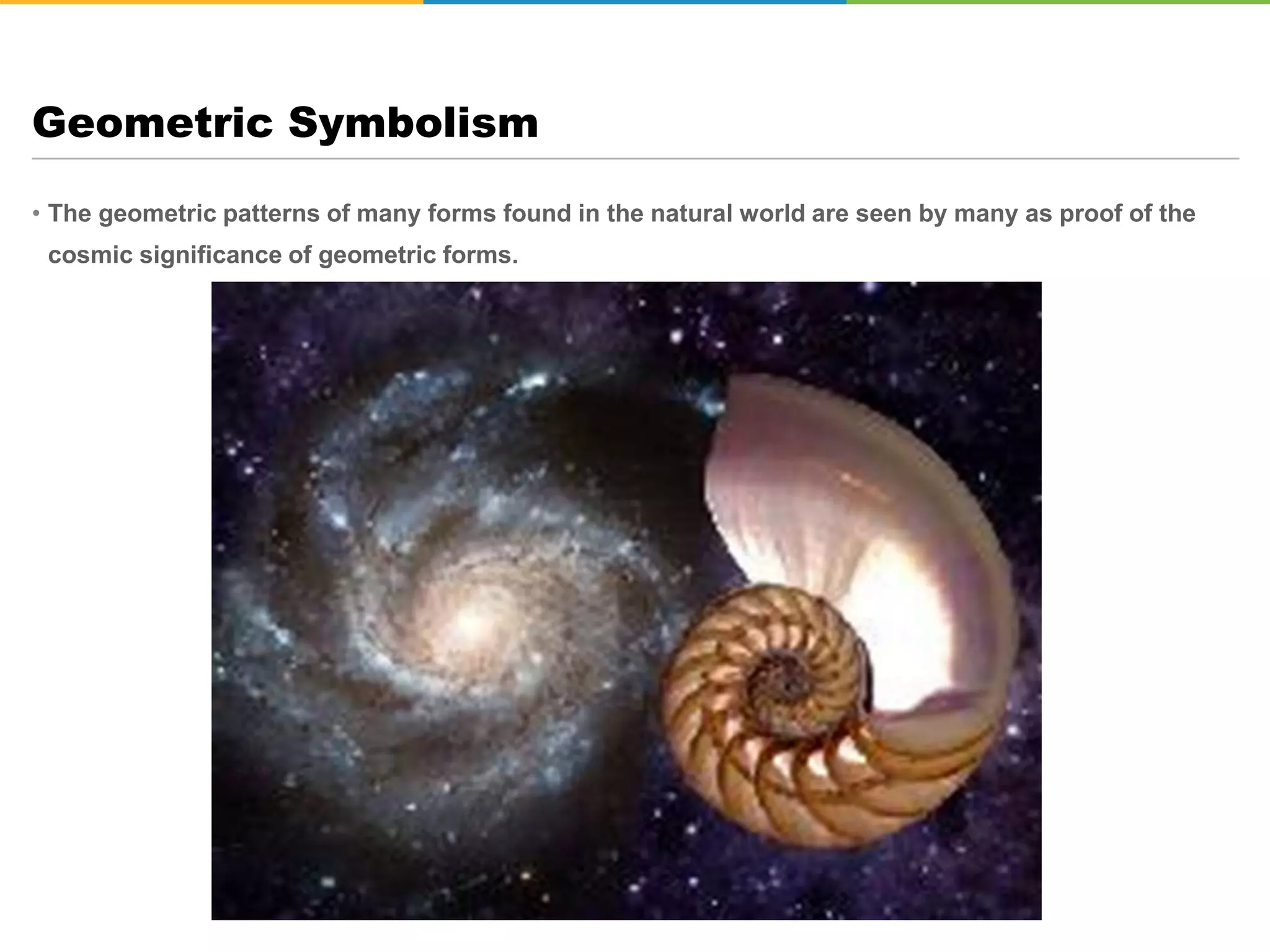
• The geometric patterns of many forms found in the natural world are seen by many as proof of the
cosmic significance of geometric forms.
Geometric Symbolism
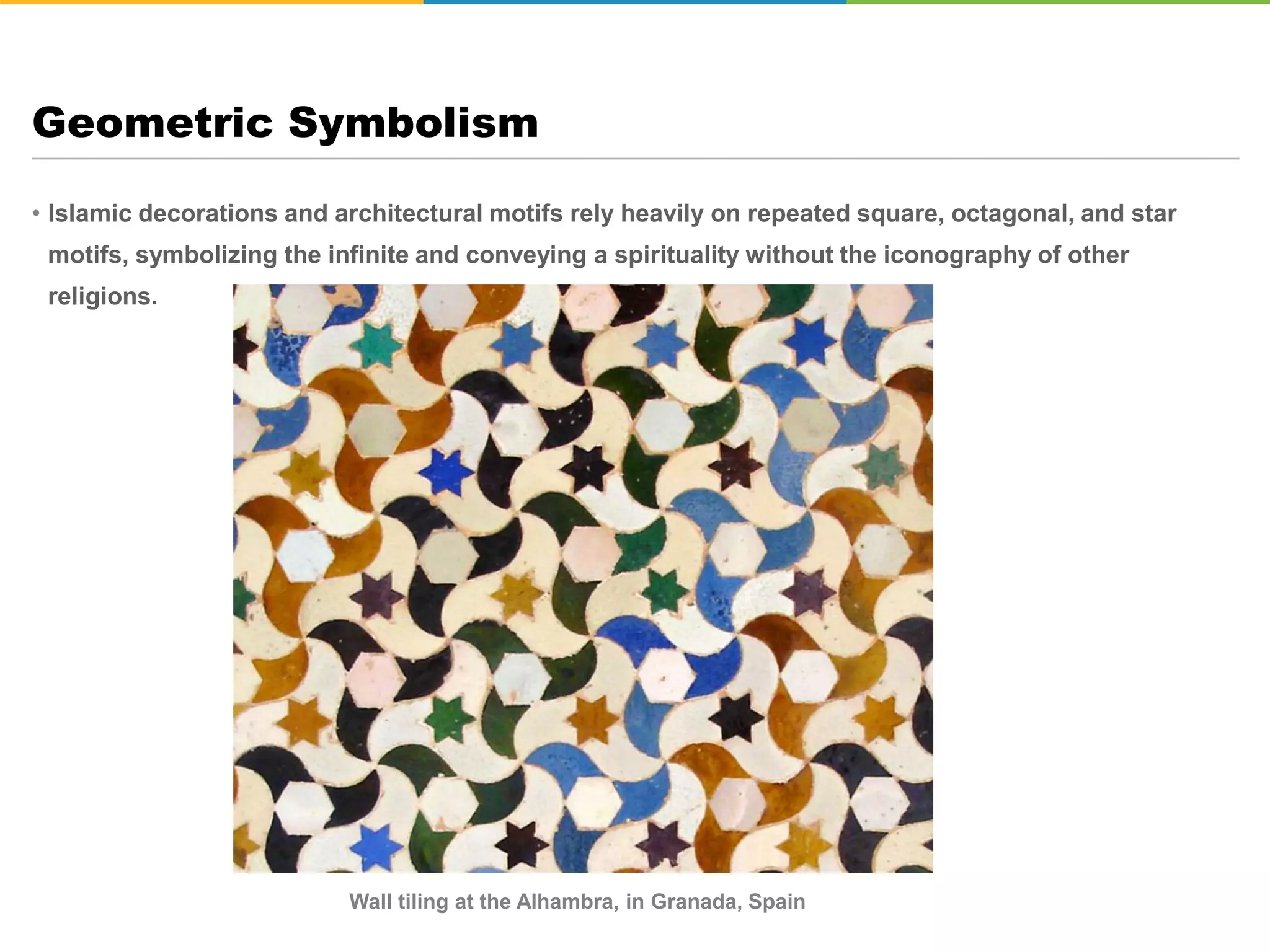
• Islamic decorations and architectural motifs rely heavily on repeated square, octagonal, and star
motifs, symbolizing the infinite and conveying a spirituality without the iconography of other
religions.
Geometric Symbolism
Wall tiling at the Alhambra, in Granada, Spain
8. What is a common geometric image that depicts a square with
four gates containing a circle with a center point, and exhibits
radial balance?
A) a motif
B) a mandala
C) an octagon
D) a sadhana
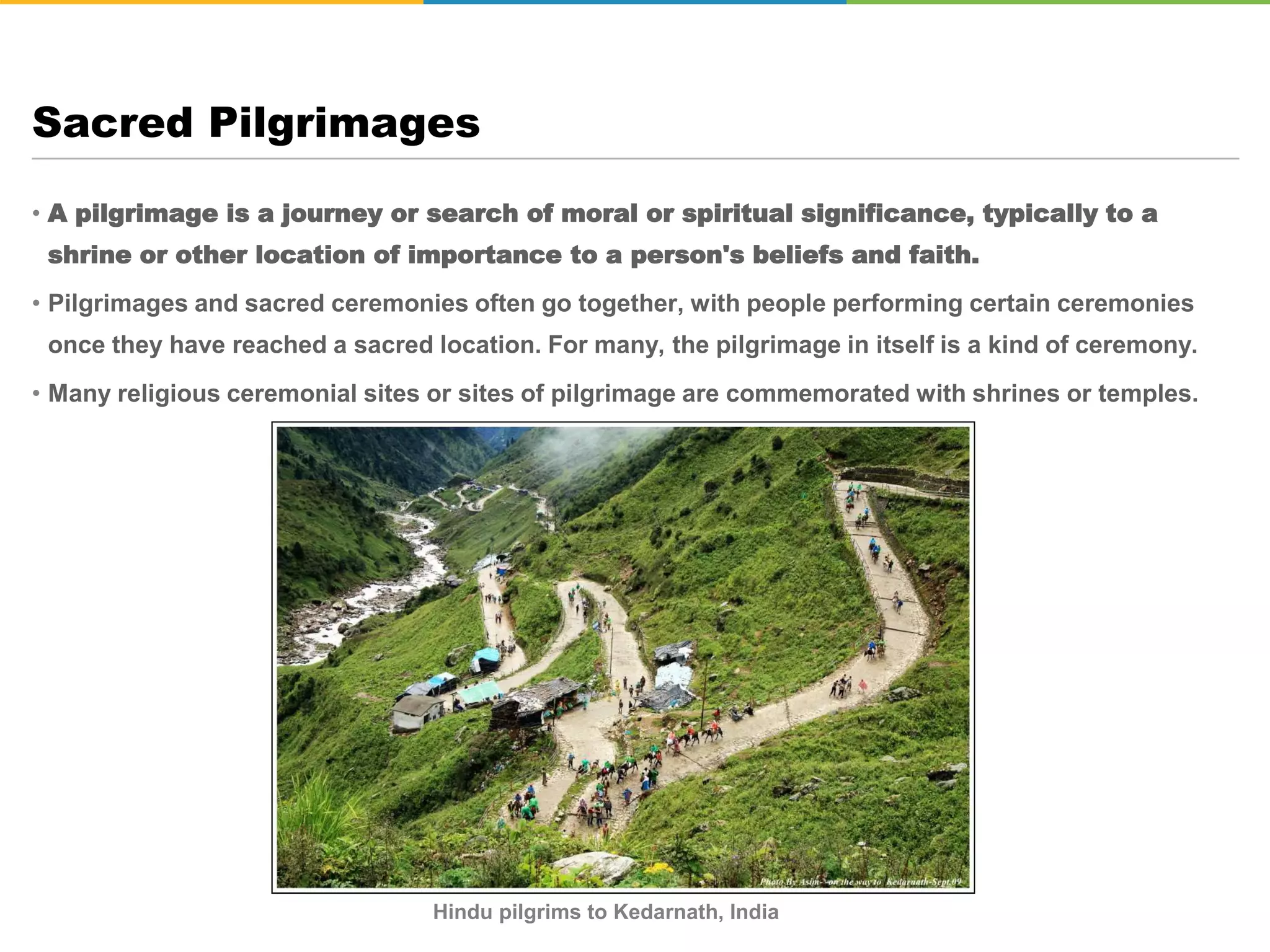
• A pilgrimage is a journey or search of moral or spiritual significance, typically to a
shrine or other location of importance to a person's beliefs and faith.
• Pilgrimages and sacred ceremonies often go together, with people performing certain ceremonies
once they have reached a sacred location. For many, the pilgrimage in itself is a kind of ceremony.
• Many religious ceremonial sites or sites of pilgrimage are commemorated with shrines or temples.
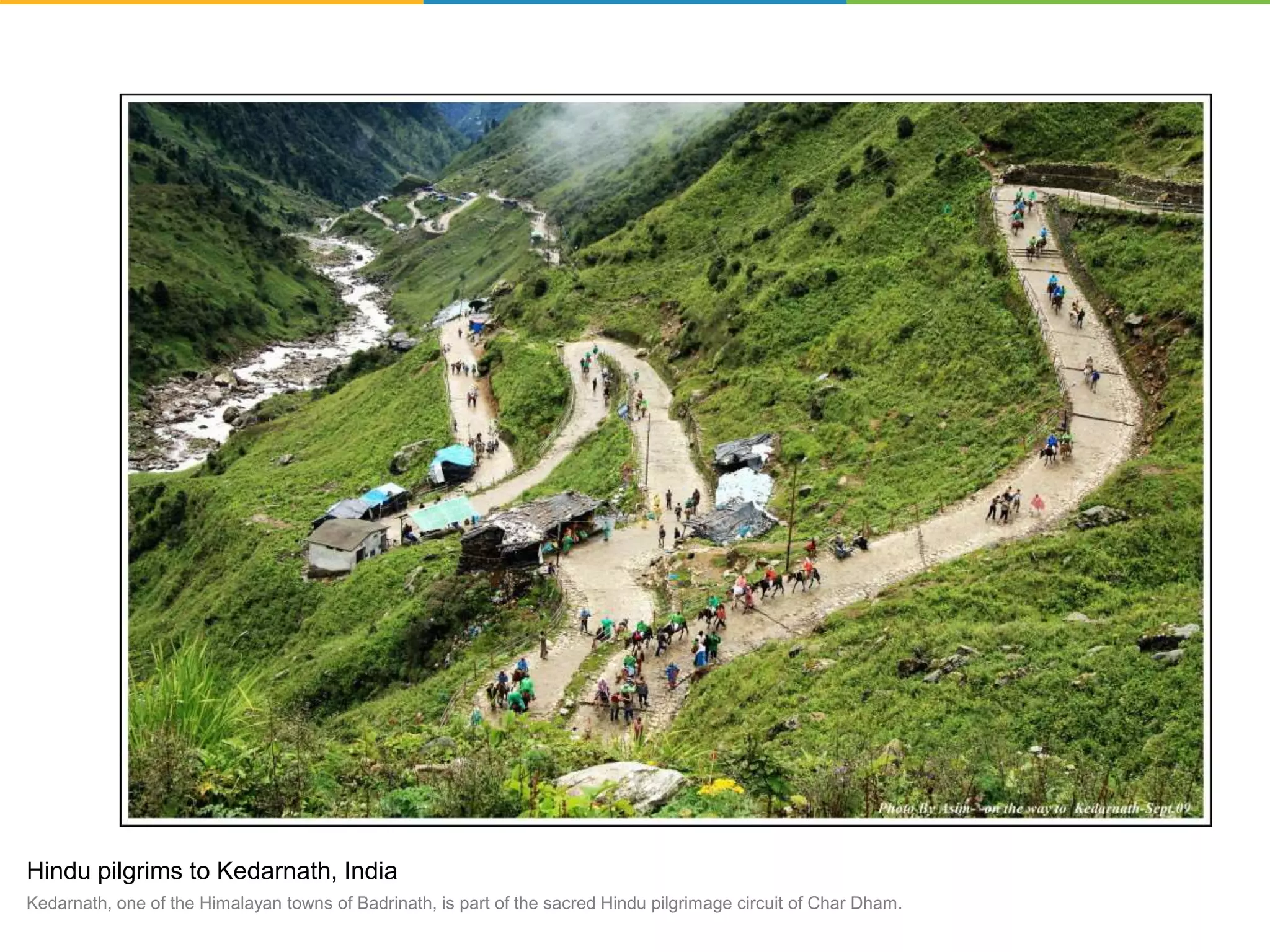
Sacred Pilgrimages
Hindu pilgrims to Kedarnath, India
Kedarnath, one of the Himalayan towns of Badrinath, is part of the sacred Hindu pilgrimage circuit of Char Dham.
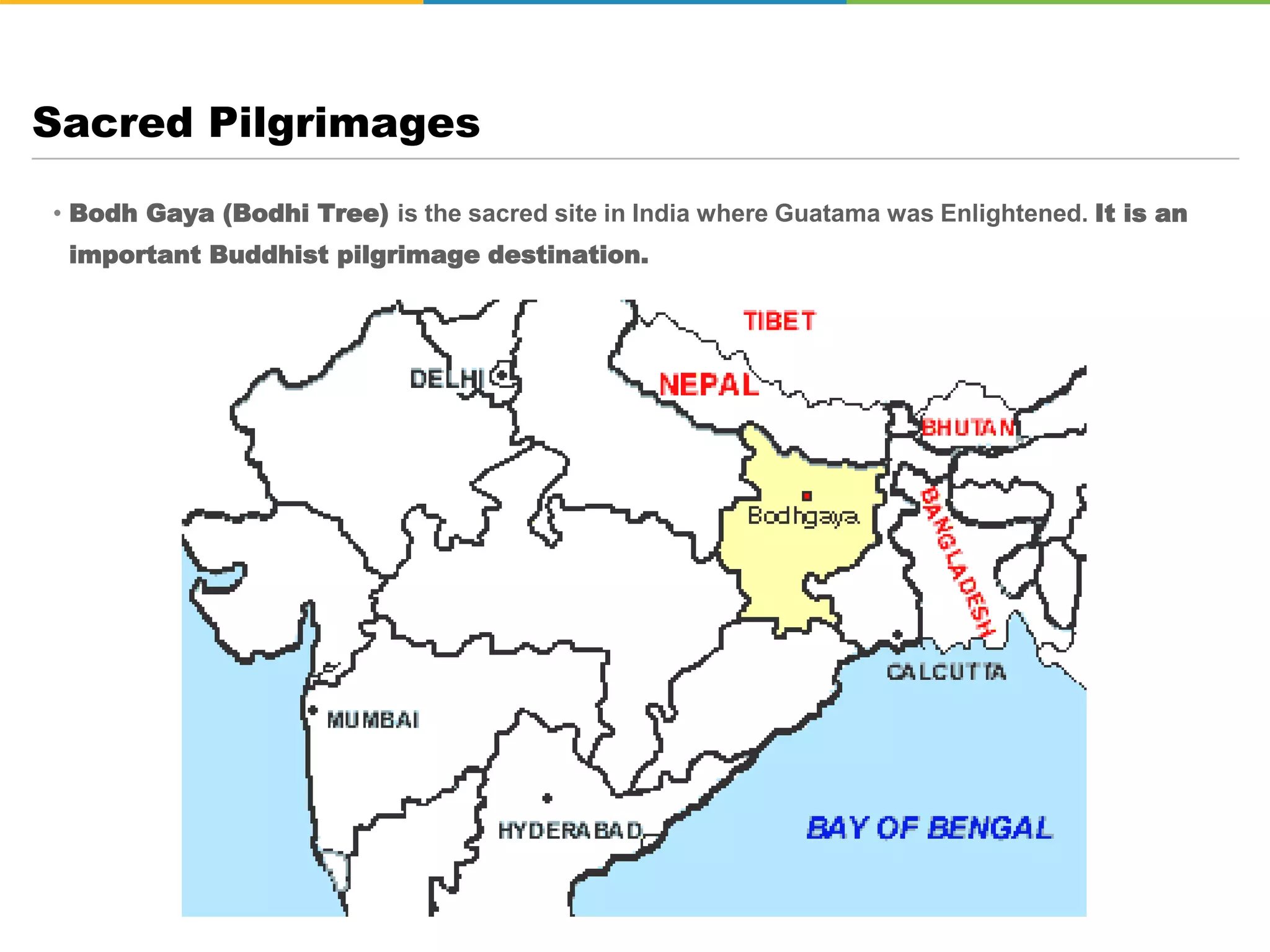
• Bodh Gaya (Bodhi Tree) is the sacred site in India where Guatama was Enlightened. It is an
important Buddhist pilgrimage destination.
Sacred Pilgrimages
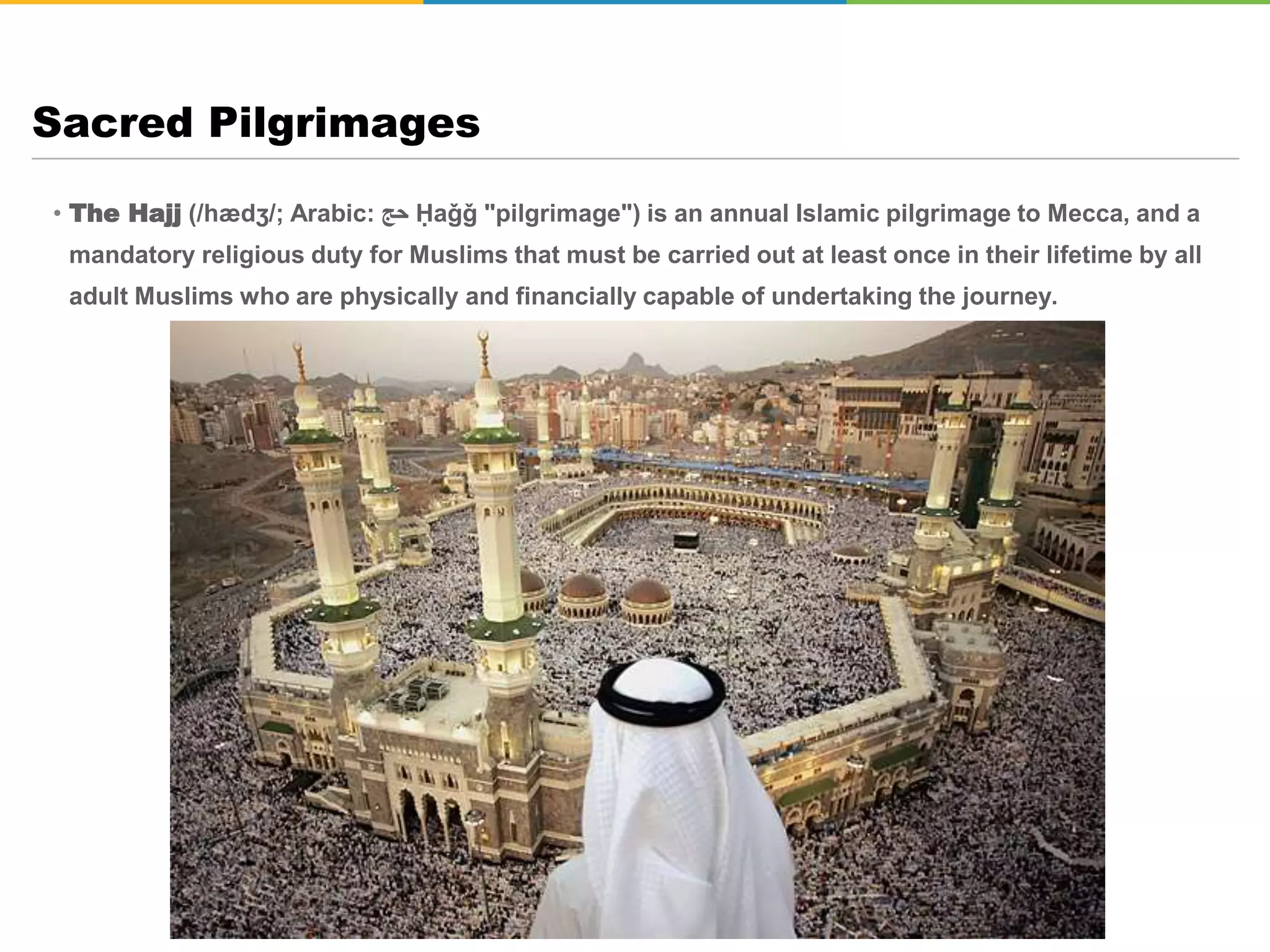
• The Hajj (/hædʒ/; Arabic: ‫حج‬ Ḥaǧǧ "pilgrimage") is an annual Islamic pilgrimage to Mecca, and a
mandatory religious duty for Muslims that must be carried out at least once in their lifetime by all
adult Muslims who are physically and financially capable of undertaking the journey.
Sacred Pilgrimages
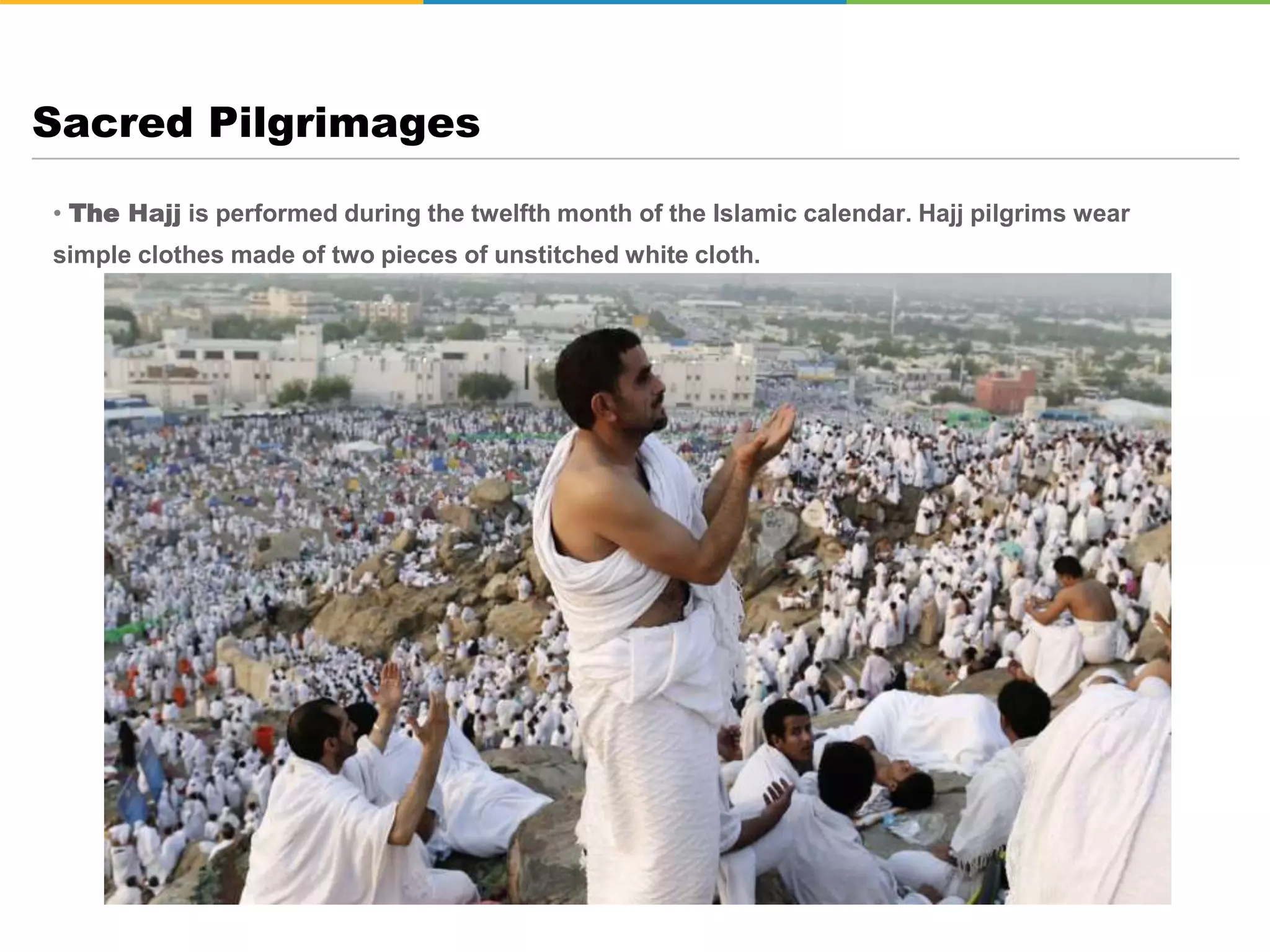
• The Hajj is performed during the twelfth month of the Islamic calendar. Hajj pilgrims wear
simple clothes made of two pieces of unstitched white cloth.
Sacred Pilgrimages
9. Buddha's place of Enlightenment, which is a common site of
pilgrimage for followers of Buddhism, is called
A) Lumbini
B) Sarnath
C) Kusinara
D) Bodh Gaya
10. Which of the following statements about the Hajj is false?
A) All Muslims, if financially and physically able, must perform it once in
their lifetime.
B) It is performed during the twelfth month of the Islamic calendar.
C) Pilgrims wear simple clothes made of two pieces of unstitched white
cloth.
D) It is an optional part of the Muslim faith.
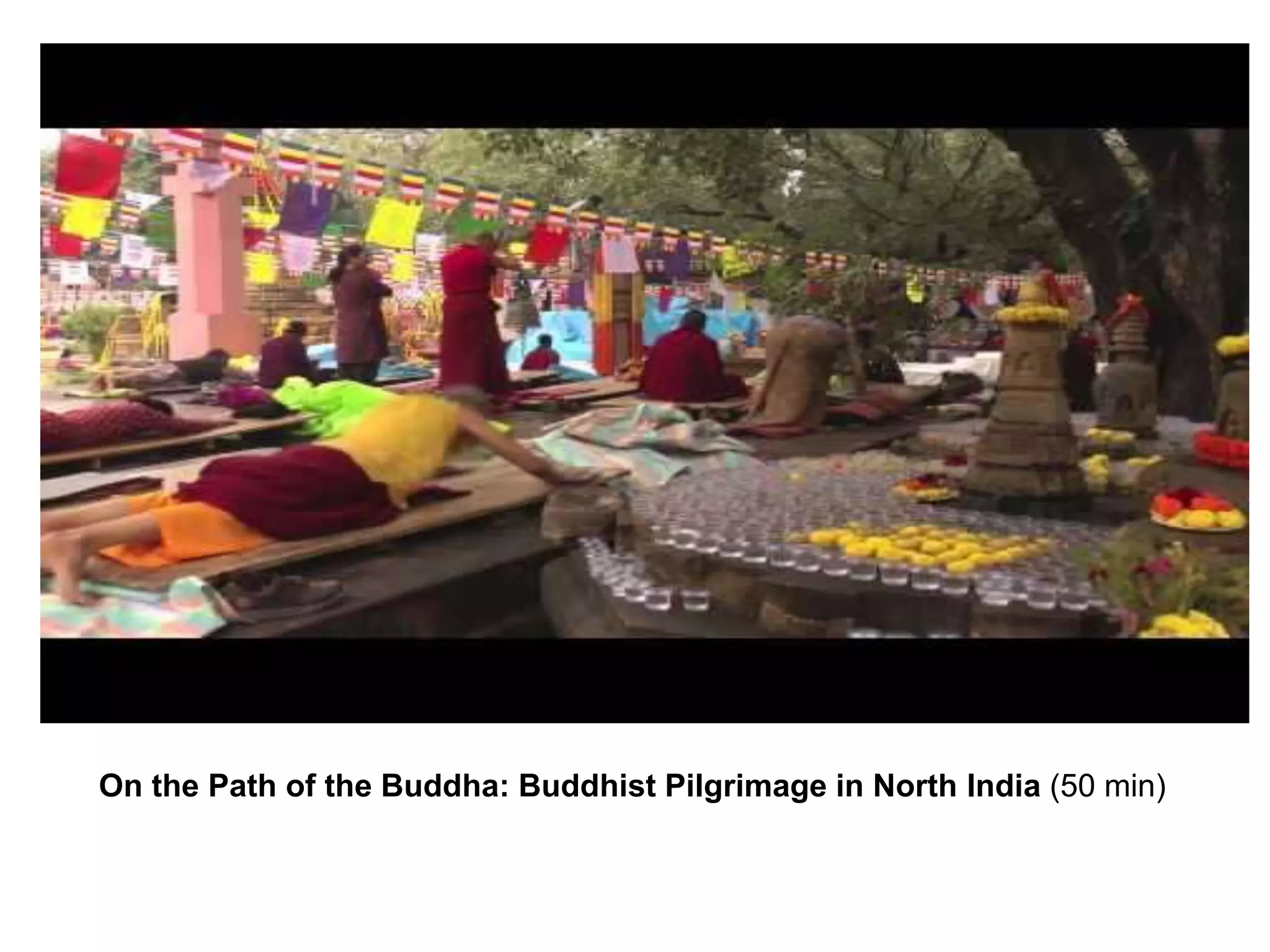
On the Path of the Buddha: Buddhist Pilgrimage in North India (50 min)
Key terms
• animism The religious belief of attributing a spiritual essence to natural phenomena, including animals, plants, and sometimes
even inanimate objects. (from Latin anima "soul, life")
• animist A believer in animism. Animism is the religious belief that natural phenomena, including animals, plants, and often even
inanimate objects, possess a spiritual essence.
• anthropomorphic Having the form or attributes of a human
• Ceremonies Rituals with religious significance; official gatherings to celebrate, commemorate, or otherwise mark some event;
formal socially-established behaviors often in relation to people of different ranks.
• course in masonry, a row of bricks or blocks
• deity deity (plural deities)The state of being a god; divine characteristics, godhead. [from 14th c.] [quotations ▼]A divine
being; a god or goddess. [from 14th c.]
• Greek Titanomachia In Greek mythology, the Titanomachy was the ten year series of battles which were fought in Thessaly
between the two camps of deities long before the existence of mankind: the Titans, based on Mount Othrys, and the
Olympians, who would come to reign on Mount Olympus.
• henotheism Belief in or worship of one deity without denying the existence of other deities.
• iconoclasm The deliberate destruction of religious icons and other symbols or monuments, usually with religious or political
motives.
• iconoclasm The belief in, participation in, or sanction of destroying religious icons and other symbols or monuments, usually
with religious or political motives.
• ihram the clothing worn on the Muslim pilgrimage to the Hajj (Mecca); one length of cotton cloth around the loins and another
thrown over the left shoulder
• mandala Any ritualistic geometric design, symbolic of the universe, used as an aid to meditation, particularly in Hinduism and
Buddhism.
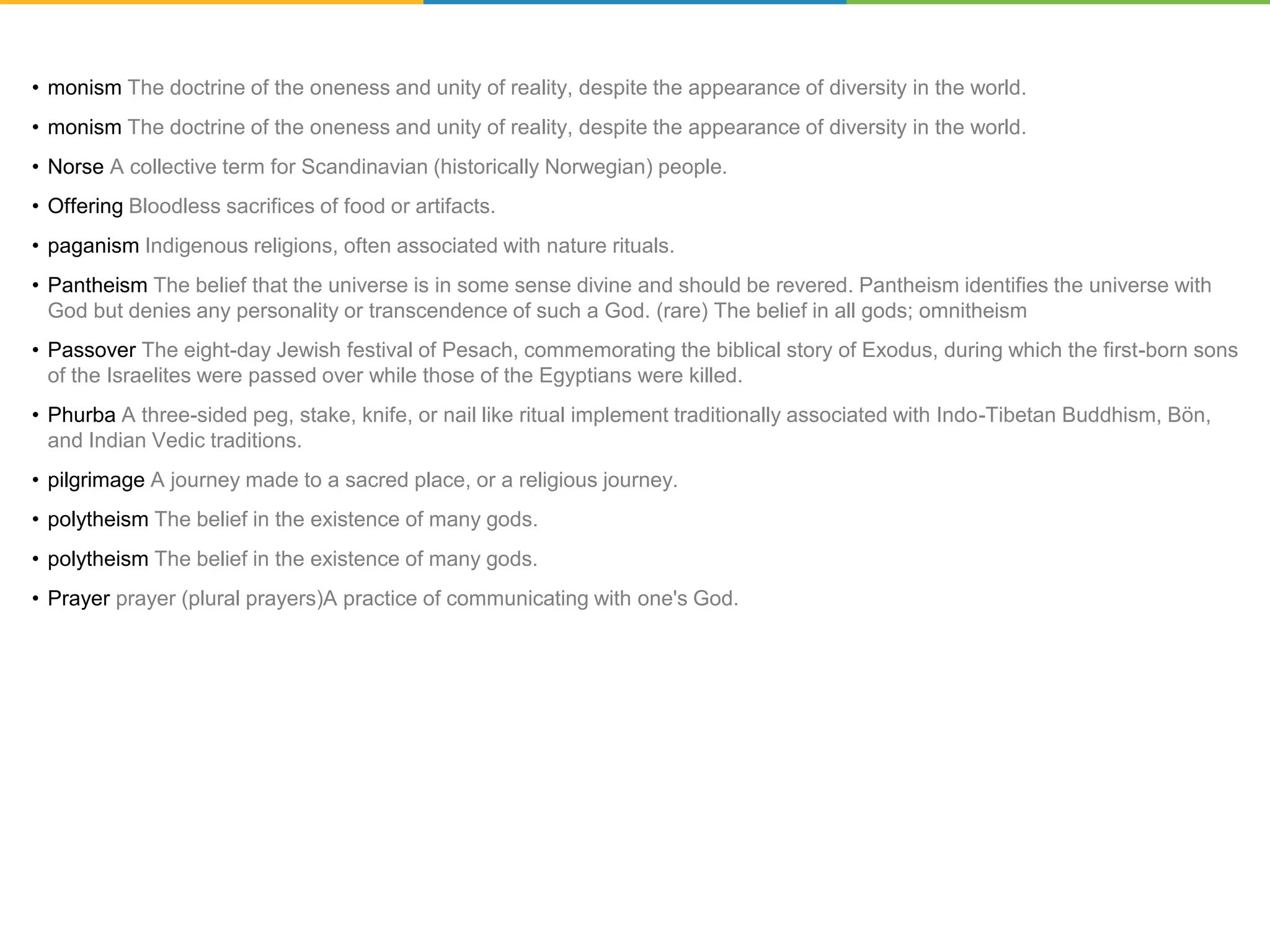
• monism The doctrine of the oneness and unity of reality, despite the appearance of diversity in the world.
• Norse A collective term for Scandinavian (historically Norwegian) people.
• Offering Bloodless sacrifices of food or artifacts.
• paganism Indigenous religions, often associated with nature rituals.
• Pantheism The belief that the universe is in some sense divine and should be revered. Pantheism identifies the universe with
God but denies any personality or transcendence of such a God. (rare) The belief in all gods; omnitheism
• Passover The eight-day Jewish festival of Pesach, commemorating the biblical story of Exodus, during which the first-born sons
of the Israelites were passed over while those of the Egyptians were killed.
• Phurba A three-sided peg, stake, knife, or nail like ritual implement traditionally associated with Indo-Tibetan Buddhism, Bön,
and Indian Vedic traditions.
• pilgrimage A journey made to a sacred place, or a religious journey.
• polytheism The belief in the existence of many gods.
• Prayer prayer (plural prayers)A practice of communicating with one's God.
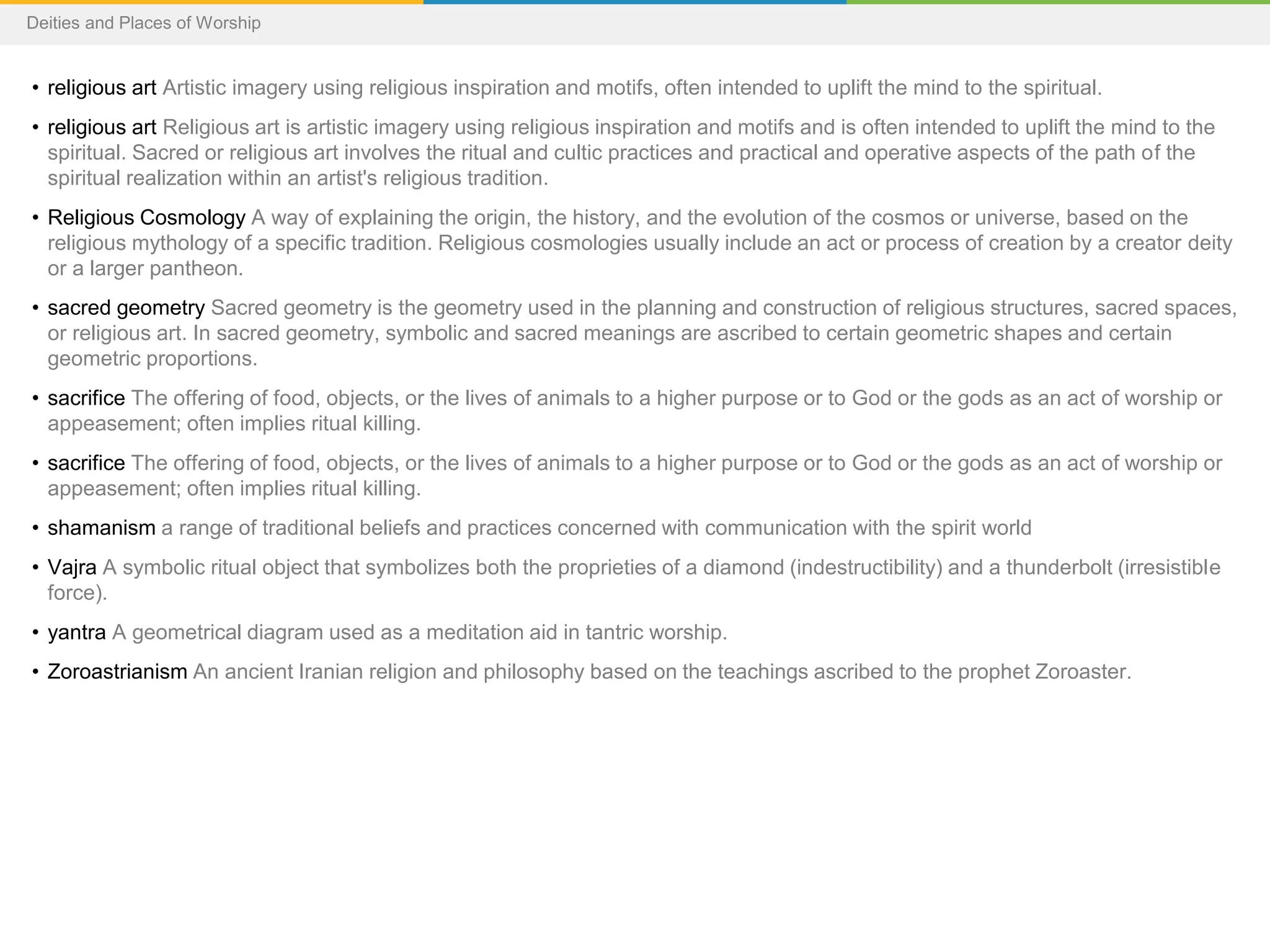
• religious art Artistic imagery using religious inspiration and motifs, often intended to uplift the mind to the spiritual.
• religious art Religious art is artistic imagery using religious inspiration and motifs and is often intended to uplift the mind to the
spiritual. Sacred or religious art involves the ritual and cultic practices and practical and operative aspects of the path of the
spiritual realization within an artist's religious tradition.
• Religious Cosmology A way of explaining the origin, the history, and the evolution of the cosmos or universe, based on the
religious mythology of a specific tradition. Religious cosmologies usually include an act or process of creation by a creator deity
or a larger pantheon.
• sacred geometry Sacred geometry is the geometry used in the planning and construction of religious structures, sacred spaces,
or religious art. In sacred geometry, symbolic and sacred meanings are ascribed to certain geometric shapes and certain
geometric proportions.
• sacrifice The offering of food, objects, or the lives of animals to a higher purpose or to God or the gods as an act of worship or
appeasement; often implies ritual killing.
• sacrifice The offering of food, objects, or the lives of animals to a higher purpose or to God or the gods as an act of worship or
appeasement; often implies ritual killing.
• shamanism a range of traditional beliefs and practices concerned with communication with the spirit world
• Vajra A symbolic ritual object that symbolizes both the proprieties of a diamond (indestructibility) and a thunderbolt (irresistible
force).
• yantra A geometrical diagram used as a meditation aid in tantric worship.
• Zoroastrianism An ancient Iranian religion and philosophy based on the teachings ascribed to the prophet Zoroaster.
Deities and Places of Worship
QUIZ ANSWERS
Free to share, print, make copies and changes. Get yours at www.boundless.com
Deities and Places of Worship
1. Animism is consider to be
A) a religion in and of itself.
B) a belief that is found in several religions.
C) an anthropological study or religious elements.
D) a pagan religion.
Free to share, print, make copies and changes. Get yours at www.boundless.com
Boundless - LO. "Boundless." CC BY-SA 3.0 http://www.boundless.com/
Deities and Places of Worship
1. Animism is consider to be
A) a religion in and of itself.
B) a belief that is found in several religions.
C) an anthropological study or religious elements.
D) a pagan religion.
Free to share, print, make copies and changes. Get yours at www.boundless.com
Deities and Places of Worship
Which of the following is an example of polytheism?
A) the worship of Christ in Christianity
B) the worship of Muhammed in Islam
C) the worship of nature in paganism
D) kachina
Free to share, print, make copies and changes. Get yours at www.boundless.com
Boundless - LO. "Boundless." CC BY-SA 3.0 http://www.boundless.com/
Deities and Places of Worship
Which of the following is an example of polytheism?
A) the worship of Christ in Christianity
B) the worship of Muhammed in Islam
C) the worship of nature in paganism
D) kachina
Free to share, print, make copies and changes. Get yours at www.boundless.com
Deities and Places of Worship
Which of the following statements regarding pantheism is FALSE?
A) Pantheism is the belief in an all-encompassing God in which nature is
equivalent with divinity.
B) Pantheistic art often depicts the multiple incarnations of sacred beings
found in nature.
C) Pantheism is the belief in a personal or anthropomorphic god that
transcends the universe.
D) Pantheistic art often depicts the flow, order, and interconnectivity of
the universe.
Free to share, print, make copies and changes. Get yours at www.boundless.com
Boundless - LO. "Boundless." CC BY-SA 3.0 http://www.boundless.com/
Deities and Places of Worship
Which of the following statements regarding pantheism is FALSE?
A) Pantheism is the belief in an all-encompassing God in which nature is
equivalent with divinity.
B) Pantheistic art often depicts the multiple incarnations of sacred beings
found in nature.
C) Pantheism is the belief in a personal or anthropomorphic god that
transcends the universe.
D) Pantheistic art often depicts the flow, order, and interconnectivity of
the universe.
Free to share, print, make copies and changes. Get yours at www.boundless.com
Deities and Places of Worship
Which of the following statements is true?
A) Deities are often expressed in religious art as having human form.
B) Both of these statements are true.
C) Many religions consider it blasphemous to depict a deity in human
form.
D) Neither of these statements are true.
Free to share, print, make copies and changes. Get yours at www.boundless.com
Boundless - LO. "Boundless." CC BY-SA 3.0 http://www.boundless.com/
Deities and Places of Worship
Which of the following statements is true?
A) Deities are often expressed in religious art as having human form.
B) Both of these statements are true.
C) Many religions consider it blasphemous to depict a deity in human
form.
D) Neither of these statements are true.
Free to share, print, make copies and changes. Get yours at www.boundless.com
Deities and Places of Worship
The offering of liquids through the act of pouring is known as a
A) libation
B) eucharist
C) charity
D) qurban
Free to share, print, make copies and changes. Get yours at www.boundless.com
Boundless - LO. "Boundless." CC BY-SA 3.0 http://www.boundless.com/
Deities and Places of Worship
The offering of liquids through the act of pouring is known as a
A) libation
B) eucharist
C) charity
D) qurban
Free to share, print, make copies and changes. Get yours at www.boundless.com
Deities and Places of Worship
Animal sacrifices were performed by many religions throughout
history for the purpose of
A) changing the course of nature
B) appeasing a god or gods
C) envoking a spiritual commune with god or gods
D) all of these answers
Free to share, print, make copies and changes. Get yours at www.boundless.com
Boundless - LO. "Boundless." CC BY-SA 3.0 http://www.boundless.com/
Deities and Places of Worship
Animal sacrifices were performed by many religions throughout
history for the purpose of
A) changing the course of nature
B) appeasing a god or gods
C) envoking a spiritual commune with god or gods
D) all of these answers
Free to share, print, make copies and changes. Get yours at www.boundless.com
Deities and Places of Worship
Which of the following is an example of prayer?
A) Native American dance
B) the chanting of mantras by Hindus
C) Sufi dance
D) all of these answers
Free to share, print, make copies and changes. Get yours at www.boundless.com
Boundless - LO. "Boundless." CC BY-SA 3.0 http://www.boundless.com/
Deities and Places of Worship
Which of the following is an example of prayer?
A) Native American dance
B) the chanting of mantras by Hindus
C) Sufi dance
D) all of these answers
Free to share, print, make copies and changes. Get yours at www.boundless.com
Deities and Places of Worship
Which religious tradition considers the creation of art itself to be a
meditative practice?
A) Islam
B) Buddhism
C) Christianity
D) Judaism
Free to share, print, make copies and changes. Get yours at www.boundless.com
Boundless - LO. "Boundless." CC BY-SA 3.0 http://www.boundless.com/
Deities and Places of Worship
Which religious tradition considers the creation of art itself to be a
meditative practice?
A) Islam
B) Buddhism
C) Christianity
D) Judaism
Free to share, print, make copies and changes. Get yours at www.boundless.com
Deities and Places of Worship
What is a common geometric image that depicts a square with
four gates containing a circle with a center point, and exhibits
radial balance?
A) a motif
B) a mandala
C) an octagon
D) a sadhana
Free to share, print, make copies and changes. Get yours at www.boundless.com
Boundless - LO. "Boundless." CC BY-SA 3.0 http://www.boundless.com/
Deities and Places of Worship
What is a common geometric image that depicts a square with
four gates containing a circle with a center point, and exhibits
radial balance?
A) a motif
B) a mandala
C) an octagon
D) a sadhana
Free to share, print, make copies and changes. Get yours at www.boundless.com
Deities and Places of Worship
Buddha's place of Enlightenment, which is a common site of
pilgrimage for followers of Buddhism, is called
A) Lumbini
B) Sarnath
C) Kusinara
D) Bodh Gaya
Free to share, print, make copies and changes. Get yours at www.boundless.com
Boundless - LO. "Boundless." CC BY-SA 3.0 http://www.boundless.com/
Deities and Places of Worship
Buddha's place of Enlightenment, which is a common site of
pilgrimage for followers of Buddhism, is called
A) Lumbini
B) Sarnath
C) Kusinara
D) Bodh Gaya
Free to share, print, make copies and changes. Get yours at www.boundless.com
Deities and Places of Worship
Which of the following statements about the Hajj is false?
A) All Muslims, if financially and physically able, must perform it once in
their lifetime.
B) It is performed during the twelfth month of the Islamic calendar.
C) Pilgrims wear simple clothes made of two pieces of unstitched white
cloth.
D) It is an optional part of the Muslim faith.
Free to share, print, make copies and changes. Get yours at www.boundless.com
Saylor OER. "Art History « Saylor.org – Free Online Courses Built by Professors." CC BY 3.0 http://www.saylor.org/majors/Art-History/
Deities and Places of Worship
Which of the following statements about the Hajj is false?
A) All Muslims, if financially and physically able, must perform it once in
their lifetime.
B) It is performed during the twelfth month of the Islamic calendar.
C) Pilgrims wear simple clothes made of two pieces of unstitched white
cloth.
D) It is an optional part of the Muslim faith.

2 sacred spaces

  • 1.
    Deities and Places of Worship I.Introduction to Deities and Places of Worship II. Images of Deities III. Places of Worship Baraka is a 1992 non-narrative documentary film directed by Ron Fricke. The film is often compared to Koyaanisqatsi, the first of the Qatsi films by Godfrey Reggio for which Fricke was cinematographer. https://youtu.be/zDnJhlozDIE?list=PLZs0gQed9tMQDD6yXWvkayI Wq3ECToyEQ
  • 2.
    Deities and Places of Worship Introductionto Deities and Places of Worship Images of Deities Places of Worship
  • 3.
    Introduction to Deitiesand Places of Worship China Disabled People’s Performing Art Troupe presents a beautiful performance of the Thousand-Hand Guan Yin, the Bodhisattva of Compassion. What’s amazing is the all the performers are deaf, making the choreography to the music even more incredible. Guan Yin is the bodhisattva of compassion, revered by Buddhists as the Goddess of Mercy. Her name is short for Guan Shi Yin. Guan means to observe, watch, or monitor; Shi means the world; Yin means sounds, specifically sounds of those who suffer. Thus, Guan Yin is a compassionate being who watches for, and responds to, the people in the world who cry out for help.
  • 4.
    Great Mosque ofDjenné Originally built in the 13th or 14th century, the Great Mosque seen today was completed in 1907. The Great Mosque of Djenné is the largest mud brick or adobe building in the world and is considered by many architects to be the greatest achievement of the Sudano-Sahelian architectural style, with definite Islamic influences. • Places of Worship
  • 5.
    Religious art isartistic imagery using religious inspiration and motifs and is often intended to uplift the mind to the spiritual. Sacred art involves the ritual and cultic practices and practical and operative aspects of the path of the spiritual realization within the artist's religious tradition. Photo of a Chenrezig Sand Mandala created and exhibited at the House of Commons on the occasion of the visit of the Dalai Lama, 21 May 2008.
  • 6.
    • Buddhist artfollowed believers as the dharma spread and evolved in each new host country. It developed to the north through Central Asia and into Eastern Asia to form the Northern branch of Buddhist art and to the east as far as Southeast Asia to form the Southern branch of Buddhist art. Religion as a Theme
  • 7.
    • In India,Buddhist art flourished and even influenced the development of Hindu art. Religion as a Theme The Mahabodhi Temple, a UNESCO World Heritage Site, is one of the four holy sites related to the life of the Lord Buddha, and particularly to the attainment of Enlightenment. The first temple was built by The Indian Emperor Ashoka in the 3rd century BC, and the present temple dates from the 5th century or 6th century AD. It is one of the earliest Buddhist temples built entirely in brick, still standing in India, from the late Gupta period The Mahabodhi Tree
  • 8.
    • In India,Buddhist art flourished and even influenced the development of Hindu art. Religion as a Theme The Mahabodhi Temple, a UNESCO World Heritage Site, is one of the four holy sites related to the life of the Lord Buddha, and particularly to the attainment of Enlightenment. The first temple was built by The Indian Emperor Ashoka in the 3rd century BC, and the present temple dates from the 5th century or 6th century AD. It is one of the earliest Buddhist temples built entirely in brick, still standing in India, from the late Gupta period The Mahabodhi Tree
  • 9.
    • Tibetan Buddhistart was created as a meditation practice. An example of Tibetan meditation art is the sand mandala, which were made by monks . The form of the mandala represents the pure surroundings (palace) of a Buddha on which he meditates to train the mind. The work is rarely, if ever, signed by the artist. Religion as a Theme Photo of a Chenrezig Sand Mandala created and exhibited at the House of Commons on the occasion of the visit of the Dalai Lama, 21 May 2008.
  • 10.
    • Tibetan sandmandala, made by monks . The form of the mandala represents the pure surroundings (palace) of a Buddha on which he meditates to train the mind. The work is rarely, if ever, signed by the artist. Religion as a Theme Stop Motion Timelapse of Tibetan Monks Creating a Sand Mandala at Seret & Sons Gallery
  • 11.
    • Other TibetanBuddhist art includes metal ritual objects, such as the vajra and the phurba. Religion as a Theme Phurba - Ritual Dagger used to drive away evil spirits or negativity. Phurba causes aggravated damage and double damage to spirits. Phurba is capable of moving under it's own power by flying about and is quite fast and capable of lifting a man off the ground. Vajra is a Sanskrit word meaning both thunderbolt and diamond. Additionally, it is a weapon which is used as a ritual object to symbolize both the properties of a diamond (indestructibility) and a thunderbolt (irresistible force).
  • 12.
    • Other TibetanBuddhist art includes metal ritual objects, such as the vajra and the phurba. Religion as a Theme Phurba - Ritual Dagger Vajra - Thunderbolt / Diamond
  • 13.
    • Islamic artprohibited the depiction of representational images in religious art. Therefore, the naturally decorative nature of Arabic script led to the use of calligraphic decorations, which usually involved repeating geometrical patterns that expressed ideals of order and nature. Religion as a Theme Islamic Calligraphy Eighteenth century writing in Ottoman calligraphy, depicting the phrase 'In the name of God, Most Merciful, Most Gracious'
  • 14.
    • Islamic artprohibited the depiction of representational images in religious art. Therefore, the naturally decorative nature of Arabic script led to the use of calligraphic decorations, which usually involved repeating geometrical patterns that expressed ideals of order and nature. Religion as a Theme Taj Mahal
  • 15.
    • Religion andspirituality has been a theme in art throughout history and throughout many areas of the world, from Hinduism and Judaism to indigenous spiritual practices. Religion as a Theme Borobudur Temple Indonesia
  • 16.
    • Animism • Polytheism •Pantheism • Monotheism • Humans and Their Deities • Ceremonies • Offerings • Sacrifices • Prayers • The Cosmos Images of Deities Shiva Nataraja, the Lord of the Dance Nataraja from Tamil Nadu, India. Chola dynasty copper alloy sculpture, ca. 950 - 1000 CE. The deity is depicted as having multiple arms, as is common for idols of Hindu gods.
  • 17.
    Krishna Krishna displays hisVishvarupa (Universal Form) to Arjuna on the battlefield of Kurukshetra.
  • 18.
    • Reverence forthe sacred in Nature. • Animism is the religious belief attributing a spiritual essence to natural phenomena, including animals, plants, and inanimate objects Animism The Great Shrine at Ise (Japan) Shinto Shrine The present buildings reproduce the temple first ceremoniously rebuilt in 692 CE by Empress Jito. The first temple had been built by her husband Emperor Temmu (678-686), the first Mikado to rule over a united Japan.
  • 19.
    • In termsof its features, ANIMISM is defined as a set of beliefs based on the existence of non-human spiritual beings: that there is no separation between the spiritual and material world and souls exist not only in humans, but also in all other entities of the natural environment. Animism The Great Shrine at Ise (Japan) Shinto Shrine The present buildings reproduce the temple first ceremoniously rebuilt in 692 CE by Empress Jito. The first temple had been built by her husband Emperor Temmu (678-686), the first Mikado to rule over a united Japan.
  • 20.
    • Animism isused in the anthropology of religion as a term for the religion of indigenous tribal peoples, especially prior to the development of civilization and organized religions.. Animism Animist and Buddhist icons in a park in Vientiane, Laos
  • 21.
    • Examples ofanimist art are as varied and diverse as the multiple world religions that have produced them. However, the common element among them is that they depict natural elements (animals, nature, earth) as spiritual entities. Animism Dogon Dama Dance Masks Mali, Africa
  • 22.
    • Examples ofanimist art are as varied and diverse as the multiple world religions that have produced them. However, the common element among them is that they depict natural elements (animals, nature, earth) as spiritual entities. Animism Pueblo Buffalo Dance
  • 23.
    Hindu Cow In Hinduism,the cow is not considered a god, but rather, a symbol of wealth, strength, abundance, selfless giving, and a full Earthly life.
  • 24.
    Chinese Lion Dance- Lunar New Year Celebration 2014 at Disney California Adventure Animism
  • 25.
    • The worshipof multiple deities. Polytheism AFRICA
  • 26.
    • Polytheist artis as varied as the cultures and regions where it is found. Polytheism A kachina is a spirit being in western Pueblo religious beliefs.
  • 27.
    • The deitiesof polytheism are often portrayed as complex personages of greater or lesser status. Polytheism 12th-century polychrome wooden figure of Guanyin of the Southern Sea Nelson-Atkins Museum, Kansas
  • 28.
    • Polytheism cannotbe completely separated from the animist beliefs and art prevalent in most folk religions. Polytheism Animist and Buddhist icons in a park in Vientiane, Laos
  • 29.
    • The beliefthat the Universe (or nature as the totality of everything) is identical with divinity, or that everything composes an all-encompassing, immanent god. (EVERYTHING IS GOD) • Pantheists do not believe in a personal or anthropomorphic god that transcends the universe. • Pantheism was popularized in the modern era through the work of Baruch Spinoza. Pantheism World Pantheist Movement Symbol Spiral images favored in the World Pantheist Movement's symbol
  • 30.
    • Belief inONE deity only. Monotheism
  • 31.
    • Although monotheismis the belief in a singular God, polytheism is somewhat reconcilable with inclusive monotheism or other forms of monism. Monotheism
  • 32.
    • In monotheisticreligious art, God, or the Supreme Deity, is often presented with multiple forms or, in the Christian case, is understood to be part of a Divine Trinity. Hence, visual representations of monotheism are, in some cases, difficult to distinguish from polytheistic motifs. Monotheism Trinity Father, Son, Holy Ghost
  • 33.
    1. Animism isconsider to be A) a religion in and of itself. B) a belief that is found in several religions. C) an anthropological study or religious elements. D) a pagan religion.
  • 34.
    2. Which ofthe following is an example of polytheism? A) the worship of Christ in Christianity B) the worship of Muhammed in Islam C) the worship of nature in paganism D) kachina
  • 35.
    3. Which ofthe following statements regarding pantheism is FALSE? A) Pantheism is the belief in an all-encompassing God in which nature is equivalent with divinity. B) Pantheistic art often depicts the multiple incarnations of sacred beings found in nature. C) Pantheism is the belief in a personal or anthropomorphic god that transcends the universe. D) Pantheistic art often depicts the flow, order, and interconnectivity of the universe.
  • 36.
    • Deities aredepicted in a variety of forms but are also frequently expressed in religious art as having human form, although some faiths and traditions consider it blasphemous to imagine or depict the deity as having any concrete form. Humans and Their Deities
  • 37.
    Prajñpāramitā The statue ofPrajñpāramitā from Singhasari, East Java.
  • 38.
    • Theories andmyths about, and modes of worship of, deities are largely a matter of religion, and have varied extensively over recorded history. For example, human burials between 50,000 and 30,000 BCE provide evidence of human belief in an afterlife and possibly in deities. Humans and Their Deities
  • 39.
    • The boundarybetween human and divine in most cultures is by no means absolute. Demigods are the offspring of a union between human and deity, and most royal houses in Antiquity claimed divine ancestors. The religious art of this tradition often depicts royal figures with religious iconography. Humans and Their Deities Japanese Emperor Jimmu View on Boundless.comBurial site of Qin Huangdi, China’s First Emperor
  • 40.
    Quetzacoatl Quetzalcoatl, an Aztecgod, depicted as a snake devouring a man, from the Codex Telleriano-Remensis.
  • 41.
    4. Which ofthe following statements is true? A) Deities are often expressed in religious art as having human form. B) Both of these statements are true. C) Many religions consider it blasphemous to depict a deity in human form. D) Neither of these statements are true.
  • 42.
    • A ceremonytypically marks a rite of passage in a human life, marking the significance of birth, initiation, puberty or social adulthood, graduation, death, burial, spiritual events, and weddings. Rituals & Ceremonies Hindu Wedding Ceremony
  • 43.
    • A ceremonytypically marks a rite of passage in a human life, marking the significance of birth, initiation, puberty or social adulthood, graduation, death, burial, spiritual events, and weddings. Rituals & Ceremonies Hindu Wedding Ceremony Traditional Maori Facial Tattoo in process.
  • 44.
    • In religiousart, ceremonies are often depicted as events of communal worship, in which believers gather together to celebrate a particular religious process that accompanies major rites of passage. Ceremonies Hindu Wedding Ceremony A day out of an Initiation ritual, held in the Sepik River area, Papua New Guinea.
  • 45.
    Yagya Symbolism This imagedepicts the symbolism of a yagya ceremony, (clockwise from left top corner) Rishi, Pitri, Bhuta, Manushya and (centre) Deva yajnas.
  • 46.
    • Three popularforms of ceremonial processes are: DANCING, funereal or burial rites, and festivals. Ceremonies The Dogon Dama - Mask Dance
  • 47.
    • Three popularforms of ceremonial processes are: dancing, FUNEREAL OR BURIAL RITES, and festivals. Ceremonies Indonesia Bali Kutri Cremation Ceremony
  • 48.
    • Three popularforms of ceremonial processes are: dancing, funereal or burial rites, and FESTIVALS. Ceremonies Ganesh Chaturthi Festival, Mumbai
  • 49.
  • 50.
  • 51.
    Each spring, peopleflock to Kawasaki, Japan, to celebrate Kanamara Matsuri, aka the "Festival of the Steel Phallus,” a celebration of the penis and fertility.
  • 52.
    According to theBBC, the festival is believed to have roots in the 17th century, when prostitutes are said to have prayed for protection from sexually transmitted infections at Kawasaki's Kanamara shrine.
  • 53.
    Today, the festivalreportedly raises awareness about safe sex practices and fundraises for HIV prevention.
  • 54.
    Burning Man Festival:Every year, participants in the Burning Man Festival descend on the playa of Nevada's Black Rock Desert to form a temporary city—a self-reliant community populated by performers, artists, free spirits, and more.
  • 56.
    • Religious artoften depicts the act of SACRIFICE according to the traditions and norms of a given religious society. Offerings Aztec Human Sacrifice The Aztecs practiced human sacrifice on an unusually large scale; for instance, a sacrifice would be made every day to aid the sun in rising.
  • 57.
    • The term"sacrifice" is also used metaphorically to describe selfless good deeds for others or a short term loss in return for a greater power gain. Recently, it has also come into use as meaning "doing without something" or "giving something up". Offerings Hindu SADHU
  • 58.
    • While sacrificeoften implies ritual killing, the term offering (Latin oblatio) can be used for bloodless sacrifices of food or artifacts. For offerings of liquids (beverages) by pouring, the term LIBATION is used. Offerings Lingam Puja
  • 59.
  • 60.
    • Alms forBuddhist Monks, Chiang Mai Thailand Offerings
  • 61.
    • Images ofanimal sacrifice are prevalent in religious art from various cultures, including ancient polytheist religions, Christian, Judaic, and Islam. • Animal sacrifice is the ritual killing of an animal as part of a religion; it is practiced by adherents of many religions as a means of appeasing a god or gods or changing the course of nature. Human sacrifice was also practiced by many ancient cultures. Sacrifices A sacrificial bull decorated for sale stands at its feed trough at the animal market on the outskirts of Karachi, Pakistan
  • 62.
    • In religiousart, prayer often features as a motif to convey belief, devotion, and adoration of the divine. Prayers Sioux Ghost Dance: Native American Prayers, 1891
  • 63.
    • During prayer,a variety of body postures may be assumed, often with specific meaning (mainly respect or adoration) associated with them. In religious art, the depiction of prayer is often understood through these outward signs. Prayers
  • 64.
    The Wailing Wall TheWailing Wall is all that remains of the Western wall of the Temple in Jerusalem.
  • 65.
    • Prayer maybe either individual or communal and take place in public or in private. It may involve the use of words or song or art. When language is used, prayer may take the form of a hymn, incantation, formal creed, or a spontaneous utterance in the praying person. Prayers
  • 67.
    5. The offeringof liquids through the act of pouring is known as a A) libation B) eucharist C) charity D) qurban
  • 68.
    6. Animal sacrificeswere performed by many religions throughout history for the purpose of A) changing the course of nature B) appeasing a god or gods C) envoking a spiritual commune with god or gods D) all of these answers
  • 69.
    7. Which ofthe following is an example of prayer? A) Native American dance B) the chanting of mantras by Hindus C) Sufi dance D) all of these answers
  • 70.
    • Religious cosmologiesusually include an act or process of creation by a creator deity or a larger pantheon. • In religious art, cosmology is often expressed in painting, sculpture, or architecture in order to teach followers the belief structure of the relationship between humans and a particular deity, as well as an understanding of the origin of the universe. The Cosmos Hindu Creation Story
  • 71.
    • Although ourbook focuses on the religious cosmology of Buddhism and Judeo- Christianity, countless variations of religious cosmology exist, for both polytheistic and monotheistic traditions, as well as for pantheists. The Cosmos Mt Meru (Buddhist)
  • 72.
    • Although ourbook focuses on the religious cosmology of Buddhism and Judeo- Christianity, countless variations of religious cosmology exist, for both polytheistic and monotheistic traditions, as well as for pantheists. The Cosmos Australian Aboriginal DREAMTIME
  • 73.
    • Sacred Objects •Elements of Nature • Geometric Symbolism • Sacred Ceremonies and Pilgrimages Places of Worship Parshva Sushil Dham Jain Temple is a modern Jain temple built of white marble located in Attibele near Bangalore.
  • 74.
    Friday Mosque Tiled exteriorof the Friday Mosque of Herat, Afghanistan
  • 75.
    • A sacredart object refers to art that makes use of religious inspiration and motifs. • The 10 largest organized religions of the world -- Buddhism, Hinduism, Christianity, Islam, Confucianism, Judaism, Sikhism, Baha'i, Jainism and Shinto – ALL have longstanding traditions that relate to sacred objects. Sacred Objects Tibetan Buddhist ritual objects, the vajra and the phurba.
  • 76.
    • Forms ofpaganism, shamanism, and other indigenous religions incorporate elements of nature in a wide variety of ways, from worship to monuments to depictions in artwork. Elements of Nature
  • 77.
    • Many societiesthroughout history have worshiped trees or centered their spiritual practices around sacred groves. Sacred groves are considered living temples, providing space for ritual and connection to the divine. • Sacred trees are often symbolic and depicted in religious artwork, such as the Bodhi Tree in Buddhism or the Glastonbury Thorn in Christianity. Elements of Nature
  • 78.
    • Bodh Gaya(Bodhi Tree) is the sacred site in India where Guatama was Enlightened. It is an important Buddhist pilgrimage destination. Elements of Nature
  • 79.
    • Many societieswould establish their villages near or along sacred mountain ranges, believing that the sacred mountain or mountains acted as a portal to the gods. Elements of Nature Wang Chen, Mountain Retreat At River's Edge. Hanging scroll painting China, Qing Dynasty (1644-1911),
  • 80.
    • Sacred geometryuses geometry in the planning and construction of religious structures such as churches, temples, mosques, monuments, and altars, and in the creation of religious art. Geometric Symbolism
  • 81.
    A MANDALA isgeometric image that depicts a square with four gates containing a circle with a center point, and exhibits radial balance. MANDALAS are used for PRAYER & MEDITATION. Geometric Symbolism Yantra Mandala
  • 82.
    • The geometricpatterns of many forms found in the natural world are seen by many as proof of the cosmic significance of geometric forms. Geometric Symbolism
  • 83.
    • Islamic decorationsand architectural motifs rely heavily on repeated square, octagonal, and star motifs, symbolizing the infinite and conveying a spirituality without the iconography of other religions. Geometric Symbolism Wall tiling at the Alhambra, in Granada, Spain
  • 84.
    8. What isa common geometric image that depicts a square with four gates containing a circle with a center point, and exhibits radial balance? A) a motif B) a mandala C) an octagon D) a sadhana
  • 85.
    • A pilgrimageis a journey or search of moral or spiritual significance, typically to a shrine or other location of importance to a person's beliefs and faith. • Pilgrimages and sacred ceremonies often go together, with people performing certain ceremonies once they have reached a sacred location. For many, the pilgrimage in itself is a kind of ceremony. • Many religious ceremonial sites or sites of pilgrimage are commemorated with shrines or temples. Sacred Pilgrimages Hindu pilgrims to Kedarnath, India
  • 86.
    Hindu pilgrims toKedarnath, India Kedarnath, one of the Himalayan towns of Badrinath, is part of the sacred Hindu pilgrimage circuit of Char Dham.
  • 87.
    • Bodh Gaya(Bodhi Tree) is the sacred site in India where Guatama was Enlightened. It is an important Buddhist pilgrimage destination. Sacred Pilgrimages
  • 88.
    • The Hajj(/hædʒ/; Arabic: ‫حج‬ Ḥaǧǧ "pilgrimage") is an annual Islamic pilgrimage to Mecca, and a mandatory religious duty for Muslims that must be carried out at least once in their lifetime by all adult Muslims who are physically and financially capable of undertaking the journey. Sacred Pilgrimages
  • 89.
    • The Hajjis performed during the twelfth month of the Islamic calendar. Hajj pilgrims wear simple clothes made of two pieces of unstitched white cloth. Sacred Pilgrimages
  • 90.
    9. Buddha's placeof Enlightenment, which is a common site of pilgrimage for followers of Buddhism, is called A) Lumbini B) Sarnath C) Kusinara D) Bodh Gaya
  • 91.
    10. Which ofthe following statements about the Hajj is false? A) All Muslims, if financially and physically able, must perform it once in their lifetime. B) It is performed during the twelfth month of the Islamic calendar. C) Pilgrims wear simple clothes made of two pieces of unstitched white cloth. D) It is an optional part of the Muslim faith.
  • 92.
    On the Pathof the Buddha: Buddhist Pilgrimage in North India (50 min)
  • 93.
    Key terms • animismThe religious belief of attributing a spiritual essence to natural phenomena, including animals, plants, and sometimes even inanimate objects. (from Latin anima "soul, life") • animist A believer in animism. Animism is the religious belief that natural phenomena, including animals, plants, and often even inanimate objects, possess a spiritual essence. • anthropomorphic Having the form or attributes of a human • Ceremonies Rituals with religious significance; official gatherings to celebrate, commemorate, or otherwise mark some event; formal socially-established behaviors often in relation to people of different ranks. • course in masonry, a row of bricks or blocks • deity deity (plural deities)The state of being a god; divine characteristics, godhead. [from 14th c.] [quotations ▼]A divine being; a god or goddess. [from 14th c.] • Greek Titanomachia In Greek mythology, the Titanomachy was the ten year series of battles which were fought in Thessaly between the two camps of deities long before the existence of mankind: the Titans, based on Mount Othrys, and the Olympians, who would come to reign on Mount Olympus. • henotheism Belief in or worship of one deity without denying the existence of other deities. • iconoclasm The deliberate destruction of religious icons and other symbols or monuments, usually with religious or political motives. • iconoclasm The belief in, participation in, or sanction of destroying religious icons and other symbols or monuments, usually with religious or political motives. • ihram the clothing worn on the Muslim pilgrimage to the Hajj (Mecca); one length of cotton cloth around the loins and another thrown over the left shoulder • mandala Any ritualistic geometric design, symbolic of the universe, used as an aid to meditation, particularly in Hinduism and Buddhism.
  • 94.
    • monism Thedoctrine of the oneness and unity of reality, despite the appearance of diversity in the world. • monism The doctrine of the oneness and unity of reality, despite the appearance of diversity in the world. • Norse A collective term for Scandinavian (historically Norwegian) people. • Offering Bloodless sacrifices of food or artifacts. • paganism Indigenous religions, often associated with nature rituals. • Pantheism The belief that the universe is in some sense divine and should be revered. Pantheism identifies the universe with God but denies any personality or transcendence of such a God. (rare) The belief in all gods; omnitheism • Passover The eight-day Jewish festival of Pesach, commemorating the biblical story of Exodus, during which the first-born sons of the Israelites were passed over while those of the Egyptians were killed. • Phurba A three-sided peg, stake, knife, or nail like ritual implement traditionally associated with Indo-Tibetan Buddhism, Bön, and Indian Vedic traditions. • pilgrimage A journey made to a sacred place, or a religious journey. • polytheism The belief in the existence of many gods. • polytheism The belief in the existence of many gods. • Prayer prayer (plural prayers)A practice of communicating with one's God.
  • 95.
    • religious artArtistic imagery using religious inspiration and motifs, often intended to uplift the mind to the spiritual. • religious art Religious art is artistic imagery using religious inspiration and motifs and is often intended to uplift the mind to the spiritual. Sacred or religious art involves the ritual and cultic practices and practical and operative aspects of the path of the spiritual realization within an artist's religious tradition. • Religious Cosmology A way of explaining the origin, the history, and the evolution of the cosmos or universe, based on the religious mythology of a specific tradition. Religious cosmologies usually include an act or process of creation by a creator deity or a larger pantheon. • sacred geometry Sacred geometry is the geometry used in the planning and construction of religious structures, sacred spaces, or religious art. In sacred geometry, symbolic and sacred meanings are ascribed to certain geometric shapes and certain geometric proportions. • sacrifice The offering of food, objects, or the lives of animals to a higher purpose or to God or the gods as an act of worship or appeasement; often implies ritual killing. • sacrifice The offering of food, objects, or the lives of animals to a higher purpose or to God or the gods as an act of worship or appeasement; often implies ritual killing. • shamanism a range of traditional beliefs and practices concerned with communication with the spirit world • Vajra A symbolic ritual object that symbolizes both the proprieties of a diamond (indestructibility) and a thunderbolt (irresistible force). • yantra A geometrical diagram used as a meditation aid in tantric worship. • Zoroastrianism An ancient Iranian religion and philosophy based on the teachings ascribed to the prophet Zoroaster. Deities and Places of Worship
  • 96.
  • 97.
    Free to share,print, make copies and changes. Get yours at www.boundless.com Deities and Places of Worship 1. Animism is consider to be A) a religion in and of itself. B) a belief that is found in several religions. C) an anthropological study or religious elements. D) a pagan religion.
  • 98.
    Free to share,print, make copies and changes. Get yours at www.boundless.com Boundless - LO. "Boundless." CC BY-SA 3.0 http://www.boundless.com/ Deities and Places of Worship 1. Animism is consider to be A) a religion in and of itself. B) a belief that is found in several religions. C) an anthropological study or religious elements. D) a pagan religion.
  • 99.
    Free to share,print, make copies and changes. Get yours at www.boundless.com Deities and Places of Worship Which of the following is an example of polytheism? A) the worship of Christ in Christianity B) the worship of Muhammed in Islam C) the worship of nature in paganism D) kachina
  • 100.
    Free to share,print, make copies and changes. Get yours at www.boundless.com Boundless - LO. "Boundless." CC BY-SA 3.0 http://www.boundless.com/ Deities and Places of Worship Which of the following is an example of polytheism? A) the worship of Christ in Christianity B) the worship of Muhammed in Islam C) the worship of nature in paganism D) kachina
  • 101.
    Free to share,print, make copies and changes. Get yours at www.boundless.com Deities and Places of Worship Which of the following statements regarding pantheism is FALSE? A) Pantheism is the belief in an all-encompassing God in which nature is equivalent with divinity. B) Pantheistic art often depicts the multiple incarnations of sacred beings found in nature. C) Pantheism is the belief in a personal or anthropomorphic god that transcends the universe. D) Pantheistic art often depicts the flow, order, and interconnectivity of the universe.
  • 102.
    Free to share,print, make copies and changes. Get yours at www.boundless.com Boundless - LO. "Boundless." CC BY-SA 3.0 http://www.boundless.com/ Deities and Places of Worship Which of the following statements regarding pantheism is FALSE? A) Pantheism is the belief in an all-encompassing God in which nature is equivalent with divinity. B) Pantheistic art often depicts the multiple incarnations of sacred beings found in nature. C) Pantheism is the belief in a personal or anthropomorphic god that transcends the universe. D) Pantheistic art often depicts the flow, order, and interconnectivity of the universe.
  • 103.
    Free to share,print, make copies and changes. Get yours at www.boundless.com Deities and Places of Worship Which of the following statements is true? A) Deities are often expressed in religious art as having human form. B) Both of these statements are true. C) Many religions consider it blasphemous to depict a deity in human form. D) Neither of these statements are true.
  • 104.
    Free to share,print, make copies and changes. Get yours at www.boundless.com Boundless - LO. "Boundless." CC BY-SA 3.0 http://www.boundless.com/ Deities and Places of Worship Which of the following statements is true? A) Deities are often expressed in religious art as having human form. B) Both of these statements are true. C) Many religions consider it blasphemous to depict a deity in human form. D) Neither of these statements are true.
  • 105.
    Free to share,print, make copies and changes. Get yours at www.boundless.com Deities and Places of Worship The offering of liquids through the act of pouring is known as a A) libation B) eucharist C) charity D) qurban
  • 106.
    Free to share,print, make copies and changes. Get yours at www.boundless.com Boundless - LO. "Boundless." CC BY-SA 3.0 http://www.boundless.com/ Deities and Places of Worship The offering of liquids through the act of pouring is known as a A) libation B) eucharist C) charity D) qurban
  • 107.
    Free to share,print, make copies and changes. Get yours at www.boundless.com Deities and Places of Worship Animal sacrifices were performed by many religions throughout history for the purpose of A) changing the course of nature B) appeasing a god or gods C) envoking a spiritual commune with god or gods D) all of these answers
  • 108.
    Free to share,print, make copies and changes. Get yours at www.boundless.com Boundless - LO. "Boundless." CC BY-SA 3.0 http://www.boundless.com/ Deities and Places of Worship Animal sacrifices were performed by many religions throughout history for the purpose of A) changing the course of nature B) appeasing a god or gods C) envoking a spiritual commune with god or gods D) all of these answers
  • 109.
    Free to share,print, make copies and changes. Get yours at www.boundless.com Deities and Places of Worship Which of the following is an example of prayer? A) Native American dance B) the chanting of mantras by Hindus C) Sufi dance D) all of these answers
  • 110.
    Free to share,print, make copies and changes. Get yours at www.boundless.com Boundless - LO. "Boundless." CC BY-SA 3.0 http://www.boundless.com/ Deities and Places of Worship Which of the following is an example of prayer? A) Native American dance B) the chanting of mantras by Hindus C) Sufi dance D) all of these answers
  • 111.
    Free to share,print, make copies and changes. Get yours at www.boundless.com Deities and Places of Worship Which religious tradition considers the creation of art itself to be a meditative practice? A) Islam B) Buddhism C) Christianity D) Judaism
  • 112.
    Free to share,print, make copies and changes. Get yours at www.boundless.com Boundless - LO. "Boundless." CC BY-SA 3.0 http://www.boundless.com/ Deities and Places of Worship Which religious tradition considers the creation of art itself to be a meditative practice? A) Islam B) Buddhism C) Christianity D) Judaism
  • 113.
    Free to share,print, make copies and changes. Get yours at www.boundless.com Deities and Places of Worship What is a common geometric image that depicts a square with four gates containing a circle with a center point, and exhibits radial balance? A) a motif B) a mandala C) an octagon D) a sadhana
  • 114.
    Free to share,print, make copies and changes. Get yours at www.boundless.com Boundless - LO. "Boundless." CC BY-SA 3.0 http://www.boundless.com/ Deities and Places of Worship What is a common geometric image that depicts a square with four gates containing a circle with a center point, and exhibits radial balance? A) a motif B) a mandala C) an octagon D) a sadhana
  • 115.
    Free to share,print, make copies and changes. Get yours at www.boundless.com Deities and Places of Worship Buddha's place of Enlightenment, which is a common site of pilgrimage for followers of Buddhism, is called A) Lumbini B) Sarnath C) Kusinara D) Bodh Gaya
  • 116.
    Free to share,print, make copies and changes. Get yours at www.boundless.com Boundless - LO. "Boundless." CC BY-SA 3.0 http://www.boundless.com/ Deities and Places of Worship Buddha's place of Enlightenment, which is a common site of pilgrimage for followers of Buddhism, is called A) Lumbini B) Sarnath C) Kusinara D) Bodh Gaya
  • 117.
    Free to share,print, make copies and changes. Get yours at www.boundless.com Deities and Places of Worship Which of the following statements about the Hajj is false? A) All Muslims, if financially and physically able, must perform it once in their lifetime. B) It is performed during the twelfth month of the Islamic calendar. C) Pilgrims wear simple clothes made of two pieces of unstitched white cloth. D) It is an optional part of the Muslim faith.
  • 118.
    Free to share,print, make copies and changes. Get yours at www.boundless.com Saylor OER. "Art History « Saylor.org – Free Online Courses Built by Professors." CC BY 3.0 http://www.saylor.org/majors/Art-History/ Deities and Places of Worship Which of the following statements about the Hajj is false? A) All Muslims, if financially and physically able, must perform it once in their lifetime. B) It is performed during the twelfth month of the Islamic calendar. C) Pilgrims wear simple clothes made of two pieces of unstitched white cloth. D) It is an optional part of the Muslim faith.