WITHHOLDING TAX IN
SAP
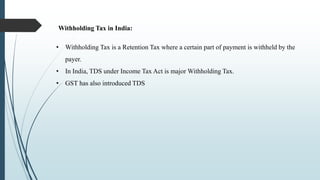
Withholding Tax in India:
• Withholding Tax is a Retention Tax where a certain part of payment is withheld by the
payer.
• In India, TDS under Income Tax Act is major Withholding Tax.
• GST has also introduced TDS
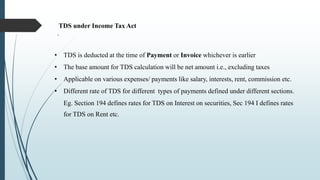
TDS under Income Tax Act
`
• TDS is deducted at the time of Payment or Invoice whichever is earlier
• The base amount for TDS calculation will be net amount i.e., excluding taxes
• Applicable on various expenses/ payments like salary, interests, rent, commission etc.
• Different rate of TDS for different types of payments defined under different sections.
Eg. Section 194 defines rates for TDS on Interest on securities, Sec 194 I defines rates
for TDS on Rent etc.
Important Terms
TAX KEYS:
• Tax keys are defined to identify different Sections under which TDS is levied
• It is required for Reporting Tax details for respective Sections under ITA
Recipient Types:
• Different persons are defined under recipient types [Example: Company, Individual/HUF]
• Recipient type is assigned to respective vendor
• Used in case different tax types are applicable to different persons
(Individual/HUF/Company)
Exemption Reason Code:
• Exemptions, if any, are defined as exemption reason code.
• Exemption Reason code gets assigned to respective Vendor master record
Business Place:
• Business Place are location where tax is deducted
• A Business place is created for each TAN number that a company has.
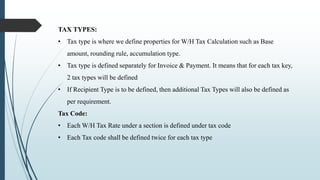
TAX TYPES:
• Tax type is where we define properties for W/H Tax Calculation such as Base
amount, rounding rule, accumulation type.
• Tax type is defined separately for Invoice & Payment. It means that for each tax key,
2 tax types will be defined
• If Recipient Type is to be defined, then additional Tax Types will also be defined as
per requirement.
Tax Code:
• Each W/H Tax Rate under a section is defined under tax code
• Each Tax code shall be defined twice for each tax type
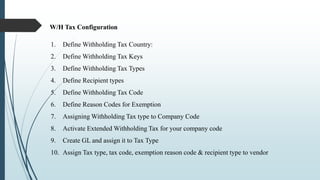
W/H Tax Configuration
1. Define Withholding Tax Country:
2. Define Withholding Tax Keys
3. Define Withholding Tax Types
4. Define Recipient types
5. Define Withholding Tax Code
6. Define Reason Codes for Exemption
7. Assigning Withholding Tax type to Company Code
8. Activate Extended Withholding Tax for your company code
9. Create GL and assign it to Tax Type
10. Assign Tax type, tax code, exemption reason code & recipient type to vendor
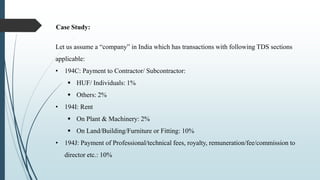
Case Study:
Let us assume a “company” in India which has transactions with following TDS sections
applicable:
• 194C: Payment to Contractor/ Subcontractor:
 HUF/ Individuals: 1%
 Others: 2%
• 194I: Rent
 On Plant & Machinery: 2%
 On Land/Building/Furniture or Fitting: 10%
• 194J: Payment of Professional/technical fees, royalty, remuneration/fee/commission to
director etc.: 10%
What to define for configuring W/H Tax for the given case?
1. Tax keys: 3 Tax keys by the name 194C, 194I & 194J shall be defined under basic
settings of Extended Withholding Tax
2. Tax Types: In the given case, we shall define 3 Tax types for Invoice and 3 Tax types
for Payment. [Additional Tax types will be defined for recipient types-next point].
3. Recipient Types: For Tax key 194C, different rates are prescribed for different
persons. Therefore, we should define 2 Recipient types- i) Individual/HUF ii) Others.
2 Additional Tax Types (1 for Invoice & 1 for Payment) shall be defined before
creating recipient types.
4. Tax Codes: In the given case, there are 5 different tax rates applicable. Therefore, we
shall define 5 tax codes twice, for each Tax type of Invoice & Payment.
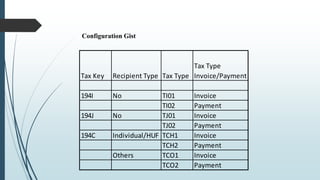
Configuration Gist
Tax Key Recipient Type Tax Type
Tax Type
Invoice/Payment
194I No TI01 Invoice
TI02 Payment
194J No TJ01 Invoice
TJ02 Payment
194C Individual/HUF TCH1 Invoice
TCH2 Payment
Others TCO1 Invoice
TCO2 Payment
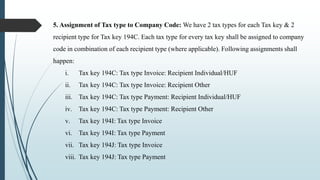
5. Assignment of Tax type to Company Code: We have 2 tax types for each Tax key & 2
recipient type for Tax key 194C. Each tax type for every tax key shall be assigned to company
code in combination of each recipient type (where applicable). Following assignments shall
happen:
i. Tax key 194C: Tax type Invoice: Recipient Individual/HUF
ii. Tax key 194C: Tax type Invoice: Recipient Other
iii. Tax key 194C: Tax type Payment: Recipient Individual/HUF
iv. Tax key 194C: Tax type Payment: Recipient Other
v. Tax key 194I: Tax type Invoice
vi. Tax key 194I: Tax type Payment
vii. Tax key 194J: Tax type Invoice
viii. Tax key 194J: Tax type Payment
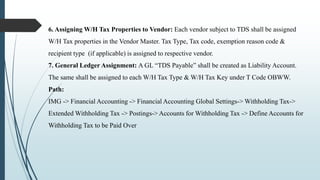
6. Assigning W/H Tax Properties to Vendor: Each vendor subject to TDS shall be assigned
W/H Tax properties in the Vendor Master. Tax Type, Tax code, exemption reason code &
recipient type (if applicable) is assigned to respective vendor.
7. General Ledger Assignment: A GL “TDS Payable” shall be created as Liability Account.
The same shall be assigned to each W/H Tax Type & W/H Tax Key under T Code OBWW.
Path:
IMG -> Financial Accounting -> Financial Accounting Global Settings-> Withholding Tax->
Extended Withholding Tax -> Postings-> Accounts for Withholding Tax -> Define Accounts for
Withholding Tax to be Paid Over
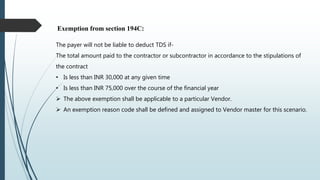
Exemption from section 194C:
The payer will not be liable to deduct TDS if-
The total amount paid to the contractor or subcontractor in accordance to the stipulations of
the contract
• Is less than INR 30,000 at any given time
• Is less than INR 75,000 over the course of the financial year
 The above exemption shall be applicable to a particular Vendor.
 An exemption reason code shall be defined and assigned to Vendor master for this scenario.
Withholding tax in sap

Withholding tax in sap

  • 1.
  • 2.
    Withholding Tax inIndia: • Withholding Tax is a Retention Tax where a certain part of payment is withheld by the payer. • In India, TDS under Income Tax Act is major Withholding Tax. • GST has also introduced TDS
  • 3.
    TDS under IncomeTax Act ` • TDS is deducted at the time of Payment or Invoice whichever is earlier • The base amount for TDS calculation will be net amount i.e., excluding taxes • Applicable on various expenses/ payments like salary, interests, rent, commission etc. • Different rate of TDS for different types of payments defined under different sections. Eg. Section 194 defines rates for TDS on Interest on securities, Sec 194 I defines rates for TDS on Rent etc.
  • 4.
    Important Terms TAX KEYS: •Tax keys are defined to identify different Sections under which TDS is levied • It is required for Reporting Tax details for respective Sections under ITA Recipient Types: • Different persons are defined under recipient types [Example: Company, Individual/HUF] • Recipient type is assigned to respective vendor • Used in case different tax types are applicable to different persons (Individual/HUF/Company) Exemption Reason Code: • Exemptions, if any, are defined as exemption reason code. • Exemption Reason code gets assigned to respective Vendor master record Business Place: • Business Place are location where tax is deducted • A Business place is created for each TAN number that a company has.
  • 5.
    TAX TYPES: • Taxtype is where we define properties for W/H Tax Calculation such as Base amount, rounding rule, accumulation type. • Tax type is defined separately for Invoice & Payment. It means that for each tax key, 2 tax types will be defined • If Recipient Type is to be defined, then additional Tax Types will also be defined as per requirement. Tax Code: • Each W/H Tax Rate under a section is defined under tax code • Each Tax code shall be defined twice for each tax type
  • 6.
    W/H Tax Configuration 1.Define Withholding Tax Country: 2. Define Withholding Tax Keys 3. Define Withholding Tax Types 4. Define Recipient types 5. Define Withholding Tax Code 6. Define Reason Codes for Exemption 7. Assigning Withholding Tax type to Company Code 8. Activate Extended Withholding Tax for your company code 9. Create GL and assign it to Tax Type 10. Assign Tax type, tax code, exemption reason code & recipient type to vendor
  • 7.
    Case Study: Let usassume a “company” in India which has transactions with following TDS sections applicable: • 194C: Payment to Contractor/ Subcontractor:  HUF/ Individuals: 1%  Others: 2% • 194I: Rent  On Plant & Machinery: 2%  On Land/Building/Furniture or Fitting: 10% • 194J: Payment of Professional/technical fees, royalty, remuneration/fee/commission to director etc.: 10%
  • 8.
    What to definefor configuring W/H Tax for the given case? 1. Tax keys: 3 Tax keys by the name 194C, 194I & 194J shall be defined under basic settings of Extended Withholding Tax 2. Tax Types: In the given case, we shall define 3 Tax types for Invoice and 3 Tax types for Payment. [Additional Tax types will be defined for recipient types-next point]. 3. Recipient Types: For Tax key 194C, different rates are prescribed for different persons. Therefore, we should define 2 Recipient types- i) Individual/HUF ii) Others. 2 Additional Tax Types (1 for Invoice & 1 for Payment) shall be defined before creating recipient types. 4. Tax Codes: In the given case, there are 5 different tax rates applicable. Therefore, we shall define 5 tax codes twice, for each Tax type of Invoice & Payment.
  • 9.
    Configuration Gist Tax KeyRecipient Type Tax Type Tax Type Invoice/Payment 194I No TI01 Invoice TI02 Payment 194J No TJ01 Invoice TJ02 Payment 194C Individual/HUF TCH1 Invoice TCH2 Payment Others TCO1 Invoice TCO2 Payment
  • 10.
    5. Assignment ofTax type to Company Code: We have 2 tax types for each Tax key & 2 recipient type for Tax key 194C. Each tax type for every tax key shall be assigned to company code in combination of each recipient type (where applicable). Following assignments shall happen: i. Tax key 194C: Tax type Invoice: Recipient Individual/HUF ii. Tax key 194C: Tax type Invoice: Recipient Other iii. Tax key 194C: Tax type Payment: Recipient Individual/HUF iv. Tax key 194C: Tax type Payment: Recipient Other v. Tax key 194I: Tax type Invoice vi. Tax key 194I: Tax type Payment vii. Tax key 194J: Tax type Invoice viii. Tax key 194J: Tax type Payment
  • 11.
    6. Assigning W/HTax Properties to Vendor: Each vendor subject to TDS shall be assigned W/H Tax properties in the Vendor Master. Tax Type, Tax code, exemption reason code & recipient type (if applicable) is assigned to respective vendor. 7. General Ledger Assignment: A GL “TDS Payable” shall be created as Liability Account. The same shall be assigned to each W/H Tax Type & W/H Tax Key under T Code OBWW. Path: IMG -> Financial Accounting -> Financial Accounting Global Settings-> Withholding Tax-> Extended Withholding Tax -> Postings-> Accounts for Withholding Tax -> Define Accounts for Withholding Tax to be Paid Over
  • 12.
    Exemption from section194C: The payer will not be liable to deduct TDS if- The total amount paid to the contractor or subcontractor in accordance to the stipulations of the contract • Is less than INR 30,000 at any given time • Is less than INR 75,000 over the course of the financial year  The above exemption shall be applicable to a particular Vendor.  An exemption reason code shall be defined and assigned to Vendor master for this scenario.

Editor's Notes

  • #3 Applicable on persons notified by Government Applicable on payments exceeding INR 2.5 Lacs Interstate Supplies: 2% of payment for IGST Intrastate Supply: 1% of payment for CGST & 1% for SGST