1Integrated Scenario Analysis for the California Water Plan Update 2009Rich Juricich, DWRMohammad Rayej, DWRDavid Groves, RANDDavid Yates, NCARDavid Purkey, SEIBrian Joyce, SEIAndy Draper, MWH
Presentation OverviewWater Plan Highlights and climate change Scenario concepts used in California Water PlanApplication of scenarios to statewide Hydrologic RegionsSummary of climate information in Water Plan Update 20092
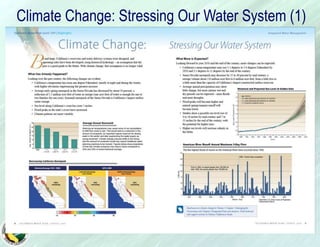
3Climate Change: Stressing Our Water System (1)
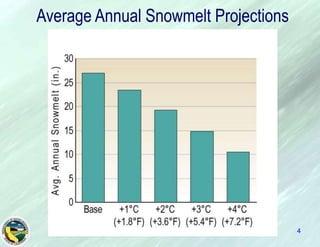
4Average Annual Snowmelt Projections
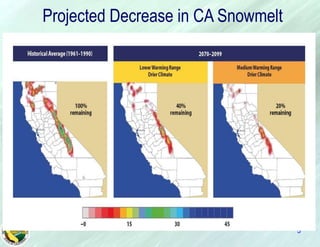
5Projected Decrease in CA Snowmelt
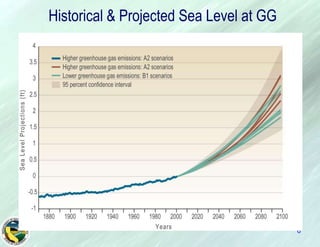
6Historical & Projected Sea Level at GG
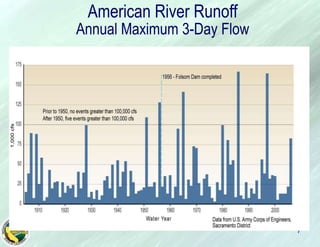
7American River RunoffAnnual Maximum 3-Day Flow
8Scenario Concepts
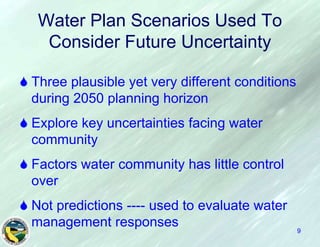
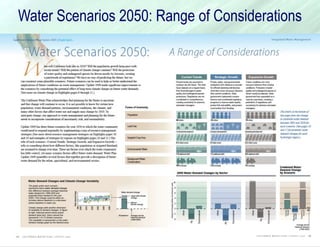
Water Plan Scenarios Used ToConsider Future UncertaintyThree plausible yet very different conditions during 2050 planning horizonExplore key uncertainties facing water communityFactors water community has little control overNot predictions ---- used to evaluate water management responses9
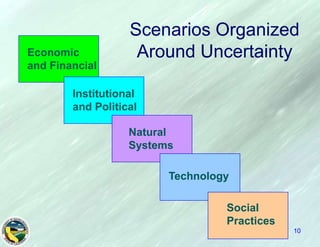
Scenarios Organized Around UncertaintyEconomic and FinancialInstitutional and PoliticalNatural SystemsTechnologySocialPractices10
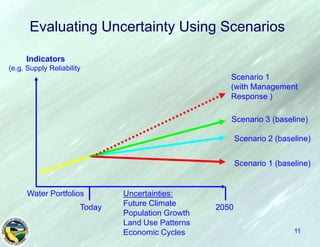
Evaluating Uncertainty Using ScenariosIndicators(e.g. Supply Reliability)Scenario 1 (with ManagementResponse )Scenario 3 (baseline)Scenario 2 (baseline)Scenario 1 (baseline)Water PortfoliosUncertainties:Future Climate Population GrowthLand Use PatternsEconomic Cycles2050Today11
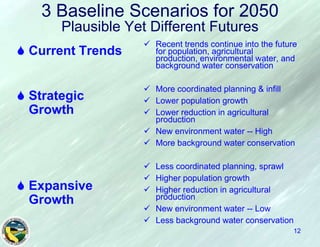
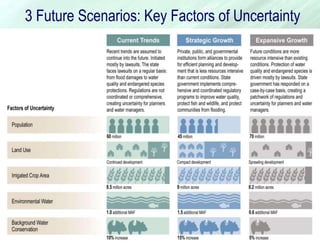
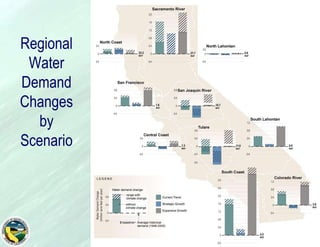
3 Baseline Scenarios for 2050Plausible Yet Different FuturesRecent trends continue into the future for population, agricultural production, environmental water, and background water conservation
More coordinated planning & infill
Lower population growth
Lower reduction in agricultural production
New environment water -- High
More background water conservation
Less coordinated planning, sprawl
Higher population growth
Higher reduction in agricultural production
New environment water -- Low
Less background water conservationCurrent TrendsStrategic GrowthExpansive Growth12
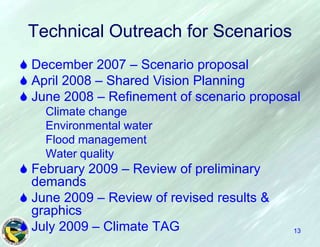
Technical Outreach for ScenariosDecember 2007 – Scenario proposalApril 2008 – Shared Vision PlanningJune 2008 – Refinement of scenario proposalClimate changeEnvironmental waterFlood managementWater qualityFebruary 2009 – Review of preliminary demandsJune 2009 – Review of revised results & graphicsJuly 2009 – Climate TAG13
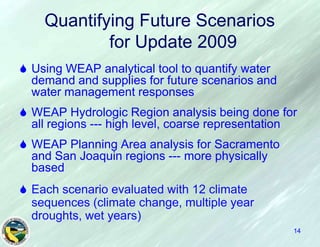
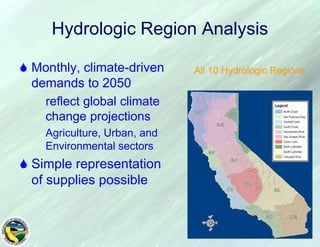
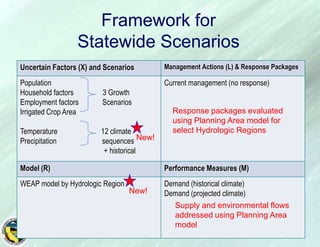
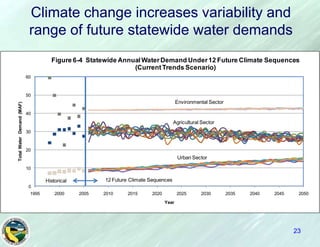
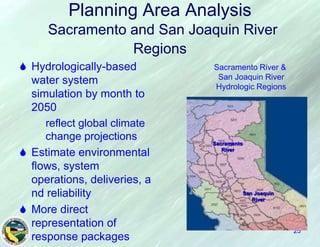
Quantifying Future Scenariosfor Update 2009Using WEAP analytical tool to quantify water demand and supplies for future scenarios and water management responsesWEAP Hydrologic Region analysis being done for all regions --- high level, coarse representationWEAP Planning Area analysis for Sacramento and San Joaquin regions --- more physically basedEach scenario evaluated with 12 climate sequences (climate change, multiple year droughts, wet years)14
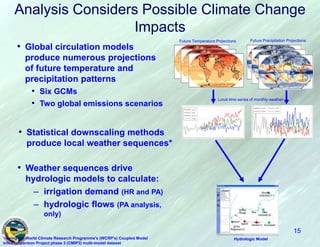
15Future Precipitation ProjectionsFuture Temperature Projections Local time series of monthly weatherStatistical downscaling methods produce local weather sequences*
Weather sequences drive hydrologic models to calculate:
irrigation demand (HR and PA)
hydrologic flows (PA analysis, only) Hydrologic ModelAnalysis Considers Possible Climate Change ImpactsGlobal circulation models produce numerous projections of future temperature and precipitation patterns

Juricich Sess11 102309