PRESENTED BY
S.RAMANATHAN
I B.C.A
Wireless Sensor Networks: A
Detailed Survey
CONTENTS
2
Introduction
Applications of sensor networks
Factors influencing sensor network design
Communication architecture of sensor networks
Conclusion
Introduction
3
A sensor network is composed of a large number
of sensor nodes, which are densely deployed
either inside the phenomenon or very close to it.
Random deployment
Cooperative capabilities
Applications of sensor networks
4
Temperature
Humidity
Vehicular movement
Lightning condition
Pressure
Soil makeup
Noise levels
The presence or absence of certain kinds of objects
Mechanical stress levels on attached objects
The current characteristics such as speed, direction, and
size of an object
SIMPLE PICTURE
5
Applications of sensor networks
6
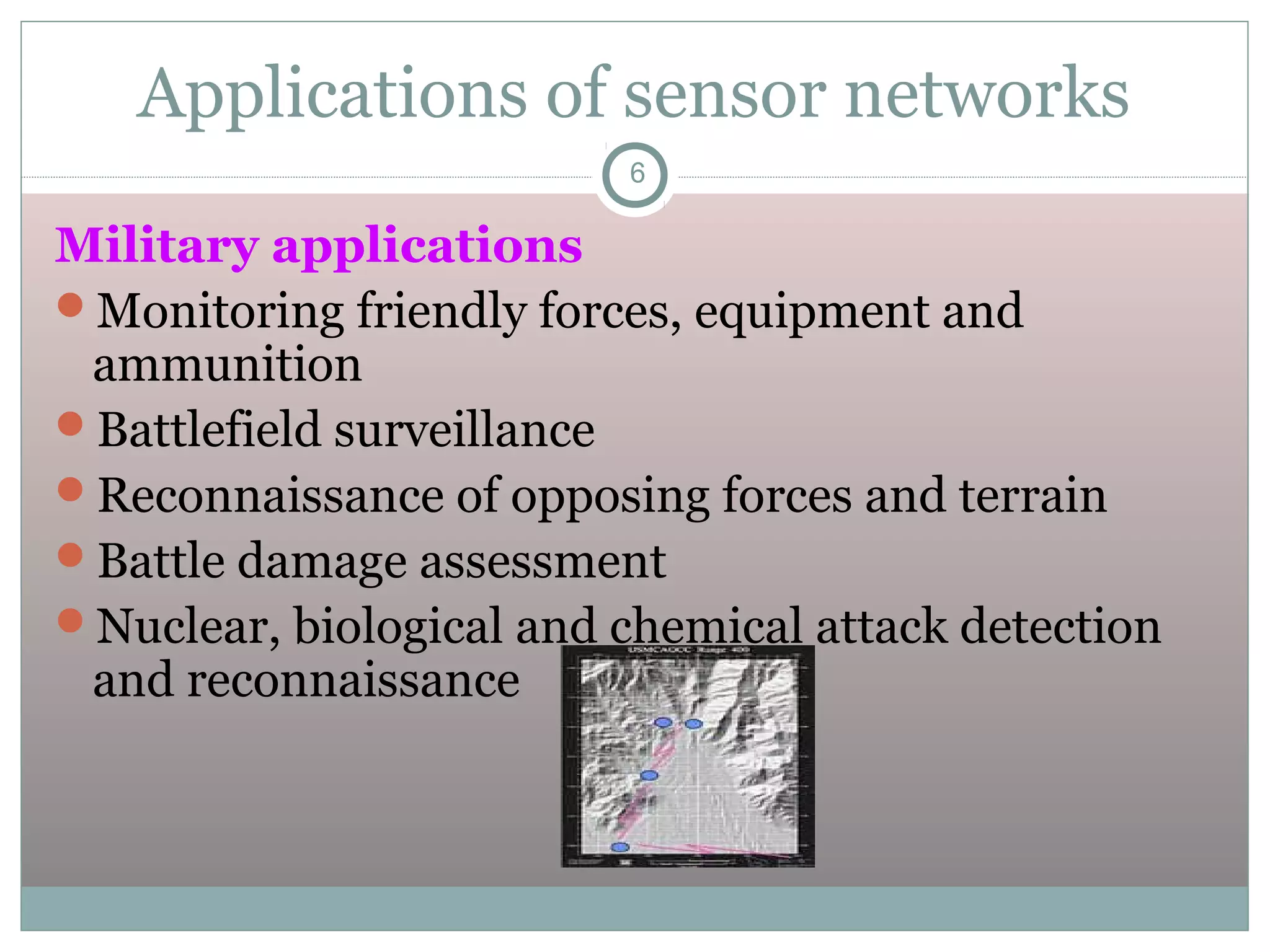
Military applications
Monitoring friendly forces, equipment and
ammunition
Battlefield surveillance
Reconnaissance of opposing forces and terrain
Battle damage assessment
Nuclear, biological and chemical attack detection
and reconnaissance
Applications of sensor networks
7
Environmental applications
Forest fire detection
Flood detection
Precision agriculture
Applications of sensor networks
8
Health applications
Tele monitoring of human physiological data
Tracking and monitoring patients and doctors inside
a hospital
Drug administration in hospitals
Home applications
Home automation
Samrt environment
Factors influencing sensor network design
9
Fault tolerance
 Fault tolerance is the ability to sustain sensor
network functionalities without any interruption
due to sensor node failures.
 The fault tolerance level depends on the
application of the sensor networks
Scalability
 Scalability measures the density of the sensor
nodes.
Factors influencing sensor network design
10
Production costs
The cost of a single node is very important to
justify the overall cost of the networks.
The cost of a sensor node is a very challenging
issue given the amount of functionalities with a
price of much less than a dollar.
Factors influencing sensor network design
11
Hardware constraints
Factors influencing sensor network design
12
Sensor network topology
Pre-deployment and deployment phase
Post-deployment phase
Re-deployment of additional nodes phase
Factors influencing sensor network design
13
Transmission media
In a sensor network, communicating nodes are
linked by a wireless medium. To enable global
operation, the chosen transmission medium
must be available worldwide.
 Radio
 infrared
 optical media
Factors influencing sensor network design
14
Power consumption
Sensing
Communication
Data processing
Communication architecture of sensor networks
15
Communication architecture of sensor networks
16
Communication architecture of sensor networks
17
Application layer
The three possible application layer protocols are -
Sensor management protocol (SMP)
Task assignment and data advertisement protocol
(TADAP)
Sensor query and data dissemination protocol
(SQDDP)
Communication architecture of sensor networks
18
Transport layer
This layer is especially needed when the system is
planned to be accessed through Internet or other
external networks.
No attempt thus far to propose a scheme or to
discuss the issues related to the transport layer of a
sensor network in literature.
Communication architecture of sensor networks
19
Network layer
Power efficiency is always an important
consideration.
Data aggregation is useful only when it does not
hinder the collaborative effort of the sensor nodes.
An ideal sensor network has attribute-based
addressing and location awareness.
Communication architecture of sensor networks
20
Data aggregation
Communication architecture of sensor networks
21
Data link layer
The data link layer is responsible for the medium
access and error control. It ensures reliable point-to-
point and point-to-multipoint connections in a
communication network.
Medium access control
Creation of the network infrastructure
Fairly and efficiently share communication resources
between sensor nodes
Communication architecture of sensor networks
22
Power saving modes of operation
Operation in a power saving mode is energy efficient
only if the time spent in that mode is greater than a
certain threshold.
Error control
Forward Error Correction (FEC)
Automatic Repeat Request (ARR)
Simple error control codes with low-complexity
encoding and decoding might present the best
solutions for sensor networks.
Communication architecture of sensor networks
23
Physical layer
The physical layer is responsible for frequency selection,
frequency generation, signal detection, modulation and
data encryption.
CONCULSION
Flexibility and fault tolerance create exciting new
applications for remote sensing
In future the wide range of applications will make sensor
networks an integral part of our lives
THANK YOU
24
ANY
QUERYS
?

Wireless sensor-networks

  • 1.
    PRESENTED BY S.RAMANATHAN I B.C.A WirelessSensor Networks: A Detailed Survey
  • 2.
    CONTENTS 2 Introduction Applications of sensornetworks Factors influencing sensor network design Communication architecture of sensor networks Conclusion
  • 3.
    Introduction 3 A sensor networkis composed of a large number of sensor nodes, which are densely deployed either inside the phenomenon or very close to it. Random deployment Cooperative capabilities
  • 4.
    Applications of sensornetworks 4 Temperature Humidity Vehicular movement Lightning condition Pressure Soil makeup Noise levels The presence or absence of certain kinds of objects Mechanical stress levels on attached objects The current characteristics such as speed, direction, and size of an object
  • 5.
  • 6.
    Applications of sensornetworks 6 Military applications Monitoring friendly forces, equipment and ammunition Battlefield surveillance Reconnaissance of opposing forces and terrain Battle damage assessment Nuclear, biological and chemical attack detection and reconnaissance
  • 7.
    Applications of sensornetworks 7 Environmental applications Forest fire detection Flood detection Precision agriculture
  • 8.
    Applications of sensornetworks 8 Health applications Tele monitoring of human physiological data Tracking and monitoring patients and doctors inside a hospital Drug administration in hospitals Home applications Home automation Samrt environment
  • 9.
    Factors influencing sensornetwork design 9 Fault tolerance  Fault tolerance is the ability to sustain sensor network functionalities without any interruption due to sensor node failures.  The fault tolerance level depends on the application of the sensor networks Scalability  Scalability measures the density of the sensor nodes.
  • 10.
    Factors influencing sensornetwork design 10 Production costs The cost of a single node is very important to justify the overall cost of the networks. The cost of a sensor node is a very challenging issue given the amount of functionalities with a price of much less than a dollar.
  • 11.
    Factors influencing sensornetwork design 11 Hardware constraints
  • 12.
    Factors influencing sensornetwork design 12 Sensor network topology Pre-deployment and deployment phase Post-deployment phase Re-deployment of additional nodes phase
  • 13.
    Factors influencing sensornetwork design 13 Transmission media In a sensor network, communicating nodes are linked by a wireless medium. To enable global operation, the chosen transmission medium must be available worldwide.  Radio  infrared  optical media
  • 14.
    Factors influencing sensornetwork design 14 Power consumption Sensing Communication Data processing
  • 15.
  • 16.
  • 17.
    Communication architecture ofsensor networks 17 Application layer The three possible application layer protocols are - Sensor management protocol (SMP) Task assignment and data advertisement protocol (TADAP) Sensor query and data dissemination protocol (SQDDP)
  • 18.
    Communication architecture ofsensor networks 18 Transport layer This layer is especially needed when the system is planned to be accessed through Internet or other external networks. No attempt thus far to propose a scheme or to discuss the issues related to the transport layer of a sensor network in literature.
  • 19.
    Communication architecture ofsensor networks 19 Network layer Power efficiency is always an important consideration. Data aggregation is useful only when it does not hinder the collaborative effort of the sensor nodes. An ideal sensor network has attribute-based addressing and location awareness.
  • 20.
    Communication architecture ofsensor networks 20 Data aggregation
  • 21.
    Communication architecture ofsensor networks 21 Data link layer The data link layer is responsible for the medium access and error control. It ensures reliable point-to- point and point-to-multipoint connections in a communication network. Medium access control Creation of the network infrastructure Fairly and efficiently share communication resources between sensor nodes
  • 22.
    Communication architecture ofsensor networks 22 Power saving modes of operation Operation in a power saving mode is energy efficient only if the time spent in that mode is greater than a certain threshold. Error control Forward Error Correction (FEC) Automatic Repeat Request (ARR) Simple error control codes with low-complexity encoding and decoding might present the best solutions for sensor networks.
  • 23.
    Communication architecture ofsensor networks 23 Physical layer The physical layer is responsible for frequency selection, frequency generation, signal detection, modulation and data encryption. CONCULSION Flexibility and fault tolerance create exciting new applications for remote sensing In future the wide range of applications will make sensor networks an integral part of our lives THANK YOU
  • 24.