A
PRESENTATION
ON
SENSOR NETWORKS
SUBMITTED BY :
Shubham
INDEX
 INTRODUCTION OF SENSOR NETWORKS
 TYPES OF SENSOR NETWORKS
 CHRACTERISTICS OF SENSOR NETWORKS
 SOFTWARE ENGINEERING
 CHARACTERISTICS MIDDLEWARE FOR SENSOR NETWORKS
 CONCEPT OF SOFTWARE ORIENTED ARCHITECTURE(SOA) FOR SENSOR
NETWORKS
 ARCHITECTURE OF NODE APPLICATION FOR SENSOR NETWORKS
 OVERALL GENERAL ARCHITECTURE
 ACRITECTURAL ISSUE
 ARCHITECTURE CLUSTER BASED
 STANDARDS AND SPECIALIZATIONS
 DISADVANTAGES OF SENSOR NETWORKS
 ADVANTAGES OF SENOR NETWORKS
 APPLICATION OF SENSOR NETWORKS
 REFERENCES
INTRODUCTION
OF
SENSOR NETWORKS
 A Sensor Network(SN) is a self-configuring network of small sensor nodes communicating
among themselves using radio signals, and deployed in quantity to sense, monitor and
understand the physical world.
 Sensor nodes are called motes.
 Sensor Networks provide a bridge between the real physical and virtual worlds.
  Have a wide range of potential applications to industry, science, transportation, civil
infrastructure, and security.
TYPES OF SENSOR
NETWORKS
UNSTRUCTURED SENSOR NETWORK STRUCTURED SENSOR NETWORK
1. Dense Collection of nodes 1. Few and scarcely distributed
2. Ad – hoc deployment 2. Pre – planned deployment
3. Difficulty in network maintenance 3. Lower network maintenance
CHARACTERISTICS
OF
SENSOR NETWORKS
 Self Organizing
 Concurrent Processing
 Low Cost
 Restricted Energy Resource
 Tiny
 Small Radio Range
SOFTWARE ENGINEERING
 Service Oriented Architecture
 Application :-
- Sensor Application
- Node Application
- Sensor Network Application
 Sensor Application - Readout of a sensor, local storage of the data. It ha full access to the hardware
and is able to access operating system directly.
 Node Application – Application specific task and function of the middleware and to built and
maintain the network.
 Sensor Network Application – Main task and required services of the entire network.
CHARACTERISTICS
OF
MIDDLEWARE FOR
SENSOR NETWORKS
 Middleware – Middleware is the software layer between the application and the Operating
System.
 Middleware has to be –
• Scalable
• Generic
• Adaptive
• Reflective
CONCEPT OF SOFTWARE ORIENTED
ARCHITECTURE (SOA) FOR SENSOR
NETWORKS
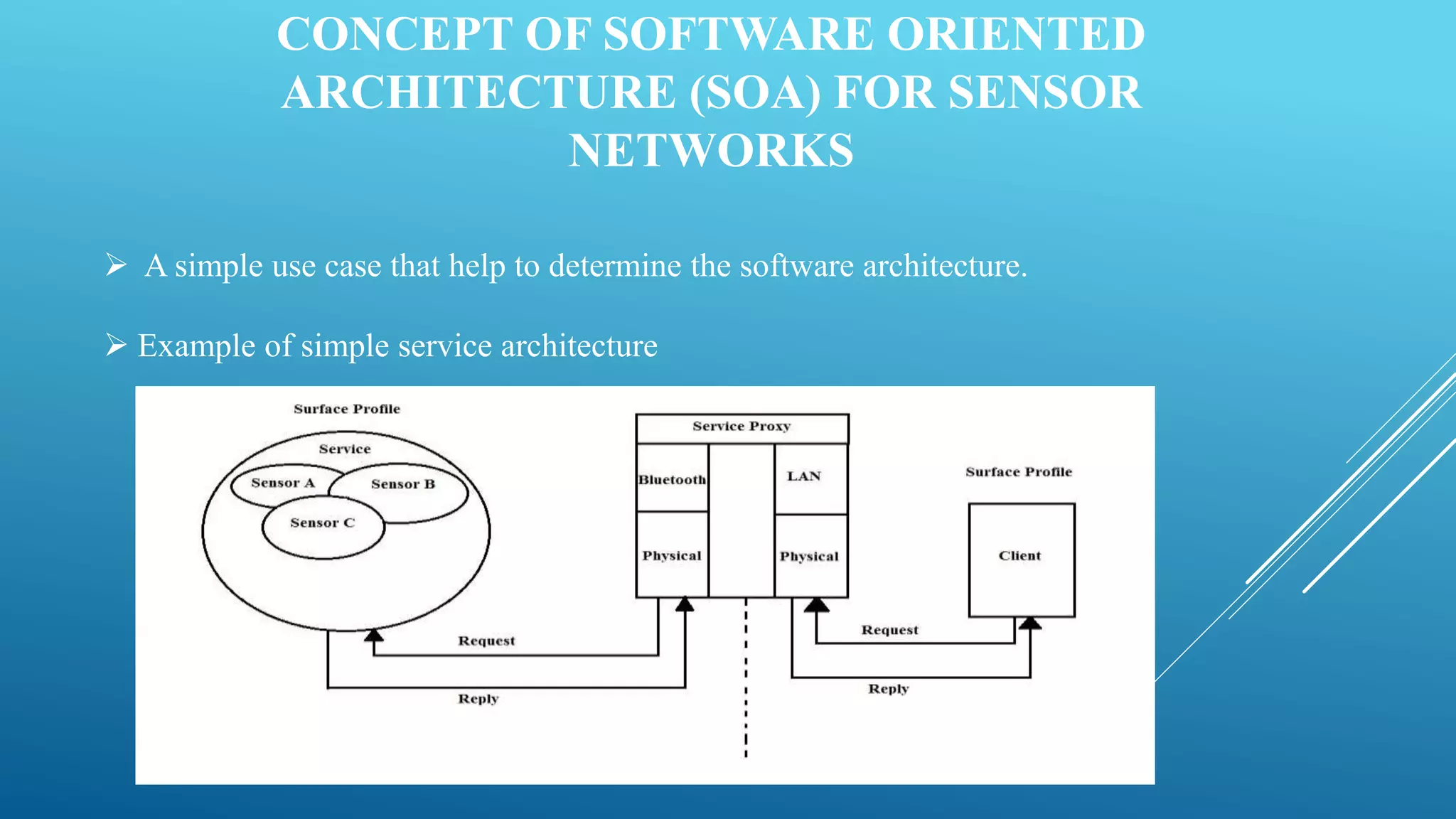
 A simple use case that help to determine the software architecture.
 Example of simple service architecture
ARCHITECTURE OF NODE APPLICATION
STRUCTURE
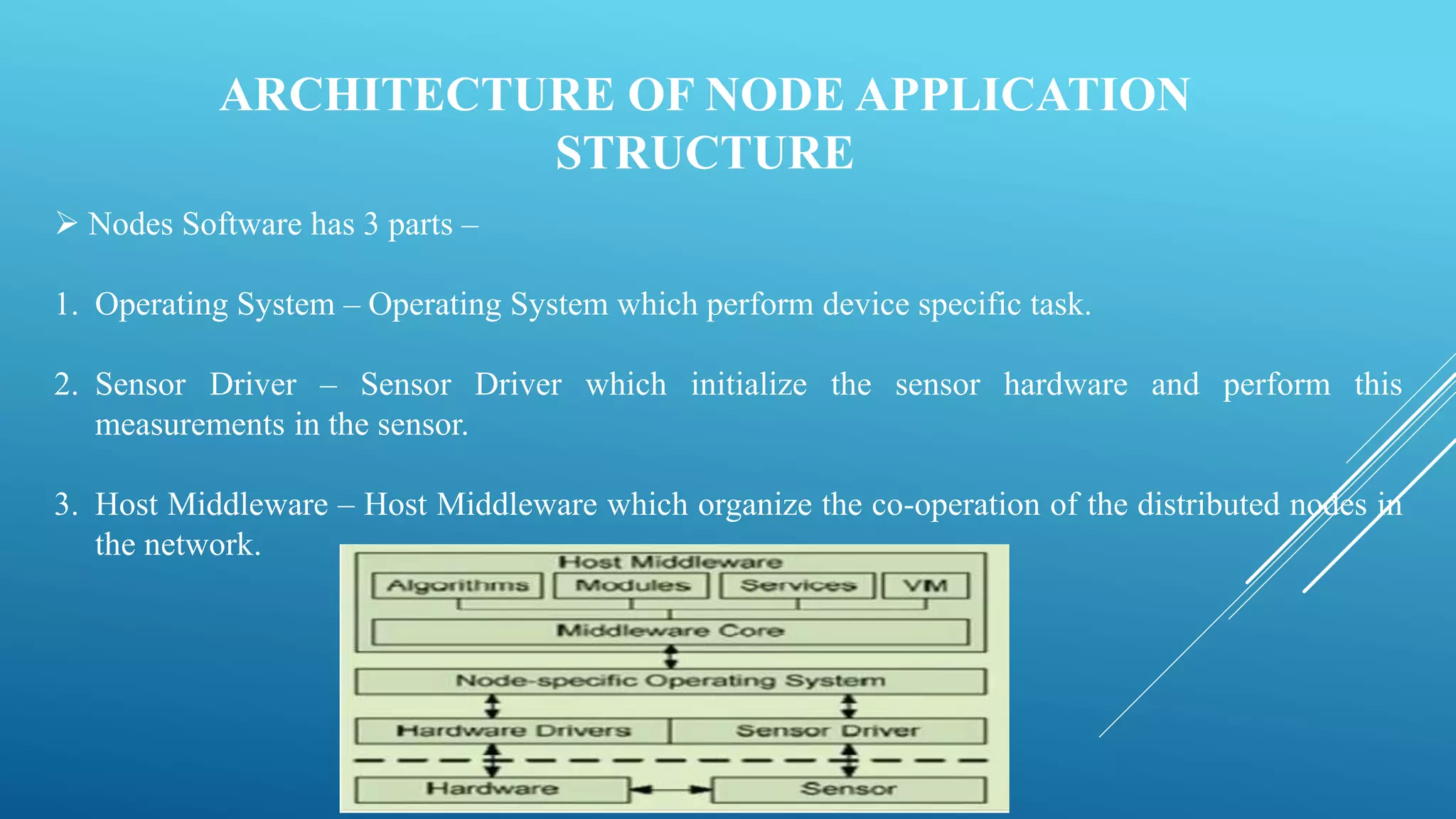
 Nodes Software has 3 parts –
1. Operating System – Operating System which perform device specific task.
2. Sensor Driver – Sensor Driver which initialize the sensor hardware and perform this
measurements in the sensor.
3. Host Middleware – Host Middleware which organize the co-operation of the distributed nodes in
the network.
OVERALL GENERALARCHITECTURE
 The general overall software architecture of the sensor network is show in the figure.
 Individual node interact with the distributed middleware layer to perform the functions dedicated
by the sensor network application.
ARCHITECTURAL ISSUE
 Energy Efficient
 Network Topology
 Failure in long range communication
 Increase the traffic decrease the life time
ARCHITECTURE CLUSTER BASED
 Provide the Quality Of Service (QoS).
 Dynamic Architecture – Cluster is the basic unit of software.
STANDARDS AND SPECIFICATIONS
 Predominant standards commonly use in sensor network includes –
1. Zig Bee – Transmit the data over the long distance by using the intermediate divices to reach
more distant ones.
2. Bluetooth – Wireless technology standard for exchanging data over short distances from fixed
and mobile devices by creating PAN(Personal Area Network).
DISADVANTAGE OF SENSOR NETWORKS
 Easy for hacker to hack a network.
 Comparatively low speed of communication.
 Cost at large
 Life of nodes
ADVANTAGE OF SENSOR NETWORKS
 Avoids a lot of wiring.
 Can accommodate a new device at any time.
 Flexible to through physical partition.
 In can be access through the centralize monitor.
APPLICATION OF SENSOR NETWORKS
 Area Monitoring
 Air pollution monitoring
 Health care monitoring
 Water quality monitoring
 Forest fire detection
 Landslide detection
REFERENCES
1. www.google.com
2. www.youtube.com
3. www.wikipedia.com

Presentation seminar shubham

  • 1.
  • 2.
    INDEX  INTRODUCTION OFSENSOR NETWORKS  TYPES OF SENSOR NETWORKS  CHRACTERISTICS OF SENSOR NETWORKS  SOFTWARE ENGINEERING  CHARACTERISTICS MIDDLEWARE FOR SENSOR NETWORKS  CONCEPT OF SOFTWARE ORIENTED ARCHITECTURE(SOA) FOR SENSOR NETWORKS  ARCHITECTURE OF NODE APPLICATION FOR SENSOR NETWORKS  OVERALL GENERAL ARCHITECTURE  ACRITECTURAL ISSUE  ARCHITECTURE CLUSTER BASED  STANDARDS AND SPECIALIZATIONS  DISADVANTAGES OF SENSOR NETWORKS  ADVANTAGES OF SENOR NETWORKS  APPLICATION OF SENSOR NETWORKS  REFERENCES
  • 3.
    INTRODUCTION OF SENSOR NETWORKS  ASensor Network(SN) is a self-configuring network of small sensor nodes communicating among themselves using radio signals, and deployed in quantity to sense, monitor and understand the physical world.  Sensor nodes are called motes.  Sensor Networks provide a bridge between the real physical and virtual worlds.   Have a wide range of potential applications to industry, science, transportation, civil infrastructure, and security.
  • 4.
    TYPES OF SENSOR NETWORKS UNSTRUCTUREDSENSOR NETWORK STRUCTURED SENSOR NETWORK 1. Dense Collection of nodes 1. Few and scarcely distributed 2. Ad – hoc deployment 2. Pre – planned deployment 3. Difficulty in network maintenance 3. Lower network maintenance
  • 5.
    CHARACTERISTICS OF SENSOR NETWORKS  SelfOrganizing  Concurrent Processing  Low Cost  Restricted Energy Resource  Tiny  Small Radio Range
  • 6.
    SOFTWARE ENGINEERING  ServiceOriented Architecture  Application :- - Sensor Application - Node Application - Sensor Network Application  Sensor Application - Readout of a sensor, local storage of the data. It ha full access to the hardware and is able to access operating system directly.  Node Application – Application specific task and function of the middleware and to built and maintain the network.  Sensor Network Application – Main task and required services of the entire network.
  • 7.
    CHARACTERISTICS OF MIDDLEWARE FOR SENSOR NETWORKS Middleware – Middleware is the software layer between the application and the Operating System.  Middleware has to be – • Scalable • Generic • Adaptive • Reflective
  • 8.
    CONCEPT OF SOFTWAREORIENTED ARCHITECTURE (SOA) FOR SENSOR NETWORKS  A simple use case that help to determine the software architecture.  Example of simple service architecture
  • 9.
    ARCHITECTURE OF NODEAPPLICATION STRUCTURE  Nodes Software has 3 parts – 1. Operating System – Operating System which perform device specific task. 2. Sensor Driver – Sensor Driver which initialize the sensor hardware and perform this measurements in the sensor. 3. Host Middleware – Host Middleware which organize the co-operation of the distributed nodes in the network.
  • 10.
    OVERALL GENERALARCHITECTURE  Thegeneral overall software architecture of the sensor network is show in the figure.  Individual node interact with the distributed middleware layer to perform the functions dedicated by the sensor network application.
  • 11.
    ARCHITECTURAL ISSUE  EnergyEfficient  Network Topology  Failure in long range communication  Increase the traffic decrease the life time
  • 12.
    ARCHITECTURE CLUSTER BASED Provide the Quality Of Service (QoS).  Dynamic Architecture – Cluster is the basic unit of software.
  • 13.
    STANDARDS AND SPECIFICATIONS Predominant standards commonly use in sensor network includes – 1. Zig Bee – Transmit the data over the long distance by using the intermediate divices to reach more distant ones. 2. Bluetooth – Wireless technology standard for exchanging data over short distances from fixed and mobile devices by creating PAN(Personal Area Network).
  • 14.
    DISADVANTAGE OF SENSORNETWORKS  Easy for hacker to hack a network.  Comparatively low speed of communication.  Cost at large  Life of nodes
  • 15.
    ADVANTAGE OF SENSORNETWORKS  Avoids a lot of wiring.  Can accommodate a new device at any time.  Flexible to through physical partition.  In can be access through the centralize monitor.
  • 16.
    APPLICATION OF SENSORNETWORKS  Area Monitoring  Air pollution monitoring  Health care monitoring  Water quality monitoring  Forest fire detection  Landslide detection
  • 17.