OPTIMAL JAMMING ATTACK 
STRATEGIES IN WIRELESS 
SENSOR NETWORKS 
PRESENTED BY, 
ARCHANA.B,NITHIYA.K 
III CSE 
KINGS COLLEGE OF ENGINEERING
OBJECTIVES 
The objective of this paper is to detect the 
jammer and avoid the collisions in 
wireless sensor networks.
CONTENT: 
 Jamming attack in wireless sensor 
network 
Optimal jamming attacks 
Defense policy 
Modeling Assumptions 
Attack detection model
INTRODUCTION 
In this paper the fundamental characteristic 
of wireless networks that Renders them more 
vulnerable to attacks than their wire line 
Counterparts Is the open, shared nature of their 
medium this exposes . 
If the attacker abuses a protocol with the 
primary goal to obtain performance benefits 
itself, the attack is referred to as misbehavior.
EXSISTING SYSTEM: 
The sensor node, looses its energy 
continuously so it is failed because of 
attacker attacks. 
 It take more time to transfer the 
information because of the retransmission 
process again and again.
PROPOSED SYSTEM 
Using the monitoring node the attacker is 
detected. 
The attacker is release power signals at 
that time the sensor node is act as 
sleeping node so does not loses the 
consumed energy.
WSN & WSN ATTACKS: 
WSN(WWiirreelleessss SSeennssoorr NNeettwwoorrkkss)) 
TTyyppeess ooff aattttaacckk iinn WWSSNN 
 Passive Attack 
 Active Attack 
PASSIVE ATTACK : Passively absorping ongoing 
communication 
ACTIVE ATTACK : Attacker is involved in transmission
DOS ATTACKS 
Depending on whether one looks at the 
cause of the consequence of it miss 
behavior in Wireless Networks stems. 
The utility is expressed in terms of 
consumed energy or achievable 
throughput on per link or end_to_end 
basis.
JAMMER 
Jammer is neither authenticated nor 
associated with the network. 
The attacker attempt to strike a balance 
short and long term benefits.
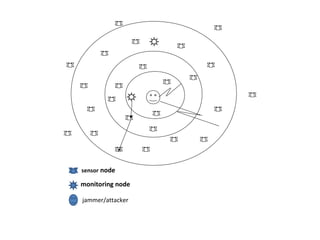
sensor node 
monitoring node 
jammer/attacker
OPTIMAL ATTACK 
We derive the optimal attack and optimal defense 
strategies as solution to optimization problems 
that are faced by the attacker. 
For attack detection we provide a methodology. 
We include in the formulation the attack 
detection.
ATTACK DETECTION MODEL 
The monitoring mechanism consists of , 
Determination of a subset of 
nodes(M). 
1.Employment of a detection 
algorithm. 
2.A detection algorithm is part of the 
detection module.
TYPES OF LINK LAYER JAMMER 
Deceptive, 
Random, 
 Reactive jammer.
REACTIVE JAMMER 
The reactive jammer is the most sophisticated 
one as it launches its attack after sensing 
ongoing transmission. 
Channel surfing involves on-demand 
frequency hopping as a countermeasure.
DETECTION ALGORITHM 
 A detection algorithm is part of the 
detection module at a monitor node; it takes as 
input observation samples obtained by the 
monitor node (i.e., collision/not collision) 
 decides whether there is an attack or not. On 
one hand.
OBSERVATION WINDOW 
The observation window should be small 
enough, such that the attack is detected in a 
timely manner and appropriate 
countermeasures are initiated. 
 On the other hand, this window should be 
sufficiently large, such that the chance of a 
false alarm notification is reduced.
CONCLUSION 
We studied controllable jamming attacks in 
wireless sensor networks, which are easy to 
launch and difficult to detect and confront. 
Our work is a first step towards understanding 
the structure of these problems. 
Interesting issues arise in multi-channel 
networks.
THANK YOU
QQUURRIIEESS??

Wireless sensor networks

  • 1.
    OPTIMAL JAMMING ATTACK STRATEGIES IN WIRELESS SENSOR NETWORKS PRESENTED BY, ARCHANA.B,NITHIYA.K III CSE KINGS COLLEGE OF ENGINEERING
  • 2.
    OBJECTIVES The objectiveof this paper is to detect the jammer and avoid the collisions in wireless sensor networks.
  • 3.
    CONTENT:  Jammingattack in wireless sensor network Optimal jamming attacks Defense policy Modeling Assumptions Attack detection model
  • 4.
    INTRODUCTION In thispaper the fundamental characteristic of wireless networks that Renders them more vulnerable to attacks than their wire line Counterparts Is the open, shared nature of their medium this exposes . If the attacker abuses a protocol with the primary goal to obtain performance benefits itself, the attack is referred to as misbehavior.
  • 5.
    EXSISTING SYSTEM: Thesensor node, looses its energy continuously so it is failed because of attacker attacks.  It take more time to transfer the information because of the retransmission process again and again.
  • 6.
    PROPOSED SYSTEM Usingthe monitoring node the attacker is detected. The attacker is release power signals at that time the sensor node is act as sleeping node so does not loses the consumed energy.
  • 7.
    WSN & WSNATTACKS: WSN(WWiirreelleessss SSeennssoorr NNeettwwoorrkkss)) TTyyppeess ooff aattttaacckk iinn WWSSNN  Passive Attack  Active Attack PASSIVE ATTACK : Passively absorping ongoing communication ACTIVE ATTACK : Attacker is involved in transmission
  • 8.
    DOS ATTACKS Dependingon whether one looks at the cause of the consequence of it miss behavior in Wireless Networks stems. The utility is expressed in terms of consumed energy or achievable throughput on per link or end_to_end basis.
  • 9.
    JAMMER Jammer isneither authenticated nor associated with the network. The attacker attempt to strike a balance short and long term benefits.
  • 10.
    sensor node monitoringnode jammer/attacker
  • 11.
    OPTIMAL ATTACK Wederive the optimal attack and optimal defense strategies as solution to optimization problems that are faced by the attacker. For attack detection we provide a methodology. We include in the formulation the attack detection.
  • 12.
    ATTACK DETECTION MODEL The monitoring mechanism consists of , Determination of a subset of nodes(M). 1.Employment of a detection algorithm. 2.A detection algorithm is part of the detection module.
  • 13.
    TYPES OF LINKLAYER JAMMER Deceptive, Random,  Reactive jammer.
  • 14.
    REACTIVE JAMMER Thereactive jammer is the most sophisticated one as it launches its attack after sensing ongoing transmission. Channel surfing involves on-demand frequency hopping as a countermeasure.
  • 15.
    DETECTION ALGORITHM A detection algorithm is part of the detection module at a monitor node; it takes as input observation samples obtained by the monitor node (i.e., collision/not collision)  decides whether there is an attack or not. On one hand.
  • 16.
    OBSERVATION WINDOW Theobservation window should be small enough, such that the attack is detected in a timely manner and appropriate countermeasures are initiated.  On the other hand, this window should be sufficiently large, such that the chance of a false alarm notification is reduced.
  • 17.
    CONCLUSION We studiedcontrollable jamming attacks in wireless sensor networks, which are easy to launch and difficult to detect and confront. Our work is a first step towards understanding the structure of these problems. Interesting issues arise in multi-channel networks.
  • 18.
  • 19.