
Security in Wireless Ad-Hoc
Networks
by
Raju Vemula
Outline
lIntroduction
lMANET
lSSN
lSecurity
lProperties
lFunctions
lClassification of attacks
lSolutions
lConclusion
lReferences
Introduction
lDifferent technologies have been developed for
different situations and necessities.
lWi-Fi technology for Wireless LAN and short range
mobile access networks.
lWireless USB is technology for Internet network on
the go.
lDifferent technologies like infrared, bluetooth are short
range.
Introduction
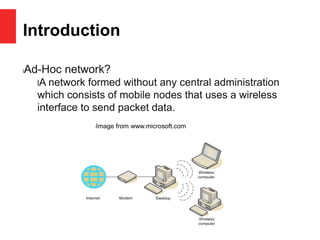
lAd-Hoc network?
lA network formed without any central administration
which consists of mobile nodes that uses a wireless
interface to send packet data.
lImage from www.microsoft.com
Introduction
lThere are 2 types ad-hoc networks.
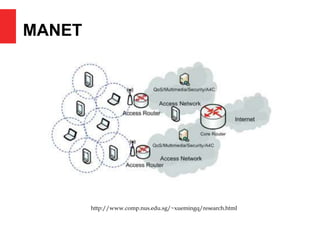
lMANET(Mobile ad-hoc network)
lAn autonomous system of mobile hosts connected
by wireless links, often called MANET.
lEstablishing survivable, efficient, dynamic
communication for emergency/rescue
operations.
lDisaster relief efforts.
MANET
http://www.comp.nus.edu.sg/~xuemingq/research.html
Introduction
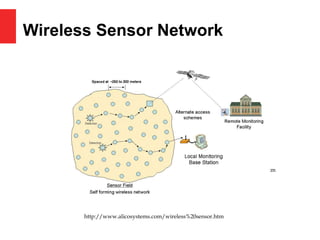
lWSN(Wireless Sensor Network)
lA smart sensor network consists of a number of
sensors spread across a geographical area.
lEach sensor has wireless communication capability
and sufficient intelligence for signal processing and
networking.
lMilitary sensor networks to detect enemy
movements.
lThe presence of hazardous material.
lEnvironmental sensor networks to detect and
monitor environmental changes.
Wireless Sensor Network
http://www.alicosystems.com/wireless%20sensor.htm
Properties
 There is no fixed topology
 Wireless nodes are small they move freely in and out
of range.
lE.g. Mobile phones, PDA, and wrist watches.
 Limited energy
 Most of the devices are operate on battery power
which is limited.
Properties
 Every node is a router
 Every node present in the network has limited amount of
communication range. All nodes out of this range can only
be reached by packet forwarding.
 Limited CPU/Resources
 In consume electronics price plays a big role.
 They are cheap and have limited CPU power.
Security Functions
 Availability
 It makes sure that all the required network services are
available to the authorized users.
 Authentication
 Authentication enables MANET to ensure the identity of
peer node that is communicating with.
 Confidentiality
 Confidentiality ensures that some information discloses
only to the unauthorized users.
Security Functions
 Data Integrity
 It guarantees for the information that is being
transferred.
 Key and trust management
 Basic operations includes establishing key
exchange and update as well as secret
connections.
Classification of attacks
lThere are so many ways that a malicious user may attack a ad-
hoc network.
lInternal attacks
lInternal attacks are more difficult to protect against as
the internal nodes are trustworthy.
lExternal attacks
lExternal attacks are produced by users which are not
part of network. For example one may issue an attack on
company from the office next to that.
Classification of attacks
lThe other types of attacks are:
lActive attacks
lActive attacks are caused by the users who are able to
inject the packets into the network. They are able to alter
the data, interfere with the routing information and
disrupt the service.
lPassive attacks
lPassive attacks is mainly to steal information and to
listen on the communication in the network. These may
monitor and analyze the traffic.
Classification of attacks
lAnother way to classify the attacks is by the layer at which
they may occur.
lAt the physical layer the malicious user may jam the
communication, intercept the messages or they may just listen
the messages.
lAt the data link layer the attacks conducted are traffic analysis
and monitoring and service disruption.
lAt network layer many attacks are observed like wormhole,
black hole, flooding, and resource consumption.
• Wormhole Attack:
In this attack network tunnel information to another network.
At this time hacker may easily enter and do misuse inside
the network.
• Black hole Attack:
It is a type of DOS(Denial of service) attack in which a router
that is supposed to relay packets instead discard them.
Solutions
l“Packet Leashes: A Defense Against Wormhole Attacks in Wireless Ad
Hoc Networks”, Yih-Chun Hu, Adrian Perrig, David. B. Johnson
lProtection against warm-hole attacks
lPacket leashes
lTemporal
lThe packet has an upper bound on its lifetime which restricts
the maximum travel distance.
lTransmission time and expiration time of the packet.
lGeographical
lThe recipient of the packet is within a certain distance from
the sender.
Solutions
l“Security-Aware Ad Hoc Routing for Wireless Networks”, Seung
Yi, Prasad Naldurg, Robert Kravets
lProtection against black-hole attacks
lUser identity is bound with an associated trust level.
lFor each trust level, it is used a simple shared secret to
generate a symmetric encryption/decryption key
lProvides a suite of cryptographic techniques: digital
signature, and encryption
Key Management
lKey management system must be secure, cause most
cryptographic system rely on it.
l3 types of keys in the network
lGroup Key
Key for all members in group to encrypt and
decrypt the data.
lSymmetric key
Shared between team leader and member node
of the same group.
lShared key
Shared only by all group leaders in the network.
Conclusion
lSituations are unpredictable with the wireless networks,
even with the infrastructural support.
lPresent solutions to address these attacks are not strong
enough.
lKey management solutions may help, but not every time.
lStill a lot of research has to be done.
References
lH Yang, H Y. Luo, F Ye, S W. Lu, and L Zhang, “Security in mobile ad hoc networks:
Challenges and solutions” (2004). IEEE Wireless Communications. 11 (1), pp. 38-47.
lYih-Chun Hu , Adrian Perrig, “A Survey of Secure Wireless Ad Hoc Routing”, IEEE
Security and Privacy, v.2 n.3, p.28-39, May 2004.
lThe Resurrecting Duckling: Security Issues for Ad-hoc Wireless Networks.
Frank Stajano, Ross Anderson.
lAdam Burg, “Ad hoc network specific attacks”, Seminar on Ad hoc
networking: concepts, applications, and security, Technische Universitat
Munchen, 2003.
lCharles E. Perkins (Hrsg.). Ad Hoc Networking, Addison-Wesley 2000.
Thank you

Ad hoc secuirty-vemula

  • 1.
    Security in WirelessAd-Hoc Networks by Raju Vemula
  • 2.
  • 3.
    Introduction lDifferent technologies havebeen developed for different situations and necessities. lWi-Fi technology for Wireless LAN and short range mobile access networks. lWireless USB is technology for Internet network on the go. lDifferent technologies like infrared, bluetooth are short range.
  • 4.
    Introduction lAd-Hoc network? lA networkformed without any central administration which consists of mobile nodes that uses a wireless interface to send packet data. lImage from www.microsoft.com
  • 5.
    Introduction lThere are 2types ad-hoc networks. lMANET(Mobile ad-hoc network) lAn autonomous system of mobile hosts connected by wireless links, often called MANET. lEstablishing survivable, efficient, dynamic communication for emergency/rescue operations. lDisaster relief efforts.
  • 6.
  • 7.
    Introduction lWSN(Wireless Sensor Network) lAsmart sensor network consists of a number of sensors spread across a geographical area. lEach sensor has wireless communication capability and sufficient intelligence for signal processing and networking. lMilitary sensor networks to detect enemy movements. lThe presence of hazardous material. lEnvironmental sensor networks to detect and monitor environmental changes.
  • 8.
  • 9.
    Properties  There isno fixed topology  Wireless nodes are small they move freely in and out of range. lE.g. Mobile phones, PDA, and wrist watches.  Limited energy  Most of the devices are operate on battery power which is limited.
  • 10.
    Properties  Every nodeis a router  Every node present in the network has limited amount of communication range. All nodes out of this range can only be reached by packet forwarding.  Limited CPU/Resources  In consume electronics price plays a big role.  They are cheap and have limited CPU power.
  • 11.
    Security Functions  Availability It makes sure that all the required network services are available to the authorized users.  Authentication  Authentication enables MANET to ensure the identity of peer node that is communicating with.  Confidentiality  Confidentiality ensures that some information discloses only to the unauthorized users.
  • 12.
    Security Functions  DataIntegrity  It guarantees for the information that is being transferred.  Key and trust management  Basic operations includes establishing key exchange and update as well as secret connections.
  • 13.
    Classification of attacks lThereare so many ways that a malicious user may attack a ad- hoc network. lInternal attacks lInternal attacks are more difficult to protect against as the internal nodes are trustworthy. lExternal attacks lExternal attacks are produced by users which are not part of network. For example one may issue an attack on company from the office next to that.
  • 14.
    Classification of attacks lTheother types of attacks are: lActive attacks lActive attacks are caused by the users who are able to inject the packets into the network. They are able to alter the data, interfere with the routing information and disrupt the service. lPassive attacks lPassive attacks is mainly to steal information and to listen on the communication in the network. These may monitor and analyze the traffic.
  • 15.
    Classification of attacks lAnotherway to classify the attacks is by the layer at which they may occur. lAt the physical layer the malicious user may jam the communication, intercept the messages or they may just listen the messages. lAt the data link layer the attacks conducted are traffic analysis and monitoring and service disruption. lAt network layer many attacks are observed like wormhole, black hole, flooding, and resource consumption.
  • 16.
    • Wormhole Attack: Inthis attack network tunnel information to another network. At this time hacker may easily enter and do misuse inside the network. • Black hole Attack: It is a type of DOS(Denial of service) attack in which a router that is supposed to relay packets instead discard them.
  • 17.
    Solutions l“Packet Leashes: ADefense Against Wormhole Attacks in Wireless Ad Hoc Networks”, Yih-Chun Hu, Adrian Perrig, David. B. Johnson lProtection against warm-hole attacks lPacket leashes lTemporal lThe packet has an upper bound on its lifetime which restricts the maximum travel distance. lTransmission time and expiration time of the packet. lGeographical lThe recipient of the packet is within a certain distance from the sender.
  • 18.
    Solutions l“Security-Aware Ad HocRouting for Wireless Networks”, Seung Yi, Prasad Naldurg, Robert Kravets lProtection against black-hole attacks lUser identity is bound with an associated trust level. lFor each trust level, it is used a simple shared secret to generate a symmetric encryption/decryption key lProvides a suite of cryptographic techniques: digital signature, and encryption
  • 19.
    Key Management lKey managementsystem must be secure, cause most cryptographic system rely on it. l3 types of keys in the network lGroup Key Key for all members in group to encrypt and decrypt the data. lSymmetric key Shared between team leader and member node of the same group. lShared key Shared only by all group leaders in the network.
  • 20.
    Conclusion lSituations are unpredictablewith the wireless networks, even with the infrastructural support. lPresent solutions to address these attacks are not strong enough. lKey management solutions may help, but not every time. lStill a lot of research has to be done.
  • 21.
    References lH Yang, HY. Luo, F Ye, S W. Lu, and L Zhang, “Security in mobile ad hoc networks: Challenges and solutions” (2004). IEEE Wireless Communications. 11 (1), pp. 38-47. lYih-Chun Hu , Adrian Perrig, “A Survey of Secure Wireless Ad Hoc Routing”, IEEE Security and Privacy, v.2 n.3, p.28-39, May 2004. lThe Resurrecting Duckling: Security Issues for Ad-hoc Wireless Networks. Frank Stajano, Ross Anderson. lAdam Burg, “Ad hoc network specific attacks”, Seminar on Ad hoc networking: concepts, applications, and security, Technische Universitat Munchen, 2003. lCharles E. Perkins (Hrsg.). Ad Hoc Networking, Addison-Wesley 2000.
  • 22.