by
Clyde A. Lettsome, PhD, PE, MEM
•   What Do Engineers Do?
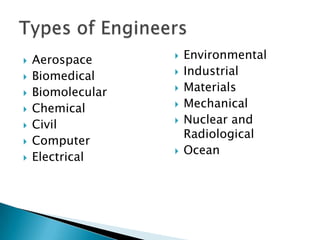
•   Types of Engineers
•   Engineering vs. Engineering Technology
•   Engineering Job Security & Salaries
•   What is Expected?
•   Overview of Expectations
•   Advantages of Licensing
•   Career Goals
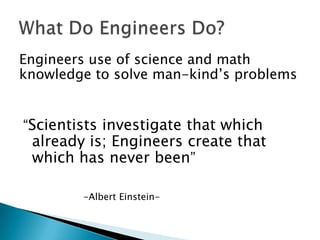
Engineers use of science and math
knowledge to solve man-kind’s problems


“Scientists investigate that which
 already is; Engineers create that
 which has never been”

        -Albert Einstein-
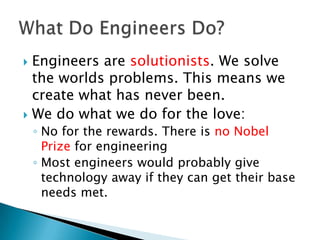
 Engineers are solutionists. We solve
  the worlds problems. This means we
  create what has never been.
 We do what we do for the love:
    ◦ No for the rewards. There is no Nobel
      Prize for engineering
    ◦ Most engineers would probably give
      technology away if they can get their base
      needs met.
   Aerospace         Environmental
   Biomedical        Industrial
   Biomolecular      Materials
   Chemical          Mechanical
   Civil             Nuclear and
                       Radiological
   Computer
                      Ocean
   Electrical
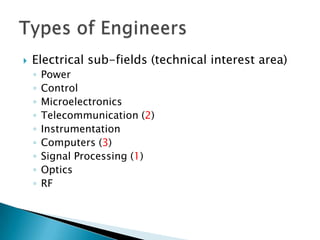
   Electrical sub-fields (technical interest area)
    ◦   Power
    ◦   Control
    ◦   Microelectronics
    ◦   Telecommunication (2)
    ◦   Instrumentation
    ◦   Computers (3)
    ◦   Signal Processing (1)
    ◦   Optics
    ◦   RF
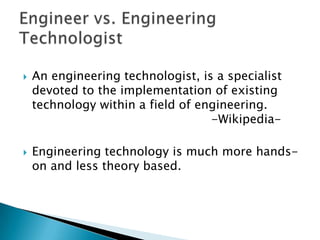
   An engineering technologist, is a specialist
    devoted to the implementation of existing
    technology within a field of engineering.
                                   -Wikipedia-

   Engineering technology is much more hands-
    on and less theory based.
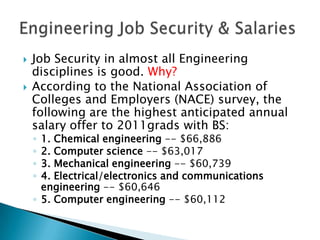
   Job Security in almost all Engineering
    disciplines is good. Why?
   According to the National Association of
    Colleges and Employers (NACE) survey, the
    following are the highest anticipated annual
    salary offer to 2011grads with BS:
    ◦ 1. Chemical engineering -- $66,886
    ◦ 2. Computer science -- $63,017
    ◦ 3. Mechanical engineering -- $60,739
    ◦ 4. Electrical/electronics and communications
      engineering -- $60,646
    ◦ 5. Computer engineering -- $60,112
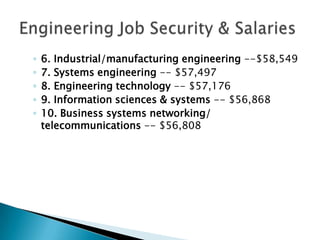
◦   6. Industrial/manufacturing engineering --$58,549
◦   7. Systems engineering -- $57,497
◦   8. Engineering technology -- $57,176
◦   9. Information sciences & systems -- $56,868
◦   10. Business systems networking/
    telecommunications -- $56,808
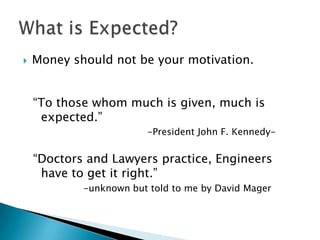
   Money should not be your motivation.


    “To those whom much is given, much is
     expected.”
                        -President John F. Kennedy-

    “Doctors and Lawyers practice, Engineers
     have to get it right.”
            -unknown but told to me by David Mager
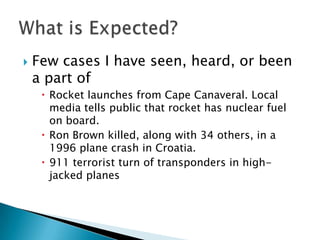
   Few cases I have seen, heard, or been
    a part of
      Rocket launches from Cape Canaveral. Local
       media tells public that rocket has nuclear fuel
       on board.
      Ron Brown killed, along with 34 others, in a
       1996 plane crash in Croatia.
      911 terrorist turn of transponders in high-
       jacked planes
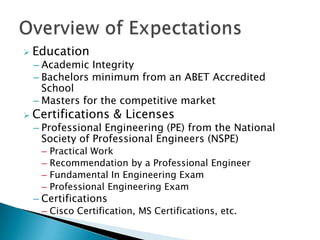
   Education
    – Academic Integrity
    – Bachelors minimum from an ABET Accredited
      School
    – Masters for the competitive market
   Certifications & Licenses
    – Professional Engineering (PE) from the National
      Society of Professional Engineers (NSPE)
     –   Practical Work
     –   Recommendation by a Professional Engineer
     –   Fundamental In Engineering Exam
     –   Professional Engineering Exam
    – Certifications
     – Cisco Certification, MS Certifications, etc.
   Prepare, sign and seal, and submit
    engineering plans to a public authority
   A legal requirement for those who are in
    responsible charge of work who wish to
    pursue a career as a consulting engineer
   For those considering a career in education
   More credibility as expert witnesses in court
    than most engineers.
   Moore’s Law – Technology doubles every 18
    to 24 months
    – Continuing Education
     –   Take classes at a university
     –   Obtain training in your discipline
     –   Attend conferences and webinars
     –   Write papers and reviews
     –   Attend Seminars
    – Become an active member of a Professional Society
     – Institute of Electrical and Electronics Engineers (IEEE)
     – American Society of Civil Engineers (ASCE)
     – American Society of Mechanical Engineers (ASME)
 Career   Tracks
 –Management – Obtain an MBA or MEM
 –Technical – Obtain MS in your discipline of
  Engineering
 –Research & Education – Obtain a PhD
   My Blog: ClydeLettsome.com
   Facebook
   Twitter
   LinkedIn
   Youtube
   SlideShare
   OpenForum by American Express
   Yahoo Contributor
   Ezine

Engineering as a career

  • 1.
  • 2.
    What Do Engineers Do? • Types of Engineers • Engineering vs. Engineering Technology • Engineering Job Security & Salaries • What is Expected? • Overview of Expectations • Advantages of Licensing • Career Goals
  • 3.
    Engineers use ofscience and math knowledge to solve man-kind’s problems “Scientists investigate that which already is; Engineers create that which has never been” -Albert Einstein-
  • 4.
     Engineers aresolutionists. We solve the worlds problems. This means we create what has never been.  We do what we do for the love: ◦ No for the rewards. There is no Nobel Prize for engineering ◦ Most engineers would probably give technology away if they can get their base needs met.
  • 5.
    Aerospace  Environmental  Biomedical  Industrial  Biomolecular  Materials  Chemical  Mechanical  Civil  Nuclear and Radiological  Computer  Ocean  Electrical
  • 6.
    Electrical sub-fields (technical interest area) ◦ Power ◦ Control ◦ Microelectronics ◦ Telecommunication (2) ◦ Instrumentation ◦ Computers (3) ◦ Signal Processing (1) ◦ Optics ◦ RF
  • 7.
    An engineering technologist, is a specialist devoted to the implementation of existing technology within a field of engineering. -Wikipedia-  Engineering technology is much more hands- on and less theory based.
  • 8.
    Job Security in almost all Engineering disciplines is good. Why?  According to the National Association of Colleges and Employers (NACE) survey, the following are the highest anticipated annual salary offer to 2011grads with BS: ◦ 1. Chemical engineering -- $66,886 ◦ 2. Computer science -- $63,017 ◦ 3. Mechanical engineering -- $60,739 ◦ 4. Electrical/electronics and communications engineering -- $60,646 ◦ 5. Computer engineering -- $60,112
  • 9.
    6. Industrial/manufacturing engineering --$58,549 ◦ 7. Systems engineering -- $57,497 ◦ 8. Engineering technology -- $57,176 ◦ 9. Information sciences & systems -- $56,868 ◦ 10. Business systems networking/ telecommunications -- $56,808
  • 10.
    Money should not be your motivation. “To those whom much is given, much is expected.” -President John F. Kennedy- “Doctors and Lawyers practice, Engineers have to get it right.” -unknown but told to me by David Mager
  • 11.
    Few cases I have seen, heard, or been a part of  Rocket launches from Cape Canaveral. Local media tells public that rocket has nuclear fuel on board.  Ron Brown killed, along with 34 others, in a 1996 plane crash in Croatia.  911 terrorist turn of transponders in high- jacked planes
  • 12.
    Education – Academic Integrity – Bachelors minimum from an ABET Accredited School – Masters for the competitive market  Certifications & Licenses – Professional Engineering (PE) from the National Society of Professional Engineers (NSPE) – Practical Work – Recommendation by a Professional Engineer – Fundamental In Engineering Exam – Professional Engineering Exam – Certifications – Cisco Certification, MS Certifications, etc.
  • 13.
    Prepare, sign and seal, and submit engineering plans to a public authority  A legal requirement for those who are in responsible charge of work who wish to pursue a career as a consulting engineer  For those considering a career in education  More credibility as expert witnesses in court than most engineers.
  • 14.
    Moore’s Law – Technology doubles every 18 to 24 months – Continuing Education – Take classes at a university – Obtain training in your discipline – Attend conferences and webinars – Write papers and reviews – Attend Seminars – Become an active member of a Professional Society – Institute of Electrical and Electronics Engineers (IEEE) – American Society of Civil Engineers (ASCE) – American Society of Mechanical Engineers (ASME)
  • 15.
     Career Tracks –Management – Obtain an MBA or MEM –Technical – Obtain MS in your discipline of Engineering –Research & Education – Obtain a PhD
  • 17.
    My Blog: ClydeLettsome.com  Facebook  Twitter  LinkedIn  Youtube  SlideShare  OpenForum by American Express  Yahoo Contributor  Ezine