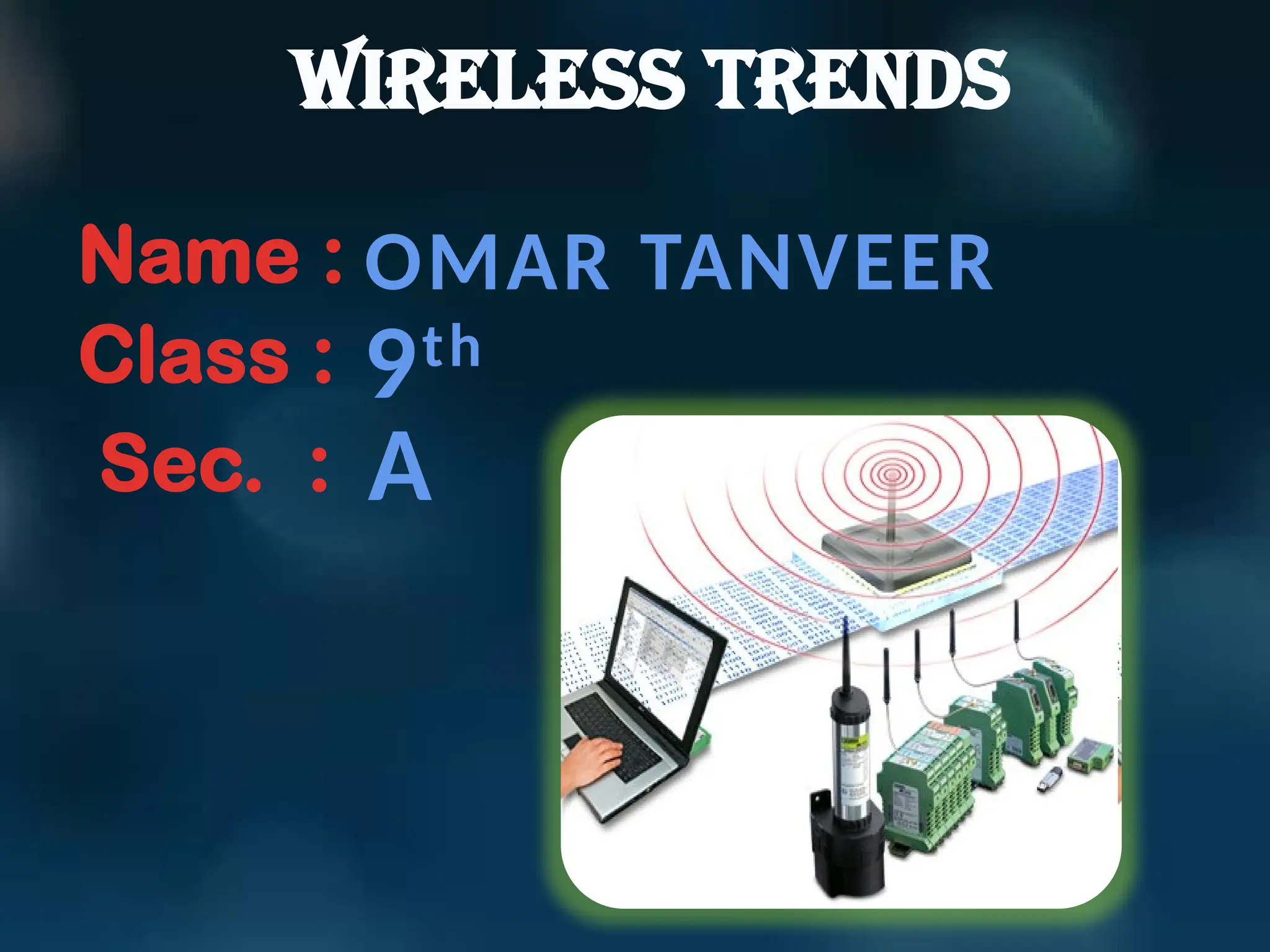
Wireless Trends
Name :
Class :
OMAR TANVEER
9th
Sec. : A
Wireless Comes of Age
• Guglielmo Marconi invented the wireless telegraph
in 1896
– Communication by encoding alphanumeric characters in
analog signal
• Communications satellites launched in 1960s
• Advances in wireless technology
– Radio, television, mobile telephone, communication
satellites
• More recently
– Satellite communications, wireless networking, cellular
technology
Wireless?
• A wireless LAN or WLAN is a wireless local area network
that uses radio waves as its carrier.
• The last link with the users is wireless, to give a network
connection to all users in a building or campus.
• The backbone network usually uses cables
• Wireless communication is the transfer of information
between two or more points that are not connected by an
electrical conductor
• The benefit of wireless networks is driving the explosive
growth of the WLAN market.
Broadband Wireless
Technology
• Higher data rates obtainable with broadband
wireless technology
– Graphics, video, audio
• Shares same advantages of all wireless services:
convenience and reduced cost
– Service can be deployed faster than fixed service
– No cost of cable plant
– Service is mobile, deployed almost anywhere
Bluetooth Wireless
Technology
• Bluetooth technology was originally intended to be a
wireless replacement for cables and wires between things
like phones , computers , keyboards and mice.
• Bluetooth works great in those devices and it can do so much
more connecting TV , music players and even home
healthcare devices.
• With the rapid advancements in Bluetooth technology , we
can now create new connections that we weren’t possible
using wires.
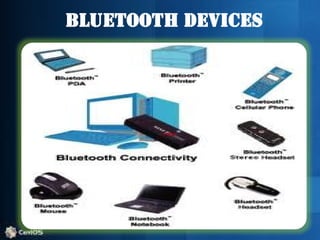
Bluetooth Devices
Wi-Fi
•Wi-Fi is a popular technology that allows an electronic
device to exchange data wirelessly (using radio waves)
over a computer network, including high-speed Internet
connections.
•The Wi-Fi Alliance defines Wi-Fi as any "wireless local
area network (WLAN) products that are based on the
Institute of Electrical and Electronics Engineers' (IEEE)
802.11 standards".
•However, since most modern WLANs are based on these
standards, the term "Wi-Fi" is used in general English as a
synonym for "WLAN".
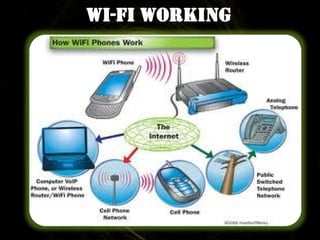
Wi-Fi working

WIRELESS TREn ND OMAR TANVEER.pptx

  • 1.
    Wireless Trends Name : Class: OMAR TANVEER 9th Sec. : A
  • 2.
    Wireless Comes ofAge • Guglielmo Marconi invented the wireless telegraph in 1896 – Communication by encoding alphanumeric characters in analog signal • Communications satellites launched in 1960s • Advances in wireless technology – Radio, television, mobile telephone, communication satellites • More recently – Satellite communications, wireless networking, cellular technology
  • 3.
    Wireless? • A wirelessLAN or WLAN is a wireless local area network that uses radio waves as its carrier. • The last link with the users is wireless, to give a network connection to all users in a building or campus. • The backbone network usually uses cables • Wireless communication is the transfer of information between two or more points that are not connected by an electrical conductor • The benefit of wireless networks is driving the explosive growth of the WLAN market.
  • 4.
    Broadband Wireless Technology • Higherdata rates obtainable with broadband wireless technology – Graphics, video, audio • Shares same advantages of all wireless services: convenience and reduced cost – Service can be deployed faster than fixed service – No cost of cable plant – Service is mobile, deployed almost anywhere
  • 5.
    Bluetooth Wireless Technology • Bluetoothtechnology was originally intended to be a wireless replacement for cables and wires between things like phones , computers , keyboards and mice. • Bluetooth works great in those devices and it can do so much more connecting TV , music players and even home healthcare devices. • With the rapid advancements in Bluetooth technology , we can now create new connections that we weren’t possible using wires.
  • 6.
  • 7.
    Wi-Fi •Wi-Fi is apopular technology that allows an electronic device to exchange data wirelessly (using radio waves) over a computer network, including high-speed Internet connections. •The Wi-Fi Alliance defines Wi-Fi as any "wireless local area network (WLAN) products that are based on the Institute of Electrical and Electronics Engineers' (IEEE) 802.11 standards". •However, since most modern WLANs are based on these standards, the term "Wi-Fi" is used in general English as a synonym for "WLAN".
  • 8.