






WIRELESS CONNECTIVITY FOR INTERNET OF THINGS
BY
A.SUMANTH
16241D5508
CONTENTS
• Introduction
• Frequency bands and world wide regulations
• Communication protocols
• Network range
• Network topology and size
• Different technologies
• Advantages
• Disadvantages
• Conclusion
INTRODUCTION
• Coined by British technology pioneer Kevin Ashton.
• A system in which objects in the physical world could be connected to the
Internet by sensors.
• The power of connecting Radio-Frequency Identification (RFID) tags.
• A popular term for describing scenarios in which Internet connectivity.
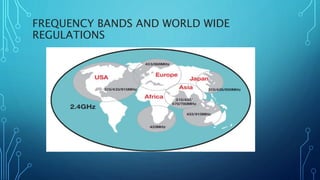
FREQUENCYAND WORLD WIDE REGULATIONS
• Regulated by ITU-R.
• ISM bands vary from country to country.
• Popular are 433MHz,868MHz,915MHz,2.4MHz.
• Higher frequency bands offer more channels and more bandwidth.
• Lower frequency radio waves propagate better than higher frequency.
FREQUENCY BANDS AND WORLD WIDE
REGULATIONS
COMMUNICATION PROTOCOLS
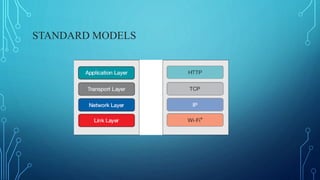
• Most common model is OSI model.
• Breaks communication into functional layers allowing easier implementation.
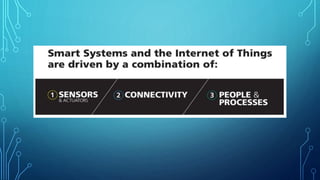
• The IOT is all about connecting things to internet.
• So that a IP address is desired.
• Non IP address devices can also be communicated.
STANDARD MODELS
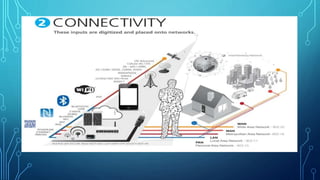
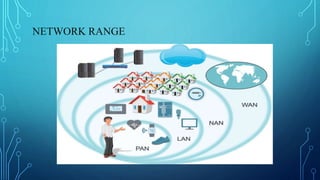
NETWORK RANGE
NETWORK TOPOLOGY AND SIZE
6LOWPAN
• Acronym for IP v6.
• First wireless connectivity standard crated for internet of things.
• Based on 802.15.4 .
• Can communicate with any other ip based devices.
• Mesh topology.
• Low power consumption.
DISADVANTAGES
• Still many of them runs on IP v4.
• This require a protocol converter from IP v4 to IP v6.
• No industry standard.
• There is no standard organization to run certificate programs.
BLUE TOOTH
 Proposed by Ericson in 1994.
 Data rate upto 1 mbps to 24 mbps.
 The rules regarding the implementation is present Bluetooth protocol
stack.
 Bluetooth 4.2 version specification enables IOT through low power IP
connectivity.
 Uses Frequency hopping spread spectrum technique.
 The Bluetooth is related to IOT by means of acting as internet gateway.
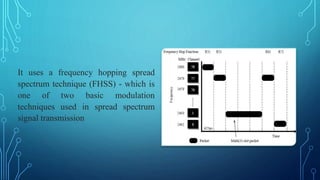
It uses a frequency hopping spread
spectrum technique (FHSS) - which is
one of two basic modulation
techniques used in spread spectrum
signal transmission
DISADVANTAGES
 Data sent between two Bluetooth devices is very slow compared with Wi-Fi
transfer Rate.
 Range Of a Bluetooth Device is 15-30 feet depending upon the Device.
 Security is Biggest Disadvantage as transfer takes place through radio waves and
a hacker can easily hack it.
 Battery usage is also a problem, it will make device out of power before it would
have if Bluetooth was not powered on.
Wi-fi
 A popular wireless communication technique.
 Follows IEEE 802.11 Standard
 Supports Internet protocol based communication.
 The hardware part of it is known as Wi-Fi radio..
 Data rates ranging from 1 mbps to 1300 mbps.
 Requires an intermediate agent called wifi router.
DISADVANTAGES
 Spectrum assignments & operational limitations
 Power consumption is fairly high.
 Degradation in performance.
 Networks have limited range
 Used to steal personal and confidential information
ZIG BEE
• Low cost wireless network communication .
• Operates world wide at unlicensed bands of radio spectrum.
• Covers upto 100 meters distance.
• Data rate 0f 20 to 250 Kbps .
• Zig bee pro offers an optional new and innovative feature Green power.
DISADVANTAGES
• Replacement with Zigbee compliant appliances can be costly.
• No more secure than a typical 802.11 wireless network.
• Zigbee compliance certification for appliance manufacturers
mandates lithium battery use.
• Can be confusing at first for the homeowner.
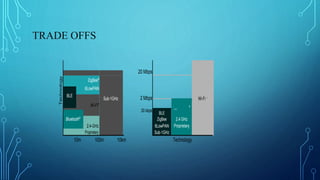
TRADE OFFS
Technology
20 Mbps
ZigBee®
6LowPAN
BLE
Sub-1GHz 2 Mbps Wi-Fi ®
Wi-Fi®
®
20 kbps
BLE
Bluetooth
Bluetooth®
2.4 GHzZigBee
2.4-GHz 6LowPAN Proprietary
Proprietary Sub-1GHz
10m 100m 10km Technology
CONCLUSION
• There is no substitute for connecting of things but the only challenge resides
in proper selection of connectivity technology for the effective
implementation.
THANK YOU

Wireless connectivity for iot

  • 1.
    WIRELESS CONNECTIVITY FORINTERNET OF THINGS BY A.SUMANTH 16241D5508
  • 2.
    CONTENTS • Introduction • Frequencybands and world wide regulations • Communication protocols • Network range • Network topology and size • Different technologies • Advantages • Disadvantages • Conclusion
  • 3.
    INTRODUCTION • Coined byBritish technology pioneer Kevin Ashton. • A system in which objects in the physical world could be connected to the Internet by sensors. • The power of connecting Radio-Frequency Identification (RFID) tags. • A popular term for describing scenarios in which Internet connectivity.
  • 6.
    FREQUENCYAND WORLD WIDEREGULATIONS • Regulated by ITU-R. • ISM bands vary from country to country. • Popular are 433MHz,868MHz,915MHz,2.4MHz. • Higher frequency bands offer more channels and more bandwidth. • Lower frequency radio waves propagate better than higher frequency.
  • 7.
    FREQUENCY BANDS ANDWORLD WIDE REGULATIONS
  • 8.
    COMMUNICATION PROTOCOLS • Mostcommon model is OSI model. • Breaks communication into functional layers allowing easier implementation. • The IOT is all about connecting things to internet. • So that a IP address is desired. • Non IP address devices can also be communicated.
  • 9.
  • 10.
  • 11.
  • 12.
    6LOWPAN • Acronym forIP v6. • First wireless connectivity standard crated for internet of things. • Based on 802.15.4 . • Can communicate with any other ip based devices. • Mesh topology. • Low power consumption.
  • 14.
    DISADVANTAGES • Still manyof them runs on IP v4. • This require a protocol converter from IP v4 to IP v6. • No industry standard. • There is no standard organization to run certificate programs.
  • 15.
    BLUE TOOTH  Proposedby Ericson in 1994.  Data rate upto 1 mbps to 24 mbps.  The rules regarding the implementation is present Bluetooth protocol stack.  Bluetooth 4.2 version specification enables IOT through low power IP connectivity.  Uses Frequency hopping spread spectrum technique.  The Bluetooth is related to IOT by means of acting as internet gateway.
  • 16.
    It uses afrequency hopping spread spectrum technique (FHSS) - which is one of two basic modulation techniques used in spread spectrum signal transmission
  • 17.
    DISADVANTAGES  Data sentbetween two Bluetooth devices is very slow compared with Wi-Fi transfer Rate.  Range Of a Bluetooth Device is 15-30 feet depending upon the Device.  Security is Biggest Disadvantage as transfer takes place through radio waves and a hacker can easily hack it.  Battery usage is also a problem, it will make device out of power before it would have if Bluetooth was not powered on.
  • 18.
    Wi-fi  A popularwireless communication technique.  Follows IEEE 802.11 Standard  Supports Internet protocol based communication.  The hardware part of it is known as Wi-Fi radio..  Data rates ranging from 1 mbps to 1300 mbps.  Requires an intermediate agent called wifi router.
  • 19.
    DISADVANTAGES  Spectrum assignments& operational limitations  Power consumption is fairly high.  Degradation in performance.  Networks have limited range  Used to steal personal and confidential information
  • 20.
    ZIG BEE • Lowcost wireless network communication . • Operates world wide at unlicensed bands of radio spectrum. • Covers upto 100 meters distance. • Data rate 0f 20 to 250 Kbps . • Zig bee pro offers an optional new and innovative feature Green power.
  • 21.
    DISADVANTAGES • Replacement withZigbee compliant appliances can be costly. • No more secure than a typical 802.11 wireless network. • Zigbee compliance certification for appliance manufacturers mandates lithium battery use. • Can be confusing at first for the homeowner.
  • 22.
    TRADE OFFS Technology 20 Mbps ZigBee® 6LowPAN BLE Sub-1GHz2 Mbps Wi-Fi ® Wi-Fi® ® 20 kbps BLE Bluetooth Bluetooth® 2.4 GHzZigBee 2.4-GHz 6LowPAN Proprietary Proprietary Sub-1GHz 10m 100m 10km Technology
  • 23.
    CONCLUSION • There isno substitute for connecting of things but the only challenge resides in proper selection of connectivity technology for the effective implementation.
  • 24.