
Benzene
The Windsor Consulting Group, Inc.
Industrial Hygiene and Occupational Health
Global Business Strategies
Regulated areas
Concentrations exceed
permissible exposure limit (PEL)
Concentrations exceed shortterm exposure limits (STEL)

1a
Regulated areas
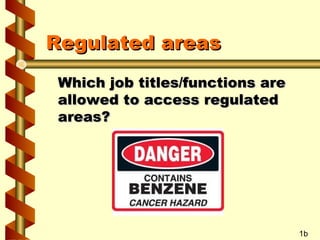
Which job titles/functions are
allowed to access regulated
areas?

1b
Definitions
Benzene vapor exposure in air
OSHA PEL – 1 ppm for 8-Hr TWA
OSHA Action Level (AL) –
0.5 ppm for 8-hour TWA

2a
Definitions
OSHA STEL – 5 ppm for 15minutes
Engineering and administrative
controls
Work practices
2b
Monitoring
Employees are able to observe
the monitoring.

3a
Monitoring
Ongoing monitoring depends
upon the following factors:

• Concentrations at or above the
action level, but at or below the 8hour TWA (annually)
• Concentrations above the TWA (at
least every 6 months)
• The STEL (as necessary)
3b
Monitoring
Monitoring is required after
clean-up of spills, leaks,
unintentional releases
Monitoring may be stopped
under some conditions

3c
Monitoring
Employees must be told of
monitoring results within 15
working days:
•
•

Individually
Group posting

Written notification must
include corrective actions
3d
Monitoring
Additional monitoring may be
performed if there is a change
in:
•
•
•
•

A process
Equipment
Personnel
Work practices

3e
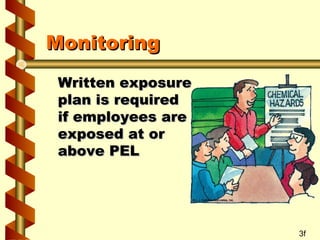
Monitoring
Written exposure
plan is required
if employees are
exposed at or
above PEL

3f
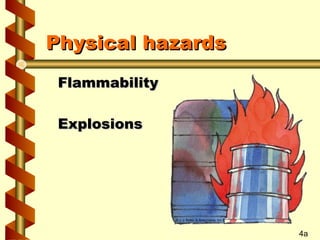
Physical hazards
Flammability
Explosions

4a
Health hazards
Inhalation as vapor
Eye exposure
Skin exposure – absorption and
defatting (ACGIH)
Ingestion

4b
Health hazards
Acts as a narcotic
Blood disorders
Vague signs and symptoms
Carcinogen - Acute Mylogenous
Leukemia (AML)

4c
Health hazards
Reproductive health changes
Mutagenic
Tumorigenic

4d
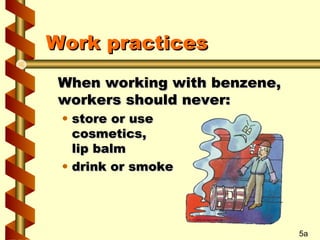
Work practices
When working with benzene,
workers should never:
• store or use
cosmetics,
lip balm
• drink or smoke

5a
Work practices
Storage and handling
procedures
Prohibit sources of ignition
Use non-sparking tools

5b
Work practices
Never incinerate benzene
cartridges, tanks, containers
Review flammable and
combustible liquids regulations
- 29 CFR 1910.106

5c
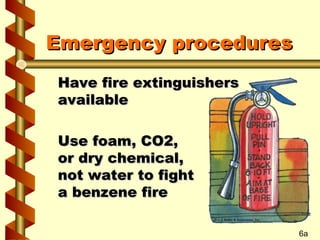
Emergency procedures
Have fire extinguishers
available
Use foam, CO2,
or dry chemical,
not water to fight
a benzene fire
6a
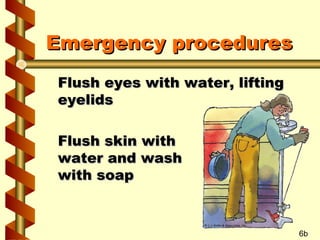
Emergency procedures
Flush eyes with water, lifting
eyelids
Flush skin with
water and wash
with soap

6b
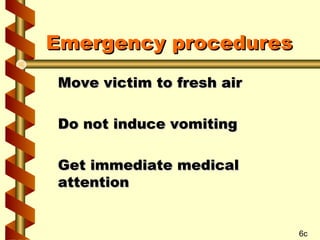
Emergency procedures
Move victim to fresh air
Do not induce vomiting
Get immediate medical
attention

6c
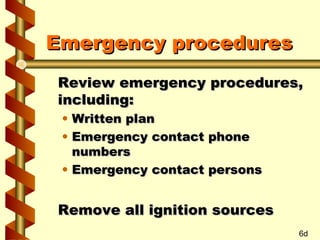
Emergency procedures
Review emergency procedures,
including:
• Written plan
• Emergency contact phone
numbers
• Emergency contact persons

Remove all ignition sources
6d
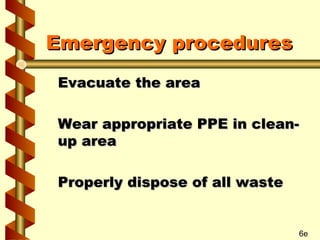
Emergency procedures
Evacuate the area
Wear appropriate PPE in cleanup area
Properly dispose of all waste

6e
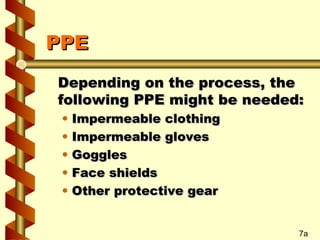
PPE
Depending on the process, the
following PPE might be needed:
•
•
•
•
•

Impermeable clothing
Impermeable gloves
Goggles
Face shields
Other protective gear

7a
PPE
Understand the processes for
proper:
•
•
•
•
•
•

Selection
Use
Inspection
Cleaning
Disposal
Decontamination

7b
Use and limitations of
respirators
Respirators are required:

• during periods necessary to install
or put into effect engineering
controls
• during periods necessary to install
or put into effect work practice
controls

8a
Use and limitations of
respirators
Respirators are required:

• where exposure levels are above
the TWA or STEL
• where engineering controls and
work practice controls are not
sufficient to keep exposures below
the TWA

8b
Medical surveillance
Medical surveillance is required
for all employees exposed:
• at or above the action level for at
least 30 days
• at or above the PEL 10 or more
days per year
• to solvents containing more than
0.1% benzene

9a
Medical surveillance
Exposure thresholds are
determined without PPE use

9b
Medical surveillance
Examinations are:

• prior to assignment to an area
where exposure may be at or
above the conditions previously
listed
• annually
• after exposure in an emergency
• as a follow-up to previous exams
9c
Medical surveillance
Examinations are:

• at intervals recommended by the
company physician
• whenever an employee shows
signs and symptoms of toxic levels
of exposure

9d
Medical surveillance
Employees who are required to
use respirators at least 30 days
per year will have a pulmonary
function test every 3 years
Medical exams are thorough
and emphasize blood chemistry
9e
Medical surveillance
Related conditions not directly
related to benzene may be
included in examinations
Employees receive a copy of the
physician’s written opinion
within 15 days after it is
received by the company
9f
Medical surveillance
Records are retained by the
employer for the duration of
employment plus 30 years

9g
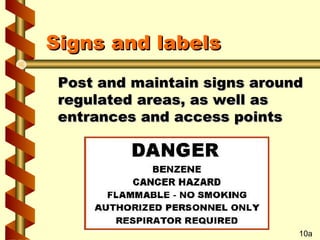
Signs and labels
Post and maintain signs around
regulated areas, as well as
entrances and access points

10a
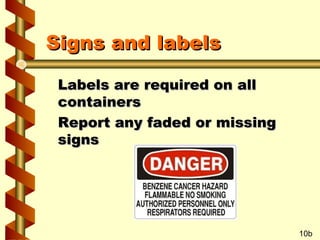
Signs and labels
Labels are required on all
containers
Report any faded or missing
signs

10b
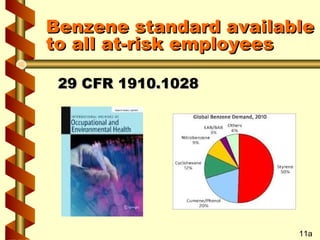
Benzene standard available
to all at-risk employees
29 CFR 1910.1028

11a
Conclusion

WCG
Offices located in Washington, DC and New York Metro Area
Email: windsgroup@aol.com
Tel: 1+ 732.221.5687
Websites: www.manta.com/c/mm41tzk/the-windsor-consulting-group-inc
and www.hgexperts.com/expert-witness.asp?id=49425

Windsor Consulting Group Benzene Training