Windows Operating System Internals - by David A. Solomon and Mark E. Russinovich with Andreas Polze
Unit OS1:
Overview of Operating Systems
1.2. The Evolution of Operating Systems
2
Copyright Notice
© 2000-2005 David A. Solomon and Mark Russinovich
These materials are part of the Windows Operating
System Internals Curriculum Development Kit,
developed by David A. Solomon and Mark E.
Russinovich with Andreas Polze
Microsoft has licensed these materials from David
Solomon Expert Seminars, Inc. for distribution to
academic organizations solely for use in academic
environments (and not for commercial use)
3
Roadmap for Section 1.2.
History of Operating Systems
Tasks of an Operating System
OS as extension of the hardware
Main concepts: processes, files, system calls
Operating system structuring
4
The Evolution of Operating
System Functionality
Batch Job Processing
Linkage of library routines to programs
Management of files, I/O devices, secondary storage
Multiprogramming
Resource managment and sharing for multiple programs
Quasi-simultaneous program execution
Single user
Multiuser/Timesharing Systems
Management of multiple simultaneous users interconnected via terminals
Fair resource management: CPU scheduling, spooling, mutual exclusion
Real-Time Systems (process control systems)
Management of time-critical processes
High requirements with respect to reliability and availability
5
Tasks of an Operating System
Processor management - Scheduling
Fairness
Non-blocking behavior
Priorities
Memory management
Virtual versus physical memory, memory hierarchy
Protection of competing/conurrent programs
Storage management – File system
Access to external storage media
Device management
Hiding of hardware dependencies
Management of concurrent accesses
Batch processing
Definition of an execution order; throughput maximization
6
Kernel- and User Mode Programs
Typical functionality implemented in either mode:
Kernel:
Privileged mode
Strict assumptions about reliability/security of code
Memory resident
CPU-, memory-, Input/Output managment
Multiprocessor management, diagnosis, test
Parts of file system and of the networking interface
User Space:
More flexible
Simpler maintenance and debugging
Compiler, assembler, interpreter, linker/loader
File system management, telecommunication, network management
Editors, spreadsheets, user applications
7
Layered Model of
Operating System Concepts
nr name typical objects typical operations
1 Integrated circuits register, gate, bus Nand, Nor, Exor
2 Machine language instruction counter, ALU Add, Move, Load, Store
3 Subroutine linkage procedure block Stack Call, JSR, RTS
4 Interrupts interrupt handlers Bus error, Reset
5 Simple processes process, semaphore wait, ready, execute
6 Local memory data block, I/O channel read, write, open, close
7 Virtual model page, frame read, write, swap
8 Process communication channel (pipe), message read, write, open
9 File management files read, write, open, copy
10 Device management ext.memory, terminals read, write
11 I/O data streams data streams open, close, read, write
12 User processes user processes login, logout, fork
13 Directory management internal tables create, delete, modify
14 Graphical user interface window, menu, icon OS system calls
8
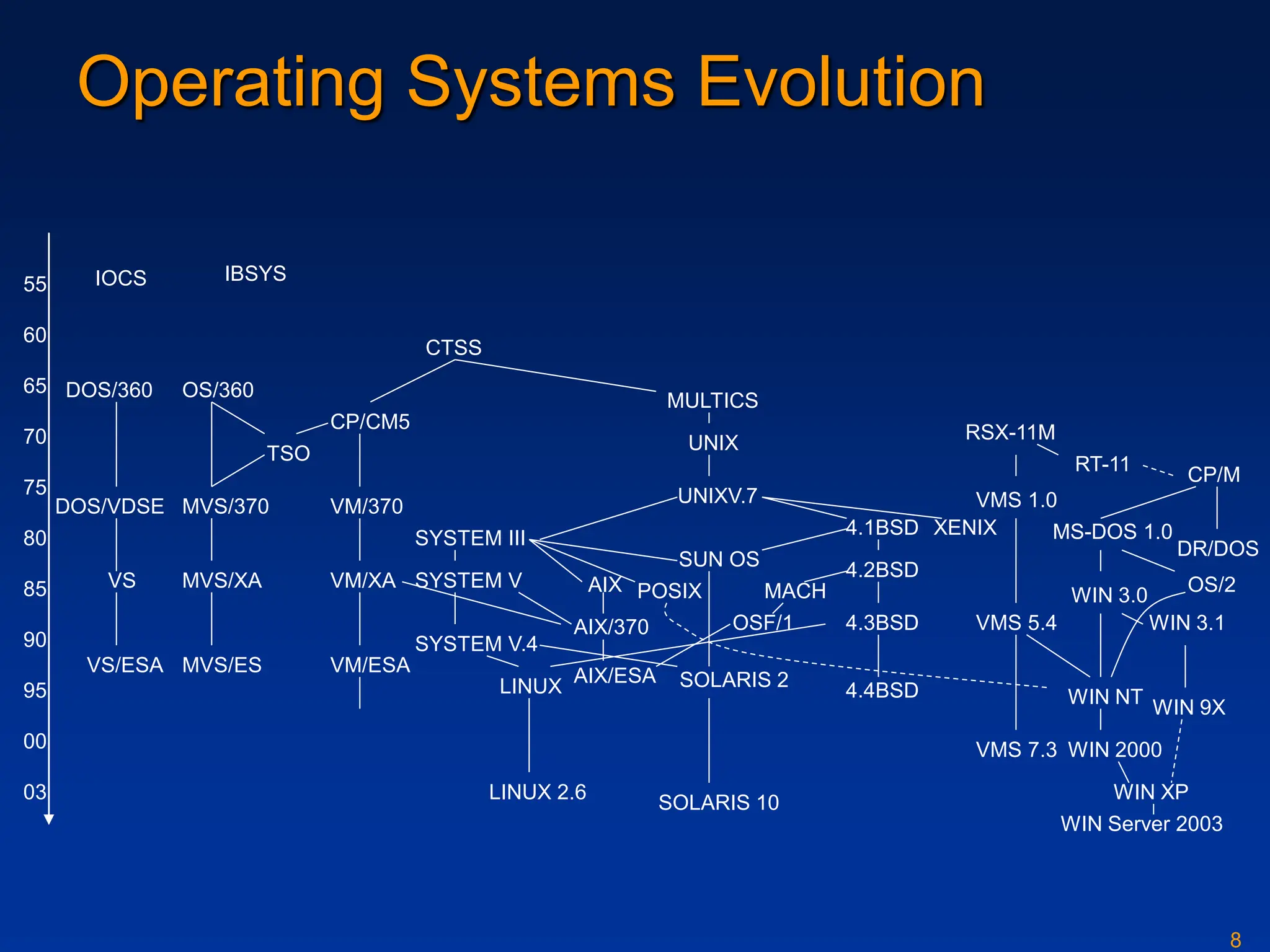
Operating Systems Evolution
55
60
65
70
75
80
85
90
95
00
03
IOCS
DOS/360
DOS/VDSE
VS
VS/ESA
OS/360
MVS/370
MVS/XA
MVS/ES
TSO
IBSYS
CTSS
CP/CM5
VM/370
VM/XA
VM/ESA
SYSTEM III
SYSTEM V
SYSTEM V.4
MULTICS
UNIX
UNIXV.7
AIX/370
AIX
SUN OS
POSIX
SOLARIS 2
4.1BSD
4.2BSD
4.3BSD
4.4BSD
MACH
OSF/1
AIX/ESA
XENIX MS-DOS 1.0
CP/M
DR/DOS
OS/2
WIN 3.0
WIN NT
WIN 2000
WIN 9X
WIN XP
LINUX
RSX-11M
VMS 1.0
VMS 5.4
VMS 7.3
WIN 3.1
SOLARIS 10
RT-11
LINUX 2.6
WIN Server 2003
9
Structuring of Operating Systems
Monolithical systems
Unstructured
Supervisor call changes
from user mode into
kernel mode
App App
System services
Hardware
OS
procedures
User Mode
Kernel Mode
10
Layered OS
Each layer is given access only to lower-level
interfaces
Application
Program
Application
Program
Application
Program
System Services
File System
Memory and I/O Device Management
Processor Scheduling
Hardware
User Mode
Kernel Mode
11
Microkernel OS
(Client/server OS)
Kernel implements:
Scheduling
Memory
Management
Interprocess
communication
(IPC)
User-mode servers
Memory
Server
Client
App
Network
Server
Process
Server
File
Server
Display
Server
Microkernel
Hardware
request
reply
User Mode
Kernel Mode
12
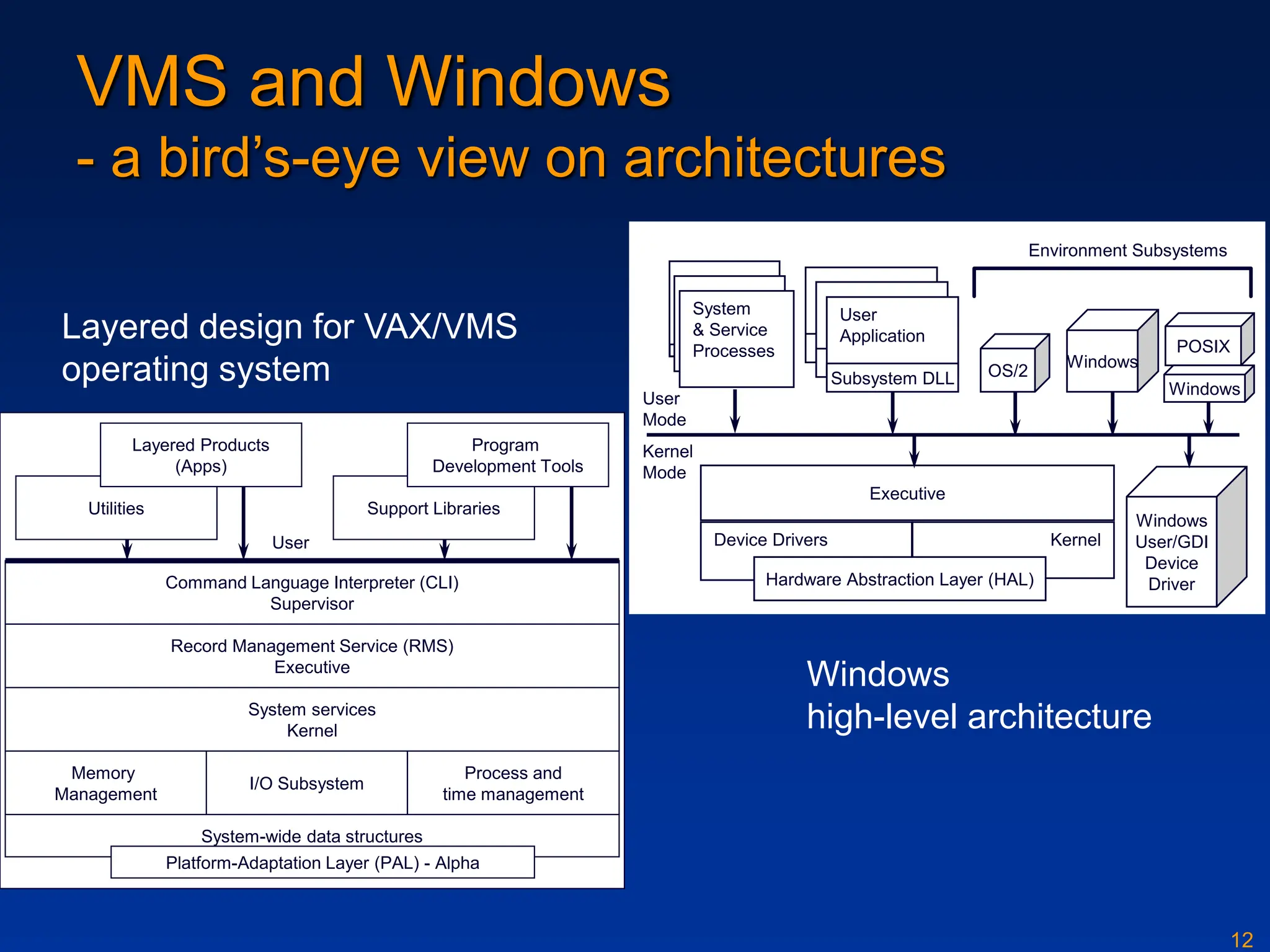
VMS and Windows
- a bird’s-eye view on architectures
System-wide data structures
Memory
Management
I/O Subsystem
Process and
time management
System services
Kernel
Record Management Service (RMS)
Executive
Command Language Interpreter (CLI)
Supervisor
Platform-Adaptation Layer (PAL) - Alpha
Support Libraries
Utilities
Program
Development Tools
Layered Products
(Apps)
User
Layered design for VAX/VMS
operating system
Windows
high-level architecture
OS/2
Windows
POSIX
Environment Subsystems
User
Application
Subsystem DLL
Windows
User/GDI
Device
Driver
Executive
Device Drivers Kernel
Hardware Abstraction Layer (HAL)
User
Mode
Kernel
Mode
System
& Service
Processes
Windows
13
Release History
Although product name has varied, internally, each version
identified by a “build number”
Internal identification - increments each time NT is built from
source (5-6 times a week)
Interesting timeline:
http://windows2000.about.com/library/weekly/aa010218a.htm
Build# Version Date
297 PDC developer release Jul 1992
511 NT 3.1 Jul 1993
807 NT 3.5 Sep 1994
1057 NT 3.51 May 1995
1381 NT 4.0 Jul 1996
2195 Windows 2000 (NT 5.0) Dec 1999
2600 Windows XP (NT 5.1) Aug 2001
3790 Windows Server 2003 (NT 5.2) Mar 2003
4051 Longhorn PDC Developer Preview Oct 2003
Within the CRK, the term Windows refers to Windows 2000, XP, Server 2003
14
Windows And Linux Evolution
Windows and Linux kernels are based on foundations developed in
the mid-1970s
1970 1980 1990 2000
1970 1980 1990 2000
(see http://www.levenez.com for diagrams showing history of Windows & Unix)
15
Further Reading
Dennis M. Ritchie, The Evolution of the Unix Time-sharing System,
in Proc. of Lang. Design and Programming Meth. Conf., Sydney,
Australia, Sept 1979, Lecture Notes in Computer Science #79,
Springer-Verlag, 1980.
David Donald Miller, OpenVMS Operating System Concepts,
2nd Ed., Digital Press, 1997.
History of Digital Operating Systems (from pp. 447)
Mark E. Russinovich and David A. Solomon,
Microsoft Windows Internals,
4th Edition, Microsoft Press, 2004.
Historical Perspective (from pp. xix)
G. Pascal Zachary, Show Stopper! The Breakneck Race to Create
Windows NT and the Next Generation at Microsoft,
ISBN: 0029356717, Free Press, 1994.

Evolution of computers aaaaaaaaaaaaaaaaaaaaaaaaaaa

  • 1.
    Windows Operating SystemInternals - by David A. Solomon and Mark E. Russinovich with Andreas Polze Unit OS1: Overview of Operating Systems 1.2. The Evolution of Operating Systems
  • 2.
    2 Copyright Notice © 2000-2005David A. Solomon and Mark Russinovich These materials are part of the Windows Operating System Internals Curriculum Development Kit, developed by David A. Solomon and Mark E. Russinovich with Andreas Polze Microsoft has licensed these materials from David Solomon Expert Seminars, Inc. for distribution to academic organizations solely for use in academic environments (and not for commercial use)
  • 3.
    3 Roadmap for Section1.2. History of Operating Systems Tasks of an Operating System OS as extension of the hardware Main concepts: processes, files, system calls Operating system structuring
  • 4.
    4 The Evolution ofOperating System Functionality Batch Job Processing Linkage of library routines to programs Management of files, I/O devices, secondary storage Multiprogramming Resource managment and sharing for multiple programs Quasi-simultaneous program execution Single user Multiuser/Timesharing Systems Management of multiple simultaneous users interconnected via terminals Fair resource management: CPU scheduling, spooling, mutual exclusion Real-Time Systems (process control systems) Management of time-critical processes High requirements with respect to reliability and availability
  • 5.
    5 Tasks of anOperating System Processor management - Scheduling Fairness Non-blocking behavior Priorities Memory management Virtual versus physical memory, memory hierarchy Protection of competing/conurrent programs Storage management – File system Access to external storage media Device management Hiding of hardware dependencies Management of concurrent accesses Batch processing Definition of an execution order; throughput maximization
  • 6.
    6 Kernel- and UserMode Programs Typical functionality implemented in either mode: Kernel: Privileged mode Strict assumptions about reliability/security of code Memory resident CPU-, memory-, Input/Output managment Multiprocessor management, diagnosis, test Parts of file system and of the networking interface User Space: More flexible Simpler maintenance and debugging Compiler, assembler, interpreter, linker/loader File system management, telecommunication, network management Editors, spreadsheets, user applications
  • 7.
    7 Layered Model of OperatingSystem Concepts nr name typical objects typical operations 1 Integrated circuits register, gate, bus Nand, Nor, Exor 2 Machine language instruction counter, ALU Add, Move, Load, Store 3 Subroutine linkage procedure block Stack Call, JSR, RTS 4 Interrupts interrupt handlers Bus error, Reset 5 Simple processes process, semaphore wait, ready, execute 6 Local memory data block, I/O channel read, write, open, close 7 Virtual model page, frame read, write, swap 8 Process communication channel (pipe), message read, write, open 9 File management files read, write, open, copy 10 Device management ext.memory, terminals read, write 11 I/O data streams data streams open, close, read, write 12 User processes user processes login, logout, fork 13 Directory management internal tables create, delete, modify 14 Graphical user interface window, menu, icon OS system calls
  • 8.
    8 Operating Systems Evolution 55 60 65 70 75 80 85 90 95 00 03 IOCS DOS/360 DOS/VDSE VS VS/ESA OS/360 MVS/370 MVS/XA MVS/ES TSO IBSYS CTSS CP/CM5 VM/370 VM/XA VM/ESA SYSTEMIII SYSTEM V SYSTEM V.4 MULTICS UNIX UNIXV.7 AIX/370 AIX SUN OS POSIX SOLARIS 2 4.1BSD 4.2BSD 4.3BSD 4.4BSD MACH OSF/1 AIX/ESA XENIX MS-DOS 1.0 CP/M DR/DOS OS/2 WIN 3.0 WIN NT WIN 2000 WIN 9X WIN XP LINUX RSX-11M VMS 1.0 VMS 5.4 VMS 7.3 WIN 3.1 SOLARIS 10 RT-11 LINUX 2.6 WIN Server 2003
  • 9.
    9 Structuring of OperatingSystems Monolithical systems Unstructured Supervisor call changes from user mode into kernel mode App App System services Hardware OS procedures User Mode Kernel Mode
  • 10.
    10 Layered OS Each layeris given access only to lower-level interfaces Application Program Application Program Application Program System Services File System Memory and I/O Device Management Processor Scheduling Hardware User Mode Kernel Mode
  • 11.
    11 Microkernel OS (Client/server OS) Kernelimplements: Scheduling Memory Management Interprocess communication (IPC) User-mode servers Memory Server Client App Network Server Process Server File Server Display Server Microkernel Hardware request reply User Mode Kernel Mode
  • 12.
    12 VMS and Windows -a bird’s-eye view on architectures System-wide data structures Memory Management I/O Subsystem Process and time management System services Kernel Record Management Service (RMS) Executive Command Language Interpreter (CLI) Supervisor Platform-Adaptation Layer (PAL) - Alpha Support Libraries Utilities Program Development Tools Layered Products (Apps) User Layered design for VAX/VMS operating system Windows high-level architecture OS/2 Windows POSIX Environment Subsystems User Application Subsystem DLL Windows User/GDI Device Driver Executive Device Drivers Kernel Hardware Abstraction Layer (HAL) User Mode Kernel Mode System & Service Processes Windows
  • 13.
    13 Release History Although productname has varied, internally, each version identified by a “build number” Internal identification - increments each time NT is built from source (5-6 times a week) Interesting timeline: http://windows2000.about.com/library/weekly/aa010218a.htm Build# Version Date 297 PDC developer release Jul 1992 511 NT 3.1 Jul 1993 807 NT 3.5 Sep 1994 1057 NT 3.51 May 1995 1381 NT 4.0 Jul 1996 2195 Windows 2000 (NT 5.0) Dec 1999 2600 Windows XP (NT 5.1) Aug 2001 3790 Windows Server 2003 (NT 5.2) Mar 2003 4051 Longhorn PDC Developer Preview Oct 2003 Within the CRK, the term Windows refers to Windows 2000, XP, Server 2003
  • 14.
    14 Windows And LinuxEvolution Windows and Linux kernels are based on foundations developed in the mid-1970s 1970 1980 1990 2000 1970 1980 1990 2000 (see http://www.levenez.com for diagrams showing history of Windows & Unix)
  • 15.
    15 Further Reading Dennis M.Ritchie, The Evolution of the Unix Time-sharing System, in Proc. of Lang. Design and Programming Meth. Conf., Sydney, Australia, Sept 1979, Lecture Notes in Computer Science #79, Springer-Verlag, 1980. David Donald Miller, OpenVMS Operating System Concepts, 2nd Ed., Digital Press, 1997. History of Digital Operating Systems (from pp. 447) Mark E. Russinovich and David A. Solomon, Microsoft Windows Internals, 4th Edition, Microsoft Press, 2004. Historical Perspective (from pp. xix) G. Pascal Zachary, Show Stopper! The Breakneck Race to Create Windows NT and the Next Generation at Microsoft, ISBN: 0029356717, Free Press, 1994.